

SUBSCRIBE TO OUR FREE NEWSLETTER
Daily news & progressive opinion—funded by the people, not the corporations—delivered straight to your inbox.
5
#000000
#FFFFFF
To donate by check, phone, or other method, see our More Ways to Give page.
Daily news & progressive opinion—funded by the people, not the corporations—delivered straight to your inbox.
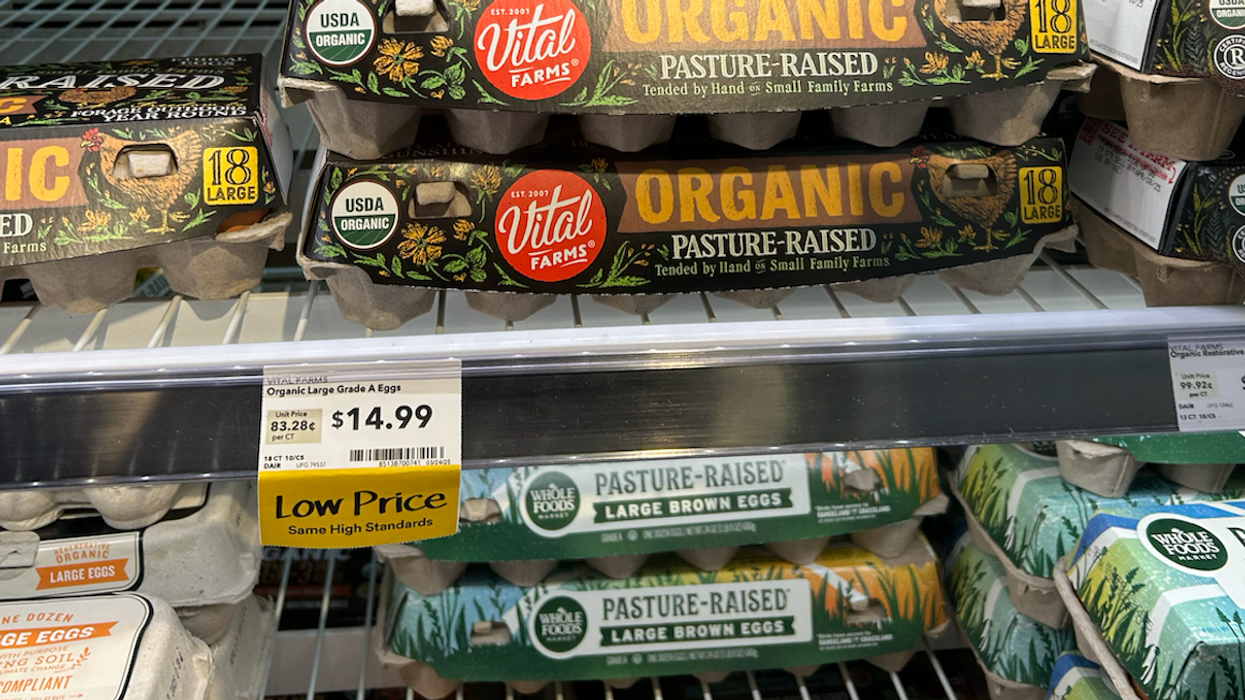
"The only egg prices Donald Trump is lowering," quipped the DNC chair, "is our nest eggs."
For the third straight month, U.S retail egg prices have hit a record high, despite falling wholesale prices, no bird flu outbreaks, and President Donald Trump's campaign promises—and recent misleading claims.
On Thursday, the U.S. Bureau of Labor Statistics' Consumer Price Index (CPI) reported the average retail cost of a dozen eggs rose from $5.90 in February to $6.23 last month.
Egg prices continue to increase despite bird flu outbreak slowing finance.yahoo.com/news/egg-pri...
[image or embed]
— Yahoo Finance (@yahoofinance.com) April 10, 2025 at 6:22 AM
Earlier this week, Trump claimed that "eggs are down 79%" due to his administration's work, a possible reference to the wholesale price, which does not reflect retail cost due to the role that profit-hungry industrial producers and grocery cartels play in inflating prices.
Trump also said that egg prices "are going down more," a statement that contradicts not only recent trends but also his own administration's Food Price Outlook, which forecasts a 57.6% increase in egg prices for 2025, with a prediction interval of 31.1%-91.5%.
Recent record egg prices have largely been driven by an avian flu epidemic that has forced farmers to cull over 166 million birds, most of them egg-laying hens. However, no farms are currently reporting any bird flu outbreaks.
On Tuesday, Cal-Maine Foods, the nation's largest egg producer, announced quarterly profits of $509 million, more than triple its gains from a year ago. The Mississippi-based company, which produces around 20% of U.S. eggs, also enjoyed a more than 600% increase in gross profits between fiscal years 2021-23, according to the consumer advocacy group Food & Water Watch (FWW).
Yet even as its profits soared, Cal-Maine still took $42 million in federal compensation for losses due to bird flu.
The top five egg producers own roughly half of all U.S. laying hens. The biggest of those corporations is Cal-Maine, which just announced quarterly profits of $509 million — more than 3x what it made a year ago. Corporate concentration + bird flu = a price-hiking free for all.
— Robert Reich (@rbreich.bsky.social) April 9, 2025 at 10:31 AM
Last month, the U.S. Justice Department's antitrust division launched an investigation of alleged price-fixing by the nation's largest egg producers, including Cal-Maine, which isn't even the largest recipient of avian flu-related government assistance. Versova, which operates farms in Iowa and Ohio, has been allotted more than $107 million in federal bird flu relief, The Washington Post reported Wednesday. Hillandale Farms, a Pennsylvania-based company sold last month to Global Eggs, received $53 million in avian flu-related subsidies.
"For those companies to be bailed out and then turn around and set exploitative prices, it just adds insult to injury for consumers," Thomas Gremillion, director of food policy at the Consumer Federation of America, told the Post. "Absolutely, it's unfair."
FWW research director Amanda Starbuck took aim at the corporate food system, saying Thursday that "the industry is proving itself effective at extracting enormous profits out of American consumers."
"We are all paying for it—at the store, with food shortages, and with the growing threat of the next pandemic," she continued.
"Restoring sanity to the grocery aisle will require immediate action to transform our food system," Starbuck added. "To lower egg prices, the Trump administration must take on the food monopolies, hasten and prioritize its investigation into corporate price fixing, and stop the spread of factory farms."
The fresh CPI figures weren't all bad news, as the index saw its first decline in five years, falling 0.1% mainly on the strength of lower oil prices. The 12-month increase in consumer prices also slowed from 2.8% to 2.4%.
However, the mildly positive CPI news was overshadowed by the economic uncertainty caused by Trump's mercurial global trade war, including a ramped-up 145% tariff on imports from China, one of the top U.S. trading partners, and ongoing stock market chaos.
"The only egg prices Donald Trump is lowering," Democratic National Committee Chair Ken Martin quipped earlier this week, "is our nest eggs."
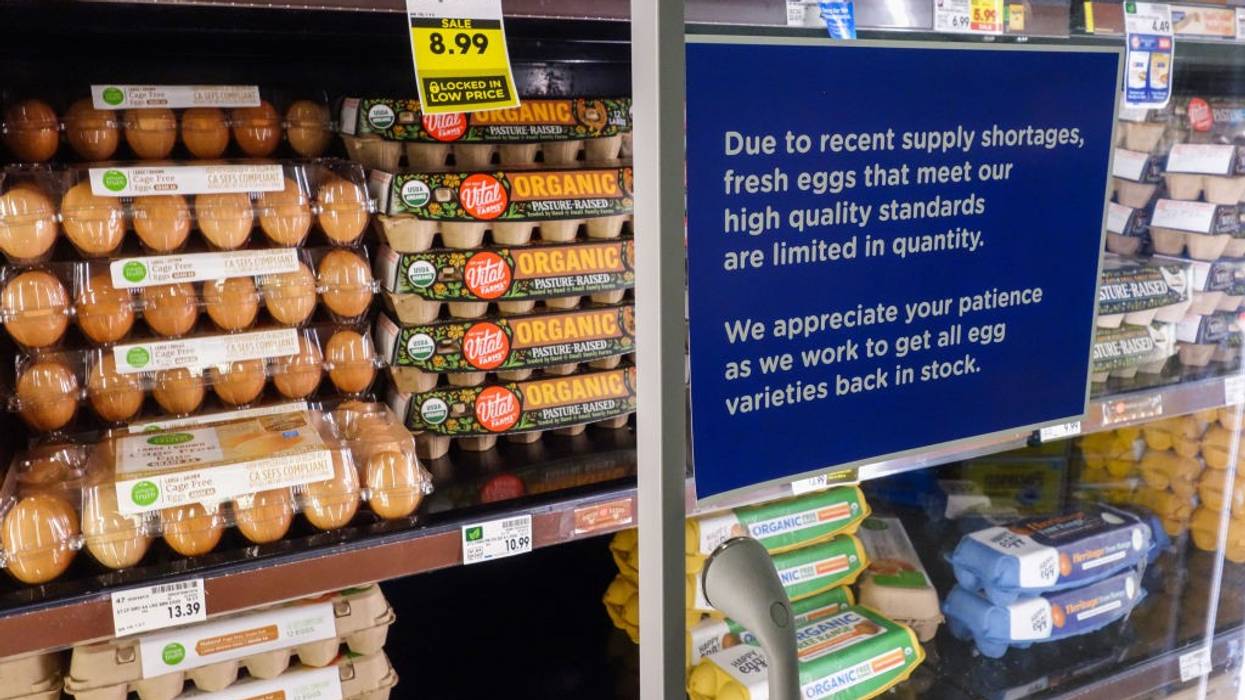
A new Food & Water Watch report details how "corporations use the worsening bird flu crisis to jack up egg prices, even as their own factory farms fuel the spread of disease."
The nation's largest egg producers would have American consumers believe that avian flu and inflation are behind soaring prices, but a report published Tuesday shows corporate price gouging is the real culprit driving the record cost of the dietary staple.
The fourth installment of Food & Water Watch's (FWW) Economic Cost of Food Monopolies series—titled The Rotten Egg Oligarchy—reports that the average price of a dozen eggs in the United States hit an all-time high of $4.95 in January 2025. That's more than two-and-a-half times the average price from three years ago.
"While egg prices spiral out of reach, making eggs a luxury item, Big Ag is profiting hand over fist," FWW research director Amanda Starbuck said in a statement. "But make no mistake—today's high prices are built on a foundation of corporate price gouging. Our research shows how corporations use the worsening bird flu crisis to jack up egg prices, even as their own factory farms fuel the spread of disease."
FWW found that "egg prices were already rising before the current [avian flu] outbreak hit U.S. commercial poultry flocks in February 2022, and have never returned to pre-outbreak levels."
Furthermore, "egg price spikes hit regions that were bird flu-free until recently," the report states. "The U.S. Southeast remained free of bird flu in its table egg flocks until January 2025, and actually increased egg production in 2022 and 2023 over 2021 levels. Nevertheless, retail egg prices in the Southeast rose alongside January 2023's national price spikes."
"The corporate food system is to blame for exacerbating the scale of the outbreak as well as the high cost of eggs," the publication continues. "Factory farms are virus incubators, with the movement of animals, machines, and workers between operations helping to spread the virus."
"Meanwhile, just a handful of companies produce the majority of our eggs, giving them outsized control over the prices paid by retailers, who often pass on rising costs to consumers," the paper adds. "This highly consolidated food system also enables companies to leverage a temporary shortage in one region to raise prices across the entire country."
Cal-Maine, the nation's top egg producer, enjoyed a more than 600% increase in gross profits between fiscal years 2021-23, according to FWW. The Mississippi-based company did not suffer any avian flu outbreaks in fiscal year 2023, during which it sold more eggs than during the previous two years. Yet it still sold conventional eggs at nearly three times the price as in 2021, amounting to over $1 billion in windfall profits. Meanwhile Cal-Maine paid shareholders dividends totaling $250 million in 2023, 40 times more during the previous fiscal year.
The report highlights how factory farming creates ideal conditions for the spread of avian flu, a single case of which requires the extermination of the entire flock at the affected facility, under federal regulations.
"These impacts cannot be understated," FWW stressed. "Today's average factory egg farm confines over 800,000 birds, with some operations confining several million. This magnifies the scale of animal suffering and death, as well as the enormous environmental and safety burden of disposing of a million or more infected bird carcasses."
Citing U.S. Department of Agriculture (USDA) figures, The Guardian reported Tuesday that more than 54 million birds have been affected in the past three months alone.
Egg producers know precisely how the supply-and-demand implications of these outbreaks and subsequent culls can boost their bottom lines. Meanwhile, they play a dangerous game as epidemiologists widely view a potential avian flu mutation that can be transmitted from birds to humans as the next major pandemic threat—one that's exacerbated by the Trump administration's withdrawal from the World Health Organization and cuts to federal agencies focused on averting the next pandemic.
"We cannot afford to place our food system in the hands of a few corporations that put corporate profit above all else."
So far, 70 avian flu cases—one of them fatal—have been reported in the United States, according to the U.S. Centers for Disease Control and Prevention. However, under Trump, the CDC has stopped publishing regular reports on its avian flu response plans and activities. The USDA, meanwhile, said it "accidentally" terminated staffers working on avian flu response during the firing flurry under Elon Musk's Department of Government Efficiency. The agency is scrambling to reverse the move.
"We cannot afford to place our food system in the hands of a few corporations that put corporate profit above all else," the FWW report argues. "Nor can we allow the factory farm system to continue polluting our environment and serving as the breeding ground for the next human pandemic."
"We need to enforce our nation's antitrust laws to go after corporate price fixing and collusion," the publication adds. "We also need a national ban on new and expanding factory farms, while transitioning to smaller, regional food systems that are more resilient to disruptions."
That is highly unlikely under Trump, whose policies—from taxation to regulation and beyond—have overwhelmingly favored the ultrawealthy and corporations over working Americans. Meanwhile, one of the president's signature campaign promises, to lower food prices "on day one," has evaporated amid ever-rising consumer costs.
According to the USDA's latest Food Price Outlook, overall food prices are projected to rise 3.4% in 2025. Eggs, however, are forecast to soar a staggering 41.1% this year—and possibly by as much as 74.9%.
"If President Trump has any interest in fulfilling his campaign pledge to lower food prices," Starbuck stressed, "he must begin by taking on the food monopolies exploiting pandemic threat for profit."
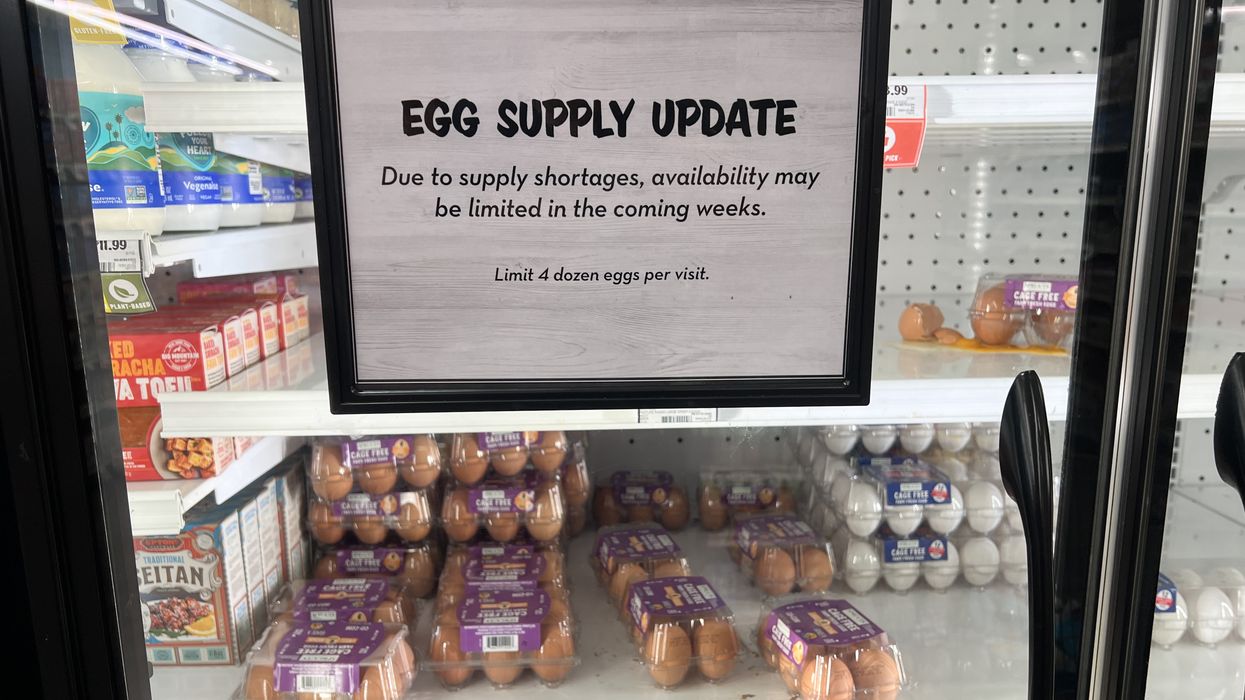
"Evidence indicates that by not increasing their supply, the five dominant egg firms are forcing prices to stay high while reporting dramatic profit increases and level sales," according to the group Farm Action.
An advocacy group dedicated to fighting corporate agriculture monopolies on Wednesday urged federal antitrust enforcers to take action against egg producers that the group accuses of taking advantage of the bird flu crisis in order to raise prices, inflate their profits, and consolidate their market power.
What's more, the slow recovery of "flock size"—the total number of egg-laying hens—"despite historically high prices, further suggests coordinated efforts to restrict supply and sustain inflated prices" that warrants investigation, according to a letter sent by Farm Action president Angela Huffman to Federal Trade Commission Chair Andrew Ferguson and Acting Assistant Attorney General Omeed Assefi, who has been tapped to temporarily lead the DOJ antitrust division.
The letter, which invokes the behavior of "dominant egg producers," largely provides data on one company, Cal-Maine Foods, the biggest producer and marketer of shell eggs in the country.
Separately, Democratic voices are urging the Trump administration to take action around corporate conduct as it relates to food prices. FTC Commissioner Alvaro Bedoya, a Biden appointee, has also urged Ferguson to open an investigation into egg production and marketing practices—pointing to a 2023 request from Farm Action to the FTC to investigate potential antitrust violations in the egg industry.
And last week Sen. Elizabeth Warren (D-Mass.) wrote that she had sent President Donald Trump a list of ways he "can use his executive authority to tackle high food costs by focusing on corporate profiteering."
Egg prices have risen starting in 2022, coinciding with the arrival of bird flu in the United States, and are likely to keep rising in 2025.
The wholesale price of "Grade-A, Large, White, Shell Eggs" rose from $0.50-$1.30 per dozen in 2021 to $1.50-$5.00 per dozen in 2022, and then eased in 2023 before climbing up again in 2024. As of January 2025, the national index of weekly prices for that same type of eggs was up to $6.00-$8.00 per dozen, according to Farm Action.
"The previous all-time high [for wholesale prices] was late December 2022 heading into Christmas, when we touched $5.46 per dozen," Ryan Hojnowski, a market reporter at Expana, wrote in an e-mail to CNBC. "Of course we have blown way past that this time."
Retail prices have also increased. Retail prices for large, Grade-A eggs reached an average of $4.25 per dozen in December 2022 after never reaching above $3 a dozen in the 2010s. Retail prices declined in 2023 and then rose again throughout 2024, reaching $4.15 per dozen in December of last year.
Farm Action argues that while bird flu has been cited as the main driver for rising egg prices, its actual impact on production has been minimal. According to the letter, bird flu has forced the culling of roughly 115 million egg-laying chickens, but the impact of these losses on the total size of the U.S. supply of egg-laying flock has been "relatively modest." Huffman wrote that this culling has caused egg production to drop from 8.1 billion eggs per month in 2021 to 7.75 billion eggs per month at the end of 2024.
But crucially, according to the letter, per capita production of eggs has not been below per capita consumption of eggs in any year between 2022 and the present—while the total value of egg production has risen from $8.8 billion in 2021 to $17.9 billion in 2023.
Cal-Maine specifically has seen its profits soar. The company tallied gross profits of $179.6 million in fiscal year 2020, but the producer reported $1.2 billion and $541.6 million in gross profits in fiscal year 2023 and 2024, respectively, according to the letter. Between fiscal year 2020 and fiscal year 2024, sale levels have remained fairly consistent, wrote Huffman.
"Evidence indicates that by not increasing their supply, the five dominant egg firms are forcing prices to stay high while reporting dramatic profit increases and level sales. These same firms are then using their increased profits to acquire their competition, further driving market consolidation instead of investing in replenishing or expanding their flocks," Farm Action wrote in a statement on Wednesday.
As evidence, they cite a number of mergers that took place in the industry in 2023, and point to the fact that the top five egg producers' share of the "U.S. layer hen flock" increased from 37% to 46% between 2023 and 2025.
"There appears to be a remarkable unwillingness among large egg producers to invest in the internal reconstruction or expansion of their egg-laying flocks in response to persistently high prices," wrote Huffman, which she contrasts with the quicker flock recovery that took place during the first bird flu outbreak in 2014-2015.
The "lagging recovery" and "the fact that egg producers are showing unusual discipline in their pricing and output decisions" indicates that market forces are not "operating as they should be." The letter suggests a few factors that may contribute to the lack of competition.
The group is urging the two agencies to launch investigations, specifically encouraging the FTC to launch an investigation into pricing and production practices of dominant egg producers and their hatchery suppliers to make sure the market is "truly free and fair."
This is far from the first time that the food and grocery industry has been accused of inappropriately raising prices.
In August 2024, a top executive at the supermarket chain Kroger even admitted under questioning from a Federal Trade Commission attorney that the grocery chain raised its egg and milk prices above the rate of inflation.

"American families working to put food on the table deserve to know whether the increased prices they are paying for eggs represent a legitimate response to reduced supply or out-of-control corporate greed."
Sen. Elizabeth Warren and Rep. Katie Porter on Thursday demanded answers from the five largest egg producers in the United States over recent price surges that companies have blamed on an avian flu outbreak—a narrative that advocates view as an effort to distract attention from rampant profiteering in the industry.
Warren (D-Mass.) and Porter (D-Calif.) invoked that criticism in letters to Rose Acre Farms, Cal-Maine Foods, Hillandale Farms, Versova Management, and Daybreak Foods, writing that they are concerned by the "massive spike" in prices and "the extent to which egg producers may be using fears about avian flu and supply shocks as a cover to pad their own profits at the expense of American families."
"American families working to put food on the table deserve to know whether the increased prices they are paying for eggs represent a legitimate response to reduced supply or out-of-control corporate greed," the lawmakers wrote. "Although wholesale prices have decreased, consumers are still waiting for relief at the grocery checkout, which could take several more weeks."
Bureau of Labor Statistics data shows that the average price for a carton of a dozen large Grade A eggs was $4.80 in January, up from $1.93 a year earlier. Consumers in some states have been paying more than $7 per carton in recent weeks.
To explain the price surge—which has been eyebrow-raising even amid elevated inflation throughout the U.S. economy—egg-producing companies have pointed to a large avian flu outbreak that has impacted an estimated 58 million birds, including around 43 million egg-laying chickens.
But the advocacy group Farm Action has argued that the industry's explanations "don't stand up to the facts."
"Cal-Maine's net average selling price for a dozen conventional eggs increased by 150.5% from a year ago," the group observed last month. "The average size of egg-laying flocks never dropped more than six to eight percent lower than it was a year prior. Moreover, the effect of the loss of egg-laying hens on production was itself blunted by 'record-high' lay rates throughout the year."
"And there's one other critical piece missing from this industry narrative—Cal-Maine, which controls 20% of the egg market, hasn't reported a single case of avian flu at any of its facilities," Farm Action added.
In a recent letter to Federal Trade Commission Chair Lina Khan, Farm Action demanded an investigation into the highly concentrated industry, noting that top companies such as Cal-Maine "have a history of engaging in 'cartelistic conspiracies' to limit production, split markets, and increase prices for consumers."
Warren and Porter spotlighted Farm Action's work in their letter Thursday, decrying industry practices as "a pattern we've seen too often since the Covid-19 pandemic: companies jacking up their prices to pad their own profits, putting an additional burden on American families and the economy as a whole."
"Cal-Maine Foods, which controls approximately 20% of the retail egg market, was reporting record profit margins and no positive avian flu cases on any of its farms," the lawmakers wrote. "In December, Cal-Maine Foods reported a gross profits increase of more than 600% over the same quarter in 2021, which the company claimed was 'driven by record average conventional egg selling price."
The two progressive Democrats asked the egg giants to promptly answer a series of specific questions, including, "To what extent has your company met or exceeded quarterly profit margin goals during the 2022 avian flu outbreak?"
The lawmakers also asked whether the companies' "executives, officials, or any other affiliated individuals" had "any direct or indirect communication with other egg producers about production or prices for eggs?"
"Given corporations' rampant profiteering during the Covid-19 pandemic and the ensuing economic crisis, and the egg industry's history of anticompetitive practices," Warren and Porter wrote, "[we] ask that you provide transparency about the rationale for the
increase in egg prices and the financial impact on your company."

The threats are all clear and present, but if we don't prepare in advance... well, we saw what happened last time.
Trump’s no longer president, but he and his racism could still be responsible for millions more American deaths from a new pandemic disease. How and why? I’ll explain in just a moment, but first let’s look at the disease itself.
One reason egg prices are so high right now is because a new strain of bird flu — H1N5 — has popped up among egg-laying chickens. The disease has a shocking mortality rate, leading to the death (both from disease and from euthanizing flocks to stop its spread) of almost 60 million domesticated birds in the US alone, so far.
The virus has mutated enough to infect wild birds, and dead or dying wild birds with H1N5 have now been found in 920 counties across all 50 states. It’s also spread to mink in Europe (whose respiratory systems are so similar to ours they’re used for research) and has caused seizures and death among bears in the United States.
The disease also infects and kills humans, although all of the cases so far have been people infected directly from sick animals.
Nonetheless, the numbers are grim: according to the World Health Organization, there have been 863 people infected with H1N5 “bird flu” so far, most of them in Egypt, Indonesia, and Vietnam, and 456 of them — 52.8 percent — have died of the disease.
For comparison, Ebola kills about 40 percent of the people infected by it, according to the CDC.
For the H1N5 flu to move from bird-to-human transmission to human-to-human transmission will only require a small mutation in the virus.
It would just have to pick up a gene that’s present in the other flu variants that currently infect people, presumably by infecting a person who’s also already infected with or recovering from a “normal” flu. Like a poultry worker who catches the seasonal flu but goes to work anyway because she doesn’t have paid sick leave.
Odds are that if it stays as deadly as it currently is it wouldn’t spread as rapidly or as widely as a less deadly variety, simply because it would kill its hosts so quickly.
But even if its pathogenicity dropped from 52.8 percent all the way down to 2.5 percent, that would equal the Spanish Flu of the 1918-1920 pandemic that killed 50 million people around the world and an estimated 675,000 Americans when our population was only a third of what it is today.
For comparison, Covid kills 1.4 percent of unvaccinated people who acquire the disease.
To deal with this potential crisis, America should right now be developing H1N5 vaccines in large quantities and begin inoculating workers in factory farms, slaughter, and meat-packing operations. And informing the American people about the possible scope of an H1N5 pandemic.
Instead of going along with government efforts to prepare for and even prevent another pandemic, however, Republican politicians — as the legacy from the way Trump handled Covid — will probably instead try to block CDC, WHO, and HHS efforts.
If their Bird Flu behavior is consistent with past Covid behavior, they’ll be joined in that by DeSantis, who’s even now convened a grand jury to investigate the companies manufacturing Covid medications, and other crackpots across the GOP who’re trying to convince Americans that vaccines are killing people left and right.
Just imagine how they’ll react to a new government effort to vaccinate as many Americans as possible and even mandate vaccines for workers in a position to infect many people (from healthcare workers to waiters and clerks).
Which is where we’ll run into that crisis created by Donald Trump’s racism and lust for dictatorial power that I mentioned earlier. It’s a badly underreported story: most Americans have no idea how one day’s headlines changed the course of our country’s response to Covid, leading to at least 300,000 unnecessary deaths.
While Trump told Bob Woodward how deadly Covid was in January of 2020, he initially lied to the American people about it, hoping to keep the economy going into that election year.
But by March of that year he began behaving as if his administration was actually committed to doing something about Covid.
Trump put medical doctors on TV daily, the media was freaking out about refrigerated trucks carrying bodies away from New York hospitals, and doctors and nurses were our new national heroes.
On March 7th, US deaths had risen from 4 to 22, but that was enough to spur federal action. Trump’s official emergency declaration came on March 11th, and most of the country shut down or at least went partway toward that outcome that week.
The Dow collapsed and millions of Americans were laid off, but saving lives was, after all, the number one consideration. Jared Kushner even put together an all-volunteer taskforce of mostly preppie 20-somethings to coordinate getting PPE to hospitals.
But then came April 7th, the fateful day that changed the course of the pandemic and guaranteed the unnecessary death of hundreds of thousands of Americans.
The New York Times ran a front-page story with the headline: Black Americans Face Alarming Rates of Coronavirus Infection in Some States.
Other media ran similar headlines across America, and it was heavily reported on cable news and the network news that night. Most of the people dying, our nation’s media breathlessly reported, were Black or Hispanic, not white people.
Republicans responded with a collective, “What the hell?!?”
Limbaugh declared that afternoon that:
“[W]ith the coronavirus, I have been waiting for the racial component.” And here it was. “The coronavirus now hits African Americans harder — harder than illegal aliens, harder than women. It hits African Americans harder than anybody, disproportionate representation.”
Claiming that he knew this was coming as if he was some sort of a medical savant, Limbaugh said:
“But now these — here’s Fauxcahontas, Cory Booker, Kamala Harris demanding the federal government release daily race and ethnicity data on coronavirus testing, patients, and their health outcomes. So they want a database to prove we are not caring enough about African Americans…”
It didn’t take a medical savant, of course, to see this coming. African Americans die disproportionately from everything, from heart disease to strokes to cancer to childbirth. It’s a symptom of a racially rigged economy and a healthcare system that only responds to money, which America has conspired to keep from African Americans for over 400 years. Of course they’re going to die more frequently from coronavirus.
But the New York Times and the Washington Post simultaneously publishing front-page articles about that racial death disparity with regard to Covid, both on April 7th, echoed across the rightwing media landscape like a Fourth of July fireworks display.
Tucker Carlson, the only prime-time Fox News host who’d previously expressed serious concerns about the dangers of the virus, changed his tune the same day, as documented by Media Matters for America. Now, he said:
“[W]e can begin to consider how to improve the lives of the rest, the countless Americans who have been grievously hurt by this, by our response to this. How do we get 17 million of our most vulnerable citizens back to work? That’s our task.”
White people were out of work, and Black people were most of the casualties, outside of the extremely elderly. Those white people wanted their jobs back, and if Trump was going to win in November he needed the economy humming again!
Brit Hume joined Tucker’s show and, using his gravitas as a “real news guy,” intoned:
“The disease turned out not to be quite as dangerous as we thought.”
Left unsaid was the issue of to whom it was “not quite as dangerous,” but Limbaugh listeners and Fox viewers are anything but unsophisticated when it comes to hearing dog-whistles on behalf of white supremacy.
Only 12,677 Americans were dead by that day, but now that Republicans knew most of the non-elderly were Black, things were suddenly very, very different. Now it was time to quit talking about people dying and start talking about getting people back to work!
It took less than a week for Trump to get the memo, presumably through Fox and Stephen Miller.
On April 12th, he retweeted a call to fire Dr. Anthony Fauci and declared, in another tweet, that he had the sole authority to open the US back up, and that he’d be announcing a specific plan to do just that “shortly.”
On April 13th, the ultra-rightwing, nearly-entirely-white-managed US Chamber of Commerce published a policy paper titled Implementing A National Return to Work Plan.
Unspoken but big on the agenda of corporate America was the desire get the states to rescind their stay-home-from-work orders so that companies could cut their unemployment costs.
When people file unemployment claims, those claims are ultimately paid by the companies themselves, so when a company has a lot of claims they get a substantial increase in their unemployment insurance premiums/taxes.
If the “stay home” orders were repealed, workers could no longer, in most states, file for or keep receiving unemployment compensation.
The next day, Freedomworks, the billionaire-founded and -funded group that animated the Tea Party against Obamacare a decade earlier, published an op-ed on their website calling for an “economic recovery” program including an end to the capital gains tax and a new law to “shield” businesses from Covid death or disability lawsuits.
Three days after that, Freedomworks and the House Freedom Caucus issued a joint statement declaring that “[I]t’s time to re-open the economy.”
Freedomworks published their “#ReopenAmerica Rally Planning Guide” encouraging conservatives to show up “in person” at their state capitols and governor’s mansions, and, for signage, to “Keep it short: ‘I’m essential,’ ‘Let me work,’ ‘Let Me Feed My Family’” and to “Keep [the signs looking] homemade.”
One of the first #OpenTheCountry rallies to get widespread national attention was April 19th in New Hampshire. Over the next several weeks, rallies filled with white people had metastasized across the nation, from Oregon to Arizona, Delaware, North Carolina, Virginia, Illinois and elsewhere.
One that drew particularly high levels of media attention, complete with swastikas, Confederate flags, and assault rifles, was directed against the governor of Michigan, rising Democratic star Gretchen Whitmer.
Trump lied about the coronavirus and told people it was like the flu and could be cured with hydroxychloroquine, a fairly toxic malaria medicine that actually makes people with Covid get sicker and more likely to die. In states where governors were maintaining mask requirements to save lives, Trump’s rhetoric infuriated his “white trash base” (to quote James Carville).
First they showed up at the Capitol building in Lansing with guns, swastikas, and Confederate flags. Then they plotted to kidnap the governor, hold a mock trial, and televise her execution.
When Rachel Maddow reported that meat packing plants were epicenters of mass infection, the Republican-voting Chief Justice of the Wisconsin Supreme Court pointed out that the virus flare wasn’t coming from the “regular [white] folks” of the surrounding community; they were mostly Hispanic and Black.
The conservative meme was now well established: this isn’t that big a deal for white people, and you can’t trust public health officials, doctors, or the CDC who are all trying to protect vulnerable Black people.
About a third of the people the virus killed were old white folks in nursing homes. Which, commentators on the right said, could be a good thing for the economy because they’re just “useless eaters” who spend our Medicare, Medicaid, and Social Security tax money but are on death’s door anyway.
For example, Texas’s Republican Lt. Governor Dan Patrick told Fox News:
“Let’s get back to living… And those of us that are 70-plus, we’ll take care of ourselves.”
A conservative town commissioner in Antioch, CA noted that losing many elderly “would reduce burdens in our defunct Social Security System…and free up housing…”
He added, “We would lose a large portion of the people with immune and other health complications. I know it would be loved ones as well. But that would once again reduce our impact on medical, jobs, and housing.”
Then came news that the biggest outbreaks were happening in prisons along with the meat packing plants, places with even fewer white people (and the few whites in them were largely poor and thus disposable).
Trump’s response to this was to issue an executive order using the Defense Production Act (which he had refused to use to order production of testing or PPE equipment) to force the largely Hispanic and Black workforce back into the slaughterhouses and meat processing plants.
African Americans were dying in our cities, Hispanics were dying in meat packing plants, the elderly were dying in nursing homes.
But the death toll among white people, particularly affluent white people in corporate management who were less likely to be obese, have hypertension or struggle with diabetes, was relatively low.
And those who came through the infection were presumed to be immune to subsequent bouts, so we could issue them “COVID Passports” and give them hiring priority.
As an “expert” member of Jared Kushner’s team of young, unqualified volunteers supervising the administration’s PPE response to the virus noted to Vanity Fair’s Katherine Eban:
“The political folks believed that because it was going to be relegated to Democratic states, that they could blame those governors, and that would be an effective political strategy.”
It was, after all, exclusively Blue States that were then hit hard by the virus: Washington, New York, New Jersey, and Connecticut.
Former Attorney General Robert F. Kennedy’s grandson Max Kennedy Jr, 26, was one of the volunteers, and blew the whistle to Congress on Kushner and Trump. As Jane Mayer wrote for The New Yorker:
“Kennedy was disgusted to see that the political appointees who supervised him were hailing Trump as ‘a marketing genius,’ because, Kennedy said they’d told him, ‘he personally came up with the strategy of blaming the states.’”
So the answer to the question of why, by June of 2020, the United States had about 25% of the world’s Covid deaths, but only 4.5% of the world’s population, is pretty straightforward: Republicans chose to be just fine with Black people dying, particularly when they could blame it on Democratic Blue-state governors and a vast liberal conspiracy at the CDC.
And once they put that strategy into place in April, it later became politically impossible to back away from it, even as more and more Red State white people became infected.
Everything since then, right down to Trump’s December 26th, 2020 tweet (“The lockdowns in Democrat run states are absolutely ruining the lives of so many people — Far more than the damage that would be caused by the China Virus.”), has been a double-down on death and destruction, now regardless of race.
So here we are facing the early warning signs of a possible new pandemic that could be even more deadly than Covid. And because Trump chose to politicize the Covid pandemic, only 27 percent of Republicans today trust the CDC (compared with over three-quarters of Democrats).
Only 34 percent of Republicans today even trust their own doctors or medical science in general, which helps explain why so many were enthusiastic to take horse dewormer or antimalarial drugs in a futile effort to stop Covid.
And, of course, there are the Republicans in Congress who will recoil from any mention of planning for another pandemic. Since such preparations would include costs, and that may increase pressure to raise income taxes on billionaires above their current 3%, it’ll be a fight.
Nonetheless, the Biden administration should be moving on this now, as Zeynep Tufekci so eloquently noted in last Friday’s New York Times. The best time to stop a pandemic is before it starts.