SUBSCRIBE TO OUR FREE NEWSLETTER
Daily news & progressive opinion—funded by the people, not the corporations—delivered straight to your inbox.
5
#000000
#FFFFFF
To donate by check, phone, or other method, see our More Ways to Give page.
Daily news & progressive opinion—funded by the people, not the corporations—delivered straight to your inbox.
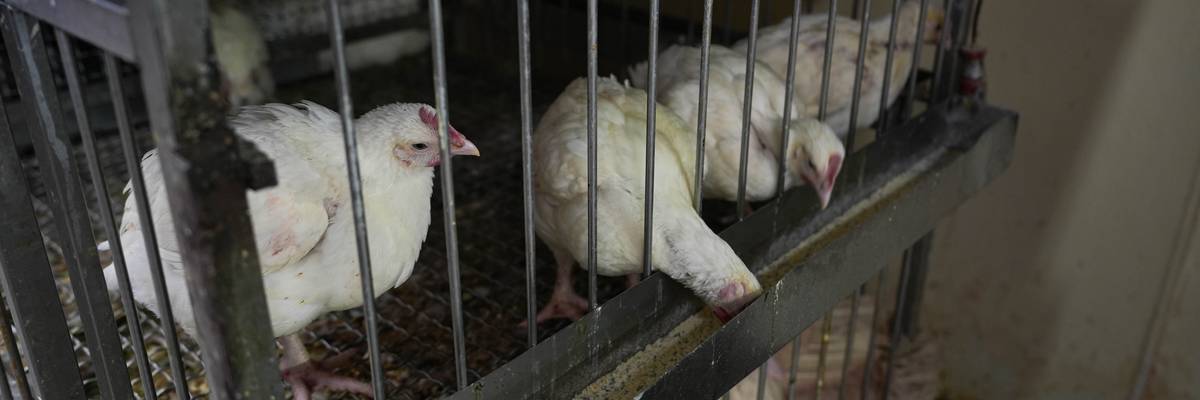
A live poultry market is seen as New York Gov. Kathy Hochul has temporarily shut down poultry markets in New York City, Westchester, Nassau, and Suffolk counties, in New York, United States on February 07, 2025.
"New information and transmission countermeasures can and must be developed and shared as rapidly as the virus evolves," wrote the letter's authors.
A broad coalition of environmental, health, and animal groups is demanding greater transparency from the U.S. Centers for Disease Control and Prevention when it comes to disseminating information about H5N1, or bird flu, that has sickened hundreds of dairy cattle herds, killed millions of chickens, and also infected dozens of humans.
The Monday letter, which was signed by two staff members at the Center for Biological Diversity on behalf of a larger group that includes Earthjustice, the Animal Legal Defense Fund, the Institute for Agriculture and Trade Policy, and others, was sent to CDC acting Director Susan Monarez.
"New information and transmission countermeasures can and must be developed and shared as rapidly as the virus evolves," according to the letter, which says that it has been over a month since the CDC issued a regular update about its bird flu response activity.
On the CDC's "News & Spotlight" page on the section of its website dedicated to bird flu, no update has been posted since January 17. Prior to that date, the page featured regular updates, such as a post about the agency's accomplishments related to curbing bird flu in 2024-25.
Also, the CDC "appears to have delayed or denied the publication of key scientific research on avian influenza in its Morbidity and Mortality Weekly Report, including a study suggesting that infected house cats may be transmitting [highly pathogenic avian influenza] to humans," according to the letter. The letter links to February 6 reporting from The New York Times, which says that the CDC briefly posted but then took down a report that discussed cases of potential human-to-cat and cat-to-human transmission of bird flu.
That report now appears online and was posted as part of the CDC's Morbidity and Mortality Weekly Report for February 20.
"This is exactly the kind of information that concerns the public and should have been shared broadly—not withheld—so that Americans could avoid this route of infection and researchers and public health officials could understand and defeat this virus," the letter states.
According to the authors of the letter, publicizing data about bird flu is crucial, especially given reports of federal personnel cuts potentially impacting the government's bird flu response. Last week, the U.S. Department of Agriculture said it had sent termination letters to "several" staff working on the government's bird flu response, and that the agency was working to reverse the firings.
"The CDC should release to the public all information related to the avian influenza outbreak as soon as it is confirmed. This commitment to public transparency is essential to an effective, whole-of-society response to this growing disease threat," the letter concludes.
Dear Common Dreams reader, It’s been nearly 30 years since I co-founded Common Dreams with my late wife, Lina Newhouser. We had the radical notion that journalism should serve the public good, not corporate profits. It was clear to us from the outset what it would take to build such a project. No paid advertisements. No corporate sponsors. No millionaire publisher telling us what to think or do. Many people said we wouldn't last a year, but we proved those doubters wrong. Together with a tremendous team of journalists and dedicated staff, we built an independent media outlet free from the constraints of profits and corporate control. Our mission has always been simple: To inform. To inspire. To ignite change for the common good. Building Common Dreams was not easy. Our survival was never guaranteed. When you take on the most powerful forces—Wall Street greed, fossil fuel industry destruction, Big Tech lobbyists, and uber-rich oligarchs who have spent billions upon billions rigging the economy and democracy in their favor—the only bulwark you have is supporters who believe in your work. But here’s the urgent message from me today. It's never been this bad out there. And it's never been this hard to keep us going. At the very moment Common Dreams is most needed, the threats we face are intensifying. We need your support now more than ever. We don't accept corporate advertising and never will. We don't have a paywall because we don't think people should be blocked from critical news based on their ability to pay. Everything we do is funded by the donations of readers like you. When everyone does the little they can afford, we are strong. But if that support retreats or dries up, so do we. Will you donate now to make sure Common Dreams not only survives but thrives? —Craig Brown, Co-founder |
A broad coalition of environmental, health, and animal groups is demanding greater transparency from the U.S. Centers for Disease Control and Prevention when it comes to disseminating information about H5N1, or bird flu, that has sickened hundreds of dairy cattle herds, killed millions of chickens, and also infected dozens of humans.
The Monday letter, which was signed by two staff members at the Center for Biological Diversity on behalf of a larger group that includes Earthjustice, the Animal Legal Defense Fund, the Institute for Agriculture and Trade Policy, and others, was sent to CDC acting Director Susan Monarez.
"New information and transmission countermeasures can and must be developed and shared as rapidly as the virus evolves," according to the letter, which says that it has been over a month since the CDC issued a regular update about its bird flu response activity.
On the CDC's "News & Spotlight" page on the section of its website dedicated to bird flu, no update has been posted since January 17. Prior to that date, the page featured regular updates, such as a post about the agency's accomplishments related to curbing bird flu in 2024-25.
Also, the CDC "appears to have delayed or denied the publication of key scientific research on avian influenza in its Morbidity and Mortality Weekly Report, including a study suggesting that infected house cats may be transmitting [highly pathogenic avian influenza] to humans," according to the letter. The letter links to February 6 reporting from The New York Times, which says that the CDC briefly posted but then took down a report that discussed cases of potential human-to-cat and cat-to-human transmission of bird flu.
That report now appears online and was posted as part of the CDC's Morbidity and Mortality Weekly Report for February 20.
"This is exactly the kind of information that concerns the public and should have been shared broadly—not withheld—so that Americans could avoid this route of infection and researchers and public health officials could understand and defeat this virus," the letter states.
According to the authors of the letter, publicizing data about bird flu is crucial, especially given reports of federal personnel cuts potentially impacting the government's bird flu response. Last week, the U.S. Department of Agriculture said it had sent termination letters to "several" staff working on the government's bird flu response, and that the agency was working to reverse the firings.
"The CDC should release to the public all information related to the avian influenza outbreak as soon as it is confirmed. This commitment to public transparency is essential to an effective, whole-of-society response to this growing disease threat," the letter concludes.
A broad coalition of environmental, health, and animal groups is demanding greater transparency from the U.S. Centers for Disease Control and Prevention when it comes to disseminating information about H5N1, or bird flu, that has sickened hundreds of dairy cattle herds, killed millions of chickens, and also infected dozens of humans.
The Monday letter, which was signed by two staff members at the Center for Biological Diversity on behalf of a larger group that includes Earthjustice, the Animal Legal Defense Fund, the Institute for Agriculture and Trade Policy, and others, was sent to CDC acting Director Susan Monarez.
"New information and transmission countermeasures can and must be developed and shared as rapidly as the virus evolves," according to the letter, which says that it has been over a month since the CDC issued a regular update about its bird flu response activity.
On the CDC's "News & Spotlight" page on the section of its website dedicated to bird flu, no update has been posted since January 17. Prior to that date, the page featured regular updates, such as a post about the agency's accomplishments related to curbing bird flu in 2024-25.
Also, the CDC "appears to have delayed or denied the publication of key scientific research on avian influenza in its Morbidity and Mortality Weekly Report, including a study suggesting that infected house cats may be transmitting [highly pathogenic avian influenza] to humans," according to the letter. The letter links to February 6 reporting from The New York Times, which says that the CDC briefly posted but then took down a report that discussed cases of potential human-to-cat and cat-to-human transmission of bird flu.
That report now appears online and was posted as part of the CDC's Morbidity and Mortality Weekly Report for February 20.
"This is exactly the kind of information that concerns the public and should have been shared broadly—not withheld—so that Americans could avoid this route of infection and researchers and public health officials could understand and defeat this virus," the letter states.
According to the authors of the letter, publicizing data about bird flu is crucial, especially given reports of federal personnel cuts potentially impacting the government's bird flu response. Last week, the U.S. Department of Agriculture said it had sent termination letters to "several" staff working on the government's bird flu response, and that the agency was working to reverse the firings.
"The CDC should release to the public all information related to the avian influenza outbreak as soon as it is confirmed. This commitment to public transparency is essential to an effective, whole-of-society response to this growing disease threat," the letter concludes.