SUBSCRIBE TO OUR FREE NEWSLETTER
Daily news & progressive opinion—funded by the people, not the corporations—delivered straight to your inbox.
5
#000000
#FFFFFF
To donate by check, phone, or other method, see our More Ways to Give page.
Daily news & progressive opinion—funded by the people, not the corporations—delivered straight to your inbox.
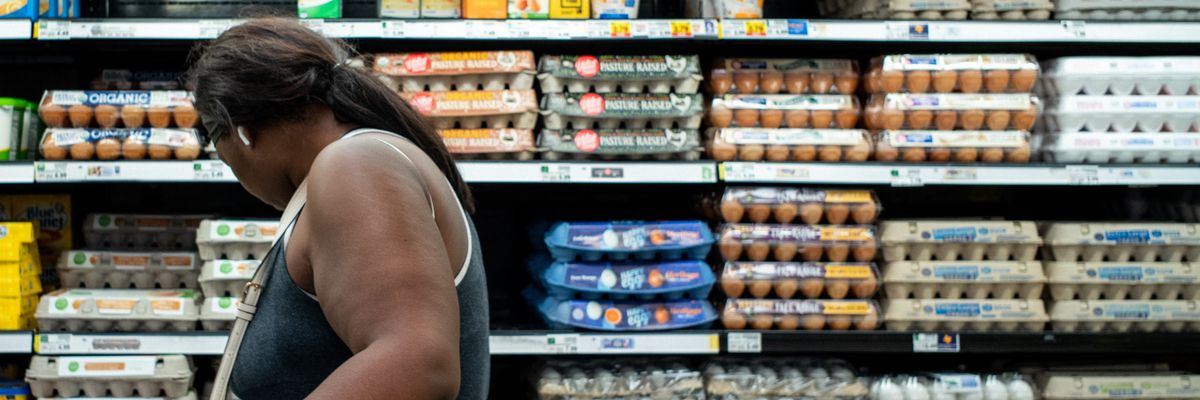
A customer shops for eggs in a Kroger grocery store on August 15, 2022 in Houston, Texas.
"The thing is, execs all over the economy were saying this stuff on their earning calls back in 2021," said one progressive economist. "This was not a secret."
A top Kroger executive admitted under questioning from a Federal Trade Commission attorney on Tuesday that the grocery chain raised its egg and milk prices above the rate of inflation, a concession that came as no surprise to economists who have been highlighting corporate price gouging across the U.S. economy in recent years.
Andy Groff, Kroger's senior director for pricing, said during a court hearing on the FTC's legal challenge to the company's proposed acquisition of Albertsons—its primary competitor—that Kroger's objective is to "pass through our inflation to consumers."
Groff's comment came in response to questioning about an internal email he sent to other Kroger executives in March. In that note, Groff observed that "on milk and eggs, retail inflation has been significantly higher than cost inflation."
A Kroger spokesperson told Bloomberg in a statement that the email was "cherry-picked" and "does not reflect Kroger's decadeslong business model to lower prices for customers by reducing its margins."
But Rakeen Mabud, chief economist at the Groundwork Collaborative, noted Wednesday that "execs all over the economy were saying this stuff on their earning calls back in 2021."
"This was not a secret," Mabud added.
Bloomberg reported Tuesday that "in Illinois, where Kroger operates the Mariano's chain, company executives create a weekly report on egg prices, comparing prices from Walmart, Meijer Inc., and Albertsons' Jewel-Osco, said Matthew Marx, president of the Kroger division overseeing Mariano's."
"The FTC walked Marx through several of the weekly egg reports from 2022 and 2023," the outlet added. "In May 2022, for example, both Walmart and Meijer dropped egg prices by 14 cents a dozen, but Mariano's opted to keep its pricing the same to match the higher price at Jewel-Osco, Marx said. A year later, in April 2023, as egg prices again soared, Mariano's opted to keep its pricing near Jewel-Osco's even as Walmart was lowering its own."
The U.S. grocery sector—dominated by Kroger, Walmart, and a handful of other major companies—profited hugely during the Covid-19 pandemic as corporate giants exploited supply chain disruptions to aggressively jack up prices.
"The grocery industry, as represented by four of its largest players, became more profitable in the pandemic, and it has stayed that way for a couple of years at least," The Financial Times noted Monday. "It is a good guess that price increases in excess of cost increases have played a role in this."
In its legal challenge against Kroger's proposed merger with Albertsons, the FTC argues that the deal would further drive up costs for consumers by eliminating "fierce competition" between the two grocers.
Laurel Kilgour, research manager at the American Economic Liberties Project, said after opening arguments in the case earlier this week that the FTC "previewed concrete evidence that a Kroger-Albertsons merger would lead to higher prices for millions of Americans and worse working conditions for hundreds of thousands of workers."
"By contrast, lawyers for Kroger and Albertsons touted fake promises of utopian outcomes that are not legally enforceable. Indeed, Albertsons has a track record of profiting from similar fake promises that turned out disastrously for competition and for communities, and this time is no different," Kilgour continued. "At a time when working families are especially concerned with costs and access to food, we need more—not less—competition between grocery stores on prices, wages, the freshness of produce, and service quality."
Dear Common Dreams reader, It’s been nearly 30 years since I co-founded Common Dreams with my late wife, Lina Newhouser. We had the radical notion that journalism should serve the public good, not corporate profits. It was clear to us from the outset what it would take to build such a project. No paid advertisements. No corporate sponsors. No millionaire publisher telling us what to think or do. Many people said we wouldn't last a year, but we proved those doubters wrong. Together with a tremendous team of journalists and dedicated staff, we built an independent media outlet free from the constraints of profits and corporate control. Our mission has always been simple: To inform. To inspire. To ignite change for the common good. Building Common Dreams was not easy. Our survival was never guaranteed. When you take on the most powerful forces—Wall Street greed, fossil fuel industry destruction, Big Tech lobbyists, and uber-rich oligarchs who have spent billions upon billions rigging the economy and democracy in their favor—the only bulwark you have is supporters who believe in your work. But here’s the urgent message from me today. It's never been this bad out there. And it's never been this hard to keep us going. At the very moment Common Dreams is most needed, the threats we face are intensifying. We need your support now more than ever. We don't accept corporate advertising and never will. We don't have a paywall because we don't think people should be blocked from critical news based on their ability to pay. Everything we do is funded by the donations of readers like you. When everyone does the little they can afford, we are strong. But if that support retreats or dries up, so do we. Will you donate now to make sure Common Dreams not only survives but thrives? —Craig Brown, Co-founder |
A top Kroger executive admitted under questioning from a Federal Trade Commission attorney on Tuesday that the grocery chain raised its egg and milk prices above the rate of inflation, a concession that came as no surprise to economists who have been highlighting corporate price gouging across the U.S. economy in recent years.
Andy Groff, Kroger's senior director for pricing, said during a court hearing on the FTC's legal challenge to the company's proposed acquisition of Albertsons—its primary competitor—that Kroger's objective is to "pass through our inflation to consumers."
Groff's comment came in response to questioning about an internal email he sent to other Kroger executives in March. In that note, Groff observed that "on milk and eggs, retail inflation has been significantly higher than cost inflation."
A Kroger spokesperson told Bloomberg in a statement that the email was "cherry-picked" and "does not reflect Kroger's decadeslong business model to lower prices for customers by reducing its margins."
But Rakeen Mabud, chief economist at the Groundwork Collaborative, noted Wednesday that "execs all over the economy were saying this stuff on their earning calls back in 2021."
"This was not a secret," Mabud added.
Bloomberg reported Tuesday that "in Illinois, where Kroger operates the Mariano's chain, company executives create a weekly report on egg prices, comparing prices from Walmart, Meijer Inc., and Albertsons' Jewel-Osco, said Matthew Marx, president of the Kroger division overseeing Mariano's."
"The FTC walked Marx through several of the weekly egg reports from 2022 and 2023," the outlet added. "In May 2022, for example, both Walmart and Meijer dropped egg prices by 14 cents a dozen, but Mariano's opted to keep its pricing the same to match the higher price at Jewel-Osco, Marx said. A year later, in April 2023, as egg prices again soared, Mariano's opted to keep its pricing near Jewel-Osco's even as Walmart was lowering its own."
The U.S. grocery sector—dominated by Kroger, Walmart, and a handful of other major companies—profited hugely during the Covid-19 pandemic as corporate giants exploited supply chain disruptions to aggressively jack up prices.
"The grocery industry, as represented by four of its largest players, became more profitable in the pandemic, and it has stayed that way for a couple of years at least," The Financial Times noted Monday. "It is a good guess that price increases in excess of cost increases have played a role in this."
In its legal challenge against Kroger's proposed merger with Albertsons, the FTC argues that the deal would further drive up costs for consumers by eliminating "fierce competition" between the two grocers.
Laurel Kilgour, research manager at the American Economic Liberties Project, said after opening arguments in the case earlier this week that the FTC "previewed concrete evidence that a Kroger-Albertsons merger would lead to higher prices for millions of Americans and worse working conditions for hundreds of thousands of workers."
"By contrast, lawyers for Kroger and Albertsons touted fake promises of utopian outcomes that are not legally enforceable. Indeed, Albertsons has a track record of profiting from similar fake promises that turned out disastrously for competition and for communities, and this time is no different," Kilgour continued. "At a time when working families are especially concerned with costs and access to food, we need more—not less—competition between grocery stores on prices, wages, the freshness of produce, and service quality."
A top Kroger executive admitted under questioning from a Federal Trade Commission attorney on Tuesday that the grocery chain raised its egg and milk prices above the rate of inflation, a concession that came as no surprise to economists who have been highlighting corporate price gouging across the U.S. economy in recent years.
Andy Groff, Kroger's senior director for pricing, said during a court hearing on the FTC's legal challenge to the company's proposed acquisition of Albertsons—its primary competitor—that Kroger's objective is to "pass through our inflation to consumers."
Groff's comment came in response to questioning about an internal email he sent to other Kroger executives in March. In that note, Groff observed that "on milk and eggs, retail inflation has been significantly higher than cost inflation."
A Kroger spokesperson told Bloomberg in a statement that the email was "cherry-picked" and "does not reflect Kroger's decadeslong business model to lower prices for customers by reducing its margins."
But Rakeen Mabud, chief economist at the Groundwork Collaborative, noted Wednesday that "execs all over the economy were saying this stuff on their earning calls back in 2021."
"This was not a secret," Mabud added.
Bloomberg reported Tuesday that "in Illinois, where Kroger operates the Mariano's chain, company executives create a weekly report on egg prices, comparing prices from Walmart, Meijer Inc., and Albertsons' Jewel-Osco, said Matthew Marx, president of the Kroger division overseeing Mariano's."
"The FTC walked Marx through several of the weekly egg reports from 2022 and 2023," the outlet added. "In May 2022, for example, both Walmart and Meijer dropped egg prices by 14 cents a dozen, but Mariano's opted to keep its pricing the same to match the higher price at Jewel-Osco, Marx said. A year later, in April 2023, as egg prices again soared, Mariano's opted to keep its pricing near Jewel-Osco's even as Walmart was lowering its own."
The U.S. grocery sector—dominated by Kroger, Walmart, and a handful of other major companies—profited hugely during the Covid-19 pandemic as corporate giants exploited supply chain disruptions to aggressively jack up prices.
"The grocery industry, as represented by four of its largest players, became more profitable in the pandemic, and it has stayed that way for a couple of years at least," The Financial Times noted Monday. "It is a good guess that price increases in excess of cost increases have played a role in this."
In its legal challenge against Kroger's proposed merger with Albertsons, the FTC argues that the deal would further drive up costs for consumers by eliminating "fierce competition" between the two grocers.
Laurel Kilgour, research manager at the American Economic Liberties Project, said after opening arguments in the case earlier this week that the FTC "previewed concrete evidence that a Kroger-Albertsons merger would lead to higher prices for millions of Americans and worse working conditions for hundreds of thousands of workers."
"By contrast, lawyers for Kroger and Albertsons touted fake promises of utopian outcomes that are not legally enforceable. Indeed, Albertsons has a track record of profiting from similar fake promises that turned out disastrously for competition and for communities, and this time is no different," Kilgour continued. "At a time when working families are especially concerned with costs and access to food, we need more—not less—competition between grocery stores on prices, wages, the freshness of produce, and service quality."