SUBSCRIBE TO OUR FREE NEWSLETTER
Daily news & progressive opinion—funded by the people, not the corporations—delivered straight to your inbox.
5
#000000
#FFFFFF
To donate by check, phone, or other method, see our More Ways to Give page.
Daily news & progressive opinion—funded by the people, not the corporations—delivered straight to your inbox.
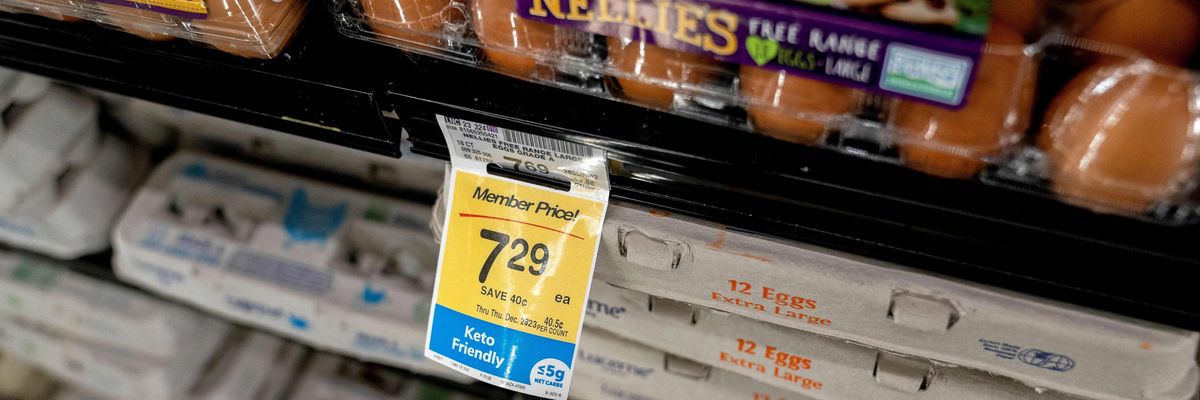
Eggs are seen at a grocery store in Washington, D.C. on January 19, 2023.
"American families working to put food on the table deserve to know whether the increased prices they are paying for eggs represent a legitimate response to reduced supply or out-of-control corporate greed."
Sen. Elizabeth Warren and Rep. Katie Porter on Thursday demanded answers from the five largest egg producers in the United States over recent price surges that companies have blamed on an avian flu outbreak—a narrative that advocates view as an effort to distract attention from rampant profiteering in the industry.
Warren (D-Mass.) and Porter (D-Calif.) invoked that criticism in letters to Rose Acre Farms, Cal-Maine Foods, Hillandale Farms, Versova Management, and Daybreak Foods, writing that they are concerned by the "massive spike" in prices and "the extent to which egg producers may be using fears about avian flu and supply shocks as a cover to pad their own profits at the expense of American families."
"American families working to put food on the table deserve to know whether the increased prices they are paying for eggs represent a legitimate response to reduced supply or out-of-control corporate greed," the lawmakers wrote. "Although wholesale prices have decreased, consumers are still waiting for relief at the grocery checkout, which could take several more weeks."
Bureau of Labor Statistics data shows that the average price for a carton of a dozen large Grade A eggs was $4.80 in January, up from $1.93 a year earlier. Consumers in some states have been paying more than $7 per carton in recent weeks.
To explain the price surge—which has been eyebrow-raising even amid elevated inflation throughout the U.S. economy—egg-producing companies have pointed to a large avian flu outbreak that has impacted an estimated 58 million birds, including around 43 million egg-laying chickens.
But the advocacy group Farm Action has argued that the industry's explanations "don't stand up to the facts."
"Cal-Maine's net average selling price for a dozen conventional eggs increased by 150.5% from a year ago," the group observed last month. "The average size of egg-laying flocks never dropped more than six to eight percent lower than it was a year prior. Moreover, the effect of the loss of egg-laying hens on production was itself blunted by 'record-high' lay rates throughout the year."
"And there's one other critical piece missing from this industry narrative—Cal-Maine, which controls 20% of the egg market, hasn't reported a single case of avian flu at any of its facilities," Farm Action added.
In a recent letter to Federal Trade Commission Chair Lina Khan, Farm Action demanded an investigation into the highly concentrated industry, noting that top companies such as Cal-Maine "have a history of engaging in 'cartelistic conspiracies' to limit production, split markets, and increase prices for consumers."
Warren and Porter spotlighted Farm Action's work in their letter Thursday, decrying industry practices as "a pattern we've seen too often since the Covid-19 pandemic: companies jacking up their prices to pad their own profits, putting an additional burden on American families and the economy as a whole."
"Cal-Maine Foods, which controls approximately 20% of the retail egg market, was reporting record profit margins and no positive avian flu cases on any of its farms," the lawmakers wrote. "In December, Cal-Maine Foods reported a gross profits increase of more than 600% over the same quarter in 2021, which the company claimed was 'driven by record average conventional egg selling price."
The two progressive Democrats asked the egg giants to promptly answer a series of specific questions, including, "To what extent has your company met or exceeded quarterly profit margin goals during the 2022 avian flu outbreak?"
The lawmakers also asked whether the companies' "executives, officials, or any other affiliated individuals" had "any direct or indirect communication with other egg producers about production or prices for eggs?"
"Given corporations' rampant profiteering during the Covid-19 pandemic and the ensuing economic crisis, and the egg industry's history of anticompetitive practices," Warren and Porter wrote, "[we] ask that you provide transparency about the rationale for the
increase in egg prices and the financial impact on your company."
Dear Common Dreams reader, It’s been nearly 30 years since I co-founded Common Dreams with my late wife, Lina Newhouser. We had the radical notion that journalism should serve the public good, not corporate profits. It was clear to us from the outset what it would take to build such a project. No paid advertisements. No corporate sponsors. No millionaire publisher telling us what to think or do. Many people said we wouldn't last a year, but we proved those doubters wrong. Together with a tremendous team of journalists and dedicated staff, we built an independent media outlet free from the constraints of profits and corporate control. Our mission has always been simple: To inform. To inspire. To ignite change for the common good. Building Common Dreams was not easy. Our survival was never guaranteed. When you take on the most powerful forces—Wall Street greed, fossil fuel industry destruction, Big Tech lobbyists, and uber-rich oligarchs who have spent billions upon billions rigging the economy and democracy in their favor—the only bulwark you have is supporters who believe in your work. But here’s the urgent message from me today. It's never been this bad out there. And it's never been this hard to keep us going. At the very moment Common Dreams is most needed, the threats we face are intensifying. We need your support now more than ever. We don't accept corporate advertising and never will. We don't have a paywall because we don't think people should be blocked from critical news based on their ability to pay. Everything we do is funded by the donations of readers like you. When everyone does the little they can afford, we are strong. But if that support retreats or dries up, so do we. Will you donate now to make sure Common Dreams not only survives but thrives? —Craig Brown, Co-founder |
Sen. Elizabeth Warren and Rep. Katie Porter on Thursday demanded answers from the five largest egg producers in the United States over recent price surges that companies have blamed on an avian flu outbreak—a narrative that advocates view as an effort to distract attention from rampant profiteering in the industry.
Warren (D-Mass.) and Porter (D-Calif.) invoked that criticism in letters to Rose Acre Farms, Cal-Maine Foods, Hillandale Farms, Versova Management, and Daybreak Foods, writing that they are concerned by the "massive spike" in prices and "the extent to which egg producers may be using fears about avian flu and supply shocks as a cover to pad their own profits at the expense of American families."
"American families working to put food on the table deserve to know whether the increased prices they are paying for eggs represent a legitimate response to reduced supply or out-of-control corporate greed," the lawmakers wrote. "Although wholesale prices have decreased, consumers are still waiting for relief at the grocery checkout, which could take several more weeks."
Bureau of Labor Statistics data shows that the average price for a carton of a dozen large Grade A eggs was $4.80 in January, up from $1.93 a year earlier. Consumers in some states have been paying more than $7 per carton in recent weeks.
To explain the price surge—which has been eyebrow-raising even amid elevated inflation throughout the U.S. economy—egg-producing companies have pointed to a large avian flu outbreak that has impacted an estimated 58 million birds, including around 43 million egg-laying chickens.
But the advocacy group Farm Action has argued that the industry's explanations "don't stand up to the facts."
"Cal-Maine's net average selling price for a dozen conventional eggs increased by 150.5% from a year ago," the group observed last month. "The average size of egg-laying flocks never dropped more than six to eight percent lower than it was a year prior. Moreover, the effect of the loss of egg-laying hens on production was itself blunted by 'record-high' lay rates throughout the year."
"And there's one other critical piece missing from this industry narrative—Cal-Maine, which controls 20% of the egg market, hasn't reported a single case of avian flu at any of its facilities," Farm Action added.
In a recent letter to Federal Trade Commission Chair Lina Khan, Farm Action demanded an investigation into the highly concentrated industry, noting that top companies such as Cal-Maine "have a history of engaging in 'cartelistic conspiracies' to limit production, split markets, and increase prices for consumers."
Warren and Porter spotlighted Farm Action's work in their letter Thursday, decrying industry practices as "a pattern we've seen too often since the Covid-19 pandemic: companies jacking up their prices to pad their own profits, putting an additional burden on American families and the economy as a whole."
"Cal-Maine Foods, which controls approximately 20% of the retail egg market, was reporting record profit margins and no positive avian flu cases on any of its farms," the lawmakers wrote. "In December, Cal-Maine Foods reported a gross profits increase of more than 600% over the same quarter in 2021, which the company claimed was 'driven by record average conventional egg selling price."
The two progressive Democrats asked the egg giants to promptly answer a series of specific questions, including, "To what extent has your company met or exceeded quarterly profit margin goals during the 2022 avian flu outbreak?"
The lawmakers also asked whether the companies' "executives, officials, or any other affiliated individuals" had "any direct or indirect communication with other egg producers about production or prices for eggs?"
"Given corporations' rampant profiteering during the Covid-19 pandemic and the ensuing economic crisis, and the egg industry's history of anticompetitive practices," Warren and Porter wrote, "[we] ask that you provide transparency about the rationale for the
increase in egg prices and the financial impact on your company."
Sen. Elizabeth Warren and Rep. Katie Porter on Thursday demanded answers from the five largest egg producers in the United States over recent price surges that companies have blamed on an avian flu outbreak—a narrative that advocates view as an effort to distract attention from rampant profiteering in the industry.
Warren (D-Mass.) and Porter (D-Calif.) invoked that criticism in letters to Rose Acre Farms, Cal-Maine Foods, Hillandale Farms, Versova Management, and Daybreak Foods, writing that they are concerned by the "massive spike" in prices and "the extent to which egg producers may be using fears about avian flu and supply shocks as a cover to pad their own profits at the expense of American families."
"American families working to put food on the table deserve to know whether the increased prices they are paying for eggs represent a legitimate response to reduced supply or out-of-control corporate greed," the lawmakers wrote. "Although wholesale prices have decreased, consumers are still waiting for relief at the grocery checkout, which could take several more weeks."
Bureau of Labor Statistics data shows that the average price for a carton of a dozen large Grade A eggs was $4.80 in January, up from $1.93 a year earlier. Consumers in some states have been paying more than $7 per carton in recent weeks.
To explain the price surge—which has been eyebrow-raising even amid elevated inflation throughout the U.S. economy—egg-producing companies have pointed to a large avian flu outbreak that has impacted an estimated 58 million birds, including around 43 million egg-laying chickens.
But the advocacy group Farm Action has argued that the industry's explanations "don't stand up to the facts."
"Cal-Maine's net average selling price for a dozen conventional eggs increased by 150.5% from a year ago," the group observed last month. "The average size of egg-laying flocks never dropped more than six to eight percent lower than it was a year prior. Moreover, the effect of the loss of egg-laying hens on production was itself blunted by 'record-high' lay rates throughout the year."
"And there's one other critical piece missing from this industry narrative—Cal-Maine, which controls 20% of the egg market, hasn't reported a single case of avian flu at any of its facilities," Farm Action added.
In a recent letter to Federal Trade Commission Chair Lina Khan, Farm Action demanded an investigation into the highly concentrated industry, noting that top companies such as Cal-Maine "have a history of engaging in 'cartelistic conspiracies' to limit production, split markets, and increase prices for consumers."
Warren and Porter spotlighted Farm Action's work in their letter Thursday, decrying industry practices as "a pattern we've seen too often since the Covid-19 pandemic: companies jacking up their prices to pad their own profits, putting an additional burden on American families and the economy as a whole."
"Cal-Maine Foods, which controls approximately 20% of the retail egg market, was reporting record profit margins and no positive avian flu cases on any of its farms," the lawmakers wrote. "In December, Cal-Maine Foods reported a gross profits increase of more than 600% over the same quarter in 2021, which the company claimed was 'driven by record average conventional egg selling price."
The two progressive Democrats asked the egg giants to promptly answer a series of specific questions, including, "To what extent has your company met or exceeded quarterly profit margin goals during the 2022 avian flu outbreak?"
The lawmakers also asked whether the companies' "executives, officials, or any other affiliated individuals" had "any direct or indirect communication with other egg producers about production or prices for eggs?"
"Given corporations' rampant profiteering during the Covid-19 pandemic and the ensuing economic crisis, and the egg industry's history of anticompetitive practices," Warren and Porter wrote, "[we] ask that you provide transparency about the rationale for the
increase in egg prices and the financial impact on your company."