

SUBSCRIBE TO OUR FREE NEWSLETTER
Daily news & progressive opinion—funded by the people, not the corporations—delivered straight to your inbox.
5
#000000
#FFFFFF
To donate by check, phone, or other method, see our More Ways to Give page.
Daily news & progressive opinion—funded by the people, not the corporations—delivered straight to your inbox.
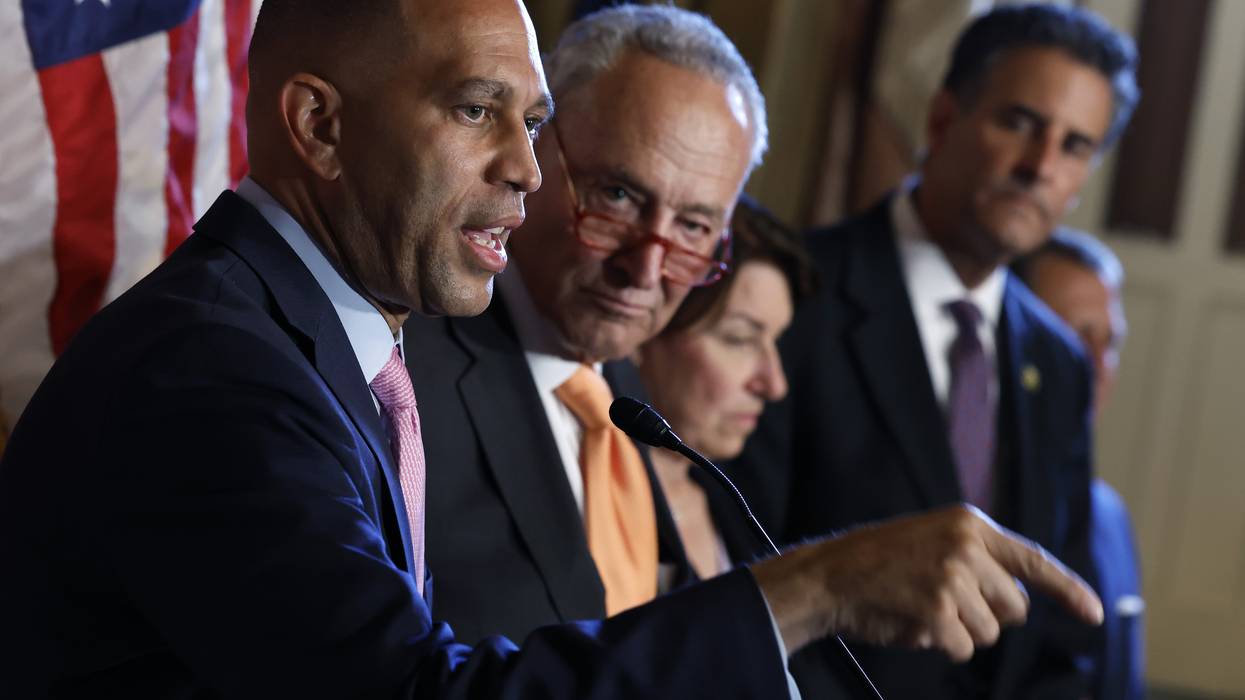
When so many Americans don’t want to see these two in leadership positions in the House and the Senate, it’s a dereliction of duty in a democracy to ignore that.
“Why not?” is an important question, so I’m going to answer it as clearly as I can.
For many decades, the Democratic Party has been guided by leadership like that of Hakeem Jeffries and Chuck Schumer. In Schumer’s case, I mean him specifically. In Jeffries’ case, it’s more the ideology. And that leadership has led to the Democratic Party being disrespected, mistrusted, and unliked nationwide. Of course, we still have pockets where the party is strong, but in general, we’re running at about a 39% approval rating across the country. And those two are even less popular than President Donald Trump.
But the biggest reason the Democratic Party needs new leadership is that it needs to rebuild trust with the American people. It needs to rebuild trust with its own voters, in government, in our institutions, and in our systems of justice and accountability. The party needs to make sure life is affordable enough for people to not only survive, but thrive. It also needs to work towards restoring faith in our democracy by strengthening it.
That means taking on a lot of efforts where the people’s interests are at odds with many of the members in the House and the Senate. Those policy fights will go against not just their donors, but their friendships and their relationships. They’re still in a mindset of bipartisanship as opposed to supermajoritarian rule. You can’t have both.
If you want a country that’s able to change things, like ending Citizens United and ending gerrymandering at the federal level, you need a powerful Democratic Party. And if you look back through history, America has made most of its major changes and improvements under supermajoritarian, single-party rule at the federal level, with big majorities in state legislatures and governors’ mansions around the country too.
The simple fact of the matter is that divided governments are great for maintaining the status quo, but they’re not built for change at all. And this moment we’re in, and the foreseeable future, are going to require change. Systemic, dramatic, radical change. Adapting to things like AI and robotics. Adapting to climate change. Working to repair broken institutions like our judicial branch, our prison systems, and our healthcare systems. Fixing our relationship with tech companies, with markets, and with private firms, including what we require from them in exchange for allowing them to exist.
Neither Chuck Schumer nor Hakeem Jeffries is well-suited for this. I’m not sure any of the people who’ve raised their hands are the exact choices we need. But at this point, the most valuable thing that comes out of the fight to replace them is just the fight itself. Flexing the muscles of the electorate.
When so many Americans don’t want to see Hakeem and Chuck in leadership positions in the House and the Senate, it’s a dereliction of duty in a democracy to ignore that. But that, in and of itself, has no consequences unless we provide them.
That, I think, is why it’s so important that we’re doing what we’re doing. All across this country, organizations, individuals, and a handful of elected officials are taking a stand and saying, “No. We need to move in a different direction. This isn’t the way.” And that unity of purpose, that unity of mission, is one of the most valuable things to come out of this fight.
So what are we doing here at A Fight Worth Having?
We’re sending LED trucks all across DS so the new members, the Congressional Progressive Caucus, and others are reminded that the American people are behind them if they choose to be brave. We’re running ads on television in DC. We’re running full-page newspaper ads. We’re trying to make sure the people in DC see and know that the American people are united in their resistance to this leadership, and that they’ll be doing the people’s business if they take a stand.
We’re also running a series of about 110 polls across the country to see exactly where Americans stand, and we’re releasing that polling, hopefully on Monday or Tuesday, before the votes for Speaker. We’re doing everything we can to make sure these folks are ready.
The other thing we’re doing is raising money for the handful of folks who’ve said, “No more” and committed to opposing Jeffries. So far, we’ve raised $86,000.
If you want to help these members, you can do so here.
This is the first of many fights that are worth having. Let's go.

For more than half a century, powerful interests have worked to build an America that serves the wealthy few. Now we have an opportunity to chart a different course, rooted in economic justice, human dignity, democracy, peace, and a livable planet.
The billionaire class made a bad bet. They thought their extraordinary wealth could buy them a country. That hundreds of millions of dollars in campaign contributions, control over powerful communications platforms, and an increasingly authoritarian political movement could overwhelm the democratic will of the American people.
On November 3, millions of Americans reminded them of something they had forgotten: Organized money has an opponent. Organized people.
From the millions who marched in the No Kings demonstrations to the volunteers who knocked on doors, registered voters, and mobilized their communities, Americans delivered an extraordinary repudiation of Donald Trump and his assault on democracy.
Democrats need an ambitious agenda that improves people's lives while confronting the concentrated wealth and political power that have prevented meaningful reform.
Young Americans helped power the Democratic victories. Latino voters shifted away from Republicans. Across the country, voters expressed their frustration with an administration that has prioritized the wealthy while ordinary Americans struggle with the cost of living.
Democrats won control of both houses of Congress. But the significance of this election extends far beyond which party holds the gavels. We may be witnessing a historic opportunity to reverse a political and economic transformation more than half a century in the making.
In 1971, corporate attorney Lewis Powell wrote a confidential memorandum for the US Chamber of Commerce urging business leaders to organize a sustained campaign to influence universities, the media, the courts, and government.
The Powell Memo helped inspire a corporate political offensive that reshaped American politics. Business interests invested enormous resources in think tanks, lobbying, political campaigns, and legal institutions, advancing policies that weakened unions, reduced taxes on corporations and the wealthy, rolled back regulations, and concentrated economic and political power.
The consequences are all around us. America has generated extraordinary prosperity, but an increasingly disproportionate share has flowed to the top. Housing, healthcare, and education have become increasingly unaffordable, while billionaires exercise extraordinary political influence.
Today's tech oligarchs didn't invent this power grab. They inherited a playbook.
But this election demonstrated that ordinary people, acting collectively, still possess the power to challenge concentrated wealth.
The question now is what we do with that power.
For decades, Democrats have been told that winning elections requires moving toward the center, moderating their ambitions, and reassuring wealthy donors that fundamental economic arrangements will remain undisturbed.
I've spent much of my adult life watching Democrats invoke Ronald Reagan more often than Franklin Roosevelt. Think about that. The party of the New Deal, Social Security, and organized labor has too often looked to the political philosophy of a president who helped undermine that legacy.
Yet Roosevelt understood something today's Democrats desperately need to remember: Government can transform people's lives, and doing so can build lasting political support.
Medicare for All would help democratize economic security. Public financing would help democratize political power.
His New Deal, propelled in significant part by organized labor and popular movements, established Social Security, strengthened workers' rights, created jobs, and helped build a more economically secure middle class. Those reforms were incomplete, and many Americans were excluded from their benefits. But they demonstrated the extraordinary possibilities of government acting on behalf of ordinary people.
In 1944, Roosevelt proposed a Second Bill of Rights that included the right to a decent job, adequate income, housing, medical care, education, and economic security.
More than 80 years later, that vision remains unfinished.
And in the wealthiest nation in human history, there is no justification for leaving it that way.
Democrats need an ambitious agenda that improves people's lives while confronting the concentrated wealth and political power that have prevented meaningful reform.
Two commitments should stand at its center: Medicare for All and public financing of elections.
The first would transform economic security. The second would help transform political power.
Start with healthcare.
The United States spends approximately two and a half times the OECD average per person on healthcare, yet delivers worse outcomes across key measures, from life expectancy to preventable deaths. Millions remain uninsured, while many people with coverage cannot afford to use it when they need care.
In America, cost effectively rations access to healthcare.
Other wealthy nations guarantee universal health coverage while spending substantially less. Yet our political leaders continue defending a fragmented, profit-driven system that places the financial interests of insurance companies ahead of people's health.
Medicare for All would guarantee healthcare as a fundamental human right, eliminate a major source of financial insecurity, and reduce workers' dependence on employers for health coverage.
But why has such fundamental reform remained politically elusive?
Part of the answer lies in the extraordinary influence of the industries that profit from the existing system. Insurance companies, pharmaceutical manufacturers, and other powerful interests spend enormous sums lobbying politicians, financing campaigns, and influencing the public debate.
Which brings us to the second pillar: getting big money out of politics.
We need to overturn Citizens United, end the system of unlimited independent political spending and super PAC contributions, and establish robust public financing of elections so candidates can compete without depending on wealthy donors and corporate interests.
We should ban congressional stock trading and strengthen protections against conflicts of interest. But those reforms alone will not address the underlying system in which politicians must continually raise money from the very industries they are supposed to regulate.
Public financing offers a way to change that relationship, allowing candidates to rely more heavily on ordinary voters rather than wealthy contributors.
This is essential because campaign finance reform is not simply another progressive issue. It affects our ability to accomplish virtually everything else.
How can Democrats seriously challenge corporate monopolies, tax billionaires, protect workers, or reform healthcare while remaining financially dependent on the interests determined to block those changes?
Medicare for All would help democratize economic security. Public financing would help democratize political power.
Together, they could fundamentally change the terrain on which every other progressive struggle takes place.
These two reforms must anchor a broader commitment to economic and social justice.
We need a living wage of at least $20 an hour, stronger unions and collective bargaining rights, affordable housing and childcare, and a tax system that requires billionaires and giant corporations to contribute their fair share.
We need to defend reproductive freedom, confront climate change, regulate Wall Street, enforce antitrust laws, and protect the democratic institutions increasingly threatened by concentrated wealth and authoritarianism.
The millions who marched, organized, and voted cannot simply return home and wait for the next election. They must continue demanding accountability and building the political power necessary to sustain change.
We must also challenge a foreign policy that devotes extraordinary resources to militarism while urgent human needs go unmet, and use congressional power to end illegal wars.
These are not radical demands in a society with the wealth and resources to achieve them. They are the foundations of a government that places human well-being above corporate profits.
And they challenge the conventional wisdom that progressive ambition is politically dangerous.
Sen. Bernie Sanders (I-Vt.) built a national movement by demanding universal healthcare, economic justice, and an end to billionaire domination of politics. New York Mayor Zohran Mamdani demonstrated that an unapologetically progressive affordability agenda could win broad support in America's largest city.
Their success does not mean every progressive candidate will win. But it demolishes the assumption that Democrats must abandon ambitious ideas to appeal to voters.
As Mamdani has emphasized, voters want change they can experience in their everyday lives, in the cost of rent, groceries, childcare, and healthcare.
Winning is one thing. Delivering is another.
None of this will happen overnight.
Trump remains president. Corporate interests will fight to protect their power. Even with congressional majorities, Democrats face vetoes, Senate procedural obstacles, and opposition from within their own ranks.
But political obstacles are not reasons to abandon fundamental principles.
Democrats should introduce Medicare for All legislation, fight for living wages, advance public financing, and investigate corporate abuses and political corruption. If Trump vetoes popular legislation, let Americans see what Democrats fought for and who stood in the way.
Congressional Democrats can also use hearings, subpoenas, oversight, and their control over federal spending to expose corruption, challenge corporate influence, and build the case for structural reform.
And that accountability must extend beyond Trump and the Republican Party. Democrats cannot credibly challenge a corrupt political system while protecting its beneficiaries within their own ranks.
The millions who marched, organized, and voted cannot simply return home and wait for the next election. They must continue demanding accountability and building the political power necessary to sustain change.
If Democrats fail to deliver meaningful improvements in people's lives, they risk recreating the disillusionment that helped bring Trump to power.
The political and economic system that has concentrated so much wealth and power in the hands of so few was not inevitable. It was built through decades of deliberate political choices. And it can be changed through collective action.
The millions who marched, organized, and voted must remain engaged. Join an organization. Organize in your workplace and community. Hold elected officials accountable. Keep marching, keep voting, and keep demanding more.
For more than half a century, powerful interests have worked to build an America that serves the wealthy few. Now we have an opportunity to chart a different course, rooted in economic justice, human dignity, democracy, peace, and a livable planet.
This is what democracy looks like. Now let's show what democracy can deliver.

While there are a number of steps Congress must take to help increase revenue, they should start by asking the wealthiest Americans to pay their fair share.
Last week, Americans went to the polls demanding change, and they got it. Democrats flipped both the House and the Senate, winning not only in blue states and battlegrounds, but in states that hadn’t sent a Democrat to the Senate in decades. Older voters played a crucial role in that outcome, accounting for roughly 34% of the electorate despite being just 24% of eligible voters. According to analysis by The New York Times and Siena College, voters 65 and older moved six points toward Democrats, voting 52-47 Democratic in the midterms.
These voters came with a clear priority. According to a post-election survey by the NORC Civic Health & Elections Project, 90% of voters over 50, including 87% of Republicans and Independents, said protecting Social Security from cuts was very or extremely important to their vote.
Candidates across the political spectrum knew that Social Security would be an animating issue in this election. Democrats campaigned on making the wealthiest Americans pay their fair share. Republicans touted the president’s message about ending taxes on Social Security benefits. While the messages differed, both parties recognized that older voters care deeply about the future of the program that helps tens of millions of Americans retire with dignity after a lifetime of hard work.
Social Security’s own estimates show that eliminating the income cap entirely could close roughly half of the program’s long-term shortfall. While it’s not the end-all solution, and Congress will need to come up with a lasting solution, it’s the right place to start.
Now that the dust has settled on the election, voters are demanding action. This week, newly elected members are in Washington for orientation, and Democratic leaders are deciding how to put their new majorities to work. But voters handed these members something more important than control of Congress. They handed them a mandate to protect Social Security, and a deadline.
This deadline is not abstract. Earlier this year, the Social Security Trustees Report projected that unless Congress acts, beginning in 2032, Social Security will no longer be able to pay full scheduled benefits. That would trigger an automatic benefit cut of 22%, or roughly $500 a month for a typical retiree. For many, their benefits have to cover utilities, food, transportation, and healthcare. A $500 monthly cut would be devastating.
The Senators elected last week will serve until January 2033. If that cut comes, it comes on their watch.
Every year that Congress delays action, the fix gets bigger and more complex. But the good news is that few Congresses in history have been better positioned to act. New members won by promising to protect Social Security, and the voters who elected them are watching.
While there are a number of steps Congress must take to help increase revenue, they should start by asking the wealthiest Americans to pay their fair share. When Congress last strengthened Social Security in 1983, lawmakers intended payroll taxes to apply to about 90% of wages. But as income at the very top has grown disproportionately, only about 83% of today’s wages are subject to the payroll tax. Once someone earns over $184,500 a year, they stop paying Social Security taxes on additional wages. That means teachers, custodians, mechanics, construction workers, and nurses pay on every dollar they earn. Meanwhile, someone making over $5 million a year is done paying into the trust fund before mid-January.
Social Security’s own estimates show that eliminating the income cap entirely could close roughly half of the program’s long-term shortfall. While it’s not the end-all solution, and Congress will need to come up with a lasting solution, it’s the right place to start.
This idea is widely popular. A September poll found that 72% of respondents would support Congress instituting even a 1% tax on income above $184,500. Other surveys have found broad support for applying the payroll tax to income above $400,000. That’s why candidates around the country ran on it. In North Carolina, Roy Cooper warned voters about looming cuts and told them “the wealthy have to pay their fair share.” In Ohio, Sherrod Brown won back a Senate seat by calling to raise the cap so billionaires pay their fair share. In Texas, James Talarico flipped a seat held by Republicans for more than three decades by pledging to apply the tax to earnings over $400,000. In Michigan, Abdul El-Sayed campaigned on scrapping the cap altogether.
The idea doesn’t belong to one party, either. Republican Sen. Bernie Moreno (Ohio) has joined Democratic Senator Elizabeth Warren (Mass.) in calling for eliminating the cap. But just as the idea doesn’t belong to one party alone, the responsibility to act doesn’t either.
The American people have demanded urgent action, and this new Congress is primed to deliver it. For the sake of today’s retirees and future generations, they must not squander this opportunity.

Brazil’s COP30 presidency promised a science-based path to halting and reversing deforestation by 2030. Instead, the resulting road map overlooks a primary driver of deforestation: the world's appetite for meat.
On November 3, Brazil released the highly anticipated COP30 Presidency Roadmap on Enhancing Efforts Towards Halting and Reversing Deforestation and Forest Degradation by 2030. At COP30 last year, which Brazil hosted, the presidency's commitment to produce it was a key compromise that helped the summit reach an agreement after more than 90 countries called for one. The road map comes at a critical time: The world remains far off track to meet its 2030 deforestation target.
The road map discusses forest protection, management, and restoration through financial incentives, regulation, and international cooperation. For food, this entails increasing production on existing farmland (how food is produced) and preventing further forest clearing (where food is produced), including measures that prohibit purchasing products from deforested land. But it ignores the question of which foods are produced and consumed.
This matters because food systems overwhelmingly drive deforestation, and what we eat determines how much land they require.
Countries should urge the Brazilian COP30 presidency to incorporate explicit action on diets as the road map moves into implementation, and include similar commitments in their own plans.
Demand for food generally means demand for agricultural land—for crops, livestock, or animal feed—and forests are cleared to meet this. That’s why, despite increased productivity, agricultural expansion drives nearly 90% of global deforestation.
How much land we need depends largely on which foods we eat. A meat-heavy diet can require approximately four times as much land—or more—than plant-based ones. That’s why expert bodies are so explicit about the need to address diets. The United Nation’s Global Land Outlook, for example, states that, where appropriate, a transition to plant-based diets is a logical first step to ensure food systems deliver positive outcomes for nature and climate while continuing to provide sustenance. The Intergovernmental Panel on Climate Change (IPCC), the Intergovernmental Science-Policy Platform on Biodiversity and Ecosystem Services, UNEP’s Global Environment Outlook, and EAT-Lancet Commission likewise emphasize the importance of dietary change in reducing pressure on land. In light of this consensus across major global scientific assessments, the road map's absence of guidance on diets is highly unusual.
As 2030 approaches, half measures won’t do. Reducing consumption-related pressure on land needs to be a top priority.
Governments already shape what people eat through subsidies, public procurement, and other policies. As the road map notes, potentially harmful agricultural subsidies amounted to approximately US$406 billion in 2023. Redirecting this could make healthier, less land-intensive foods more affordable.
There are good examples already of policies supporting forest-friendly food systems. France’s strategy against imported deforestation calls for a shift toward plant proteins. Denmark has a permanent fund to support the development of plant-based food and demand for it. Brazil’s own Food Systems and Climate Framework for Public Policies recommends measures to promote healthy, sustainable diets, including discouraging excessive consumption of animal-source foods.
The road map’s other measures can’t compensate for this omission.
First, national and local forest protection measures are better suited to preventing deforestation within their own jurisdictions. Given that markets for meat and animal feed are highly globalized, preventing deforestation in one location does not necessarily translate into equivalent global or even national progress. Demand for meat and animal feed can simply shift pressure onto forests elsewhere. Real success means reducing deforestation, not relocating it.
Second, increasing production efficiency can be counterproductive without demand-side measures—lower production costs can stimulate demand, encouraging further agricultural expansion. As the IPCC notes, increasing profits from intensive farming can incentivize land conversion. To achieve the necessary environmental outcomes, agricultural intensification must also be accompanied by dietary changes and food waste reduction.
At COP31, countries and NGOs may be inclined to welcome the road map without reservation.
Historically, many forest policy discussions have placed less emphasis on food consumption than science demands. Food is deeply personal and sociocultural, meaning that policy interventions, such as subsidies, are often mistakenly framed as critiques of individual behavior rather than systemic reform. Policymakers may therefore find it more comfortable to focus on production than on consumption.
Industry narratives deepen this discomfort by alleging that addressing meat consumption puts nutritionally vulnerable populations at risk. But reducing high meat consumption where suitable alternatives are available does not mean depriving people who lack access to those alternatives. On the contrary, reducing excessive consumption where alternatives exist is necessary to keep food systems within safe planetary boundaries, with major benefits for public health, climate, and biodiversity.
For these reasons, many have understandably focused on forest initiatives that seemed more achievable. But a global road map must identify the measures needed to meet its targets. If the most impactful measures are politically uncomfortable, the road map should help build support for them.
The road map’s release can still mark an important step forward, but only if countries recognize that much more is needed. There is already significant awareness—during the development of the road map, numerous stakeholders representing civil society, government, and academia shared extensive inputs on the need to address diets.
Countries should urge the Brazilian COP30 presidency to incorporate explicit action on diets as the road map moves into implementation, and include similar commitments in their own plans. Countries with high levels of meat consumption should lead by committing to reductions in their forest and climate plans—using credible policy measures such as public procurement policies and dietary guidelines that account for environmental impacts as well as nutritional needs. They should also work through the formal negotiations—particularly on agriculture and in any cover decision—to strengthen climate action on food systems, including consumption.
With just over four years remaining until the end of 2030, another plan that leaves one of the most powerful tools for reducing deforestation untouched is little cause for celebration.

I'm a democrat and a socialist, but there are reasons I'm not a member of the Democratic Socialists of America.
I am a democrat and a socialist.
I am a democrat because I believe that everyone should be free and enabled to live lives of their own choosing in a society governed by and in the interests of all.
And I am a socialist because I believe that our work together should be democratically managed and its fruits equitably shared to maximize the prosperity of all and not just the profits of a few.
That makes me a democratic socialist. But I am not now a member of the Democratic Socialists of America, though I was once, decades ago. It has since become the largest organization of democratic socialists in the country. But for now, I have no interest in rejoining.
My reasons are simple and straight forward. The DSA has duly elected leaders and national spokespeople who are self-declared Leninists and not democratic by any reasonable definition of the term.
It also has declared itself in favor of the very top-down, centralized “socialism” built on “public ownership of the largest corporations and essential industries” that bears a stronger resemblance to the Soviet Union’s correctly derided “dictatorship of the proletariat” than it does to Sweden’s widely admired “People’s Home.”
I understand that DSA consists of several competing tendencies. I find many of them agreeable and applaud many of the goals outlined in the national program.
But if socialists have learned anything from the movement’s successes and failures over the last 150 years, it is that Leninism is not democratic and that monopolistic industries, whether private or public, do not lead to widely shared prosperity.
These organizational inconsistencies might seem unimportant, or even a virtuous sign of open-mindedness. They are neither. Instead, they raise serious questions about the organizations maturity and reliability. If it hasn’t learned anything from socialism’s past and can't figure out how to keep cuckoo birds from laying eggs in its nest, how mature and reliable can it be?
If we are serious about democracy and socialism, we need to be clear about what they are, how they work, and why they matter.
For example, many say that governing in the interests of all is impossible because no group of people can agree on everything. To which I would reply, true. But just because democracy is hard does not mean it is impossible.
Democracy does not demand conformity; it requires learning to live with difference. It is about learning to accept—to agree to disagree. There are very few things about which we can all agree and most are incontrovertible (the sun will come tomorrow). But there are a great many things we can all accept (even bad drivers try to obey the rules of the road).
Most people in my experience think "democracy" is about either procedure (elections, debates, laws, etc.), or power (the control of everything by everyone—or, at least, "the majority"). I think, on the contrary, that it is about freedom—the ability of everyone to lead lives of their own choosing.
Many also say that the best way to ensure prosperity is to encourage private property and free markets, and that public ownership and planned markets deliver not prosperity but poverty.
To which I would reply, not if the public options are envisioned as complements to private property and free markets rather than alternatives to them.
Private property and free markets are essential to prosperity. But when private property becomes concentrated in the hands of a very few people, markets become less free and prosperity becomes less widely shared, super-sized for some and doled out in teaspoonfuls for others.
Public property and social provision are essential counterweights to these baleful effects of private monopolies and ruinous competition.
I am a socialist thus for the same reason I am a democrat. Capitalism is a market economy run by and in the interests of capitalists; socialism is a market economy run by and in the interests of the whole society—wage earners and consumers as well as owners, managers, and investors.
An economy that best serves the interests of everyone is, as I understand the term, “socialist” by definition. It combines both private property and public enterprise to protect and maximize the profits of capital and the wages of labor, with each sharing equitably in the prosperity of all.
Some say that this sort of mixed economy is impossible, that the best we can do is to govern the private economy from the outside by imposing “rules of the road” that companies and other economic actors must obey.
But people don’t obey the rules of the road because they have to. They obey them because they choose to.
Hasn’t every driver driven over the speed limit, run a red light, or veered into the on-coming lane of traffic, when it suited them to do so? It isn’t the law that keeps us from doing so all the time. It is our self-interest.
Similarly, if we are going successfully to release the energies and simultaneously to restrain the excesses of private enterprise, we must have a countervailing system of public enterprises that can compete with the private by providing the goods and services required for a decent standard of living at prices everyone can afford.
Our public enterprises— think the post office, public schools, the transportation network, the national parks, the armed forces, etc., even the farm bill—thus represent a really existing, actually desirable socialism we already have. They provide affordable goods and services we need or want, not in the place of private provision, but as a complement and counterweight to it.
The best way to achieve the kind of democratic socialism we might want, or can at least accept, is not to make all private property public, but to expand the number and functioning of the affordable public options.
We don’t need to burn down the American People’s Home! We need to open it up, air it out, renovate the broken bits, extend it here and there, and make it the welcoming and comfortable place for everyone that the best of its founders wanted it to be.

If Democrats want to show Americans that government can work for them, the minority party cannot be allowed to undermine the majority’s enactments.
The Democrats’ path to enduring power is clear: Demonstrate that they have the competence and commitment to confront the troubles that drove the blue tsunami—to attack inflation, corruption, affordability, and falling incomes. If Democrats can do this, they will secure the voters’ trust and their stewardship of the nation may endure. If they fail, sadly there will be another turn of the wheel in two years.
What should this strategy look like? The voters have told us loud and clear: Pass laws that address the problems. Confront President Donald Trump with the choice: Either sign them into law, showing that Democrats can indeed “get things done,” or veto them and make clear who is the problem.
But this strategy faces a colossal institutional barrier: the filibuster. Unless Democrats abolish that barrier, Congress will not enact new laws and President Trump will not be forced to accept or veto those enactments.
When a majority elected to “get things done” cannot do so, their failure undermines public confidence in democracy and supports the reactionary view that government is good for nothing.
In the new Congress that convenes on January 3, 2027, Democrats will hold at least 54 Senate seats against the Republicans’ 44. Their decisive margin reflects the voters’ determination that the Democrats should run Congress.
But hard as it is to believe, 54 to 44 isn’t good enough.
Under current Senate rules, a simple majority is not enough to pass legislation. The Senate’s “cloture” or filibuster rule requires the support of no fewer than 60 senators before the Senate can end debate and enact a proposed law. Otherwise the law dies stillborn. The filibuster turns our majority-rule democracy inside out and gives a minority party veto power.
The issue is simple: After the voters have said No to a party, does the party have the right to say No to the voters?
The minority veto is a perversion of the Framers’ constitutional design. Under the Constitution, a handful of matters require supermajorities: overriding a presidential veto, proposing constitutional amendments, removing an impeached president, ratifying treaties. Under the Constitution, ordinary legislation requires only a simple majority. That is as it should be.
Requiring a supermajority for ordinary legislation is a formula for gridlock. When a majority elected to “get things done” cannot do so, their failure undermines public confidence in democracy and supports the reactionary view that government is good for nothing. We can no longer tolerate the damage done by that viewpoint.
Victories in formerly red states are bringing to Washington new Democratic senators who campaigned as moderates and seek to promote bipartisanship and “reaching across the aisle” to Republicans.
Well and good, but that is no reason for preserving the anti-democracy filibuster.
First, few if any Republicans are willing to reciprocate. Rep. Steve Scalise (R-La.), one of the aspirants to replace exiting GOP leader Mike Johnson (R-La.), demands Republicans “stand united” to protect the “progress” supposedly made by President Trump, so they can win in 2028. Another, Jim Jordan (R-Ohio), touts his readiness to provide “battle-tested” leadership and calls for an “offensive” against Democratic “havoc.”
Does this sound like Republicans reaching across the aisle?
History shows that winning the support of a handful of Republicans to overcome the 60-vote supermajority hurdle requires compromises that harm the public and rob Democrats of credit for achieving what the public wants. Consider two examples from the Obama era.
Voters astonished most political pundits, the political class, and even themselves when they swept Republicans away and turned formerly deep red states blue. Now it is up to Democrats to protect this amazing achievement.
The sub-prime housing bubble and the Great Recession: In 2008, Barack Obama and the Democrats won a decisive electoral victory in the midst of a devastating national financial crisis. Many feared that another Great Depression was imminent. The rescue plan required (among other things) stimulating the economy with government spending to prevent mass unemployment. But Republicans had no interest in being part of the solution. As they later acknowledged, their number one goal was making President Obama a one-term president.
Obama compromised on the size of the stimulus in an effort to accommodate supposed moderate Republicans and overcome the filibuster. Nonetheless, not one GOP representative voted for the “bipartisan” plan to save the economy.
Three Republican senators—just enough to beat the filibuster—did vote Yes. But the compromised program led to an anemic recovery, in which millions remained unemployed or underemployed for over two years. Obama’s similar “moderacy” with regard to the housing crisis yielded equally disastrous compromises. Banks were bailed out, but not homeowners—and 10 million families lost their homes to foreclosures.
Democrats got little credit for the economic rescue because the filibuster-beating compromises created misery for millions of Americans, not relief.
Expanding health insurance: Passing the Affordable Care Act—Obamacare—also required undesirable and unpopular compromises because of the filibuster. The health insurance law should, for example, have included a “public option”—giving Americans the choice of a government-run insurance program, essentially Medicare for all—but it was eliminated to gain the extra votes needed to satisfy the filibuster supermajority. Other bad compromises included barring Medicare from negotiating with pharmaceutical companies over drug prices.
What was a great accomplishment—bringing medical insurance to tens of millions of Americans whose healthcare was inadequate—became a political liability.
Ending the filibuster would not prevent Democrats from trying to work with Republicans. If you see yourself as a moderate Democrat who wants to reach across the aisle, nothing stops you from doing so after repealing the filibuster.
Ending the filibuster just means that the agreement of the people who call Democrats jihadists, child abusers, crazy, communists, and Godless America-haters should not be needed to pass legislation.
Voters astonished most political pundits, the political class, and even themselves when they swept Republicans away and turned formerly deep red states blue. Now it is up to Democrats to protect this amazing achievement. The filibuster will allow Republicans to destroy what the people are clearly demanding.
Time to end the filibuster.

The midterm results offer a major ray of hope that ordinary people possess enough knowledge and determination to challenge the powerful interests, mega donors, and shadowy agendas shaping their country's foreign policy.
On the very morning of the critical US midterm elections, President Donald Trump made what seemed like a shocking announcement: no more aid to Israel.
“Bibi Netanyahu and I have made a deal that we give Israel $4 billion a year, and we made a deal months ago that we're stopping,” Trump told Fox News' Fox & Friends.
He goes on to make two seemingly contradictory assertions: “We won't be paying Israel,” and “We'll help Israel if they need it.”
There is a fundamental lesson here: Americans can no longer be satisfied with empty promises.
In truth, there was little euphoria among those who have long campaigned against US funding of Israel. The lack of enthusiasm can be explained by two factors: Few take Trump's pledges seriously, and his remarks were widely understood as a desperate attempt to stave off what was shaping up to be a disastrous election outcome.
The election ultimately delivered one of the most humiliating defeats in Republican Party history, with Democrats capturing both the Senate and House of Representatives and making sweeping gains across the country.
Republicans quickly turned against Trump, who made the unusual admission that the war on Iran had contributed to their defeat.
Vice President JD Vance, widely considered a potential presidential contender in 2028, was more explicit. “The reason we lost is the war,” Vance tweeted on November 4, calling for Republicans to “change our relationship to Israel.”
Though Vance was criticized by some within his party for naming Israel, the clearest indication that unconditional US support for Israel had become a major political liability came from Trump himself.
First, his rushed Election Day announcement was an unmistakable attempt to influence voters before they cast their ballots. Trump failed, but in doing so, he revealed that he and his party understood Israel had become a major factor in their political predicament.
Indeed, Trump described the $4 billion payment as “a bad talking point,” complaining that critics were using it against Republicans.
Second, Trump's acknowledgment that the Iran War had hurt Republicans exposed the very Israel connection that Vance was prepared to articulate more openly.
The war on Iran was not America's war. It was Netanyahu's war, pursued as part of his longstanding quest to dominate the Middle East, with Washington paying the military, economic, and political price.
This is hardly hyperbole. Netanyahu has repeatedly presented Iran as an existential enemy, while his far-right allies have openly celebrated American military involvement.
Ironically, Washington's own 2026 National Defense Strategy had identified defending the US homeland and asserting American interests throughout the Western Hemisphere as its foremost priorities. Yet the administration plunged into another devastating Middle Eastern war.
Thanks to independent journalists and analysts operating outside mainstream media, Americans have become increasingly aware of the damage this relationship has inflicted on their country's economy, military standing, and international reputation.
According to Quinnipiac University, 48% of registered American voters now believe the US is too supportive of Israel, compared with just 16% in January 2017.
This growing awareness, coupled with the seismic shift in Congress following the midterms, is still not enough to guarantee tangible and irreversible change.
The midterm results nevertheless offer a major ray of hope that America is not a lost cause after all, and that ordinary people possess enough knowledge and determination to challenge the powerful interests, mega donors, and shadowy agendas shaping their country's foreign policy.
There is a fundamental lesson here: Americans can no longer be satisfied with empty promises. And this brings us back to Trump's announcement.
Israel has been the largest cumulative recipient of US foreign assistance, with the Council on Foreign Relations estimating that American aid since 1948 has exceeded $300 billion, adjusted for inflation.
That staggering figure, however, hardly tells half the story. Washington has consistently found ways to finance Israel's wars beyond the declared annual military assistance of $3.8 billion.
For example, in April 2024, President Joe Biden signed emergency legislation providing Israel with an additional $8.7 billion in direct military assistance, separate from the regular annual allocation. The money included $3.5 billion in additional Foreign Military Financing and $5.2 billion for missile defense programs.
These extraordinary funding mechanisms demonstrate how Washington can continue financing Israel's military even when regular assistance becomes politically controversial.
And that is only part of the picture.
Congress has been considering proposals to expand US-Israeli defense technology cooperation, potentially shifting more spending into Pentagon research, development, and procurement accounts.
In essence, Israel could continue benefiting from billions in American military spending without those expenditures being labeled conventional foreign aid.
What Trump appears to be offering, therefore, is a sleight of hand: Remove the politically damaging label of aid while preserving, and potentially expanding, the military relationship itself.
A Democratic-controlled Congress could block some of these initiatives. But many Democrats remain committed supporters of Israel, and the American Israel Public Affairs Committee (AIPAC) will continue to spend heavily to influence congressional elections.
True, association with the lobby has become a political liability for some candidates. But AIPAC and its allies can be expected to seek alternative strategies, political vehicles, and alliances to preserve their influence.
The election results are certainly a major step in the right direction, but America's political civil war is only beginning: progressive Democrats against the party establishment, disillusioned Republicans against MAGA loyalists, independent media against mainstream institutions, and so on.
The good news, for now, is that the tireless work of generations of conscientious Americans are finally paying off. Thanks in no small part to their efforts, millions of Americans are beginning to recognize that Israel is not a friend of their country, and that this sinister relationship must end once and for all.

Voters didn't deliver a majority just to watch Democrats perform helplessness. It’s time to reject corporate-backed leadership before this wave hits a wall.
As an elder millennial, I remember the “Blue Wave” of 2006-2008 well. I remember feeling like young people had really accomplished something, and that there was something to hope for. I also remember the gnawing defeat that followed when Democrats all but squandered the opportunity.
The American people expect this “Blue Wave” to destroy the status quo politics that are robbing them of dignified lives. But if House Democrats continue to perform helplessness and elect Hakeem Jeffries, that wave will encounter a massive seawall and lose its force.
Hakeem Jeffries' donor network represents everything a progressive majority should stand against. Reporting from Sludge reveals that his top backers include major Wall Street investors, cryptocurrency interests, defense giants, and the American Israel Public Affairs Committee (AIPAC)—corporate players with a direct financial stake in how aggressively Congress regulates the private sector.
If Democrats hand Jeffries the gavel without a fight, they will squander this opportunity and, yet again, betray the American people.
Among these ties, his relationship with the defense sector is particularly alarming. This cycle alone, Palantir’s head of government affairs contributed over $44,000, while Anduril’s CEO and COO poured nearly $150,000 into Jeffries’s fundraising committees. This comes alongside over $1 million in earmarked campaign funds channeled through AIPAC, despite Jeffries publicly downplaying direct PAC contributions.
The danger here is that these financial ties have immediate foreign policy consequences. In September, Iran reported capturing an Anduril underwater drone in the Strait of Hormuz. Despite the Navy trying to do damage control, the reality remains: an Anduril weapon was deployed in a conflict Jeffries himself had previously condemned as "unlawful." All the while, the very executives profiting from that technology were fueling his rise to the speakership.
This financial dependency directly shapes his policy stance and a pattern of stalling and evasion. In March, less than a week after branding the war in Iran illegal, Jeffries deflected when asked if he would block additional war funding, claiming Democrats would "cross that bridge when we get to it." By June, he reversed course, arguing Democrats shouldn’t spend another dime.
Voters deserve to know whether the defense executives funding his campaigns influenced that three-month delay. A leader who hesitates to halt an illegal war while taking campaign cash from weapons manufacturers is indefensibly corrupt, and ought to be disqualified from the speakership.
That same failure to hold the line reemerged on Tuesday during a critical vote on executive oversight. The House voted 211-204 to refer Rep. Thomas Massie’s (R-Ky.) articles of impeachment against Defense Secretary Pete Hegseth to committee, effectively killing the resolution. Eleven Democrats—all of whom are funded by AIPAC—were conveniently absent. While several blamed traffic delays and police escorts, reporting from Common Dreams revealed they missed the floor vote to attend a fundraiser for Elect Democratic Women, an AIPAC front group.
A future speaker who is so bought out by military contractors and corporate interests that he can’t whip his members for a vote of this magnitude is not ready to lead investigations into one of the most corrupt administrations in modern history. The American people deserve more than yet another farce.
Voters are much smarter than they’re given credit for. A PBS poll found that voters believe that the economy, our state of democracy, and government corruption are the top issues facing our country. They know exactly what’s happening and what’s at stake.
Yet, they’re supposed to believe that a compromised Jeffries speakership will set an agenda that roots out corruption? I can assure you: They don’t. That sharp skepticism is why over 1 million people have signed a Change.org petition demanding House Democrats deny Jeffries the speakership and elect someone who truly represents the people.
If Democrats hand Jeffries the gavel without a fight, they will squander this opportunity and, yet again, betray the American people. I sure as hell wouldn’t want that to be my legacy. And House Democrats should feel the same way.

After the passage of four anti-trans ballot initiatives in the 2026 midterms, it's time to loudly affirm that trans lives matter.
“I don’t want boys competing with my daughter.” “There are biological differences.” These were responses I got while canvassing in Spokane, Washington for the “No Hate in WA State” campaign against two anti-LGBTQ and anti-trans ballot initiatives, I-001 and I-638.
I had hoped these misinformed perspectives weren’t widespread, but the election results prove otherwise. In Spokane county, which is supposed to be a blue dot in Eastern Washington, the tally as of November 7 showed only 34% of voters rejecting hate by voting against I-638, the anti-trans sports ban.
Post-election, we’ve been celebrating how anti-trans hatemongering by Republican candidates nationwide didn’t have the potency it has in the past. This is fantastic, but we’ve paid less attention to persistent transphobia in the electorate. Two red states (Arizona and Nebraska), and two blue states (Washington and Colorado), passed repressive anti-trans sports bans in the midterms. As one organizer noted, “Voters punished the politicians who used trans people as a wedge, then voted to take away trans people’s rights when asked directly.”
Can we work toward a future in Washington where we reject anti-trans laws because they hurt trans people?
In contradistinction to our reputation as a LGBTQ+ positive state, the measure in Washington is the worst of the four in that it requires girls to prove their “biological sex” via expensive hormone testing or invasive physical exams. Washington Gov. Bob Ferguson acknowledged that he campaigned more aggressively against other ballot initiatives saying, “I’ve got to focus my time on where I think I can have the biggest impact.” That’s disappointing, especially in an election where we saw real leadership from candidates like Michigan Sen.-elect Abdul El-Sayed who refused to throw trans folks under the bus.
The strategy of the No Hate campaign wasn’t to directly address transphobia, but to focus on how the initiatives hurt all kids. For I-638, we leaned into talking about the invasive sex exams that ALL girls would be subject to in order to play sports. This argument seemed to have a lot of traction—you could literally see people’s faces distort imagining their daughters, nieces, or granddaughters having to drop their panties for genital checks. However, it seems that repulsion wasn’t enough to overcome transphobia.
Encountering transphobia at one door, I also found myself saying that there are only a handful of trans girl athletes, suggesting the threat is purposely overblown. Others have talked about how this is a “culture war” issue and trans kids are being scapegoated to distract us from real threats—rising inflation, wars, corruption, and so forth.
While all of this may be true, it doesn’t address anti-trans myths, hate, and transphobia. I thought about the trans students I have come to know at Eastern Washington University. Would they want me to argue that their numbers are too small to count, that we should worry more about harm to “real” girls, or that their ability to play sports (or use bathrooms) is simply a distracting “cultural” issue? Are they wondering when people will fight anti-trans initiatives by centering them, by insisting that trans lives matter?
I am relieved that Washington voters rejected 2 of the 3 horrendous hedge-fund-Heywood backed initiatives, but this makes the passage of I-638 even harder to face. I’m sure there will be a lot of discussion about what went wrong. As a professor of Gender, Women’s, and Sexuality studies, I know part of it. We haven’t done enough to educate the public about transgender people. As evidenced by my canvassing experiences, I know I didn’t do enough.
This ban on trans student athletes will have terrible impacts stoking anti-trans discrimination, bigotry, and violence. It says to trans youth and adults that Washingtonians don’t think they should exist. And that’s true even if we find legal or bureaucratic ways to keep the initiative from being implemented.
I want to do better. I want our state to catch up to others in rejecting the scapegoating of transgender people. Can we work toward a future in Washington where we reject anti-trans laws because they hurt trans people? Can we move beyond baseline pleas for tolerance? Can we articulate the truth about how we all benefit from the richness transgender, non-binary, and two-spirit folks bring into our world?
I want to consider what it would be like not just to reject transphobia, but to support and uplift trans athletes for the courage it takes to compete as their true selves in a society that wants to erase them. Research shows that their competition doesn’t stymie or hurt any others, that individual differences and class privilege are more significant factors in advantaging student athletes than gender identity, and that trans athletes can inspire and galvanize their teams.
I am challenging myself and others to move from a message of “No Hate” to a joyful call to “Celebrate” our fabulous fierce trans student athletes—and all trans folks.

For more than 50 years, the ESA has reflected a bipartisan commitment to preventing extinction. Our senators should not trade that legacy for a bill that creates new bureaucratic hurdles and leaves imperiled wildlife with fewer protections.
America needs development and a transition to clean energy, something we can all largely agree upon. Another thing we agree on is the importance of protecting our shared natural heritage and utilizing bedrock conservation laws to protect it. But the Senate’s Bipartisan American Affordability and Jobs Act, or BAAJA, promises expediency through permitting in rubber-stamping development while also posing one of the most sweeping attacks on the Endangered Species Act in the law’s more than 50-year history.
The ESA does not stand in the way of America achieving a clean energy future and increased development. It is one of the world’s most successful conservation laws, credited with saving 99% of listed species from extinction. And it is extremely popular, with the support of 84% of the American public. The Senate’s bill would weaken it at every point of the permitting process.
Supporters of rolling back provisions of the ESA argue that endangered species reviews slow projects down, but evidence says otherwise. A peer-reviewed study of 88,290 US Fish and Wildlife Service consultations over a seven-year period found jeopardy for only two projects, and even in those two circumstances, an alternative was found to allow the projects to proceed in a modified form. Not a single project was stopped. Formal consultations took an average of two months to complete. And informal consultations, accounting for more than 90% of reviews, took an average of two weeks to complete.
With only 120-230 Florida panthers left in the wild, exempting highways from review removes the very tool designed to find solutions before we lose this animal to extinction.
ESA consultation is not a roadblock. It’s how projects move forward while identifying and reducing harm to wildlife. The Senate’s BAAJA fixes a problem that the data shows does not exist and instead will create very real and dangerous problems to species and habitat.
BAAJA would let states take over federal endangered species reviews, called consultations. This could happen even when agencies lack the staff, funding, or scientific expertise to do the work. Species don’t understand state boundary lines. Migratory birds travel across states, making it unrealistic and extremely difficult for a single state to assess a project’s effects on them. States that have become hostile to ESA protections, like Alaska, could attempt to lock in oil and gas development despite protections for animals like polar bears. And without the staff or expertise to conduct efficient consultations, state reviews could easily be slower than the fast federal averages that we have today.
What’s more, certain highway projects and nationwide water-permit renewals would be fully exempt from key ESA safeguards, creating God Squads without the squad process. Roads fragment habitat, and vehicle collisions kill wildlife. For the Florida panther, vehicle strikes are a leading cause of death and their efforts to expand territory are inhibited by roadways that cut through their range. With only 120-230 Florida panthers left in the wild, exempting highways from review removes the very tool designed to find solutions before we lose this animal to extinction. If this bill passed, these highway projects would never even ask the question whether or not they would jeopardize the existence of a species.
Under BAAJA, communities and conservation organizations would have just 150 days to bring certain ESA challenges, down from six years that currently apply. Local cases from around the country would have to be filed in the DC Circuit, and courts would operate on accelerated schedules. Expecting a small community group in rural America to move with the expediency and resources of a corporation is unrealistic, inequitable, and foolish. If the public cannot challenge unlawful decisions in time, the law becomes unenforceable, and harm to wildlife is often irreversible.
The bill also introduces new, vaguely drafted statutory definitions and standards for scientific assessments. Vague and confusing language like this is rife for abuse and could invite lawsuits that slow projects down, which is precisely the opposite of this bill’s stated goal.The language could be interpreted to make it harder for wildlife biologists to act on the best available science, particularly when information is incomplete, which is often the case with rare or elusive species.
This bill also implies that our hard-working federal employees aren’t doing enough. It would shorten the standard formal consultation period from 90 to 60 days without providing any additional agency staffing or funding to meet these shortened deadlines. Cutting the clock without capacity isn’t creating efficiency, it’s telling scientists that they either aren’t working hard enough, or that they should rush through the process, an offensive idea that could lead to less thorough reviews and allow key information to protect endangered species to slip through the cracks.
Real permitting reform is possible, and we can foster development in the US. Investing in agency staffing, enhancing coordination, modernizing technological systems, and giving project developers earlier, clearer guidance are direct paths to improving the process. Gutting one of our most effective and popular conservation laws does the opposite.
For more than 50 years, the ESA has reflected a bipartisan commitment to preventing extinction. Our senators should not trade that legacy for a bill that creates new bureaucratic hurdles and leaves imperiled wildlife with fewer protections.
Contact your senators today and tell them to oppose BAAJA because of its ESA attacks and to keep our wildlife and natural heritage safe for generations to come.

Blessings should go to those who fought and died struggling for a better future for people across the South.
I cried tears of joy when I first heard the news of Scott Colom's victory as Mississippi's US Senator. It's historic. But it's also somewhat personal to me. When I was young I l heard the great Nina Simone perform her song "Mississippi Goddam" at the Village Vanguard.
Maybe today, decades later, she could sing "Mississippi God Bless."
But blessings also should go to the civil rights activists who fighting and died struggling for voting rights, some of whom I had loose personal connections with.
James Cheny, Andy Goodman, and Mickey Schwerner were tortured, murdered, and buried in a swamp by the Ku Klux Klan for trying to register black people to vote during Mississippi Freedom Summer. My mother knew Andy Goodman's mother, a psychologist and social activist, so this was a personal as well as political loss for my family.
My wife was a distant relative of Mickey Schwerner and had dinner at his family's home when she was about 15. Mickey introduced her to soul music. After they left, her father, a Republican, said they would never go back since he considered the progressive Schwerner family to be "communists." But this alleged communist gave his life fighting to bring democracy to the Jim Crow south.
My father was also friendly with Dr. Martin Luther King. Born in Georgia and raised in South Carolina, he chaired the New York chapter of the Southern Conference Educational Fund which raised money for the civil rights movement. I met Dr. King as a child when he had dinner at our home and was inspired by him for the rest of my life.
It may have taken decades for Mississippi to elect its first African American senator in nearly a century. But now, later in life, I experience it as an historic victory for democracy. But also it's a belated victory for Dr. King, James Cheney, Andy Goodman, Mickey Schwerner, and so many others who risked, and even sacrificed their lives fighting for civil rights and voting rights.
The fight isn't over. But today I say this: "Mississippi God Bless."