SUBSCRIBE TO OUR FREE NEWSLETTER
Daily news & progressive opinion—funded by the people, not the corporations—delivered straight to your inbox.
5
#000000
#FFFFFF
To donate by check, phone, or other method, see our More Ways to Give page.
Daily news & progressive opinion—funded by the people, not the corporations—delivered straight to your inbox.
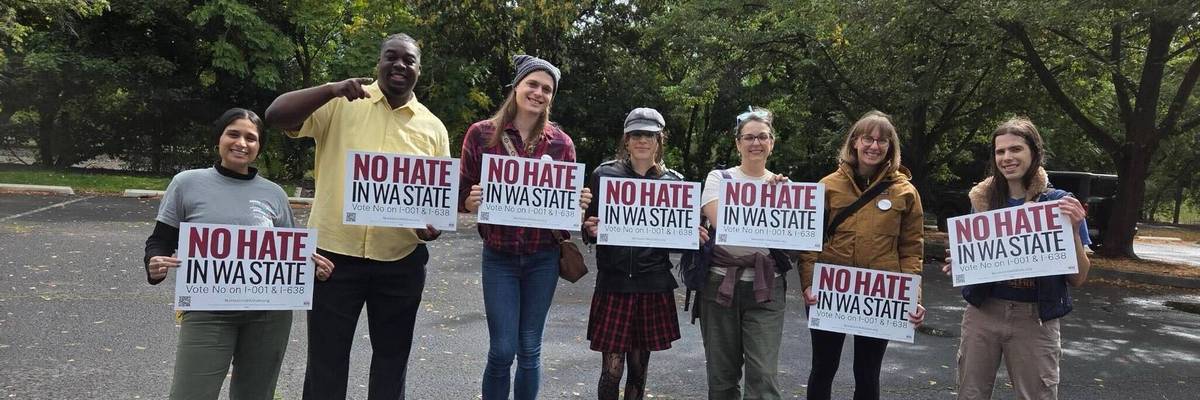
People advocate against anti-trans ballot initiatives in Washington state on October 5, 2026.
After the passage of four anti-trans ballot initiatives in the 2026 midterms, it's time to loudly affirm that trans lives matter.
“I don’t want boys competing with my daughter.” “There are biological differences.” These were responses I got while canvassing in Spokane, Washington for the “No Hate in WA State” campaign against two anti-LGBTQ and anti-trans ballot initiatives, I-001 and I-638.
I had hoped these misinformed perspectives weren’t widespread, but the election results prove otherwise. In Spokane county, which is supposed to be a blue dot in Eastern Washington, the tally as of November 7 showed only 34% of voters rejecting hate by voting against I-638, the anti-trans sports ban.
Post-election, we’ve been celebrating how anti-trans hatemongering by Republican candidates nationwide didn’t have the potency it has in the past. This is fantastic, but we’ve paid less attention to persistent transphobia in the electorate. Two red states (Arizona and Nebraska), and two blue states (Washington and Colorado), passed repressive anti-trans sports bans in the midterms. As one organizer noted, “Voters punished the politicians who used trans people as a wedge, then voted to take away trans people’s rights when asked directly.”
Can we work toward a future in Washington where we reject anti-trans laws because they hurt trans people?
In contradistinction to our reputation as a LGBTQ+ positive state, the measure in Washington is the worst of the four in that it requires girls to prove their “biological sex” via expensive hormone testing or invasive physical exams. Washington Gov. Bob Ferguson acknowledged that he campaigned more aggressively against other ballot initiatives saying, “I’ve got to focus my time on where I think I can have the biggest impact.” That’s disappointing, especially in an election where we saw real leadership from candidates like Michigan Sen.-elect Abdul El-Sayed who refused to throw trans folks under the bus.
The strategy of the No Hate campaign wasn’t to directly address transphobia, but to focus on how the initiatives hurt all kids. For I-638, we leaned into talking about the invasive sex exams that ALL girls would be subject to in order to play sports. This argument seemed to have a lot of traction—you could literally see people’s faces distort imagining their daughters, nieces, or granddaughters having to drop their panties for genital checks. However, it seems that repulsion wasn’t enough to overcome transphobia.
Encountering transphobia at one door, I also found myself saying that there are only a handful of trans girl athletes, suggesting the threat is purposely overblown. Others have talked about how this is a “culture war” issue and trans kids are being scapegoated to distract us from real threats—rising inflation, wars, corruption, and so forth.
While all of this may be true, it doesn’t address anti-trans myths, hate, and transphobia. I thought about the trans students I have come to know at Eastern Washington University. Would they want me to argue that their numbers are too small to count, that we should worry more about harm to “real” girls, or that their ability to play sports (or use bathrooms) is simply a distracting “cultural” issue? Are they wondering when people will fight anti-trans initiatives by centering them, by insisting that trans lives matter?
I am relieved that Washington voters rejected 2 of the 3 horrendous hedge-fund-Heywood backed initiatives, but this makes the passage of I-638 even harder to face. I’m sure there will be a lot of discussion about what went wrong. As a professor of Gender, Women’s, and Sexuality studies, I know part of it. We haven’t done enough to educate the public about transgender people. As evidenced by my canvassing experiences, I know I didn’t do enough.
This ban on trans student athletes will have terrible impacts stoking anti-trans discrimination, bigotry, and violence. It says to trans youth and adults that Washingtonians don’t think they should exist. And that’s true even if we find legal or bureaucratic ways to keep the initiative from being implemented.
I want to do better. I want our state to catch up to others in rejecting the scapegoating of transgender people. Can we work toward a future in Washington where we reject anti-trans laws because they hurt trans people? Can we move beyond baseline pleas for tolerance? Can we articulate the truth about how we all benefit from the richness transgender, non-binary, and two-spirit folks bring into our world?
I want to consider what it would be like not just to reject transphobia, but to support and uplift trans athletes for the courage it takes to compete as their true selves in a society that wants to erase them. Research shows that their competition doesn’t stymie or hurt any others, that individual differences and class privilege are more significant factors in advantaging student athletes than gender identity, and that trans athletes can inspire and galvanize their teams.
I am challenging myself and others to move from a message of “No Hate” to a joyful call to “Celebrate” our fabulous fierce trans student athletes—and all trans folks.
This country and this world are at a monumental crossroads. US voters have an opportunity to beat back the forces of fascism and confront the billionaires who are rigging the economy, our media system, and our democracy, making it increasingly impossible for ordinary people to get by. We’re not just talking about the election. We’re talking about what must be done once these fascist elements are vanquished from power. We need a bolder set of solutions than what either major party has so far been willing to offer and a working-class movement ready to fight like hell for it. Trump didn't emerge from nowhere. The conditions that fueled MAGA authoritarianism were created by decades of radical neoliberal economic policies and a corrupt political system dominated by corporate interests. They slashed taxes on the super-rich, promising that the benefits would trickle down. They said giveaways to the corporate titans would make life more affordable for the rest of us. It was all bullshit. And when a bitter, betrayed populace searches for someone to blame, right-wing demagogues have little trouble finding scapegoats. People know when they're being lied to, but you won't hear any of this from the corporate media. Only independent journalism—powered and funded by people who believe in building a better world—can deliver truly trustworthy daily news. If you share our vision, please contribute whatever you can to sustain our work. |
“I don’t want boys competing with my daughter.” “There are biological differences.” These were responses I got while canvassing in Spokane, Washington for the “No Hate in WA State” campaign against two anti-LGBTQ and anti-trans ballot initiatives, I-001 and I-638.
I had hoped these misinformed perspectives weren’t widespread, but the election results prove otherwise. In Spokane county, which is supposed to be a blue dot in Eastern Washington, the tally as of November 7 showed only 34% of voters rejecting hate by voting against I-638, the anti-trans sports ban.
Post-election, we’ve been celebrating how anti-trans hatemongering by Republican candidates nationwide didn’t have the potency it has in the past. This is fantastic, but we’ve paid less attention to persistent transphobia in the electorate. Two red states (Arizona and Nebraska), and two blue states (Washington and Colorado), passed repressive anti-trans sports bans in the midterms. As one organizer noted, “Voters punished the politicians who used trans people as a wedge, then voted to take away trans people’s rights when asked directly.”
Can we work toward a future in Washington where we reject anti-trans laws because they hurt trans people?
In contradistinction to our reputation as a LGBTQ+ positive state, the measure in Washington is the worst of the four in that it requires girls to prove their “biological sex” via expensive hormone testing or invasive physical exams. Washington Gov. Bob Ferguson acknowledged that he campaigned more aggressively against other ballot initiatives saying, “I’ve got to focus my time on where I think I can have the biggest impact.” That’s disappointing, especially in an election where we saw real leadership from candidates like Michigan Sen.-elect Abdul El-Sayed who refused to throw trans folks under the bus.
The strategy of the No Hate campaign wasn’t to directly address transphobia, but to focus on how the initiatives hurt all kids. For I-638, we leaned into talking about the invasive sex exams that ALL girls would be subject to in order to play sports. This argument seemed to have a lot of traction—you could literally see people’s faces distort imagining their daughters, nieces, or granddaughters having to drop their panties for genital checks. However, it seems that repulsion wasn’t enough to overcome transphobia.
Encountering transphobia at one door, I also found myself saying that there are only a handful of trans girl athletes, suggesting the threat is purposely overblown. Others have talked about how this is a “culture war” issue and trans kids are being scapegoated to distract us from real threats—rising inflation, wars, corruption, and so forth.
While all of this may be true, it doesn’t address anti-trans myths, hate, and transphobia. I thought about the trans students I have come to know at Eastern Washington University. Would they want me to argue that their numbers are too small to count, that we should worry more about harm to “real” girls, or that their ability to play sports (or use bathrooms) is simply a distracting “cultural” issue? Are they wondering when people will fight anti-trans initiatives by centering them, by insisting that trans lives matter?
I am relieved that Washington voters rejected 2 of the 3 horrendous hedge-fund-Heywood backed initiatives, but this makes the passage of I-638 even harder to face. I’m sure there will be a lot of discussion about what went wrong. As a professor of Gender, Women’s, and Sexuality studies, I know part of it. We haven’t done enough to educate the public about transgender people. As evidenced by my canvassing experiences, I know I didn’t do enough.
This ban on trans student athletes will have terrible impacts stoking anti-trans discrimination, bigotry, and violence. It says to trans youth and adults that Washingtonians don’t think they should exist. And that’s true even if we find legal or bureaucratic ways to keep the initiative from being implemented.
I want to do better. I want our state to catch up to others in rejecting the scapegoating of transgender people. Can we work toward a future in Washington where we reject anti-trans laws because they hurt trans people? Can we move beyond baseline pleas for tolerance? Can we articulate the truth about how we all benefit from the richness transgender, non-binary, and two-spirit folks bring into our world?
I want to consider what it would be like not just to reject transphobia, but to support and uplift trans athletes for the courage it takes to compete as their true selves in a society that wants to erase them. Research shows that their competition doesn’t stymie or hurt any others, that individual differences and class privilege are more significant factors in advantaging student athletes than gender identity, and that trans athletes can inspire and galvanize their teams.
I am challenging myself and others to move from a message of “No Hate” to a joyful call to “Celebrate” our fabulous fierce trans student athletes—and all trans folks.