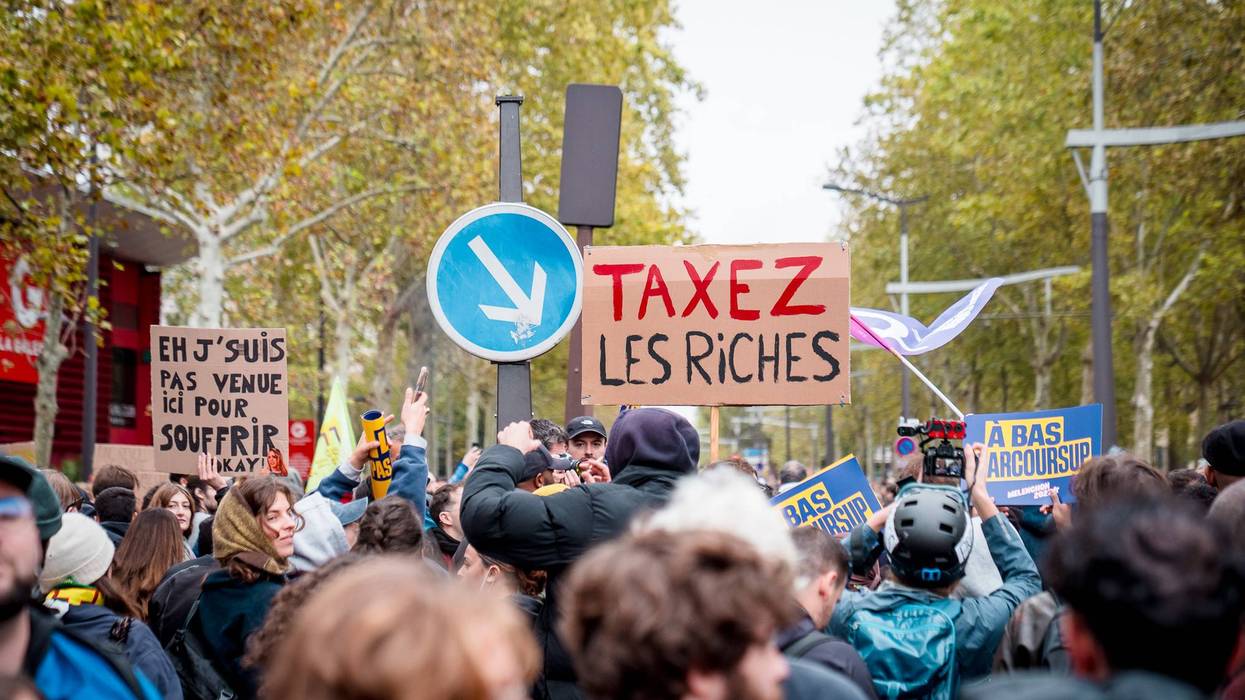
Thousands March Across Europe Against Inequality and 'for Young People’s Future'
“Looking at countries like the United States, we don’t want to end up like them, where part of the population has everything and the others have nothing,” one French protester said.
Hundreds of thousands of people took to the streets across Europe on Saturday as anger continues to build over the rising cost of living and deteriorating social services.
While demonstrators emphasized different demands in different countries, the protest wave reflects a sense that the status quo has ceased to work for ordinary people, especially the young.
“I see so many more similarities than differences,” Alice de Brito, the vice president of French student union UNEF, told CNN of the protests. “We are all talking about the need for investments in education, in the universities, in youth in general. But we are also talking about the cost of living, about housing.”
France
Across France, between 410,000 and 800,000 people turned out in the continuation of protests that erupted in September when students began to mobilize against underfunding, teacher shortages, and other poor conditions in their schools. Adult workers have joined with the students, criticizing widespread inequality and the rising cost of living, leading to mass demonstrations on October 17 and again a week later.
“Looking at countries like the United States, we don’t want to end up like them, where part of the population has everything and the others have nothing,” Paris protester Louis Ledoux--Xatard told The Associated Press.
“Too many billionaires; we are preparing the revolution," one group of protesters chanted, according to Al Jazeera.
There were 289 protests in France, including in Marseilles, Nantes, Nice, Lyon, Bordeaux, and Orleans. Interior Minister Laurent Nunez said that almost 1,000 people were arrested, though the number was expected to grow. Two people sustained significant injuries.
"Behind every police officer, a compliant camera."
The protest in Paris had originally been scheduled to run through the center of the city, but authorities relocated it to outskirts and banned marches organized by groups other than unions.
"It won’t stop the movement. It won’t stop students from demanding better conditions in schools,” nurse Soumaya Abed told AP of the changes.
Jean-Luc Mélenchon, who leads the left-wing France Unbowed party, criticized the government of President Emmanuel Macron for changing the route, but also praised the marchers for carrying on.
"Total victory for the social movement," Mélenchon wrote on social media. "The march gathered at the new authorized point and is now flowing calmly over more than four kilometers. The provocations for disorder by the Paris police prefect and [French Prime Minister Sébastien] Lecornu are a total failure. For the authorities, it is time to give in, or soon they will have only the exit door left."
Victoire totale du mouvement social. La marche s'est rassemblée au nouveau point autorisé et déferle dans le calme sur plus de quatre kilomètres. Les provocations aux désordres du préfet de police et de Lecornu sont un échec total. Pour les autorités, il est temps de céder, sinon il ne leur restera bientôt que la porte de sortie.
— Jean-Luc Mélenchon (@JLMelenchon) October 24, 2026
Media reported that the Parisian demonstration was largely peaceful until the end, when police released tear gas and fired water cannons and some black-clad protesters threw projectiles.
Reporters with Agence France-Presse said they saw:
police charge several times and vigorously use tear gas and batons against some, mostly young, protesters.
"The police started moving towards everyone, telling them to get down and back off. They were just taking people down, you know, beating protesters," one demonstrator bleeding from a baton blow to his face, who gave his first name as David, told AFP.
Other witnesses also described a repressive police response to The Guardian:
Mike, a 23-year-old student who also declined to give his surname, said: “Look around, they’re just teenagers. Is it normal for teenagers to be teargassed and beaten with batons?”
For Jessica, a 24-year-old student, said: “I just don’t understand why there’s so much violence. I feel like our right to protest is being trampled on.”
Mélenchon lambasted the police and the media for working together to discredit the movement.
"In Paris, to ruin the day and unwind, the so-called forces of law and order gas and fire into the crowd at the back of the procession, all in a bid to get footage for the domestic news channels that spent the whole week airing the images that spurred the Trappes killer," he wrote on social media, referring to a racially motivated shooting west of Paris on Friday that killed one and wounded five.
In a second post, he added: "It continues with the policing of minds through the televisions of power. Tonight, staging of the « tails of the procession » to spew hatred against the popular movement. Without a single image of the masses in peaceful action. Behind every police officer, a compliant camera."
He encouraged readers to "turn off the televisions! Form your own opinion without a guardian. Journey through social networks. Stay free to think for yourselves."
Belgium
In neighboring Belgium, hundreds of people marched in Brussels in a continuation of demonstrations for improvements in the education system.
“We are here for young people’s future, for better work," rally speaker Celia Ponce told the crowd, as The Brussels Times reported.
She also accused governments of wanting to "destroy public services."
Protesters build barricades with bikes and scooters in Brussels, Belgium.Follow Press TV on Telegram: https://t.co/1ymjeeywxb https://t.co/TtQNj1BQYU
— PressTV Extra (@PresstvExtra) October 24, 2026
Police used tear gas to disperse some protesters and, in an incident reported by Reuters, kicked and hit one demonstrator after they fell during a chase.
Spain
Approximately 25,000 people marched in Madrid to support Spain's pension system and demand that it keep pace with inflation and that a gender gap be eliminated, according to Al Jazeera.
"How beautiful Madrid is when it defends its rights," Emilio Delgado, deputy spokesperson for left party Mas Madrid, wrote on social media. "We propose that no pension should be below the minimum wage. A lifetime of work deserves a dignified retirement."
Un aviso a @NunezFeijoo: No vamos a permitir que recortéis las pensiones. https://t.co/lQ7V0cQomZ
— Emilio Delgado (@EmilioDelgadoOr) October 24, 2026
The protests come a month ahead of Spain's general election, in which current Prime Minister Pedro Sanchez's Spanish Socialist Workers' Party will face off against the right-wing Popular Party. Popular Party leader Alberto Nunez Feijoo has promised to adjust pensions according to inflation if his party wins, but demonstrators are still concerned about what a right-wing victory would mean for the pension system.
Portugal
In Portugal, meanwhile, the main demand was affordable housing.
People marched in Lisbon, continuing a movement that began October 10 in the city of Porto calling on the government to address the country's housing crisis, according to The Resident.
Palco dos protestos promovidos pelo movimento Acampada de Lisboa, o Rossio voltou a acolher "um mar de gente" que reivindica soluções do Governo para a atual crise da habitação.Veja a reportagem em direto no local: https://t.co/gpSIyl2mLr#agitacaosocial #europa #protestos #manifestacoes #lisboa #rossio #pais #portugal #habitacao #custodevida #noticias #sicnoticias
— SIC Notícias (@SICNoticias) October 24, 2026
"We have no home, so we set up tents!” read the slogan of the March, organized by the Acampada de Lisboa movement.
The protesters also opposed new policies from Prime Minister Luis Montenegro that would weaken a limit on annual rent increases and make it easier to evict people who are unable to make rent payments, according to AP.
Italy
Thousands of people joined demonstrations across Italy to protest the affordability crisis as well as the right-wing government of Prime Minister Giorgia Meloni. Protests were called for eight cities including Milan, Turin, and Rome, with 10,000 attending the Milan demonstration alone.
“We are here because of the rising prices and because I believe that our government has no respect for its citizens,” a 17-year-old student participant, who did not give a name, told Al Jazeera. “There are four people in my family. My mother works in a factory, but my father is about to lose his job. It’s hard to make ends meet on just one salary."
Thousands of protesters took to the streets across Italy to demonstrate against Giorgia Meloni’s right-wing government and the rising cost of living, as hundreds of soldiers were deployed to Milan as protests continue.🔗: https://t.co/JquqwnAyhj https://t.co/B97TnZaY9L
— Al Jazeera English (@AJEnglish) October 24, 2026
The Italian protests were a continuation of demonstrations that have taken place throughout October. There were fewer clashes between police and demonstrators on Saturday compared with earlier marches, though some protesters tried to enter the Colosseum before being pushed back.
Albania
In Albania, outrage over plans by US President Donald Trump's son-in-law Jared Kushner to build a luxury resort near a protected wildlife area—which is widely seen as an example of government corruption—has dovetailed with demands by students for less corruption in the education system specifically as well as lower tuition fees and more funding.
A demonstration in the capital of Tirana on Saturday marked the 12th day of anti-government protests this month following a summer of mobilizations against the luxury hotel.
Some protesters lit fires and threw projectiles, while police used tear gas, rubber bullets, and water cannons.
Protesters in Albania have fought running battles with police, on a 12th day of anti-government protests. Police in the capital, Tirana, used water cannon, tear gas and rubber bullets after Prime Minister Edi Rama warned he would take strong action to quell unrest. https://t.co/6oZMYPU7Ei
— Al Jazeera English (@AJEnglish) October 24, 2026
One demonstrator, the 28-year-old Daniel Tahiri, told Reuters that the Albanian government was a "dictatorship with the clothes of democracy."
"Albanians have woken up," Tahiri said.


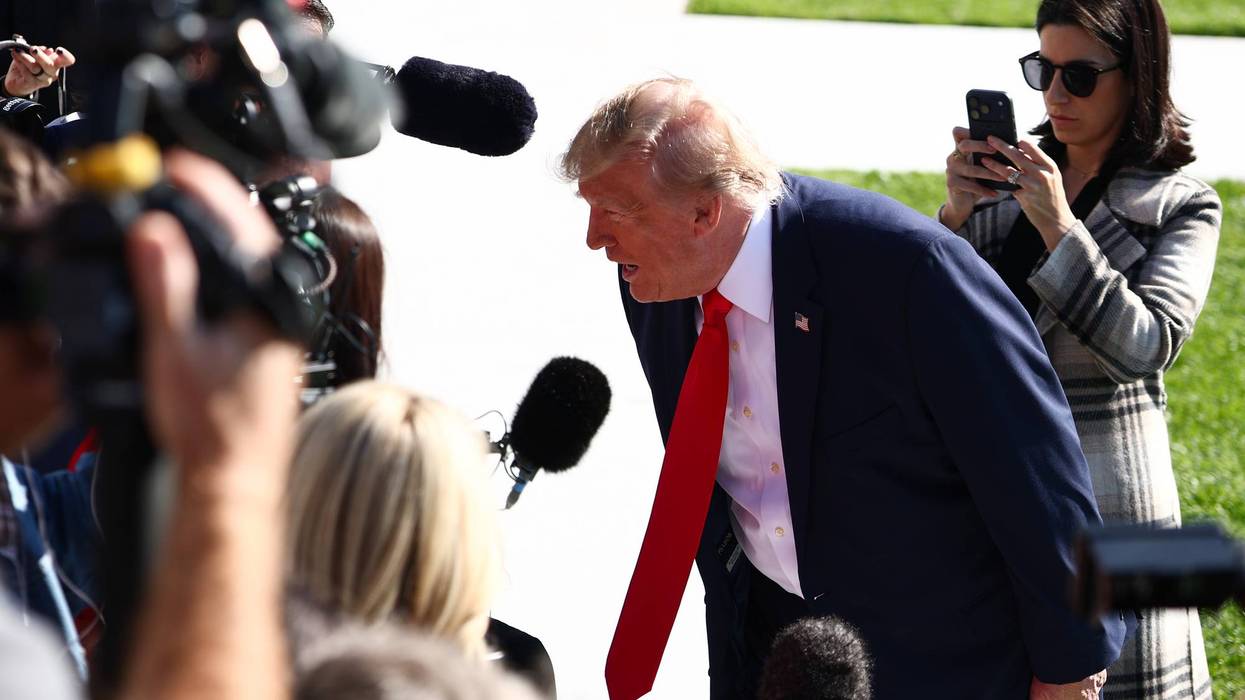
 US President Donald Trump arrives for a campaign rally at the Menard Memorial Sports Center on October 13, 2026, in Wasilla, Alaska. (Photo by Alex Wong/Getty Images)

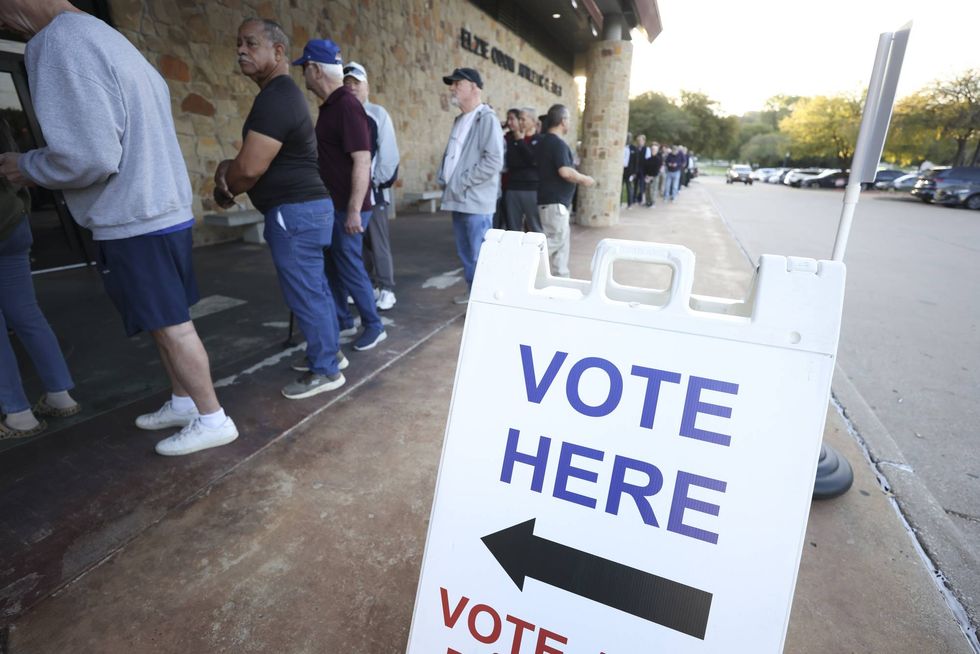 Voters line up outside the Elzie Odom Athletic Center in Arlington, Texas, on October 19, 2026, the first day of early voting for the November 3 midterm elections. (Photo by Chitose Suzuki/The Dallas Morning News via Getty Images)