

SUBSCRIBE TO OUR FREE NEWSLETTER
Daily news & progressive opinion—funded by the people, not the corporations—delivered straight to your inbox.
5
#000000
#FFFFFF
To donate by check, phone, or other method, see our More Ways to Give page.
Daily news & progressive opinion—funded by the people, not the corporations—delivered straight to your inbox.
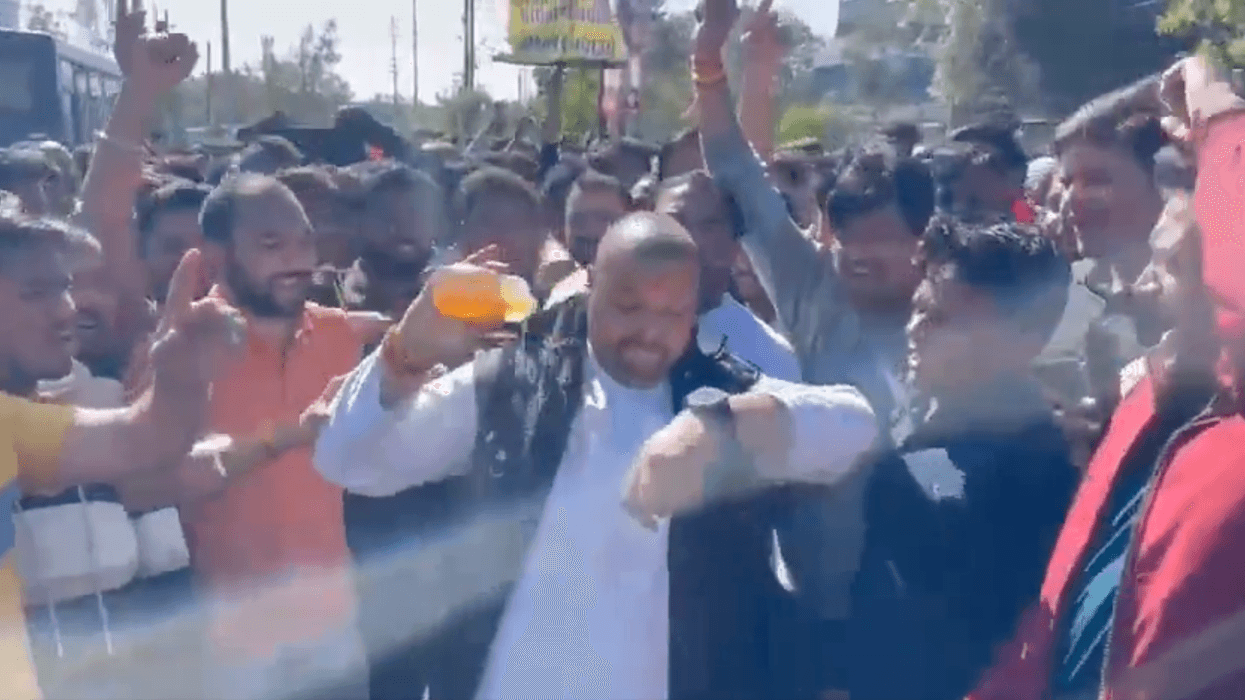
The plan to remove more than 370 tons of toxic waste from Bhopal and transport it to another city has been denounced as a "farce and greenwashing publicity stunt."
After more than 370 tons of hazardous waste from the deadliest industrial disaster in history arrived in the town of Pithampur in central India, two men were filmed in the city on Friday dousing themselves in liquid before they were set on fire in an apparent self-immolation protest.
The men poured the flammable liquid on themselves in a crowd of protesters and were then set on fire by another demonstrator.
They were taken to a hospital after the self-immolation and are "safe now," the administrative head of Dhar district, where Pithampur is located, told Agence France-Presse.
Note: The below video contains graphic images.
The protest took place 40 years and one month after a chemical disaster at a factory owned by the American company Union Carbide in Bhopal.
On December 2, 1984, a tank storing the toxic chemical methyl isocyanate, which Union Carbide used to produce pesticides, shattered from its concrete casing—allowing about 40 tons of the deadly gas to drift across the city of more than 2 million people.
The disaster killed roughly 3,500 people in the following days from direct exposure to the poisonous chemical, and 25,000 people are estimated to have died overall as the contamination has been linked to deadly illnesses including cancers, lung disease, and kidney disease.
Large numbers of babies have been born with severe disabilities, to parents affected by the gas leak, and a high rate of stillbirths in the area has been reported.
But Union Carbide—now owned by Dow Chemical—and the Indian government have never carried out an operation to remove all the contamination from Bhopal's groundwater, which has been found to contain levels of carcinogenic chemicals that were 50 times higher than what's accepted by the U.S. Environmental Protection Agency.
Dow Chemical has denied liability for the accident, citing a 1989 settlement with the Indian government. The deal also gave about $500 to each person identified as a victim at the time—but nothing was set aside for most people who later developed health problems.
Last month, on the 40th anniversary of the disaster, the Madhya Pradesh high court ordered the government to begin removing the toxic waste and a plan was devised for the transport of more than 370 tons of sealed waste, which would be taken to a plant in Pithampur—150 miles away—and incinerated.
The plan has garnered condemnation from both Pithampur residents and people in Bhopal as well as campaigners who have demanded justice for Bhopal for decades.
The incineration is expected to take six months and to create nearly 1,000 tons of toxic residue, which will be buried in landfills—prompting fears that the damage and public health threats in Bhopal will spread to Pithampur.
The Hindu reported that police used water cannons and batons to disperse some protesters who tried to march toward the facility where the waste was delivered on Wednesday.
In Bhopal, Rachna Dhingra, a coordinator of the International Campaign for Justice in Bhopal, told The Guardian that the plan to move the contamination was a "farce and greenwashing publicity stunt to remove a tiny fraction of the least harmful waste," which had already been placed in containers and moved to a warehouse in 2005.
"There's still 1.2 million tons of poisonous waste leaching into the ground every day that they refuse to deal with," said Dhingra. "We can see for ourselves the birth defects and chronic health conditions. All this does is take the heat off the government and lets the U.S. corporations off the hook."
"It does nothing," said Dhingra, "to help the people in Bhopal who for decades have been seen as expendable."
In a video, Nelson said he would set himself ablaze "to stop supplying Israel with the money and weapons it uses to imprison and murder innocent Palestinians" and "to pressure Israel to end the genocide in Gaza."
For the third time since Israel launched a war on Gaza for which it is currently on trial for genocide at the World Court, a person in the United States has set themself on fire to protest Israel's killing of more than 41,000 Palestinians and U.S. complicity in the slaughter.
In an incident all but completely ignored by the U.S. corporate media, a man identified as Matt Nelson set himself alight near the Israeli Consulate in Boston at around 8:15 pm local time on Wednesday, September 11.
"My name is Matt Nelson and I'm about to engage in an extreme act of protest," he said in a video first uploaded to YouTube on Wednesday. "We are all culpable in the ongoing genocide in Gaza."
"We are slaves to capitalism and the military-industrial complex. Most of us are too apathetic to care," Nelson continued. "The protest I'm about to engage in is a call to our government to stop supplying Israel with the money and weapons it uses to imprison and murder innocent Palestinians, to pressure Israel to end the genocide in Gaza, and to support the [International Criminal Court] indictment of [Israeli Prime Minister] Benjamin Netanyahu and other members of the Israeli government."
"A democracy is supposed to serve the will of the people, not the interests of the wealthy," he added. "Take the power back. Free Palestine."
According to NBC Boston, first responders confirmed a man suffered serious burn injuries. Nelson's current condition has not been reported.
NBC Boston and other local media took flak from critics on social media, who noted that the outlets chose to report the incident's location as "outside the Four Seasons Hotel" instead of by the Israeli Consulate.
Nelson is the third person known to have self-immolated in Gaza-related protests in the United States since October.
On December 1, a woman—whose identity remains unknown—carrying a Palestinian flag was hospitalized in critical condition after setting herself alight outside the Israeli consulate in Atlanta. Police called it an "act of extreme political protest." Israeli Consul-General Anat Sultan-Dadon called it an act of "hate and incitement toward Israel."
Then, in an incident that gained worldwide attention, Aaron Bushnell, a 25-year-old active-duty U.S. airman, doused himself in an unknown accelerant, donned his service cap, and set himself ablaze in front of the Israeli Embassy in Washington, D.C. on February 25.
Bushnell repeatedly screamed "Free Palestine" as he burned. Secret Service officers quickly rushed to the scene, with at least one of them drawing his pistol and pointing it at the burning man while ordering him to "get on the ground, you fucker."
As he screamed and writhed in agony, Bushnell managed one final, garbled, yet unmistakable "free Palestine" as his body was engulfed in flames. He died later that day.
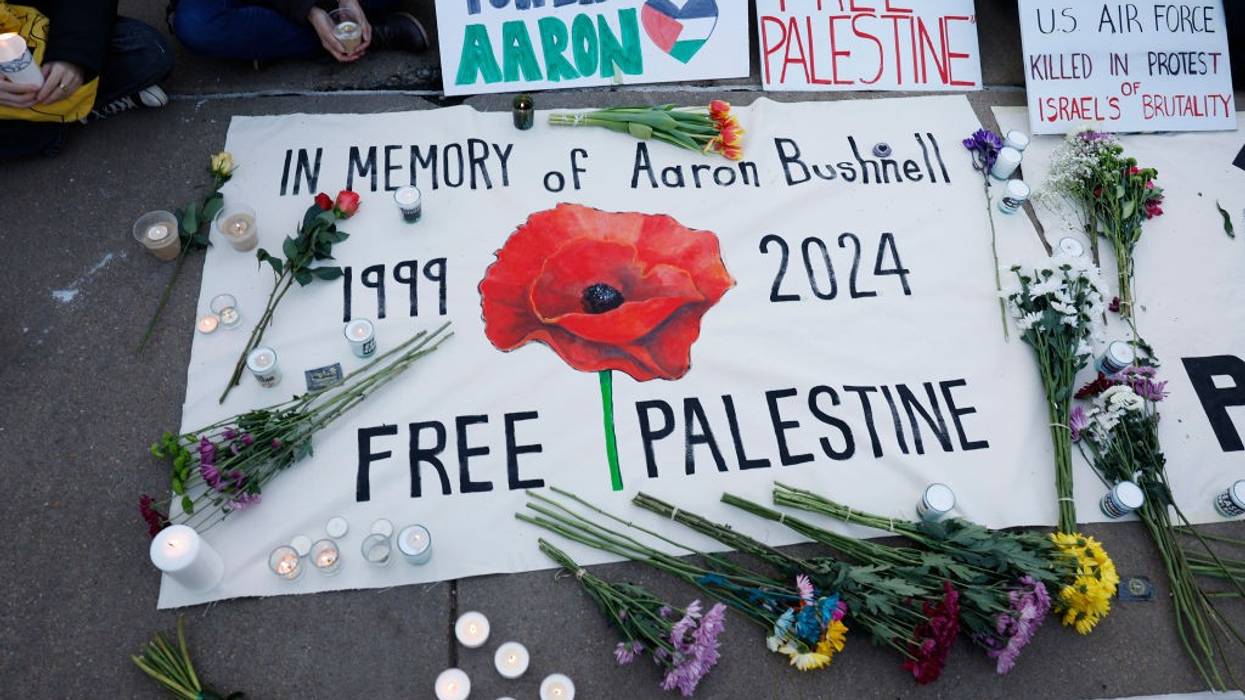
Arguments over language and tactics are often a way to avoid arguments we’d prefer not to have, even if working through those very arguments could produce the resolutions we want to reach.
It began with Aaron Bushnell and a visceral response of mine: Why would anyone do such a thing?
Bushnell was the 25-year-old active-duty airman who set himself ablaze on February 25 in front of the Israeli embassy in Washington, D.C., to protest that country’s brutal war in Gaza. The first question was tough enough, but his dramatic and deadly action also brought to mind other questions that have occupied my thinking, research, and writing in these last several years: What spurs someone to such an unyielding, ultimate commitment to a cause? What kind of political action is actually effective?
When the campus protests over the bloodbath in Gaza exploded shortly after Bushnell’s act, those questions came to seem even more pressing to me.
When a dissident’s striking (even, in Bushnell’s case, ultimate) political act is reduced to a set of personal maladies, his or her message can be all too easily massaged away.
And not only was I not alone in my interest in Bushnell’s act, he wasn’t even the first American to self-immolate over the fate of the Palestinians. Last December, an unidentified woman set herself on fire outside the Israeli consulate in Atlanta, apparently in a similar protest. She survived, just barely. (In April, a man who self-immolated across from the courthouse in Manhattan where Donald Trump was on trial for illegally trying to influence the 2016 election seemed aggrieved about other things.)
Three incidents, of course, do not an epidemic make, but they do attract attention. So, the phenomenon of self-immolation stayed in the news for a while.
Bushnell live streamed his action, which was quickly posted on the social media platform Twitch (though that video was soon taken down there). As of this writing, however, it’s still up at Reddit. It opens on the early afternoon of a clear February day, with Bushnell in combat fatigues walking resolutely toward the Israeli embassy. He had emailed some independent news outlets about his protest and, as he walks, he says, “I am an active-duty member of the U.S. Air Force, and I will no longer be complicit in genocide. I’m about to engage in an extreme act of protest, but compared to what people have been experiencing in Palestine at the hands of their colonizers, it’s not extreme at all.”
He then props up his cell phone on the pavement, pours some flammable liquid over his head, pulls his cap down, and flicks a lighter on around his ankles. When his uniform doesn’t ignite, he lights the pool of liquid surrounding him. It erupts into flames, which climb his body. Yelling “Free Palestine,” he bucks and moans in what must be unbearable pain before collapsing on the ground. Police and Secret Service agents rush over with fire extinguishers. One points a gun at the crumpled, still-flaming body and yells at him to get on the ground. Off-camera, another responds, “I don’t need guns, I need fire extinguishers!” After the video ends, Bushnell will be loaded into an ambulance and taken to a hospital, where he will soon die. In its only response, it seems, the Israeli embassy will report that none of its staff were injured.
In the following weeks, third-party presidential candidates Cornel West and Jill Stein will express solidarity with Bushnell; vigils honoring him will be held in several American cities, including Portland, Oregon, where members of the anti-war veterans group About Face will burn their uniforms in his memory; the Palestinian town of Jericho will name a street after him; another active-duty airman will be inspired to stage a hunger strike in front of the White House and, when he’s ordered back to his base in Spain, two fellow members of Veterans For Peace will begin a hunger strike in his stead.
The initial media coverage of Bushnell’s action was straightforward enough, though often giving as much space to the history of self-immolation as to the politics of his protest. A notable exception was a Washington Post column by Shadi Hamid, who considered Bushnell’s position on the U.S. government’s support for Israel and concluded that while his act might have been unreasonable, his sense of powerlessness was not.
It didn’t take long, however, for the focus to shift to the psychology of self-immolation, then to Bushnell’s background and the implication that he was distinctly damaged. About six weeks after the event, The Boston Globe ran a feature on the Community of Jesus, a monastic community on Cape Cod, where the young Bushnell was raised and home-schooled. The story relied heavily on disgruntled former members—one characterized it as a cult—who recalled harsh, group-enforced discipline, practices meant to undermine family bonds, humiliations, and verbal assaults. The article did include a disclaimer toward the end—“It’s unclear what, if any, connection Bushnell’s upbringing had on his final protest.”—but all too clear was a striking skepticism about his psychological stability.
The need to understand and explain (or explain away) such an extreme, self-abnegating act is anything but unusual, nor is the linking of self-immolation to mental disturbance. Bushnell was explicit about his distress over the situation in Gaza, and it sounded as if he was also dealing with a sense of moral injury, a malady of the heart as much as the head, but none of that was proof of derangement. Setting yourself on fire for whatever reason is inarguably an act of suicide, yet the mental state of someone at that moment is ultimately unknowable since such suicides almost invariably take their secrets to the grave. When it comes to self-immolation, I’m inclined to take people at their word. Apparently, that puts me in the minority.
“I won’t speculate on the dead man’s mental health,” wrote Graeme Wood in a snotty op-ed for The Atlantic. “He grew up in a cult, described himself as an anarchist, and generally eschewed what Buddhists might call ‘the middle way,’ a life of mindful moderation, in favor of extreme spiritual and political practice.” Fanaticism, he suggested, was Bushnell’s “default setting.”
It wasn’t just those who were unsympathetic to Bushnell’s act for whom the state of his psyche took precedence over the purpose of the protest. It may, in fact, be a particular genius of American democracy that it can absorb dissent and, in that way, blunt revolt, but that seemingly benign tolerance can push activists to ever more radical acts in a bid to focus attention on their cause. Sadly enough, though, when a dissident’s striking (even, in Bushnell’s case, ultimate) political act is reduced to a set of personal maladies, his or her message can be all too easily massaged away.
Self-immolation is a low-cost, low-tech, readily documentable act that’s easy to do without significant planning, assistance, or much forethought. Of course, “easy” might be the wrong word for it, and self-immolation is an exceedingly rare, singular, and extreme form of political protest. Unlike marches or strikes, it involves only one person. Unlike suicide missions, the harm is intended to be inflicted only on yourself. Unlike the slow, wasting away of a hunger strike, it’s seldom reversible and usually fatal. Unlike most public protest, it doesn’t rely on an authority’s response to have an effect. And while most people wouldn’t consider it an option, to those who would set themselves aflame, sooner or later it becomes the only option.
Self-immolation is also heart-stoppingly dramatic, capturing the public’s attention, emotions, and imagination despite, or maybe because of its inherent contradictions. It is at once an act of despair and of defiance, of purity and of bravado. Above all, it defies any idea of acceptable risk. Moreover, as a form of nonviolent protest, it’s shockingly violent, and though our normal urge as humans is to look away from such suffering, the image remains irrepressible.
As it happens, self-immolation as protest has an ancient history. It appears in Hindu tales, Greco-Roman myths, the early Christian era, fourth-century China, and 17th-century Russia. It’s happened in protests against America’s war in Vietnam; against the Soviet, Indian, and Sri Lankan governments, as well as Chinese policies in Tibet; and recently in the U.S. over climate change.
According to Michael Biggs, a sociologist who conducted an extensive study of the subject, the motivations and rationales of self-immolators range from the selfless and strategic to the psychological and egocentric. Such an array of reasons is on display in The Self-Immolators, testimony compiled from protesters around the world who set themselves on fire between 1963 and 2013. It makes for sad reading: so many lives, so much anguish, so little effect.
Historically, the effectiveness of such awe-inspiring protest is, at best, unclear. There were certainly cases that did gain widespread attention and so influenced events and policies. As a threesome, consider Thich Quang Duc, the Vietnamese monk in the iconic photograph, who self-immolated to protest his government’s mistreatment of Buddhists; Norman Morrison, the American Quaker who self-immolated under then-Defense Secretary Robert McNamara’s Pentagon window to protest America’s war in Vietnam (McNamara was reportedly “horrified,” while President John F. Kennedy exclaimed, “Jesus Christ!”); and Mohamed Bouazizi, the street vendor in Tunisia, whose self-immolation protesting corruption was considered a catalyst for the Arab Spring uprising.
Sadly, however, Bushnell’s action, far more typically, didn’t make a dent in Israel’s belligerence or limit the weaponry and intelligence his country still sends Israel. And the shock of the act, of the image of him burning to death seemed, if anything, to blot out the purpose. Maybe witnessing someone dying in flames, even online, is simply too disturbing to let witnesses easily absorb its intended message. Or maybe the intensity of Bushnell’s moral obligation shamed those who agreed with him and did nothing for those who didn’t.
While it’s hardly burning yourself to death, all those students who camped out last spring, erecting tents on university lawns, defying administrators, and dominating the news narrative for weeks, also faced risks. Though no student protesters died, by demanding institutional responses to Israel’s war in Gaza, some were barred from graduating, denied job offers, summarily kicked out of their housing, physically attacked, and arrested.
And then, as with Aaron Bushnell, we changed the subject. The issue wasn’t this country’s, or any individual university’s role in the war in Gaza—so insisted school authorities, opportunistic politicians, and an obliging media—but free speech and the function of higher education.
In contrast to self-immolation, which is always about the image, language was all-important in those campus protests and became a minefield. The hotly debated meaning of terms and slogans, the name-calling that stopped discussion, the debate over who controlled the debate, the mutual misunderstandings, and the alarming tolerance of intolerance were all exacerbated in the self-enclosed, pressure-cooker communities that college campuses generally are.
Protest that doesn’t challenge our norms, or at least get people to think about other possibilities, is just spectacle.
Quickly, the “sides” were slotted into pro-Israeli and pro-Palestinian categories, flattening any nuance among the protesters, even though a range of sentiments, perspectives, demands, and goals were apparent. That reduction also undermined the prospect for critical analysis, any true exchange of views, or the possibility of minds being changed—everything, in other words, that’s supposed to underpin a liberal education. And whatever happened to the idea of being pro-peace? I don’t remember that label ever being applied to the protests, although the one area most protesters agreed on was the need for a cease-fire in Gaza.
In his keynote speech at MIT’s graduation, entrepreneur Noubar Afeyan acknowledged the students’ pain over the tragic Israeli-Palestinian conflict and rued his own lack of answers on the subject, concluding, “But I do know this: Having conviction should not be confused with having all the answers.”
I have a certain sympathy for that sentiment, though I doubt I did when I was a student with my own set of demands over a different tragic conflict, which leaves me sympathetic to the student activists, too. After all, you don’t need answers to pinpoint a problem accurately or to believe peace is a precondition for finding such answers. Protest isn’t supposed to be nice. Dissent courts the heterodox. The point of a political action is to get in people’s faces, disturb complacency, and command a response. Protest that doesn’t challenge our norms, or at least get people to think about other possibilities, is just spectacle.
Of course, dissent also threatens authority, and the kneejerk reaction of authorities fearing that they’re losing control is to try to take ever more control. Insisting that the students and their organizations were being punished not for their speech but for breaking the rules, university administrators suspended anti-Zionist groups, breached principles of academic freedom, opened the way for violence by ushering the police onto campus, and caved to financial pressure from donors and alumni. And what to make of the suggestion of a Harvard dean, who, “look[ing] forward to calmer times on campus,” argued that the solution was for faculty members to just shut up?
You’d think such beleaguered university administrators would learn. Clampdowns usually backfire, and severe punishments hardly make for calmer campuses. The repression, in fact, succeeded mainly in turning the conversation from core issues like war and human rights to an assessment of free speech and the very nature of academia—not to mention good old American anti-intellectualism. Educational leaders were called before Congress to confess; university presidents were fired; hate speech codes, mostly moribund in this century, got renewed attention; and the crisis became focused on campuses riven by incivility and bad words.
Dissension at educational institutions over what kinds of expression are acceptable, no less desirable, has a long history and merits periodic revisiting. I suspect, though, that there’s another reason what we say has bested what we do as the issue du jour: that is, a lot of Americans find it easier to champion the idea of free speech than to demand that Israel get out of Gaza or that the Biden administration rethink its military aid policies.
About 20 years ago, when I wrote a book about free expression controversies, I saw repeatedly how words make convenient scapegoats. Arguments over language are often a way to avoid arguments we’d prefer not to have, even if working through those very arguments could produce the resolutions we want to reach. As paramount as free speech is to me in the pantheon of human rights, I wish in this case—and in Aaron Bushnell’s memory—we hadn’t relegated war to just a background hum but had assessed the validity of the protesters’ demands and dealt with them, as fraught and frightening, involved and painful as that process would inevitably have been.
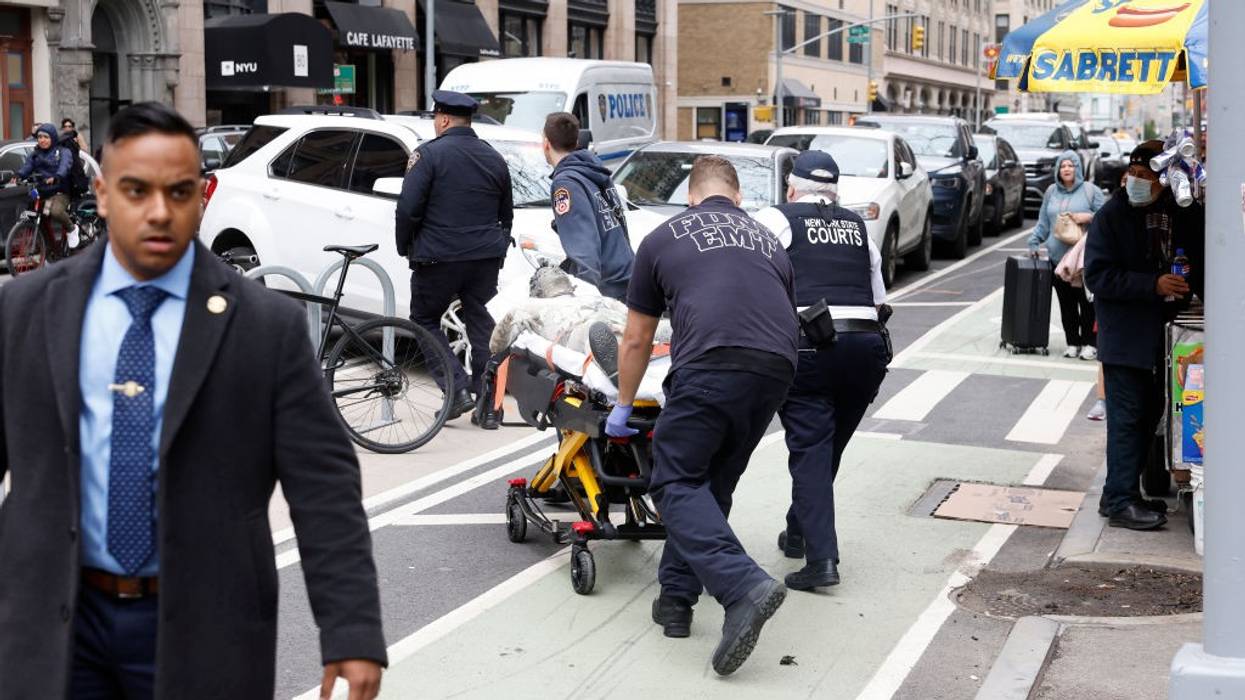
An unverified online manifesto identifies the person as "an investigative researcher" who has discovered that "our own government (along with many of their allies) is about to hit us with an apocalyptic fascist world coup."
This is a developing story... Please check back for possible updates...
Law enforcement officials confirmed to CNN that someone lit themself on fire Friday outside the New York City courthouse where former President Donald Trump, the presumptive Republican nominee, is on trial for allegedly falsifying business records.
"The man walked into the park across the street from the courthouse, throwing flyers into the air," the network reported, citing law enforcement. "He then pulled something out of a backpack—it was not immediately clear what the item was—and lit himself on fire."
Journalists were in the area for the historic trial and CNN anchor Laura Coates was among those who described the scene live on-air as New York Police Department officers and emergency responders worked to extinguish the fire.
Police were "slow to respond in part because of barricades around park," Politico's Emily Ngo explained, sharing photos and videos from the scene on social media. There is "only one way to get into park outside the courthouse without jumping the fence. It's been barricaded in anticipation of protests. And since there hasn't been much in the way of protests, police presence is light. Police had to run all the way around to get to the man."
The person who self-immolated "was responsive when he was removed but he is very, very badly burned. Body charred," Ngo said.
CNN reported that the flyers featured allegations of wrongdoings against New York University and said, "NYU is a mob front."
A self-identified citizen journalist named Jack shared on social media a photo of a booklet the person reportedly left in the dirt.
An unverified Substack post says in part: "My name is Max Azzarello, and I am an investigative researcher who has set himself on fire outside of the Trump trial in Manhattan. This extreme act of protest is to draw attention to an urgent and important discovery: We are victims of a totalitarian con, and our own government (along with many of their allies) is about to hit us with an apocalyptic fascist world coup."
Inside Manhattan Criminal Court, the remaining jurors were sworn in for Trump's case, in which he faces 34 charges for records related to alleged hush money payments to cover up sex scandals during the 2016 election cycle. There are 12 jurors and six alternates.
The former president was indicted by a New York grand jury last spring. He also faces two federal criminal cases—one related to his handling of classified material and another for trying to overturn his 2020 loss, which culminated in the January 6, 2021 insurrection—as well as an election interference case in Georgia.
"Many of us like to ask ourselves, 'What would I do if I was alive during slavery? Or the Jim Crow South? Or apartheid? What would I do if my country was committing genocide?' The answer is, you're doing it."
"My name is Aaron Bushnell, I am an active-duty member of the United States Air Force, and I will no longer be complicit in genocide. I'm about to engage in an extreme act of protest, but compared to what people have been experiencing in Palestine at the hands of their colonizers, it's not extreme at all."
That's how the 25-year-old from San Antonio introduced himself—and bade farewell—to the world in a livestream video of his Sunday afternoon walk to the Israeli Embassy in Washington, D.C. Arriving outside the front gate, Bushnell set down his phone, took eight paces, turned to face the camera, doused himself in an unknown accelerant, donned his service cap, and set himself alight. He repeatedly screamed "Free Palestine" as he burned.
Uniformed Secret Service officers arrived on the scene even before Bushnell was able to ignite the fire. They repeatedly ordered him to "get on the ground."
"Get on the ground, you fucker," someone—presumably an officer—can be heard saying in the video as Bushnell screams and writhes in agony. He managed one final, garbled, yet unmistakable "free Palestine" as his body was engulfed in flames.
Note: The following video contains blurred graphic images that some readers may find disturbing.
Nearly two-and-a-half minutes into the video, an officer in a white shirt rushes in with an extinguisher while an officer points his pistol at Bushnell's burning body.
"I don't need guns," implored the man in the white shirt, "I need fire extinguishers."
NPR reported Bushnell was rushed to a hospital in critical condition. He died Sunday evening.
Bushnell left a final message on social media early Sunday morning.
"Many of us like to ask ourselves, 'What would I do if I was alive during slavery? Or the Jim Crow South? Or apartheid? What would I do if my country was committing genocide?'" he wrote in his first Facebook post in nearly six years. "The answer is, you're doing it. Right now."
Some observers criticized U.S. corporate media outlets for publishing articles with headlines omitting the words "Gaza," "Palestine," or "genocide."
Others took aim at reports attributing Bushnell's act to mental health issues.
"They will try to spin-doctor it as mental health issues, but he was rational and clear about his political reasoning, which resonates with [the] majority of the world," Syracuse University professor Farhana Sultana said on social media. "May his sacrifice not be in vain. Indeed. it was legitimate moral outrage and courage against the holocaust and barbarity in Palestine with U.S. full participation. May his sacrifice not be in vain, may his last words on this earth ring true. #FreePalestine."
CounterPunch editor Joshua Frank wrote: "Please, stop saying Aaron Bushnell was mentally ill. The real mental illness is witnessing a genocide taking place and not doing a thing to stop it."
More than 100,000 Palestinians—mostly women and children—have been killed or wounded by Israeli bombs and bullets since the October 7 attacks on Israel. Around 90% of Gaza's 2.3 million people have been forcibly displaced, and at least hundreds of thousands of Gazans are on the brink of starvation.
The U.S. government backs Israel with nearly $4 billion in annual military aid and diplomatic support including three vetoes of United Nations Security Council cease-fire resolutions. The Biden administration is seeking an additional $14.3 billion in armed assistance for Israel, and has twice sidestepped Congress to fast-track emergency military aid.
Last month, The Intercept reported that documents obtained through a Freedom of Information Act request suggested that the Biden administration deployed a U.S. Air Force team to Israel to assist the Israel Defense Forces with targeting intelligence.
Bushnell's death is the second reported U.S. self-immolation since the start of the Gaza genocide. On December 1, a woman—whose identity and outcome remain unknown—carrying a Palestinian flag was hospitalized in critical condition after setting herself alight outside the Israeli consulate in Atlanta.
Police called it an "act of extreme political protest." Israeli Consul-General Anat Sultan-Dadon called it an act of "hate and incitement toward Israel."
People have set themselves on fire as an act of political protest for many centuries. Following the examples of Vietnamese Buddhist monks and nuns who self-immolated in 1963 to protest persecution by the U.S.-backed Ngô Đình Diệm dictatorship, at least half a dozen Americans burned themselves to death to protest the Vietnam War. Americans also self-immolated over the 1991 and 2003 invasions of Iraq, the climate emergency, alleged corruption at the U.S. Department of Veterans Affairs, and other reasons.
In December 2010, the self-immolation of Tunisian street vendor Mohamed Bouazizi was a major catalyst for the Arab Spring uprising that swept across North Africa and the Middle East.
The late Vietnamese Buddhist monk, peace activist, and author Thích Nhất Hạnh explained in a letter to the Rev. Martin Luther King Jr. that the monks and nuns who self-immolated were not committing suicide. Rather, their self-sacrifices were aimed "at moving the hearts of the oppressors, and at calling the attention of the world to the suffering endured."
"It is done," he explained, "to wake us up."
The 988 Suicide & Crisis Lifeline—which offers 24/7, free, and confidential support—can be reached by calling or texting 988, or through chat at 988lifeline.org.

Emulating the Buddhist monks he admired who burned themselves to death to protest the Vietnam War, a Colorado activist has died after setting himself on fire in front of the Supreme Court to protest federal quiescence on climate change. The little-noted but long-planned Earth Day action by Wynn Bruce, 50, was not a suicide, said a fellow-Buddhist, but "a deeply fearless act of compassion to bring attention to climate crisis... People are being driven to extreme amounts of climate grief and despair."
Emulating the Buddhist monks he admired who burned themselves to death to protest the Vietnam War, a Colorado activist died this weekend after setting himself on fire in front of the Supreme Court to protest federal quiescence on climate change. Wynn Bruce, 50, of Boulder CO., died Saturday from his injuries after being airlifted to a hospital. Bruce's self-immolation pointedly took place on Earth Day as hundreds of thousands railed against an accelerating climate crisis with signs like "No Planet B," "Stop Ecocide," "Don't Burn Our Future." He also acted at what could be Ground Zero for the planet as a right-wing-controlled SCOTUS weighs a possibly disastrous case that could restrict or eliminate the EPA's authority to regulate carbon emissions. "This act is not suicide," wrote Kritee Kanko, a friend, climate scientist and Zen Buddhist priest. "This is a deeply fearless act of compassion to bring attention to climate crisis." She adds that "people are being driven to extreme amounts of climate grief and despair" - a despair California environmentalist Cody Petterson mournfully echoes when he cites "a truly holy war...to save the whole of life from ourselves."
Bruce's action, incongruously first reported in the MAGA-themed New York Post, got startlingly little press coverage - no shoot-outs - but was carefully planned. A photo-journalist by trade, Bruce often posted political commentary on social media, quoting MLK - "A riot is the language of the unheard" - mourning George Floyd, and blasting Trump, "war profiteers" and collective inaction before "irreversible" climate change. Last year, he posted a cryptic message that, as it turned out, named the date and method of his death: "4/22/2022," with a fire emoji. Bruce, who identified as Buddhist, also commemorated the January death of Thich Nhat Hanh, a renowned Zen Buddhist master and anti-war activist who wrote admiringly about Vietnamese monks who decades ago protested the war by setting themselves on fire. "To burn oneself by fire is to prove that what one is saying is of the utmost importance," Nhat Hanh wrote. "There is nothing more painful than burning oneself. To say something while experiencing this kind of pain is to say it with utmost courage, frankness, determination and sincerity." Also, tragedy. May Bruce rest in peace and power.
There were some lovely, moving moments in the memorial service of Concepcion Picciotto at Luther's Place Church on Saturday.
Concepcion is known -- with William Thomas, who died a few years ago -- for leading what is apparently the longest protest in U.S. history: Against nuclear weapons in Lafayette Park, in front of the White House. She died last month.
As WTOP -- the local news station -- noted today: "Picciotto's nuke vigil became a permanent fixture across from the White House for five consecutive presidents, including President Barack Obama, but not one of the presidents ever spoke to her."
Tom Hastings, with trembling hands holding the microphone, sobbed, "I built nuclear weapons for 23 years," and then that Concepcion "was so unselfish" -- as she literally died to the end for peace, with failing health, virtually homeless, continuing the vigil. She was almost like a protester who immolates oneself, but in slow motion.
At the memorial service, the speakers included former CIA man Ray McGovern who noted the Washington Post's apparent proclivity for questioning Concepcion's sanity, and asked who was the mad one here given the Post's apparent view that her desire to prevent nuclear war was at best quaint. Her lawyer, who spoke first and long, did some of the same, but seemed at one point to frame the nuclear threat stemming from the doctrine of MAD, mutually assured destruction, as a simple relic of the Cold War. He almost echoed a patronizing tone that one might hear from the Post, referring to his arguments with her, barely disguising an eyeroll.
There were glimmers of Concepcion's radicalness certainly during the service -- she wasn't outright cooped into a banal liberal symbol as Martin Luther King often has been, but, critically, the word "Israel" was not uttered at the memorial in the church. This was incredible since it was hard to go three minutes talking with Concepcion without her talking about Israel -- either its crimes or the incredible threat posed by its unacknowledged nuclear weapons. Her work stressed things that so few do: Israel is perhaps the greatest threat because it has a massive nuclear arsenal, refuses to sign the Nuclear Non-Proliferation Treaty, uses violence with incredible impunity, and it is an expansionist settler colonial state.
And Concepcion was not -- as some, including Caitlin Gibson of the Washington Post, have referred to her as -- an anti-nuclear "proliferation" activist. She was for disarmament. Concepcion was clear: "Live by the bomb, die by the bomb." Her point was the U.S. and other nuclear powers live by the bomb and must stop. She was about disarming the current nuclear weapons states; not simply preventing proliferation of nuclear weapons to more states. After all, it is largely the policy of the U.S. government that current nuclear weapons states should maintain them and others should be denied them. The U.S. government occasionally does wage or threaten wars over this issue.
Concepcion focusing on Israel was at times even jarring even to me -- a Palestinian American -- when I'd talk to her. Don't take my word for it, look up some videos of her. She doesn't go long before mentioning Israel. And if you think it through, for very good reason.
The word "Israel" was finally uttered from the microphone -- after a hundred or so people left the church and went to the site of her long-standing protest in front of the White House and were setup there photo-op style by Medea Benjamin of CodePink, along with what came off like a bizarre gravestone prop.
Perhaps it's thus with all prophets -- the moment they die, many around them push aside their central statements that seem inconvenient but were actually the center-line to their dedication and integrity.
It was left to Simin Royanian, an Iranian-American activist and analyst to utter the word when finally granted the mic. She noted Concepcion's staunch opposition to Israel's Zionism and said she was always supportive of Palestinian and other liberation movements in the Mideast.
Perhaps it's thus with all prophets -- the moment they die, many around them push aside their central statements that seem inconvenient but were actually the center-line to their dedication and integrity.
But, no, Concepcion was largely ignored in life. John Steinbach, longtime antinuclear peace activist and co-coordinator of the Hiroshima/Nagasaki Peace Committee told me: "Concepcion wasn't taken serious by a lot of groups. I can't tell you the number of times I tried to get mainstream peace groups that had protests in Lafayette Square to include or invite or at least acknowledge her vigil which was right there. It never happened." In contrast, Steinbach notes: "The Japanese [nuclear bomb] survivors loved and respected her and always wanted to spend time with her."
The memorial service did feature a Japanese representative reading a statement from the Hiroshima/Nagasaki Peace Committee. Unfortunately, it also offered a fair number of cliches -- "We Shall Overcome" and a lengthy homily presuming to praise the prophetic voice while ignoring much of the substance of it, instead repeatedly invoking the song "Turn, Turn, Turn".
But there was nothing cliche about Concepcion.
She had a pointed, high pitched, Spanish accented voice and would utter totally political incorrect statements. "Don't Be a Lemming -- Save Yourself -- Renounce Genocidal Weapons" read her sign. "Silence is a war crime." She'd be good at staying on message as they say, repeating what her signs would say. "Bush is war criminal" she'd repeat.
And she held signs on Israel up high and unapologetic: "Judaism YES / Zionism NO" and "Disarm IsraHell -- 200 Illegal Nucs -- Save the World -- Save the Children" and "Stop Funding Israeli Terrorism."
Great stuff.
But she did make political statements on Israel that I would never make; and I didn't delved into her personal struggles with other activists, which were apparently contentious at times. One sign she'd hold up was "One Nation Under Israel" (which featured a U.S. flag with a star from the Israeli flag on it) and another: "Terrorists Are Us -- 'Holocaust:' A Word Used by Zionists to perpetrate Crimes Against Humanity" (with a swastika scrawled in) -- which featured the website of Neturei Karta - Orthodox Jews United Against Zionism.
I think the Nazi "Holocaust" isn't just a "word" that's been used for murderous purposes, but also an actual historical fact. But she didn't write that it was "just" that, though many may have read it that way. Nor do I subscribe to the view that the U.S. is "Under Israel". In fact, I don't see nations anymore. I mostly see forces: imperialism, colonialism, corporate capitalism, white supremacy and misogyny asserting their power and how other forces resist and are complicit with them.
But I've not seen any of Concepcion's signs on Israel anymore at the memorial, which is continuing and seems to be sanitizing itself. As I write, the vigil does have one sign about an upcoming protest against AIPAC -- so it's apparently still alright to criticize right-wing Zionist groups -- and perhaps unintentionally pump them up -- but not the more liberal varieties. This type of framing divorces the centrality of Israel's nuclear weapons, which the U.S. government has rendered it forbidden to speak of, from the anti-nuclear work on the vigil.
Really, did you catch that? It's illegal for U.S. officials to talk about Israel's nuclear arsenal. As Grant Smith has found: "Under two known gag orders -- punishable by imprisonment -- U.S. security-cleared government agency employees and contractors may not disclose that Israel has a nuclear weapons program." So perhaps score one for the "One Nation Under Israel" camp.
But ignoring Israel's nuclear weapons has the ironic effect of the naive viewer wondering "why pick on Israel?" -- since the Israeli nuclear arsenal -- which was the brainchild of liberal Zionists Ben Gurion and Shimon Peres -- is sidelined instead of being front and center.
Concepcion was certainly difficult, at least for me, to talk with. I tried helping her find housing at one point, which might have lead to connections that might have helped, it was hard to tell at times, but she was undoubtedly a handful -- only housing around the White House would do of course. And I certainly wished that the protest would be more understandable, it certainly came off as eccentric at times. But I think that can be fixed without it being effectively sanitized, which seems where it is headed.
Front and center are now typical banal signs, which were back bench material for Concepcion: "War Is Not the Answer". Really? I've got news for you: War often is the answer. War can be exactly the answer if the question is how to effectively dominate the planet, which it often is to many.
Fast disappearing from the vigil is what was central to Concepcion: by embracing a radical humanity, discerning the taboos of the establishment, she rightly raged against them.
The memorial service put on for Concepcion featured a rendition of "Ain't Gonna Study War No More." I disagree. We actually haven't studied war nearly enough. The "peace movement" needs to get over itself and talk about war: the death, destruction, flying limbs and stench of it in precise terms if it has any interest in actually changing things and not just feeling superior to those dreaded Republicans.
Fast disappearing from the vigil is what was central to Concepcion: by embracing a radical humanity, discerning the taboos of the establishment, she rightly raged against them. At the current rate, I fully expect "Free Tibet" signs to pop up at the vigil.
In my chatting with her occasionally over the years, I think Concepcion pointed to a central truth -- that colonialism and Zionism were central forces threatening the planet. And that central truth is continually obscured by people talking about neo-conservatives or liberal interventionists instead of seeing an entire neo-colonial project at work, or perhaps not so "neo" at times -- just plain colonial. And one should be clear: She didn't really single out Israel as some do -- she'd talk about unmentionable U.S. "terrorism" and "war crimes" as easily as Israeli.
If she seemed to become overly persistent on imperialism and Zionism and Israel's unacknowledged threat to humanity, I think it was a reaction not just to those threats and officialdom and not just to corporate media -- but also "progressive activists" silence on central questions of nuclear armed Zionism.
Unfortunately, her own memorial service became a monument to that silence.