

SUBSCRIBE TO OUR FREE NEWSLETTER
Daily news & progressive opinion—funded by the people, not the corporations—delivered straight to your inbox.
5
#000000
#FFFFFF
To donate by check, phone, or other method, see our More Ways to Give page.
Daily news & progressive opinion—funded by the people, not the corporations—delivered straight to your inbox.
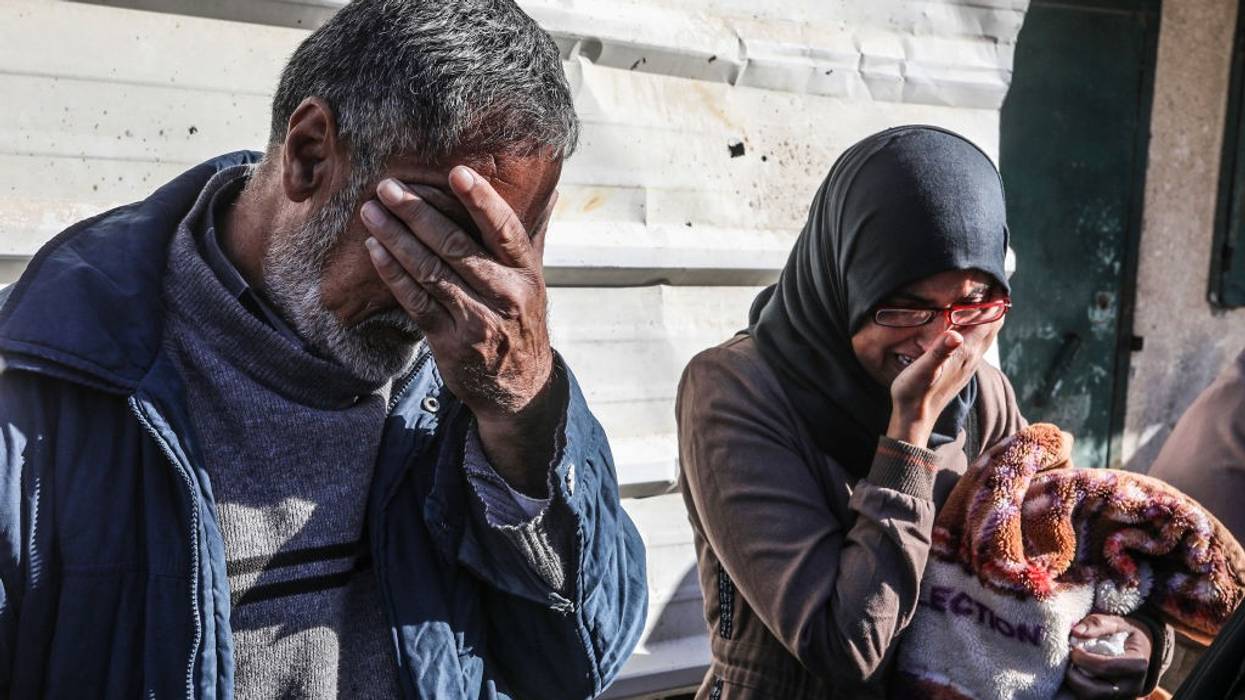
I rage. I grieve. But my grief is nothing next to those who find their spouses or their children wrapped in bloody shrouds and left among the dead.
Strange now to think of you while I read the words of a Jewish poet long gone on his boat of metaphors and flowers for the constant beat of time and all it brings forth. I think of you and how once you flourished there beside the sea despite the ever-tightening constraints placed upon you by the hateful gods of Zion. They tried to make you yield to oppression. They took away your freedom. They took away your land, parcel by parcel. They torched your olive trees, burned your crops, bulldozed your homes, sexually assaulted your men and women, killed your children, invaded your towns and villages, while the world looked on and looked away and excused crimes against you, your wanton destruction as the necessary acts of a persecuted people fighting back against the terrorists in their midst—you, the people of Gaza.
They said your children are destined to become terrorists, so even newborns are legitimate targets. So too are the mothers who have brought them into the world and will turn them into killers and haters of Israeli Jews, decreed the gods of Zion. But you will never be gone no matter how many martyrs they make, no matter how many loved ones they take from you while their people cheer the killing, salute the killers, treat them as heroes, bring their children to watch you dying, teach them to see you as vermin, animals, sub-humans not worth a single shekel of mercy. There are days when I can understand how Aaron Bushnell, a U.S. Air Force servicemember, could light himself on fire in front of the Israeli Embassy in Washington D.C. The genocide was more than he could bear. And his fiery exit from our world was an expression of his principled opposition to this genocide.
Who can doubt his death by self-immolation was also a cry from the heart for the suffering of your people, Gaza. The flames that engulfed Aaron are the same flames rising among families in Gaza, families sheltering in tents or huddling in whatever homes have not yet been bombed, shelled, hit with a Hellfire missile. Like Aaron, like so many others, I grieve. Am filled with rage for what could only happen with the full approval and backing of my own government, a willing accomplice to genocide.
I can imagine that within their suffering, there must be a much greater force, one that draws its power from the land and the culture that has shaped them. And it is this force, this fire that must not be extinguished for it is the thing that gives hope to marginalized, dispossessed people.
While an entire people is being inexorably exterminated, I go about my life feeling powerless to make any significant difference in the lives of Palestinians stripped of dignity, herded into enclaves where the killers can more easily and comfortably complete their tasks with no limit on the amount of suffering they can inflict. I can rail against the murderers and their overlords and those who cheer them on from Washington to Tel Aviv. But what good does railing do when so many are starving, bleeding out on hospital floors, caught in the gunsights of snipers and quadcopter drones, torn to pieces or incinerated in the flames from a missile attack while lying asleep in some thin tissue of a tent.
It is the children who weigh most heavily on my heart. Your children, Gaza. Not even their tender, untested lives are safe from the bullet's wrath, the bomb's fiery breath, the hatred that pours from the very souls of those people we claim are only defending themselves. Children. Like the children I see every day in the town where I live. I watch them in the local bakery whooping with delight at displays of beautifully crafted pastries. Some of them come straight from their dancing class still dressed in slippers and tights and skirts trimmed with sparkling costume jewels. And the parents, credit cards at the ready, are quick to indulge their children's sweetest tooth.
There are almost no bakeries left in your towns and villages, Gaza, where children can pick out their favorite sweet or pastry and hold it in their hands as the children do here knowing after it's gone, there will always be another. Those bakeries that have not been destroyed have had to close their doors because of flour and fuel shortages caused by Israel's blockade. In the north, there was one bakery where families could find bread. And then the Israelis bombed the warehouse where the flour was kept. In March, they gunned down men and women waiting for a convoy of trucks to deliver priceless bags of flour and other forms of aid. How can I not think of you, Gaza, each time I cut into a loaf of bread or lift a sweet roll to my lips. I see your children holding out empty bowls and pots as they clamor around a charity kitchen and push for a helping of the day's fare. But the day may come when there will no more such kitchens and no more cauldrons of soup or vegetable stew. Already a famine is spreading from one end of your land to the other, and starvation, the weapon of choice by Zion's holy warriors, may very well "finish the job." And should that happen, clean-up crews from the Promised Land will scrub the stones till no trace of blood remains. Tons of rubble will give rise to lofty towers and luxury apartments. On holidays, settler families will take their kids down to the sea and let them scour the beach for trinkets—a doll, a bracelet, a shiny ring. Things from a time when other children, long gone from Gaza, played in the waves and flew their kites on ocean breezes as signs of their presence and the angels who loved them. While the ghosts of all the martyrs, scooped from their graves, will haunt the wind with a long lament for the life they lost when the killers came.
Have I arrived at the place where Aaron Bushnell came to, the place where he knew he could no longer accept the deliberate immolation of families by America's closest ally and the refusal of the world's greatest power to lift a finger in defense of Palestinian life? No. I walk on, yet ashamed to be a citizen of this place, my country. As I was ashamed at 25 and traveling overseas with a freshly printed passport while my country was at war in Vietnam, a war the International War Crimes Tribunal in 1967 found met the definition of genocide. And again, 25 years later, in Iraq's public hospitals, the same shame followed me as I visited the pediatric wards. The wards were strangely, unnaturally silent. Mothers and grandmothers could do nothing but hold the hands of their loved ones or wipe their brows with a damp cloth because no medicine would be coming, and it was only a matter of time before the children would all be dead. That time, in Iraq, it wasn't Israel withholding aid but America, and as in Gaza, it was the young, the elderly, the sick, the poor who were the first to suffer and to die.
I walk on, knowing there is no justification for what Israel has done, is doing to your children, Gaza. From afar, I see men searching for survivors of another attack. One of the men finds a child by a pile of rubble. As he lifts her up, her arms collapse at her side. Her head falls back. Her eyes, once glistening with life and the light of childhood, stare up at the heavens where no gods reside and the only inhabitants are stone-cold killers throwing down whatever will deprive your people, Gaza, of the will to live... of life itself.
So, yes, I rage. I grieve. But my grief is nothing next to those who find their spouses or their children wrapped in bloody shrouds and left among the dead. My grief is nothing beside the mother whose child is withering away, his body a mere outline of bones, his heart a tattered flag soon to be set free, his arms too weak to even lift his voice beyond a whispered cry. But she has no food to give him. It has all been taken away as part of a glorious plan to which Yahweh has given His seal of approval, or so the story has been told and the generals of Zion agree. What would I do if I were sheltering in a school among dozens of families hoping to survive another night under relentless bombardment? And should the school be hit, and men, women, and children ripped apart, decapitated, how then would I grieve in the midst of this carnage? For that matter, if the people I most dearly love were among the dead in whatever is left of this shelter, would I have the strength to carry on or would my grief, like a bird of prey, sink its talons into me and not let go till it drops me into a pit of my own oblivion?
Here, in this sun-filled room, I have no fear of winter. No matter how cold it gets, I can simply adjust the thermostat in my home or put another blanket on the bed. But for you, Gaza, there are no thermostats and no cozy, indoor gatherings of families and friends, sharing glasses of steaming hot tea and slices of crunchy, sugary knafeh. Ninety percent of your people are displaced and facing another winter of harsh rains and falling temperatures without adequate shelter, warm blankets, sources of heat, and enough food to prevent malnutrition. Families in tent encampments along the coast have no defense against rising tides that can flood the tents and wash away clothing and bedding, and even pull little children out to sea. No matter how immiserated the people of Gaza become, no matter how violently they shiver night after winter night in leaky, patched up tents, their suffering is never too much for the armed forces of Zion. The bombs continue to fall, the missiles continue to find their mark, and extended families continue to be blown apart in the name of fighting Hamas—that elusive, shape-shifting entity whose command centers can magically assume the form of a school or hospital, and just as easily shape shift into an outdoor market or apartment building where extended families may be sheltering.
I saw footage of a field trip in which students came to the Israeli town of Sderot to "watch the genocide" from an observation deck. Using coin-operated binoculars, the students searched for signs of the suffering taking place in northern Gaza in which thousands of Palestinians are trapped and being deliberately starved to death. But the horror wasn't visible, and the students came away disappointed. They would need a different set of eyes to see what you're going through, Gaza. And even then, they might not understand or be moved.
Fourteen months of war have left behind an estimated 46 million tons of rubble. That much can be seen with the naked eye. What can't be seen are the estimated 10,000 victims—from the very young to the very old—buried under concrete slabs, twisted metal rods, tin roofs, asbestos, and other contaminants. The amount of debris is so great, if it could be bulldozed into one enormous heap, there would be enough material to fill Egypt's largest pyramid 11 times. The bodies of the men, women, and children entombed within that ravaged land may never be recovered or given a proper burial.
To paraphrase a line from the poet Wallace Stevens, there is the rubble we can see and the rubble we can't. I am many, many times removed from the extreme suffering your people face each day of their lives, Gaza. I can only imagine that in their hearts, that other kind of rubble exists—a great expanse of smoldering fires, heaps of shattered dreams, jagged shards of trauma and loss, bloody pieces of a life that once was whole. And no place safe to go, not even in the furthest depths of one's very soul. There are no machines that can clear away this sort of rubble or convert it into new, life-giving, life-supportive structures where hopes and aspirations can once again take root and flourish. But there is compassion and mercy, the promise of peace and the path to restorative justice.
Should a time ever come when Netanyahu, his generals, and his accomplices in Berlin and Washington D.C. are called to account for their crimes, a god worthy of the name would need to look very deeply into the hearts of those who have destroyed Gaza. Would she find within her otherworldly being the capacity to forgive the Israeli soldiers who murdered children in cold blood, stormed the hospitals, ordered the evacuation of patients, including those who could barely walk or were desperately ill? Would she forgive the pilots flying drones or actual aircraft who deliberately bombed civilian targets, whether a school, a hospital, even tents sheltering families who had nowhere else to go but a designated "safe zone"—in effect, a kill zone? Would she forgive the military masterminds who drew up the battle plans, the members of the Knesset who sanctioned genocide and called it self-defense? Would she forgive Joe Biden and other Western leaders who continued to arm Israel even as it committed war crimes and crimes against humanity? And what of the Israeli citizens for whom the daily massacres of your people, Gaza, were occasions to celebrate, to rejoice in the power and glory of the IDF and the blessed patrimony handed down from God to the chosen people, according to the Torah and other sacred Jewish texts?
I raise these questions but have no answer. Nor can I proclaim the greatness of God as I would if I were a religious Jew reciting the Kaddish for someone who has died. I can, however, proclaim the greatness of the Palestinian people, their strong ties to the land of their ancestors, and their refusal to submit to occupation and oppression. I praise the families of Gaza who have endured hunger, illness, displacement, trauma, and the cruelty of Israel's assault that spares no one, not even the newborn child, or the old man or woman forced to evacuate whatever shelter has become their home. I cannot even begin to fathom the depth of the suffering of these families or the reserves of courage and faith that must sustain them. But I can imagine that within their suffering, there must be a much greater force, one that draws its power from the land and the culture that has shaped them. And it is this force, this fire that must not be extinguished for it is the thing that gives hope to marginalized, dispossessed people.
I praise the many Palestinian doctors, nurses, medics, first responders who risk their lives every day that others may live. I praise the teachers in Gaza who continue to set up makeshift classrooms so children can continue their education even while schools have been systematically destroyed by the Israeli military. I praise the Palestinian journalists who do not let the murder of their colleagues keep them from reporting the truth about Israel's reign of terror. I praise Fadel Nabhani, a young man in Gaza. Besides caring for his family, he is doing all he can to provide food for cats and other animals that would otherwise die from hunger. Fadel also tries to take care of sick cats even though medicine, like food, is increasingly unavailable.
I praise Luay and Najah, adult siblings who are lifelong farmers. Originally from north Gaza, they have been displaced four times with their respective families. One day, while searching for firewood in the southern city of Rafah, it occurred to Najah that she and her brother could continue doing what had always given their lives purpose and meaning—farming. With seeds they had brought with them from Beit Lahiya in the north, they planted radishes, wild garlic, Swiss chard, beans, tomatoes, and herbs, including mint and thyme. Najah has said that each time she places a seed in the soil she prays to God to feed their families and also the birds. Despite the constant threat from Israeli missiles, their hard work yielded an abundant harvest—enough to sustain themselves, their relatives, and their neighbors. That mattered more to them than selling their crop in the market.
The fourth time they were displaced, Najah, Luay, and their families ended up living in tents on barren land mostly consisting of sand. They could have given up and relied on whatever food supplies made it through the Israeli checkpoints. Instead, they got to work, reciting a prayer for each seed they planted. Once again, their devotion to the land, their love of farming, and their desire to provide for as many people as they could... bore fruit.
This too exemplifies the spirit of resistance that is up against the tanks, bombs, missiles, and bottomless cruelty of the Israeli state, its violation of international human rights law, and its ongoing program of ethnic cleansing in Gaza. I stand with those who recognize this gross disparity, support the right of Palestinians to resist the annexation of their land and the destruction of their society, and oppose the U.S. role in arming the perpetrator of genocide.
Amen.
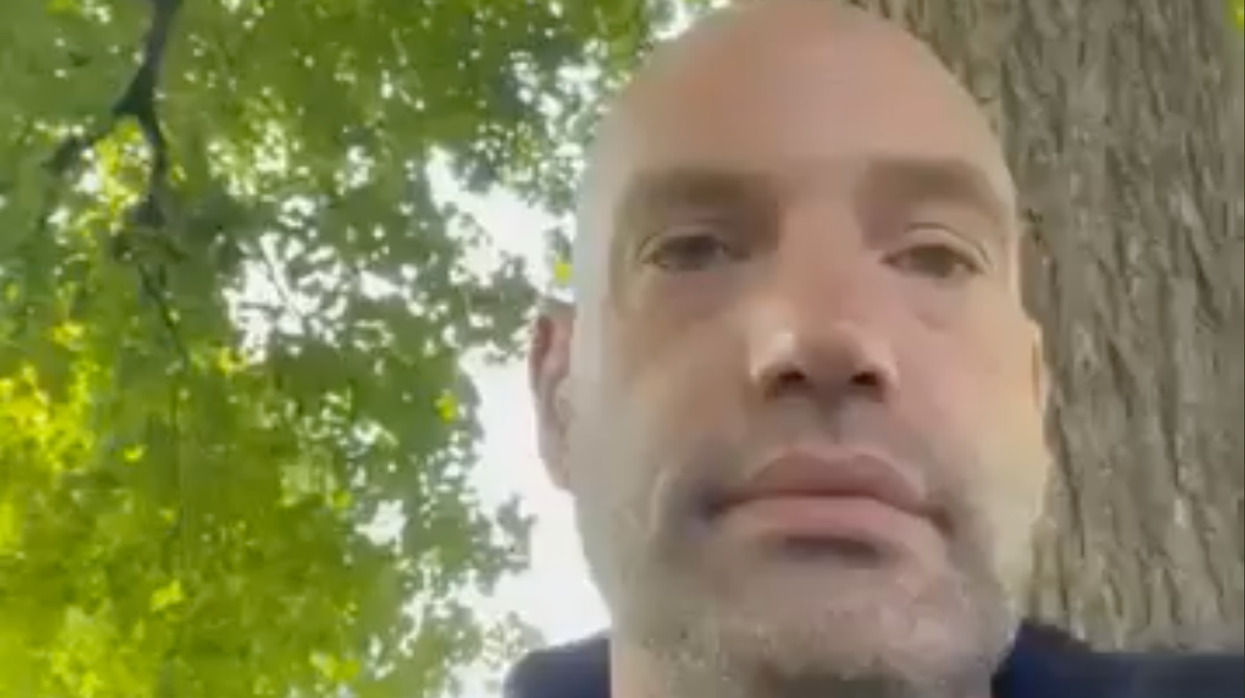
In a video, Nelson said he would set himself ablaze "to stop supplying Israel with the money and weapons it uses to imprison and murder innocent Palestinians" and "to pressure Israel to end the genocide in Gaza."
For the third time since Israel launched a war on Gaza for which it is currently on trial for genocide at the World Court, a person in the United States has set themself on fire to protest Israel's killing of more than 41,000 Palestinians and U.S. complicity in the slaughter.
In an incident all but completely ignored by the U.S. corporate media, a man identified as Matt Nelson set himself alight near the Israeli Consulate in Boston at around 8:15 pm local time on Wednesday, September 11.
"My name is Matt Nelson and I'm about to engage in an extreme act of protest," he said in a video first uploaded to YouTube on Wednesday. "We are all culpable in the ongoing genocide in Gaza."
"We are slaves to capitalism and the military-industrial complex. Most of us are too apathetic to care," Nelson continued. "The protest I'm about to engage in is a call to our government to stop supplying Israel with the money and weapons it uses to imprison and murder innocent Palestinians, to pressure Israel to end the genocide in Gaza, and to support the [International Criminal Court] indictment of [Israeli Prime Minister] Benjamin Netanyahu and other members of the Israeli government."
"A democracy is supposed to serve the will of the people, not the interests of the wealthy," he added. "Take the power back. Free Palestine."
According to NBC Boston, first responders confirmed a man suffered serious burn injuries. Nelson's current condition has not been reported.
NBC Boston and other local media took flak from critics on social media, who noted that the outlets chose to report the incident's location as "outside the Four Seasons Hotel" instead of by the Israeli Consulate.
Nelson is the third person known to have self-immolated in Gaza-related protests in the United States since October.
On December 1, a woman—whose identity remains unknown—carrying a Palestinian flag was hospitalized in critical condition after setting herself alight outside the Israeli consulate in Atlanta. Police called it an "act of extreme political protest." Israeli Consul-General Anat Sultan-Dadon called it an act of "hate and incitement toward Israel."
Then, in an incident that gained worldwide attention, Aaron Bushnell, a 25-year-old active-duty U.S. airman, doused himself in an unknown accelerant, donned his service cap, and set himself ablaze in front of the Israeli Embassy in Washington, D.C. on February 25.
Bushnell repeatedly screamed "Free Palestine" as he burned. Secret Service officers quickly rushed to the scene, with at least one of them drawing his pistol and pointing it at the burning man while ordering him to "get on the ground, you fucker."
As he screamed and writhed in agony, Bushnell managed one final, garbled, yet unmistakable "free Palestine" as his body was engulfed in flames. He died later that day.
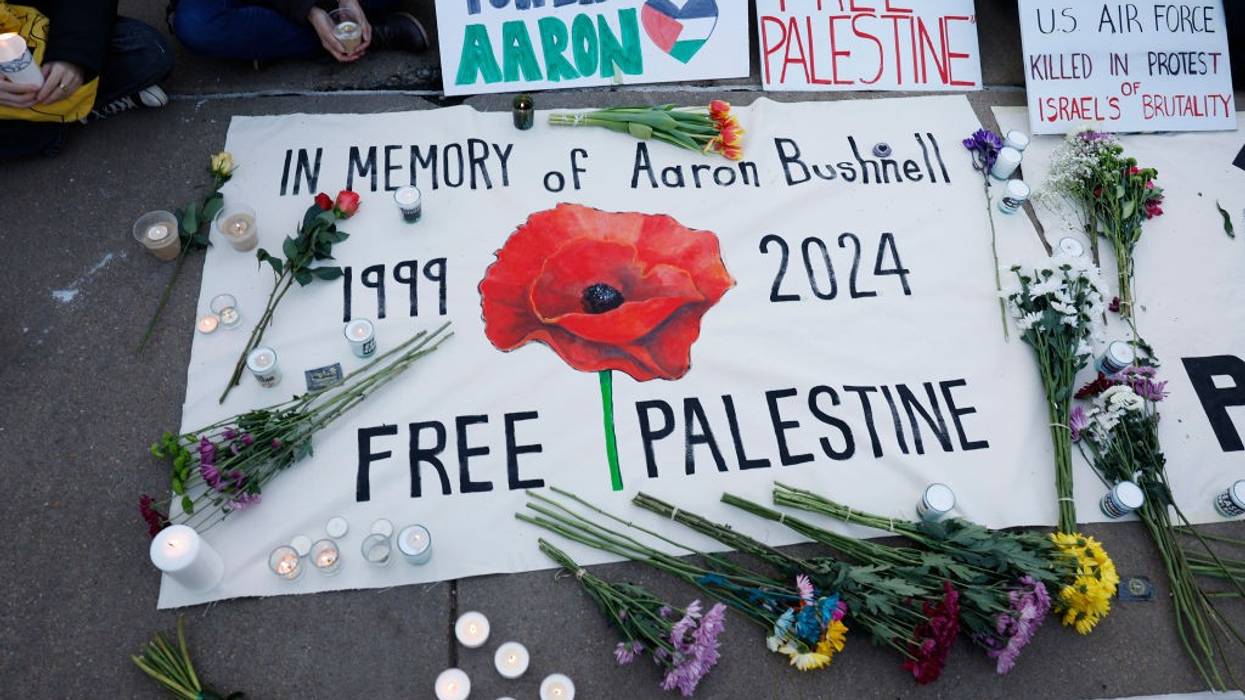
Arguments over language and tactics are often a way to avoid arguments we’d prefer not to have, even if working through those very arguments could produce the resolutions we want to reach.
It began with Aaron Bushnell and a visceral response of mine: Why would anyone do such a thing?
Bushnell was the 25-year-old active-duty airman who set himself ablaze on February 25 in front of the Israeli embassy in Washington, D.C., to protest that country’s brutal war in Gaza. The first question was tough enough, but his dramatic and deadly action also brought to mind other questions that have occupied my thinking, research, and writing in these last several years: What spurs someone to such an unyielding, ultimate commitment to a cause? What kind of political action is actually effective?
When the campus protests over the bloodbath in Gaza exploded shortly after Bushnell’s act, those questions came to seem even more pressing to me.
When a dissident’s striking (even, in Bushnell’s case, ultimate) political act is reduced to a set of personal maladies, his or her message can be all too easily massaged away.
And not only was I not alone in my interest in Bushnell’s act, he wasn’t even the first American to self-immolate over the fate of the Palestinians. Last December, an unidentified woman set herself on fire outside the Israeli consulate in Atlanta, apparently in a similar protest. She survived, just barely. (In April, a man who self-immolated across from the courthouse in Manhattan where Donald Trump was on trial for illegally trying to influence the 2016 election seemed aggrieved about other things.)
Three incidents, of course, do not an epidemic make, but they do attract attention. So, the phenomenon of self-immolation stayed in the news for a while.
Bushnell live streamed his action, which was quickly posted on the social media platform Twitch (though that video was soon taken down there). As of this writing, however, it’s still up at Reddit. It opens on the early afternoon of a clear February day, with Bushnell in combat fatigues walking resolutely toward the Israeli embassy. He had emailed some independent news outlets about his protest and, as he walks, he says, “I am an active-duty member of the U.S. Air Force, and I will no longer be complicit in genocide. I’m about to engage in an extreme act of protest, but compared to what people have been experiencing in Palestine at the hands of their colonizers, it’s not extreme at all.”
He then props up his cell phone on the pavement, pours some flammable liquid over his head, pulls his cap down, and flicks a lighter on around his ankles. When his uniform doesn’t ignite, he lights the pool of liquid surrounding him. It erupts into flames, which climb his body. Yelling “Free Palestine,” he bucks and moans in what must be unbearable pain before collapsing on the ground. Police and Secret Service agents rush over with fire extinguishers. One points a gun at the crumpled, still-flaming body and yells at him to get on the ground. Off-camera, another responds, “I don’t need guns, I need fire extinguishers!” After the video ends, Bushnell will be loaded into an ambulance and taken to a hospital, where he will soon die. In its only response, it seems, the Israeli embassy will report that none of its staff were injured.
In the following weeks, third-party presidential candidates Cornel West and Jill Stein will express solidarity with Bushnell; vigils honoring him will be held in several American cities, including Portland, Oregon, where members of the anti-war veterans group About Face will burn their uniforms in his memory; the Palestinian town of Jericho will name a street after him; another active-duty airman will be inspired to stage a hunger strike in front of the White House and, when he’s ordered back to his base in Spain, two fellow members of Veterans For Peace will begin a hunger strike in his stead.
The initial media coverage of Bushnell’s action was straightforward enough, though often giving as much space to the history of self-immolation as to the politics of his protest. A notable exception was a Washington Post column by Shadi Hamid, who considered Bushnell’s position on the U.S. government’s support for Israel and concluded that while his act might have been unreasonable, his sense of powerlessness was not.
It didn’t take long, however, for the focus to shift to the psychology of self-immolation, then to Bushnell’s background and the implication that he was distinctly damaged. About six weeks after the event, The Boston Globe ran a feature on the Community of Jesus, a monastic community on Cape Cod, where the young Bushnell was raised and home-schooled. The story relied heavily on disgruntled former members—one characterized it as a cult—who recalled harsh, group-enforced discipline, practices meant to undermine family bonds, humiliations, and verbal assaults. The article did include a disclaimer toward the end—“It’s unclear what, if any, connection Bushnell’s upbringing had on his final protest.”—but all too clear was a striking skepticism about his psychological stability.
The need to understand and explain (or explain away) such an extreme, self-abnegating act is anything but unusual, nor is the linking of self-immolation to mental disturbance. Bushnell was explicit about his distress over the situation in Gaza, and it sounded as if he was also dealing with a sense of moral injury, a malady of the heart as much as the head, but none of that was proof of derangement. Setting yourself on fire for whatever reason is inarguably an act of suicide, yet the mental state of someone at that moment is ultimately unknowable since such suicides almost invariably take their secrets to the grave. When it comes to self-immolation, I’m inclined to take people at their word. Apparently, that puts me in the minority.
“I won’t speculate on the dead man’s mental health,” wrote Graeme Wood in a snotty op-ed for The Atlantic. “He grew up in a cult, described himself as an anarchist, and generally eschewed what Buddhists might call ‘the middle way,’ a life of mindful moderation, in favor of extreme spiritual and political practice.” Fanaticism, he suggested, was Bushnell’s “default setting.”
It wasn’t just those who were unsympathetic to Bushnell’s act for whom the state of his psyche took precedence over the purpose of the protest. It may, in fact, be a particular genius of American democracy that it can absorb dissent and, in that way, blunt revolt, but that seemingly benign tolerance can push activists to ever more radical acts in a bid to focus attention on their cause. Sadly enough, though, when a dissident’s striking (even, in Bushnell’s case, ultimate) political act is reduced to a set of personal maladies, his or her message can be all too easily massaged away.
Self-immolation is a low-cost, low-tech, readily documentable act that’s easy to do without significant planning, assistance, or much forethought. Of course, “easy” might be the wrong word for it, and self-immolation is an exceedingly rare, singular, and extreme form of political protest. Unlike marches or strikes, it involves only one person. Unlike suicide missions, the harm is intended to be inflicted only on yourself. Unlike the slow, wasting away of a hunger strike, it’s seldom reversible and usually fatal. Unlike most public protest, it doesn’t rely on an authority’s response to have an effect. And while most people wouldn’t consider it an option, to those who would set themselves aflame, sooner or later it becomes the only option.
Self-immolation is also heart-stoppingly dramatic, capturing the public’s attention, emotions, and imagination despite, or maybe because of its inherent contradictions. It is at once an act of despair and of defiance, of purity and of bravado. Above all, it defies any idea of acceptable risk. Moreover, as a form of nonviolent protest, it’s shockingly violent, and though our normal urge as humans is to look away from such suffering, the image remains irrepressible.
As it happens, self-immolation as protest has an ancient history. It appears in Hindu tales, Greco-Roman myths, the early Christian era, fourth-century China, and 17th-century Russia. It’s happened in protests against America’s war in Vietnam; against the Soviet, Indian, and Sri Lankan governments, as well as Chinese policies in Tibet; and recently in the U.S. over climate change.
According to Michael Biggs, a sociologist who conducted an extensive study of the subject, the motivations and rationales of self-immolators range from the selfless and strategic to the psychological and egocentric. Such an array of reasons is on display in The Self-Immolators, testimony compiled from protesters around the world who set themselves on fire between 1963 and 2013. It makes for sad reading: so many lives, so much anguish, so little effect.
Historically, the effectiveness of such awe-inspiring protest is, at best, unclear. There were certainly cases that did gain widespread attention and so influenced events and policies. As a threesome, consider Thich Quang Duc, the Vietnamese monk in the iconic photograph, who self-immolated to protest his government’s mistreatment of Buddhists; Norman Morrison, the American Quaker who self-immolated under then-Defense Secretary Robert McNamara’s Pentagon window to protest America’s war in Vietnam (McNamara was reportedly “horrified,” while President John F. Kennedy exclaimed, “Jesus Christ!”); and Mohamed Bouazizi, the street vendor in Tunisia, whose self-immolation protesting corruption was considered a catalyst for the Arab Spring uprising.
Sadly, however, Bushnell’s action, far more typically, didn’t make a dent in Israel’s belligerence or limit the weaponry and intelligence his country still sends Israel. And the shock of the act, of the image of him burning to death seemed, if anything, to blot out the purpose. Maybe witnessing someone dying in flames, even online, is simply too disturbing to let witnesses easily absorb its intended message. Or maybe the intensity of Bushnell’s moral obligation shamed those who agreed with him and did nothing for those who didn’t.
While it’s hardly burning yourself to death, all those students who camped out last spring, erecting tents on university lawns, defying administrators, and dominating the news narrative for weeks, also faced risks. Though no student protesters died, by demanding institutional responses to Israel’s war in Gaza, some were barred from graduating, denied job offers, summarily kicked out of their housing, physically attacked, and arrested.
And then, as with Aaron Bushnell, we changed the subject. The issue wasn’t this country’s, or any individual university’s role in the war in Gaza—so insisted school authorities, opportunistic politicians, and an obliging media—but free speech and the function of higher education.
In contrast to self-immolation, which is always about the image, language was all-important in those campus protests and became a minefield. The hotly debated meaning of terms and slogans, the name-calling that stopped discussion, the debate over who controlled the debate, the mutual misunderstandings, and the alarming tolerance of intolerance were all exacerbated in the self-enclosed, pressure-cooker communities that college campuses generally are.
Protest that doesn’t challenge our norms, or at least get people to think about other possibilities, is just spectacle.
Quickly, the “sides” were slotted into pro-Israeli and pro-Palestinian categories, flattening any nuance among the protesters, even though a range of sentiments, perspectives, demands, and goals were apparent. That reduction also undermined the prospect for critical analysis, any true exchange of views, or the possibility of minds being changed—everything, in other words, that’s supposed to underpin a liberal education. And whatever happened to the idea of being pro-peace? I don’t remember that label ever being applied to the protests, although the one area most protesters agreed on was the need for a cease-fire in Gaza.
In his keynote speech at MIT’s graduation, entrepreneur Noubar Afeyan acknowledged the students’ pain over the tragic Israeli-Palestinian conflict and rued his own lack of answers on the subject, concluding, “But I do know this: Having conviction should not be confused with having all the answers.”
I have a certain sympathy for that sentiment, though I doubt I did when I was a student with my own set of demands over a different tragic conflict, which leaves me sympathetic to the student activists, too. After all, you don’t need answers to pinpoint a problem accurately or to believe peace is a precondition for finding such answers. Protest isn’t supposed to be nice. Dissent courts the heterodox. The point of a political action is to get in people’s faces, disturb complacency, and command a response. Protest that doesn’t challenge our norms, or at least get people to think about other possibilities, is just spectacle.
Of course, dissent also threatens authority, and the kneejerk reaction of authorities fearing that they’re losing control is to try to take ever more control. Insisting that the students and their organizations were being punished not for their speech but for breaking the rules, university administrators suspended anti-Zionist groups, breached principles of academic freedom, opened the way for violence by ushering the police onto campus, and caved to financial pressure from donors and alumni. And what to make of the suggestion of a Harvard dean, who, “look[ing] forward to calmer times on campus,” argued that the solution was for faculty members to just shut up?
You’d think such beleaguered university administrators would learn. Clampdowns usually backfire, and severe punishments hardly make for calmer campuses. The repression, in fact, succeeded mainly in turning the conversation from core issues like war and human rights to an assessment of free speech and the very nature of academia—not to mention good old American anti-intellectualism. Educational leaders were called before Congress to confess; university presidents were fired; hate speech codes, mostly moribund in this century, got renewed attention; and the crisis became focused on campuses riven by incivility and bad words.
Dissension at educational institutions over what kinds of expression are acceptable, no less desirable, has a long history and merits periodic revisiting. I suspect, though, that there’s another reason what we say has bested what we do as the issue du jour: that is, a lot of Americans find it easier to champion the idea of free speech than to demand that Israel get out of Gaza or that the Biden administration rethink its military aid policies.
About 20 years ago, when I wrote a book about free expression controversies, I saw repeatedly how words make convenient scapegoats. Arguments over language are often a way to avoid arguments we’d prefer not to have, even if working through those very arguments could produce the resolutions we want to reach. As paramount as free speech is to me in the pantheon of human rights, I wish in this case—and in Aaron Bushnell’s memory—we hadn’t relegated war to just a background hum but had assessed the validity of the protesters’ demands and dealt with them, as fraught and frightening, involved and painful as that process would inevitably have been.

"As the descendant of European Jews, I was raised in a particularly unforgiving moral environment when it came to the topic of bearing responsibility for ethnic cleansing," wrote Maj. Harrison Mann.
An American Army officer on Monday described months of being increasingly disturbed by the images and news of Israel's U.S.-backed bombardment of Gaza, which culminated in his public resignation from his position at the Defense Intelligence Agency to avoid further complicity in Israel's "ethnic cleansing" of Palestinians.
Army Maj. Harrison Mann published his resignation letter on LinkedIn, saying he had distributed it internally on April 16 to announce his resignation from the agency.
As an officer at the DIA, Mann said, he has been unable to escape the fact that his place of work "directly executes policy" for the Biden administration, including its "nearly unqualified support for the government of Israel, which has enabled and empowered the killing and starving of tens and thousands of innocent Palestinians."
"My work here—however administrative or marginal it appeared—unquestionably contributed to that support," wrote Mann.
He described wrestling with the question of whether he could continue working at the DIA, reasoning with himself that, "I don't make policy and it's not my place to question it."
"However, at some point it became difficult to defend the outcomes of this particular policy," Mann wrote. "At some point—whatever the justification—you're either advancing a policy that advances the mass starvation of children, or you're not."
At the time Mann sent his letter to his colleagues, Israel was conducting airstrikes and preparing its ground invasion of Rafah, the southern Gaza city that over 1 million Palestinians have been forcibly displaced to since October.
Israel has continued to block aid to Gaza even after saying in early April it would open a crossing and a port, and has now pushed the enclave into what the United Nations World Food Program chief said earlier this month was a "full-blown famine." Dozens of people have died of starvation. At least 35,091 people who have been killed in Israel's military assault—two-thirds of those killed have been women and children, despite Israel's claim it is targeting Hamas fighters.
Mann wrote that as the bombardment dragged on and U.S. President Joe Biden's defense and funding of the Israel Defense Forces (IDF) continued, his mind turned to his European Jewish relatives.
"As the descendant of European Jews, I was raised in a particularly unforgiving moral environment when it came to the topic of bearing responsibility for ethnic cleansing—my grandfather refused to ever purchase products manufactured in Germany—where the paramount importance of 'never again' and the inadequacy of 'just following orders' were oft repeated," wrote Mann. "But I also have hope that my grandfather would afford me some grace; that he would still be proud of me for stepping away from this war, however belatedly."
Mann publicized his letter about six weeks after foreign affairs officer Annelle Sheline resigned from her position at the U.S. State Department, saying her work in the human rights realm in the Middle East had become "impossible" in light of Biden's material and political support for Israel's assault on Gaza.
Education Department official Tariq Habash, a Palestinian American, also resigned in protest earlier this year, and a top official who oversaw arms transfers at the State Department, Josh Paul, stepped down in October, citing the Biden administration's decision to send more arms to Israel as the war began.
In February, U.S. Air Force member Aaron Bushnell died after self-immolating in front of the Israeli Embassy in Washington, D.C., having said he was engaging "in an extreme act of protest" to avoid being complicit in genocide.
On LinkedIn, Mann wrote Monday that he "received an unexpected outpouring of support" when he distributed his letter internally, and appeared to address other federal employees who may be questioning their complicity in Biden's policies.
"I am sharing [the letter] now in the hope that you too will discover you are not alone, you are not voiceless, and you are not powerless," wrote Mann.
Feds United for Peace, which includes employees across 30 federal agencies who have advocated for a cease-fire in Gaza, called Mann's letter "incredibly significant."
The New York Times reported that it is not known "whether other military officers have resigned in protest of U.S. foreign policy" since the Hamas-led attack on Israel in October and the IDF's deadly retaliation, "but the resignation of an active-duty officer in protest of U.S. foreign policy is likely uncommon—especially one in which the officer makes public the reasons for doing so."
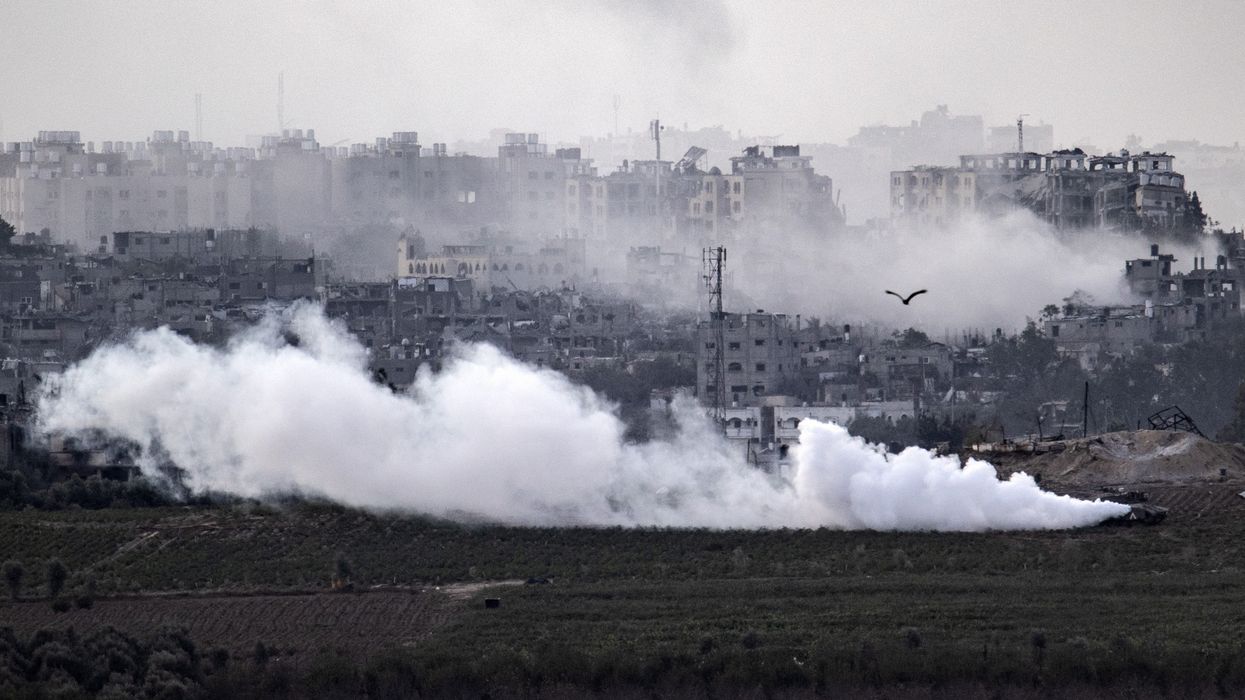
To the victor goes the spoils, so it’s said, but a planet despoiled by thermonuclear war, cast into darkness, ravaged by radiation, disease, and death, would, of course, offer no victory to anyone.
When I was in the U.S. military, I learned a saying (often wrongly attributed to the Greek philosopher Plato) that only the dead have seen the end of war. Its persistence through history to this very moment should indeed be sobering. What would it take for us humans to stop killing each other with such vigor and in such numbers?
Song lyrics tell me to be proud to be an American, yet war and profligate preparations for more of the same are omnipresent here. My government spends more on its military than the next 10 countries combined (and most of them are allies). In this century, our leaders have twice warned of an “axis of evil” intent on harming us, whether the fantasy troika of Iraq, Iran, and North Korea cited by former President George W. Bush early in 2002 or a new one—China, Russia, and North Korea—in the Indo-Pacific today. Predictably given that sort of threat inflation, this country is now closing in on a trillion dollars a year in “defense spending,” or close to two-thirds of federal discretionary spending, in the name of having a military machine capable of defeating “evil” troikas (as well as combatting global terrorism). A significant part of that huge sum is reserved for producing a new generation of nuclear weapons that will be quite capable of destroying this planet with missiles and warheads to spare.
My country, to be blunt, has long been addicted to war, killing, violence, and massive preparations for more of the same. We need an intervention. We need to confront our addiction. Yet when it comes to war and preparations for future conflicts, our leaders aren’t even close to hitting rock bottom. They remain in remarkable denial and see no reason to change their ways.
With that horrifying spectacle—and given the TV news and social media, it truly has been a spectacle!—of genocide in Gaza, America’s leaders have embraced the very worst of Machiavelli, preferring to be feared rather than loved, while putting power first and principle last.
To cite two recent examples: Just before Easter weekend this year, President Joe Biden swore he was personally devastated by Palestinian suffering in Gaza. At the same time, his administration insisted that a United Nations Security Council resolution for a cease-fire in Gaza that it allowed to pass was “non-binding” and, perhaps to make that very point, reportedly shipped 1,800 MK84 2,000-pound bombs and 500 MK82 500-pound bombs off to Israel, assumedly to be used in—yes!—Gaza.
The Biden administration refuses to see the slightest contradiction in such a stance. Men like Joe Biden and his chief diplomat Antony Blinken confess to being disturbed, even shocked, by the devastation our bombs deliver. Who knew Israel would use them to kill or wound more than 100,000 Palestinians? Who knew that they’d reduce significant parts of Gaza to rubble? Who knew that a blank check of support for Israel would enable that country to—it’s hard not to use the phrase—offer a final solution to the Gaza question?
Not to be outdone by the Democrats, Republican Congressman Tim Walberg of Michigan recently cited the examples of Hiroshima and Nagasaki in seeking a “quick” end to the conflict in Gaza (before walking his comments back somewhat). For him, Israel remains America’s greatest ally, whatever its actions, even as he argues that Palestinians in Gaza merit no humanitarian aid from the United States whatsoever.
With that horrifying spectacle—and given the TV news and social media, it truly has been a spectacle!—of genocide in Gaza, America’s leaders have embraced the very worst of Machiavelli, preferring to be feared rather than loved, while putting power first and principle last. Former National Security Adviser and Secretary of State Henry Kissinger, recently deceased, rightly vilified for pursuing a Bismarckian Realpolitik, and deeply involved in the devastation of Vietnam, Cambodia, and Laos, might even have blanched at the full-throttled support for war (and weapons sales) now being pursued by this country’s leaders. Dividing the world into armed camps based on fear seems basic to our foreign policy, a reality now echoed in domestic politics as well, as the Democratic blue team and the MAGA Republican red team attack each other as “fascistic” or worse. In this all-American world of ours, all is conflict, all is war.
When asked about such an addiction to war, your average government official will likely claim it’s not our fault. “Freedom isn’t free,” so the bumper sticker says, meaning in practice that this country stands prepared to kill others without mercy to ensure its “way of life,” which also in practice means unbridled consumption by an ever-shrinking portion of Americans and unapologetic profiteering by the richest and greediest of us. Call it the “moderate” bipartisan consensus within the Washington Beltway. Only an “extremist” would dare call for restraint, tolerance, diplomacy, and peace.
Short of an attack on Earth by aliens, it’s hard to imagine the U.S. today making common cause with “enemies” like China, Iran, North Korea, or Russia. What gives? Isn’t there a better way and, if so, how would we get there?
In fact, there is a common foe—or perhaps a common cause—that should unite us all as humans. That cause is Earth, the health of our planet and all the life forms on it. And that foe, to state the obvious (even if it regularly goes unsaid), is war, which is unhealthy in the extreme not just for us but for our planet, too.
War turns people into killers—of our fellow humans, of course, but also of all forms of life within our (often very large) blast radii. In addition, war is a mass distraction from what should truly matter to us: the sacredness of life and the continued viability of our planet and its ecology. Call it a cliché but there’s no way to deny it: There is indeed only one Spaceship Earth. As far as we know now, our planet is the sole body in the universe teeming with life. Of course, the universe is incomprehensibly vast and there could well be other forms of life out there, but we don’t know that, not with certainty anyway.
Is this the future we have to look forward to, an endless echoing of our murderous past?
Imagine, in a dystopic future, America’s “best and brightest” (or the “best and brightest” of another country) acting in a nuclear fury, employing the very weaponry that continues to proliferate but hasn’t been used since the destruction of two Japanese cities on August 6 and 9, 1945, and so crippling Spaceship Earth. Imagine also that our planet is truly the universe’s one magnificent and magical spot of life. Wouldn’t it be hard then to imagine a worse crime, not just against humanity, but life itself cosmically? There would be no recompense, no forgiveness, no redemption—and possibly no recovery either.
Of course, I don’t know if God (or gods) exists. Though I was raised a Catholic, I find myself essentially an agnostic today. Yet I do believe in the sacredness of life in all its diversity. And as tenacious as life may be, given our constant pursuit of war, I fear the worst.
If you’re of a certain age, you may recall when the astronauts on Apollo 8 witnessed earthrise as their spaceship orbited the moon in 1968. The crew read from Genesis, though in truth it could have been from any creation story we humans have ever imagined to account for how we and our world came to be. Specific religions or creeds didn’t truly matter at that moment, nor should they now. What mattered was the sense of awe we felt as we first viewed the Earth from space in its full glory but also all its fragility.
For make no mistake, this planet is fragile. Its ecosystems can be destroyed. Not for nothing did the inventor of the atomic bomb, J. Robert Oppenheimer, turn to the Hindu scriptures to intone, “Now I am become death, the destroyer of worlds,” when he saw the first atomic device explode and expand into a mushroom cloud during the Trinity test in New Mexico in July 1945.
In the febrile postwar climate of anti-communism that would all too soon follow, America’s leaders would decide that atomic bombs weren’t faintly destructive enough. What they needed were thermonuclear bombs, 1,000 times more destructive, to fight World War III against the “big fat commie rat.” Now nine (9!) nations have nuclear weapons, with more undoubtedly hankering to join the club. So how long before mushroom clouds soar toward the stratosphere again? How long before we experience some version of planetary ecocide via a nuclear exchange and the nuclear winter that could follow it?
The genocide happening in Gaza today may foreshadow one possible future for this planet. The world’s lone superpower, its self-styled beacon of freedom, now dismisses U.N. Security Council resolutions to stop the killing as “non-binding.” Meanwhile, Israel, whose founding was a response to a Holocaust inflicted during World War II and whose people collectively said Never Again, is now killing, starving, and displacing hundreds of thousands of Palestinians in the name of righteous vengeance for Hamas’s October 7 attack.
If the U.S. and Israel can spin mass murder in Palestine as not just defensible, but even positive (“defeating Hamas terrorists”), what hope do we have as a species? Is this the future we have to look forward to, an endless echoing of our murderous past?
I refuse to believe it. It truly should be possible to imagine and work toward something better. Yet, in all honesty, it’s hard to imagine new paths being blazed by such fossilized thinkers as Joe Biden and Donald Trump.
“Don’t trust anyone over 30” was a telling catchphrase of the 1960s. Now, we’re being told as Americans that we’ll have to place our trust in one of two men almost at or exceeding 80 years of age. Entrusting and empowering political dinosaurs, however, represents an almost surefire path toward future extinction-level events.
Let me turn instead to a 25-year-old who did imagine a better future, even as he protested in the most extreme way imaginable the genocide in Gaza. This February, fellow airman Aaron Bushnell lit himself on fire outside the Israeli embassy in Washington, D.C. He sacrificed his life in a most public way to challenge us to do something, anything, to stop genocide. America’s “leaders” answered him by ignoring his sacrifice and sending more bombs, thousands of them, to Israel.
Aaron Bushnell did, however, imagine a better world. As he explained last year in a private post:
I’ve realized that a lot of the difference between me and my less radical friends is that they are less capable of imagining a better world than I am. I follow YouTubers like Andrewism that fill my head with concrete images of free, post-scarcity communities and it makes me so much more prepared to reject things about the current world, because I’ve imagined how things could be and that helps me see how extremely bullshit things are right now.
What I’m trying to say is, it’s so important to imagine a better world. Let your thoughts run wild with idealistic dreams of what the world should look like and let the pain and anger at how it’s not that way flow through you. Let it free your mind and fuel your rage against the machine.
It’s not too late for you or anyone. We can have the world of our dreams tomorrow, but we have to be willing to fight today.
His all-too-public suicide was a fiery cry of despair, but also a plea for a better future, one free of mass murder.
Earlier this week, millions of people across America witnessed a total eclipse of the sun. It’s awe-inspiring, even a bit alarming, to see the sun disappear in the middle of the day. Those watching took comfort in knowing that it would reappear from behind the moon in a matter of seconds or minutes and so gloried in that fleeting moment of preternatural darkness.
But imagine if the moon and sun were somehow to become permanently stuck in place. Imagine that darkness was our future—our only future. Sadly enough, however, it’s not the moon but we humans who can potentially cast the Earth into lasting darkness. Via the nuclear winter that could result from a nuclear conflict on this planet, we could indeed cast a shadow between the sun and life itself, a power of destruction that, tragically, may far exceed our current level of wisdom.
We know from history that it’s far easier to destroy than to create, far easier to kill than to preserve. Yet when countries make genocide or ecocide (from nuclear winter) possible and defensible (as a sign of uncompromising “toughness” and perhaps the defense of “freedom”), you know that their leaders are, in some sense, morally obtuse monsters. And who or what are we if we choose to follow such monsters?
As human populations rise, as vital resources like water, food, and fuel shrink, as this planet grows ever hotter thanks to our intervention and our excesses, we’ll need to cooperate more than ever to ensure our mutual survival. Far too often, however, America’s strategic thinkers dismiss cooperation through diplomacy or otherwise as naïve, unreliable, and impractical. “Competition” through zero-sum games, war, or other hyperviolent urges seems so much more “reasonable,” so much more “human.”
To the victor goes the spoils, so it’s said. But a planet despoiled by thermonuclear war, cast into darkness, ravaged by radiation, disease, and death, would, of course, offer no victory to anyone. Unless we put our efforts into ending war, rather than continuing to war on one another, such conflicts will, sooner or later, undoubtedly put an end to us.
In reality, our worst enemy isn’t some “axis” or other combination of imagined foes from without, it’s within. We remain the world’s most dangerous species, the one capable of wiping out most or all of the rest, not to speak of ourselves, with our folly. So, as Aaron Bushnell wrote, free your mind. Collectively, there must be a better way for all creatures, great and small, on this fragile spaceship of ours.
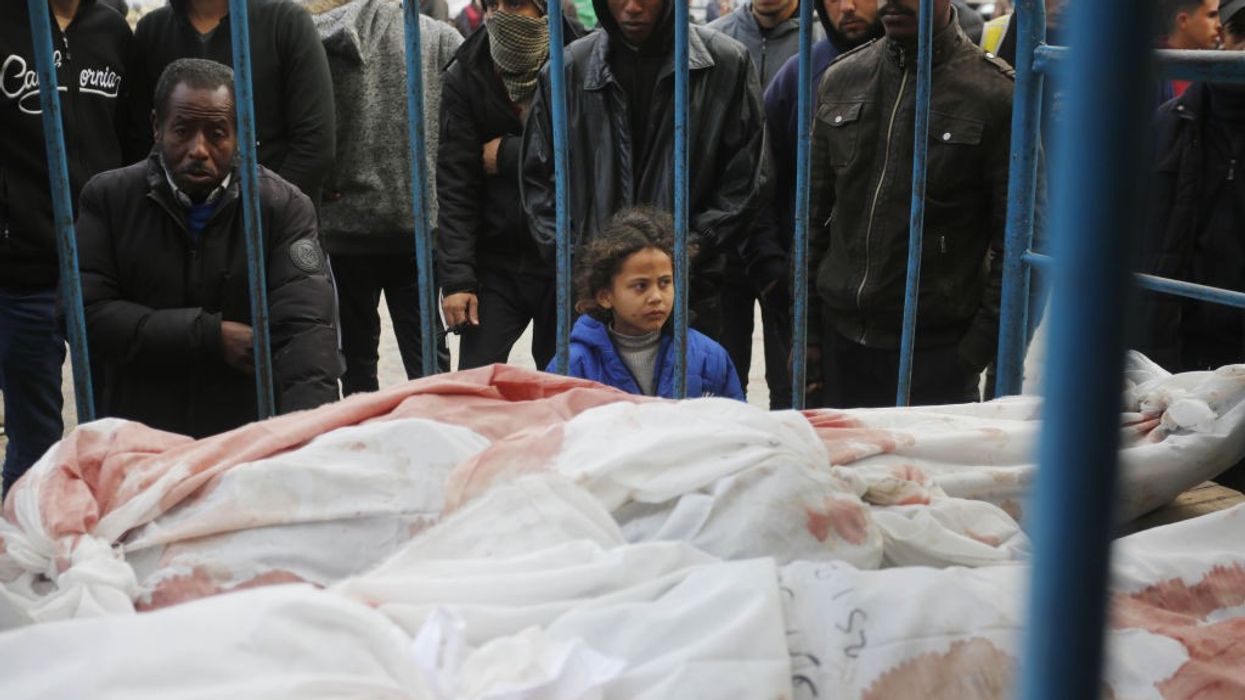
Condemning “war crimes” is nothing more than a shrug; it’s war itself that must be not simply “condemned,” but transcended.
Even the international condemnation of the Israeli devastation of Gaza often feels tepid.
Consider, for instance, the words of United Nations Secretary General António Guterres, in the wake of Israel’s April 1 drone strike on a convoy of cars from World Central Kitchen, a disaster relief organization bringing food to starving Gazans. The strike killed seven aid workers.
Noting that a total of 196 aid workers have so far been killed in Gaza’s six months of bombardment and starvation, Guterres said: “This is unconscionable. But it is an inevitable result of the way the war is being conducted.”
Hebert and Bushnell—and all the others on the planet who feel the same connection with the victims of war—aren’t simply “being critical” of how Israel is “conducting” its war.
Yes, of course, this is unconscionable, but the implication here is that there are decent, moral ways to conduct a war, to “defend yourself” from an impoverished, occupied population. Wage war if you must, but don’t commit war crimes! When I hear such words, I feel my soul start spinning wildly. War itself is the problem. It cannot be reduced to a just and strategic video game—yeah, soldiers will be killed, but not civilians! No dead children, please (especially under age six).
The logic void here is that war begins with dehumanization. Those people are evil and we have to defend ourselves against them, which means killing them. And this attitude never stays neat and tidy—especially not on this insanely militarized planet, which (with America in the lead) regards nothing as more important than keeping humanity on the brink of nuclear and eco-suicide.
Condemning “war crimes” is nothing more than a shrug. It’s war itself that must be not simply “condemned,” but transcended. Utterly transcended. The time is now. And the lack of any official acknowledgment of this, let alone a movement in this direction with real political traction, feels... uh, personal.
Two nights ago I had this weird dream, which left me gasping in terror and despair. In the dream, my wife, nine months pregnant, suddenly disappeared as we slept. Where did she go? I felt lost and clueless, but made my way to the hospital, thinking she’s about to give birth but forgot to bring me with her to be part of the process. At the hospital, I eventually find the delivery room, but there’s a line of people ahead of me, waiting to get in. I have no idea who they are. I’m filled with desperation—my God, my God, our child is about to be born, I need to be there—and rush to the front of the line, then try to lift myself into the delivery room through an opening, but am unable to do so.
Then I wake up. Huh? This is totally weird. In real life, I had been present throughout my daughter’s delivery (36 years ago) and remain immensely grateful that I could help my wife endure the pain of birth and eventually dance with our newborn.
I had no idea what this dream was telling me, but I remained deeply stressed by it, as though a spiritual theft had occurred. I felt robbed of my family, at the deepest level of love. And then I started reading and watching the news—a daily flow of suffering from Palestine... moms, dads, children in unimaginable grief over the deaths of loved ones. Spiritual robbery! My God, this is the daily news. We absorb it was we go about the day. Perhaps the dream was trying to link me to this suffering.
And then I thought about Larry Hebert, a U.S. airman who recently began waging a hunger strike in defiance of his country’s complicity in the genocide of Gaza. He stood in front of the White House holding a sign declaring: “Active-Duty Airman Refuses to Eat While Gaza Starves.”
And Hebert was influenced by Aaron Bushnell, also an active-duty airman, who stood in front of the Israeli embassy in Washington, D.C. on February 24, doused himself in flammable liquid, lit a match, and set himself on fire, shouting, “Free Palestine!” as he burned to death.
War is personal, even when it’s occurring on the other side of the planet—or it can be. Hebert and Bushnell—and all the others on the planet who feel the same connection with the victims of war—aren’t simply “being critical” of how Israel is “conducting” its war. They’re screaming from their souls: “No! No! No! Stop blowing the limbs off children! Stop killing moms and newborns! Stop dehumanizing them, stop doing what you’re doing. War is wrong!”
And here in the United States, this cry is directed at the president, Genocide Joe, and his ever more wimpy “expressions of concern” about Israeli Prime Minister Benjamin Netanyahu’s conduct of the war, even as his administration supports it and supports it and supports it, recently, for instance, transferring “billions of dollars in bombs and fighter jets to Israel”—including thousands of 2,000-pound monster bombs. Use them carefully, Benjamin!
And we can’t refuse to vote for Biden without bequeathing another term in office to would-be dictator and Bible salesman Donald Trump—wow, what a lovely democracy we have here. Maybe Palestinian children are terrified, but the Military Industrial Complex has nothing to fear.
Attention, patriots! Attention, mainstream journalists! Waging war doesn’t keep us safe. Diminishing the humanity of others, then killing them and stealing their land, while it may be embedded in our history, doesn’t make anyone safe. It guarantees endless hell. But guess what?
“Just as individuals can relinquish their righteous rage and compulsion to punish indiscriminately, so, too, can groups and nations. But doing so requires leaders who can reach across divided communities and provide hope in a seemingly hopeless time to override the all-too-human drive to retaliate.”
These are the words of psychiatric researchers Jessica Stern and Bessel van der Kolk, who continue: “They must understand that a legacy of trauma makes Israeli Jews and Palestinians vulnerable to reactive violence, leading to a seemingly endless cycle of bloodshed.”
Think of Mahatma Gandhi. Think of Martin Luther King, Jr. Think of Nelson Mandela or Susan B. Antony or Frederick Douglass or a million others. Real change is possible, and it’s rarely—perhaps never—violent, but creating it involves the loving wholeness of who we are. The future is a vast unknown, but no one owns it. We have to create it together.
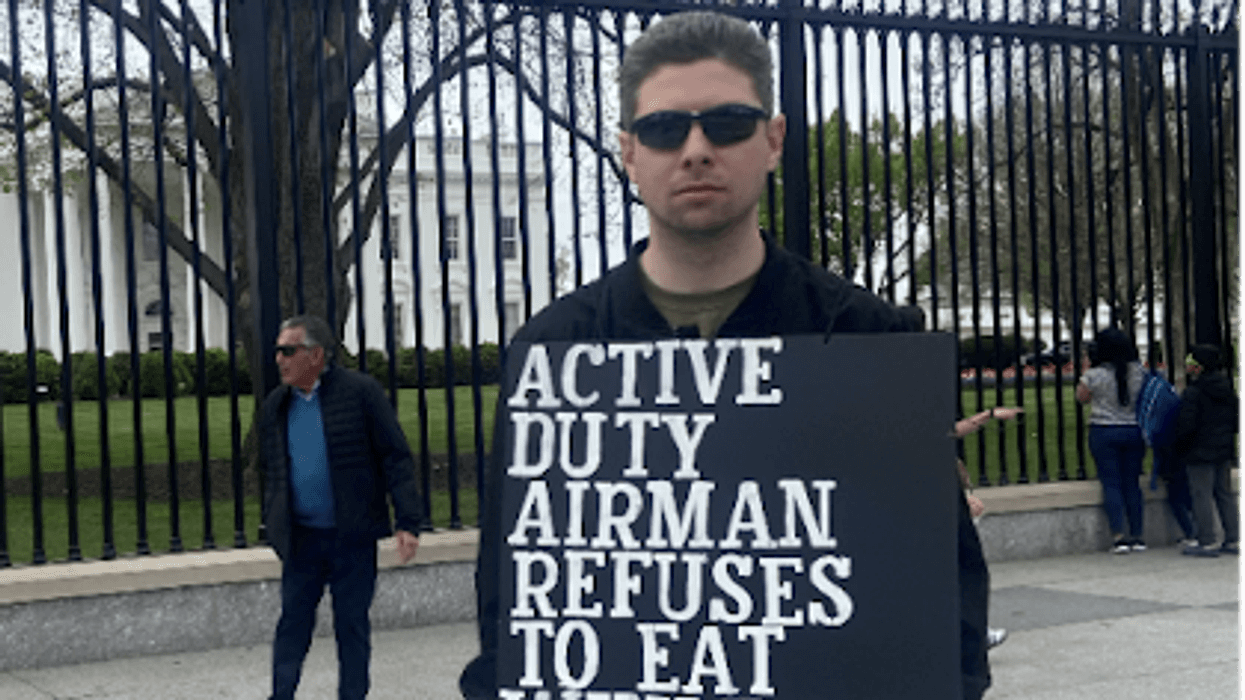
Airman Larry Hebert, who began a hunger strike at the White House on Easter Sunday, says he was inspired by the self-immolation of active-duty Airman Aaron Bushnell.
An active-duty Air Force airman is on a hunger strike in front of the White House, in solidarity with the children of Gaza, who are being deliberately starved to death.
Larry Hebert, a senior airman with six years in the Air Force, began his hunger strike at the White House on Easter Sunday. He says he will be present at the White House from 10:00 am to 3:00 pm, April 1-6, and will then move to the House of Representatives, beginning Monday, April 8, when Congress is back in session.
Airman Hebert, who recently joined the organization Veterans For Peace, says he was inspired by the self-immolation of active-duty Airman Aaron Bushnell.
"When Aaron Bushnell took his own life at the Israeli Embassy for the people of Gaza, that had a profound impact on me. I felt and resonated exactly with how he was feeling, and so that was really powerful and influential," Hebert said. "But what really infuriated me was the response afterward. Leadership within the military and within our government were just silent. There was utter silence surrounding Aaron Bushnell and what he did."
"We anticipate that other active-duty military and veterans will be following his example."
"I knew I had to raise my voice in opposition to the U.S. government supplying Israel the bombs and rockets to commit genocide in Gaza," said Hebert. "Active-duty members are afraid to speak out, and I hope my example and that of others, like Aaron, can change that."
In mid-March, Hebert, from rural New Hampshire, took an authorized leave from his assignment at Naval Station Rota, Spain. Since then he has participated in demonstrations demanding a permanent cease-fire in Gaza and visited several congressional offices to press for an end to U.S. weapons shipments to Israel, which violate several U.S. laws.
Hebert is standing outside the White House this week with a sign that reads "Active-duty airman refuses to eat while Gaza starves."
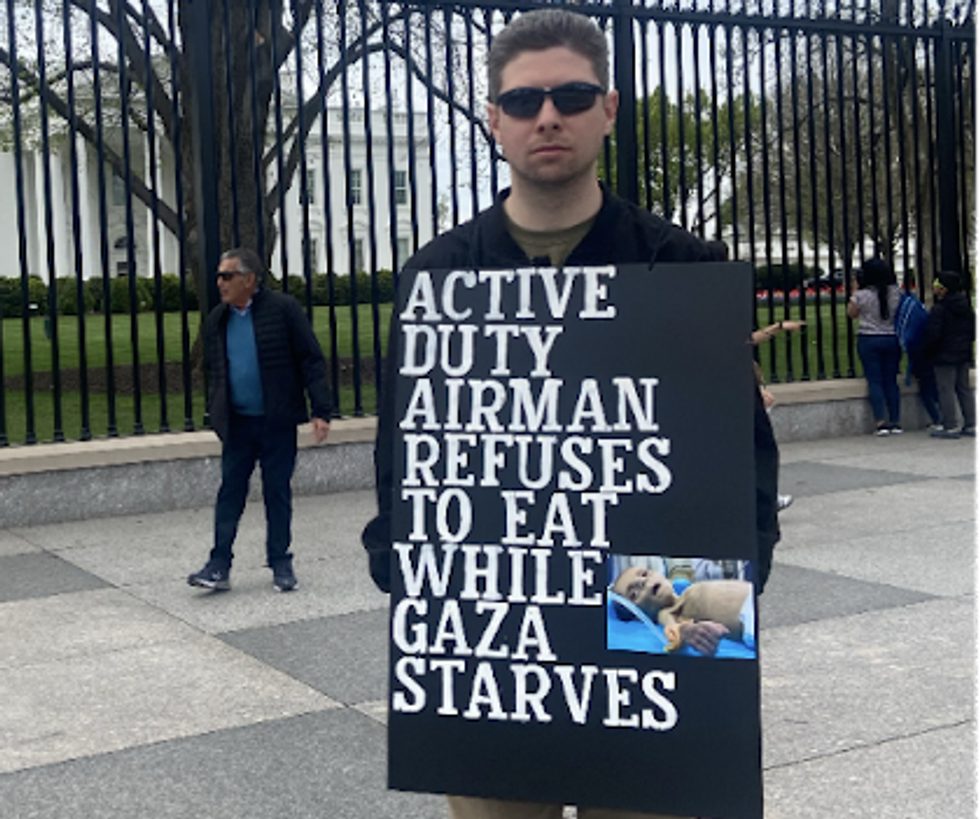
He is not wearing a military uniform, which might be considered a violation of military regulations.
"I am on Day 4 of my hunger strike in solidarity with the civilians that are being deliberately starved in Gaza," said Hebert on Wednesday.
Hebert told
Task and Purpose that he currently works as an avionics technician assigned to Naval Station Rota, Spain. The NAVSTA base provides cargo, fuel, and logistics support to military units in the region and supports U.S. and NATO ships with three active piers.
Hebert plans to continue the hunger strike—limiting himself to water and a juice supplement—for as long as he physically can.
He told Military.com, "I don't have a stop or an end for it right now. I'm going to go until my body cannot go any longer or we get the cease-fire and the end of unconditional aid to Israel."
Hebert joins many hundreds of current and retired military and civilian government officials urging U.S. leaders to stop fueling Israel's war that has killed over 32,000 Palestinians, nearly half of whom are children. Starvation and disease are rapidly becoming as deadly as the war itself throughout Gaza, where Israel has bombed hospitals, mosques, and residential neighborhoods to rubble.
"We applaud and wholeheartedly support the courageous action of this young Airman," said Mike Ferner, national director of Veterans For Peace. "We hope he will inspire other military personnel and veterans to take similar actions."
Veterans For Peace supports military personnel who act in good conscience and refuse to participate in genocide, war crimes, and crimes against humanity, whether directly or in support roles. For example, orders to load or transport U.S. weapons to Israel are illegal, under both U.S. and international law.
Veterans For Peace recommends that military personnel who want more information about their legal rights, or who wish to be discharged from the military, contact the GI Rights Hotline.
Airman Hebert's protest is gaining national and international notice. On Tuesday alone, he was interviewed by Democracy Now, The New York Times, The Guardian, Voice of America, Al Jazeera, WMUR-New Hampshire, and The Katie Halpern Show on YouTube.
"Larry Hebert's bold action is having an impact," said Ferner of Veterans For Peace. "We anticipate that other active-duty military and veterans will be following his example."
For active-duty members of the U.S. military considering following in Herbert's footsteps, or anyone who seeks more information, here are some of the laws the U.S. is currently breaking. In a February 12 letter to the U.S. State Department inspector-general, Veterans For Peace detailed the U.S. laws currently being violated by U.S. officials every time weapons shipments to Israel are authorized to include:

The real purpose of this spectacle was to deliver votes for the president, not meals for the starving.
The head of Save the Children described the Biden Administration’s recent airdrop of food into Gaza airdrop as “theater.” That it is. So is the Vice President’s sudden “demand” for a six-week ceasefire. For that matter, so is the ceasefire itself — if it happens. It’s likely to be characterized by ongoing immiseration and slow death, to be followed by the faster forms of killing.
It’s an American theater of cruelty whose real purpose is to deliver votes for the president, not meals for the starving. It will end as it began: in fire. The question is, what kind of fire and for whom?
The American airdrop consisted of 38,000 “MRE’s,” or “Meals Ready to Eat,” those unwholesome feed bags the US military buys by the millions to feed its underpaid and undervalued soldiers. To call this gesture a publicity stunt is unfair to publicity stunts, which are hollow but rarely lethal. It’s part of a killing strategy of deflection and deception.
More than 2,100,000 people are starving in Gaza; the children are already dying. If divided evenly, every person in Gaza would receive precisely 1.8 percent of each bag pictured above – that is, if they got any of it, which is unlikely amidst all the US-backed chaos. Hunger can’t be cured homeopathically, with microscopic doses.
The average weight of an MRE is 22 ounces. (I looked it up.) That means this airdrop provided roughly one-third of an ounce of food for every man, woman, and child. That’s like a bird hunter scattering breadcrumbs for pigeons before he starts killing them again.
At the going price for MREs (I looked that up, too), the retail cost of the food dropped comes to $617,405. That’s 29 cents for every starving person in Gaza (which is pretty much all of them.) And the military probably got a discount.
Perhaps the cost should be billed to the Biden campaign. Its real purpose is to offset the growing backlash against the administration’s support for mass slaughter, which was quantified in the Michigan primary’s surge of anti-Biden “uncommitted” votes. The president has seemed publicly insensate to the deaths of children, but even his dimming organs of perception can smell unfriendly votes. And whatever he doesn’t catch, his advisors presumably will.
Meanwhile, the president and his party continue to push a bill that would provide $14 billion in military aid to Israel. That’s more than twenty-two thousand times as much as the US spent on this food drop. Roughly $10 billion of that would consist of weapons for the IDF, including “advanced weapons systems” like the ones that are currently destroying apartment buildings, schools, and hospitals.
That cost should be billed to the American conscience.
From the Washington Post: “Critics say airdrops are expensive and ineffective, and argue diplomatic efforts should be focused on opening Gaza’s border crossing to allow aid convoys access.” But that would require confronting Israel, which the Biden Administration has yet to do in any meaningful way.
The United States could send food aid on ships to the Gaza shore with troops through the Rafah Crossing. It could confront Israel with a simple choice: fire on our military, or accept that the policy of mass starvation has come to an end. The fact that it doesn’t means that the dying will continue.
The same inaction gives the lie to Kamala Harris’ belated discovery that “people in Gaza are starving” and her lofty call for “an immediate ceasefire” – which sounds good, except that the administration is absolving Israel of all responsibility for the deaths and for the lack of a ceasefire.
The latest evidence for that was a press briefing in which two unnamed “senior administration officials” spoke on conditions of anonymity (conditions which the media should not have accepted, according to the professional standards of journalism.)
“Can you say broadly whether you feel that Israel is cooperating enough on getting aid into Gaza?” they were asked. “Do you feel that having done this, having had to do this airdrop today, is a statement at all on their cooperation?”
“The challenge is from various sources.” Replied “Senior Administration Official,” but “it is not a reflection on Israel or Israeli practices. It's a reflection on need. The need is there.”
Got that? Israel had nothing to do with it. “The need” just appeared and is now simply “there.”
Palestine is the land of biblical miracles, but that’s a new one.
Robert Ford, a much-decorated career diplomat and former ambassador to Syria, tweeted:
“I've seen Israel humiliate previous US administrations, but … forcing USA to do airdrops of aid to Gaza as if USA is no better than Egypt & Jordan is Israel's worst humiliation of USA i've ever seen.”
Even now, Biden responds to this humiliation with more acts of submission and collaboration. His unnamed officials blamed the ongoing violence solely on one party, saying it continues
“because a terrorist group holding hostages, including Americans, is continuing to fight and attack. They could stop this -- Hamas could -- tonight, instantly, and allow the free movement of assistance, medicine, care to go to the civilians of Gaza with whom, under whom, in whose homes they have embedded themselves for these past 17 years.”
This is Netanyahu’s rhetoric. But even if all these claims are true (they’re highly disputable), none justify the ongoing, criminal violence being waged on a civilian population.
The anonymous officials also proclaimed that Hamas is holding up a ceasefire agreement but insisted that Israel has “more or less” agreed to it. Hamas showed up the following day for a negotiation session; Israel did not. That was no surprise. Anyone who has done any deals at all knows that people either agree or they don’t. “More or less” is the language of the huckster, not the diplomat.
No wonder those officials remained anonymous. Perhaps they, unlike their boss, retain a vestigial sense of shame.
But I doubt it.
Neither the president nor his newly high-minded VP have renounced their own Senate bill, which provides billions to the Israeli war machine while ending all support for UNRWA — the most vital aid agency in Gaza — and pledging no minimum amount of aid in return.
Even the European Union, whose actions have largely been shameful on this issue, has reversed itself on UNRWA. Its top diplomat, Josep Borrell, has acknowledged that UNRWA is an “irreplaceable actor.”
The EU is still holding back some funds, regrettably, but it has released $54 millionand has promised additional funding after certain conditions are met. Biden and his party have yet to change their position, even as more children die of starvation.
Which brings us to an update on the sacrifice of airman Aaron Bushnell, who immolated himself outside the Israeli Embassy while shouting “Free Palestine!” A law enforcement officer shouted, “I don't need guns, I need fire extinguishers.”
That phrase should become the guiding principle of American foreign policy.
I’ve been reluctant to write about Bushnell’s act. Not because I don’t admire it — I do — but because those of us who have struggled with depression have an intimate relationship with suicide. Perhaps too intimate to be objective.
But this wasn’t suicide. The Vietnamese Buddhist monk Thich Nhat Hanh wrote to Martin Luther King, Jr. in 1965. In his letter, he explains the actions of the monks who immolated themselves during the Vietnam War. One sentence struck me then, just as it strikes me now:
“The importance is not to take one’s life, but to burn.”
He continued:
“To burn oneself by fire is to prove that what one is saying is of the utmost importance. There is nothing more painful than burning oneself. To say something while experiencing this kind of pain is to say it with the utmost of courage, frankness, determination and sincerity.”
My fear – and, frankly, my expectation – was that Bushnell’s sacrifice would be ignored. Instead, it has resonated. His memory has been kept alive in the discourse. Maybe, just maybe, something is awakening in the American conscience.
The French actor and playwright Antonin Artaud developed the concept of a “theater of cruelty” as a way to awaken audiences with “the fiery magnetism of its images,” until it becomes “a spiritual therapeutics whose touch can never be forgotten.”
One of Artaud’s dramas was intended to reflect “the Fall of Jerusalem, according to the Bible and history; with the blood-red color that trickles from it and the people's feeling of abandon and panic visible even in the light.”
History repeats itself, as the indigenous people of the region once again feel a sense of abandon and panic that is almost “visible in the light.”
Artaud was also fascinated by the story of Rabbi Shimon, a pioneer in the same mystical tradition that must have guided my great-grandfather as a rabbinical judge in 19th-century Russia-Ukraine.
The story of Shimon’s death as it has been sent down goes like this, as summarized in a Jewish Kabbalist website:
“On that day fire surrounded the house of Rabbi Shimon ... fire from the heavens descended and surrounded Rabbi Shimon. It gave him protection and opened a pure path for his soul ascending the upper worlds.”
Artaud wrote that Shimon’s mystical story “has the ever-present violence and force of a conflagration.” The story of the rabbi “who burns like fire,” he wrote, “is as immediate as fire itself.”
The fiery magnetism of Aaron Bushnell’s sacrifice has touched the world. The theater of cruelty, which was not designed to be cruel, has found its mirror image in love and sacrifice. I’m no theologian, but who knows? Maybe the fire that took Aaron’s life will provide protection and a pure path – for him, and those for whom he died.
But it’s not enough to hope. Action is needed now, before it’s too late, because fire comes in many forms. It can burn slowly, giving light and warmth. Or it can arise suddenly, unexpectedly, assuming the shape of inescapable justice as it moves among us.
Aaron Bushnell and Johan Galtung both devoted their lives to ending war in different ways.
The world recently lost two principled opponents of war, but under drastically different circumstances. Johan Galtung died on February 17 at the age of 93. The Norwegian sociologist was known as the father of peace studies and spent his life researching conflicts and fostering dialog in pursuit of peace.
Aaron Bushnell was just 25 years old. He was an active duty member of the U.S. Air Force. On Sunday, February 25, Aaron Bushnell started a live video stream as he walked toward the Israeli Embassy in Washington, D.C.
“I will no longer be complicit in genocide,” Bushnell said. “I am about to engage in an extreme act of protest, but compared to what people have been experiencing in Palestine at the hands of their colonizers, it’s not extreme at all. This is what our ruling class has decided will be normal.”
“He didn’t have thoughts of suicide. He had thoughts of justice.”
Standing at the embassy’s gate, with the video still running, he doused himself with a liquid and set himself on fire. His final words, shouted several times as the flames consumed him, were “Free Palestine! Free Palestine!” As an officer pointed a gun at Aaron, a second officer yelled, “I don’t need guns. I need a fire extinguisher.”
Aaron was formally declared dead hours later.
Earlier that day, he posted a link to the live stream, with the caption, “Many of us like to ask ourselves, 'What would I do if I was alive during slavery? Or the Jim Crow South? Or apartheid? What would I do if my country was committing genocide?' The answer is, you’re doing it. Right now.”
Levi Pierpont was a friend of Aaron’s. They met in basic training at Lackland Air Force Base in San Antonio, Texas. Speaking on the Democracy Now! news hour, days after Aaron’s death, Levi said they both joined the military “to explore the United States, to explore the world, to meet people from other backgrounds.” He went on, “over the years, both of us shifted in our beliefs regarding war, largely because of what we saw in the military, because we were a part of it. I know that he and I both were encouraged by people on YouTube that were writing video essays about social justice movements in the United States.”
“I did end up getting out as a conscientious objector,” Levi continued. “We spoke throughout that process. And at the time that I began to make headway with the process and it began to near its end—I got out in July of 2023—he felt like he was already close enough to his own end date that he decided not to take the same path. And I understood that, because the conscientious objector process can take over a year.”
Johan Galtung was also a conscientious objector, as a young man in Norway. As a child, Nazi Germany occupied his country and imprisoned his father. In one interview, he recalled how his mother made him read the newspaper to learn the names of political prisoners who the Germans had executed the day before, to see if his father was among them, to spare her the pain of reading the list. His father survived, but the war forever changed Johan. He devoted his life to bridging divides and finding creative solutions to real-world conflicts.
“I look forward to the U.S., instead of intervening militarily, starting solving conflicts,” Galtung said on Democracy Now!, in April 2012. “You have so many bright people in this country, so many well-educated people. Solving conflict, you have to talk with the other side, or the other sides. You have to sit down with Taliban and al Qaeda people or people close to al Qaeda. You have to sit down with Pentagon people, State Department people. And you have to ask them, ‘What does the Afghanistan look like where you would like to live? What does the Middle East look like where you would like to live?’ You get an enormous amount of very thoughtful people having very deep reflections.”
Levi Pierpont mourns the loss of his friend, and wishes Aaron hadn’t taken his own life.
“I don’t want anybody else to die this way. If he had asked me about this, I would have begged him not to. I would have done anything I could to stop him. But, obviously, we can’t get him back,” Levi said on Democracy Now!. “I would have told him that this wasn’t necessary to get the message out. I would have told him that there were other ways.”
Having expressed his deep sorrow, Levi concluded, “He didn’t have thoughts of suicide. He had thoughts of justice. That’s what this was about. It wasn’t about his life. It was about using his life to send a message.”

His sacrifice begins to define the size of the changes we must make in our global politics, in our relationship with power, in our relationship with one another.
The easiest way to cope with the news is to shrivel it into an us-vs.-them abstraction and, thus, to extract as much humanity from it as possible.
I’m thinking about the recent protest death of Aaron Bushnell, who set himself on fire—doused himself in flammable liquid, lit a match, and ignited himself—in front of the Israeli embassy in Washington, D.C. this past Sunday, February 24. The last words he shouted were “Free Palestine!”
No, this is not the first such death. Over the centuries—and particularly in recent decades, since the Vietnam war—a number of people, spiritually distraught over war or other social conditions, have killed themselves in protest by self-immolation... that is, in the most painful way imaginable. You might say they entered hell of their own accord. Why? The question tears at the soul.
To minimize this as a PR stunt is itself a manifestation of illness—not mental illness, perhaps, but spiritual illness, which is the nature of war itself.
Not to worry, however! You can peruse mainstream coverage of the suicide and begin to relax as the act fades into just more yada yada. Either the guy was mentally ill or absurdly hungry to generate a major public-relations impact for his cause. Here’s NPR, for instance, quoting a university professor—an expert on protest suicides—who explained that such acts started happening regularly around the world in the 1960s, when television had claimed media dominance and, thus, “protesters were able to reach a larger audience.”
This is basically the same way the media covers war itself: strategically. Human lives—human deaths—morph into video-game abstractions. What really matters is who’s winning.
All I can do is stand, or kneel, with the spirit of Aarin Bushnell, the 25-year-old man, an active-duty member of the U.S. Air Force, whose death is real, who surrendered his life because he could no longer bear his country’s complicity in Israel’s devastation of Gaza. Livestreaming what he was about to do, he said in his cellphone video:
I will no longer be complicit in genocide. I am about to engage in an extreme act of protest. But compared to what people have been experiencing in Palestine at the hands of their colonizers, it’s not extreme at all. This is what our ruling class has decided will be normal.
And as the flames began to engulf him, he cried “Free Palestine!” until he finally collapsed. Police and others ran to him, sprayed the flames with a fire extinguisher. They rushed him to a hospital, where he died several hours later.
To minimize this as a PR stunt is itself a manifestation of illness—not mental illness, perhaps, but spiritual illness, which is the nature of war itself. I say this in my own incomprehension at the motive behind such an action: To open yourself to the pain a bombing victim himself might feel is something more than an “act of protest.”
It’s a direct confrontation with the wrong you can no longer bear witnessing or being a part of, and yes, it is using violence—but not to harm or kill your opponent. Instead, you are attempting to widen the public’s understanding of what you are protesting by killing yourself. It’s the absolute opposite of war. This is consciousness shift. This is an awareness that we are connected to one another and that we must protect that connection, even at our own expense.
These words of Pierre Teilhard de Chardin, Jesuit priest and author of The Phenomenon of Man, suddenly seem remarkably relevant: “Someday, after mastering the winds, the waves, the tides, and gravity, we shall harness for God the energies of love, and then, for a second time in the history of the world, man will have discovered fire.”
The “energies of love...” What does this mean? I can only say this: It’s bigger than the horrific foolishness of organizing human society around the political need for an enemy, or what Walter Wink, in his book The Powers That Be, called “the myth of redemptive violence”—the belief that violence saves us.
Indeed, he wrote: “It doesn’t seem to be mythic in the least. Violence simply appears to be in the nature of things. It’s what works. It seems inevitable, the last and, often, the first resort in conflicts. If a god is what you turn to when all else fails, violence certainly functions as a god.”
Attention, mankind! That’s the wrong god. And we know this, at the deepest core of our being. As I contemplate Bushnell’s suicide, I also find myself unavoidably thinking about a 13-year-old schoolgirl named Marian Fisher, one of five girls killed by a lost soul of a gunman at an Amish school in Lancaster County, Pennsylvania, in 2006. As survivors recounted, when the gunman threatened the children, Marian said to him: “Shoot me first.”
There’s something here beyond “normal” thinking, beyond, shall we say, “survival of the fittest.” What’s at stake is humanity’s collective consciousness, which both Aaron and Marion knelt to and gave their lives for, seeming to know it transcended them.
Their sacrifice—and the sacrifices of so many others over the years—begins to define the size of the changes we must make in our global politics, in our relationship with power, in our relationship with one another.
By trying to put such a change into words, let me not oversimplify it. I turn again to Teilhard de Chardin and his belief that we will harness the energies of love “...and then, for a second time in the history of the world, man will have discovered fire.”