

SUBSCRIBE TO OUR FREE NEWSLETTER
Daily news & progressive opinion—funded by the people, not the corporations—delivered straight to your inbox.
5
#000000
#FFFFFF
To donate by check, phone, or other method, see our More Ways to Give page.
Daily news & progressive opinion—funded by the people, not the corporations—delivered straight to your inbox.
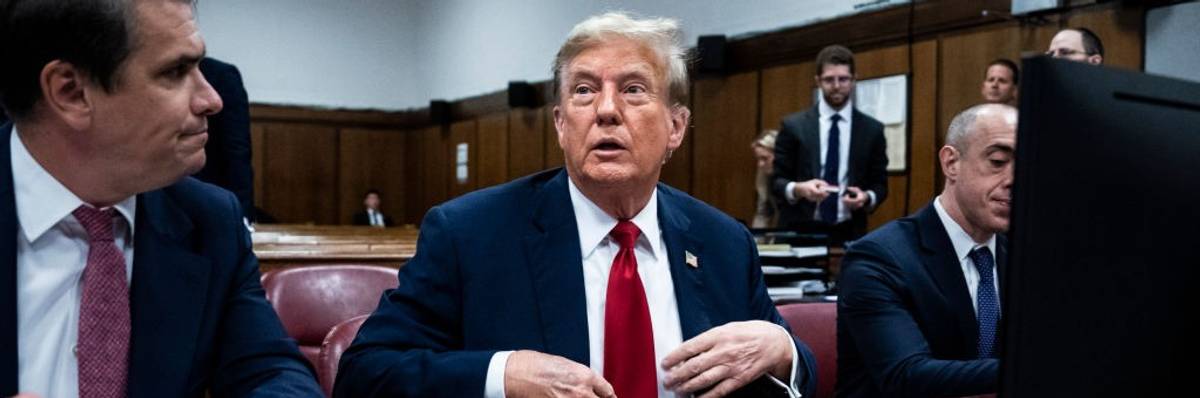
Former U.S. President Donald Trump appears with his legal team, Todd Blanche (L) and Emil Bove (R), at Manhattan Criminal Court in New York City on April 15, 2024.
"Trump engaged in criminal acts to cover up the truth just days before the 2016 election, and now he will finally face a jury of everyday Americans."
As former U.S. President Donald Trump's first of four potential criminal trials began in New York on Monday, progressive groups emphasized that what is often called a hush money case involving a porn star "is about voter deception."
Trump, the presumptive Republican candidate to face Democratic President Joe Biden in November, faces 88 felony charges across the four cases. For this one, he was indicted by a New York grand jury last spring with 34 counts of falsifying business records related to alleged hush money payments to cover up sex scandals during the 2016 election cycle.
The payments were made by Michael Cohen, Trump's former fixer, to porn star Stormy Daniels, and by the tabloid The National Enquirer to Karen McDougal, a former Playboy model. The twice-impeached ex-president has pleaded not guilty.
"This case is about the allegation that Trump criminally hid information from voters to influence the outcome of the 2016 election," said Lisa Gilbert, executive vice president of the watchdog group Public Citizen, in a statement Monday.
"You can draw a clear pattern from this election interference behavior to his more emboldened efforts to subvert the 2020 election, which led to the January 6th insurrection, a lasting stain on American democracy," she added, referring to the 2021 U.S. Capitol attack that some critics argue makes him constitutionally ineligible to hold office again. "Accountability for criminal deception of voters is absolutely necessary to ensure future candidates and public officials know they can't get away with this sort of conduct."
Gilbert stressed that "despite what Donald Trump and his allies may claim, no one is above the law—including a former president charged with serious crimes, and today marks the start of the legal system's chance to prove this point."
Stand Up America president and founder Sean Eldridge similarly celebrated that "Donald Trump will finally face accountability for falsifying his company's business records in order to conceal damning information from voters ahead of the 2016 election."
"Concealing secret payments and then lying in official filings to cover it up is a serious crime, which is why Trump has been charged with 34 felony counts," Eldridge said. "This case is a clear example of Trump's pattern of engaging in criminal behavior to cling to power and hide the truth from the American people. No one is above the law in the United States of America, including former presidents."
"A functioning democracy depends on voters having the information they need to pick their leaders," he continued. "Trump engaged in criminal acts to cover up the truth just days before the 2016 election, and now he will finally face a jury of everyday Americans."
This is the first criminal trial of a former American president. Monday featured a series of rulings from Judge Juan Merchan—who has rejected Trump's demands that he step away from the case—and the beginning of jury selection.
The New York Times reported that "the initial pool of prospective jurors dwindled rapidly. More than half of the first group of 96 were dismissed in short order after indicating that they did not believe they could be impartial. Court adjourned for the day roughly two hours after jury selection began, with zero jurors chosen."
In addition to the case in New York, Trump faces two federal cases—overseen by Special Counsel Jack Smith because of Trump's 2024 campaign. One is about his mishandling of classified material and the other stems from his attempt to reverse the 2020 election results. The Republican also faces a Georgia case for interfering with the last presidential contest.
It is not clear whether any of the other three cases will go to trial before the November election. Trump is trying to claim presidential immunity to get the federal election charges dismissed and the U.S. Supreme Court—to which he appointed three justices—is set to hear arguments in that case on April 25.
Public Citizen is among the groups that last week submitted briefs to the high court criticizing Trump's claims. The watchdog's president, Robert Weissman, said that "Trump's legal theory defies common sense and would enable an almost limitless tyranny. Nothing in the Constitution—which aims to prevent tyranny—supports Trump's theory."
This post has been updated with the former president's 88 charges, reduced from 91 in March.
Dear Common Dreams reader, It’s been nearly 30 years since I co-founded Common Dreams with my late wife, Lina Newhouser. We had the radical notion that journalism should serve the public good, not corporate profits. It was clear to us from the outset what it would take to build such a project. No paid advertisements. No corporate sponsors. No millionaire publisher telling us what to think or do. Many people said we wouldn't last a year, but we proved those doubters wrong. Together with a tremendous team of journalists and dedicated staff, we built an independent media outlet free from the constraints of profits and corporate control. Our mission has always been simple: To inform. To inspire. To ignite change for the common good. Building Common Dreams was not easy. Our survival was never guaranteed. When you take on the most powerful forces—Wall Street greed, fossil fuel industry destruction, Big Tech lobbyists, and uber-rich oligarchs who have spent billions upon billions rigging the economy and democracy in their favor—the only bulwark you have is supporters who believe in your work. But here’s the urgent message from me today. It's never been this bad out there. And it's never been this hard to keep us going. At the very moment Common Dreams is most needed, the threats we face are intensifying. We need your support now more than ever. We don't accept corporate advertising and never will. We don't have a paywall because we don't think people should be blocked from critical news based on their ability to pay. Everything we do is funded by the donations of readers like you. When everyone does the little they can afford, we are strong. But if that support retreats or dries up, so do we. Will you donate now to make sure Common Dreams not only survives but thrives? —Craig Brown, Co-founder |
As former U.S. President Donald Trump's first of four potential criminal trials began in New York on Monday, progressive groups emphasized that what is often called a hush money case involving a porn star "is about voter deception."
Trump, the presumptive Republican candidate to face Democratic President Joe Biden in November, faces 88 felony charges across the four cases. For this one, he was indicted by a New York grand jury last spring with 34 counts of falsifying business records related to alleged hush money payments to cover up sex scandals during the 2016 election cycle.
The payments were made by Michael Cohen, Trump's former fixer, to porn star Stormy Daniels, and by the tabloid The National Enquirer to Karen McDougal, a former Playboy model. The twice-impeached ex-president has pleaded not guilty.
"This case is about the allegation that Trump criminally hid information from voters to influence the outcome of the 2016 election," said Lisa Gilbert, executive vice president of the watchdog group Public Citizen, in a statement Monday.
"You can draw a clear pattern from this election interference behavior to his more emboldened efforts to subvert the 2020 election, which led to the January 6th insurrection, a lasting stain on American democracy," she added, referring to the 2021 U.S. Capitol attack that some critics argue makes him constitutionally ineligible to hold office again. "Accountability for criminal deception of voters is absolutely necessary to ensure future candidates and public officials know they can't get away with this sort of conduct."
Gilbert stressed that "despite what Donald Trump and his allies may claim, no one is above the law—including a former president charged with serious crimes, and today marks the start of the legal system's chance to prove this point."
Stand Up America president and founder Sean Eldridge similarly celebrated that "Donald Trump will finally face accountability for falsifying his company's business records in order to conceal damning information from voters ahead of the 2016 election."
"Concealing secret payments and then lying in official filings to cover it up is a serious crime, which is why Trump has been charged with 34 felony counts," Eldridge said. "This case is a clear example of Trump's pattern of engaging in criminal behavior to cling to power and hide the truth from the American people. No one is above the law in the United States of America, including former presidents."
"A functioning democracy depends on voters having the information they need to pick their leaders," he continued. "Trump engaged in criminal acts to cover up the truth just days before the 2016 election, and now he will finally face a jury of everyday Americans."
This is the first criminal trial of a former American president. Monday featured a series of rulings from Judge Juan Merchan—who has rejected Trump's demands that he step away from the case—and the beginning of jury selection.
The New York Times reported that "the initial pool of prospective jurors dwindled rapidly. More than half of the first group of 96 were dismissed in short order after indicating that they did not believe they could be impartial. Court adjourned for the day roughly two hours after jury selection began, with zero jurors chosen."
In addition to the case in New York, Trump faces two federal cases—overseen by Special Counsel Jack Smith because of Trump's 2024 campaign. One is about his mishandling of classified material and the other stems from his attempt to reverse the 2020 election results. The Republican also faces a Georgia case for interfering with the last presidential contest.
It is not clear whether any of the other three cases will go to trial before the November election. Trump is trying to claim presidential immunity to get the federal election charges dismissed and the U.S. Supreme Court—to which he appointed three justices—is set to hear arguments in that case on April 25.
Public Citizen is among the groups that last week submitted briefs to the high court criticizing Trump's claims. The watchdog's president, Robert Weissman, said that "Trump's legal theory defies common sense and would enable an almost limitless tyranny. Nothing in the Constitution—which aims to prevent tyranny—supports Trump's theory."
This post has been updated with the former president's 88 charges, reduced from 91 in March.
As former U.S. President Donald Trump's first of four potential criminal trials began in New York on Monday, progressive groups emphasized that what is often called a hush money case involving a porn star "is about voter deception."
Trump, the presumptive Republican candidate to face Democratic President Joe Biden in November, faces 88 felony charges across the four cases. For this one, he was indicted by a New York grand jury last spring with 34 counts of falsifying business records related to alleged hush money payments to cover up sex scandals during the 2016 election cycle.
The payments were made by Michael Cohen, Trump's former fixer, to porn star Stormy Daniels, and by the tabloid The National Enquirer to Karen McDougal, a former Playboy model. The twice-impeached ex-president has pleaded not guilty.
"This case is about the allegation that Trump criminally hid information from voters to influence the outcome of the 2016 election," said Lisa Gilbert, executive vice president of the watchdog group Public Citizen, in a statement Monday.
"You can draw a clear pattern from this election interference behavior to his more emboldened efforts to subvert the 2020 election, which led to the January 6th insurrection, a lasting stain on American democracy," she added, referring to the 2021 U.S. Capitol attack that some critics argue makes him constitutionally ineligible to hold office again. "Accountability for criminal deception of voters is absolutely necessary to ensure future candidates and public officials know they can't get away with this sort of conduct."
Gilbert stressed that "despite what Donald Trump and his allies may claim, no one is above the law—including a former president charged with serious crimes, and today marks the start of the legal system's chance to prove this point."
Stand Up America president and founder Sean Eldridge similarly celebrated that "Donald Trump will finally face accountability for falsifying his company's business records in order to conceal damning information from voters ahead of the 2016 election."
"Concealing secret payments and then lying in official filings to cover it up is a serious crime, which is why Trump has been charged with 34 felony counts," Eldridge said. "This case is a clear example of Trump's pattern of engaging in criminal behavior to cling to power and hide the truth from the American people. No one is above the law in the United States of America, including former presidents."
"A functioning democracy depends on voters having the information they need to pick their leaders," he continued. "Trump engaged in criminal acts to cover up the truth just days before the 2016 election, and now he will finally face a jury of everyday Americans."
This is the first criminal trial of a former American president. Monday featured a series of rulings from Judge Juan Merchan—who has rejected Trump's demands that he step away from the case—and the beginning of jury selection.
The New York Times reported that "the initial pool of prospective jurors dwindled rapidly. More than half of the first group of 96 were dismissed in short order after indicating that they did not believe they could be impartial. Court adjourned for the day roughly two hours after jury selection began, with zero jurors chosen."
In addition to the case in New York, Trump faces two federal cases—overseen by Special Counsel Jack Smith because of Trump's 2024 campaign. One is about his mishandling of classified material and the other stems from his attempt to reverse the 2020 election results. The Republican also faces a Georgia case for interfering with the last presidential contest.
It is not clear whether any of the other three cases will go to trial before the November election. Trump is trying to claim presidential immunity to get the federal election charges dismissed and the U.S. Supreme Court—to which he appointed three justices—is set to hear arguments in that case on April 25.
Public Citizen is among the groups that last week submitted briefs to the high court criticizing Trump's claims. The watchdog's president, Robert Weissman, said that "Trump's legal theory defies common sense and would enable an almost limitless tyranny. Nothing in the Constitution—which aims to prevent tyranny—supports Trump's theory."
This post has been updated with the former president's 88 charges, reduced from 91 in March.

