
SUBSCRIBE TO OUR FREE NEWSLETTER
Daily news & progressive opinion—funded by the people, not the corporations—delivered straight to your inbox.
5
#000000
#FFFFFF
To donate by check, phone, or other method, see our More Ways to Give page.


Daily news & progressive opinion—funded by the people, not the corporations—delivered straight to your inbox.
As one of the only industrialized countries in the world without national paid leave, the United States forces moms in particular to choose between continuing to work or raising our children.
Every mother in America knows this struggle well: How do you afford to raise a child?
My daughter was born almost 14 years ago, and my family is still financially recovering from the struggle of supporting a newborn. And we’re not alone—American families are spending a greater and greater portion of their income on childcare.
According to the nonprofit Child Care Aware, the average cost of childcare in the U.S. is now more than $10,000 per year—and even higher for infants and toddlers. And the problem is only getting worse. It’s no wonder so many women are choosing not to have children because they say they can’t afford them.
I’ve come to understand my experience as a failure of our elected leaders to provide basic needs like affordable, accessible childcare and paid family and medical leave.
Right before I found out I was pregnant, I was let go from my job and lost my benefits and stable income.
Once my daughter was born, instead of enjoying every moment of being new parents, my partner and I were stressed about our financial situation. I didn’t have a job to go back to, and even if I did, we wouldn’t have been able to afford childcare.
I remember tirelessly googling childcare providers in the area and becoming exasperated at the costs. There was no way that we could afford to pay $300-plus a week just for daycare—we wouldn’t be able to cover our basic living expenses.
The situation became a Catch-22: If I didn’t work, it would be impossible to balance our bills and afford the essentials to raise a child. But if I did, we wouldn’t be able to afford those things anyway, because all the money would be going to daycare.
This is why so many mothers like me are driven out of the workforce. As one of the only industrialized countries in the world without national paid leave, the United States forces moms in particular to choose between continuing to work or raising our children.
The fortunate mothers who do have access to a paid leave program are significantly less likely to quit their jobs and more likely to work for the same employer after the birth of their first child. That’s not just good for mothers—that’s good for employers and our economy as a whole.
As I think back to those days, I remember always feeling sad, not realizing that like 10-15% of new mothers I was likely dealing with postpartum depression. That feeling was only compounded by isolation and the stress of financial insecurity.
Paid leave can help address those mental stressors. According to one study, women who took longer than 12 weeks maternity leave reported fewer depressive symptoms, a reduction in severe depression, and an improvement in their overall mental health. I know I would’ve benefited greatly from knowing that I could take the time to care for my child without worrying about winding up in dire financial straits.
Having a child should be a joyful event, not a deeply stressful one. I’ve come to understand my experience as a failure of our elected leaders to provide basic needs like affordable, accessible childcare and paid family and medical leave.
I’m glad that unlike elections in the past, this crisis has become a major issue. I hope to see a day when no mother has to go through what I did.
"It will be important for Southerners from all backgrounds," one expert wrote, "to stand together and build the coalitions needed to demand policymakers create a new economic development model."
"For at least the last 40 years, pay and job quality for workers across the South has been inferior compared to other regions—thanks to the racist and anti-worker Southern economic development model."
That's according to a Thursday report by Chandra Childers, a senior policy and economic analyst at the Economic Policy Institute (EPI). The new publication is part of her "Rooted in Racism and Economic Exploitation" series.
Previous documents in the series have discussed how "Southern politicians claim that 'business-friendly' policies lead to an abundance of jobs and economic prosperity" but in reality, their failed model is designed "to extract the labor of Black and brown Southerners as cheaply as possible" and has resulted in "economic underperformance."
"Because of the political opposition to unions, when workers try to organize, employers know that they can illegally intimidate them, refuse to recognize the union, or negotiate a contract in bad faith."
Thursday's report dives into various elements of the Southern economic development model, which "is characterized by low wages, limited regulations on businesses, a regressive tax system, subsidies that funnel tax dollars to the wealthy and corporations, a weak safety net, and staunchly anti-union policies and practices."
Childers uses a U.S. Census Bureau definition of the South, which includes: Alabama, Arkansas, Delaware, Florida, Georgia, Kentucky, Louisiana, Maryland, Mississippi, North Carolina, Oklahoma, South Carolina, Tennessee, Texas, Virginia, West Virginia, and the District of Columbia.
The EPI report highlights that "Southern states have lower median wages than other regions," "low-wage workers make up a larger share of the workforce across the South," and "every state that lacks a state minimum wage" is in the region.
The publication also points out the decline of coverage from employer-provided health insurance and pensions in the South, as well as how workers there "have less access to paid leave than their peers in other regions" and "Southern state lawmakers have also disempowered local communities."
"Across the South, most states have passed so-called right-to-work laws, with the exceptions of Delaware, Maryland, and the District of Columbia," Childers detailed. "Right-to-work laws do not, in any way, guarantee workers will have access to a job if they want one. They simply make it harder for unions to be financially sustainable."
"In addition to right-to-work laws and the overall opposition from political leaders across the region, workers seeking to organize a union typically face intense opposition from employers," she continued. "Further, because of the political opposition to unions, when workers try to organize, employers know that they can illegally intimidate them, refuse to recognize the union, or negotiate a contract in bad faith—with little to no fear of being held accountable by political leaders."
While "there are city and county officials who support higher minimum wages and access to pensions and paid leave for workers" in the South, she explained, their ability to take action is limited by preemption, which "is when state policymakers either block a local ordinance or dismantle an existing ordinance" intended to help the working class.
Childers' report doesn't explicitly point fingers at particular political parties, but the region has been largely dominated by Republican officials during the past four decades covered by the analysis.
While the Republican presidential campaign of former President Donald Trump is clearly making a play for working-class voters by selecting Sen. JD Vance (R-Ohio) as the vice presidential candidate and inviting International Brotherhood of Teamsters general president Sean O'Brien to speak at this week's convention—provoking criticism from progressive politicians and labor leaders—Southern GOP leaders continue to display disdain toward efforts to organize workers.
As Volkswagen employees in Tennessee began voting on whether to join the United Auto Workers in April, six Southern GOP governors put out a joint statement saying they were "highly concerned about the unionization campaign driven by misinformation and scare tactics that the UAW has brought into our states."
EPI said at the time that the governors' anti-union statement "clearly shows how scared they are that workers organizing with UAW to improve jobs and wages will upend the highly unequal, failed anti-worker economic development model of Southern states."
The Chattanooga vote was a success, but the following month organizers faced a tough loss at a pair of Mercedes-Benz plants in Alabama, where the UAW is now seeking a new election. Meanwhile, regional GOP policymakers have ramped up attacks on unions, advancing legislation that makes organizing harder.
"To begin to work toward changing the Southern economic development model," Childers argued, "it will be important for Southerners from all backgrounds—across race, ethnicity, gender, immigrant statuses, and income levels—to stand together and build the coalitions needed to demand policymakers create a new economic development model."
The expert urged people across the South to fight for a model that includes a living wage, guaranteed health insurance, pensions, and paid leave.
"Finally, and perhaps most important, workers must be able to come together in a union to demand fair wages and benefits, a safe working environment, and the ability to have a say about their workplace—even when politicians are intransigent," she stressed. "This is a model that would serve the interests of all Southerners."
"Americans who put in an honest day's work deserve to take time off," said Rep. Seth Magaziner. "This is a matter of fairness and respect in the workplace."
With nearly 27 million American workers lacking any annual paid leave days, U.S. Sen. Bernie Sanders on Wednesday said Congress must "end the international embarrassment" of being the only wealthy country in the world that doesn't ensure people can take time off from work without risking their livelihoods.
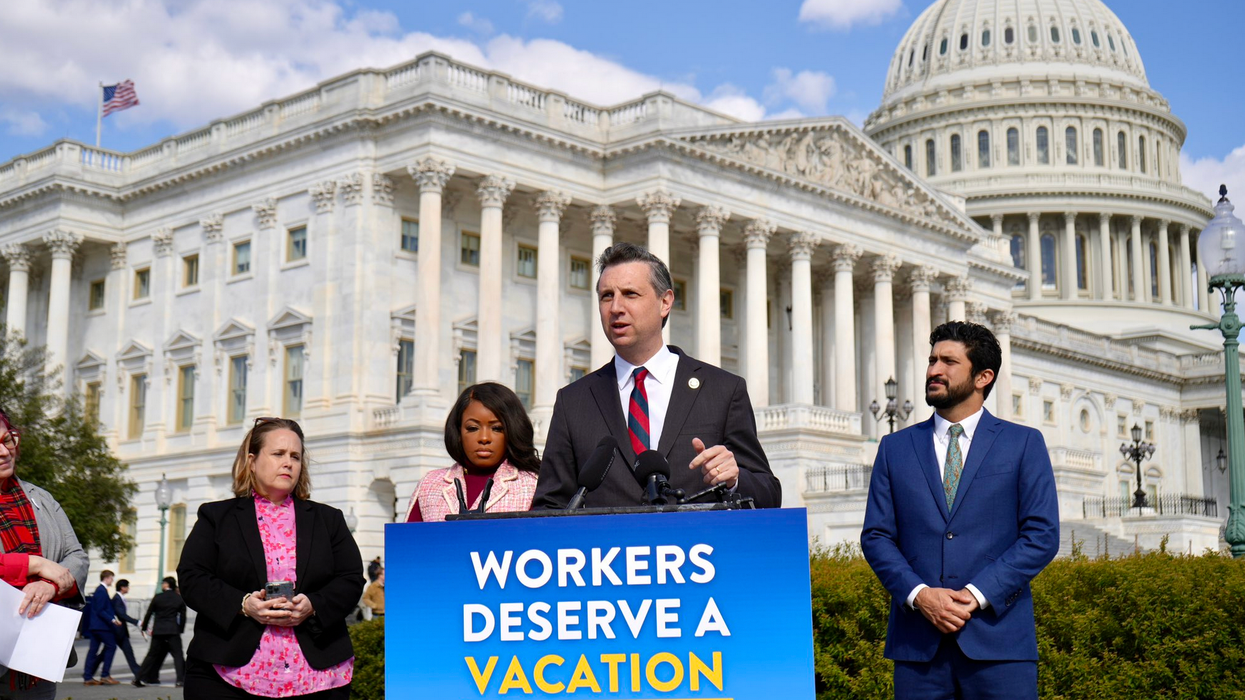
The Vermont Independent senator plans to introduce a companion bill to the Protected Time Off (PTO) Act, which was unveiled by U.S. Reps. Seth Magaziner (D-R.I.), Nikki Budzinski (D-Ill.), Greg Casar (D-Texas), and Jasmine Crockett (D-Texas).
"Americans who put in an honest day's work deserve to take time off, and I'm proud to introduce the PTO Act to make this a reality for all," said Magaziner. "This is a matter of fairness and respect in the workplace."
Under the PTO Act, employees who work full time would earn at least two weeks of paid annual leave per year, which they could use for any reason with no loss in pay. Workers would be protected from discrimination for exercising their right to take annual time off. Paid vacation time would be guaranteed in addition to paid sick leave and paid family and medical leave.
"The United States is the richest country in the history of the world—and yet, we fall behind nearly every other developed nation in terms of worker benefits and paid time off. For the millions of American workers, including the vast majority of hourly workers, a day off to care for a sick child or attend a friend's wedding means missing a day's pay—forcing workers to choose between their family, friends, or their own health and well-being, and financial stability," said Crockett. "The PTO Act sets a standard for all employers to adhere to, allowing all workers a set number of PTO days per year and bringing American labor policy closer to that of most of the developed world."
The lawmakers noted that workers in the European Union are guaranteed a minimum of 20 paid vacation days per year, with some countries requiring as many as 25 to 30 days off annually.
Forty-three members of Congress have signed on as co-sponsors of the legislation, and labor advocacy groups and unions including the Economic Policy Institute, the National Employment Law Project, and the AFL-CIO have endorsed the PTO Act.
"We're coming out of the gate with a lot of momentum," said Magaziner. "We're going to keep fighting to get this bill passed and signed into law because Americans work hard and everyone deserves to take a break every once in a while."
Susan Valentine, political director for the hospitality industry union UNITE HERE, said paid time off must no longer be treated as "a perk or a bonus" in the United States.
"It is a fundamental right that every worker deserves," said Valentine. "But too often, workers in the service and hospitality industries don't have access to PTO—perpetuating inequality and reinforcing a system that values profit over people. We must strive for a future where all workers have the opportunity to take off without sacrificing their financial security."
"The work we've done over the last five months will make a generational impact on our state—it will lower costs, improve lives, and cut child poverty," said Gov. Tim Walz.
Progressives are applauding what Minnesota House Speaker Melissa Hortman called the state's "transformational" legislative session, which ended on Tuesday after the Democratic-Farmer-Labor Party passed nearly every item on its agenda, securing economic justice, reproductive rights, and labor protections for Minnesotans.
With the DFL holding only a narrow majority in the state House and Senate—a six-vote and one-vote margin, respectively—policy researcher Will Stancil said on social media that "the scale of their achievement cannot be overstated."
"The Minnesota Legislature just completed what is probably the most productive session anywhere in the country since probably the New Deal," he said. "Sweeping bills and reforms across every area of life."
Stancil was among a number of progressives who highlighted nearly two dozen bills passed by the DFL and signed into law by Democratic Gov. Tim Walz, who posted an image of a whiteboard with party's legislative agenda on it along with the word, "Done."
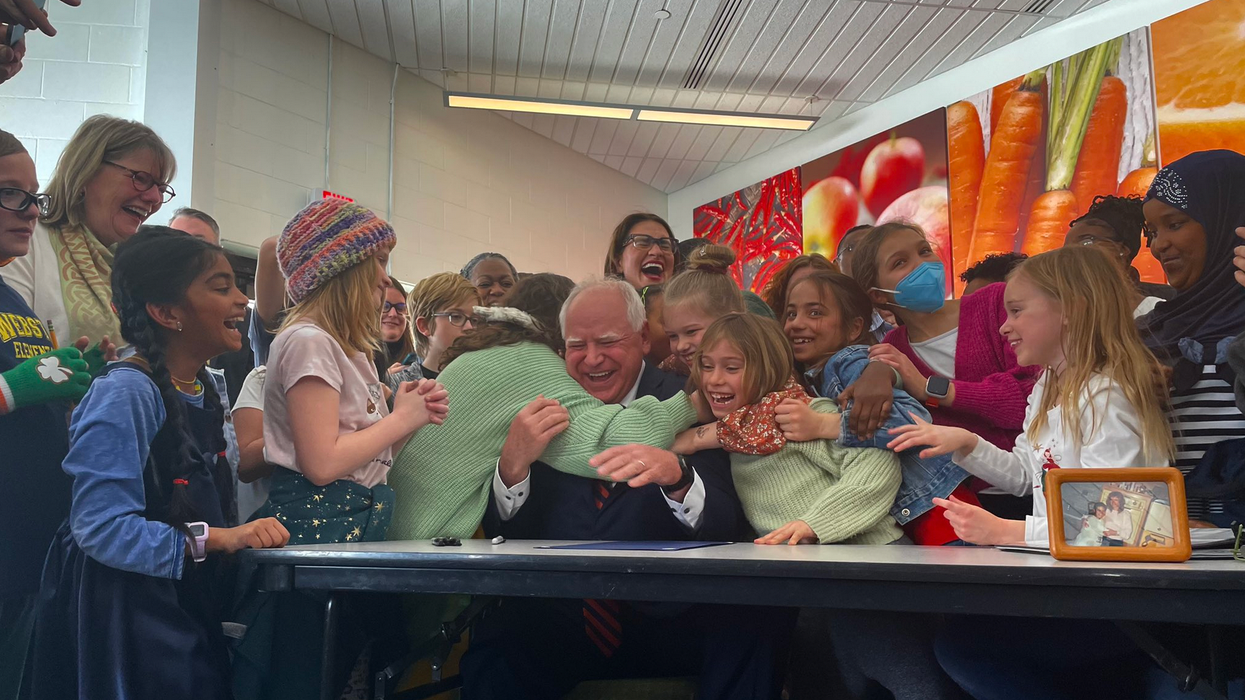
The party's achievements over the past five months include a statewide paid family and medical leave program, which provides 20 weeks of leave; the legalization of recreational marijuana use; and a law providing free school meals to all public and charter school students—part of Walz's plan to "make Minnesota the best state in the country to raise a child."
"The work we've done over the last five months will make a generational impact on our state—it will lower costs, improve lives, and cut child poverty," said Walz on Tuesday.
The party also passed a bill codifying Roe v. Wade amid a nationwide assault on abortion rights, legal protections for transgender youths who receive gender-affirming healthcare in the state, and a bill setting a minimum wage for Uber and Lyft drivers, leading a crowd of drivers to give the legislation's sponsor, state Sen. Omar Fateh (D-62), a "hero's welcome" after it passed on Sunday.
"Rather than looking at the November numbers result and imposing some kind of self-limiting narrative about the scope of their mandate, Minnesota Democrats looked at their priorities and said, 'How much of the list can we get done?'" said Stancil. "Turns out the answer was 'Almost everything.'"
The party's achievements in Minnesota, said pro-workers' rights media organization More Perfect Union, should "set the precedent for state governments across the country."
"On the balance," said the organization, "Minnesota progressives took narrow House and Senate majorities following years of gridlock—and in their first session in power, managed to set the bar for Democratic legislatures."
"It is a total disgrace that millions of workers are having to choose between their job and caring for their family, their newborn child, or themselves when they are sick and in need of care," said Sen. Bernie Sanders.
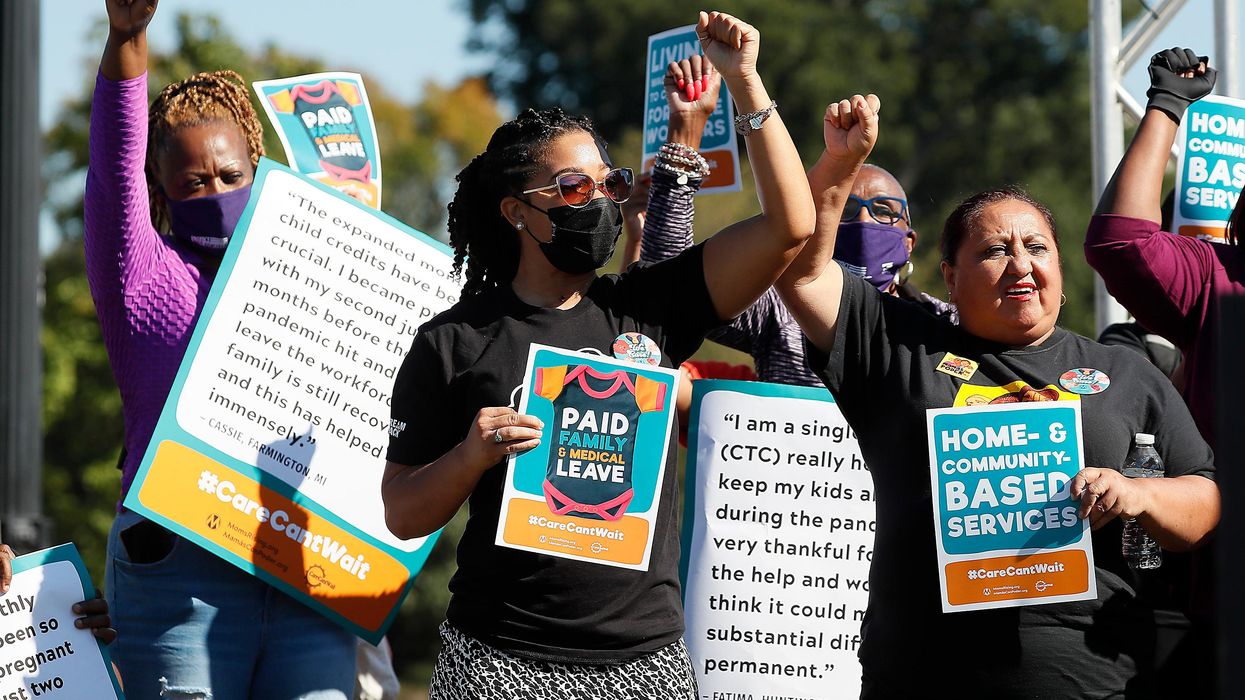
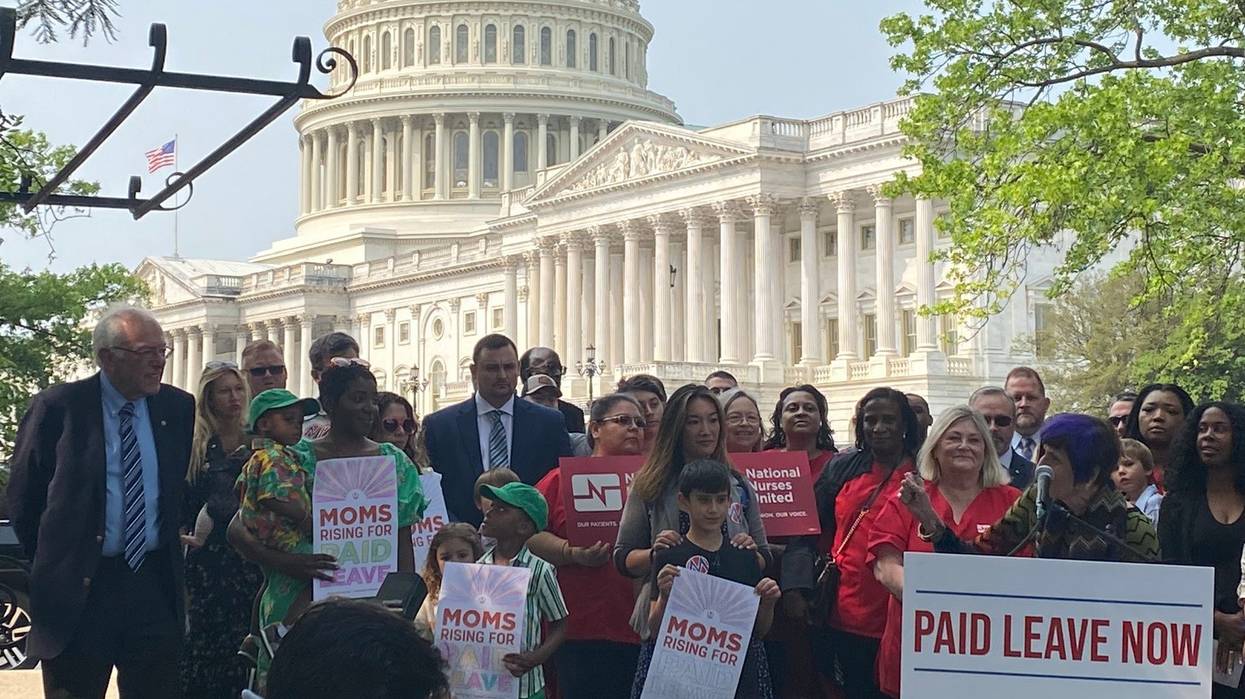
Mothers along with leaders from nursing and railway unions joined U.S. Rep. Rosa DeLauro as well as Sens. Bernie Sanders and Kirsten Gillibrand on Capitol Hill Wednesday morning to introduce two bills that would guarantee paid leave nationwide.
A fact sheet from Sanders' office highlights that "34 million American workers in the U.S. lack paid sick time entirely, including 25% of the private sector workforce and 9% of the public sector workforce," and such policies are "particularly inaccessible" for low-wage workers.
"It is time to end this absurdity," declared Sanders, who chairs the Senate Committee on Health, Education, Labor, and Pensions (HELP). "It is time for the United States to join nearly every other major country in the world and finally guarantee paid sick leave."
"In the richest country in the history of the world, it is a total disgrace that millions of workers are having to choose between their job and caring for their family, their newborn child, or themselves when they are sick and in need of care," he asserted. "It is time Congress passed this legislation to ensure workers receive the basic dignity and benefits that they deserve."
DeLauro and Gillibrand (D-N.Y.) also unveiled an updated version of the Family and Medical Insurance Leave (FAMILY) Act, which would ensure that all workers in the United States have access to paid leave for serious medical events. The legislation would provide up to 12 weeks of partial income annually and ensure those with the lowest pay earn up to 85% of their normal wages.
The FAMILY Act would also ensure workers who have been at their job for over 90 days have the right to be reinstated after their leave, allow states to continue administering existing programs, and establish a new Office of Paid Family and Medical Leave. As DeLauro noted, she and Gillibrand have been fighting for versions of their bill for the past decade.
"Thirty years ago, we broke ground by enshrining the Family and Medical Leave Act into law, providing unpaid family and medical leave for working Americans," she said. "Let's break ground again by making it paid. Since 2013, I have been proud to be joined by Sen. Gillibrand in introducing the FAMILY Act, which would establish the nation's first universal, comprehensive paid family and medical leave program. This year, the fight continues, as we reintroduce a strengthened FAMILY Act to meet families where they are now and ensure no one has to make the impossible choice between their job and the health of themselves or their loved ones."
The proposals are backed by dozens of advocacy organizations and unions, with several groups and activists demanding swift passage of both bills—though the odds are unlikely, with slim Democratic control of the Senate and the House's GOP majority.
"I had my first child, I was a public school teacher, and I had to drain all my sick time to try to maintain some income during my unpaid maternity leave," said Rachel Shelton, a MomsRising member from Asheville, North Carolina, in a statement.
"That was a huge challenge, because babies get sick!" Shelton explained. "When I had my second, I made the tough decision to leave my job because the situation was unsustainable. It shouldn't be this hard to balance caregiving and work. We need Congress to pass the FAMILY Act and Healthy Families Act, now. It's past time we guarantee all working people the paid leave and paid sick days we need to care for our families and for ourselves."
National Nurses United also supports both bills. The organization's president, Jean Ross, said that "nurses want what is best for patients, and that's why our union supports paid sick and family leave for all workers. Nurses see the negative health consequences on patients when they are unable to take leave due to their own illness, or the need to care for family."
"Nobody should have to choose between their own health or the health of their loved ones, and their livelihood," Ross stressed. "Further, nursing is a majority female profession, and paid sick and family leave is essential to ensuring that nursing becomes a sustainable profession."
The introductions—which also featured remarks from Senate Majority Leader Chuck Schumer (D-N.Y.) and Senate Appropriations Committee Chair Patty Murray (D-Wash.)—come after a year of railway workers, backed by key congressional allies including Sanders, gaining national attention for their fight for paid leave in the face of dangerous working conditions and industry greed.
Mike Baldwin, president of the Brotherhood of Railroad Signalmen, said Wednesday that "the BRS would like to thank those members of Congress who support paid sick leave. Rail workers were deemed essential during the pandemic. They came to work sick because they didn't want to miss a day's pay, or worse be disciplined for their absence."
"This legislation is important to rail workers," he said of the HFA. "It is an essential need, and it isn't just a frivolous want."
"Now it's time for the entire rail industry, which made over $26 billion in profits last year, to provide at least seven paid sick days to every rail worker in America," said Sen. Bernie Sanders in response.
After sustained pressure from organized workers and their allies, freight rail giant CSX Transportation agreed Tuesday to provide 5,000 employees in two unions with four days of paid sick leave each year—an industry-first move progressive said should serve as an example for other companies to follow.
The agreement reached between Jacksonville, Florida-based CSX and two unions—the Brotherhood of Railway Carmen (BRC) and the Brotherhood of Maintenance of Way Employes Division (BMWED)—will provide four days of fully paid sick leave each year, while allowing union members to take up to three personal leave days annually. Additionally, employees can apply their unused paid sick days to their 401K retirement accounts or take payouts.
"We are extremely proud that BRC is one of the very first unions to reach this type of an agreement," said Don Grissom, president of the BRC—which represents mechanical workers—in a statement. "This agreement is a significant accomplishment and provides a very important benefit for our members working at CSXT. The other carriers should take note and come to the bargaining table in a similar manner."
"Today's agreement is a huge win for our members at CSXT," Grissom added, "and we will continue the fight to secure paid sick leave for our members working on other railroads."
Referring to the classification for railroad companies with annual revenue exceeding $250 million, BMWED president Tony D. Cardwell said in a statement that "the other Class I railroads just reported extremely healthy earnings for 2022, many of which were record-setting."
"Other than absolute greed, there is no reason why the other Class I railroads cannot enter into an identical paid sick leave agreement."
"The workers are responsible for these profits," Caldwell added. "Other than absolute greed, there is no reason why the other Class I railroads cannot enter into an identical paid sick leave agreement with BMWED, or any other rail union for that matter, especially in light of what CSX and the BMWED have done today."
Sen. Bernie Sanders (I-Vt.), an outspoken supporter of railroad workers, tweeted that "now it's time for the entire rail industry, which made over $26 billion in profits last year, to provide at least seven paid sick days to every rail worker in America."
On the other hand, labor advocates have called out Republicans, many Democrats in Congress, and the Biden administration for siding with corporations and billionaires over workers.
Paid sick leave was a key issue in last year's contract negotiations between a dozen rail worker unions and railroad companies. While eight of the unions voted in favor of a tentative agreement negotiated by the Biden administration—a deal that had no paid sick days—four unions rejected the proposal.
Congress subsequently intervened to compel the four holdout unions to accept the contract, while House Democrats passed a concurrent resolution adding seven days of paid sick leave to the agreement.
On Thursday, Sanders will join with unions in a joint press conference where they will make a fresh demand for paid sick leave across the industry.
"There is no better use than spending the money on transformative investments that can restore the public sector and provide vital help to low-wage workers and their families," said one expert.
The American Rescue Plan Act of 2021 created a $350 billion fund to help state and local governments mitigate the Covid-19 pandemic and facilitate economic recovery. Nearly two years later, however, more than $150 billion remains unspent even as employment in the public sector and caring professions remains below pre-pandemic levels.
Dave Kamper, a researcher at the Economic Policy Institute (EPI) and 20-year veteran of the labor movement, argued Wednesday that states and cities should use tens of billions of dollars in untapped relief money to reconstruct the public sector and strengthen the care economy.
"The ARPA dollars earmarked as part of the State and Local Fiscal Recovery Fund (SLFRF) have fueled transformative investments across the country, but there's more to be done now," Kamper wrote in an EPI blog post.
"A return to the pre-pandemic status quo is not sufficient."
"As 2023 begins, state and local governments should prioritize spending relief funds on... rebuilding the public sector; expanding access to paid leave; and bolstering our systems of care through increasing access to quality childcare and eldercare, and supporting the workers who perform that work," Kamper continued. These are "three critical areas that are incredibly important for the welfare of children and families."
As shown in the map below, the 10 states with the lowest uptake of SLFRF dollars have each spent less than 7.5% of their allotted funds.
"It's not clear why those states have not yet made significant use of the money," wrote Kamper, though he noted that "all 10 states have Republican governors and Republican-controlled state legislatures."
"While private sector employment has exceeded pre-pandemic levels, public sector employment is still far below February 2020 levels," Kamper wrote. "In December, there were 452,000 fewer workers in the public sector than before the pandemic, and state and local governments in particular have 2.3% fewer workers than before than pandemic."
"Fully half those losses are in K-12 public education," he continued. "Not only are flourishing public schools necessary to the long-term well-being of children and communities, but it's also the case that parents can't easily reenter the workforce if safe and nurturing schools aren't available."
Noting that "state and local governments never fully recovered from the Great Recession of 2008-09" thanks to an ill-advised bipartisan austerity regime throughout the 2010s, Kamper stressed that "a return to the pre-pandemic status quo is not sufficient."
According to Kamper, "The shortfall in state and local government jobs is driven in large part by the inadequate wages paid to public sector workers."
As he explained:
Fully one-third of state and local government workers are paid less than $20 an hour, and 15% are paid less than $15 an hour. Black and Latinx employees are especially likely to be paid inadequate wages in the public sector, which also employs a disproportionate share of women workers. These workers need a raise, and state and local governments will need assistance in raising pay for their workers. Meanwhile, the teacher pay penalty has hit a new high: Teachers are now paid 23.5% less than comparable college-educated, non-teaching peers.
Fortunately, a solution is in sight, Kamper pointed out: Rather than continuing to sit on "substantial SLFRF dollars," policymakers "can and should" use these funds "to increase public sector pay and fill vacant jobs."
Kamper went on the make the case for investing idle SLFRF money to expand paid sick and family leave—a popular and lifesaving policy that is currently denied to most of the country's worst-paid private sector employees—and to boost care worker wages.
Low wages in the care economy, where "women and Black and Brown workers make up a disproportionate share of the workforce," are a key reason why "only 76% of the childcare service jobs lost during the pandemic have been recovered" and why there were nearly 300,000 fewer employees nursing and residential care facilities in November 2022 than in February 2020, Kamper observed.
"The needs of today demand action."
"It is unlikely that federal policymakers will enact significant new paid leave policies in 2023, nor can we expect substantial new federal investments in childcare, domestic healthcare, or long-term residential care" given the current makeup of Congress, Kamper wrote. "State and local governments can and should use SLFRF dollars to fill the gap, providing needed supports to working families and children."
"State and local governments, which spent so much of the Great Recession dealing with the consequences of austerity policies that ravaged public services, may very well be reluctant to spend down their still-ample SLFRF balances," he acknowledged. "There is, however, no better time than the present."
"The needs of today demand action," Kamper concluded. "State and local governments have more than $150 billion left to spend, and there is no better use than spending the money on transformative investments that can restore the public sector and provide vital help to low-wage workers and their families."
This week marks 95 years since the passage of the 19th Amendment, which gave women the right to vote, and 44 years since Congress designated its anniversary Women's Equality Day. This gives us the opportunity to consider how far we've come and how far we have to go and envision what the world would look like if women attained full equality. I will leave a discussion of political equality to my colleagues working tirelessly on that mission and focus on the economy.
Women make up almost half of all workers in America, and working mothers are the primary breadwinners in 40 percent of the nation's families, so economic equality would make an immense difference for families and the economy.
Just how immense? The Institute for Women's Policy Research finds that if working women were paid the same as men of the same age with similar education and hours of work, then the US economy would have produced an additional income of $447.6 billion in 2014. The average incomes of families with a working woman would increase by $7,078 annually, and poverty rates would fall dramatically. Equal pay for working women of color, who face a far larger pay gap than white women, would boost the average incomes of their families to a still greater extent.
To achieve this, lawmakers must enact policies to combat overt discrimination, such as the Paycheck Fairness Act and the Pregnant Workers Fairness Act. But that's not enough. We must also uproot the structural factors that prevent women from pursuing and attaining the same career opportunities as men.
Since women are more likely to leave the workforce or scale back on employment to care for children, elderly parents, or other loved ones in need, paid leave is a critical reform to boost family incomes and enable women to remain attached to the workforce. The catch is that to fully benefit women without imposing a stigma that could backfire on women's wages and employment; leave policies must be crafted so that men have incentives to take advantage of them as well. In other words, an America where women are equal is one where men also have greater opportunity to cuddle their babies and be present for their aging parents--roles that growing numbers of millennial men say they crave but have difficulty achieving.
At the same time, while it is entirely legitimate (and quite important) to ask why there aren't more female executives at the nation's largest companies and partners at top law firms, women's equality also demands that we work for a world where the jobs that employ a majority of women are no longer so poorly paid.
It is unacceptable that early childhood teachers--increasingly recognized as critical to children's development--still earn wages too low to live on and see little or no wage increase when they have greater educational attainment. Similarly, it's intolerable that minimum wage and overtime pay standards that apply to other employees still have not been extended to home care workers, a workforce overwhelmingly made up of women of color. Strategies that target poor conditions in these and other disproportionately female occupations are needed, as are those that increase women's opportunities in higher-paid, male-dominated jobs.
In the meantime, policies that benefit working people in general—from raising the minimum wage and the tipped minimum wage to improving overtime pay and expanding the ability to join unions—benefit working women substantially and are a key part of achieving equality.
In his 2014 State of the Union address, President Obama declared, "When women succeed, America succeeds." Achieving genuine equality would lift the entire nation.
The populist sentiment that is sweeping the nation has both a source and a solid base, according to new polling that shows a majority of Americans feel like the growing gap between the rich and the poor is cause for serious concern and should be proactively addressed by government policies.
The new poll, conducted jointly by the New York Times and CBS News, found that a "strong majority"--more than six out of 10 people across party lines--think the nation's "wealth should be more evenly divided" among its people and only slightly less (with Republican support falling off) think government policies should drive the effort to reduce the gap between the rich and the poor.
The survey covered three areas of interest—economic inequality, workers' rights, and international trade—and found, at least in broad strokes, overwhelming support for the positions of most progressives.
In abbreviated terms, the results show that Americans: 1) Recognize and dislike current levels of economic inequality and want something done about it; 2) Think low-wage workers deserve a significant raise, paid sick and parental leave, and better workplace protections; and 3) Don't know much about pending so-called "free trade deals" being negotiated in secret and largely ignored by the mainstream media, but what they do know, they don't like very much.
On specific policies that could help reduce inequality, 68 percent of respondents said they would support raising taxes on individuals who make more than $1 million a year.

The findings of the poll, according to the Times,
help explain the populist appeals from politicians of both parties, but particularly Democrats, who are seeking to capitalize on the sense among Americans that the economic recovery is benefiting only a handful at the very top.
Far from a strictly partisan issue, inequality looms large in the minds of almost half of Republicans and two-thirds of independents, suggesting that it will outlive the presidential primary contests and become a central theme in next year's general election campaign.
The survey also looked at people's sentiments regarding workers' rights in the country and showed that, across the board, support exists for stronger protections, better wages, and increased worker benefits. Among those questions, more than 71 percent think the federal minimum wage should be raised from its current rate of $7.25 per hour to $10.10; a larger majority (81 percent) favor policies that would require employers to offer paid parental leave, and a still larger proportion (85 percent) think an increase of paid sick leave for workers is a good idea.
Strikingly, there was significantly less support for the idea that fast-food restaurant employees and other low-wage workers should enjoy the $15 minimum wage a growing number of them are fighting for, but a large majority of people believe that scheduled workers in those industries should have better protections when it comes to their scheduling.

Another finding that will bolster the position and arguments of many progressives--as they continue their fight against the Trans-Pacific Partnership agreement and Fast Track authority that would give the Obama administration (and his successor) the ability to rush through the TPP and other corporate-friendly deals like TTIP and TISA in the future--is that essential support for such deals is low. Additionally striking is how little Americans feel they know about these deals, which supports critics' argument that the mainstream and corporate media have done a terrible job of informing the public about such complex and secretive agreements over the last year or more.