SUBSCRIBE TO OUR FREE NEWSLETTER
Daily news & progressive opinion—funded by the people, not the corporations—delivered straight to your inbox.
5
#000000
#FFFFFF
To donate by check, phone, or other method, see our More Ways to Give page.
Daily news & progressive opinion—funded by the people, not the corporations—delivered straight to your inbox.
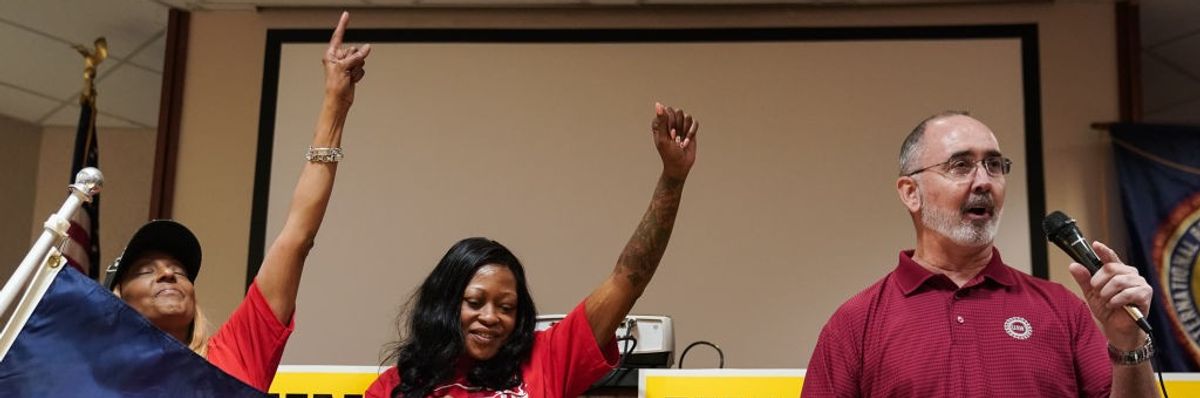
United Auto Workers president Shawn Fain, right, speaks as local organizers raise their fists at a UAW vote watch party on April 19, 2024 in Chattanooga, Tennessee.
GOP leaders in the region are "truly astonished that workers might not trust their corporate overlords with their working conditions, pay, health, and retirement," said one critic.
Since six Southern Republican governors last week showed "how scared they are" of the United Auto Workers' U.S. organizing drive, Tennessee Volkswagen employees have voted to join the UAW while GOP policymakers across the region have ramped up attacks on unions.
The UAW launched "the largest organizing drive in modern American history" after securing improved contracts last year with a strike targeting the Big Three automakers—General Motors, Ford, and Stellantis. The ongoing campaign led to the "landslide" victory in Chattanooga last week, which union president Shawn Fain pointed to as proof that "you can't win in the South" isn't true.
The Tennessee win "is breaking the brains of Republicans in that region. They're truly astonished that workers might not trust their corporate overlords with their working conditions, pay, health, and retirement," Thom Hartmann wrote in a Friday opinion piece.
"The problem for Republicans is that unions represent a form of democracy in the workplace, and the GOP hates democracy as a matter of principle."
"The problem for Republicans is that unions represent a form of democracy in the workplace, and the GOP hates democracy as a matter of principle," he argued. "Republicans appear committed to politically dying on a number of hills that time has passed by. Their commitment to gutting voting rolls and restricting voting rights, their obsession with women’s reproductive abilities, and their hatred of regulations and democracy in the workplace are increasingly seen by average American voters as out-of-touch and out-of-date."
Just before voting began in Chattanooga, GOP Govs. Kay Ivey of Alabama, Brian Kemp of Georgia, Tate Reeves of Mississippi, Henry McMaster of South Carolina, Bill Lee of Tennessee, and Greg Abbott of Texas claimed that "unionization would certainly put our states' jobs in jeopardy" and the UAW is "making big promises to our constituents that they can't deliver on."
The next nationally watched UAW vote is scheduled for May 13-17 at a Mercedes-Benz plant in Vance, Alabama.
"Workers at our plant are ready for this moment," Mercedes employee Jeremy Kimbrell said last week. "We are ready to vote yes because we are ready to win our fair share. We are going to end the Alabama discount and replace it with what our state actually needs. Workers sticking together and sticking by our community."
As workers gear up for the election, the Alabama House of Representatives on Tuesday voted 72-30 for a bill that would withhold future economic incentive money from companies that voluntarily recognize unions rather than holding secret ballots. The state Senate previously passed a version of the legislation but now must consider it with the lower chamber's amendments.
The Associated Press noted that "Georgia Gov. Brian Kemp signed similar legislation on Monday" and that Tennessee already has one on the books.
With his signature on Senate Bill 362, "Kemp's aim is to thwart future organizing attempts by workers at automotive plants in Georgia, such as those operated by Hyundai Motor Group," according to The Atlanta Journal-Constitution.
As the newspaper detailed:
Georgia has been a right-to-work state since 1947, when Congress passed the Taft-Hartley Act, allowing workers to refuse to join a union or pay dues, even though they may benefit from contracts negotiated by a union with their employer. Just 5.4% of workers in the state belonged to a union in 2023, according to the U.S. Bureau of Labor Statistics.
But the National Labor Relations Act of 1935, also known as the Wagner Act, protects the right for workers to form a union and collectively bargain for better wages and working conditions.
The new Georgia law is expected to be challenged in court, labor experts have said.
Acting U.S. Labor Secretary Julie Su told the AP on Thursday that she is not sure if the department will challenge the laws, given the National Labor Relations Board's responsibilities, but she stressed that "there are federal standards beneath which no worker should have to live and work."
In terms of joining a union, "that choice belongs to the worker, free from intervention, either by the employer or by politicians, free from retaliation and threats," Su said. "And what we are seeing is that workers who were thought to be too vulnerable to assert that right are doing it, and they're doing it here in the South."
The U.S. labor chief also slammed "unacceptable" union-busting efforts by companies and suggested that protecting the right to unionize is part of President Joe Biden's "promise to center workers in the economy."
"He has said he's the most pro-worker, pro-union president in history, and we are going to make good on that promise. And that includes making sure that workers have the right to join a union," Su said of the president.
Biden's commitment to workers and unionizing rights has caught the attention of GOP leaders. The governors' joint statement nodded to the UAW's January endorsement of the president, who is seeking reelection in November, and South Carolina's leader attacked the administration earlier this year.
During his January State of the State speech, McMaster declared that "we will not let our state's economy suffer or become collateral damage as labor unions seek to consume new jobs and conscript new dues-paying members. And we will not allow the Biden administration's pro-union policies to chip away at South Carolina's sovereign interests. We will fight. All the way to the gates of hell. And we will win."
News From the States reported Friday that "of all the foreign-owned automakers in South Carolina, BMW would be the most likely mark in the near term if enough of its workers show interest. The massive plant near Greer—the manufacturer's only U.S. production facility—employs some 11,000 people, twice the number of workers at Volkswagen in Tennessee and Mercedes in Alabama. It has operated in the Upstate for nearly 30 years and is in the process of adding electric vehicle lines."
However, a UAW spokesperson told the outlet that they don't yet have the numbers for the BMW and Volvo facilities in the state, and Marick Masters, a Wayne State University professor who studies the union, said: "I don't think they're writing anybody off but they know the history of unionization. And I would say South Carolina is a very inhospitable place for unions."
Dear Common Dreams reader, It’s been nearly 30 years since I co-founded Common Dreams with my late wife, Lina Newhouser. We had the radical notion that journalism should serve the public good, not corporate profits. It was clear to us from the outset what it would take to build such a project. No paid advertisements. No corporate sponsors. No millionaire publisher telling us what to think or do. Many people said we wouldn't last a year, but we proved those doubters wrong. Together with a tremendous team of journalists and dedicated staff, we built an independent media outlet free from the constraints of profits and corporate control. Our mission has always been simple: To inform. To inspire. To ignite change for the common good. Building Common Dreams was not easy. Our survival was never guaranteed. When you take on the most powerful forces—Wall Street greed, fossil fuel industry destruction, Big Tech lobbyists, and uber-rich oligarchs who have spent billions upon billions rigging the economy and democracy in their favor—the only bulwark you have is supporters who believe in your work. But here’s the urgent message from me today. It's never been this bad out there. And it's never been this hard to keep us going. At the very moment Common Dreams is most needed, the threats we face are intensifying. We need your support now more than ever. We don't accept corporate advertising and never will. We don't have a paywall because we don't think people should be blocked from critical news based on their ability to pay. Everything we do is funded by the donations of readers like you. When everyone does the little they can afford, we are strong. But if that support retreats or dries up, so do we. Will you donate now to make sure Common Dreams not only survives but thrives? —Craig Brown, Co-founder |
Since six Southern Republican governors last week showed "how scared they are" of the United Auto Workers' U.S. organizing drive, Tennessee Volkswagen employees have voted to join the UAW while GOP policymakers across the region have ramped up attacks on unions.
The UAW launched "the largest organizing drive in modern American history" after securing improved contracts last year with a strike targeting the Big Three automakers—General Motors, Ford, and Stellantis. The ongoing campaign led to the "landslide" victory in Chattanooga last week, which union president Shawn Fain pointed to as proof that "you can't win in the South" isn't true.
The Tennessee win "is breaking the brains of Republicans in that region. They're truly astonished that workers might not trust their corporate overlords with their working conditions, pay, health, and retirement," Thom Hartmann wrote in a Friday opinion piece.
"The problem for Republicans is that unions represent a form of democracy in the workplace, and the GOP hates democracy as a matter of principle."
"The problem for Republicans is that unions represent a form of democracy in the workplace, and the GOP hates democracy as a matter of principle," he argued. "Republicans appear committed to politically dying on a number of hills that time has passed by. Their commitment to gutting voting rolls and restricting voting rights, their obsession with women’s reproductive abilities, and their hatred of regulations and democracy in the workplace are increasingly seen by average American voters as out-of-touch and out-of-date."
Just before voting began in Chattanooga, GOP Govs. Kay Ivey of Alabama, Brian Kemp of Georgia, Tate Reeves of Mississippi, Henry McMaster of South Carolina, Bill Lee of Tennessee, and Greg Abbott of Texas claimed that "unionization would certainly put our states' jobs in jeopardy" and the UAW is "making big promises to our constituents that they can't deliver on."
The next nationally watched UAW vote is scheduled for May 13-17 at a Mercedes-Benz plant in Vance, Alabama.
"Workers at our plant are ready for this moment," Mercedes employee Jeremy Kimbrell said last week. "We are ready to vote yes because we are ready to win our fair share. We are going to end the Alabama discount and replace it with what our state actually needs. Workers sticking together and sticking by our community."
As workers gear up for the election, the Alabama House of Representatives on Tuesday voted 72-30 for a bill that would withhold future economic incentive money from companies that voluntarily recognize unions rather than holding secret ballots. The state Senate previously passed a version of the legislation but now must consider it with the lower chamber's amendments.
The Associated Press noted that "Georgia Gov. Brian Kemp signed similar legislation on Monday" and that Tennessee already has one on the books.
With his signature on Senate Bill 362, "Kemp's aim is to thwart future organizing attempts by workers at automotive plants in Georgia, such as those operated by Hyundai Motor Group," according to The Atlanta Journal-Constitution.
As the newspaper detailed:
Georgia has been a right-to-work state since 1947, when Congress passed the Taft-Hartley Act, allowing workers to refuse to join a union or pay dues, even though they may benefit from contracts negotiated by a union with their employer. Just 5.4% of workers in the state belonged to a union in 2023, according to the U.S. Bureau of Labor Statistics.
But the National Labor Relations Act of 1935, also known as the Wagner Act, protects the right for workers to form a union and collectively bargain for better wages and working conditions.
The new Georgia law is expected to be challenged in court, labor experts have said.
Acting U.S. Labor Secretary Julie Su told the AP on Thursday that she is not sure if the department will challenge the laws, given the National Labor Relations Board's responsibilities, but she stressed that "there are federal standards beneath which no worker should have to live and work."
In terms of joining a union, "that choice belongs to the worker, free from intervention, either by the employer or by politicians, free from retaliation and threats," Su said. "And what we are seeing is that workers who were thought to be too vulnerable to assert that right are doing it, and they're doing it here in the South."
The U.S. labor chief also slammed "unacceptable" union-busting efforts by companies and suggested that protecting the right to unionize is part of President Joe Biden's "promise to center workers in the economy."
"He has said he's the most pro-worker, pro-union president in history, and we are going to make good on that promise. And that includes making sure that workers have the right to join a union," Su said of the president.
Biden's commitment to workers and unionizing rights has caught the attention of GOP leaders. The governors' joint statement nodded to the UAW's January endorsement of the president, who is seeking reelection in November, and South Carolina's leader attacked the administration earlier this year.
During his January State of the State speech, McMaster declared that "we will not let our state's economy suffer or become collateral damage as labor unions seek to consume new jobs and conscript new dues-paying members. And we will not allow the Biden administration's pro-union policies to chip away at South Carolina's sovereign interests. We will fight. All the way to the gates of hell. And we will win."
News From the States reported Friday that "of all the foreign-owned automakers in South Carolina, BMW would be the most likely mark in the near term if enough of its workers show interest. The massive plant near Greer—the manufacturer's only U.S. production facility—employs some 11,000 people, twice the number of workers at Volkswagen in Tennessee and Mercedes in Alabama. It has operated in the Upstate for nearly 30 years and is in the process of adding electric vehicle lines."
However, a UAW spokesperson told the outlet that they don't yet have the numbers for the BMW and Volvo facilities in the state, and Marick Masters, a Wayne State University professor who studies the union, said: "I don't think they're writing anybody off but they know the history of unionization. And I would say South Carolina is a very inhospitable place for unions."
Since six Southern Republican governors last week showed "how scared they are" of the United Auto Workers' U.S. organizing drive, Tennessee Volkswagen employees have voted to join the UAW while GOP policymakers across the region have ramped up attacks on unions.
The UAW launched "the largest organizing drive in modern American history" after securing improved contracts last year with a strike targeting the Big Three automakers—General Motors, Ford, and Stellantis. The ongoing campaign led to the "landslide" victory in Chattanooga last week, which union president Shawn Fain pointed to as proof that "you can't win in the South" isn't true.
The Tennessee win "is breaking the brains of Republicans in that region. They're truly astonished that workers might not trust their corporate overlords with their working conditions, pay, health, and retirement," Thom Hartmann wrote in a Friday opinion piece.
"The problem for Republicans is that unions represent a form of democracy in the workplace, and the GOP hates democracy as a matter of principle."
"The problem for Republicans is that unions represent a form of democracy in the workplace, and the GOP hates democracy as a matter of principle," he argued. "Republicans appear committed to politically dying on a number of hills that time has passed by. Their commitment to gutting voting rolls and restricting voting rights, their obsession with women’s reproductive abilities, and their hatred of regulations and democracy in the workplace are increasingly seen by average American voters as out-of-touch and out-of-date."
Just before voting began in Chattanooga, GOP Govs. Kay Ivey of Alabama, Brian Kemp of Georgia, Tate Reeves of Mississippi, Henry McMaster of South Carolina, Bill Lee of Tennessee, and Greg Abbott of Texas claimed that "unionization would certainly put our states' jobs in jeopardy" and the UAW is "making big promises to our constituents that they can't deliver on."
The next nationally watched UAW vote is scheduled for May 13-17 at a Mercedes-Benz plant in Vance, Alabama.
"Workers at our plant are ready for this moment," Mercedes employee Jeremy Kimbrell said last week. "We are ready to vote yes because we are ready to win our fair share. We are going to end the Alabama discount and replace it with what our state actually needs. Workers sticking together and sticking by our community."
As workers gear up for the election, the Alabama House of Representatives on Tuesday voted 72-30 for a bill that would withhold future economic incentive money from companies that voluntarily recognize unions rather than holding secret ballots. The state Senate previously passed a version of the legislation but now must consider it with the lower chamber's amendments.
The Associated Press noted that "Georgia Gov. Brian Kemp signed similar legislation on Monday" and that Tennessee already has one on the books.
With his signature on Senate Bill 362, "Kemp's aim is to thwart future organizing attempts by workers at automotive plants in Georgia, such as those operated by Hyundai Motor Group," according to The Atlanta Journal-Constitution.
As the newspaper detailed:
Georgia has been a right-to-work state since 1947, when Congress passed the Taft-Hartley Act, allowing workers to refuse to join a union or pay dues, even though they may benefit from contracts negotiated by a union with their employer. Just 5.4% of workers in the state belonged to a union in 2023, according to the U.S. Bureau of Labor Statistics.
But the National Labor Relations Act of 1935, also known as the Wagner Act, protects the right for workers to form a union and collectively bargain for better wages and working conditions.
The new Georgia law is expected to be challenged in court, labor experts have said.
Acting U.S. Labor Secretary Julie Su told the AP on Thursday that she is not sure if the department will challenge the laws, given the National Labor Relations Board's responsibilities, but she stressed that "there are federal standards beneath which no worker should have to live and work."
In terms of joining a union, "that choice belongs to the worker, free from intervention, either by the employer or by politicians, free from retaliation and threats," Su said. "And what we are seeing is that workers who were thought to be too vulnerable to assert that right are doing it, and they're doing it here in the South."
The U.S. labor chief also slammed "unacceptable" union-busting efforts by companies and suggested that protecting the right to unionize is part of President Joe Biden's "promise to center workers in the economy."
"He has said he's the most pro-worker, pro-union president in history, and we are going to make good on that promise. And that includes making sure that workers have the right to join a union," Su said of the president.
Biden's commitment to workers and unionizing rights has caught the attention of GOP leaders. The governors' joint statement nodded to the UAW's January endorsement of the president, who is seeking reelection in November, and South Carolina's leader attacked the administration earlier this year.
During his January State of the State speech, McMaster declared that "we will not let our state's economy suffer or become collateral damage as labor unions seek to consume new jobs and conscript new dues-paying members. And we will not allow the Biden administration's pro-union policies to chip away at South Carolina's sovereign interests. We will fight. All the way to the gates of hell. And we will win."
News From the States reported Friday that "of all the foreign-owned automakers in South Carolina, BMW would be the most likely mark in the near term if enough of its workers show interest. The massive plant near Greer—the manufacturer's only U.S. production facility—employs some 11,000 people, twice the number of workers at Volkswagen in Tennessee and Mercedes in Alabama. It has operated in the Upstate for nearly 30 years and is in the process of adding electric vehicle lines."
However, a UAW spokesperson told the outlet that they don't yet have the numbers for the BMW and Volvo facilities in the state, and Marick Masters, a Wayne State University professor who studies the union, said: "I don't think they're writing anybody off but they know the history of unionization. And I would say South Carolina is a very inhospitable place for unions."