SUBSCRIBE TO OUR FREE NEWSLETTER
Daily news & progressive opinion—funded by the people, not the corporations—delivered straight to your inbox.
5
#000000
#FFFFFF
To donate by check, phone, or other method, see our More Ways to Give page.
Daily news & progressive opinion—funded by the people, not the corporations—delivered straight to your inbox.
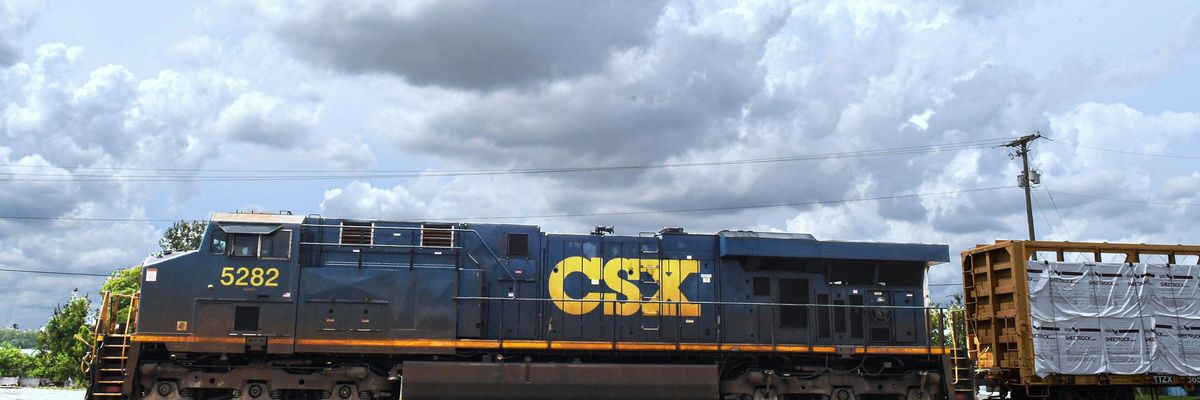
A CSX freight train is seen in Orlando, Florida on September 14, 2022.
"Now it's time for the entire rail industry, which made over $26 billion in profits last year, to provide at least seven paid sick days to every rail worker in America," said Sen. Bernie Sanders in response.
After sustained pressure from organized workers and their allies, freight rail giant CSX Transportation agreed Tuesday to provide 5,000 employees in two unions with four days of paid sick leave each year—an industry-first move progressive said should serve as an example for other companies to follow.
The agreement reached between Jacksonville, Florida-based CSX and two unions—the Brotherhood of Railway Carmen (BRC) and the Brotherhood of Maintenance of Way Employes Division (BMWED)—will provide four days of fully paid sick leave each year, while allowing union members to take up to three personal leave days annually. Additionally, employees can apply their unused paid sick days to their 401K retirement accounts or take payouts.
"We are extremely proud that BRC is one of the very first unions to reach this type of an agreement," said Don Grissom, president of the BRC—which represents mechanical workers—in a statement. "This agreement is a significant accomplishment and provides a very important benefit for our members working at CSXT. The other carriers should take note and come to the bargaining table in a similar manner."
"Today's agreement is a huge win for our members at CSXT," Grissom added, "and we will continue the fight to secure paid sick leave for our members working on other railroads."
Referring to the classification for railroad companies with annual revenue exceeding $250 million, BMWED president Tony D. Cardwell said in a statement that "the other Class I railroads just reported extremely healthy earnings for 2022, many of which were record-setting."
"Other than absolute greed, there is no reason why the other Class I railroads cannot enter into an identical paid sick leave agreement."
"The workers are responsible for these profits," Caldwell added. "Other than absolute greed, there is no reason why the other Class I railroads cannot enter into an identical paid sick leave agreement with BMWED, or any other rail union for that matter, especially in light of what CSX and the BMWED have done today."
Sen. Bernie Sanders (I-Vt.), an outspoken supporter of railroad workers, tweeted that "now it's time for the entire rail industry, which made over $26 billion in profits last year, to provide at least seven paid sick days to every rail worker in America."
On the other hand, labor advocates have called out Republicans, many Democrats in Congress, and the Biden administration for siding with corporations and billionaires over workers.
Paid sick leave was a key issue in last year's contract negotiations between a dozen rail worker unions and railroad companies. While eight of the unions voted in favor of a tentative agreement negotiated by the Biden administration—a deal that had no paid sick days—four unions rejected the proposal.
Congress subsequently intervened to compel the four holdout unions to accept the contract, while House Democrats passed a concurrent resolution adding seven days of paid sick leave to the agreement.
On Thursday, Sanders will join with unions in a joint press conference where they will make a fresh demand for paid sick leave across the industry.
Dear Common Dreams reader, It’s been nearly 30 years since I co-founded Common Dreams with my late wife, Lina Newhouser. We had the radical notion that journalism should serve the public good, not corporate profits. It was clear to us from the outset what it would take to build such a project. No paid advertisements. No corporate sponsors. No millionaire publisher telling us what to think or do. Many people said we wouldn't last a year, but we proved those doubters wrong. Together with a tremendous team of journalists and dedicated staff, we built an independent media outlet free from the constraints of profits and corporate control. Our mission has always been simple: To inform. To inspire. To ignite change for the common good. Building Common Dreams was not easy. Our survival was never guaranteed. When you take on the most powerful forces—Wall Street greed, fossil fuel industry destruction, Big Tech lobbyists, and uber-rich oligarchs who have spent billions upon billions rigging the economy and democracy in their favor—the only bulwark you have is supporters who believe in your work. But here’s the urgent message from me today. It's never been this bad out there. And it's never been this hard to keep us going. At the very moment Common Dreams is most needed, the threats we face are intensifying. We need your support now more than ever. We don't accept corporate advertising and never will. We don't have a paywall because we don't think people should be blocked from critical news based on their ability to pay. Everything we do is funded by the donations of readers like you. When everyone does the little they can afford, we are strong. But if that support retreats or dries up, so do we. Will you donate now to make sure Common Dreams not only survives but thrives? —Craig Brown, Co-founder |
After sustained pressure from organized workers and their allies, freight rail giant CSX Transportation agreed Tuesday to provide 5,000 employees in two unions with four days of paid sick leave each year—an industry-first move progressive said should serve as an example for other companies to follow.
The agreement reached between Jacksonville, Florida-based CSX and two unions—the Brotherhood of Railway Carmen (BRC) and the Brotherhood of Maintenance of Way Employes Division (BMWED)—will provide four days of fully paid sick leave each year, while allowing union members to take up to three personal leave days annually. Additionally, employees can apply their unused paid sick days to their 401K retirement accounts or take payouts.
"We are extremely proud that BRC is one of the very first unions to reach this type of an agreement," said Don Grissom, president of the BRC—which represents mechanical workers—in a statement. "This agreement is a significant accomplishment and provides a very important benefit for our members working at CSXT. The other carriers should take note and come to the bargaining table in a similar manner."
"Today's agreement is a huge win for our members at CSXT," Grissom added, "and we will continue the fight to secure paid sick leave for our members working on other railroads."
Referring to the classification for railroad companies with annual revenue exceeding $250 million, BMWED president Tony D. Cardwell said in a statement that "the other Class I railroads just reported extremely healthy earnings for 2022, many of which were record-setting."
"Other than absolute greed, there is no reason why the other Class I railroads cannot enter into an identical paid sick leave agreement."
"The workers are responsible for these profits," Caldwell added. "Other than absolute greed, there is no reason why the other Class I railroads cannot enter into an identical paid sick leave agreement with BMWED, or any other rail union for that matter, especially in light of what CSX and the BMWED have done today."
Sen. Bernie Sanders (I-Vt.), an outspoken supporter of railroad workers, tweeted that "now it's time for the entire rail industry, which made over $26 billion in profits last year, to provide at least seven paid sick days to every rail worker in America."
On the other hand, labor advocates have called out Republicans, many Democrats in Congress, and the Biden administration for siding with corporations and billionaires over workers.
Paid sick leave was a key issue in last year's contract negotiations between a dozen rail worker unions and railroad companies. While eight of the unions voted in favor of a tentative agreement negotiated by the Biden administration—a deal that had no paid sick days—four unions rejected the proposal.
Congress subsequently intervened to compel the four holdout unions to accept the contract, while House Democrats passed a concurrent resolution adding seven days of paid sick leave to the agreement.
On Thursday, Sanders will join with unions in a joint press conference where they will make a fresh demand for paid sick leave across the industry.
After sustained pressure from organized workers and their allies, freight rail giant CSX Transportation agreed Tuesday to provide 5,000 employees in two unions with four days of paid sick leave each year—an industry-first move progressive said should serve as an example for other companies to follow.
The agreement reached between Jacksonville, Florida-based CSX and two unions—the Brotherhood of Railway Carmen (BRC) and the Brotherhood of Maintenance of Way Employes Division (BMWED)—will provide four days of fully paid sick leave each year, while allowing union members to take up to three personal leave days annually. Additionally, employees can apply their unused paid sick days to their 401K retirement accounts or take payouts.
"We are extremely proud that BRC is one of the very first unions to reach this type of an agreement," said Don Grissom, president of the BRC—which represents mechanical workers—in a statement. "This agreement is a significant accomplishment and provides a very important benefit for our members working at CSXT. The other carriers should take note and come to the bargaining table in a similar manner."
"Today's agreement is a huge win for our members at CSXT," Grissom added, "and we will continue the fight to secure paid sick leave for our members working on other railroads."
Referring to the classification for railroad companies with annual revenue exceeding $250 million, BMWED president Tony D. Cardwell said in a statement that "the other Class I railroads just reported extremely healthy earnings for 2022, many of which were record-setting."
"Other than absolute greed, there is no reason why the other Class I railroads cannot enter into an identical paid sick leave agreement."
"The workers are responsible for these profits," Caldwell added. "Other than absolute greed, there is no reason why the other Class I railroads cannot enter into an identical paid sick leave agreement with BMWED, or any other rail union for that matter, especially in light of what CSX and the BMWED have done today."
Sen. Bernie Sanders (I-Vt.), an outspoken supporter of railroad workers, tweeted that "now it's time for the entire rail industry, which made over $26 billion in profits last year, to provide at least seven paid sick days to every rail worker in America."
On the other hand, labor advocates have called out Republicans, many Democrats in Congress, and the Biden administration for siding with corporations and billionaires over workers.
Paid sick leave was a key issue in last year's contract negotiations between a dozen rail worker unions and railroad companies. While eight of the unions voted in favor of a tentative agreement negotiated by the Biden administration—a deal that had no paid sick days—four unions rejected the proposal.
Congress subsequently intervened to compel the four holdout unions to accept the contract, while House Democrats passed a concurrent resolution adding seven days of paid sick leave to the agreement.
On Thursday, Sanders will join with unions in a joint press conference where they will make a fresh demand for paid sick leave across the industry.