

SUBSCRIBE TO OUR FREE NEWSLETTER
Daily news & progressive opinion—funded by the people, not the corporations—delivered straight to your inbox.
5
#000000
#FFFFFF
To donate by check, phone, or other method, see our More Ways to Give page.
Daily news & progressive opinion—funded by the people, not the corporations—delivered straight to your inbox.
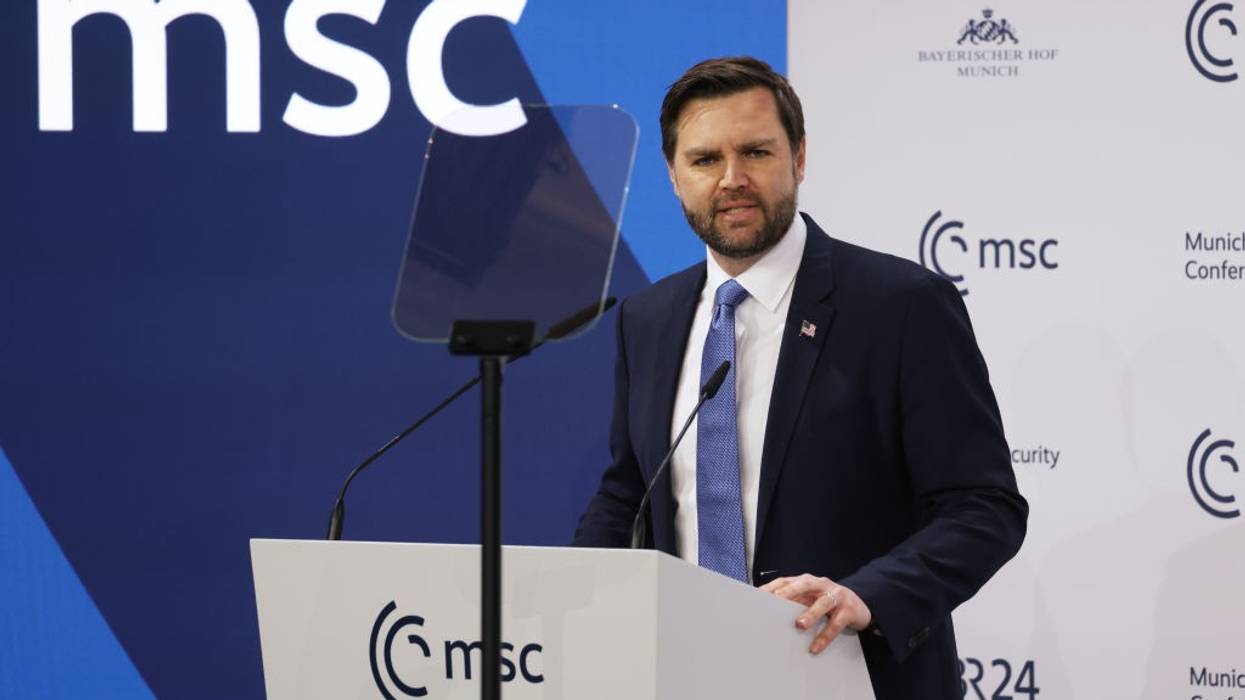
Rebuking the U.S. vice president, German Chancellor Olaf Scholz said that "a commitment to 'never again' is not reconcilable with support for the AfD."
U.S. Vice President JD Vance faced growing backlash on Saturday after scolding the European political establishment for shunning far-right parties and subsequently meeting with the leader of the neo-Nazi Alternative for Germany, just a week ahead of the country's general election.
While Vance did not explicitly mention Alternative for Germany, or AfD, during his remarks Friday at the Munich Security Conference, he declared that "there is no room for firewalls"—a reference to mainstream German political parties' refusal to work with AfD or include it in governing coalitions.
The Guardian reported that "a whisper of 'Jesus Christ' and the squirming in chairs could be heard in an overflow room" during the U.S. vice president's remarks, which he delivered a week after hundreds of thousands took to the streets of Munich to protest far-right extremism.
Following his speech, Vance met with AfD leader Alice Weidel, who praised the vice president's Munich address as "excellent" in a post on X—a social media platform owned by billionaire Elon Musk, who has also expressed support for AfD as he works to dismantle agencies throughout the U.S. government.
Reuters reported that Weidel—whose grandfather was a Nazi judge appointed directly by Adolf Hitler—met with Vance at his hotel "for about 30 minutes and discussed the Ukraine war, German domestic policy, and freedom of speech."
Vance was the highest-ranking U.S. official to ever meet with the leader of the AfD, which is seen as the most extreme of Europe's far-right parties.
On Saturday, German Chancellor Olaf Scholz rebuked Vance and said that "we will not accept outsiders intervening in our democracy," even "friends and allies."
"Never again fascism, never again racism, never again aggressive war," Scholz said in his speech at the Munich Security Conference. "That is why an overwhelming majority in our country opposes anyone who glorifies or justifies criminal National Socialism."
"A commitment to 'never again' is not reconcilable with support for the AfD," said Scholz.

First time a far-right party has won an election in Germany since the 1930s Nazi-era
Germany's far-right party Alternative for Germany (AfD) is projected to win in Sunday's statewide elections in a political earthquake—the first time a far-right party has won an election in Germany since the 1930s Nazi-era.
According to exit polls, AfD, founded in 2013 with an anti-migration and eurosceptic platform, won the most votes in the eastern state of Thuringia and is tied for first in the state of Saxony.
Today's election results are seen as a barometer of public sentiment toward German Chancellor Olaf Scholz's coalition ahead of Germany's next national election in a little over a year.
"This is a historic success for us," said national co-leader of the AfD Alice Weidel.
The Guardian reports:
"The anti-migration, anti-Islam AfD spent the last week of its campaign hammering home the message that the government is “failing” its citizens while harnessing shock and outrage over the deadly mass stabbing in the western city of Solingen allegedly by a Syrian rejected asylum seeker."
"The party, whose Saxony and Thuringia chapters security authorities have classed as rightwing extremist, could come out on top in both regions, as well as in Brandenburg, the rural state surrounding Berlin which will vote on 22 September, polls show."
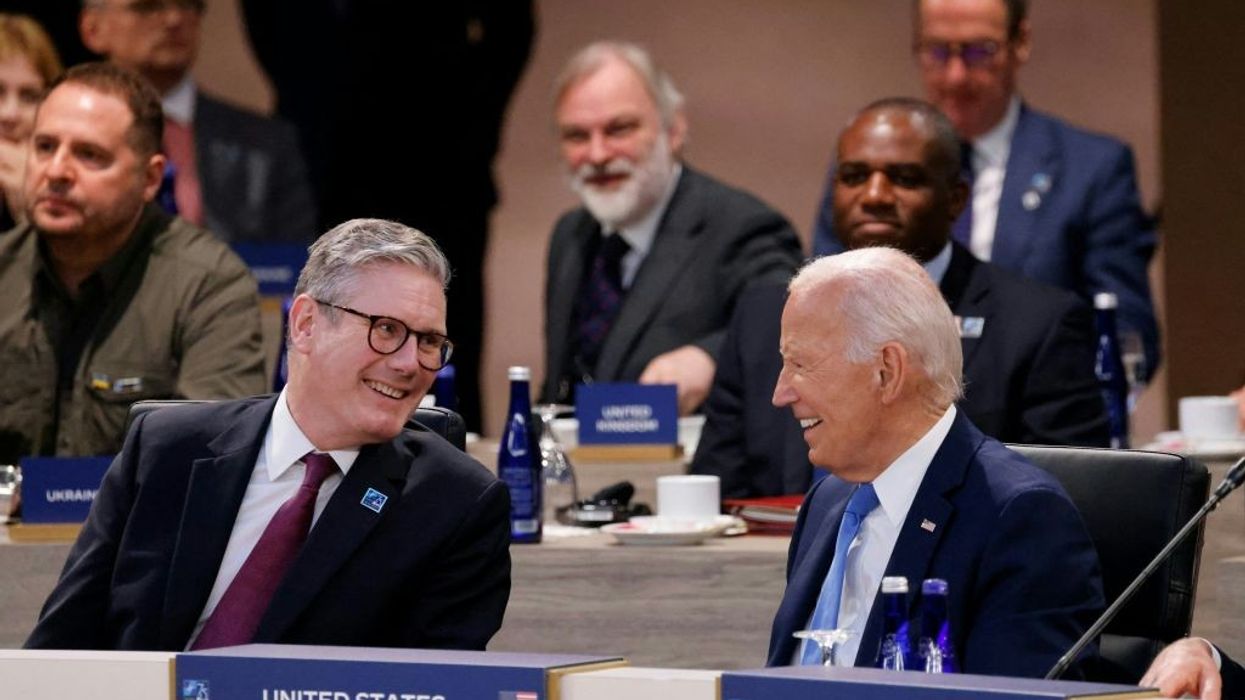
"There was a time when Global South countries had to make arguments in favor of a more just, multipolar order," said one critic. "These days, Western leaders make that case better than anyone."
Just days after releasing $3.5 billion for Israel to spend on weapons while waging war on the Gaza Strip, U.S. President Joe Biden on Monday joined leaders of France, Italy, Germany, and the United Kingdom in expressing support for "ongoing efforts to de-escalate tensions and reach a cease-fire and hostage release deal."
Biden put out a Thursday statement with Egyptian President Abdel Fattah el-Sisi and Qatari Emir Tamim al-Thani, acknowledging their months of meditation and declaring that "the time has come" for an agreement. On Monday, the U.S. and European leaders endorsed that call "to renew talks later this week with an aim to concluding the deal as soon as possible, and stressed there is no further time to lose."
"All parties must live up to their responsibilities," said Biden, French President Emmanuel Macron, Italian Prime Minister Giorgia Meloni, German Chancellor Olaf Scholz, and U.K. Prime Minister Keir Starmer. "In addition, unfettered delivery and distribution of aid is needed."
They also addressed mounting concerns of a broader Middle East war in the wake of Israel targeting Hezbollah commander Fuad Shukr with an airstrike in Beirut, Lebanon and assassinating Hamas political leader Ismail Haniyeh at his residence in the Tehran, Iran.
"We expressed our support for the defense of Israel against Iranian aggression and against attacks by Iran-backed terrorist groups," they said. "We called on Iran to stand down its ongoing threats of a military attack against Israel and discussed the serious consequences for regional security should such an attack take place."
Trita Parsi, executive vice president of the Quincy Institute for Responsible Statecraft, said in response to the new statement: "There was a time when Global South countries had to make arguments in favor of a more just, multipolar order. These days, Western leaders make that case better than anyone. Note that this statement makes ZERO mention of Israel, despite it being investigated for a genocide."
Due to Israeli forces' annihilation of Gaza—which has killed nearly 40,000 people and injured tens of thousands more, according to local officials—Israel faces a genocide case led by South Africa at the International Court of Justice. The International Criminal Court's chief prosecutor has also applied for arrest warrants for Israeli Prime Minister Benjamin Netanyahu and Defense Minister Yoav Gallant as well as three Hamas leaders—at least one of whom has since been killed.
Assal Rad, an expert on Middle East history, highlighted reporting in The Times of Israel last week that unnamed Arab officials warn a cease-fire and hostage agreement "won't be possible" unless Biden "exerts more pressure" on Netanyahu.
According to the Israeli newspaper:
One of the Arab officials lamented that Washington is the only party with enough leverage over Jerusalem to sway Netanyahu, but that is has thus far refrained from fully exploiting its role as Israel's main security benefactor.
One way to apply pressure on Netanyahu would be for the U.S. to publicly blame the Israeli premier for the lack of an agreement, the Arab official said.
That reporting preceded the move to free up more military aid for Israel. CNN reported that the U.S. State Department "notified lawmakers on Thursday night that the Biden administration intended to release the billions of dollars worth of foreign military financing," which comes from over $14 billion in supplemental funding passed by Congress in April.
"Israel won't receive $3.5 billion worth of U.S.-made weapons immediately," CNN detailed. "Instead, the funding is so Israel can procure systems that are being built now and likely won't be delivered for several years. The supplemental funding also allocated billions of dollars' worth of equipment that the Pentagon can draw from its own stockpiles to send directly to Israel on a much faster timeline."
Following the Biden administration's decision to free up more military aid for Israel—which has received not only weapons support but also diplomatic backing on the world stage since October 7—Israeli forces killed scores of Palestinians over the weekend in a strike on a Gaza school and mosque sheltering displaced people.
A spokesperson for United Nations Secretary-General António Guterres said Monday that he "condemns the continued loss of life in Gaza, including women and children, as we witness yet another devastating strike by Israel on the al-Tabin school in Gaza City, sheltering hundreds of displaced Palestinian families, with scores of fatalities, amidst continued horror, displacement, and suffering in Gaza."
"The secretary-general is dismayed to see that the provisions of U.N. Security Council resolution 2735 (2024) remain unimplemented," the spokesperson continued. "He welcomes the mediation efforts of the United States, Egypt, and Qatar leaders, and urges both sides to rejoin negotiations and conclude the ceasefire and hostages release deal."
The U.N. chief "reiterates his urgent appeal for an immediate cease-fire and the unconditional release of all hostages," the spokesperson added. "He also again underscores the need to ensure the protection of civilians and for unimpeded and safe humanitarian access into and across Gaza. The secretary-general underlines that international humanitarian law, including the principles of distinction, proportionality, and precautions in attack, must be upheld at all times."
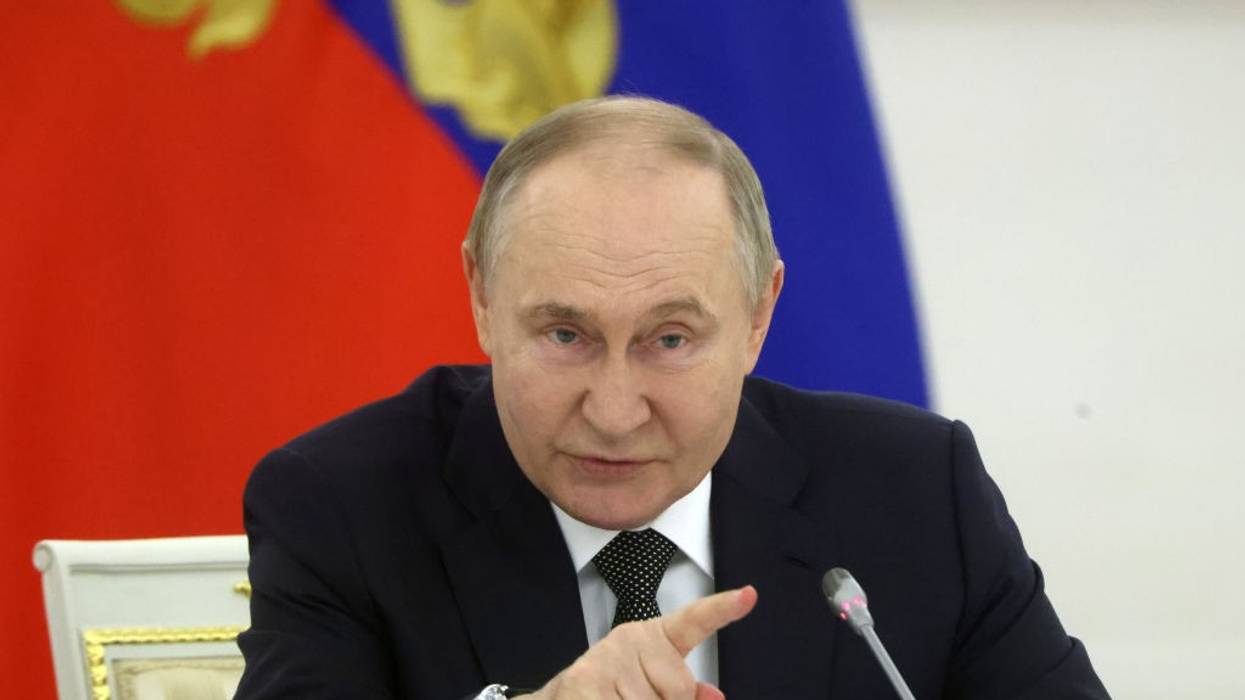
The Russian president condemned the West's "constant escalation" as NATO members including France, Germany, and Canada back Kyiv's use of long-range missiles to attack targets inside his country.
As the head of the North Atlantic Treaty Organization and leaders of NATO member nations joined the United States in advocating Ukrainian use of Western-supplied weapons to strike inside Russia, Russian President Vladimir Putin warned Tuesday that any such attacks could have grave repercussions.
"This constant escalation can lead to serious consequences," Putin told reporters during a visit to Uzbekistan. "If these serious consequences occur in Europe, how will the United States behave, bearing in mind our parity in the field of strategic weapons? It's hard to say—do they want a global conflict?"
Putin's remarks came after French President Emmanuel Macronsaid Ukraine should be allowed to "neutralize" bases inside Russia from which Russian forces are launching missiles at Ukrainian targets.
"We should not allow them to touch other targets in Russia, and obviously civilian capacities," Macron said during a visit to Germany.
🇩🇪 🇺🇦 German Chancellor Olaf Scholz has said Germany would not prohibit Ukrainian attacks on Russian military targets, saying Ukraine "is allowed to defend itself."
He made the comments in a joint show of policy support with French President Emmanuel Macron in Meseburg. pic.twitter.com/jqJctfeD3T
— euronews (@euronews) May 29, 2024
German Chancellor Olaf Scholz—who has so far declined to approve the transfer of his country's Taurus long-range cruise missiles to Ukraine—said he agreed with Macron, so long as Kyiv adheres to any restrictions imposed by suppliers.
"Ukraine has every possibility under international law for what it is doing. That has to be said explicitly," Scholz said during a joint press conference with Macron. "I find it strange when some people argue that it should not be allowed to defend itself and take measures that are suitable for this."
NATO Secretary General Jens Stoltenberg said Tuesday that he also supports letting Ukrainian forces use Western-supplied arms to attack Russia, which launched its invasion of Ukraine in February 2022.
"The time has come to consider whether it will be right to lift some of the restrictions which have been imposed because we see now that especially in the Kharkiv region, the front line and the borderline is more or less the same," he asserted.
The United Kingdom, Canada, Poland, the Netherlands, Denmark, Finland, the Czech Republic, and other NATO members also say Ukraine should be permitted to attack targets inside Russia.
In the United States, NATO's most powerful member, there is disagreement within the Biden administration over the policy. While Secretary of State Antony Blinken is reportedly pushing for a change in the administration's stance against the use of U.S.-supplied weapons to attack Russian soil, National Security Council spokesperson John Kirby told reporters Tuesday that "there's no change to our policy at this point."
"We don't encourage or enable the use of U.S.-supplied weapons to strike inside Russia," Kirby said.
Blinken, speaking in Moldova on Wednesday ahead of NATO talks in Prague, Czech Republic, responded to a question about whether the U.S. would support Ukrainian use of Western-supplied arms to attack Russia by saying that "we're always listening, we're always learning, and we're always making determinations about what's necessary to make sure that Ukraine can effectively continue to defend itself."
"At every step along the way we've adapted and adjusted as necessary," he added. "And so that's exactly what we'll do going forward."
Police in Chișinău, Moldova's capital, violently arrested anti-war demonstrators protesting Blinken's visit. Protesters reportedly doused American flags in beetroot juice simulating blood and chanted messages including "Blinken, go home; we don't want war!" and "We don't need NATO."
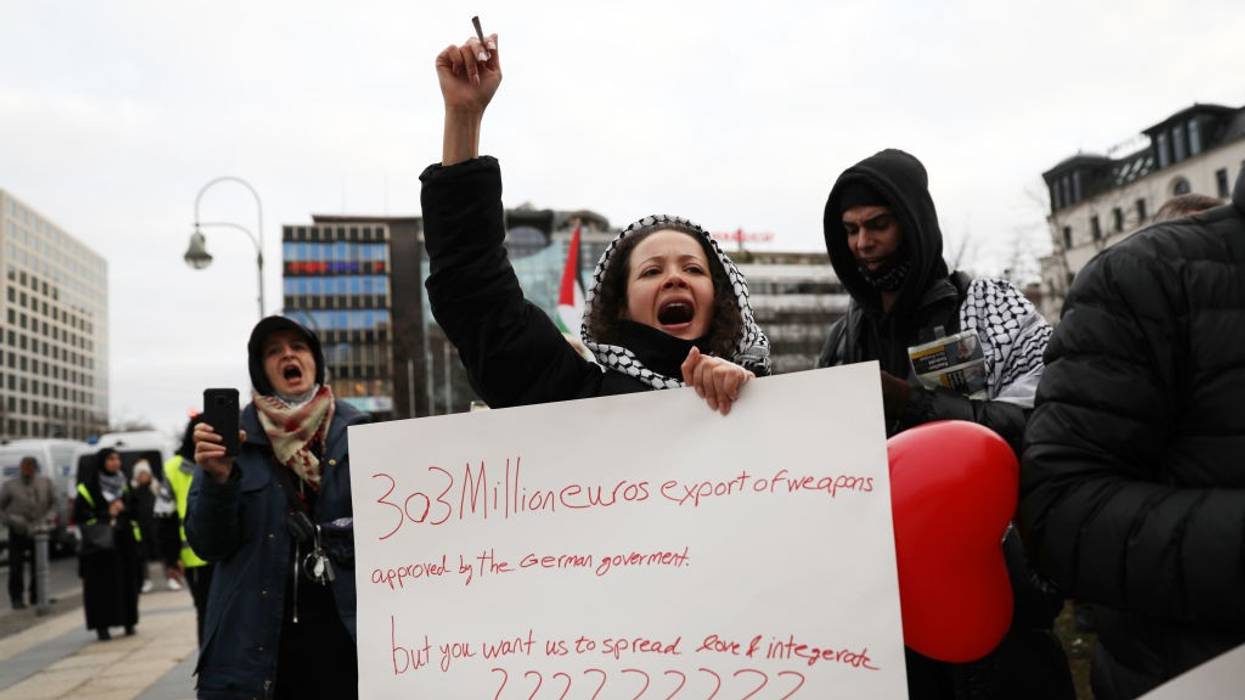
"There is reason to believe that these weapons are being used to commit grave violations of international law, such as the crime of genocide and war crimes."
The Berlin-based Lawyers' Collective on Friday sued the German government in an effort to stop weapons transfers to Israel, whose government and military are waging a genocidal war against Palestinians in Gaza.
According to the Stockholm International Peace Research Institute, Germany is the second-largest arms exporter to Israel, providing 30% of its imported weaponry from 2019-23. The top exporter, the United States, provided 69% of Israel's imported armaments during that same period.
"As there is reason to believe that these weapons are being used to commit grave violations of international law, such as the crime of genocide and war crimes, the applicants are hereby demanding that the German government protect their right to life," groups supporting the lawsuit—including the European Legal Support Center, Palestine Institute for Public Diplomacy, Law for Palestine, and Forensis—said in a statement.
Ahmed Abed, an attorney in the case who is representing Palestinian families, said during a Friday press conference in Berlin that "Germany has a constitutional responsibility to protect human life."
"The German government must stop its arms exports to Israel, as they are in violation of international law," he added. "The government cannot claim that it is not aware of this."
According to the Lawyers' Collective:
In 2023, the German government issued arms exports licenses to Israel worth €326.5 million, the majority of which were approved after October 7, 2023, a tenfold increase compared to 2022. The German government is currently supporting the Israeli army by approving the supply of 3,000 portable anti-tank weapons, 500,000 rounds of ammunition for machine guns, submachine guns, or other fully or semi-automatic firearms, as well as other military equipment, while in early 2024 Germany was preparing the authorization of 10,000 rounds of 120mm tank ammunition...
The arms deliveries and support provided by the Federal Government to Israel violate the Federal Republic's obligations under the War Weapons Control Act. The criteria for the approval of arms exports include, among other things, that the weapons are not used against Germany's obligations to international law.
The groups said that since the International Court of Justice (ICJ) found in January that Israel is plausibly committing genocide in Gaza, they believe that "the delivery of weapons is contrary to these obligations."
In February, lawyers from some of the same groups involved in the new lawsuit sued senior German officials, including Chancellor Olaf Scholz, for "aiding and abetting" Israel's genocide in Gaza.
Last month, Nicaragua filed an ICJ lawsuit against Germany accusing its government of helping Israel commit genocide against Palestinians.
In addition to exporting hundreds of millions of euros worth of arms to Israel, Germany also suspended contributions to the United Nations Relief and Works Agency for Palestine Refugees in the Near East in response to unsubstantiated Israeli accusations that 12 of the agency's 13,000 workers in Gaza were involved in the Hamas-led October 7 attacks on Israel. This, as Palestinians starve to death.
The German government has been intensely criticized for its nearly unconditional support for Israel and for violently cracking down on pro-Palestinian protests. Numerous observers contend that Germany's actions are driven by historical guilt over the Holocaust, with some critics claiming the German government is weaponizing that guilt in order to demonize Palestinians and their defenders.
The new lawsuit came as the United Nations Human Rights Council on Friday voted 28-6 with 13 abstentions in favor of a resolution demanding that Israel be held accountable for possible war crimes and crimes against humanity in Gaza. The United States and Germany were the two biggest countries to vote against the measure.
Palestinian and international human rights officials say at least 33,173 Palestinians—most of them women and children—have been killed by Israel's bombing, invasion, and siege of Gaza since October 7. More than 75,800 others have been wounded, while over 7,000 Gazans are missing and believed dead and buried beneath the rubble of the hundreds of thousands of homes and other structures damaged or destroyed by Israeli attacks.

Lawyers in Germany representing Palestinian families announced Friday that they are suing senior German officials, including Chancellor Olaf Scholz, for "aiding and abetting" Israel's genocide in Gaza.
The criminal complaint, filed Thursday with federal prosecutors in Karlsruhe in the southwestern state of Baden-Württemberg, accuses Scholz, Foreign Minister Annalena Baerbock, Defense Minister Boris Pistorius, and Economy Minister Robert Habeck of "complicity in the genocide in Gaza" by approving the export of approximately $350 million worth of military aid to Israel.
The suit also lists the German government's diplomatic support for Israel and its suspension of payments to the United Nations Relief and Works Agency for Palestine Refugees in the Near East—even as Israeli forces have killed and maimed over 100,000 Palestinians, forcibly displaced around 90% of the besieged strip's 2.3 million people, obliterated the territory's infrastructure, and pushed hundreds of thousands of Gazans to the brink of starvation.
"We Palestinians in the diaspora will not stand by and watch a genocide being committed against our families and our people."
"Our governments in Europe have a legal obligation not to provide Israel any support in perpetrating the current genocide against the Palestinian people in Gaza. This has to stop and this is what we hope to achieve by going to court," Nadija Samour, a Palestinian German lawyer who co-filed the suit, said Friday at a Berlin press conference.
"This lawsuit sends a clear message to German officials: You cannot continue to remain accomplices of such crime without consequences," she added. "We want accountability."
Last month, a provisional International Court of Justice ruling that found Israel is "plausibly" perpetrating genocide in Gaza and ordering the country's government and military to "take all measures within its power" to prevent genocidal acts.
Noting that German law requires initial suspicion for such lawsuits to proceed, Samour said that the ICJ's interim ruling "clearly showed that there is such ground for initial suspicion when it comes to the crime of genocide against the Palestinian people in Gaza."
Germany staunchly opposes the South Africa-led ICJ case. Berlin's stance has infuriated much of the Global South, including Namibia, which was colonized by Germans who perpetrated the 20th century's first genocide in the African nation.
Namibian President Hage Geingob, who died earlier this month, said in January that "Germany cannot morally express commitment to the United Nations convention against genocide, including atonement for the genocide in Namibia, whilst supporting the equivalent of a holocaust and genocide in Gaza."
Legal experts, genocide scholars, human rights campaigners, world leaders, and others have accused Israel of genocide in Gaza. Raz Segal, one of Israel's leading Holocaust scholars, has repeatedly said his country is perpetrating a "textbook case of genocide" against the people of Gaza.
Nora Ragab, a Palestinian German migration scholar and plaintiff in the lawsuit whose uncle was killed in an Israeli airstrike on Gaza, said in a statement that "we Palestinians in the diaspora will not stand by and watch a genocide being committed against our families and our people."
"We will use all means at our disposal... to hold the German government accountable for its complicity in the genocide in Gaza," she added.
Advocacy groups supporting the German lawsuit include the European Legal Support Center (ELSC), the Palestine Institute for Public Diplomacy, and Law for Palestine.
Germany "is one of the countries that has shown some of the strongest political and material support to Israel in its assault on the Gaza Strip and the Palestinians, with many German officials also inciting to genocide in their statements," ELSC said in a statement.
German arms export approvals to Israel soared last year, especially after the October 7 Hamas-led attacks. Reuters reported in November that 2023 military export authorizations through the first week of that month rose tenfold from 2022 levels, with the majority of export permits issued after October 7. German weapons and support sales to Israel totaled over $320 million last year.
Although that amount pales in comparison to the billions of dollars in annual armed aid and sales the United States provides to Israel, it does not affect the legality of such transfers. On Friday, a group of United Nations experts asserted that "any transfer of weapons or ammunition to Israel that would be used in Gaza is likely to violate international humanitarian law and must cease immediately."
Earlier this month, a Dutch court blocked the proposed export of F-35 fighter jet parts to Israel, finding a "clear risk" that those parts would be used to commit war crimes.
Many observers contend that Germany's actions are driven by historical guilt over the Holocaust. Numerous critics claim the German government is weaponizing that guilt in order to demonize Palestinians and their defenders.
"Since October 7, 2023, the Palestinian community in Germany, especially in Berlin, has been subjected to intense suppression of their protests, cultural symbols, voices, and narratives," Ragab wrote last week. "This crackdown has significantly hindered their ability to publicly express grief and outrage against the state of Israel's bombardment of Gaza."
Ragab called bans or restrictions on pro-Palestine demonstrations—sometimes enforced through police violence—"notably severe."
"By banning protests, the German state not only negates Palestinians their right to free expression and peaceful assembly, but also seeks to control the public narrative and visibility of Palestine and Palestinian life in Germany," she wrote. "Although the intensity of this suppression escalated on October 7, it is part of a historical politics of erasure, diminishing, and eradicating the collective existence and identity of Palestinians in Germany, through repression, censorship, and discrimination."
Dave Braneck, a freelance journalist in Berlin, called Germany's stance on the Gaza genocide "truly repugnant."
"You don't need a Ph.D in Middle East studies to acknowledge that children in Gaza are human," Braneck asserted. "Yet Germans fail to see the sickening irony of sanctioning the mass death of innocents and leveling of entire communities as a necessary act of atonement for the Holocaust."
He added that "if Germany had real interest in learning lessons from its appalling history, it would recognize that categorizing entire nations of people as inhuman and unworthy of sympathy or safety must be made untenable—regardless of who it's happening to."