SUBSCRIBE TO OUR FREE NEWSLETTER
Daily news & progressive opinion—funded by the people, not the corporations—delivered straight to your inbox.
5
#000000
#FFFFFF
To donate by check, phone, or other method, see our More Ways to Give page.
Daily news & progressive opinion—funded by the people, not the corporations—delivered straight to your inbox.
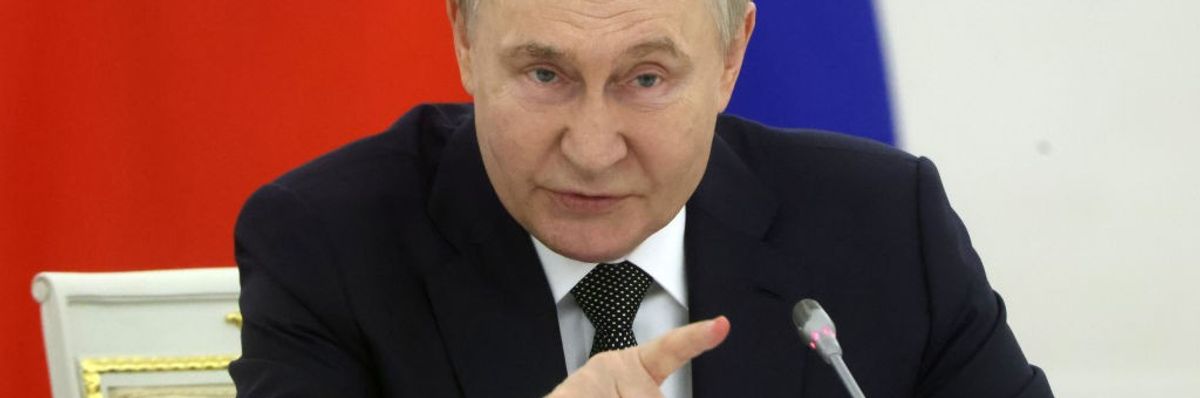
Russian President Vladimir Putin gestures while speaking at the Kremlin in Moscow on May 29, 2024.
The Russian president condemned the West's "constant escalation" as NATO members including France, Germany, and Canada back Kyiv's use of long-range missiles to attack targets inside his country.
As the head of the North Atlantic Treaty Organization and leaders of NATO member nations joined the United States in advocating Ukrainian use of Western-supplied weapons to strike inside Russia, Russian President Vladimir Putin warned Tuesday that any such attacks could have grave repercussions.
"This constant escalation can lead to serious consequences," Putin told reporters during a visit to Uzbekistan. "If these serious consequences occur in Europe, how will the United States behave, bearing in mind our parity in the field of strategic weapons? It's hard to say—do they want a global conflict?"
Putin's remarks came after French President Emmanuel Macronsaid Ukraine should be allowed to "neutralize" bases inside Russia from which Russian forces are launching missiles at Ukrainian targets.
"We should not allow them to touch other targets in Russia, and obviously civilian capacities," Macron said during a visit to Germany.
🇩🇪 🇺🇦 German Chancellor Olaf Scholz has said Germany would not prohibit Ukrainian attacks on Russian military targets, saying Ukraine "is allowed to defend itself."
He made the comments in a joint show of policy support with French President Emmanuel Macron in Meseburg. pic.twitter.com/jqJctfeD3T
— euronews (@euronews) May 29, 2024
German Chancellor Olaf Scholz—who has so far declined to approve the transfer of his country's Taurus long-range cruise missiles to Ukraine—said he agreed with Macron, so long as Kyiv adheres to any restrictions imposed by suppliers.
"Ukraine has every possibility under international law for what it is doing. That has to be said explicitly," Scholz said during a joint press conference with Macron. "I find it strange when some people argue that it should not be allowed to defend itself and take measures that are suitable for this."
NATO Secretary General Jens Stoltenberg said Tuesday that he also supports letting Ukrainian forces use Western-supplied arms to attack Russia, which launched its invasion of Ukraine in February 2022.
"The time has come to consider whether it will be right to lift some of the restrictions which have been imposed because we see now that especially in the Kharkiv region, the front line and the borderline is more or less the same," he asserted.
The United Kingdom, Canada, Poland, the Netherlands, Denmark, Finland, the Czech Republic, and other NATO members also say Ukraine should be permitted to attack targets inside Russia.
In the United States, NATO's most powerful member, there is disagreement within the Biden administration over the policy. While Secretary of State Antony Blinken is reportedly pushing for a change in the administration's stance against the use of U.S.-supplied weapons to attack Russian soil, National Security Council spokesperson John Kirby told reporters Tuesday that "there's no change to our policy at this point."
"We don't encourage or enable the use of U.S.-supplied weapons to strike inside Russia," Kirby said.
Blinken, speaking in Moldova on Wednesday ahead of NATO talks in Prague, Czech Republic, responded to a question about whether the U.S. would support Ukrainian use of Western-supplied arms to attack Russia by saying that "we're always listening, we're always learning, and we're always making determinations about what's necessary to make sure that Ukraine can effectively continue to defend itself."
"At every step along the way we've adapted and adjusted as necessary," he added. "And so that's exactly what we'll do going forward."
Police in Chișinău, Moldova's capital, violently arrested anti-war demonstrators protesting Blinken's visit. Protesters reportedly doused American flags in beetroot juice simulating blood and chanted messages including "Blinken, go home; we don't want war!" and "We don't need NATO."
Dear Common Dreams reader, It’s been nearly 30 years since I co-founded Common Dreams with my late wife, Lina Newhouser. We had the radical notion that journalism should serve the public good, not corporate profits. It was clear to us from the outset what it would take to build such a project. No paid advertisements. No corporate sponsors. No millionaire publisher telling us what to think or do. Many people said we wouldn't last a year, but we proved those doubters wrong. Together with a tremendous team of journalists and dedicated staff, we built an independent media outlet free from the constraints of profits and corporate control. Our mission has always been simple: To inform. To inspire. To ignite change for the common good. Building Common Dreams was not easy. Our survival was never guaranteed. When you take on the most powerful forces—Wall Street greed, fossil fuel industry destruction, Big Tech lobbyists, and uber-rich oligarchs who have spent billions upon billions rigging the economy and democracy in their favor—the only bulwark you have is supporters who believe in your work. But here’s the urgent message from me today. It's never been this bad out there. And it's never been this hard to keep us going. At the very moment Common Dreams is most needed, the threats we face are intensifying. We need your support now more than ever. We don't accept corporate advertising and never will. We don't have a paywall because we don't think people should be blocked from critical news based on their ability to pay. Everything we do is funded by the donations of readers like you. When everyone does the little they can afford, we are strong. But if that support retreats or dries up, so do we. Will you donate now to make sure Common Dreams not only survives but thrives? —Craig Brown, Co-founder |
As the head of the North Atlantic Treaty Organization and leaders of NATO member nations joined the United States in advocating Ukrainian use of Western-supplied weapons to strike inside Russia, Russian President Vladimir Putin warned Tuesday that any such attacks could have grave repercussions.
"This constant escalation can lead to serious consequences," Putin told reporters during a visit to Uzbekistan. "If these serious consequences occur in Europe, how will the United States behave, bearing in mind our parity in the field of strategic weapons? It's hard to say—do they want a global conflict?"
Putin's remarks came after French President Emmanuel Macronsaid Ukraine should be allowed to "neutralize" bases inside Russia from which Russian forces are launching missiles at Ukrainian targets.
"We should not allow them to touch other targets in Russia, and obviously civilian capacities," Macron said during a visit to Germany.
🇩🇪 🇺🇦 German Chancellor Olaf Scholz has said Germany would not prohibit Ukrainian attacks on Russian military targets, saying Ukraine "is allowed to defend itself."
He made the comments in a joint show of policy support with French President Emmanuel Macron in Meseburg. pic.twitter.com/jqJctfeD3T
— euronews (@euronews) May 29, 2024
German Chancellor Olaf Scholz—who has so far declined to approve the transfer of his country's Taurus long-range cruise missiles to Ukraine—said he agreed with Macron, so long as Kyiv adheres to any restrictions imposed by suppliers.
"Ukraine has every possibility under international law for what it is doing. That has to be said explicitly," Scholz said during a joint press conference with Macron. "I find it strange when some people argue that it should not be allowed to defend itself and take measures that are suitable for this."
NATO Secretary General Jens Stoltenberg said Tuesday that he also supports letting Ukrainian forces use Western-supplied arms to attack Russia, which launched its invasion of Ukraine in February 2022.
"The time has come to consider whether it will be right to lift some of the restrictions which have been imposed because we see now that especially in the Kharkiv region, the front line and the borderline is more or less the same," he asserted.
The United Kingdom, Canada, Poland, the Netherlands, Denmark, Finland, the Czech Republic, and other NATO members also say Ukraine should be permitted to attack targets inside Russia.
In the United States, NATO's most powerful member, there is disagreement within the Biden administration over the policy. While Secretary of State Antony Blinken is reportedly pushing for a change in the administration's stance against the use of U.S.-supplied weapons to attack Russian soil, National Security Council spokesperson John Kirby told reporters Tuesday that "there's no change to our policy at this point."
"We don't encourage or enable the use of U.S.-supplied weapons to strike inside Russia," Kirby said.
Blinken, speaking in Moldova on Wednesday ahead of NATO talks in Prague, Czech Republic, responded to a question about whether the U.S. would support Ukrainian use of Western-supplied arms to attack Russia by saying that "we're always listening, we're always learning, and we're always making determinations about what's necessary to make sure that Ukraine can effectively continue to defend itself."
"At every step along the way we've adapted and adjusted as necessary," he added. "And so that's exactly what we'll do going forward."
Police in Chișinău, Moldova's capital, violently arrested anti-war demonstrators protesting Blinken's visit. Protesters reportedly doused American flags in beetroot juice simulating blood and chanted messages including "Blinken, go home; we don't want war!" and "We don't need NATO."
As the head of the North Atlantic Treaty Organization and leaders of NATO member nations joined the United States in advocating Ukrainian use of Western-supplied weapons to strike inside Russia, Russian President Vladimir Putin warned Tuesday that any such attacks could have grave repercussions.
"This constant escalation can lead to serious consequences," Putin told reporters during a visit to Uzbekistan. "If these serious consequences occur in Europe, how will the United States behave, bearing in mind our parity in the field of strategic weapons? It's hard to say—do they want a global conflict?"
Putin's remarks came after French President Emmanuel Macronsaid Ukraine should be allowed to "neutralize" bases inside Russia from which Russian forces are launching missiles at Ukrainian targets.
"We should not allow them to touch other targets in Russia, and obviously civilian capacities," Macron said during a visit to Germany.
🇩🇪 🇺🇦 German Chancellor Olaf Scholz has said Germany would not prohibit Ukrainian attacks on Russian military targets, saying Ukraine "is allowed to defend itself."
He made the comments in a joint show of policy support with French President Emmanuel Macron in Meseburg. pic.twitter.com/jqJctfeD3T
— euronews (@euronews) May 29, 2024
German Chancellor Olaf Scholz—who has so far declined to approve the transfer of his country's Taurus long-range cruise missiles to Ukraine—said he agreed with Macron, so long as Kyiv adheres to any restrictions imposed by suppliers.
"Ukraine has every possibility under international law for what it is doing. That has to be said explicitly," Scholz said during a joint press conference with Macron. "I find it strange when some people argue that it should not be allowed to defend itself and take measures that are suitable for this."
NATO Secretary General Jens Stoltenberg said Tuesday that he also supports letting Ukrainian forces use Western-supplied arms to attack Russia, which launched its invasion of Ukraine in February 2022.
"The time has come to consider whether it will be right to lift some of the restrictions which have been imposed because we see now that especially in the Kharkiv region, the front line and the borderline is more or less the same," he asserted.
The United Kingdom, Canada, Poland, the Netherlands, Denmark, Finland, the Czech Republic, and other NATO members also say Ukraine should be permitted to attack targets inside Russia.
In the United States, NATO's most powerful member, there is disagreement within the Biden administration over the policy. While Secretary of State Antony Blinken is reportedly pushing for a change in the administration's stance against the use of U.S.-supplied weapons to attack Russian soil, National Security Council spokesperson John Kirby told reporters Tuesday that "there's no change to our policy at this point."
"We don't encourage or enable the use of U.S.-supplied weapons to strike inside Russia," Kirby said.
Blinken, speaking in Moldova on Wednesday ahead of NATO talks in Prague, Czech Republic, responded to a question about whether the U.S. would support Ukrainian use of Western-supplied arms to attack Russia by saying that "we're always listening, we're always learning, and we're always making determinations about what's necessary to make sure that Ukraine can effectively continue to defend itself."
"At every step along the way we've adapted and adjusted as necessary," he added. "And so that's exactly what we'll do going forward."
Police in Chișinău, Moldova's capital, violently arrested anti-war demonstrators protesting Blinken's visit. Protesters reportedly doused American flags in beetroot juice simulating blood and chanted messages including "Blinken, go home; we don't want war!" and "We don't need NATO."