

SUBSCRIBE TO OUR FREE NEWSLETTER
Daily news & progressive opinion—funded by the people, not the corporations—delivered straight to your inbox.
5
#000000
#FFFFFF
To donate by check, phone, or other method, see our More Ways to Give page.
Daily news & progressive opinion—funded by the people, not the corporations—delivered straight to your inbox.
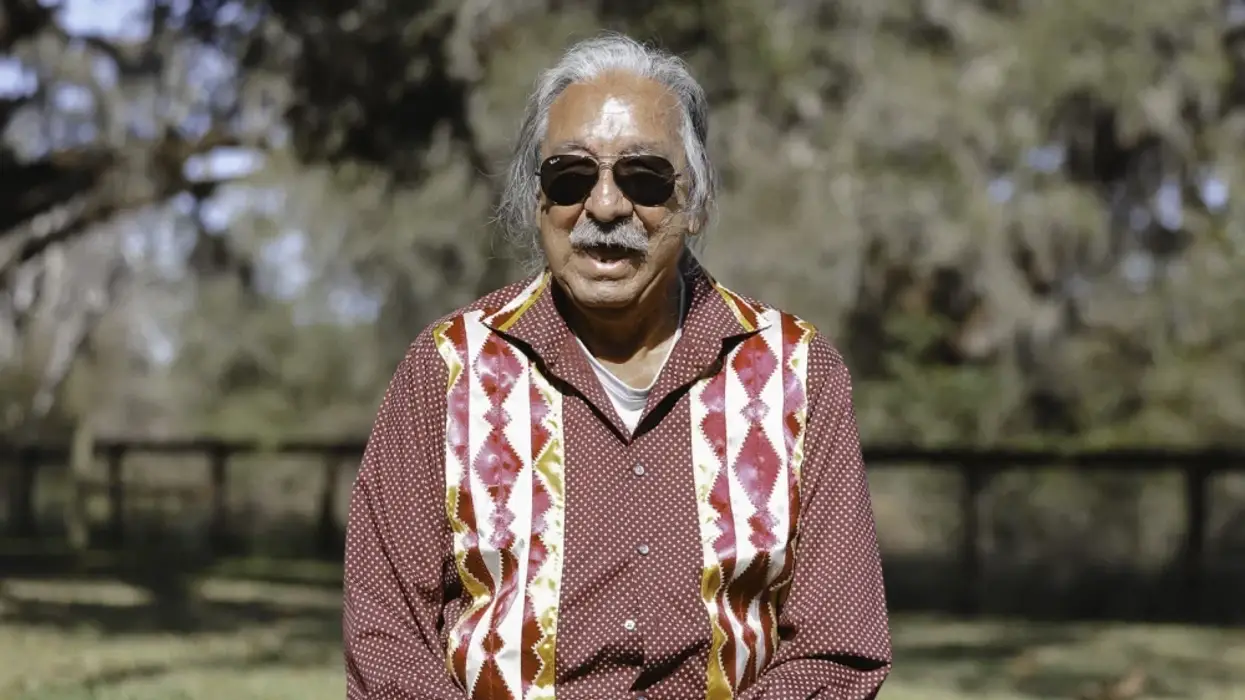
"They may have imprisoned me but they never took my spirit!" said Peltier. "I am finally going home."
Indigenous rights and criminal justice reform advocates on Tuesday celebrated as Native American political activist Leonard Peltier, who has maintained his innocence for nearly 50 years since being sentenced to life in prison for the killing of two FBI agents, walked out of a high-security prison in Florida and headed home to North Dakota.
"Today I am finally free," said Peltier in a statement to the Native news outlet Indianz.com. "They may have imprisoned me but they never took my spirit! Thank you to all my supporters throughout the world who fought for my freedom. I am finally going home. I look forward to seeing my friends, my family, and my community. It's a good day today."
Advocates for Peltier, who is 80 years old, have long called for a presidential pardon and celebrated in January when former President Joe Biden announced he was commuting Peltier's sentence. He will serve out the rest of his sentence in home confinement.
Nick Tilsen, CEO of the advocacy group NDN Collective, noted that before his conviction Peltier was one of thousands of Indigenous children who were taken from their families and sent to boarding schools, where many suffered abuse.
"He hasn't really had a home since he was taken away to boarding school," Tilsen told The Associated Press. "So he is excited to be at home and paint and have grandkids running around."
"Leonard's step outside the prison walls today marks a step toward his long overdue freedom and a step toward reconciliation with Native Americans."
Peltier, an enrolled member of the Turtle Mountain Band of Chippewa Indians in North Dakota, was convicted of two counts of first-degree murder and given two consecutive life sentences after prosecutors accused him of shooting two FBI agents at point-blank range during a confrontation at the Oglala Sioux Indian Reservation in Pine Ridge, South Dakota in 1975.
Peltier has always maintained that he did fire a gun during the confrontation, but from a distance and in self-defense. A witness who claimed that she saw Peltier shoot the agents later said she had been coerced into testifying and recanted her testimony.
Lynn Crooks, the federal chief prosecutor in the case, later admitted that the government "knew we hadn't proved" that Peltier was guilty.
The American Indian Movement, which fought for Native American treaty rights and tribal self-determination and in which Peltier was active, was subject to FBI surveillance and harassment when the shooting took place.
Kevin Sharp, an attorney and former federal judge who has represented Peltier and filed numerous clemency petitions for him, said the violent confrontation in 1975 was "unquestionably" a tragedy that was "only further compounded by the nearly 50 years of wrongful incarceration for Leonard Peltier."
"Misconduct by the government in the investigation and prosecution of Mr. Peltier has been a stain on our system of justice," said Sharp. "Leonard's step outside the prison walls today marks a step toward his long overdue freedom and a step toward reconciliation with Native Americans."
The AP reported that Peltier left USP Coleman in Sumterville, Florida in an SUV on Tuesday morning and didn't stop to speak to members of the press who were gathered outside.
Amnesty International, which has long campaigned for Peltier and considers him a political prisoner, applauded his release.
"Leonard Peltier's release is the right thing to do given the serious and ongoing human rights concerns about the fairness of his trial, his nearly 50 years behind bars, his health, and his age," Paul O'Brien, executive director of Amnesty International USA, said in a statement. "While we welcome his release from prison, he should not be restricted to home confinement."
Tilsen said that Peltier's "wrongful incarceration represented the oppression of Indigenous Peoples everywhere."
"Peltier's liberation is invaluable in and of itself," said Tilsen. "His release today is a symbol of our collective power and inherent freedom."
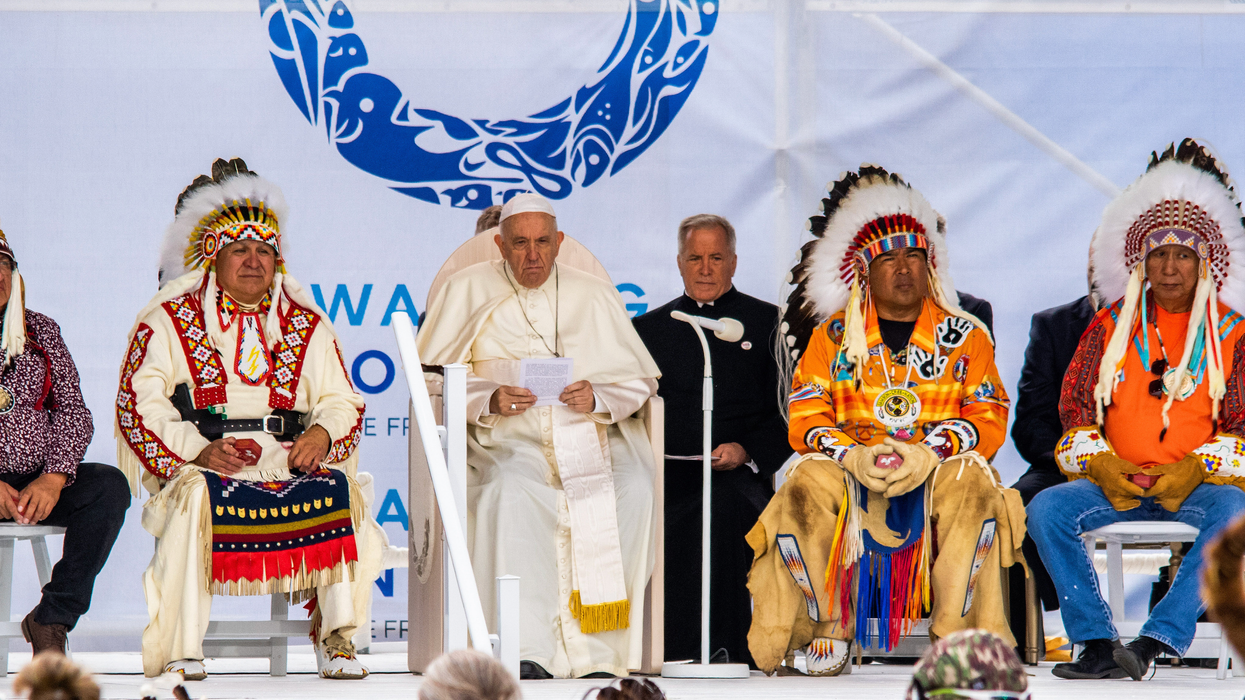
One Native American group hopes the historic move "is more than mere words, but rather is the beginning of a full acknowledgment of the history of oppression and a full accounting of the legacies of colonialism."
In a historic shift long sought by Indigenous-led activists, the Holy See on Thursday formally repudiated the doctrine of discovery, a dubious legal theory born from a series of 15th-century papal decrees used by colonizers including the United States to legally justify the genocidal conquest of non-Christian peoples and their land.
In a joint statement, the Vatican's departments of culture and education declared that "the church acknowledges that these papal bulls did not adequately reflect the equal dignity and rights of Indigenous peoples" and "therefore repudiates those concepts that fail to recognize the inherent human rights of Indigenous peoples, including what has become known as the legal and political 'doctrine of discovery.'"
"The church is also aware that the contents of these documents were manipulated for political purposes by competing colonial powers in order to justify immoral acts against Indigenous peoples that were carried out, at times, without opposition from ecclesiastical authorities," the statement added. "It is only just to recognize these errors, acknowledge the terrible effects of the assimilation policies and the pain experienced by Indigenous peoples, and ask for pardon."
Indigenous leaders—who for decades demanded the Vatican rescind the discovery doctrine—welcomed the move, while expressing hope that it brings real change.
"On the surface it sounds good, it looks good... but there has to be a fundamental change in attitudes, behavior, laws, and policies from that statement," Ernie Daniels, the former chief of Long Plain First Nation in Manitoba, Canada, told CBC Thursday.
"There's still a mentality out there—they want to assimilate, decimate, terminate, eradicate Indigenous people," added Daniels, who was part of a delegation that met with Pope Francis last year in Rome and Canada.
The pontiff—who is currently hospitalized with a respiratory infection—apologized last July in Alberta for the church's human rights crimes against First Nations and asked for forgiveness "for the wrong done by so many Christians to the Indigenous peoples."
Ghislain Picard, an Innu leader and the regional chief of the Assembly of First Nations for Quebec and Labrador, told CBC that the Vatican's move is mostly symbolic.
"The Vatican seems to be washing its hands of its role in the whole colonization of our lands, and to me it would be so simple to just accept the fact that they played a role," he said. "Reconciliation is a buzzword. But how it impacts current policy is really what's at stake here."
Discovery doctrine is rooted in a trio of papal decrees issued in the second half of the 15th century authorizing the Portuguese and Spanish monarchies to conquer land and enslave people in Africa and the Americas if they were non-Christians and dividing the Americas between the two burgeoning empires.
Nullified by the Vatican in the 16th century, the papal decrees nevertheless underpinned centuries of colonial conquest by Europeans and Euro-Americans.
In 1823, United States Supreme Court Chief Justice John Marshall wrote in Johnson v. M'Intosh that Indigenous people could not sell land to whites because Indians' "power to dispose of the soil at their own will to whomsoever they pleased was denied by the original fundamental principle that discovery gave exclusive title to those who made it."
The precedent set by Johnson was cited as recently as 2005, when then-Justice Ruth Bader Ginsburg notoriously cited doctrine of discovery in Sherrill v. Oneida Indian Nation, an opinion decried by many Native Americans.
In a Thursday interview on Indian Country Today's newscast, Arizona State University law professor Robert Miller, who is Eastern Shawnee, said that "what the church did is an important worldwide educational moment, but it doesn't change the law in any country. It doesn't change titles to land anywhere."
"It's gonna take far more than just the pope repudiating these 600-year-old papal bulls to make real changes for Indigenous peoples," he added.
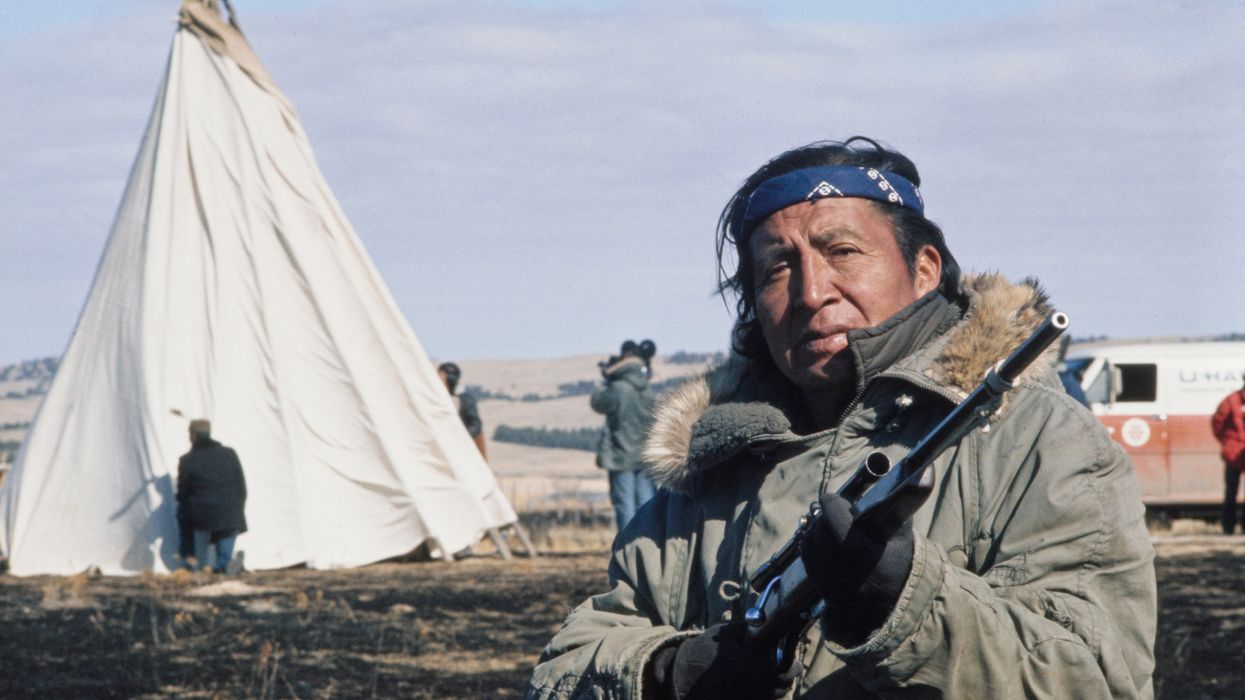
"We're not the subjugated and disenfranchised people that we were," said one Ponca elder who took part in the 1973 revolt. "Wounded Knee was an important beginning of that."
As many Native Americans on Monday marked the 50th anniversary of the militant occupation of Wounded Knee, South Dakota, participants in the 1973 uprising and other activists linked the deadly revolt to modern-day Indigenous resistance, from Standing Rock to the #LandBack movement.
On February 27, 1973 around 300 Oglala Lakota and members of the American Indian Movement (AIM), seething from centuries of injustices ranging from genocide to leniency for whites who committed crimes against Indians, occupied the hamlet of Wounded Knee on the Pine Ridge Reservation for more than two months. The uprising occurred during a period of increased Native American militancy and the rise of AIM, which first drew international attention in 1969 with the 19-month occupation of Alcatraz Island in San Francisco Bay.
"The Native people of this land after Wounded Knee, they had like a surge of new pride in being Native people," Dwain Camp, an 85-year-old Ponca elder who took part in the 1973 revolt, told The Associated Press.
"Anything that goes on, anything we do, even today with the #LandBack issue, all of that is just a continuation."
Camp said the occupation drove previously "unimaginable" changes, including the Indian Self-Determination and Education Assistance Act, the Indian Child Welfare Act, the American Indian Religious Freedom Act, and the Indian Gaming Regulatory Act.
"After we left Wounded Knee, it became paramount that protecting Mother Earth was our foremost issue," he explained. "Since that period of time, we've learned that we've got to teach our kids our true history."
Camp said the spirit of Wounded Knee lives on in Indigenous resistance today.
"We're not the subjugated and disenfranchised people that we were," he said. "Wounded Knee was an important beginning of that. And because we're a resilient people, it's something we take a lot of pride in."
Some of the participants in the 1973 uprising had been raised by grandparents who remembered or even survived the 1890 massacre of more than 200 Lakota Lakota men, women, and children by U.S. troops at Wounded Knee.
"That's how close we are to our history," Madonna Thunder Hawk, an 83-year-old elder in the Oohenumpa band of the Cheyenne River Sioux Tribe who was a frontline participant in the 1973 occupation, told Indian Country Today. "So anything that goes on, anything we do, even today with the #LandBack issue, all of that is just a continuation. It's nothing new."
Nick Tilsen, an Oglala Lakota who played a prominent role in the 2016-17 protests against the Dakota Access Pipeline at Standing Rock, North Dakota and who founded the NDN Collective, told Indian Country Today that "for me, it's important to acknowledge the generation before us—to acknowledge their risk."
"It's important for us to honor them," said Tilsen, whose parents met at the Wounded Knee occupation. "It's important for us to thank them."
Akim Reinhardt, an associate professor of history at Townson State University in Baltimore, told Indian Country Today that the AIM protests "helped establish a sense of the permanence of Red Power in much the way that Black Power had for African-Americans, a permanent legacy."
"It was the cultural legacy that racism isn't okay and people don't need to be quiet and accept it anymore," he added. "That it's okay to be proud of who you are."
Indian Country Today reports:
The occupation began on the night of Feb. 27, 1973, when a group of warriors led by Oklahoma AIM leader Carter Camp, Ponca, moved into the small town of Wounded Knee. They took over the trading post and established a base of operations along with AIM leaders Russell Means, Oglala Lakota; Dennis Banks, Ojibwe; and Clyde Bellecourt, White Earth Nation.
Within days, hundreds of activists had joined them for what became a 71-day standoff with the U.S. government and other law enforcement.
Black activist Ray Robinson, who had been working with the Oglala Sioux Civil Rights Organization, went missing during the standoff. In 2014, the FBI confirmed that Robinson died at Wounded Knee, but his body was never recovered.
AIM remains active today. Its members have participated in the fights against the Dakota Access, Keystone XL, and Line 3 pipelines, as well as in the effort to free Leonard Peltier, a former AIM leader who has been imprisoned for over 45 years after a dubious conviction for murdering two FBI agents during a separate 1975 shootout on the Pine Ridge Reservation.
Kevin McKiernan, then a rookie reporter for NPR who was smuggled into Wounded Knee after the Nixon administration banned journalists from covering the standoff, said in an interview with NPR that the #LandBack movement—spearheaded in the U.S. by NDN Collective—is a leading example of the occupation's legacy.
"And I think that there is a collective or a movement like that on every reservation with every tribe," McKiernan said. "They're going to get back, to buy back, to get donated—just do it by inches."
"That's what's going on in every inch of Indian country today," he added.
Until a few years ago, the word "occupation" was synonymous with power, imperialism and foreign invasion. Today, in the post-Occupy Wall Street era, more and more activists are using their physical presence to make demands. From Manhattan's Zuccotti Park to Tahrir Square in Cairo, occupation has become a powerful method of organizing.
One of the most dramatic such occupations is a growing encampment at the Cannonball River in North Dakota, where indigenous tribes are leading a coalition of environmental activists in protest over the building of a new crude oil pipeline.
The Dakota Access pipeline (DAPL) has stolen more than a name from American Indians ("Dakota" means "friendly" or "allied"). If built, it would pass under the Missouri River twice. The pipeline, which could leak, as many pipelines do, threatens to contaminate the drinking water, crops, and burial grounds of the Standing Rock Sioux tribe. Federal regulatory agencies, including the Army Corps of Engineers, quietly approved DAPL, transporting Bakkan crude oil from North Dakota through South Dakota, Iowa and Illinois.
Last November, President Obama rejected the Keystone XL pipeline, which would have transported tar sands oil from Alberta, Canada, to the U.S. Gulf Coast. The rejection was the result of a years-long, hard-fought battle by thousands of activists, many of whom made personal sacrifices, traveled long distances and were even arrested for their acts of civil disobedience.
DAPL, which is only seven miles shorter than Keystone would have been, has not received the same scrutiny. Now, the only thing standing in the way of the pipeline is a growing army of nonviolent protesters blocking construction. An occupation that began in April has grown to about 2,000 and is still growing. Members of the Standing Rock Sioux have set strict rules at the space they are calling Sacred Stone Camp: No weapons, alcohol, or drugs.
Members of other North American tribes, including Canadian First Nations, are traveling to the site in solidarity. Celebrities such as Leonardo DiCaprio, Shailene Woodle,y and Ezra Miller have lent their support. The protesters are standing firm, and more than 20 people have been arrested.
Jason Coppola, a filmmaker,r and journalist who has been covering the protests, explained in an interview with me that one of the most important aspects of this story is age-old: The U.S. government is violating its treaty obligations to Native American tribes. According to Coppola, "The Fort Laramie Treaty of 1868 guaranteed complete and total access, undisturbed access, [of the land] to the Great Sioux Nation of the Oceti Sakowin [Seven Council Fires]." But that treaty has not been respected. The U.S. National Archives and Records Administration explains how--as a result of an expedition led in 1874 by Gen. George Armstrong Custer in search of gold on the Black Hills reservation in North Dakota--"[t]o this day, ownership of the Black Hills remains the subject of a legal dispute between the U.S. government and the Sioux."
Coppola told me it is "important to see this fight in the broader context" because "the Lakota nation and its people have been fighting situations like this for a very long time." The DAPL dispute is not just about a pipeline running under a river. It is about the rights of the original inhabitants of the United States.
At a time when white-supremacist notions are re-emerging and a major-party presidential candidate is encouraging America to hate again, this battle of government and corporate power against Native American rights is an important reminder of the real power dynamics in the U.S. and of who has been denied rights since the founding of the country.
Earlier this year, a group of armed white men led by Ammon Bundy occupied the Malheur National Wildlife Refuge in Oregon for more than 40 days in protest of federal land ownership. Those occupiers, who garnered far greater mainstream media attention than the DAPL protesters, ignored the fact that the original stewards of the land they were claiming were members of the Burns Paiute tribe. The tribe fought for decades in court to gain rights to the land, only to be given a few hundred dollars per person as compensation.
By contrast, the very people that the U.S. has historically sold out and continues to betray lead the occupation in North Dakota. Just as it served the needs of white settlers in decades past, the government is putting corporate power and fossil fuel interests over Native American rights in the case of the DAPL project.
Energy Transfer Partners, the company building the pipeline, has launched a website with the innocent-sounding name of daplpipelinefacts.com. On it, the company touts seemingly optimistic economic gains, including the creation of "8,000 to 12,000 construction jobs" (contrasted with a mere "40 permanent operating jobs"). It echoes the standard claim of "energy independence" by liberal politicians, saying that the pipeline will help the U.S. be "truly independent of energy from unstable regions of the world" because "every barrel of crude oil produced in the United States directly displaces a barrel of imported foreign oil."
Under the "frequently asked questions" section, the website asks: "What is Dakota Access Pipeline's commitment to protecting sensitive areas and the environment, such as wetlands and culturally important sites?" The lengthy answer addresses only concerns such as restoring seed banks and vegetative cover but says nothing about the "culturally important sites" it raises in its own question. The rest of the page focuses mostly on the concerns of private landowners. There is no mention whatsoever of the Standing Rock Sioux tribe. It is as if the tribe does not exist.
Obama claimed to set his administration apart from previous ones by partnering with Native American communities. He has made it a point to visit reservations, a rare act by presidential standards. In 2014, during a visit to North Dakota, he said he was "determined to partner with tribes ... on just about every issue that touches your lives." Indeed, his rejection of the Keystone XL pipeline could be viewed in light of that partnership (Oglala Sioux leader Bryan Brewer called Keystone "a death warrant for our people" during Obama's visit). In the last few months of Obama's administration, whether it will intervene to stop the DAPL despite the approval of federal permits remains to be seen.
Regardless, indigenous activists are determined to occupy their own land for as long as it takes to stop the construction of the pipeline. If they succeed, it will be one small measure of justice in a line of injustices going back to the founding of this nation.
Underscoring how the struggles for racial, environmental, and economic justice are deeply intertwined, this year's Food Sovereignty Prize, honoring those who are taking back their food systems, will be bestowed Wednesday to the Georgia-based Federation of Southern Cooperatives and the Black Fraternal Organization of Honduras.
"On the heels of a visible resurgence of the struggle for black liberation made visible by a spate of police brutality against Black Americans, the two winners this year demonstrate a commitment to solidarity with Black people's struggles globally," wrote Alison Meares Cohen of the global hunger and poverty non-profit WhyHunger.
"Everything we're about is food sovereignty, the right of every individual on earth to wholesome food, clean water, clean air, clean land, and the self-determination of a local community to grow and do what they want. We just recognize the natural flow of life. It's what we've always done."
--Ben Burkett, Federation of Southern Cooperatives
Both of the 2015 honorees "have struggled for decades against oppression from their governments and large agricultural companies," said WhyHunger co-founder Bill Ayres in an op-ed last week. "They have pioneered excellent agricultural practices, fought for their rights, and produced nutritious food for people."
He concluded that in doing so, they have shown that "[t]here is another way to fight hunger. It is not through the latest tech solution or the latest chemical toxic concoction, but it does utilize science rooted in ecological principles, community participation, and democratic management."
The Federation of Southern Cooperatives, whose members are farmers in 16 Southern states—approximately 90 percent African-American, Native American, Latino, and White—grew out of the civil rights movement in the late 1960s. But its work "is today more important than ever," the prize committee writes, given that the number of African-American-owned farms in the U.S. has fallen from 14 percent to 1 percent in less than 100 years.
To counter that trend and keep farms Black and family-owned instead of corporate-owned, the Federation promotes land-based cooperatives and community development credit unions, provides training in sustainable agriculture and forestry, management, and marketing, and advocates in the courts and state and national legislatures.
"Our view is local production for local consumption," said Ben Burkett, co-founder of the Federation and a fourth-generation Mississippi farmer. "It's just supporting mankind as family farmers. Everything we're about is food sovereignty, the right of every individual on earth to wholesome food, clean water, clean air, clean land, and the self-determination of a local community to grow and do what they want. We just recognize the natural flow of life. It's what we've always done."
As Andrianna Natsoulas and Beverly Bell wrote in an op-ed this week, "The Federation's work to keep land in the hands of the small farmers is one of the foundations of food sovereignty, a framework of policies, principles, and practices through which food systems are controlled by, and serve the best interest of, people instead of corporations."
Meanwhile, the Black Fraternal Organization of Honduras (OFRANEH), was created in 1979 to protect the economic, social, and cultural rights of 46 Garifuna communities along the Atlantic coast of Honduras. In the face of Big Ag land grabs, tourist-driven development, and climate change, OFRANEH helps this historically oppressed minority, descending from Indigenous Caribbean and African groups, fight back through direct-action community organizing, legal action, leadership training, and movement-building. At the center of the organization's work is a focus on strengthening land security and sustainable, small-scale farming and fishing.
"Our liberation starts because we can plant what we eat," stated Miriam Miranda, coordinator of OFRANEH. "This is food sovereignty."
She continued: "We need to produce to bring autonomy and the sovereignty of our peoples. If we continue to consume [only], it doesn't matter how much we shout and protest. We need to become producers. It's about touching the pocketbook, the surest way to overcome our enemies. It's also about recovering and reaffirming our connections to the soil, to our communities, to our land."\