SUBSCRIBE TO OUR FREE NEWSLETTER
Daily news & progressive opinion—funded by the people, not the corporations—delivered straight to your inbox.
5
#000000
#FFFFFF
To donate by check, phone, or other method, see our More Ways to Give page.
Daily news & progressive opinion—funded by the people, not the corporations—delivered straight to your inbox.
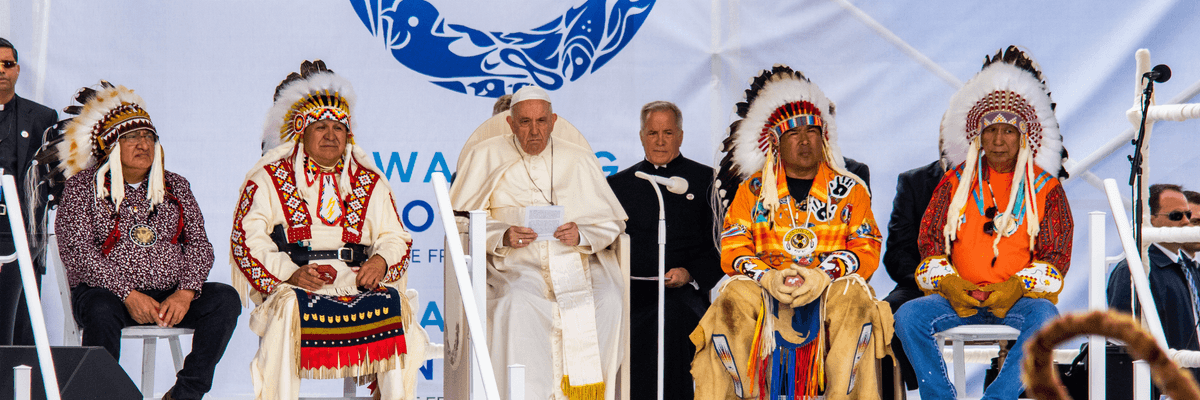
Pope Francis meets with Indigenous leaders in Maskwa Park, Alberta, Canada on July 25, 2022.
One Native American group hopes the historic move "is more than mere words, but rather is the beginning of a full acknowledgment of the history of oppression and a full accounting of the legacies of colonialism."
In a historic shift long sought by Indigenous-led activists, the Holy See on Thursday formally repudiated the doctrine of discovery, a dubious legal theory born from a series of 15th-century papal decrees used by colonizers including the United States to legally justify the genocidal conquest of non-Christian peoples and their land.
In a joint statement, the Vatican's departments of culture and education declared that "the church acknowledges that these papal bulls did not adequately reflect the equal dignity and rights of Indigenous peoples" and "therefore repudiates those concepts that fail to recognize the inherent human rights of Indigenous peoples, including what has become known as the legal and political 'doctrine of discovery.'"
"The church is also aware that the contents of these documents were manipulated for political purposes by competing colonial powers in order to justify immoral acts against Indigenous peoples that were carried out, at times, without opposition from ecclesiastical authorities," the statement added. "It is only just to recognize these errors, acknowledge the terrible effects of the assimilation policies and the pain experienced by Indigenous peoples, and ask for pardon."
Indigenous leaders—who for decades demanded the Vatican rescind the discovery doctrine—welcomed the move, while expressing hope that it brings real change.
"On the surface it sounds good, it looks good... but there has to be a fundamental change in attitudes, behavior, laws, and policies from that statement," Ernie Daniels, the former chief of Long Plain First Nation in Manitoba, Canada, told CBC Thursday.
"There's still a mentality out there—they want to assimilate, decimate, terminate, eradicate Indigenous people," added Daniels, who was part of a delegation that met with Pope Francis last year in Rome and Canada.
The pontiff—who is currently hospitalized with a respiratory infection—apologized last July in Alberta for the church's human rights crimes against First Nations and asked for forgiveness "for the wrong done by so many Christians to the Indigenous peoples."
Ghislain Picard, an Innu leader and the regional chief of the Assembly of First Nations for Quebec and Labrador, told CBC that the Vatican's move is mostly symbolic.
"The Vatican seems to be washing its hands of its role in the whole colonization of our lands, and to me it would be so simple to just accept the fact that they played a role," he said. "Reconciliation is a buzzword. But how it impacts current policy is really what's at stake here."
Discovery doctrine is rooted in a trio of papal decrees issued in the second half of the 15th century authorizing the Portuguese and Spanish monarchies to conquer land and enslave people in Africa and the Americas if they were non-Christians and dividing the Americas between the two burgeoning empires.
Nullified by the Vatican in the 16th century, the papal decrees nevertheless underpinned centuries of colonial conquest by Europeans and Euro-Americans.
In 1823, United States Supreme Court Chief Justice John Marshall wrote in Johnson v. M'Intosh that Indigenous people could not sell land to whites because Indians' "power to dispose of the soil at their own will to whomsoever they pleased was denied by the original fundamental principle that discovery gave exclusive title to those who made it."
The precedent set by Johnson was cited as recently as 2005, when then-Justice Ruth Bader Ginsburg notoriously cited doctrine of discovery in Sherrill v. Oneida Indian Nation, an opinion decried by many Native Americans.
In a Thursday interview on Indian Country Today's newscast, Arizona State University law professor Robert Miller, who is Eastern Shawnee, said that "what the church did is an important worldwide educational moment, but it doesn't change the law in any country. It doesn't change titles to land anywhere."
"It's gonna take far more than just the pope repudiating these 600-year-old papal bulls to make real changes for Indigenous peoples," he added.
Dear Common Dreams reader, It’s been nearly 30 years since I co-founded Common Dreams with my late wife, Lina Newhouser. We had the radical notion that journalism should serve the public good, not corporate profits. It was clear to us from the outset what it would take to build such a project. No paid advertisements. No corporate sponsors. No millionaire publisher telling us what to think or do. Many people said we wouldn't last a year, but we proved those doubters wrong. Together with a tremendous team of journalists and dedicated staff, we built an independent media outlet free from the constraints of profits and corporate control. Our mission has always been simple: To inform. To inspire. To ignite change for the common good. Building Common Dreams was not easy. Our survival was never guaranteed. When you take on the most powerful forces—Wall Street greed, fossil fuel industry destruction, Big Tech lobbyists, and uber-rich oligarchs who have spent billions upon billions rigging the economy and democracy in their favor—the only bulwark you have is supporters who believe in your work. But here’s the urgent message from me today. It's never been this bad out there. And it's never been this hard to keep us going. At the very moment Common Dreams is most needed, the threats we face are intensifying. We need your support now more than ever. We don't accept corporate advertising and never will. We don't have a paywall because we don't think people should be blocked from critical news based on their ability to pay. Everything we do is funded by the donations of readers like you. When everyone does the little they can afford, we are strong. But if that support retreats or dries up, so do we. Will you donate now to make sure Common Dreams not only survives but thrives? —Craig Brown, Co-founder |
In a historic shift long sought by Indigenous-led activists, the Holy See on Thursday formally repudiated the doctrine of discovery, a dubious legal theory born from a series of 15th-century papal decrees used by colonizers including the United States to legally justify the genocidal conquest of non-Christian peoples and their land.
In a joint statement, the Vatican's departments of culture and education declared that "the church acknowledges that these papal bulls did not adequately reflect the equal dignity and rights of Indigenous peoples" and "therefore repudiates those concepts that fail to recognize the inherent human rights of Indigenous peoples, including what has become known as the legal and political 'doctrine of discovery.'"
"The church is also aware that the contents of these documents were manipulated for political purposes by competing colonial powers in order to justify immoral acts against Indigenous peoples that were carried out, at times, without opposition from ecclesiastical authorities," the statement added. "It is only just to recognize these errors, acknowledge the terrible effects of the assimilation policies and the pain experienced by Indigenous peoples, and ask for pardon."
Indigenous leaders—who for decades demanded the Vatican rescind the discovery doctrine—welcomed the move, while expressing hope that it brings real change.
"On the surface it sounds good, it looks good... but there has to be a fundamental change in attitudes, behavior, laws, and policies from that statement," Ernie Daniels, the former chief of Long Plain First Nation in Manitoba, Canada, told CBC Thursday.
"There's still a mentality out there—they want to assimilate, decimate, terminate, eradicate Indigenous people," added Daniels, who was part of a delegation that met with Pope Francis last year in Rome and Canada.
The pontiff—who is currently hospitalized with a respiratory infection—apologized last July in Alberta for the church's human rights crimes against First Nations and asked for forgiveness "for the wrong done by so many Christians to the Indigenous peoples."
Ghislain Picard, an Innu leader and the regional chief of the Assembly of First Nations for Quebec and Labrador, told CBC that the Vatican's move is mostly symbolic.
"The Vatican seems to be washing its hands of its role in the whole colonization of our lands, and to me it would be so simple to just accept the fact that they played a role," he said. "Reconciliation is a buzzword. But how it impacts current policy is really what's at stake here."
Discovery doctrine is rooted in a trio of papal decrees issued in the second half of the 15th century authorizing the Portuguese and Spanish monarchies to conquer land and enslave people in Africa and the Americas if they were non-Christians and dividing the Americas between the two burgeoning empires.
Nullified by the Vatican in the 16th century, the papal decrees nevertheless underpinned centuries of colonial conquest by Europeans and Euro-Americans.
In 1823, United States Supreme Court Chief Justice John Marshall wrote in Johnson v. M'Intosh that Indigenous people could not sell land to whites because Indians' "power to dispose of the soil at their own will to whomsoever they pleased was denied by the original fundamental principle that discovery gave exclusive title to those who made it."
The precedent set by Johnson was cited as recently as 2005, when then-Justice Ruth Bader Ginsburg notoriously cited doctrine of discovery in Sherrill v. Oneida Indian Nation, an opinion decried by many Native Americans.
In a Thursday interview on Indian Country Today's newscast, Arizona State University law professor Robert Miller, who is Eastern Shawnee, said that "what the church did is an important worldwide educational moment, but it doesn't change the law in any country. It doesn't change titles to land anywhere."
"It's gonna take far more than just the pope repudiating these 600-year-old papal bulls to make real changes for Indigenous peoples," he added.
In a historic shift long sought by Indigenous-led activists, the Holy See on Thursday formally repudiated the doctrine of discovery, a dubious legal theory born from a series of 15th-century papal decrees used by colonizers including the United States to legally justify the genocidal conquest of non-Christian peoples and their land.
In a joint statement, the Vatican's departments of culture and education declared that "the church acknowledges that these papal bulls did not adequately reflect the equal dignity and rights of Indigenous peoples" and "therefore repudiates those concepts that fail to recognize the inherent human rights of Indigenous peoples, including what has become known as the legal and political 'doctrine of discovery.'"
"The church is also aware that the contents of these documents were manipulated for political purposes by competing colonial powers in order to justify immoral acts against Indigenous peoples that were carried out, at times, without opposition from ecclesiastical authorities," the statement added. "It is only just to recognize these errors, acknowledge the terrible effects of the assimilation policies and the pain experienced by Indigenous peoples, and ask for pardon."
Indigenous leaders—who for decades demanded the Vatican rescind the discovery doctrine—welcomed the move, while expressing hope that it brings real change.
"On the surface it sounds good, it looks good... but there has to be a fundamental change in attitudes, behavior, laws, and policies from that statement," Ernie Daniels, the former chief of Long Plain First Nation in Manitoba, Canada, told CBC Thursday.
"There's still a mentality out there—they want to assimilate, decimate, terminate, eradicate Indigenous people," added Daniels, who was part of a delegation that met with Pope Francis last year in Rome and Canada.
The pontiff—who is currently hospitalized with a respiratory infection—apologized last July in Alberta for the church's human rights crimes against First Nations and asked for forgiveness "for the wrong done by so many Christians to the Indigenous peoples."
Ghislain Picard, an Innu leader and the regional chief of the Assembly of First Nations for Quebec and Labrador, told CBC that the Vatican's move is mostly symbolic.
"The Vatican seems to be washing its hands of its role in the whole colonization of our lands, and to me it would be so simple to just accept the fact that they played a role," he said. "Reconciliation is a buzzword. But how it impacts current policy is really what's at stake here."
Discovery doctrine is rooted in a trio of papal decrees issued in the second half of the 15th century authorizing the Portuguese and Spanish monarchies to conquer land and enslave people in Africa and the Americas if they were non-Christians and dividing the Americas between the two burgeoning empires.
Nullified by the Vatican in the 16th century, the papal decrees nevertheless underpinned centuries of colonial conquest by Europeans and Euro-Americans.
In 1823, United States Supreme Court Chief Justice John Marshall wrote in Johnson v. M'Intosh that Indigenous people could not sell land to whites because Indians' "power to dispose of the soil at their own will to whomsoever they pleased was denied by the original fundamental principle that discovery gave exclusive title to those who made it."
The precedent set by Johnson was cited as recently as 2005, when then-Justice Ruth Bader Ginsburg notoriously cited doctrine of discovery in Sherrill v. Oneida Indian Nation, an opinion decried by many Native Americans.
In a Thursday interview on Indian Country Today's newscast, Arizona State University law professor Robert Miller, who is Eastern Shawnee, said that "what the church did is an important worldwide educational moment, but it doesn't change the law in any country. It doesn't change titles to land anywhere."
"It's gonna take far more than just the pope repudiating these 600-year-old papal bulls to make real changes for Indigenous peoples," he added.