

SUBSCRIBE TO OUR FREE NEWSLETTER
Daily news & progressive opinion—funded by the people, not the corporations—delivered straight to your inbox.
5
#000000
#FFFFFF
To donate by check, phone, or other method, see our More Ways to Give page.
Daily news & progressive opinion—funded by the people, not the corporations—delivered straight to your inbox.

One campaigner called the law’s passage a “ray of hope for Europe’s nature, future generations, and the livelihoods of rural communities.”
Environmental groups celebrated a "historic" victory on Monday as the European Union adopted a law that seeks to restore at least 20% of land and sea habitats by 2030 and 90% to 100% by 2050, following a narrow vote by the European Council that swung on the vote of an Austrian minister who defied conservatives in her own government.
The new law, aimed at reversing catastrophic biodiversity loss, includes a sweeping array of protections for European ecosystems, from forests to wetlands to coral reefs. It also aims to restore organic soils in agricultural ecosystems, with special provisions for grassland pollinators and farmland birds. It was described as the "first ever" E.U. law aimed at nature recovery.
"After years of intense campaigning and many ups and downs, we are jubilant that this law is now reality—this day will go down in history as a turning point for nature and society," World Wildlife Fund for Nature (WWF) EU, one of several organizations that campaigned for the law under a #RestoreNature banner, wrote on social media.
🚨 BREAKING: We have the EU Nature Restoration Law!
Member States have just adopted the game-changing law for Europe's degraded ecosystems
It's a huge win for the EU's nature, citizens & the economy and the people behind the #RestoreNature campaign!
Thank you all 💚 pic.twitter.com/MmZPOQXzWW
— WWF EU (@WWFEU) June 17, 2024
The law's adoption came after what WWF EU called "one of the most tumultuous journeys in the history of E.U. legislation," a two-year-long saga that was dramatic up until its final moments.
The law's final hurdle was cleared by the European Council on Monday when 20 out of the 27 E.U. environment ministers, collectively representing 66% of the bloc's population—just enough to meet the 65% required by qualified majority rules—voted in favor.
The threshold was met when Leonore Gewessler, Austria's environment minister, moved in favor of the law despite opposition from the leaders of her own coalition government. Gewessler is a member of the Austria's Green party, a junior coalition partner to the conservatives, who oppose the new E.U. law.
The law was nearly adopted by the Council in March, but was derailed when Hungary withdrew support.
On Monday, Hungary, Finland, Italy, the Netherlands, Poland, and Sweden voted against the law; Belgium abstained. It will enter into force in all member states, each of which will now be required to develop national nature restoration plans.
I want to be like @lgewessler - the most brave Envi Minister ever! Despite facing opposition in her own country - #Austria , she decided to support #NatureRestorationLaw! 👏 We will see if it is enough, but nevertheless this act of courage moved me 💚 pic.twitter.com/Q6IRYFQU8J
— Agata Szafraniuk (@AgataSzafraniuk) June 17, 2024
The E.U. parliament had passed the law in February, following trilogue negotiations last year, after which Council passage is normally a formality. But this law was a political lightning rod that threatened normal institutional processes.
"The failure to adopt the law would not only threaten Europe's highly degraded nature but also send a negative signal about established political processes within European institutions," Špela Bandelj Ruiz, a Greenpeace campaigner, told Common Dreams.
Agribusiness groups had waged a sustained campaign against the law while it was being considered by parliament, and it was one of the targets of the many farmer protests in Europe this year. There was an "unprecedented and absurd disinformation campaign," WWF EU said.
The adoption of the law, which was part of the European Green Deal, a set of environmental laws and regulations put in place by the E.U. over the last five years, comes just before a new EU parliament swears in next month, following elections last week. The new parliament will have fewer green party representatives and more conservatives than before, as well as more members from the far-right.
The nature restoration law will be instrumental in helping the E.U. to meet its commitment under the Kunming-Montréal Global Biodiversity Framework signed at the 2022 U.N. Biodiversity Conference (COP15), nonprofit groups and E.U. officials said.
"The European delegation will be able to go to the next COP with its head held high," Alain Maron, minister for Climate Transition, Environment, Energy, and Participatory Democracy of the Government of the Brussels-Capital Region, said in an E.U. statement.
COP16 will be held in October in Colombia. Greenpeace said that failure to adopt the new law would have been an "embarrassment" to the E.U.
The law comes following dire reports about the state of nature in the E.U., where more than 80% of habitats are in poor condition. "Biodiversity in the E.U. continues to decline and faces deteriorating trends from changes in land and sea use, overexploitation and unsustainable management practices, as well as water regime modification, pollution, invasive alien species, and climate change," according to a 2020 report by the European Environment Agency.
Bandelj of Greenpeace told Common Dreams that some of the language on agricultural ecosystems in the law had been watered down during negotiations; for example, some of the targets are effort-based rather than results-based, with lawmakers writing "which shall aim to" rather than using more binding language. Bandelj also expressed concern that an "emergency brake" loophole could be applied, suspending implementation of the law in the event of food security concerns.
Still, Bandelj called the law a "ray of hope for Europe's nature, future generations, and the livelihoods of rural communities."
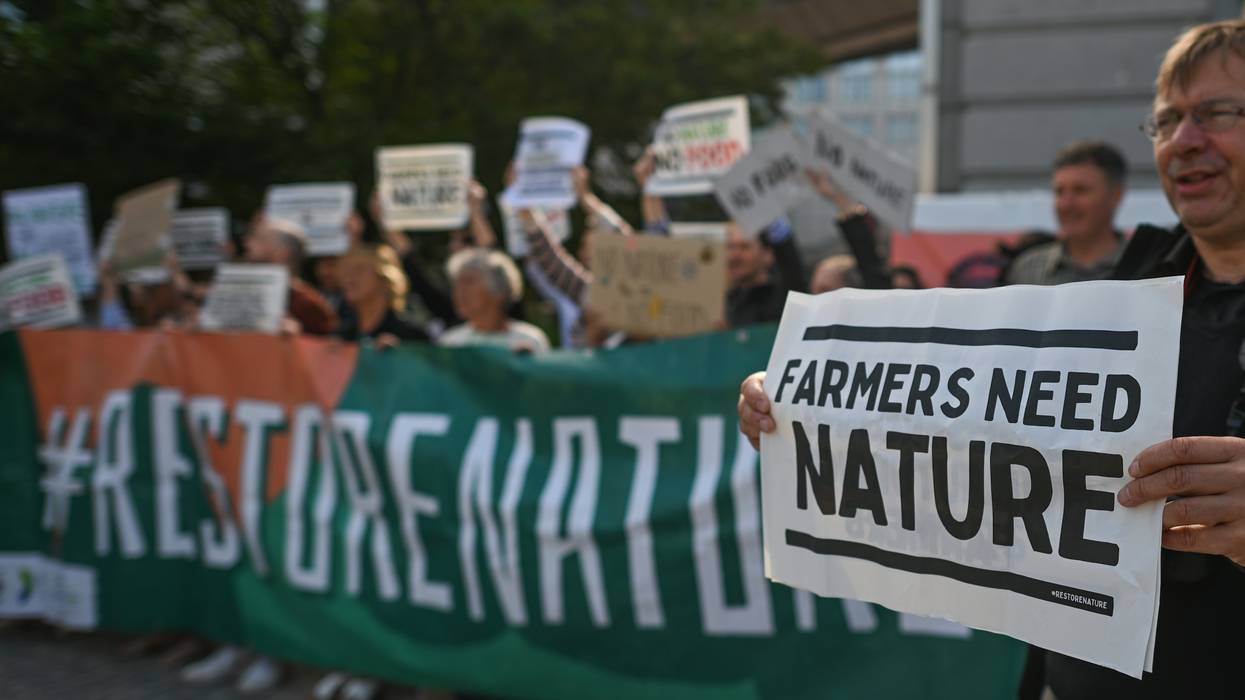
"To let this go now means we go into European elections saying the European system is not working, we do not protect nature, we do not take climate seriously," said Ireland's environmental minister. "That would be an absolute shame."
Environmental ministers in the European Union on Monday warned that the bloc's credibility on heading off the global biodiversity and climate emergencies is in peril following the European Council's decision to remove the historic Nature Restoration Law from its agenda after the proposal lost key support.
"We inspired others, yet now we risk arriving empty handed at COP16 [the 2024 UN Biodiversity Conference]," Virginijus Sinkevičius, E.U. commissioner for environment, oceans, and fisheries, said in a statement. "Backtracking now is... very difficult for me to accept."
The law, first introduced in 2022 and approved by European Parliament last month, faced one final hurdle to passage with the planned Council vote, but recent protests by farmers over the new nature restoration requirements helped push some previous supporters to reverse their positions on Monday.
The Nature Restoration Law, which supporters said they still intend to try to pass before E.U. elections in June, would require member states to adopt measures to restore at least 30% of habitats by 2030, working up to 90% by 2050. Member states would be required to take action to reverse pollinator populations, restore organic soils in agricultural use, increase development of urban green areas, and take other steps to protect biodiversity.
Since the farmer protests began in France and started spreading to other countries including Spain, Belgium, and Italy, policymakers have offered concessions including delayed implementation of another set of biodiversity rules calling for the agriculture industry to keep 4% of farming land free of crop production to regenerate healthy soil. The European Commission also shelved an anti-pesticide law in February in response to the protests.
As countries announced their new opposition to the Nature Restoration Law in recent days, some ministers suggested the demonstrations contributed to their decision.
Anikó Raisz, Hungary's minister of state for environmental affairs, said the law would "overburden the economy" and cited concerns about the "sensitive situation" in the agriculture sector. Italy also said it was concerned about the biodiversity rules' impact on farmers.
The World Wide Fund For Nature (WWF) accused far-right Hungarian President Viktor Orbán, who has dismissed European climate policies, of being behind the "unexpected and clearly politically motivated change in Hungary's position."
Hungary's opposition "was left unchallenged by Sweden, Poland, Finland, the Netherlands, Belgium, Austria, and Italy—who continue to either abstain or oppose," and "has now put the [Nature Restoration Law] in jeopardy again, giving Hungary's President Viktor Orbán the green light to further his own agenda and hold E.U. decision-making hostage," said WWF.
Eamon Ryan, Irish minister for the environment, accused other policymakers in the bloc of "buckling" before the farmer protests, which continued Tuesday, ahead of June elections.
"The biggest risk is the collapse of political ambition and will," Ryan said. "To let this go now means we go into European elections saying the European system is not working, we do not protect nature, we do not take climate seriously. That would be an absolute shame."
BirdLife Europe called on the E.U. the continue its efforts to pass the Nature Restoration Law before the session ends this summer.
"The E.U.'s reputation hangs in the balance in this critical year of E.U. elections," said the group. "Failure to make the law a reality also undermines the E.U.'s credibility and leadership on its international commitments to tackle the biodiversity and climate crises."
"This is definitely not the end of the story," Alain Maron, Belgium's minister for climate change, environment, energy, and participative democracy, told reporters at a press conference Monday. He added that the Belgian presidency of the European Council "will work hard in the next few weeks to find possible ways out of this deadlock, and get the file back on the agenda for adoption in another council."
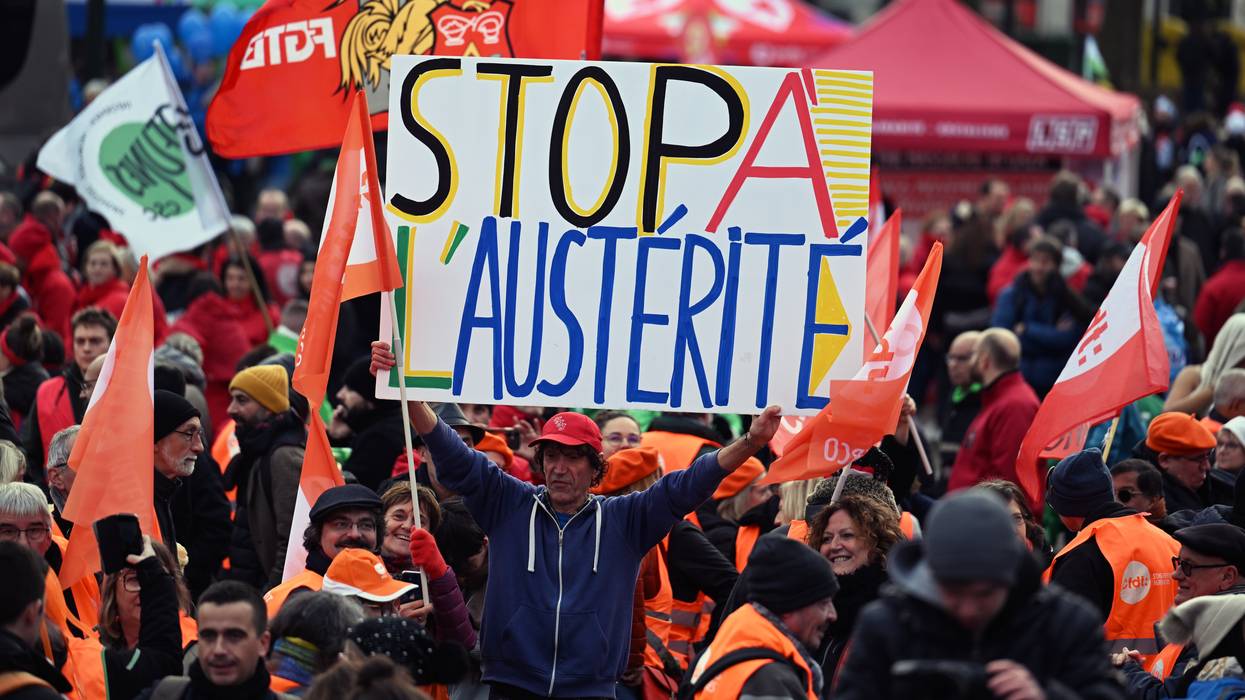
"Austerity is always aimed at the same people: working people," said one French labor leader.
Labor leaders in the European Union on Tuesday estimated that 15,000 people from across the bloc had traveled to central Brussels to march against austerity measures expected to go into effect after the New Year, with workers demanding fair wages and sufficient funding for public services.
Organized by the European Trade Union Confederation (ETUC) and other labor organizations representing workers in the agricultural, tourism, and food industries, among others, the march through the E.U.'s capital was planned in response to the Stability and Growth Pact—a set of economic rules that were paused during the coronavirus pandemic.
The rules that are set to go into effect again in 2024, following months of negotiations by finance ministers, require that member states' public debt doesn't exceed 60% of their gross domestic product and that their annual deficit stay below 3%.
The ETUC said 14 of the E.U.'s 27 member states would be required to cut a combined 45 billion euros ($49 billion) from their budgets next year under the plan, followed by more cuts in the coming years.
In a letter to the European Council on Monday, the union, which represents 45 million workers, noted that wages are already falling in the bloc, despite the fact that profit margins of corporations are increasing.
"Further austerity would have a devastating effect on the economy and on workers, deepening the social justice emergency," wrote Esther Lynch, general secretary of the ETUC, noting that the early days of the pandemic in 2020 saw European governments invest in public health measures and worker protections. "We must maintain a solidaristic and forward-looking approach."
The union called on the council to approve a further one-year extension of the Stability and Growth Pact's "escape clause," which was invoked in 2020.
"The ETUC is calling for a rethink," wrote Lynch. "A smarter reform is needed. The austerity measures imposed following the financial crisis had a profoundly damaging effect on Europe, with the scars still visible in our economy, our society, and our politics."
The New Economic Foundation released an analysis last year showing that without restrictions on public spending that were imposed in the E.U. after the 2008 financial meltdown, the average citizen of the bloc would be more than $3,000 better off, and governments would have invested $575 billion more in infrastructure and $1,000 more per person on education, healthcare, and other social services.
A return to such austerity would "kill jobs, lower wages, mean even less funding for already over-stretched public services, and all but guarantee another devastating recession," Lynch told the Associated Press.
One education worker who traveled all the way from Portugal to march told the AP that "fair taxation" is needed "so that there is enough money to go to the public services and all European citizens and all European workers can live with dignity."
"People deserve to live in dignity, to have decent salaries, to have good working conditions and they are not getting it from most governments in Europe and this austerity," Manuela Mendonca told the outlet.
The ETUC said investments in social spending and meeting climate targets must be excluded from spending limits, and called for the Recovery and Resilience Facility, which was passed to aid climate action and a digital transition across Europe, to be kept in place.
"Austerity is always aimed at the same people," said Sophie Binet, secretary-general of the General Confederation of Labor in France, at Tuesday's march. "Working people."
Marchers carried signs through Brussels that read, "For jobs and public services" and, "Stop austerity."
"Austerity has been tried and it failed," Lynch told the AP. "It is time to learn the lessons of the past and ensure the E.U.'s economic rules put the wellbeing of people and the planet before totally arbitrary limits."

"Whilst the Parliament fought hard to limit the damage, the overall package on biometric surveillance and profiling is at best lukewarm," said one advocate.
Privacy advocates on Saturday said the AI Act, a sweeping proposed law to regulate artificial intelligence in the European Union whose language was finalized Friday, appeared likely to fail at protecting the public from one of AI's greatest threats: live facial recognition.
Representatives of the European Commission spent 37 hours this week negotiating provisions in the AI Act with the European Council and European Parliament, running up against Council representatives from France, Germany, and Italy who sought to water down the bill in the late stages of talks.
Thierry Breton, the European commissioner for internal market and a key negotiator of the deal, said the final product would establish the E.U. as "a pioneer, understanding the importance of its role as global standard setter."
But Amnesty Tech, the branch of global human rights group Amnesty International that focuses on technology and surveillance, was among the groups that raised concerns about the bloc's failure to include "an unconditional ban on live facial recognition," which was in an earlier draft, in the legislation.
The three institutions, said Mher Hakobyan, Amnesty Tech's advocacy adviser on AI, "in effect greenlighted dystopian digital surveillance in the 27 EU Member States, setting a devastating precedent globally concerning AI regulation."
"While proponents argue that the draft allows only limited use of facial recognition and subject to safeguards, Amnesty's research in New York City, Occupied Palestinian Territories, Hyderabad, and elsewhere demonstrates that no safeguards can prevent the human rights harms that facial recognition inflicts, which is why an outright ban is needed," said Hakobyan. "Not ensuring a full ban on facial recognition is therefore a hugely missed opportunity to stop and prevent colossal damage to human rights, civic space, and rule of law that are already under threat throughout the E.U."
The bill is focused on protecting Europeans against other significant risks of AI, including the automation of jobs, the spread of misinformation, and national security threats.
Tech companies would be required to complete rigorous testing on AI software before operating in the EU, particularly for applications like self-driving vehicles.
Tools that could pose risks to hiring practices would also need to be subjected to risk assessments, and human oversight would be required in deploying the software,
AI systems including chatbots would be subjected to new transparency rules to avoid the creation of manipulated images and videos—known as deepfakes—without the public knowing that the images were generated by AI.
The indiscriminate scraping of internet or security footage images to create facial recognition databases would also be outright banned.
But the proposed AI Act, which could be passed before the end of the European Parliament session ends in May, includes exemptions to facial recognition provisions, allowing law enforcement agencies to use live facial recognition to search for human trafficking victims, prevent terrorist attacks, and arrest suspects of certain violent crimes.
Ella Jakubowska, a senior policy adviser at European Digital Rights, told The Washington Post that "some human rights safeguards have been won" in the AI Act.
"It's hard to be excited about a law which has, for the first time in the E.U., taken steps to legalize live public facial recognition across the bloc," Jakubowska told Reuters. "Whilst the Parliament fought hard to limit the damage, the overall package on biometric surveillance and profiling is at best lukewarm."
Hakobyan also noted that the bill did not include a ban on "the export of harmful AI technologies, including for social scoring, which would be illegal in the E.U."
"Allowing European companies to profit off from technologies that the law recognizes impermissibly harm human rights in their home states establishes a dangerous double standard," said Hakobyan.
After passage, many AI Act provisions would not take effect for 12 to 24 months.
Andreas Liebl, managing director of the German company AppliedAI Initiative, acknowledged that the law would likely have an impact on tech companies' ability to operate in the European Union.
"There will be a couple of innovations that are just not possible or economically feasible anymore," Liebl told the Post.
But Kris Shrishak, a senior fellow at the Irish Council for Civil Liberties, told The New York Times that the E.U. will have to prove its "regulatory prowess" after the law is passed.
"Without strong enforcement," said Shrishak, "this deal will have no meaning."

"With this agreement, the European Union adopts some of the most ambitious legislation in the world," one MEP who backed the measure said.
In what one proponent called a "fundamental victory," the European Union agreed late Thursday to set new penalties for acts of environmental destruction "comparable to ecocide."
The update to an E.U. directive, which targets wide-scale actions like habitat destruction and illegal logging, makes the bloc the first multinational group to criminalize these acts, The Guardian reported.
"Environmental crime is exploding around the world, it is now considered just as lucrative as drug trafficking, and is helping to destroy living conditions on Earth," Marie Toussaint, a French lawyer and member of European Parliament who helped steer the negotiations, said in a statement. "With this agreement, the European Union adopts some of the most ambitious legislation in the world. We will continue to fight so that we can never again harm living things in the name of profit."
"Our health depends on the state of the environment in which we live, so we must deter criminals willing to destroy ecosystems for profit."
The new offense comes in the wake of a growing movement to have ecocide recognized as an international crime. The original call from the Stop Ecocide Foundation was for it to be added to the Rome Statute of the International Criminal Court on equal footing with genocide, crimes against humanity, war crimes, and the crime of aggression. In 2021, the group assembled legal experts to draft a definition, which has generated interest on the national level as well. Bills have been introduced in Belgium, Spain, Italy, and the Netherlands.
"We're one step closer to stopping the destruction of our planet," Giulio Carini, communications manager at WeMove Europe, said in a statement Friday. "With today's proposal we've secured a text that paves the way to ensure we can protect nature through criminal law. This progress is a result of people-powered pressure—after more than 600,000 people across Europe have asked the E.U. to make ecocide a crime."
Thursday's agreement comes after the European Parliament's Legal Affairs Committee unanimously proposed in March that "member states shall ensure that any conduct causing severe and either widespread or long-term or irreversible damage shall be treated as an offense of particular gravity and sanctioned as such in accordance with the legal systems of the member states."
This then led to months of negotiations between the parliament, the European Council, and the European Commission that have resulted in the decision to update the "directive on protection of the environment through criminal law" to include new penalties for especially devastating environmental harms.
"We are thrilled to see this result," Jojo Mehta, co-founder and CEO of Stop Ecocide International, said in a statement. "The approved text is a hugely important step and a massive win for nature, significantly strengthening environmental protection through criminal law throughout the E.U."
The actions singled out by the text include destroying the ozone layer, introducing or spreading invasive species, water abstraction, and shipping pollution and recycling, The Guardian reported. The agreement does not mention carbon credit scams, fishing, or exporting dangerous waste to developing countries. It also does not cover crimes committed by E.U. companies abroad, though individual states may chose to penalize them.
The updated directive could also penalize permitted activities if those permits were acquired through bribes, falsehoods, or threats, or violated legal agreements. Penalties include prison time for individuals or barring companies from receiving public funds in the future. E.U. countries can also chose to fine companies with a set amount of up to €40 million Euros ($43.6 million) or up to 5% of their income.
"Our health depends on the state of the environment in which we live, so we must deter criminals willing to destroy ecosystems for profit," said Virginijus Sinkevičius, E.U. commissioner for environment, oceans, and fisheries, as The Guardian reported.
The E.U. will officially pass the new directive in the spring of 2024, after which member states have two years to enshrine it in their own legal codes.
"This is highly significant and to be wholeheartedly commended, and we can see from the rapidly growing momentum of the ecocide law initiative that European states will not be long in engaging more deeply with it in their own jurisdictions," Mehta said. "Indeed, I have no doubt that with this direction of travel being rapidly established, it is only a matter of time before ecocide is recognized in criminal law at every level."

Officials in Europe, Canada, and the U.S. have attempted to "backtrack" on the widespread unconditional support that's been expressed in the last week for Israel's assault on Gaza.
The United Nations special rapporteur on the occupied Palestinian territories expressed concern on Sunday that the international body has so far not publicly advocated for an immediate cease-fire in Gaza, as rhetoric from the United States and other influential countries has offered tacit approval of an Israeli air campaign in the blockaded enclave where at least 2,670 Palestinians, including more than 700 children, have now been killed.
Francesca Albanese, who has served as the special rapporteur since 2022, told Al Jazeera that Israel must account for exactly "how the dismantlement of Hamas is happening" as it intensifies what it claims is a war targeting Hamas to retaliate for the group's surprise attack on October 7.
The Israel Defense Forces (IDF) have spent the last week bombing residential buildings, schools housing refugees, healthcare facilities, and at least one convoy of people traveling through Gaza after Israel ordered one million people to leave the northern part of the enclave within 24 hours in order to "save their lives" from continued strikes.
The Palestinian Ministry of Health said Sunday that at least 50 entire families in Gaza have been wiped out from the civil registry, with all their members killed in air strikes and shelling.
"I don't have any sign that [a cease-fire] is being considered even at the U.N. secretary-general level," Albanese told Al Jazeera. "It troubles me because, on one hand, you have Israeli officials saying they want to eliminate Hamas. But what we see on the ground is thousands of people including children being killed and injured."
U.N. Secretary-General António Guterres has called for "international humanitarian law and human rights law" to be upheld, but has not called for a cessation of the strikes in Gaza.
On social media, Albanese said that "there can be no more delay" of a public call by Guterres for a cease-fire, and that atrocities like the mass displacement and killing of civilians "must not only be punished but also prevented."
The U.N. Security Council was discussing calls for a humanitarian cease-fire "behind closed doors" in New York on Saturday, the Vatican News reported, and other officials over the weekend signaled a retreat from the rhetoric of U.S. President Joe Biden and a number of other Western leaders last week.
Biden and the leaders of the U.K., France, Italy, and Germany said in a joint statement last week that they supported Israel's right "to defend itself" without demanding the country act within the bounds of international law as it unleashed its air campaign and called up 300,000 reservists for a likely ground assault.
Speaking to PBS Newshour Saturday, U.S. Defense Secretary Lloyd Austin said, "Hamas is not the Palestinian people... so I do not think that the people should pay the price" for Hamas' killing of at least 1,300 people, including nearly 300 soldiers.
The European Council also released its first joint statement on the crisis Sunday, saying Israel has the right to self-defense while respecting "humanitarian and international law" and ensuring "the protection of all civilians at all times."
The council said it would hold a meeting on Tuesday "to get a grip on the response to the war between Israel and Hamas," Irish Times correspondent Naomi O'Leary reported, as European officials, diplomats, and members of the European Parliament have grown concerned about European Commission President Ursula von der Leyen's stated support for what human rights experts have condemned as Israel's "collective punishment" of Palestinians in Gaza.
In Canada, Prime Minister Justin Trudeau also said Saturday night that he was "deeply concerned by the dire humanitarian situation in the Gaza Strip" as people remained without access to electricity, food, and water.
Al Jazeera journalist Sana Saeed noted that Trudeau was one of the leaders who just days ago was "cheering on Israel's 'right to defend itself,' refusing to condemn the assault on Gaza and loss of Palestinian life" even as the Israeli defense minister called all two million residents of Gaza "human animals" as he announced a "complete siege" on the enclave.
"As the Israeli genocide of Palestinians becomes clearer and harder to defend to the public at large, expect more about-faces, backtracking, and softening of stances of people who have cheered this on," said Saeed.
But such comments are mere "posturing," she added, when they are not accompanied by clear calls for a cease-fire to prevent further loss of civilian lives.
"Note how any liberals (U.S., Canada, Europe) who are now discussing 'minimizing harm' and the 'humanitarian crisis' make zero demands of a cease-fire, zero calls for even restraint by Israel," said Saeed. "Nothing."
Rights activist and photographer Patience Zalanga suggested some officials are "being hit with the reality that there are more people who aggressively oppose the genocide of Palestinians than they realized," as thousands of Americans—and tens of thousands of people worldwide—have joined protests in recent days to demand a cease-fire in Gaza.
"The United States government does not care any more or less for Palestinians," said Zalanga. "But what they do care about is how bad this looks. And it's only getting worse."