SUBSCRIBE TO OUR FREE NEWSLETTER
Daily news & progressive opinion—funded by the people, not the corporations—delivered straight to your inbox.
5
#000000
#FFFFFF
To donate by check, phone, or other method, see our More Ways to Give page.
Daily news & progressive opinion—funded by the people, not the corporations—delivered straight to your inbox.
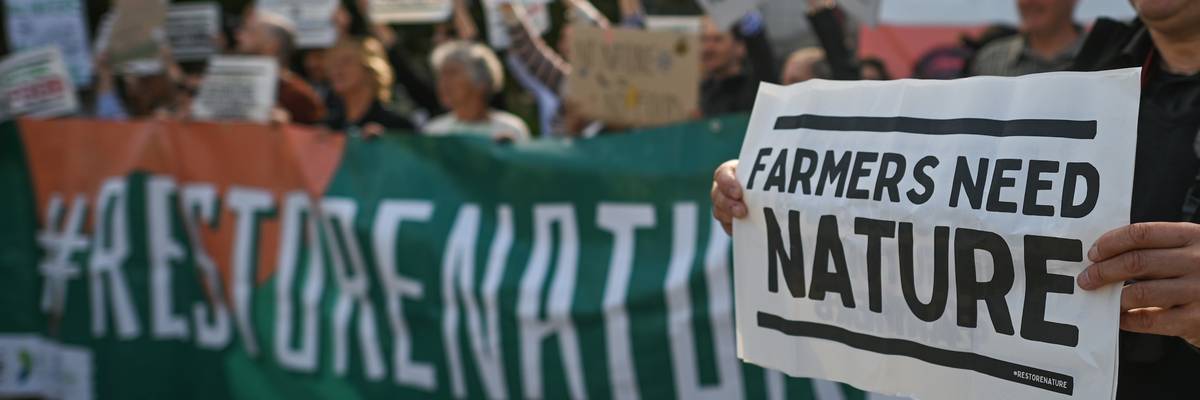
Environmental activists protest in Brussels in support of the European Union's Nature Restoration Law on May 31, 2023.
"To let this go now means we go into European elections saying the European system is not working, we do not protect nature, we do not take climate seriously," said Ireland's environmental minister. "That would be an absolute shame."
Environmental ministers in the European Union on Monday warned that the bloc's credibility on heading off the global biodiversity and climate emergencies is in peril following the European Council's decision to remove the historic Nature Restoration Law from its agenda after the proposal lost key support.
"We inspired others, yet now we risk arriving empty handed at COP16 [the 2024 UN Biodiversity Conference]," Virginijus Sinkevičius, E.U. commissioner for environment, oceans, and fisheries, said in a statement. "Backtracking now is... very difficult for me to accept."
The law, first introduced in 2022 and approved by European Parliament last month, faced one final hurdle to passage with the planned Council vote, but recent protests by farmers over the new nature restoration requirements helped push some previous supporters to reverse their positions on Monday.
The Nature Restoration Law, which supporters said they still intend to try to pass before E.U. elections in June, would require member states to adopt measures to restore at least 30% of habitats by 2030, working up to 90% by 2050. Member states would be required to take action to reverse pollinator populations, restore organic soils in agricultural use, increase development of urban green areas, and take other steps to protect biodiversity.
Since the farmer protests began in France and started spreading to other countries including Spain, Belgium, and Italy, policymakers have offered concessions including delayed implementation of another set of biodiversity rules calling for the agriculture industry to keep 4% of farming land free of crop production to regenerate healthy soil. The European Commission also shelved an anti-pesticide law in February in response to the protests.
As countries announced their new opposition to the Nature Restoration Law in recent days, some ministers suggested the demonstrations contributed to their decision.
Anikó Raisz, Hungary's minister of state for environmental affairs, said the law would "overburden the economy" and cited concerns about the "sensitive situation" in the agriculture sector. Italy also said it was concerned about the biodiversity rules' impact on farmers.
The World Wide Fund For Nature (WWF) accused far-right Hungarian President Viktor Orbán, who has dismissed European climate policies, of being behind the "unexpected and clearly politically motivated change in Hungary's position."
Hungary's opposition "was left unchallenged by Sweden, Poland, Finland, the Netherlands, Belgium, Austria, and Italy—who continue to either abstain or oppose," and "has now put the [Nature Restoration Law] in jeopardy again, giving Hungary's President Viktor Orbán the green light to further his own agenda and hold E.U. decision-making hostage," said WWF.
Eamon Ryan, Irish minister for the environment, accused other policymakers in the bloc of "buckling" before the farmer protests, which continued Tuesday, ahead of June elections.
"The biggest risk is the collapse of political ambition and will," Ryan said. "To let this go now means we go into European elections saying the European system is not working, we do not protect nature, we do not take climate seriously. That would be an absolute shame."
BirdLife Europe called on the E.U. the continue its efforts to pass the Nature Restoration Law before the session ends this summer.
"The E.U.'s reputation hangs in the balance in this critical year of E.U. elections," said the group. "Failure to make the law a reality also undermines the E.U.'s credibility and leadership on its international commitments to tackle the biodiversity and climate crises."
"This is definitely not the end of the story," Alain Maron, Belgium's minister for climate change, environment, energy, and participative democracy, told reporters at a press conference Monday. He added that the Belgian presidency of the European Council "will work hard in the next few weeks to find possible ways out of this deadlock, and get the file back on the agenda for adoption in another council."
Dear Common Dreams reader, It’s been nearly 30 years since I co-founded Common Dreams with my late wife, Lina Newhouser. We had the radical notion that journalism should serve the public good, not corporate profits. It was clear to us from the outset what it would take to build such a project. No paid advertisements. No corporate sponsors. No millionaire publisher telling us what to think or do. Many people said we wouldn't last a year, but we proved those doubters wrong. Together with a tremendous team of journalists and dedicated staff, we built an independent media outlet free from the constraints of profits and corporate control. Our mission has always been simple: To inform. To inspire. To ignite change for the common good. Building Common Dreams was not easy. Our survival was never guaranteed. When you take on the most powerful forces—Wall Street greed, fossil fuel industry destruction, Big Tech lobbyists, and uber-rich oligarchs who have spent billions upon billions rigging the economy and democracy in their favor—the only bulwark you have is supporters who believe in your work. But here’s the urgent message from me today. It's never been this bad out there. And it's never been this hard to keep us going. At the very moment Common Dreams is most needed, the threats we face are intensifying. We need your support now more than ever. We don't accept corporate advertising and never will. We don't have a paywall because we don't think people should be blocked from critical news based on their ability to pay. Everything we do is funded by the donations of readers like you. When everyone does the little they can afford, we are strong. But if that support retreats or dries up, so do we. Will you donate now to make sure Common Dreams not only survives but thrives? —Craig Brown, Co-founder |
Environmental ministers in the European Union on Monday warned that the bloc's credibility on heading off the global biodiversity and climate emergencies is in peril following the European Council's decision to remove the historic Nature Restoration Law from its agenda after the proposal lost key support.
"We inspired others, yet now we risk arriving empty handed at COP16 [the 2024 UN Biodiversity Conference]," Virginijus Sinkevičius, E.U. commissioner for environment, oceans, and fisheries, said in a statement. "Backtracking now is... very difficult for me to accept."
The law, first introduced in 2022 and approved by European Parliament last month, faced one final hurdle to passage with the planned Council vote, but recent protests by farmers over the new nature restoration requirements helped push some previous supporters to reverse their positions on Monday.
The Nature Restoration Law, which supporters said they still intend to try to pass before E.U. elections in June, would require member states to adopt measures to restore at least 30% of habitats by 2030, working up to 90% by 2050. Member states would be required to take action to reverse pollinator populations, restore organic soils in agricultural use, increase development of urban green areas, and take other steps to protect biodiversity.
Since the farmer protests began in France and started spreading to other countries including Spain, Belgium, and Italy, policymakers have offered concessions including delayed implementation of another set of biodiversity rules calling for the agriculture industry to keep 4% of farming land free of crop production to regenerate healthy soil. The European Commission also shelved an anti-pesticide law in February in response to the protests.
As countries announced their new opposition to the Nature Restoration Law in recent days, some ministers suggested the demonstrations contributed to their decision.
Anikó Raisz, Hungary's minister of state for environmental affairs, said the law would "overburden the economy" and cited concerns about the "sensitive situation" in the agriculture sector. Italy also said it was concerned about the biodiversity rules' impact on farmers.
The World Wide Fund For Nature (WWF) accused far-right Hungarian President Viktor Orbán, who has dismissed European climate policies, of being behind the "unexpected and clearly politically motivated change in Hungary's position."
Hungary's opposition "was left unchallenged by Sweden, Poland, Finland, the Netherlands, Belgium, Austria, and Italy—who continue to either abstain or oppose," and "has now put the [Nature Restoration Law] in jeopardy again, giving Hungary's President Viktor Orbán the green light to further his own agenda and hold E.U. decision-making hostage," said WWF.
Eamon Ryan, Irish minister for the environment, accused other policymakers in the bloc of "buckling" before the farmer protests, which continued Tuesday, ahead of June elections.
"The biggest risk is the collapse of political ambition and will," Ryan said. "To let this go now means we go into European elections saying the European system is not working, we do not protect nature, we do not take climate seriously. That would be an absolute shame."
BirdLife Europe called on the E.U. the continue its efforts to pass the Nature Restoration Law before the session ends this summer.
"The E.U.'s reputation hangs in the balance in this critical year of E.U. elections," said the group. "Failure to make the law a reality also undermines the E.U.'s credibility and leadership on its international commitments to tackle the biodiversity and climate crises."
"This is definitely not the end of the story," Alain Maron, Belgium's minister for climate change, environment, energy, and participative democracy, told reporters at a press conference Monday. He added that the Belgian presidency of the European Council "will work hard in the next few weeks to find possible ways out of this deadlock, and get the file back on the agenda for adoption in another council."
Environmental ministers in the European Union on Monday warned that the bloc's credibility on heading off the global biodiversity and climate emergencies is in peril following the European Council's decision to remove the historic Nature Restoration Law from its agenda after the proposal lost key support.
"We inspired others, yet now we risk arriving empty handed at COP16 [the 2024 UN Biodiversity Conference]," Virginijus Sinkevičius, E.U. commissioner for environment, oceans, and fisheries, said in a statement. "Backtracking now is... very difficult for me to accept."
The law, first introduced in 2022 and approved by European Parliament last month, faced one final hurdle to passage with the planned Council vote, but recent protests by farmers over the new nature restoration requirements helped push some previous supporters to reverse their positions on Monday.
The Nature Restoration Law, which supporters said they still intend to try to pass before E.U. elections in June, would require member states to adopt measures to restore at least 30% of habitats by 2030, working up to 90% by 2050. Member states would be required to take action to reverse pollinator populations, restore organic soils in agricultural use, increase development of urban green areas, and take other steps to protect biodiversity.
Since the farmer protests began in France and started spreading to other countries including Spain, Belgium, and Italy, policymakers have offered concessions including delayed implementation of another set of biodiversity rules calling for the agriculture industry to keep 4% of farming land free of crop production to regenerate healthy soil. The European Commission also shelved an anti-pesticide law in February in response to the protests.
As countries announced their new opposition to the Nature Restoration Law in recent days, some ministers suggested the demonstrations contributed to their decision.
Anikó Raisz, Hungary's minister of state for environmental affairs, said the law would "overburden the economy" and cited concerns about the "sensitive situation" in the agriculture sector. Italy also said it was concerned about the biodiversity rules' impact on farmers.
The World Wide Fund For Nature (WWF) accused far-right Hungarian President Viktor Orbán, who has dismissed European climate policies, of being behind the "unexpected and clearly politically motivated change in Hungary's position."
Hungary's opposition "was left unchallenged by Sweden, Poland, Finland, the Netherlands, Belgium, Austria, and Italy—who continue to either abstain or oppose," and "has now put the [Nature Restoration Law] in jeopardy again, giving Hungary's President Viktor Orbán the green light to further his own agenda and hold E.U. decision-making hostage," said WWF.
Eamon Ryan, Irish minister for the environment, accused other policymakers in the bloc of "buckling" before the farmer protests, which continued Tuesday, ahead of June elections.
"The biggest risk is the collapse of political ambition and will," Ryan said. "To let this go now means we go into European elections saying the European system is not working, we do not protect nature, we do not take climate seriously. That would be an absolute shame."
BirdLife Europe called on the E.U. the continue its efforts to pass the Nature Restoration Law before the session ends this summer.
"The E.U.'s reputation hangs in the balance in this critical year of E.U. elections," said the group. "Failure to make the law a reality also undermines the E.U.'s credibility and leadership on its international commitments to tackle the biodiversity and climate crises."
"This is definitely not the end of the story," Alain Maron, Belgium's minister for climate change, environment, energy, and participative democracy, told reporters at a press conference Monday. He added that the Belgian presidency of the European Council "will work hard in the next few weeks to find possible ways out of this deadlock, and get the file back on the agenda for adoption in another council."