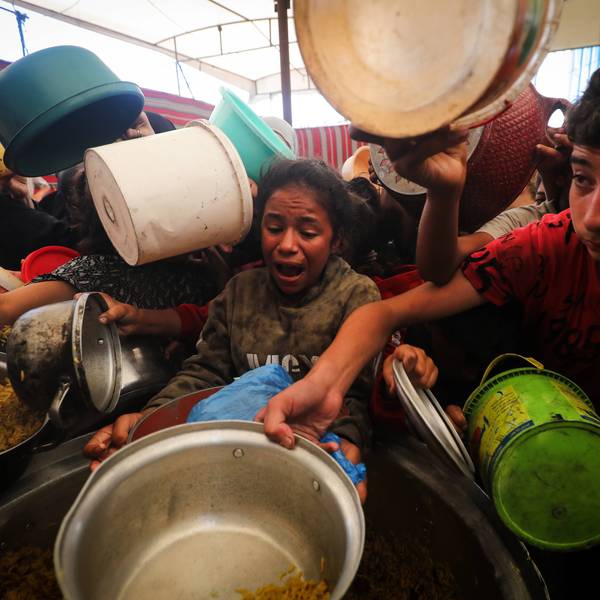
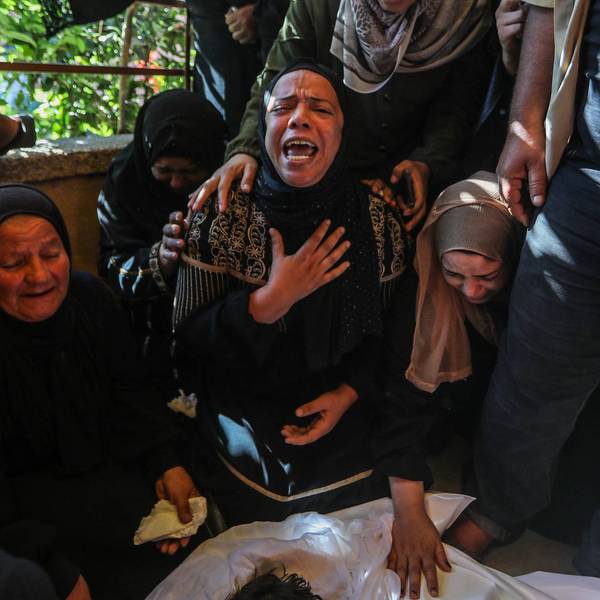
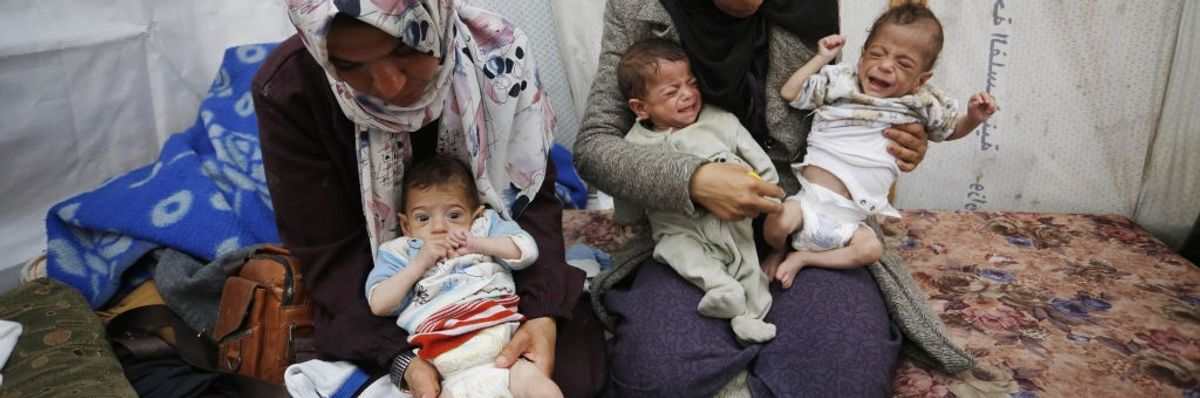
The infant triplets of Palestinian mother Nuzha Awad face the threat of dying from malnutrition and lack of medical care due to constant Israeli attacks and blockades as they take shelter in Nuseirat camp in Deir al Balah, Gaza on March 25, 2024.
UN Food Chief Says Northern Gaza Suffering 'Full-Blown Famine'
"And it's moving its way south," she warned.
United Nations World Food Program Executive Director Cindy McCain said Friday that Palestinians in the northern Gaza Strip are experiencing "full-blown famine" after nearly seven months of Israeli bombardment and invasion—and that deadly malnutrition is "moving its way south" through the embattled enclave.
While U.N. agencies have warned since March that famine was imminent in Gaza, McCain's remarks—which came during an interview with Kristen Welker that is scheduled to air on Sunday's edition of NBC News' "Meet the Press"—make her the most high-profile international official to date to publicly acknowledge a state of famine in parts of the Palestinian territory.
"It's horror," said McCain, who is American. "There is famine—full-blown famine—in the north, and it's moving its way south."
UN World Food Program @WFPChief: “There is famine — full-blown famine — in the north of Gaza, and it’s moving its way south.”
pic.twitter.com/eyk0OeOEzr
— Waleed Shahid 🪬 (@_waleedshahid) May 4, 2024
McCain's remarks come as hundreds of thousands of Gazans are on the brink of starvation. Dozens of Palestinians—the vast majority of them children and infants—have already died of malnutrition and dehydration in northern Gaza.
According to Palestinian and international officials, Israel's 211-day assault on Gaza—which many experts including Israelis call genocidal—has killed or maimed more than 123,000 Palestinians since the Hamas-led October 7 attacks, including an estimated 11,000 people who are believed to be dead and buried beneath the ruins of the hundreds of thousands of destroyed or damaged homes and other buildings.
In addition to not allowing adequate humanitarian aid into Gaza, Israeli forces have also repeatedly attacked both aid workers and desperate civilians trying to access the lifesaving provisions.
"What we are asking for and what we continually ask for is a cease-fire and the ability to have unfettered access, to get in safe through the various ports and gate crossings," McCain said during the interview.
On Saturday, Hamas spokesperson Osman Hamdan said there have been "some forward steps" toward a cease-fire agreement during negotiations in Egypt. Egyptian mediators proposed a six-week cessation of hostilities, the release of an unspecified number of Israeli and international hostages, and a partial withdrawal of Israeli forces from Gaza.
However, one Israeli official told ABC News on condition of anonymity Saturday that "Israel will under no circumstances agree to the end of the war as part of an agreement to release our abductees."
The negotiations come as Israeli forces prepare for an expected ground invasion of Rafah, Gaza's southernmost city, where more than a million refugees forcibly displaced from other parts of the strip are sheltering alongside around 280,000 local residents. On Friday, the U.N.'s humanitarian agency
warned that an Israeli ground invasion of Rafah would put hundreds of thousands of Palestinians "at imminent risk of death."
We are at a crossroads
This country and this world are at a monumental crossroads. In a few short weeks, US voters will have an opportunity to beat back the forces of fascism and confront the billionaires who are rigging the economy, our media system, and our democracy, making it increasingly impossible for ordinary people to get by. We’re not just talking about the election. We’re talking about what must be done once these fascist elements are vanquished from power. We need a bolder set of solutions than what either major party has so far been willing to offer and a working-class movement ready to fight like hell for it. Trump didn't emerge from nowhere. The conditions that fueled MAGA authoritarianism were created by decades of radical neoliberal economic policies and a corrupt political system dominated by corporate interests. They slashed taxes on the super-rich, promising that the benefits would trickle down. They said giveaways to the corporate titans would make life more affordable for the rest of us. It was all bullshit. And when a bitter, betrayed populace searches for someone to blame, right-wing demagogues have little trouble finding scapegoats. People know when they're being lied to, but you won't hear any of this from the corporate media. Only independent journalism—powered and funded by people who believe in building a better world—can deliver truly trustworthy daily news. Our Fall Campaign is underway, and we need your help. To power our newsroom through the rest of the year, we need to raise $125,000 by midnight on October 31. So if you share our vision, please contribute whatever you can to sustain our work. |
United Nations World Food Program Executive Director Cindy McCain said Friday that Palestinians in the northern Gaza Strip are experiencing "full-blown famine" after nearly seven months of Israeli bombardment and invasion—and that deadly malnutrition is "moving its way south" through the embattled enclave.
While U.N. agencies have warned since March that famine was imminent in Gaza, McCain's remarks—which came during an interview with Kristen Welker that is scheduled to air on Sunday's edition of NBC News' "Meet the Press"—make her the most high-profile international official to date to publicly acknowledge a state of famine in parts of the Palestinian territory.
"It's horror," said McCain, who is American. "There is famine—full-blown famine—in the north, and it's moving its way south."
UN World Food Program @WFPChief: “There is famine — full-blown famine — in the north of Gaza, and it’s moving its way south.”
pic.twitter.com/eyk0OeOEzr
— Waleed Shahid 🪬 (@_waleedshahid) May 4, 2024
McCain's remarks come as hundreds of thousands of Gazans are on the brink of starvation. Dozens of Palestinians—the vast majority of them children and infants—have already died of malnutrition and dehydration in northern Gaza.
According to Palestinian and international officials, Israel's 211-day assault on Gaza—which many experts including Israelis call genocidal—has killed or maimed more than 123,000 Palestinians since the Hamas-led October 7 attacks, including an estimated 11,000 people who are believed to be dead and buried beneath the ruins of the hundreds of thousands of destroyed or damaged homes and other buildings.
In addition to not allowing adequate humanitarian aid into Gaza, Israeli forces have also repeatedly attacked both aid workers and desperate civilians trying to access the lifesaving provisions.
"What we are asking for and what we continually ask for is a cease-fire and the ability to have unfettered access, to get in safe through the various ports and gate crossings," McCain said during the interview.
On Saturday, Hamas spokesperson Osman Hamdan said there have been "some forward steps" toward a cease-fire agreement during negotiations in Egypt. Egyptian mediators proposed a six-week cessation of hostilities, the release of an unspecified number of Israeli and international hostages, and a partial withdrawal of Israeli forces from Gaza.
However, one Israeli official told ABC News on condition of anonymity Saturday that "Israel will under no circumstances agree to the end of the war as part of an agreement to release our abductees."
The negotiations come as Israeli forces prepare for an expected ground invasion of Rafah, Gaza's southernmost city, where more than a million refugees forcibly displaced from other parts of the strip are sheltering alongside around 280,000 local residents. On Friday, the U.N.'s humanitarian agency
warned that an Israeli ground invasion of Rafah would put hundreds of thousands of Palestinians "at imminent risk of death."
- Leaked USAID Document Concludes Israel Impeded Gaza Aid ›
- Let Them Eat Bread! On the Abhorrent Use of Starvation as a Weapon of War ›
- USAID Chief Admits Famine Is Underway in Gaza as US Keeps Arming Israel ›
- UN Experts Say 'Targeted Starvation Campaign' by Israel Has Led to Famine Across Gaza | Common Dreams ›
- 'The Entire Population of North Gaza Is at Risk of Dying': UN Relief Official | Common Dreams ›
- Israeli Siege Leaves 130,000 Kids Trapped and at Risk of Starvation in Northern Gaza | Common Dreams ›
- As US Celebrates Thanksgiving, Israel-Imposed Starvation and Suffering in Gaza Intensifies | Common Dreams ›
United Nations World Food Program Executive Director Cindy McCain said Friday that Palestinians in the northern Gaza Strip are experiencing "full-blown famine" after nearly seven months of Israeli bombardment and invasion—and that deadly malnutrition is "moving its way south" through the embattled enclave.
While U.N. agencies have warned since March that famine was imminent in Gaza, McCain's remarks—which came during an interview with Kristen Welker that is scheduled to air on Sunday's edition of NBC News' "Meet the Press"—make her the most high-profile international official to date to publicly acknowledge a state of famine in parts of the Palestinian territory.
"It's horror," said McCain, who is American. "There is famine—full-blown famine—in the north, and it's moving its way south."
UN World Food Program @WFPChief: “There is famine — full-blown famine — in the north of Gaza, and it’s moving its way south.”
pic.twitter.com/eyk0OeOEzr
— Waleed Shahid 🪬 (@_waleedshahid) May 4, 2024
McCain's remarks come as hundreds of thousands of Gazans are on the brink of starvation. Dozens of Palestinians—the vast majority of them children and infants—have already died of malnutrition and dehydration in northern Gaza.
According to Palestinian and international officials, Israel's 211-day assault on Gaza—which many experts including Israelis call genocidal—has killed or maimed more than 123,000 Palestinians since the Hamas-led October 7 attacks, including an estimated 11,000 people who are believed to be dead and buried beneath the ruins of the hundreds of thousands of destroyed or damaged homes and other buildings.
In addition to not allowing adequate humanitarian aid into Gaza, Israeli forces have also repeatedly attacked both aid workers and desperate civilians trying to access the lifesaving provisions.
"What we are asking for and what we continually ask for is a cease-fire and the ability to have unfettered access, to get in safe through the various ports and gate crossings," McCain said during the interview.
On Saturday, Hamas spokesperson Osman Hamdan said there have been "some forward steps" toward a cease-fire agreement during negotiations in Egypt. Egyptian mediators proposed a six-week cessation of hostilities, the release of an unspecified number of Israeli and international hostages, and a partial withdrawal of Israeli forces from Gaza.
However, one Israeli official told ABC News on condition of anonymity Saturday that "Israel will under no circumstances agree to the end of the war as part of an agreement to release our abductees."
The negotiations come as Israeli forces prepare for an expected ground invasion of Rafah, Gaza's southernmost city, where more than a million refugees forcibly displaced from other parts of the strip are sheltering alongside around 280,000 local residents. On Friday, the U.N.'s humanitarian agency
warned that an Israeli ground invasion of Rafah would put hundreds of thousands of Palestinians "at imminent risk of death."
- Leaked USAID Document Concludes Israel Impeded Gaza Aid ›
- Let Them Eat Bread! On the Abhorrent Use of Starvation as a Weapon of War ›
- USAID Chief Admits Famine Is Underway in Gaza as US Keeps Arming Israel ›
- UN Experts Say 'Targeted Starvation Campaign' by Israel Has Led to Famine Across Gaza | Common Dreams ›
- 'The Entire Population of North Gaza Is at Risk of Dying': UN Relief Official | Common Dreams ›
- Israeli Siege Leaves 130,000 Kids Trapped and at Risk of Starvation in Northern Gaza | Common Dreams ›
- As US Celebrates Thanksgiving, Israel-Imposed Starvation and Suffering in Gaza Intensifies | Common Dreams ›