SUBSCRIBE TO OUR FREE NEWSLETTER
Daily news & progressive opinion—funded by the people, not the corporations—delivered straight to your inbox.
5
#000000
#FFFFFF
To donate by check, phone, or other method, see our More Ways to Give page.
Daily news & progressive opinion—funded by the people, not the corporations—delivered straight to your inbox.
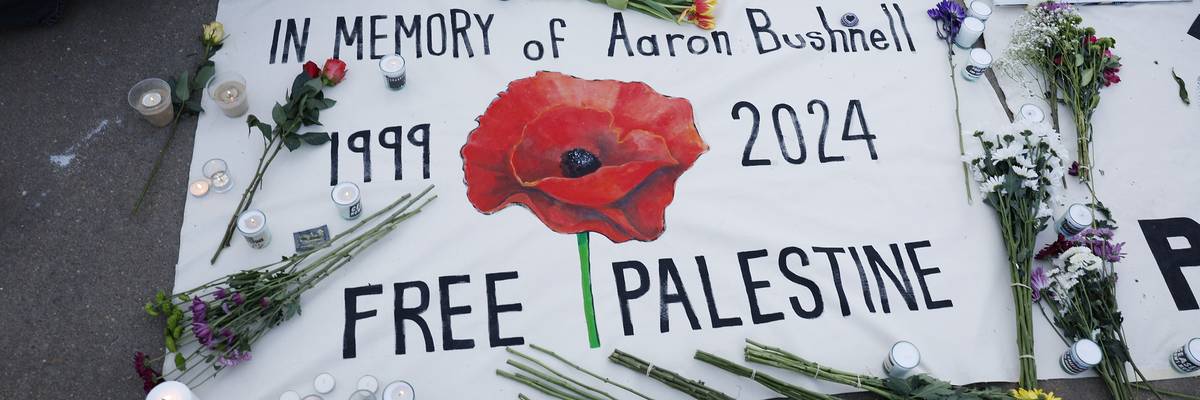
People leave notes and flowers during a vigil for U.S. Air Force active-duty airman Aaron Bushnell outside the Israeli Embassy on February 26, 2024 in Washington, D.C.
His sacrifice begins to define the size of the changes we must make in our global politics, in our relationship with power, in our relationship with one another.
The easiest way to cope with the news is to shrivel it into an us-vs.-them abstraction and, thus, to extract as much humanity from it as possible.
I’m thinking about the recent protest death of Aaron Bushnell, who set himself on fire—doused himself in flammable liquid, lit a match, and ignited himself—in front of the Israeli embassy in Washington, D.C. this past Sunday, February 24. The last words he shouted were “Free Palestine!”
No, this is not the first such death. Over the centuries—and particularly in recent decades, since the Vietnam war—a number of people, spiritually distraught over war or other social conditions, have killed themselves in protest by self-immolation... that is, in the most painful way imaginable. You might say they entered hell of their own accord. Why? The question tears at the soul.
To minimize this as a PR stunt is itself a manifestation of illness—not mental illness, perhaps, but spiritual illness, which is the nature of war itself.
Not to worry, however! You can peruse mainstream coverage of the suicide and begin to relax as the act fades into just more yada yada. Either the guy was mentally ill or absurdly hungry to generate a major public-relations impact for his cause. Here’s NPR, for instance, quoting a university professor—an expert on protest suicides—who explained that such acts started happening regularly around the world in the 1960s, when television had claimed media dominance and, thus, “protesters were able to reach a larger audience.”
This is basically the same way the media covers war itself: strategically. Human lives—human deaths—morph into video-game abstractions. What really matters is who’s winning.
All I can do is stand, or kneel, with the spirit of Aarin Bushnell, the 25-year-old man, an active-duty member of the U.S. Air Force, whose death is real, who surrendered his life because he could no longer bear his country’s complicity in Israel’s devastation of Gaza. Livestreaming what he was about to do, he said in his cellphone video:
I will no longer be complicit in genocide. I am about to engage in an extreme act of protest. But compared to what people have been experiencing in Palestine at the hands of their colonizers, it’s not extreme at all. This is what our ruling class has decided will be normal.
And as the flames began to engulf him, he cried “Free Palestine!” until he finally collapsed. Police and others ran to him, sprayed the flames with a fire extinguisher. They rushed him to a hospital, where he died several hours later.
To minimize this as a PR stunt is itself a manifestation of illness—not mental illness, perhaps, but spiritual illness, which is the nature of war itself. I say this in my own incomprehension at the motive behind such an action: To open yourself to the pain a bombing victim himself might feel is something more than an “act of protest.”
It’s a direct confrontation with the wrong you can no longer bear witnessing or being a part of, and yes, it is using violence—but not to harm or kill your opponent. Instead, you are attempting to widen the public’s understanding of what you are protesting by killing yourself. It’s the absolute opposite of war. This is consciousness shift. This is an awareness that we are connected to one another and that we must protect that connection, even at our own expense.
These words of Pierre Teilhard de Chardin, Jesuit priest and author of The Phenomenon of Man, suddenly seem remarkably relevant: “Someday, after mastering the winds, the waves, the tides, and gravity, we shall harness for God the energies of love, and then, for a second time in the history of the world, man will have discovered fire.”
The “energies of love...” What does this mean? I can only say this: It’s bigger than the horrific foolishness of organizing human society around the political need for an enemy, or what Walter Wink, in his book The Powers That Be, called “the myth of redemptive violence”—the belief that violence saves us.
Indeed, he wrote: “It doesn’t seem to be mythic in the least. Violence simply appears to be in the nature of things. It’s what works. It seems inevitable, the last and, often, the first resort in conflicts. If a god is what you turn to when all else fails, violence certainly functions as a god.”
Attention, mankind! That’s the wrong god. And we know this, at the deepest core of our being. As I contemplate Bushnell’s suicide, I also find myself unavoidably thinking about a 13-year-old schoolgirl named Marian Fisher, one of five girls killed by a lost soul of a gunman at an Amish school in Lancaster County, Pennsylvania, in 2006. As survivors recounted, when the gunman threatened the children, Marian said to him: “Shoot me first.”
There’s something here beyond “normal” thinking, beyond, shall we say, “survival of the fittest.” What’s at stake is humanity’s collective consciousness, which both Aaron and Marion knelt to and gave their lives for, seeming to know it transcended them.
Their sacrifice—and the sacrifices of so many others over the years—begins to define the size of the changes we must make in our global politics, in our relationship with power, in our relationship with one another.
By trying to put such a change into words, let me not oversimplify it. I turn again to Teilhard de Chardin and his belief that we will harness the energies of love “...and then, for a second time in the history of the world, man will have discovered fire.”
Dear Common Dreams reader, It’s been nearly 30 years since I co-founded Common Dreams with my late wife, Lina Newhouser. We had the radical notion that journalism should serve the public good, not corporate profits. It was clear to us from the outset what it would take to build such a project. No paid advertisements. No corporate sponsors. No millionaire publisher telling us what to think or do. Many people said we wouldn't last a year, but we proved those doubters wrong. Together with a tremendous team of journalists and dedicated staff, we built an independent media outlet free from the constraints of profits and corporate control. Our mission has always been simple: To inform. To inspire. To ignite change for the common good. Building Common Dreams was not easy. Our survival was never guaranteed. When you take on the most powerful forces—Wall Street greed, fossil fuel industry destruction, Big Tech lobbyists, and uber-rich oligarchs who have spent billions upon billions rigging the economy and democracy in their favor—the only bulwark you have is supporters who believe in your work. But here’s the urgent message from me today. It's never been this bad out there. And it's never been this hard to keep us going. At the very moment Common Dreams is most needed, the threats we face are intensifying. We need your support now more than ever. We don't accept corporate advertising and never will. We don't have a paywall because we don't think people should be blocked from critical news based on their ability to pay. Everything we do is funded by the donations of readers like you. When everyone does the little they can afford, we are strong. But if that support retreats or dries up, so do we. Will you donate now to make sure Common Dreams not only survives but thrives? —Craig Brown, Co-founder |
The easiest way to cope with the news is to shrivel it into an us-vs.-them abstraction and, thus, to extract as much humanity from it as possible.
I’m thinking about the recent protest death of Aaron Bushnell, who set himself on fire—doused himself in flammable liquid, lit a match, and ignited himself—in front of the Israeli embassy in Washington, D.C. this past Sunday, February 24. The last words he shouted were “Free Palestine!”
No, this is not the first such death. Over the centuries—and particularly in recent decades, since the Vietnam war—a number of people, spiritually distraught over war or other social conditions, have killed themselves in protest by self-immolation... that is, in the most painful way imaginable. You might say they entered hell of their own accord. Why? The question tears at the soul.
To minimize this as a PR stunt is itself a manifestation of illness—not mental illness, perhaps, but spiritual illness, which is the nature of war itself.
Not to worry, however! You can peruse mainstream coverage of the suicide and begin to relax as the act fades into just more yada yada. Either the guy was mentally ill or absurdly hungry to generate a major public-relations impact for his cause. Here’s NPR, for instance, quoting a university professor—an expert on protest suicides—who explained that such acts started happening regularly around the world in the 1960s, when television had claimed media dominance and, thus, “protesters were able to reach a larger audience.”
This is basically the same way the media covers war itself: strategically. Human lives—human deaths—morph into video-game abstractions. What really matters is who’s winning.
All I can do is stand, or kneel, with the spirit of Aarin Bushnell, the 25-year-old man, an active-duty member of the U.S. Air Force, whose death is real, who surrendered his life because he could no longer bear his country’s complicity in Israel’s devastation of Gaza. Livestreaming what he was about to do, he said in his cellphone video:
I will no longer be complicit in genocide. I am about to engage in an extreme act of protest. But compared to what people have been experiencing in Palestine at the hands of their colonizers, it’s not extreme at all. This is what our ruling class has decided will be normal.
And as the flames began to engulf him, he cried “Free Palestine!” until he finally collapsed. Police and others ran to him, sprayed the flames with a fire extinguisher. They rushed him to a hospital, where he died several hours later.
To minimize this as a PR stunt is itself a manifestation of illness—not mental illness, perhaps, but spiritual illness, which is the nature of war itself. I say this in my own incomprehension at the motive behind such an action: To open yourself to the pain a bombing victim himself might feel is something more than an “act of protest.”
It’s a direct confrontation with the wrong you can no longer bear witnessing or being a part of, and yes, it is using violence—but not to harm or kill your opponent. Instead, you are attempting to widen the public’s understanding of what you are protesting by killing yourself. It’s the absolute opposite of war. This is consciousness shift. This is an awareness that we are connected to one another and that we must protect that connection, even at our own expense.
These words of Pierre Teilhard de Chardin, Jesuit priest and author of The Phenomenon of Man, suddenly seem remarkably relevant: “Someday, after mastering the winds, the waves, the tides, and gravity, we shall harness for God the energies of love, and then, for a second time in the history of the world, man will have discovered fire.”
The “energies of love...” What does this mean? I can only say this: It’s bigger than the horrific foolishness of organizing human society around the political need for an enemy, or what Walter Wink, in his book The Powers That Be, called “the myth of redemptive violence”—the belief that violence saves us.
Indeed, he wrote: “It doesn’t seem to be mythic in the least. Violence simply appears to be in the nature of things. It’s what works. It seems inevitable, the last and, often, the first resort in conflicts. If a god is what you turn to when all else fails, violence certainly functions as a god.”
Attention, mankind! That’s the wrong god. And we know this, at the deepest core of our being. As I contemplate Bushnell’s suicide, I also find myself unavoidably thinking about a 13-year-old schoolgirl named Marian Fisher, one of five girls killed by a lost soul of a gunman at an Amish school in Lancaster County, Pennsylvania, in 2006. As survivors recounted, when the gunman threatened the children, Marian said to him: “Shoot me first.”
There’s something here beyond “normal” thinking, beyond, shall we say, “survival of the fittest.” What’s at stake is humanity’s collective consciousness, which both Aaron and Marion knelt to and gave their lives for, seeming to know it transcended them.
Their sacrifice—and the sacrifices of so many others over the years—begins to define the size of the changes we must make in our global politics, in our relationship with power, in our relationship with one another.
By trying to put such a change into words, let me not oversimplify it. I turn again to Teilhard de Chardin and his belief that we will harness the energies of love “...and then, for a second time in the history of the world, man will have discovered fire.”
The easiest way to cope with the news is to shrivel it into an us-vs.-them abstraction and, thus, to extract as much humanity from it as possible.
I’m thinking about the recent protest death of Aaron Bushnell, who set himself on fire—doused himself in flammable liquid, lit a match, and ignited himself—in front of the Israeli embassy in Washington, D.C. this past Sunday, February 24. The last words he shouted were “Free Palestine!”
No, this is not the first such death. Over the centuries—and particularly in recent decades, since the Vietnam war—a number of people, spiritually distraught over war or other social conditions, have killed themselves in protest by self-immolation... that is, in the most painful way imaginable. You might say they entered hell of their own accord. Why? The question tears at the soul.
To minimize this as a PR stunt is itself a manifestation of illness—not mental illness, perhaps, but spiritual illness, which is the nature of war itself.
Not to worry, however! You can peruse mainstream coverage of the suicide and begin to relax as the act fades into just more yada yada. Either the guy was mentally ill or absurdly hungry to generate a major public-relations impact for his cause. Here’s NPR, for instance, quoting a university professor—an expert on protest suicides—who explained that such acts started happening regularly around the world in the 1960s, when television had claimed media dominance and, thus, “protesters were able to reach a larger audience.”
This is basically the same way the media covers war itself: strategically. Human lives—human deaths—morph into video-game abstractions. What really matters is who’s winning.
All I can do is stand, or kneel, with the spirit of Aarin Bushnell, the 25-year-old man, an active-duty member of the U.S. Air Force, whose death is real, who surrendered his life because he could no longer bear his country’s complicity in Israel’s devastation of Gaza. Livestreaming what he was about to do, he said in his cellphone video:
I will no longer be complicit in genocide. I am about to engage in an extreme act of protest. But compared to what people have been experiencing in Palestine at the hands of their colonizers, it’s not extreme at all. This is what our ruling class has decided will be normal.
And as the flames began to engulf him, he cried “Free Palestine!” until he finally collapsed. Police and others ran to him, sprayed the flames with a fire extinguisher. They rushed him to a hospital, where he died several hours later.
To minimize this as a PR stunt is itself a manifestation of illness—not mental illness, perhaps, but spiritual illness, which is the nature of war itself. I say this in my own incomprehension at the motive behind such an action: To open yourself to the pain a bombing victim himself might feel is something more than an “act of protest.”
It’s a direct confrontation with the wrong you can no longer bear witnessing or being a part of, and yes, it is using violence—but not to harm or kill your opponent. Instead, you are attempting to widen the public’s understanding of what you are protesting by killing yourself. It’s the absolute opposite of war. This is consciousness shift. This is an awareness that we are connected to one another and that we must protect that connection, even at our own expense.
These words of Pierre Teilhard de Chardin, Jesuit priest and author of The Phenomenon of Man, suddenly seem remarkably relevant: “Someday, after mastering the winds, the waves, the tides, and gravity, we shall harness for God the energies of love, and then, for a second time in the history of the world, man will have discovered fire.”
The “energies of love...” What does this mean? I can only say this: It’s bigger than the horrific foolishness of organizing human society around the political need for an enemy, or what Walter Wink, in his book The Powers That Be, called “the myth of redemptive violence”—the belief that violence saves us.
Indeed, he wrote: “It doesn’t seem to be mythic in the least. Violence simply appears to be in the nature of things. It’s what works. It seems inevitable, the last and, often, the first resort in conflicts. If a god is what you turn to when all else fails, violence certainly functions as a god.”
Attention, mankind! That’s the wrong god. And we know this, at the deepest core of our being. As I contemplate Bushnell’s suicide, I also find myself unavoidably thinking about a 13-year-old schoolgirl named Marian Fisher, one of five girls killed by a lost soul of a gunman at an Amish school in Lancaster County, Pennsylvania, in 2006. As survivors recounted, when the gunman threatened the children, Marian said to him: “Shoot me first.”
There’s something here beyond “normal” thinking, beyond, shall we say, “survival of the fittest.” What’s at stake is humanity’s collective consciousness, which both Aaron and Marion knelt to and gave their lives for, seeming to know it transcended them.
Their sacrifice—and the sacrifices of so many others over the years—begins to define the size of the changes we must make in our global politics, in our relationship with power, in our relationship with one another.
By trying to put such a change into words, let me not oversimplify it. I turn again to Teilhard de Chardin and his belief that we will harness the energies of love “...and then, for a second time in the history of the world, man will have discovered fire.”