

SUBSCRIBE TO OUR FREE NEWSLETTER
Daily news & progressive opinion—funded by the people, not the corporations—delivered straight to your inbox.
5
#000000
#FFFFFF
To donate by check, phone, or other method, see our More Ways to Give page.
Daily news & progressive opinion—funded by the people, not the corporations—delivered straight to your inbox.

The 2026 NTE Report makes it clear that the Trump administration's primary motivation behind its trade policy is to protect the profits of big US companies.
One year ago today, President Donald Trump waved around the annual National Trade Estimates Report when he announced his reciprocal tariffs, calling it a “special book” listing other countries’ purported “non-tariff trade barriers.” Using the threat of tariffs (now deemed illegal by the Supreme Court), President Trump has bullied countries into signing up to “reciprocal trade agreements” that target many of the policies included in the report.
Earlier this week, the Office of the United States Trade Representative (USTR) released the updated 2026 version of this “special book,” and we can now see that this year’s National Trade Estimates (NTE) Report continues and expands its targeting of critical public interest regulations related to safety in the digital economy, climate policy, environmental protection, public health, and more.
Consumer advocates have long criticized the annual NTE because administrations of both parties have used it to parrot the demands of behemoth corporate interests, without sufficient regard to the public interest. After the Biden administration took positive steps, recognizing that public interest regulations should not necessarily be listed as “trade barriers,” the Trump administration reverted to regurgitating the hit list of Big Tech, Big Pharma, Big Ag, and other billionaire interests—and is now doubling down, attacking even more public interest laws around the world.
Given the proximity of Big Tech companies to the Trump administration, it was only to be expected that the NTE Report would build on the previous year’s attacks on global digital policies. Unfortunately, this year’s report once again labels other countries’ digital ecosystem policies as “trade barriers,” simply because Big Tech companies find them objectionable.
The brazen attacks against a range of crucial public interest policies, ranging from digital rights to public health regulations, reflect the unfortunate anti-people policies of this administration.
The digital ecosystem regulations being targeted by the Trump administration include:
In addition, the report also targets various revenue-sharing regulations implemented by a number of jurisdictions. These regulations typically seek to force Big Tech platforms to support local industries that they cannibalize—such as traditional news producers—or to ensure that Big Tech platforms contribute to local content development. The report lists six jurisdictions with such laws—Australia, Korea, Canada, and the EU, which already have some form of regulation in place, as well as proposed regulations in New Zealand and South Africa.
This is a significant increase from last year’s report, which listed a total of six jurisdictions’ digital competition-related or revenue-sharing laws.
While the urgency of climate change demands bold action at all levels, this year’s report unfortunately doubles down on the Trump administration’s hostility toward efforts to hasten a clean energy transition at home and globally. Instead of incorporating lessons from other countries to inform our own urgently-needed climate policies, the NTE attacks other countries’ environmental and climate laws on behalf of polluting industries, such as:
In keeping with the Trump administration’s unscientific public health policies as well as the administration’s desire to promote the interests of Big Pharma and Big Ag, the report attacks several critical public health policies from around the world. This includes:
Shockingly, the report targets South Africa’s anti-discrimination and equal opportunities regulations that seek to ensure greater participation of workers and historically marginalized communities in the corporate sector. Elon Musk criticized South Africa’s regulations earlier this year, claiming that Starlink is “not allowed to operate in South Africa simply because [he’s] not black [sic].” Taken together with President Trump’s unhinged claims about apparent “genocide” against white South Africans, the inclusion of these regulations in the NTE Report is a worrying sign that the US government intends to use trade tools to push its "anti-diversity" agenda globally.
The report also targets halal certification laws in several majority Muslim countries, notably Brunei, Egypt, the UAE, Kuwait, Oman, Qatar, and Saudi Arabia.
The 2026 NTE Report makes it clear that the Trump administration's primary motivation behind its trade policy is to protect the profits of big U.S. companies. The brazen attacks against a range of crucial public interest policies, ranging from digital rights to public health regulations, reflect the unfortunate anti-people policies of this administration.
Countries across the world should be free to adopt measures to protect citizens’ fundamental rights and consumer safety—without having such measures challenged purely to enable greater corporate profit. And they should not feel beholden to undermine their public interest protections because of the deals they signed under threat of Trump’s sweeping tariffs, especially since those tariffs have now been ruled illegal by the US Supreme Court.
While the Trump administration has made it clear that it intends to double down on its coercive trade policies, including through the use of alternative tariff authorities, we stand in solidarity with civil society around the globe in urging countries to stand up to Trump’s bullying and continue to press ahead with important policies to hold Big Tech accountable and to protect their environment and the health of their people.

In addition to reducing our security and jeopardizing the well-being of people around the world, his belligerence will cost us a huge amount of money. But at least he and his friends will get even richer.
Our Secretary of Defense (or War) Pete Hegseth seems to be having a really great time killing people in Iran, but his live action video games come at a big cost, not just in lives, but in budget dollars. To be clear, the main reason to be opposed to this pointless war is its impact on the people of Iran and elsewhere in the region. But it also has a huge economic cost that is seriously underappreciated.
The short-term cost is the shortage of oil, natural gas, fertilizers, and other items that would ordinarily travel through the Straits of Hormuz. This shortage has already sent prices of many items soaring. The impact is not just on the goods themselves, but there is a large secondary impact due to higher shipping costs, and if fertilizer supplies are not resumed soon, higher food prices, due to lower crop yields. This is a big hit to people in wealthy countries, but it is life-threatening to people living on the edge in Sub-Saharan Africa and South Asia.
But in addition to the short-term cost, there is also a longer-term cost insofar as we are making new enemies and therefore will have higher bills for military spending long into the future. We already got the first taste of this as the Trump administration floated the idea of a $200 billion special appropriation to cover the cost of the war.
There is remarkably little appreciation of how much money is at stake with wars and the military. This is because the media have a deliberate policy of uninformative budget reporting. They just write huge numbers in the millions or billions, knowing they are completely meaningless to almost everyone who sees them.
Trump seems determined to raise military spending even further. He has said he wants the country to spend 5% of GDP, or $1.5 trillion a year, on the military. This comes to $12,000 per household. That’s real money.
It would be virtually costless to provide some context for these numbers, for example, expressing them as a percentage of the budget. That would take any competent reporter 10 seconds and add maybe 10 words to a news article. This would tell you that the $200 billion (2.7% of the budget) Trump wants for his Iran war is a relatively big deal, while the $550 million (0.008% of the budget) Trump saved us by defunding public broadcasting was not.
It is striking to see that Congress might be willing to quickly cough up this money when it has refused far smaller sums that could have made a huge difference in the lives of tens of millions of people. For example, the extension of the Covid-19 relief enhancement of the Earned Income Tax Credit would have cost around $40 billion (0.6% of the budget) annually. Extending the more generous Obamacare subsidies would have cost $27 billion (0.4% of the budget) annually.
And it is important to remember that these increased costs are not likely to be just a one-year expenditure. The military budget was 3.0% of GDP in 2001, before the war in Afghanistan, and projected to fall to 2.7% over the next several years. Instead, we got the Afghan War followed by the invasion of Iraq. By 2010, spending was up to 4.6% of GDP. The difference between actual and projected spending comes to almost 2.0% of GDP, or more than $600 billion annually in today’s economy.
In contrast to the Trump administration’s efforts to seek enemies, in the 1980s and 1990s, the United States looked to diffuse tensions with the Soviet Union and saved a huge amount of money on military spending as a result. Military spending hit a post-Vietnam War peak of 6.1% of GDP in 1986. It then fell sharply as Presidents Ronald Reagan and George Bush I negotiated arms control agreements with the Soviet Union. It was down to 4.7% of GDP in fiscal 1992, when the Soviet Union collapsed. It continued to fall through the 1990s, when the United States faced no major enemies.
At that point, Russia was actually a limited ally. There were many people in the foreign policy establishment who wanted to keep it that way, looking to accommodate post-Soviet Russia in a post-Cold War world.
Instead, we took the direction of expanding NATO eastward, incorporating the former East Bloc countries into NATO, starting with Hungary. Eventually, all the former East Bloc countries were added to NATO, and then former Soviet republics such as Estonia, Latvia, and Lithuania were added. In 2008, President George W. Bush pushed for the addition of Ukraine and Georgia as well.
It is worth noting that it was not pre-ordained that NATO would be expanded eastward. NATO was formed as an anti-Soviet alliance. With the Soviet Union out of business, it was reasonable to think that NATO would be disbanded.
This was not just the dream of fringe peaceniks; many fully credentialled cold warriors also argued against expanding NATO eastward. This list includes Jack Matlock and Richard Pipes, both of whom held high-level positions under Reagan. It also included George Kennan, the godfather of the Cold War doctrine of containment. Even Henry Kissinger opposed including Ukraine in NATO.
It’s not clear whether Russia would have developed into a hostile state and potential enemy if NATO had not continued to exist and expand Eastward. We can all share our speculations on that counterfactual, but one thing that is not debatable is that having a major enemy is costly.
President Barack Obama negotiated an agreement to restrain Iran from developing nuclear weapons in 2015. While there were issued raised with the monitoring of the deal, rather than trying to work through these problems, Trump withdrew from the deal in 2018. That decision, along with President Joe Biden’s failure to restore the agreement, created the conditions under which a second Trump administration could be pushed by Israeli President Benjamin Netanyahu into this war. The war has already proved incredibly costly for the country and the world, and the costs could well go far higher.
But apart from this war, Trump seems determined to raise military spending even further. He has said he wants the country to spend 5% of GDP, or $1.5 trillion a year, on the military. This comes to $12,000 per household. That’s real money.
That is a lot of money to spend for no obvious reason. It means less money for healthcare, childcare, education, and many other items that people care about.
If the point is to put taxpayer dollars into the pockets of his family and friends, it can work out just fine. Until there is evidence otherwise, we should assume this is Trump’s real agenda for his big military budget.
The question people should be asking is who is this spending supposed to defend us against? Perhaps Trump has Russia in mind, but he is supposed to be good buddies with its President Vladimir Putin. Besides, Russia’s GDP is less than a quarter the size of the US economy. Do we really need to spend an amount that is more than 20% of Russia’s GDP to protect us against them? Can our military be that inefficient and corrupt?
Maybe Trump is thinking of China. That would be a problem, since China’s economy is already one-third larger than ours and growing far more rapidly. If Trump’s plan is to have a New Cold War with China, that is one we are likely to lose, especially since he just told all our allies to go to hell.
As with the Iran War, Trump’s push towards a newly militarized economy does not seem well-considered. Or at least it doesn’t seem well-considered as a defense strategy. If the point is to put taxpayer dollars into the pockets of his family and friends, it can work out just fine. Until there is evidence otherwise, we should assume this is Trump’s real agenda for his big military budget.
In addition to reducing our security and jeopardizing the well-being of people around the world, Donald Trump’s belligerence will cost us a huge amount of money. But at least his family and friends will get even richer. Who knows, maybe he will even get the Nobel Peace Prize this year.
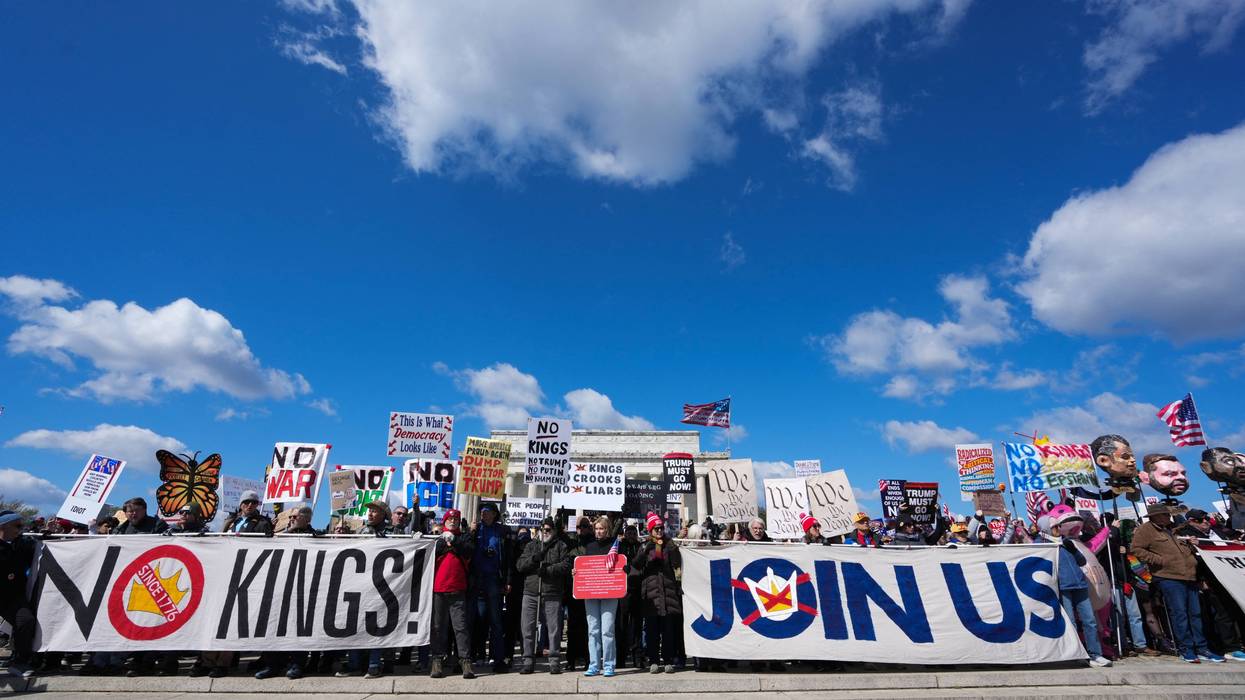
Trump has made himself the perfect target for what may well be a growing movement to rebuild humanity itself.
The glow of the recent No Kings rally still pulsates in my heart. Some 8 million people across the planet took part in over 3,000 separate events—people carrying signs that said things like “Power of Love, not Love of Power,” and “Jesus was a refugee,” and, well... “Super Callous Fragile Racist Sexist Nazi POTUS” and “Grab ’em by the midterms.”
Credit to President Donald Trump. He wages his wars and struts through life with so much arrogant swagger—so much indifference to politically correct propaganda—that he has made himself the perfect target for what may well be a growing movement to rebuild humanity itself. Oh God, I hope this is the case! Trump is the fool, the bellicose idiot of the moment—in partnership, of course, with Israeli Prime Minister Bibi Netanyahu—but they’re only the current faces of the trek to hell and nonexistence we’ve been on for a while.
No Kings is bigger than “no kings.” It’s more than just a movement to reclaim the democracy we used to have (back in the days of George W. Bush, for instance). Yes, it’s a movement in opposition to actions of the Trump administration: the pointless war in Iran and the global economic chaos it has created; the war on immigrants; the invasion, especially of blue cities, by the Immigration and Customs Enforcement (ICE) Gestapo; and, no doubt, people’s ongoing shock and outrage over the Epstein files and the sexual abuse of young girls.
“But voicing opposition is one thing,” as a recent piece in The Christian Science Monitor put it. “Turning it into action is another. The long history of American protests, dating back to the original Boston Tea Party in 1773, shows that not all mass movements produce tangible or lasting results.”
So on Saturday I knew that we marched with open souls. We felt the wrong that’s underway, perpetrated by our country, and turned that wrong, as best we could, into hope. Into love.
And tangible, lasting results are definitely what the participants want: what we want. And it’s crucial we don’t let this movement go, this movement emerging from “a broad progressive coalition,” according to the article, “with supporters across the country. No Kings organizers include labor unions, such as the American Federation of Teachers and the Service Employees International Union; veterans organizations, such as Common Defense; environmental groups, such as the League of Conservation Voters; and civil rights groups, such as the American Civil Liberties Union.”
As I pushed my wheeled walker through the streets of Appleton last Saturday, feeling an urgent connection with the thousands of people present, I wanted to swaddle the moment in my arms. I knew it was bigger than Donald Trump. I felt like we were crossing the Edmund Pettus Bridge—stepping into, and beyond, humanity’s hatred of itself. We were marching not simply for No Kings but for One Planet.
Could this be the civil rights movement rebirthing itself? This movement, of the ’50s and ’60s, wasn’t just about the nation’s great wrongs—the racism, the segregation, the enormous lie that some people are less than human. It pushed against the hatred that had been structured into law and turned into national certainty. The civil rights movement pushed us toward a connected world. It opened the nation’s eyes... and soul.
So on Saturday I knew that we marched with open souls. We felt the wrong that’s underway, perpetrated by our country, and turned that wrong, as best we could, into hope. Into love. Love for the children our bombs have murdered. Love for the families ICE has torn apart. Love for the lost refugees whisked to concentration camps.
This is One Planet! We know it on the streets. We will not stop marching until it is known in the halls of Congress. Until it is known in the White House.
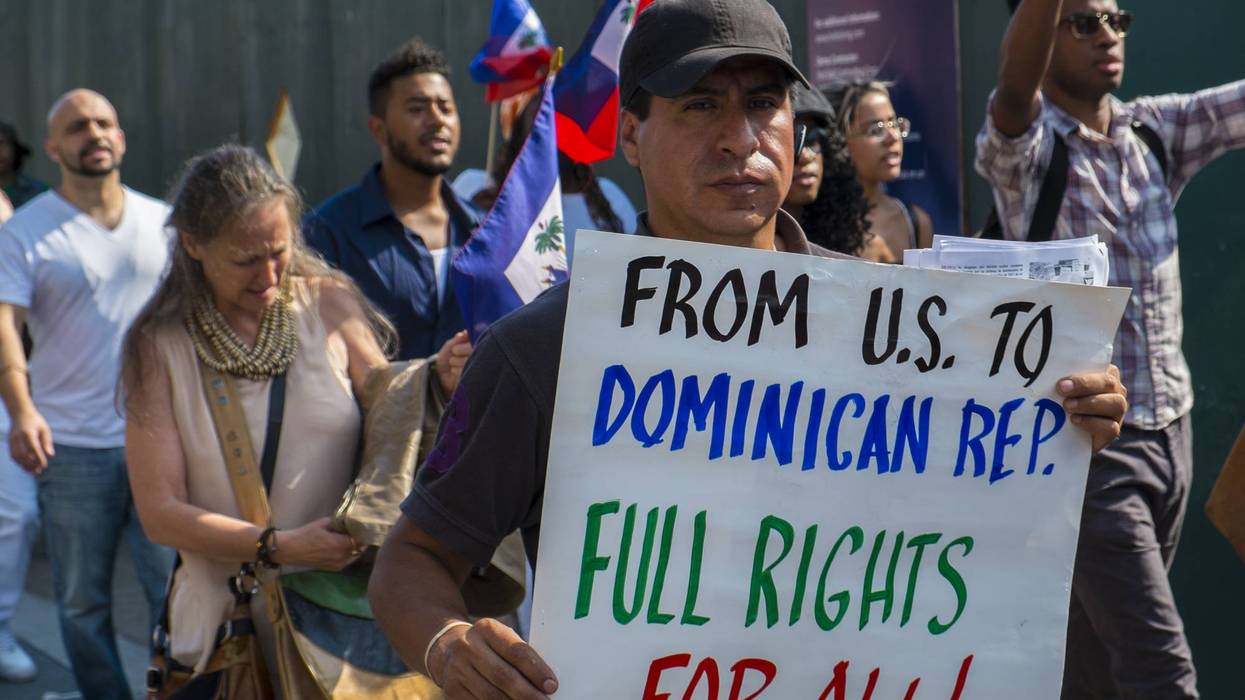
Racism and bigotry can never become the basis for deciding who gets rights and who belongs; families should never be stripped from their homes for the sake of violently manufacturing an ethnostate.
On April 1, the Supreme Court began hearing arguments in Trump v. Barbara, a class-action lawsuit challenging the Trump administration’s executive order to ban birthright citizenship for the children of undocumented immigrants.
Every lower court that has ruled on this issue thus far has found this executive order to be straightforwardly unconstitutional—and they are correct. The 14th Amendment is clear: “All persons born or naturalized in the United States, and subject to the jurisdiction thereof, are citizens of the United States and of the State wherein they reside.”
The Trump administration contends that to be “subject to the jurisdiction thereof” means one must owe “direct and immediate allegiance” to the United States and receive “protection” from it. Solicitor General D. John Sauer argues that the children of US citizens and formerly enslaved persons meet this test by virtue of having “a permanent domicile”—a permanent home they intend to stay indefinitely. By contrast, the children of undocumented immigrants “do not owe primary allegiance to the United States by virtue of domicile” because their parents “lack the legal capacity to establish domicile here.”
This reading adds much to the Citizenship Clause that is clearly not present. No plausible interpretation would assume that the drafters meant anything about loyalty, allegiance, or domiciles.
Ultimately, Trump’s birthright restrictions, like those implemented in the DR, are nothing more than racism and xenophobia masquerading as legitimate policy.
Those challenging the Trump administration argue: “The government is asking for nothing less than a remaking of our Nation’s constitutional foundations. The Order may be formally prospective, applying to tens of thousands of children born every month, and devastating families around the country. But worse yet, the government’s baseless arguments—if accepted—would cast a shadow over the citizenship of millions upon millions of Americans, going back generations.”
This warning should be taken seriously. We have already seen similar events play out in the Dominican Republic (DR).
In 1997, the mothers of Dilcia Yean and Violeta Bosico requested that the local registry office provide them with a copy of their daughters’ birth certificates. Without it, the children could not enroll in school and were at risk of deportation. While both Yean and Bosico were born in the DR to Dominican mothers, their fathers were Haitian temporary workers. On that basis, the registry denied their mothers’ request. This blatantly discriminatory denial effectively rendered the girls rightless and stateless.
Under the 1994 Dominican Constitution, both girls were entitled to birthright citizenship. Per the Constitution, citizenship is granted to “all persons born within the territory of the Republic, with the exception of the legitimate children of foreigners residing in the country in a diplomatic capacity or those who are in transit therein.” Important here is the “in transit” clause. As Ernesto Sagás notes, “This clause was originally designed to address the issue of children born on ships passing through Dominican ports, and whose parents were not intending to settle in the Dominican Republic.” However, over the years, politicians had argued (and at times acted as if) that clause extended to the children of temporary workers, like Yean and Bosico.
After years of obstruction from government officials, the mothers finally succeeded in obtaining their daughters’ birth certificates in 2001.
In 2003, the case was submitted to the Inter-American Court of Human Rights (IACHR). In court, the DR denied any wrongdoing. Rather, they defended a broad definition of “persons in transit” based on its 2004 General Migration Law (Ley No. 285-04). Under that Law, “temporary workers” were formally classified as “persons in transit.” The DR argued that Yean and Bosico were not Dominican nationals themselves because their fathers were Haitian temporary workers—their fathers were “in transit,” thus they too were “in transit.” The IACHR rejected this reasoning.
If the Supreme Court has any legitimacy left, they will do the right thing and end Trump’s birthright madness.
In September 2005, the IACHR ruled that the DR had violated several of the girls’ rights under the American Convention of Human Rights, including their right to a nationality, equal protection, and humane treatment. The IACHR ordered the Dominican government to award the girls $8,000 USD each, issue a public apology, and amend their domestic laws to make the procedure for acquiring birth certificates “simple, accessible, and reasonable since, to the contrary, applicants could remain stateless.”
In October 2005, the Senate of the Dominican Republic issued a resolution rejecting the IACHR’s decision. In December 2005, the Supreme Court of Justice of the Dominican Republic, in further defiance of the IACHR, upheld the General Migration Law’s broad definition of “persons in transit.”
In 2010, the DR took matters one step further by formally amending their Constitution. Under the 2010 Constitution, citizenship is granted to “persons born within the national territory, with the exception of the children of foreign nationals who are members of diplomatic and consular missions, of foreigners who are in transit or residing illegally within Dominican territory. Any foreigner defined as such under Dominican laws shall be considered a person in transit.” Importantly, this redefinition divorced the concept of “person in transit” from any notion of temporary stay. A person could, for instance, live continuously in the DR for years and still be considered “in transit.”
Initially, this did not impact people who already had Dominican citizenship. But in 2013, that too changed. The Constitutional Court of the Dominican Republic retroactively applied the new standard to all persons born between 1929 and 2010. The Court ordered the government to thoroughly review all birth registries within that period and remove any persons who no longer count as Dominican under the new guidelines. In the decade that followed, this ruling would strip as many as 245,000 Dominicans of their citizenship and trigger a humanitarian crisis.
Up to 86% of those impacted have been Dominicans of Haitian descent. This is no accident. It reflects the historical and persistent discrimination against Haitians rampant across the DR. The 2013 ruling made legal what people like Santiago Riverón, the mayor of Dajabón, at the Dominican-Haitian border, have long since thought. In an interview with journalist Marius Loiseau, Riverón claims that, “Haitians and Dominicans are like water and oil.” He continues, “They have already begun to invade us for good.”
Dominican President and Trump ally Luis Abinader echoes these sentiments. He remarks: “The rights of Dominicans will not be displaced. Our identity will not be diluted. Our generosity will not be exploited. Here, solidarity has limits.” He insists that stricter penalties against undocumented migrants are necessary to ensure that the “violence that is destroying Haiti will not cross over to the Dominican Republic.”
In October 2024, his administration announced plans to deport up to 10,000 undocumented migrants per week. Between then and March 2025, more than 180,000 people were forcibly deported to Haiti by Dominican officials. These mass deportations have fueled discrimination and racial profiling, excessive violence, arbitrary detention, and family separation as well as numerous human rights violations.
While there are many important differences between the DR and US, on the issue of immigration, the parallels are unmistakable. The Trump administration is also motivated by the belief that immigrants, including Haitians, pose an existential threat to the nation’s identity; that they are a serious risk to public safety; as well as a strain on social, political, and economic resources. Like Riverón and Abinader, President Trump insists that, given the scale of the “invasion,” aggressive immigration enforcement is necessary. This includes imposing denaturalization and immigrant arrest quotas. Even the formal justification for restricting birthright citizenship is similar. For both the Trump administration and the Dominican government, no matter how many years they have lived in the country or how long they intend to stay, an undocumented immigrant is always “in transit.” They never obtain a “permanent domicile.” The Dominican government does and the Trump administration aims to extend the purported ‘transientness’ of the parents to their children as a justification for denying them citizenship.
Ultimately, Trump’s birthright restrictions, like those implemented in the DR, are nothing more than racism and xenophobia masquerading as legitimate policy. If the Trump administration succeeds in restricting birthright citizenship, it—or a future MAGA presidency—will likely seek to build upon this ruling. Like the Constitutional Court of the DR, the Supreme Court may eventually rule to retroactively apply their decision to all persons born after the ratification of the 14th Amendment.
Racism and bigotry can never become the basis for deciding who gets rights and who belongs; families should never be stripped from their homes for the sake of violently manufacturing an ethnostate. What happened in the DR should be a cautionary tale for those of us in the US.
If the Supreme Court has any legitimacy left, they will do the right thing and end Trump’s birthright madness. That said, Trump cares little for democracy or the rule of law; regardless of how they decide, we will need to remain vigilant to protect ourselves, our loved ones, and our communities.