SUBSCRIBE TO OUR FREE NEWSLETTER
Daily news & progressive opinion—funded by the people, not the corporations—delivered straight to your inbox.
5
#000000
#FFFFFF
To donate by check, phone, or other method, see our More Ways to Give page.
Daily news & progressive opinion—funded by the people, not the corporations—delivered straight to your inbox.
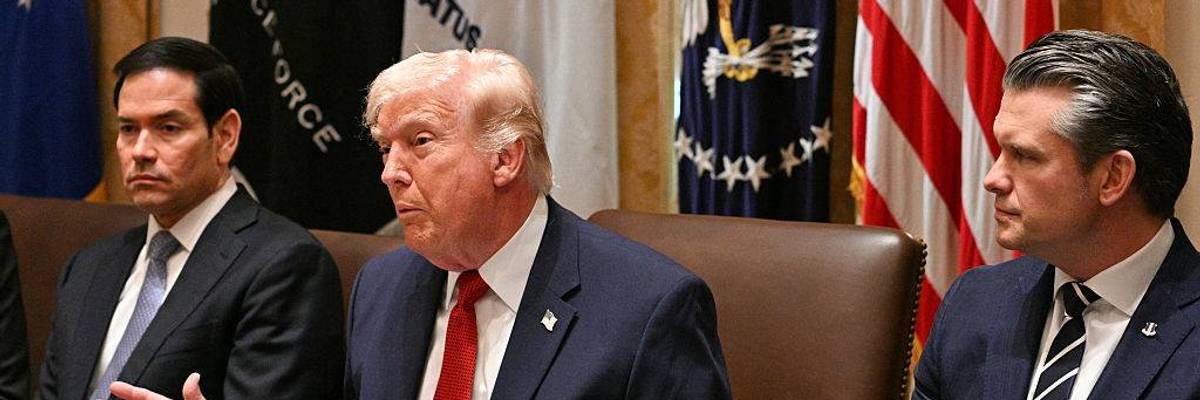
US President Donald Trump, flanked by Secretary of State Marco Rubio and Defense Secretary Pete Hegseth, speaks during a Cabinet meeting in Washington, DC, on March 26, 2026.
"Trump’s problem is that whatever the claims he might make about the damage to Iran’s nuclear and military capacity, which is substantial, the regime survives, the international economy has been severely disrupted, and the bills keep on coming in."
President Donald Trump is reportedly preparing to launch some kind of ground assault on Iran in the coming weeks, but one prominent military strategy expert believes he's heading straight for defeat.
The Washington Post on Saturday reported that the Pentagon is preparing for "weeks" of ground operations in Iran, which for the last month has disrupted global energy markets by shutting down the Strait of Hormuz in response to aerial assaults by the US and Israel.
The Post's sources revealed that "any potential ground operation would fall short of a full-scale invasion and could instead involve raids by a mixture of Special Operations forces and conventional infantry troops" that could be used to seize Kharg Island, a key Iranian oil export hub, or to search out and destroy weapons systems that could be used by the Iranians to target ships along the strait.
Michael Eisenstadt, director of the Military and Security Studies Program at the Washington Institute for Near East Policy, told the Post that taking over Kharg Island would be a highly risky operation for American troops, even if initially successful.
“I just wouldn’t want to be in that small place with Iran’s ability to rain down drones and maybe artillery,” said Eisenstadt.
Eisenstadt's analysis was echoed by Ret. Gen. Joseph Votel, former head of US Central Command, who told ABC News that seizing and occupying Kharg Island would put US troops in a state of constant danger, warning they could be "very, very vulnerable" to drones and missiles launched from the shore.
Lawrence Freedman, professor emeritus of war studies at King's College London, believes that the president has already checkmated himself regardless of what shape any ground operation takes.
In an analysis published Sunday, Freedman declared Trump had run "out of options" for victory, as there have been no signs of the Iranian regime crumbling due to US-Israeli attacks.
Freedman wrote that Trump now "appears to inhabit an alternative reality," noting that "his utterances have become increasingly incoherent, with contradictory statements following quickly one after the other, and frankly delusional claims."
Trump's loan real option at this point, Freedman continued, would to simply declare that he had achieved an unprecedented victory and just walk away. But even in that case, wrote Freedman, "this would mean leaving behind a mess in the Gulf" with no guarantee that Iran would re-open the Strait of Hormuz.
"Success in war is judged not by damage caused but by political objectives realized," Freedman wrote in his conclusion. "Here the objective was regime change, or at least the emergence of a new compliant leader... Trump’s problem is that whatever the claims he might make about the damage to Iran’s nuclear and military capacity, which is substantial, the regime survives, the international economy has been severely disrupted, and the bills keep on coming in."
Dear Common Dreams reader, It’s been nearly 30 years since I co-founded Common Dreams with my late wife, Lina Newhouser. We had the radical notion that journalism should serve the public good, not corporate profits. It was clear to us from the outset what it would take to build such a project. No paid advertisements. No corporate sponsors. No millionaire publisher telling us what to think or do. Many people said we wouldn't last a year, but we proved those doubters wrong. Together with a tremendous team of journalists and dedicated staff, we built an independent media outlet free from the constraints of profits and corporate control. Our mission has always been simple: To inform. To inspire. To ignite change for the common good. Building Common Dreams was not easy. Our survival was never guaranteed. When you take on the most powerful forces—Wall Street greed, fossil fuel industry destruction, Big Tech lobbyists, and uber-rich oligarchs who have spent billions upon billions rigging the economy and democracy in their favor—the only bulwark you have is supporters who believe in your work. But here’s the urgent message from me today. It's never been this bad out there. And it's never been this hard to keep us going. At the very moment Common Dreams is most needed, the threats we face are intensifying. We need your support now more than ever. We don't accept corporate advertising and never will. We don't have a paywall because we don't think people should be blocked from critical news based on their ability to pay. Everything we do is funded by the donations of readers like you. When everyone does the little they can afford, we are strong. But if that support retreats or dries up, so do we. Will you donate now to make sure Common Dreams not only survives but thrives? —Craig Brown, Co-founder |
President Donald Trump is reportedly preparing to launch some kind of ground assault on Iran in the coming weeks, but one prominent military strategy expert believes he's heading straight for defeat.
The Washington Post on Saturday reported that the Pentagon is preparing for "weeks" of ground operations in Iran, which for the last month has disrupted global energy markets by shutting down the Strait of Hormuz in response to aerial assaults by the US and Israel.
The Post's sources revealed that "any potential ground operation would fall short of a full-scale invasion and could instead involve raids by a mixture of Special Operations forces and conventional infantry troops" that could be used to seize Kharg Island, a key Iranian oil export hub, or to search out and destroy weapons systems that could be used by the Iranians to target ships along the strait.
Michael Eisenstadt, director of the Military and Security Studies Program at the Washington Institute for Near East Policy, told the Post that taking over Kharg Island would be a highly risky operation for American troops, even if initially successful.
“I just wouldn’t want to be in that small place with Iran’s ability to rain down drones and maybe artillery,” said Eisenstadt.
Eisenstadt's analysis was echoed by Ret. Gen. Joseph Votel, former head of US Central Command, who told ABC News that seizing and occupying Kharg Island would put US troops in a state of constant danger, warning they could be "very, very vulnerable" to drones and missiles launched from the shore.
Lawrence Freedman, professor emeritus of war studies at King's College London, believes that the president has already checkmated himself regardless of what shape any ground operation takes.
In an analysis published Sunday, Freedman declared Trump had run "out of options" for victory, as there have been no signs of the Iranian regime crumbling due to US-Israeli attacks.
Freedman wrote that Trump now "appears to inhabit an alternative reality," noting that "his utterances have become increasingly incoherent, with contradictory statements following quickly one after the other, and frankly delusional claims."
Trump's loan real option at this point, Freedman continued, would to simply declare that he had achieved an unprecedented victory and just walk away. But even in that case, wrote Freedman, "this would mean leaving behind a mess in the Gulf" with no guarantee that Iran would re-open the Strait of Hormuz.
"Success in war is judged not by damage caused but by political objectives realized," Freedman wrote in his conclusion. "Here the objective was regime change, or at least the emergence of a new compliant leader... Trump’s problem is that whatever the claims he might make about the damage to Iran’s nuclear and military capacity, which is substantial, the regime survives, the international economy has been severely disrupted, and the bills keep on coming in."
President Donald Trump is reportedly preparing to launch some kind of ground assault on Iran in the coming weeks, but one prominent military strategy expert believes he's heading straight for defeat.
The Washington Post on Saturday reported that the Pentagon is preparing for "weeks" of ground operations in Iran, which for the last month has disrupted global energy markets by shutting down the Strait of Hormuz in response to aerial assaults by the US and Israel.
The Post's sources revealed that "any potential ground operation would fall short of a full-scale invasion and could instead involve raids by a mixture of Special Operations forces and conventional infantry troops" that could be used to seize Kharg Island, a key Iranian oil export hub, or to search out and destroy weapons systems that could be used by the Iranians to target ships along the strait.
Michael Eisenstadt, director of the Military and Security Studies Program at the Washington Institute for Near East Policy, told the Post that taking over Kharg Island would be a highly risky operation for American troops, even if initially successful.
“I just wouldn’t want to be in that small place with Iran’s ability to rain down drones and maybe artillery,” said Eisenstadt.
Eisenstadt's analysis was echoed by Ret. Gen. Joseph Votel, former head of US Central Command, who told ABC News that seizing and occupying Kharg Island would put US troops in a state of constant danger, warning they could be "very, very vulnerable" to drones and missiles launched from the shore.
Lawrence Freedman, professor emeritus of war studies at King's College London, believes that the president has already checkmated himself regardless of what shape any ground operation takes.
In an analysis published Sunday, Freedman declared Trump had run "out of options" for victory, as there have been no signs of the Iranian regime crumbling due to US-Israeli attacks.
Freedman wrote that Trump now "appears to inhabit an alternative reality," noting that "his utterances have become increasingly incoherent, with contradictory statements following quickly one after the other, and frankly delusional claims."
Trump's loan real option at this point, Freedman continued, would to simply declare that he had achieved an unprecedented victory and just walk away. But even in that case, wrote Freedman, "this would mean leaving behind a mess in the Gulf" with no guarantee that Iran would re-open the Strait of Hormuz.
"Success in war is judged not by damage caused but by political objectives realized," Freedman wrote in his conclusion. "Here the objective was regime change, or at least the emergence of a new compliant leader... Trump’s problem is that whatever the claims he might make about the damage to Iran’s nuclear and military capacity, which is substantial, the regime survives, the international economy has been severely disrupted, and the bills keep on coming in."