SUBSCRIBE TO OUR FREE NEWSLETTER
Daily news & progressive opinion—funded by the people, not the corporations—delivered straight to your inbox.
5
#000000
#FFFFFF
To donate by check, phone, or other method, see our More Ways to Give page.
Daily news & progressive opinion—funded by the people, not the corporations—delivered straight to your inbox.
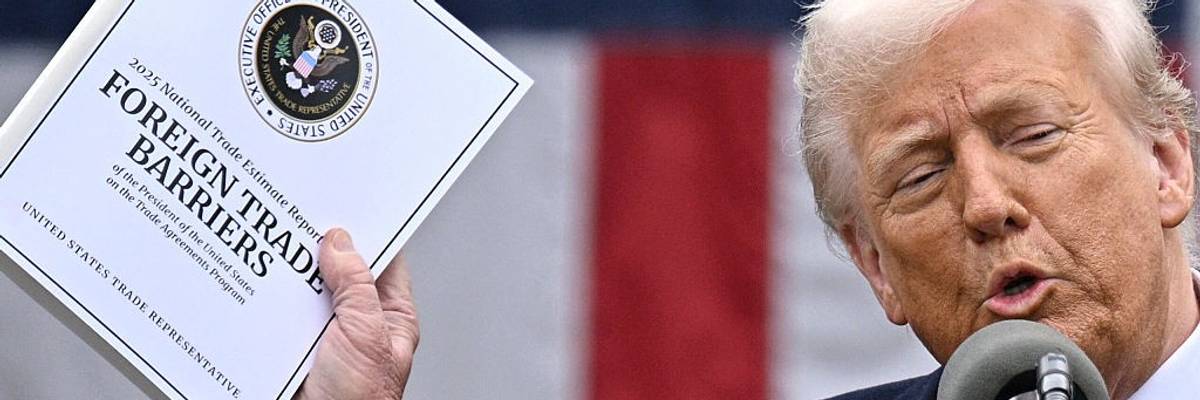
US President Donald Trump delivers remarks on reciprocal tariffs during an event in the Rose Garden entitled "Make America Wealthy Again" at the White House in Washington, DC, on April 2, 2025.
The 2026 NTE Report makes it clear that the Trump administration's primary motivation behind its trade policy is to protect the profits of big US companies.
One year ago today, President Donald Trump waved around the annual National Trade Estimates Report when he announced his reciprocal tariffs, calling it a “special book” listing other countries’ purported “non-tariff trade barriers.” Using the threat of tariffs (now deemed illegal by the Supreme Court), President Trump has bullied countries into signing up to “reciprocal trade agreements” that target many of the policies included in the report.
Earlier this week, the Office of the United States Trade Representative (USTR) released the updated 2026 version of this “special book,” and we can now see that this year’s National Trade Estimates (NTE) Report continues and expands its targeting of critical public interest regulations related to safety in the digital economy, climate policy, environmental protection, public health, and more.
Consumer advocates have long criticized the annual NTE because administrations of both parties have used it to parrot the demands of behemoth corporate interests, without sufficient regard to the public interest. After the Biden administration took positive steps, recognizing that public interest regulations should not necessarily be listed as “trade barriers,” the Trump administration reverted to regurgitating the hit list of Big Tech, Big Pharma, Big Ag, and other billionaire interests—and is now doubling down, attacking even more public interest laws around the world.
Given the proximity of Big Tech companies to the Trump administration, it was only to be expected that the NTE Report would build on the previous year’s attacks on global digital policies. Unfortunately, this year’s report once again labels other countries’ digital ecosystem policies as “trade barriers,” simply because Big Tech companies find them objectionable.
The brazen attacks against a range of crucial public interest policies, ranging from digital rights to public health regulations, reflect the unfortunate anti-people policies of this administration.
The digital ecosystem regulations being targeted by the Trump administration include:
In addition, the report also targets various revenue-sharing regulations implemented by a number of jurisdictions. These regulations typically seek to force Big Tech platforms to support local industries that they cannibalize—such as traditional news producers—or to ensure that Big Tech platforms contribute to local content development. The report lists six jurisdictions with such laws—Australia, Korea, Canada, and the EU, which already have some form of regulation in place, as well as proposed regulations in New Zealand and South Africa.
This is a significant increase from last year’s report, which listed a total of six jurisdictions’ digital competition-related or revenue-sharing laws.
While the urgency of climate change demands bold action at all levels, this year’s report unfortunately doubles down on the Trump administration’s hostility toward efforts to hasten a clean energy transition at home and globally. Instead of incorporating lessons from other countries to inform our own urgently-needed climate policies, the NTE attacks other countries’ environmental and climate laws on behalf of polluting industries, such as:
In keeping with the Trump administration’s unscientific public health policies as well as the administration’s desire to promote the interests of Big Pharma and Big Ag, the report attacks several critical public health policies from around the world. This includes:
Shockingly, the report targets South Africa’s anti-discrimination and equal opportunities regulations that seek to ensure greater participation of workers and historically marginalized communities in the corporate sector. Elon Musk criticized South Africa’s regulations earlier this year, claiming that Starlink is “not allowed to operate in South Africa simply because [he’s] not black [sic].” Taken together with President Trump’s unhinged claims about apparent “genocide” against white South Africans, the inclusion of these regulations in the NTE Report is a worrying sign that the US government intends to use trade tools to push its "anti-diversity" agenda globally.
The report also targets halal certification laws in several majority Muslim countries, notably Brunei, Egypt, the UAE, Kuwait, Oman, Qatar, and Saudi Arabia.
The 2026 NTE Report makes it clear that the Trump administration's primary motivation behind its trade policy is to protect the profits of big U.S. companies. The brazen attacks against a range of crucial public interest policies, ranging from digital rights to public health regulations, reflect the unfortunate anti-people policies of this administration.
Countries across the world should be free to adopt measures to protect citizens’ fundamental rights and consumer safety—without having such measures challenged purely to enable greater corporate profit. And they should not feel beholden to undermine their public interest protections because of the deals they signed under threat of Trump’s sweeping tariffs, especially since those tariffs have now been ruled illegal by the US Supreme Court.
While the Trump administration has made it clear that it intends to double down on its coercive trade policies, including through the use of alternative tariff authorities, we stand in solidarity with civil society around the globe in urging countries to stand up to Trump’s bullying and continue to press ahead with important policies to hold Big Tech accountable and to protect their environment and the health of their people.
Dear Common Dreams reader, It’s been nearly 30 years since I co-founded Common Dreams with my late wife, Lina Newhouser. We had the radical notion that journalism should serve the public good, not corporate profits. It was clear to us from the outset what it would take to build such a project. No paid advertisements. No corporate sponsors. No millionaire publisher telling us what to think or do. Many people said we wouldn't last a year, but we proved those doubters wrong. Together with a tremendous team of journalists and dedicated staff, we built an independent media outlet free from the constraints of profits and corporate control. Our mission has always been simple: To inform. To inspire. To ignite change for the common good. Building Common Dreams was not easy. Our survival was never guaranteed. When you take on the most powerful forces—Wall Street greed, fossil fuel industry destruction, Big Tech lobbyists, and uber-rich oligarchs who have spent billions upon billions rigging the economy and democracy in their favor—the only bulwark you have is supporters who believe in your work. But here’s the urgent message from me today. It's never been this bad out there. And it's never been this hard to keep us going. At the very moment Common Dreams is most needed, the threats we face are intensifying. We need your support now more than ever. We don't accept corporate advertising and never will. We don't have a paywall because we don't think people should be blocked from critical news based on their ability to pay. Everything we do is funded by the donations of readers like you. When everyone does the little they can afford, we are strong. But if that support retreats or dries up, so do we. Will you donate now to make sure Common Dreams not only survives but thrives? —Craig Brown, Co-founder |
One year ago today, President Donald Trump waved around the annual National Trade Estimates Report when he announced his reciprocal tariffs, calling it a “special book” listing other countries’ purported “non-tariff trade barriers.” Using the threat of tariffs (now deemed illegal by the Supreme Court), President Trump has bullied countries into signing up to “reciprocal trade agreements” that target many of the policies included in the report.
Earlier this week, the Office of the United States Trade Representative (USTR) released the updated 2026 version of this “special book,” and we can now see that this year’s National Trade Estimates (NTE) Report continues and expands its targeting of critical public interest regulations related to safety in the digital economy, climate policy, environmental protection, public health, and more.
Consumer advocates have long criticized the annual NTE because administrations of both parties have used it to parrot the demands of behemoth corporate interests, without sufficient regard to the public interest. After the Biden administration took positive steps, recognizing that public interest regulations should not necessarily be listed as “trade barriers,” the Trump administration reverted to regurgitating the hit list of Big Tech, Big Pharma, Big Ag, and other billionaire interests—and is now doubling down, attacking even more public interest laws around the world.
Given the proximity of Big Tech companies to the Trump administration, it was only to be expected that the NTE Report would build on the previous year’s attacks on global digital policies. Unfortunately, this year’s report once again labels other countries’ digital ecosystem policies as “trade barriers,” simply because Big Tech companies find them objectionable.
The brazen attacks against a range of crucial public interest policies, ranging from digital rights to public health regulations, reflect the unfortunate anti-people policies of this administration.
The digital ecosystem regulations being targeted by the Trump administration include:
In addition, the report also targets various revenue-sharing regulations implemented by a number of jurisdictions. These regulations typically seek to force Big Tech platforms to support local industries that they cannibalize—such as traditional news producers—or to ensure that Big Tech platforms contribute to local content development. The report lists six jurisdictions with such laws—Australia, Korea, Canada, and the EU, which already have some form of regulation in place, as well as proposed regulations in New Zealand and South Africa.
This is a significant increase from last year’s report, which listed a total of six jurisdictions’ digital competition-related or revenue-sharing laws.
While the urgency of climate change demands bold action at all levels, this year’s report unfortunately doubles down on the Trump administration’s hostility toward efforts to hasten a clean energy transition at home and globally. Instead of incorporating lessons from other countries to inform our own urgently-needed climate policies, the NTE attacks other countries’ environmental and climate laws on behalf of polluting industries, such as:
In keeping with the Trump administration’s unscientific public health policies as well as the administration’s desire to promote the interests of Big Pharma and Big Ag, the report attacks several critical public health policies from around the world. This includes:
Shockingly, the report targets South Africa’s anti-discrimination and equal opportunities regulations that seek to ensure greater participation of workers and historically marginalized communities in the corporate sector. Elon Musk criticized South Africa’s regulations earlier this year, claiming that Starlink is “not allowed to operate in South Africa simply because [he’s] not black [sic].” Taken together with President Trump’s unhinged claims about apparent “genocide” against white South Africans, the inclusion of these regulations in the NTE Report is a worrying sign that the US government intends to use trade tools to push its "anti-diversity" agenda globally.
The report also targets halal certification laws in several majority Muslim countries, notably Brunei, Egypt, the UAE, Kuwait, Oman, Qatar, and Saudi Arabia.
The 2026 NTE Report makes it clear that the Trump administration's primary motivation behind its trade policy is to protect the profits of big U.S. companies. The brazen attacks against a range of crucial public interest policies, ranging from digital rights to public health regulations, reflect the unfortunate anti-people policies of this administration.
Countries across the world should be free to adopt measures to protect citizens’ fundamental rights and consumer safety—without having such measures challenged purely to enable greater corporate profit. And they should not feel beholden to undermine their public interest protections because of the deals they signed under threat of Trump’s sweeping tariffs, especially since those tariffs have now been ruled illegal by the US Supreme Court.
While the Trump administration has made it clear that it intends to double down on its coercive trade policies, including through the use of alternative tariff authorities, we stand in solidarity with civil society around the globe in urging countries to stand up to Trump’s bullying and continue to press ahead with important policies to hold Big Tech accountable and to protect their environment and the health of their people.
One year ago today, President Donald Trump waved around the annual National Trade Estimates Report when he announced his reciprocal tariffs, calling it a “special book” listing other countries’ purported “non-tariff trade barriers.” Using the threat of tariffs (now deemed illegal by the Supreme Court), President Trump has bullied countries into signing up to “reciprocal trade agreements” that target many of the policies included in the report.
Earlier this week, the Office of the United States Trade Representative (USTR) released the updated 2026 version of this “special book,” and we can now see that this year’s National Trade Estimates (NTE) Report continues and expands its targeting of critical public interest regulations related to safety in the digital economy, climate policy, environmental protection, public health, and more.
Consumer advocates have long criticized the annual NTE because administrations of both parties have used it to parrot the demands of behemoth corporate interests, without sufficient regard to the public interest. After the Biden administration took positive steps, recognizing that public interest regulations should not necessarily be listed as “trade barriers,” the Trump administration reverted to regurgitating the hit list of Big Tech, Big Pharma, Big Ag, and other billionaire interests—and is now doubling down, attacking even more public interest laws around the world.
Given the proximity of Big Tech companies to the Trump administration, it was only to be expected that the NTE Report would build on the previous year’s attacks on global digital policies. Unfortunately, this year’s report once again labels other countries’ digital ecosystem policies as “trade barriers,” simply because Big Tech companies find them objectionable.
The brazen attacks against a range of crucial public interest policies, ranging from digital rights to public health regulations, reflect the unfortunate anti-people policies of this administration.
The digital ecosystem regulations being targeted by the Trump administration include:
In addition, the report also targets various revenue-sharing regulations implemented by a number of jurisdictions. These regulations typically seek to force Big Tech platforms to support local industries that they cannibalize—such as traditional news producers—or to ensure that Big Tech platforms contribute to local content development. The report lists six jurisdictions with such laws—Australia, Korea, Canada, and the EU, which already have some form of regulation in place, as well as proposed regulations in New Zealand and South Africa.
This is a significant increase from last year’s report, which listed a total of six jurisdictions’ digital competition-related or revenue-sharing laws.
While the urgency of climate change demands bold action at all levels, this year’s report unfortunately doubles down on the Trump administration’s hostility toward efforts to hasten a clean energy transition at home and globally. Instead of incorporating lessons from other countries to inform our own urgently-needed climate policies, the NTE attacks other countries’ environmental and climate laws on behalf of polluting industries, such as:
In keeping with the Trump administration’s unscientific public health policies as well as the administration’s desire to promote the interests of Big Pharma and Big Ag, the report attacks several critical public health policies from around the world. This includes:
Shockingly, the report targets South Africa’s anti-discrimination and equal opportunities regulations that seek to ensure greater participation of workers and historically marginalized communities in the corporate sector. Elon Musk criticized South Africa’s regulations earlier this year, claiming that Starlink is “not allowed to operate in South Africa simply because [he’s] not black [sic].” Taken together with President Trump’s unhinged claims about apparent “genocide” against white South Africans, the inclusion of these regulations in the NTE Report is a worrying sign that the US government intends to use trade tools to push its "anti-diversity" agenda globally.
The report also targets halal certification laws in several majority Muslim countries, notably Brunei, Egypt, the UAE, Kuwait, Oman, Qatar, and Saudi Arabia.
The 2026 NTE Report makes it clear that the Trump administration's primary motivation behind its trade policy is to protect the profits of big U.S. companies. The brazen attacks against a range of crucial public interest policies, ranging from digital rights to public health regulations, reflect the unfortunate anti-people policies of this administration.
Countries across the world should be free to adopt measures to protect citizens’ fundamental rights and consumer safety—without having such measures challenged purely to enable greater corporate profit. And they should not feel beholden to undermine their public interest protections because of the deals they signed under threat of Trump’s sweeping tariffs, especially since those tariffs have now been ruled illegal by the US Supreme Court.
While the Trump administration has made it clear that it intends to double down on its coercive trade policies, including through the use of alternative tariff authorities, we stand in solidarity with civil society around the globe in urging countries to stand up to Trump’s bullying and continue to press ahead with important policies to hold Big Tech accountable and to protect their environment and the health of their people.