SUBSCRIBE TO OUR FREE NEWSLETTER
Daily news & progressive opinion—funded by the people, not the corporations—delivered straight to your inbox.
5
#000000
#FFFFFF
To donate by check, phone, or other method, see our More Ways to Give page.
Daily news & progressive opinion—funded by the people, not the corporations—delivered straight to your inbox.
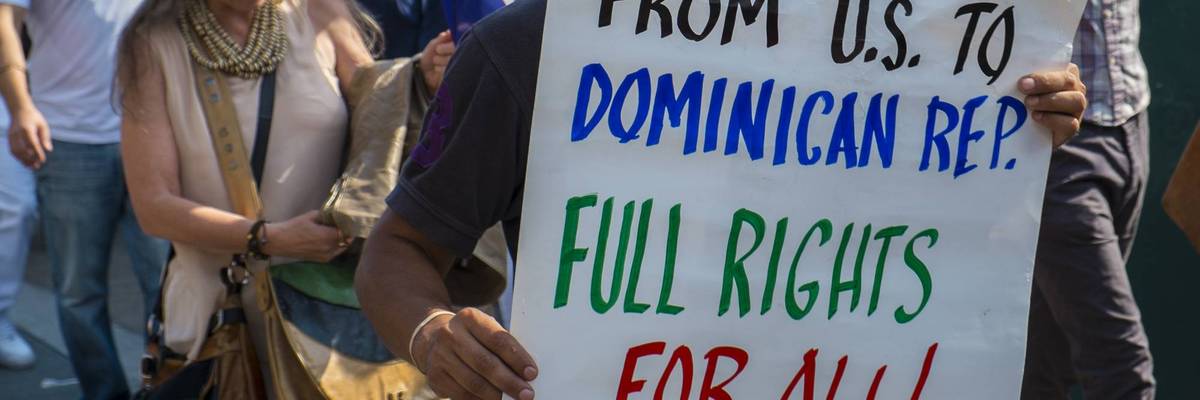
People protest against "Anti-Haitianism" and "Racist Laws" in the Dominican Republic in Flatbush, Brooklyn, a neighborhood with a large Haitian immigrant population, on June 26, 2015.
Racism and bigotry can never become the basis for deciding who gets rights and who belongs; families should never be stripped from their homes for the sake of violently manufacturing an ethnostate.
On April 1, the Supreme Court began hearing arguments in Trump v. Barbara, a class-action lawsuit challenging the Trump administration’s executive order to ban birthright citizenship for the children of undocumented immigrants.
Every lower court that has ruled on this issue thus far has found this executive order to be straightforwardly unconstitutional—and they are correct. The 14th Amendment is clear: “All persons born or naturalized in the United States, and subject to the jurisdiction thereof, are citizens of the United States and of the State wherein they reside.”
The Trump administration contends that to be “subject to the jurisdiction thereof” means one must owe “direct and immediate allegiance” to the United States and receive “protection” from it. Solicitor General D. John Sauer argues that the children of US citizens and formerly enslaved persons meet this test by virtue of having “a permanent domicile”—a permanent home they intend to stay indefinitely. By contrast, the children of undocumented immigrants “do not owe primary allegiance to the United States by virtue of domicile” because their parents “lack the legal capacity to establish domicile here.”
This reading adds much to the Citizenship Clause that is clearly not present. No plausible interpretation would assume that the drafters meant anything about loyalty, allegiance, or domiciles.
Ultimately, Trump’s birthright restrictions, like those implemented in the DR, are nothing more than racism and xenophobia masquerading as legitimate policy.
Those challenging the Trump administration argue: “The government is asking for nothing less than a remaking of our Nation’s constitutional foundations. The Order may be formally prospective, applying to tens of thousands of children born every month, and devastating families around the country. But worse yet, the government’s baseless arguments—if accepted—would cast a shadow over the citizenship of millions upon millions of Americans, going back generations.”
This warning should be taken seriously. We have already seen similar events play out in the Dominican Republic (DR).
In 1997, the mothers of Dilcia Yean and Violeta Bosico requested that the local registry office provide them with a copy of their daughters’ birth certificates. Without it, the children could not enroll in school and were at risk of deportation. While both Yean and Bosico were born in the DR to Dominican mothers, their fathers were Haitian temporary workers. On that basis, the registry denied their mothers’ request. This blatantly discriminatory denial effectively rendered the girls rightless and stateless.
Under the 1994 Dominican Constitution, both girls were entitled to birthright citizenship. Per the Constitution, citizenship is granted to “all persons born within the territory of the Republic, with the exception of the legitimate children of foreigners residing in the country in a diplomatic capacity or those who are in transit therein.” Important here is the “in transit” clause. As Ernesto Sagás notes, “This clause was originally designed to address the issue of children born on ships passing through Dominican ports, and whose parents were not intending to settle in the Dominican Republic.” However, over the years, politicians had argued (and at times acted as if) that clause extended to the children of temporary workers, like Yean and Bosico.
After years of obstruction from government officials, the mothers finally succeeded in obtaining their daughters’ birth certificates in 2001.
In 2003, the case was submitted to the Inter-American Court of Human Rights (IACHR). In court, the DR denied any wrongdoing. Rather, they defended a broad definition of “persons in transit” based on its 2004 General Migration Law (Ley No. 285-04). Under that Law, “temporary workers” were formally classified as “persons in transit.” The DR argued that Yean and Bosico were not Dominican nationals themselves because their fathers were Haitian temporary workers—their fathers were “in transit,” thus they too were “in transit.” The IACHR rejected this reasoning.
If the Supreme Court has any legitimacy left, they will do the right thing and end Trump’s birthright madness.
In September 2005, the IACHR ruled that the DR had violated several of the girls’ rights under the American Convention of Human Rights, including their right to a nationality, equal protection, and humane treatment. The IACHR ordered the Dominican government to award the girls $8,000 USD each, issue a public apology, and amend their domestic laws to make the procedure for acquiring birth certificates “simple, accessible, and reasonable since, to the contrary, applicants could remain stateless.”
In October 2005, the Senate of the Dominican Republic issued a resolution rejecting the IACHR’s decision. In December 2005, the Supreme Court of Justice of the Dominican Republic, in further defiance of the IACHR, upheld the General Migration Law’s broad definition of “persons in transit.”
In 2010, the DR took matters one step further by formally amending their Constitution. Under the 2010 Constitution, citizenship is granted to “persons born within the national territory, with the exception of the children of foreign nationals who are members of diplomatic and consular missions, of foreigners who are in transit or residing illegally within Dominican territory. Any foreigner defined as such under Dominican laws shall be considered a person in transit.” Importantly, this redefinition divorced the concept of “person in transit” from any notion of temporary stay. A person could, for instance, live continuously in the DR for years and still be considered “in transit.”
Initially, this did not impact people who already had Dominican citizenship. But in 2013, that too changed. The Constitutional Court of the Dominican Republic retroactively applied the new standard to all persons born between 1929 and 2010. The Court ordered the government to thoroughly review all birth registries within that period and remove any persons who no longer count as Dominican under the new guidelines. In the decade that followed, this ruling would strip as many as 245,000 Dominicans of their citizenship and trigger a humanitarian crisis.
Up to 86% of those impacted have been Dominicans of Haitian descent. This is no accident. It reflects the historical and persistent discrimination against Haitians rampant across the DR. The 2013 ruling made legal what people like Santiago Riverón, the mayor of Dajabón, at the Dominican-Haitian border, have long since thought. In an interview with journalist Marius Loiseau, Riverón claims that, “Haitians and Dominicans are like water and oil.” He continues, “They have already begun to invade us for good.”
Dominican President and Trump ally Luis Abinader echoes these sentiments. He remarks: “The rights of Dominicans will not be displaced. Our identity will not be diluted. Our generosity will not be exploited. Here, solidarity has limits.” He insists that stricter penalties against undocumented migrants are necessary to ensure that the “violence that is destroying Haiti will not cross over to the Dominican Republic.”
In October 2024, his administration announced plans to deport up to 10,000 undocumented migrants per week. Between then and March 2025, more than 180,000 people were forcibly deported to Haiti by Dominican officials. These mass deportations have fueled discrimination and racial profiling, excessive violence, arbitrary detention, and family separation as well as numerous human rights violations.
While there are many important differences between the DR and US, on the issue of immigration, the parallels are unmistakable. The Trump administration is also motivated by the belief that immigrants, including Haitians, pose an existential threat to the nation’s identity; that they are a serious risk to public safety; as well as a strain on social, political, and economic resources. Like Riverón and Abinader, President Trump insists that, given the scale of the “invasion,” aggressive immigration enforcement is necessary. This includes imposing denaturalization and immigrant arrest quotas. Even the formal justification for restricting birthright citizenship is similar. For both the Trump administration and the Dominican government, no matter how many years they have lived in the country or how long they intend to stay, an undocumented immigrant is always “in transit.” They never obtain a “permanent domicile.” The Dominican government does and the Trump administration aims to extend the purported ‘transientness’ of the parents to their children as a justification for denying them citizenship.
Ultimately, Trump’s birthright restrictions, like those implemented in the DR, are nothing more than racism and xenophobia masquerading as legitimate policy. If the Trump administration succeeds in restricting birthright citizenship, it—or a future MAGA presidency—will likely seek to build upon this ruling. Like the Constitutional Court of the DR, the Supreme Court may eventually rule to retroactively apply their decision to all persons born after the ratification of the 14th Amendment.
Racism and bigotry can never become the basis for deciding who gets rights and who belongs; families should never be stripped from their homes for the sake of violently manufacturing an ethnostate. What happened in the DR should be a cautionary tale for those of us in the US.
If the Supreme Court has any legitimacy left, they will do the right thing and end Trump’s birthright madness. That said, Trump cares little for democracy or the rule of law; regardless of how they decide, we will need to remain vigilant to protect ourselves, our loved ones, and our communities.Dear Common Dreams reader, It’s been nearly 30 years since I co-founded Common Dreams with my late wife, Lina Newhouser. We had the radical notion that journalism should serve the public good, not corporate profits. It was clear to us from the outset what it would take to build such a project. No paid advertisements. No corporate sponsors. No millionaire publisher telling us what to think or do. Many people said we wouldn't last a year, but we proved those doubters wrong. Together with a tremendous team of journalists and dedicated staff, we built an independent media outlet free from the constraints of profits and corporate control. Our mission has always been simple: To inform. To inspire. To ignite change for the common good. Building Common Dreams was not easy. Our survival was never guaranteed. When you take on the most powerful forces—Wall Street greed, fossil fuel industry destruction, Big Tech lobbyists, and uber-rich oligarchs who have spent billions upon billions rigging the economy and democracy in their favor—the only bulwark you have is supporters who believe in your work. But here’s the urgent message from me today. It's never been this bad out there. And it's never been this hard to keep us going. At the very moment Common Dreams is most needed, the threats we face are intensifying. We need your support now more than ever. We don't accept corporate advertising and never will. We don't have a paywall because we don't think people should be blocked from critical news based on their ability to pay. Everything we do is funded by the donations of readers like you. When everyone does the little they can afford, we are strong. But if that support retreats or dries up, so do we. Will you donate now to make sure Common Dreams not only survives but thrives? —Craig Brown, Co-founder |
On April 1, the Supreme Court began hearing arguments in Trump v. Barbara, a class-action lawsuit challenging the Trump administration’s executive order to ban birthright citizenship for the children of undocumented immigrants.
Every lower court that has ruled on this issue thus far has found this executive order to be straightforwardly unconstitutional—and they are correct. The 14th Amendment is clear: “All persons born or naturalized in the United States, and subject to the jurisdiction thereof, are citizens of the United States and of the State wherein they reside.”
The Trump administration contends that to be “subject to the jurisdiction thereof” means one must owe “direct and immediate allegiance” to the United States and receive “protection” from it. Solicitor General D. John Sauer argues that the children of US citizens and formerly enslaved persons meet this test by virtue of having “a permanent domicile”—a permanent home they intend to stay indefinitely. By contrast, the children of undocumented immigrants “do not owe primary allegiance to the United States by virtue of domicile” because their parents “lack the legal capacity to establish domicile here.”
This reading adds much to the Citizenship Clause that is clearly not present. No plausible interpretation would assume that the drafters meant anything about loyalty, allegiance, or domiciles.
Ultimately, Trump’s birthright restrictions, like those implemented in the DR, are nothing more than racism and xenophobia masquerading as legitimate policy.
Those challenging the Trump administration argue: “The government is asking for nothing less than a remaking of our Nation’s constitutional foundations. The Order may be formally prospective, applying to tens of thousands of children born every month, and devastating families around the country. But worse yet, the government’s baseless arguments—if accepted—would cast a shadow over the citizenship of millions upon millions of Americans, going back generations.”
This warning should be taken seriously. We have already seen similar events play out in the Dominican Republic (DR).
In 1997, the mothers of Dilcia Yean and Violeta Bosico requested that the local registry office provide them with a copy of their daughters’ birth certificates. Without it, the children could not enroll in school and were at risk of deportation. While both Yean and Bosico were born in the DR to Dominican mothers, their fathers were Haitian temporary workers. On that basis, the registry denied their mothers’ request. This blatantly discriminatory denial effectively rendered the girls rightless and stateless.
Under the 1994 Dominican Constitution, both girls were entitled to birthright citizenship. Per the Constitution, citizenship is granted to “all persons born within the territory of the Republic, with the exception of the legitimate children of foreigners residing in the country in a diplomatic capacity or those who are in transit therein.” Important here is the “in transit” clause. As Ernesto Sagás notes, “This clause was originally designed to address the issue of children born on ships passing through Dominican ports, and whose parents were not intending to settle in the Dominican Republic.” However, over the years, politicians had argued (and at times acted as if) that clause extended to the children of temporary workers, like Yean and Bosico.
After years of obstruction from government officials, the mothers finally succeeded in obtaining their daughters’ birth certificates in 2001.
In 2003, the case was submitted to the Inter-American Court of Human Rights (IACHR). In court, the DR denied any wrongdoing. Rather, they defended a broad definition of “persons in transit” based on its 2004 General Migration Law (Ley No. 285-04). Under that Law, “temporary workers” were formally classified as “persons in transit.” The DR argued that Yean and Bosico were not Dominican nationals themselves because their fathers were Haitian temporary workers—their fathers were “in transit,” thus they too were “in transit.” The IACHR rejected this reasoning.
If the Supreme Court has any legitimacy left, they will do the right thing and end Trump’s birthright madness.
In September 2005, the IACHR ruled that the DR had violated several of the girls’ rights under the American Convention of Human Rights, including their right to a nationality, equal protection, and humane treatment. The IACHR ordered the Dominican government to award the girls $8,000 USD each, issue a public apology, and amend their domestic laws to make the procedure for acquiring birth certificates “simple, accessible, and reasonable since, to the contrary, applicants could remain stateless.”
In October 2005, the Senate of the Dominican Republic issued a resolution rejecting the IACHR’s decision. In December 2005, the Supreme Court of Justice of the Dominican Republic, in further defiance of the IACHR, upheld the General Migration Law’s broad definition of “persons in transit.”
In 2010, the DR took matters one step further by formally amending their Constitution. Under the 2010 Constitution, citizenship is granted to “persons born within the national territory, with the exception of the children of foreign nationals who are members of diplomatic and consular missions, of foreigners who are in transit or residing illegally within Dominican territory. Any foreigner defined as such under Dominican laws shall be considered a person in transit.” Importantly, this redefinition divorced the concept of “person in transit” from any notion of temporary stay. A person could, for instance, live continuously in the DR for years and still be considered “in transit.”
Initially, this did not impact people who already had Dominican citizenship. But in 2013, that too changed. The Constitutional Court of the Dominican Republic retroactively applied the new standard to all persons born between 1929 and 2010. The Court ordered the government to thoroughly review all birth registries within that period and remove any persons who no longer count as Dominican under the new guidelines. In the decade that followed, this ruling would strip as many as 245,000 Dominicans of their citizenship and trigger a humanitarian crisis.
Up to 86% of those impacted have been Dominicans of Haitian descent. This is no accident. It reflects the historical and persistent discrimination against Haitians rampant across the DR. The 2013 ruling made legal what people like Santiago Riverón, the mayor of Dajabón, at the Dominican-Haitian border, have long since thought. In an interview with journalist Marius Loiseau, Riverón claims that, “Haitians and Dominicans are like water and oil.” He continues, “They have already begun to invade us for good.”
Dominican President and Trump ally Luis Abinader echoes these sentiments. He remarks: “The rights of Dominicans will not be displaced. Our identity will not be diluted. Our generosity will not be exploited. Here, solidarity has limits.” He insists that stricter penalties against undocumented migrants are necessary to ensure that the “violence that is destroying Haiti will not cross over to the Dominican Republic.”
In October 2024, his administration announced plans to deport up to 10,000 undocumented migrants per week. Between then and March 2025, more than 180,000 people were forcibly deported to Haiti by Dominican officials. These mass deportations have fueled discrimination and racial profiling, excessive violence, arbitrary detention, and family separation as well as numerous human rights violations.
While there are many important differences between the DR and US, on the issue of immigration, the parallels are unmistakable. The Trump administration is also motivated by the belief that immigrants, including Haitians, pose an existential threat to the nation’s identity; that they are a serious risk to public safety; as well as a strain on social, political, and economic resources. Like Riverón and Abinader, President Trump insists that, given the scale of the “invasion,” aggressive immigration enforcement is necessary. This includes imposing denaturalization and immigrant arrest quotas. Even the formal justification for restricting birthright citizenship is similar. For both the Trump administration and the Dominican government, no matter how many years they have lived in the country or how long they intend to stay, an undocumented immigrant is always “in transit.” They never obtain a “permanent domicile.” The Dominican government does and the Trump administration aims to extend the purported ‘transientness’ of the parents to their children as a justification for denying them citizenship.
Ultimately, Trump’s birthright restrictions, like those implemented in the DR, are nothing more than racism and xenophobia masquerading as legitimate policy. If the Trump administration succeeds in restricting birthright citizenship, it—or a future MAGA presidency—will likely seek to build upon this ruling. Like the Constitutional Court of the DR, the Supreme Court may eventually rule to retroactively apply their decision to all persons born after the ratification of the 14th Amendment.
Racism and bigotry can never become the basis for deciding who gets rights and who belongs; families should never be stripped from their homes for the sake of violently manufacturing an ethnostate. What happened in the DR should be a cautionary tale for those of us in the US.
If the Supreme Court has any legitimacy left, they will do the right thing and end Trump’s birthright madness. That said, Trump cares little for democracy or the rule of law; regardless of how they decide, we will need to remain vigilant to protect ourselves, our loved ones, and our communities.On April 1, the Supreme Court began hearing arguments in Trump v. Barbara, a class-action lawsuit challenging the Trump administration’s executive order to ban birthright citizenship for the children of undocumented immigrants.
Every lower court that has ruled on this issue thus far has found this executive order to be straightforwardly unconstitutional—and they are correct. The 14th Amendment is clear: “All persons born or naturalized in the United States, and subject to the jurisdiction thereof, are citizens of the United States and of the State wherein they reside.”
The Trump administration contends that to be “subject to the jurisdiction thereof” means one must owe “direct and immediate allegiance” to the United States and receive “protection” from it. Solicitor General D. John Sauer argues that the children of US citizens and formerly enslaved persons meet this test by virtue of having “a permanent domicile”—a permanent home they intend to stay indefinitely. By contrast, the children of undocumented immigrants “do not owe primary allegiance to the United States by virtue of domicile” because their parents “lack the legal capacity to establish domicile here.”
This reading adds much to the Citizenship Clause that is clearly not present. No plausible interpretation would assume that the drafters meant anything about loyalty, allegiance, or domiciles.
Ultimately, Trump’s birthright restrictions, like those implemented in the DR, are nothing more than racism and xenophobia masquerading as legitimate policy.
Those challenging the Trump administration argue: “The government is asking for nothing less than a remaking of our Nation’s constitutional foundations. The Order may be formally prospective, applying to tens of thousands of children born every month, and devastating families around the country. But worse yet, the government’s baseless arguments—if accepted—would cast a shadow over the citizenship of millions upon millions of Americans, going back generations.”
This warning should be taken seriously. We have already seen similar events play out in the Dominican Republic (DR).
In 1997, the mothers of Dilcia Yean and Violeta Bosico requested that the local registry office provide them with a copy of their daughters’ birth certificates. Without it, the children could not enroll in school and were at risk of deportation. While both Yean and Bosico were born in the DR to Dominican mothers, their fathers were Haitian temporary workers. On that basis, the registry denied their mothers’ request. This blatantly discriminatory denial effectively rendered the girls rightless and stateless.
Under the 1994 Dominican Constitution, both girls were entitled to birthright citizenship. Per the Constitution, citizenship is granted to “all persons born within the territory of the Republic, with the exception of the legitimate children of foreigners residing in the country in a diplomatic capacity or those who are in transit therein.” Important here is the “in transit” clause. As Ernesto Sagás notes, “This clause was originally designed to address the issue of children born on ships passing through Dominican ports, and whose parents were not intending to settle in the Dominican Republic.” However, over the years, politicians had argued (and at times acted as if) that clause extended to the children of temporary workers, like Yean and Bosico.
After years of obstruction from government officials, the mothers finally succeeded in obtaining their daughters’ birth certificates in 2001.
In 2003, the case was submitted to the Inter-American Court of Human Rights (IACHR). In court, the DR denied any wrongdoing. Rather, they defended a broad definition of “persons in transit” based on its 2004 General Migration Law (Ley No. 285-04). Under that Law, “temporary workers” were formally classified as “persons in transit.” The DR argued that Yean and Bosico were not Dominican nationals themselves because their fathers were Haitian temporary workers—their fathers were “in transit,” thus they too were “in transit.” The IACHR rejected this reasoning.
If the Supreme Court has any legitimacy left, they will do the right thing and end Trump’s birthright madness.
In September 2005, the IACHR ruled that the DR had violated several of the girls’ rights under the American Convention of Human Rights, including their right to a nationality, equal protection, and humane treatment. The IACHR ordered the Dominican government to award the girls $8,000 USD each, issue a public apology, and amend their domestic laws to make the procedure for acquiring birth certificates “simple, accessible, and reasonable since, to the contrary, applicants could remain stateless.”
In October 2005, the Senate of the Dominican Republic issued a resolution rejecting the IACHR’s decision. In December 2005, the Supreme Court of Justice of the Dominican Republic, in further defiance of the IACHR, upheld the General Migration Law’s broad definition of “persons in transit.”
In 2010, the DR took matters one step further by formally amending their Constitution. Under the 2010 Constitution, citizenship is granted to “persons born within the national territory, with the exception of the children of foreign nationals who are members of diplomatic and consular missions, of foreigners who are in transit or residing illegally within Dominican territory. Any foreigner defined as such under Dominican laws shall be considered a person in transit.” Importantly, this redefinition divorced the concept of “person in transit” from any notion of temporary stay. A person could, for instance, live continuously in the DR for years and still be considered “in transit.”
Initially, this did not impact people who already had Dominican citizenship. But in 2013, that too changed. The Constitutional Court of the Dominican Republic retroactively applied the new standard to all persons born between 1929 and 2010. The Court ordered the government to thoroughly review all birth registries within that period and remove any persons who no longer count as Dominican under the new guidelines. In the decade that followed, this ruling would strip as many as 245,000 Dominicans of their citizenship and trigger a humanitarian crisis.
Up to 86% of those impacted have been Dominicans of Haitian descent. This is no accident. It reflects the historical and persistent discrimination against Haitians rampant across the DR. The 2013 ruling made legal what people like Santiago Riverón, the mayor of Dajabón, at the Dominican-Haitian border, have long since thought. In an interview with journalist Marius Loiseau, Riverón claims that, “Haitians and Dominicans are like water and oil.” He continues, “They have already begun to invade us for good.”
Dominican President and Trump ally Luis Abinader echoes these sentiments. He remarks: “The rights of Dominicans will not be displaced. Our identity will not be diluted. Our generosity will not be exploited. Here, solidarity has limits.” He insists that stricter penalties against undocumented migrants are necessary to ensure that the “violence that is destroying Haiti will not cross over to the Dominican Republic.”
In October 2024, his administration announced plans to deport up to 10,000 undocumented migrants per week. Between then and March 2025, more than 180,000 people were forcibly deported to Haiti by Dominican officials. These mass deportations have fueled discrimination and racial profiling, excessive violence, arbitrary detention, and family separation as well as numerous human rights violations.
While there are many important differences between the DR and US, on the issue of immigration, the parallels are unmistakable. The Trump administration is also motivated by the belief that immigrants, including Haitians, pose an existential threat to the nation’s identity; that they are a serious risk to public safety; as well as a strain on social, political, and economic resources. Like Riverón and Abinader, President Trump insists that, given the scale of the “invasion,” aggressive immigration enforcement is necessary. This includes imposing denaturalization and immigrant arrest quotas. Even the formal justification for restricting birthright citizenship is similar. For both the Trump administration and the Dominican government, no matter how many years they have lived in the country or how long they intend to stay, an undocumented immigrant is always “in transit.” They never obtain a “permanent domicile.” The Dominican government does and the Trump administration aims to extend the purported ‘transientness’ of the parents to their children as a justification for denying them citizenship.
Ultimately, Trump’s birthright restrictions, like those implemented in the DR, are nothing more than racism and xenophobia masquerading as legitimate policy. If the Trump administration succeeds in restricting birthright citizenship, it—or a future MAGA presidency—will likely seek to build upon this ruling. Like the Constitutional Court of the DR, the Supreme Court may eventually rule to retroactively apply their decision to all persons born after the ratification of the 14th Amendment.
Racism and bigotry can never become the basis for deciding who gets rights and who belongs; families should never be stripped from their homes for the sake of violently manufacturing an ethnostate. What happened in the DR should be a cautionary tale for those of us in the US.
If the Supreme Court has any legitimacy left, they will do the right thing and end Trump’s birthright madness. That said, Trump cares little for democracy or the rule of law; regardless of how they decide, we will need to remain vigilant to protect ourselves, our loved ones, and our communities.