SUBSCRIBE TO OUR FREE NEWSLETTER
Daily news & progressive opinion—funded by the people, not the corporations—delivered straight to your inbox.
5
#000000
#FFFFFF
To donate by check, phone, or other method, see our More Ways to Give page.
Daily news & progressive opinion—funded by the people, not the corporations—delivered straight to your inbox.
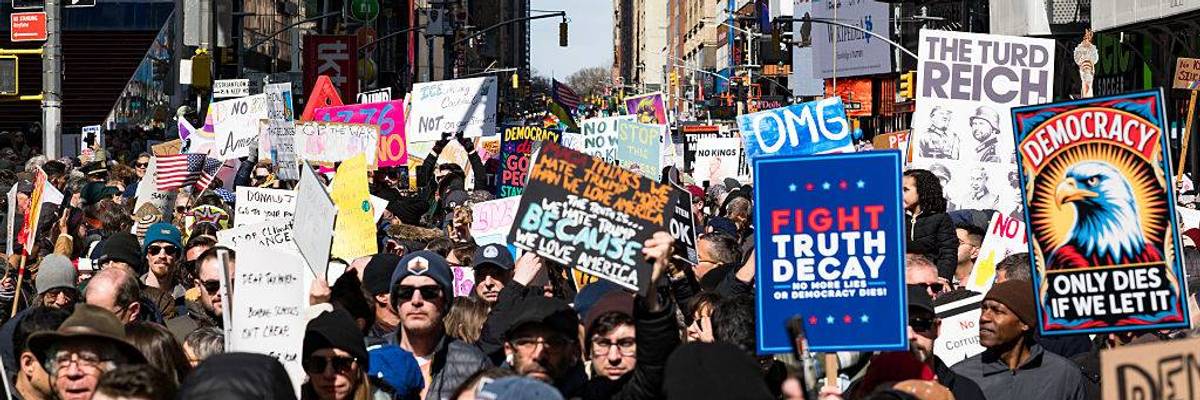
Protesters gather in Times Square during the ''No Kings'' national day of protest in New York, United States, on March 28, 2026.
"The NY Times saves its harshest skepticism for progressives," said one critic.
The New York Times is drawing criticism for publishing articles that downplayed the significance of Saturday's No Kings protests, which initial estimates suggest was the largest protest event in US history.
In a Times article that drew particular ire, reporter Jeremy Peters questioned whether nationwide events that drew an estimated 8 million people to the streets "would be enough to influence the course of the nation’s politics."
"Can the protests harness that energy and turn it into victories in the November midterm elections?" Peters asked rhetorically. "How can they avoid a primal scream that fades into a whimper?"
Journalist and author Mark Harris called Peters' take on the protests "predictable" and said it was framed so that the protests would appear insignificant no matter how many people turned out.
"There's a long, bad journalistic tradition," noted Harris. "All conservative grass-roots political movements are fascinating heartland phenomena, all progressive grass-roots political movements are ineffectual bleating. This one is written off as powered by white female college grads—the wine-moms slur, basically."
Media critic Dan Froomkin was event blunter in his criticism of the Peters piece.
"Putting anti-woke hack Jeremy Peters on this story is an act of war by the NYT against No Kings," he wrote.
Mark Jacob, former metro editor at the Chicago Tribune, also took a hatchet to Peters' analysis.
"The NY Times saves its harshest skepticism for progressives," he wrote. "Instead of being impressed by 3,000-plus coordinated protests, NYT dismisses the value of 'hitting a number' and asks if No Kings will be 'a primal scream that fades into a whimper.' F off, NY Times. We'll defeat fascism without you."
The Media and Democracy Project slammed the Times for putting Peters' analysis of the protests on its front page while burying straight news coverage of the events on page A18.
"NYT editors CHOSE that Jeremy Peters's opinions would frame the No Kings demonstrations and pro-democracy movement to millions of NYT readers," the group commented.
Joe Adalian, west coast editor for New York Mag's Vulture, criticized a Times report on the No Kings demonstrations that quoted a "skeptic" of the protests without noting that said skeptic was the chairman of the Ole Miss College Republicans.
"Of course, the Times doesn’t ID him as such," remarked Adalian. "He's just a Concerned Youth."
Jeff Jarvis, professor emeritus at the CUNY Graduate School of Journalism, took issue with a Times piece that offered five "takeaways" from the No Kings events that somehow managed to miss their broader significance.
"I despise the five-takeaways journalistic trope the Broken Times loves so," Jarvis wrote. "It is reductionist, hubristic in its claim to summarize any complex event. This one leaves out much, like the defense of democracy against fascism."
Journalist Miranda Spencer took stock of the Times' entire coverage of the No Kings demonstrations and declared it "clueless," while noting that USA Today did a far better job of communicating their significance to readers.
Harper's Magazine contributing editor Scott Horton similarly argued that international news organizations were giving the No Kings events more substantive coverage than the Times.
"In Le Monde and dozens of serious newspapers around the world, prominent coverage of No Kings 3, which brought millions of Americans on to the streets to protest Trump," Horton observed. "In NYT, an illiterate rant from Jeremy W Peters and no meaningful coverage of the protests. Something very strange going on here."
Dear Common Dreams reader, It’s been nearly 30 years since I co-founded Common Dreams with my late wife, Lina Newhouser. We had the radical notion that journalism should serve the public good, not corporate profits. It was clear to us from the outset what it would take to build such a project. No paid advertisements. No corporate sponsors. No millionaire publisher telling us what to think or do. Many people said we wouldn't last a year, but we proved those doubters wrong. Together with a tremendous team of journalists and dedicated staff, we built an independent media outlet free from the constraints of profits and corporate control. Our mission has always been simple: To inform. To inspire. To ignite change for the common good. Building Common Dreams was not easy. Our survival was never guaranteed. When you take on the most powerful forces—Wall Street greed, fossil fuel industry destruction, Big Tech lobbyists, and uber-rich oligarchs who have spent billions upon billions rigging the economy and democracy in their favor—the only bulwark you have is supporters who believe in your work. But here’s the urgent message from me today. It's never been this bad out there. And it's never been this hard to keep us going. At the very moment Common Dreams is most needed, the threats we face are intensifying. We need your support now more than ever. We don't accept corporate advertising and never will. We don't have a paywall because we don't think people should be blocked from critical news based on their ability to pay. Everything we do is funded by the donations of readers like you. When everyone does the little they can afford, we are strong. But if that support retreats or dries up, so do we. Will you donate now to make sure Common Dreams not only survives but thrives? —Craig Brown, Co-founder |
The New York Times is drawing criticism for publishing articles that downplayed the significance of Saturday's No Kings protests, which initial estimates suggest was the largest protest event in US history.
In a Times article that drew particular ire, reporter Jeremy Peters questioned whether nationwide events that drew an estimated 8 million people to the streets "would be enough to influence the course of the nation’s politics."
"Can the protests harness that energy and turn it into victories in the November midterm elections?" Peters asked rhetorically. "How can they avoid a primal scream that fades into a whimper?"
Journalist and author Mark Harris called Peters' take on the protests "predictable" and said it was framed so that the protests would appear insignificant no matter how many people turned out.
"There's a long, bad journalistic tradition," noted Harris. "All conservative grass-roots political movements are fascinating heartland phenomena, all progressive grass-roots political movements are ineffectual bleating. This one is written off as powered by white female college grads—the wine-moms slur, basically."
Media critic Dan Froomkin was event blunter in his criticism of the Peters piece.
"Putting anti-woke hack Jeremy Peters on this story is an act of war by the NYT against No Kings," he wrote.
Mark Jacob, former metro editor at the Chicago Tribune, also took a hatchet to Peters' analysis.
"The NY Times saves its harshest skepticism for progressives," he wrote. "Instead of being impressed by 3,000-plus coordinated protests, NYT dismisses the value of 'hitting a number' and asks if No Kings will be 'a primal scream that fades into a whimper.' F off, NY Times. We'll defeat fascism without you."
The Media and Democracy Project slammed the Times for putting Peters' analysis of the protests on its front page while burying straight news coverage of the events on page A18.
"NYT editors CHOSE that Jeremy Peters's opinions would frame the No Kings demonstrations and pro-democracy movement to millions of NYT readers," the group commented.
Joe Adalian, west coast editor for New York Mag's Vulture, criticized a Times report on the No Kings demonstrations that quoted a "skeptic" of the protests without noting that said skeptic was the chairman of the Ole Miss College Republicans.
"Of course, the Times doesn’t ID him as such," remarked Adalian. "He's just a Concerned Youth."
Jeff Jarvis, professor emeritus at the CUNY Graduate School of Journalism, took issue with a Times piece that offered five "takeaways" from the No Kings events that somehow managed to miss their broader significance.
"I despise the five-takeaways journalistic trope the Broken Times loves so," Jarvis wrote. "It is reductionist, hubristic in its claim to summarize any complex event. This one leaves out much, like the defense of democracy against fascism."
Journalist Miranda Spencer took stock of the Times' entire coverage of the No Kings demonstrations and declared it "clueless," while noting that USA Today did a far better job of communicating their significance to readers.
Harper's Magazine contributing editor Scott Horton similarly argued that international news organizations were giving the No Kings events more substantive coverage than the Times.
"In Le Monde and dozens of serious newspapers around the world, prominent coverage of No Kings 3, which brought millions of Americans on to the streets to protest Trump," Horton observed. "In NYT, an illiterate rant from Jeremy W Peters and no meaningful coverage of the protests. Something very strange going on here."
The New York Times is drawing criticism for publishing articles that downplayed the significance of Saturday's No Kings protests, which initial estimates suggest was the largest protest event in US history.
In a Times article that drew particular ire, reporter Jeremy Peters questioned whether nationwide events that drew an estimated 8 million people to the streets "would be enough to influence the course of the nation’s politics."
"Can the protests harness that energy and turn it into victories in the November midterm elections?" Peters asked rhetorically. "How can they avoid a primal scream that fades into a whimper?"
Journalist and author Mark Harris called Peters' take on the protests "predictable" and said it was framed so that the protests would appear insignificant no matter how many people turned out.
"There's a long, bad journalistic tradition," noted Harris. "All conservative grass-roots political movements are fascinating heartland phenomena, all progressive grass-roots political movements are ineffectual bleating. This one is written off as powered by white female college grads—the wine-moms slur, basically."
Media critic Dan Froomkin was event blunter in his criticism of the Peters piece.
"Putting anti-woke hack Jeremy Peters on this story is an act of war by the NYT against No Kings," he wrote.
Mark Jacob, former metro editor at the Chicago Tribune, also took a hatchet to Peters' analysis.
"The NY Times saves its harshest skepticism for progressives," he wrote. "Instead of being impressed by 3,000-plus coordinated protests, NYT dismisses the value of 'hitting a number' and asks if No Kings will be 'a primal scream that fades into a whimper.' F off, NY Times. We'll defeat fascism without you."
The Media and Democracy Project slammed the Times for putting Peters' analysis of the protests on its front page while burying straight news coverage of the events on page A18.
"NYT editors CHOSE that Jeremy Peters's opinions would frame the No Kings demonstrations and pro-democracy movement to millions of NYT readers," the group commented.
Joe Adalian, west coast editor for New York Mag's Vulture, criticized a Times report on the No Kings demonstrations that quoted a "skeptic" of the protests without noting that said skeptic was the chairman of the Ole Miss College Republicans.
"Of course, the Times doesn’t ID him as such," remarked Adalian. "He's just a Concerned Youth."
Jeff Jarvis, professor emeritus at the CUNY Graduate School of Journalism, took issue with a Times piece that offered five "takeaways" from the No Kings events that somehow managed to miss their broader significance.
"I despise the five-takeaways journalistic trope the Broken Times loves so," Jarvis wrote. "It is reductionist, hubristic in its claim to summarize any complex event. This one leaves out much, like the defense of democracy against fascism."
Journalist Miranda Spencer took stock of the Times' entire coverage of the No Kings demonstrations and declared it "clueless," while noting that USA Today did a far better job of communicating their significance to readers.
Harper's Magazine contributing editor Scott Horton similarly argued that international news organizations were giving the No Kings events more substantive coverage than the Times.
"In Le Monde and dozens of serious newspapers around the world, prominent coverage of No Kings 3, which brought millions of Americans on to the streets to protest Trump," Horton observed. "In NYT, an illiterate rant from Jeremy W Peters and no meaningful coverage of the protests. Something very strange going on here."