

SUBSCRIBE TO OUR FREE NEWSLETTER
Daily news & progressive opinion—funded by the people, not the corporations—delivered straight to your inbox.
5
#000000
#FFFFFF
To donate by check, phone, or other method, see our More Ways to Give page.
Daily news & progressive opinion—funded by the people, not the corporations—delivered straight to your inbox.

Yesterday, the Center for Constitutional Rights (CCR) filed eight
Freedom of Information Act (FOIA) requests regarding the United States
government's knowledge of, and actions in relation to, the May 31, 2010
attack by Israel on a flotilla of six vessels in international waters
seeking to deliver humanitarian aid to Gaza, and U.S. policy towards the
blockade of Gaza, which has entered its fourth year. The FOIA requests
were made to a number of U.S. departments and agencies, including the
Coast Guard, the Department of State, the Navy and the U.S. European
Command.
"One U.S. citizen was killed, others were injured, detained and
had their property taken, and a U.S.-registered vessel seized by Israel
during its attack in international waters last month," said CCR
attorney Katherine Gallagher. "Serious questions remain
unanswered about the U.S. response to the attack, its actions and
policies, particularly in the context of the blockade of Gaza,
internationally condemned as illegal and unjust. Citizens need to know
their government will protect their rights under U.S. and international
law vis-a-vis a foreign government, including Israel-the biggest
recipient of U.S. aid over the last fifty years."
Specifically, the FOIA requests seek information on what, if any,
communications were made between the U.S. government and Israel prior to
and after the attack; what, if any, information the U.S. shared before
or after with Israel about any of the U.S. citizens abroad; what was
done to secure the release of detained citizens; and what is being done
to return property seized from U.S. citizens and other passengers and to
ensure that such property, which includes evidence for any
investigations into the attack, is not tampered with or destroyed. A
FOIA request was also made regarding communications with other countries
and with organizations such as NATO in relation to the attack on the
flotilla and the delivery of humanitarian supplies to Gaza. Finally, a
request was made for information about U.S. policy towards Israel's
blockade of Gaza, which has been found to be a form of "collective
punishment" by various representatives of the United Nations.
Fourteen U.S. citizens were part of the flotilla, five of whom were
on the U.S.-registered vessel Challenger I and one of whom was killed
on the Mavi Marmara. U.S. citizens were injured, and their property,
including computers, video and photographic equipment which contain
potential evidence for investigations, was seized and appropriated by
Israel and has not been returned. CCR issued a statement with other
rights groups last month demanding that the U.S. insist that Israel
release seized property forthwith.
Attached Files
The Center for Constitutional Rights is dedicated to advancing and protecting the rights guaranteed by the United States Constitution and the Universal Declaration of Human Rights. CCR is committed to the creative use of law as a positive force for social change.
(212) 614-6464
"This is some Bond villain-level lunacy," said one Reddit user.
The Israeli government this week stripped Nile crocodiles of their protected status in order to advance a proposal that National Security Minister Itamar Ben-Gvir said was inspired by the Trump administration's now-shuttered Alligator Alcatraz to build a prison for Palestinians surrounded by a moat full of the ravenous reptiles.
"You read that right," the liberal US Jewish group J Street said in response to the news. "When cruelty becomes a governing principle instead of an aberration within the Israeli government, something has gone deeply wrong."
Israeli Environmental Minister Idit Silman signed a directive Wednesday reclassifying Nile crocodiles as "specially managed wild animals," a novel legal category enabling the government to keep them for security purposes.
Ben-Gvir, who heads the Israel Prison Service (IPS), said he was inspired by the Trump administration's recently closed Alligator Alcatraz immigrant detention center in Florida. He is seeking to first introduce crocodiles into a moat around Ketziot Prison in southern Israel.
While it is not certain that the plan will come to fruition, Ben-Gvir celebrated Silman's decree in a social media post showing him petting a crocodile, with the caption: "Cursed terrorist, thinking of trying to escape? Think again."
Palestinians have occasionally escaped from Israeli lockups, such as in September 2021, when six men used improvised tools, including spoons, to tunnel out of the high-security Gilboa Prison. All six escapees were caught within weeks.
 (Photo by Itamar Ben-Gvir/Facebook)
The move by Silman—who gained international notoriety by calling for the ethnic cleansing of all Palestinians from the Gaza Strip—came despite objections from her own ministry's legal adviser and the Nature and Parks Authority.
IPS, which sent a fact-finding mission to the Hamat Gader crocodile farm in January, argued that its employees could handle the animals, citing the agency's experience working with the attack dogs that Palestinian prisoners and human rights groups have claimed were used to maul and even sexually abuse detainees.
Silman's approval is contingent upon IPS meeting animal welfare requirements and appropriate holding conditions.
Meanwhile, Ben-Gvir has openly boasted about the dramatic deterioration in conditions endured by Palestinian prisoners since the Hamas-led attack of October 7, 2023 and Israel's retaliatory obliteration of Gaza, which United Nations and other experts describe as a genocide.
“We go into the prisons, and they wet themselves," Ben-Gvir said of Palestinian prisoners during a speech on Friday. "I'm not joking. They're afraid. Fear rules them, and that's how it should be.”
Ben-Gvir and other Israeli officials have worn noose lapel pins to celebrate a recently passed bill legalizing the execution by hanging of so-called "terrorists."
Former Palestinian detainees and Israeli personnel have described beatings, rape and sexual torture by male and female soldiers, routine amputations due to constant shackling, burnings, electrocutions, attacks by dogs, ice-water dousings, denial of food and water, sleep deprivation, constant loud music, and other abuse.
The Israeli military is investigating the deaths of dozens of detainees at the Sde Teiman prison in the Negev Desert, including one who died after allegedly being sodomized with an electric baton.
Ben-Gvir has defended Israeli reservists accused of torturing Palestinian prisoners, and called the reservists who allegedly gang-raped a man at Sde Teiman prison "heroes."
The minister is banned from entering a number of Western countries for his incitement to violence against Palestinians.
Several Israeli environmental groups issued a joint statement opposing the use of crocodiles in prisons.
"Crocodiles are sentient beings, with complex needs for space, water, temperature, and natural behavior," the groups said. "It is also highly doubtful that the crocodiles intended for this purpose have aggressive temperaments, and in any event, during the winter they slow their metabolism dramatically, become very sluggish, and stop eating.”
"Security should be achieved through real security measures, not through animals," they added. "We are considering filing a petition with the High Court of Justice over the matter.”
Last year, the Israeli military massacred 262 crocodiles that were being kept on a farm in the occupied West Bank near the illegal Israeli settler colony of Petzael, claiming the reptiles posed a risk to the public.
“They just slaughtered them," farm owner Danny Bitan told reporters at the time, describing the scene as "some kind of killing valley."
Ben-Gvir's plan comes amid ongoing slaughter in Gaza—where Israeli forces have killed more than 73,000 Palestinians, over 21,500 of them children, since October 2023—and accelerating colonization and ethnic cleansing in the West Bank.
News of Silman's approval sparked disbelief around the world and on social media, where Reddit users called the plan "cartoonish idiocy" and "Bond villain-level lunacy."
"The fact that Israel is trying to surround a prison with [crocodiles] tells you all you need to know about these camps, which are designed to torture, rape, and murder Palestinians, often held as hostages without charges," Israeli researcher and political commentator Shaiel Ben-Ephraim said Thursday on X.

"When wildfires hit America, Canada sends firefighters," said one journalist. "When wildfires hit Canada, America sends tariffs."
A day after a Republican senator pledged to introduce legislation sanctioning Canada for the wildfire smoke impacting various US communities this week, President Donald Trump on Friday threatened the United States' northern neighbor with new tariffs.
"We are holding Canada responsible for the fact that they are not properly maintaining their Forests, and Brush therein, and the United States is being unnecessarily invaded by filthy, polluted, and unhealthy air, the quality of which is dangerous, and totally unacceptable!" Trump wrote on his Truth Social platform. "I will call the Prime Minister during the day to find out what they are going to do about it."
"The cost is incalculable! Canada has refused to engage in basic Forest Management and Debris Removal, knowing that such refusal will lead to exactly this result," Trump continued. "This is Willful Negligence, and becoming a yearly occurrence, costing the United States Billions of Dollars, which cost of this pollution must of necessity be added to the TARIFFS Canada is currently paying."
Melanie D'Arrigo, a campaigner for single-payer healthcare in the United States, responded, "So can Canada hold US oil companies, their lobbyists, and the congresspeople they bribe for the climate crisis that increases droughts and the risk of these wildfires?"
"When Trump talks about increasing tariffs on Canada, he's talking about Americans paying more for the things they need—because the increased costs are paid by American consumers," she also stressed.
According to the Canadian Broadcasting Corporation, when asked for a comment on Trump's post, a spokesperson for Canada's Embassy in Washington, DC only said Ambassador Mark Wiseman has "engaged directly with key administration and Hill officials regarding the wildfire emergency in Canada, our efforts to address it, and the impact of wildfire smoke on Canada and the US."
CBC noted that a day earlier, four Michigan Republicans in the US House of Representatives had made similar statements in a letter to Prime Minister Mark Carney, who didn't address the missive when asked about it, but told reporters in French that "climate change is everyone's responsibility—truly everyone's—including the United States."
Big Oil-backed Trump has notably rejected scientific conclusions about the fossil fuel-driven climate emergency on the world stage and, throughout both terms, made various policy decisions that serve industry polluters—even as his own government continues to publish climate science.
While Carney has publicly embraced climate science, the Liberal leader has also recently faced criticism for "pouring fuel on the flames of the climate emergency" by "expanding tar sands and the fracked gas industry."
Meanwhile, the fires raging across Canada—and prompting air quality alerts across the US Midwest and Northwest—have spurred calls for "Nuremberg trials for Big Oil," given that the burning of fossil fuels has made the blazes more extreme and frequent.
Despite the science, Republicans on Capitol Hill seem hell-bent on strictly blaming Canadian forest management. Sen. Bernie Moreno (R-Ohio), a key ally of Trump and the fossil fuel industry, said Thursday on the social media platform X that "I'll be introducing a bill next week to sanction Canada and the responsible Canadian government officials for this atrocity."
Replying to the post, climate reporter Kate Aronoff wrote that a "major function of this site during climate-fueled disasters now is providing a space for right-wingers to beta test increasingly insane talking points for avoiding the obvious."
More Perfect Union producer Jordan Zakarin also fired back on X, writing, "The United States sanctioning another country, much less Canada, for pollution and environmental destruction is the stuff of bad satire."
Fossil Free Media director Jamie Henn said, "How about sanctioning the companies fueling the climate crisis that’s making these fires more frequent and intense?"
Democrats in Washington, DC "should introduce a Make Polluters Pay bill that taxes oil and gas companies' record profits and uses the revenue for wildfire relief, air purifiers, and all the adaptations we need to... deal with these climate disasters they helped create," he proposed.
Sen. Bernie Sanders, a Vermont Independent who caucuses with Democrats, also took aim at Republican climate lies in a lengthy social media post on Thursday, noting that "in both the United States and Canada, this heat and drought is driving longer and more intense wildfire seasons, including the more than 800 wildfires across Canada and northern Minnesota that are currently causing dangerous levels of air pollution for at least 115 million people across 20 states."
"NO, Mr. President: Climate change is not a hoax. It is reality. And your ignorance is putting our kids and grandkids at risk in exchange for the short-term profit of your billionaire friends in Big Oil," Sanders said. "Our job: Reject President Trump's lies and take on the crisis of climate change and the greed of the fossil fuel industry by transitioning our energy system to energy efficiency and sustainable forms of power. When we do that, we cut carbon emissions, reduce energy bills, and create millions of good union jobs."
Cassidy DiPaola, communications director for the Make Polluters Pay campaign, charged that "blaming Canada for these wildfires is like blaming a homeowner when an arsonist sets their house on fire. Canada is choking on the same smoke we are, and sanctioning our closest ally doesn't clear a single acre of burned forest or stop the next fire from starting."
"If Republicans actually wanted to hold someone responsible, they'd go after the fossil fuel companies whose executives knew what their products were doing to the planet and buried the science anyway," she argued. "Instead, Congress is moving in the opposite direction, weighing legislation that would grant the fossil fuel industry total immunity from climate liability. And if Republicans wanted policies that actually protect their constituents' health, they'd support climate superfund bills that fund public health programs, help wildfire survivors rebuild, and prepare communities for the risks still ahead."
Moreno's bill, she added, "is a shameless attempt to make sure the blame lands anywhere but on the fossil fuel industry, and everyday Americans will pay the price for that misdirection while the companies that caused this crisis walk away untouched."

GEO Group employee Brandon Booth faces attempted murder and assault charges for shooting a woman who sustained non-life-threatening injuries in Colorado.
Police in Aurora, Colorado on Friday announced that they had arrested an employee of a local US Immigration and Customs Enforcement detention center after he allegedly shot a woman protesting at the facility.
The Aurora Police Department said in a social media post that its officers on Thursday night responded to a report of a shooting and subsequently found two women on the scene, one of whom had been shot in her lower body.
Officers would soon after detain 42-year-old Brandon Booth, an employee of private prison firm The GEO Group, after pulling over his vehicle near the site of the shooting and finding a firearm in his possession.
The police found that, before the shooting, the two women were taking part in a protest at the Aurora ICE Processing Center where Booth works.
After the two women "initiated a verbal confrontation and took pictures of the employees’ vehicles before walking away," police said, "Booth retrieved his personally owned pistol and fired a single shot in their direction, striking one of the women on her lower body" before getting into his vehicle and fleeing the scene.
After Booth was taken into custody, he was charged attempted second-degree murder, first-degree assault, attempted first-degree assault, felony menacing, and unlawful carrying of a concealed weapon.
Booth's alleged victim was transported to a hospital where she was treated for her wounds, which police said "are believed to be non-life-threatening."
The GEO Group told local news station Fox 31 that Booth "has been placed on unpaid administrative leave," while vowing to "fully cooperate with law enforcement."
Booth's former sister-in-law, a woman named Destiny Winter, told The Denver Post on Friday that the alleged shooter "was not a good person at all," and described an incident where he gave her a concussion by slamming her into a wall more than a decade ago.
"This is not a person who does the right thing or respects boundaries, especially of women and kids," Winter explained. "This is not a person who is willing to hold himself accountable for mistakes."

The Michigan Democrat encouraged his followers to focus less on Stevens' voice and more on the $50 million in support she's received from "AIPAC, Trump-aligned billionaires, and corporate PACs."
Rep. Haley Stevens has become the subject of mockery in recent days after a viral clip showed her on the campaign trail for Michigan's Democratic US Senate primary attempting to rev up supporters with an almost comically Midwestern drawl.
“I am gonna be workin’ on our behalf, I am gonna be tellin’ the stories on our behalf,” Stevens said in the 19-second clip, which was posted over the weekend by the social media arm of the Republican National Committee. “And you better believe I’m gonna be doin’ it with a little bit of joy, a little bit of enthusiasm, a little bit of energy, and a little bit of ‘stick it to ’em!’ Because that’s the Michigan way!”
While Stevens may have been attempting to portray an authentic working-class affect, it came off as anything but to the denizens of X, the everything app.
Rather than a salt-of-the-earth Michigander, users said she sounded more like one of Chris Farley's characters on Saturday Night Live, Millhouse from The Simpsons "trying to give a class presentation," or a "baseball coach from the Great Depression."
But one person has refrained from joining the pile-on: Her Democratic primary opponent, Dr. Abdul El-Sayed.
In a post to social media on Friday, he discouraged his supporters online from ridiculing Stevens "for things that have nothing to do with her policies or politics," which he said was "unkind and unhelpful."
El-Sayed, the former director of public health for Detroit, who has championed a progressive agenda including Medicare For All, increased taxes on the wealthy, and an end to military aid to Israel, instead urged his backers to "focus on the issues" in the last weeks before the primary that will be held on August 4.
Since state Sen. Mallory McMorrow (D-8) dropped out of the race earlier this month, out-of-state donors have revved up their pro-Stevens spending in what Punchbowl News reporter Ally Munick described as a "full court press to stop" El-Sayed.
As Common Dreams reported on Thursday:
Outside spending for Stevens from what the Detroit Free Press described as “murky” groups has dwarfed the amount spent for El-Sayed. The political advertisement tracker AdImpact said that of the $46 million spent or reserved by the two campaigns for television ads, nearly three-quarters has been spent on behalf of Stevens or against El-Sayed...
Additional outside spending in support of Stevens is estimated to have soared to roughly $50 million, according to an analysis by [Mutnick].
Last Friday, United Democracy Project (UDP), which is affiliated with the American Israel Public Affairs Committee (AIPAC), disclosed that it has spent nearly $15 million on the Michigan US Senate race so far, including $9.3 million in support of Stevens and $5.7 million against El-Sayed.
El-Sayed has faced some criticism for how he's spoken about his opponent—he recently said: "Haley Stevens is a suit with a large AIPAC bank account, that’s it. I hope maybe they find some way to teach her how to string together two coherent sentences."
However, he stressed Friday that this tidal wave of big money is what his followers should truly find worthy of scorn.
"Congresswoman Stevens has welcomed corporations and special interests to support her," he said. "She votes to send our money abroad while Michiganders struggle. She’s bought by DTE, Blue Cross, Big Tech, and Big Pharma who pick our pockets. AIPAC, Trump-aligned billionaires, and corporate PACs are spending $50,000,000+ to support her."
"THOSE are the issues," El-Sayed said. "We don’t need to be unkind to be honest."

"If you only watched the first 10 seconds you might conclude this guy was a MAGA thug who could not be persuaded of anything. But he listened and he thought and he went, 'Hmm, okay I'm not so sure anymore.'"
Two days after a US Immigration and Customs Enforcement agent fatally shot Johan Sebastián Durán Guerrero in Biddeford, Maine, a local videographer was filming an interview with a neighbor about the latest shooting by the agency when another resident was heard off camera uttering a familiar refrain among those who support President Donald Trump's mass deportation policy.
"There's a right way to get in the country and a wrong way to get in the country," the man was heard saying as the interviewee, who had been calling for politicians to speak out about the killing, paused her comments and appeared to brace herself for an unpleasant confrontation.
The videographer, Kalle Bailey, pointed the camera at the passerby and asked if he wanted to make any comments on camera.
The man repeated his remark, adding, "Anyone that skips the line, it's just like if me and you were waiting in a steakhouse and some jerk just skipped the whole line and said, 'Screw you, screw you, screw you, and screw you.'"
"For the people that are doing it the wrong way, well, unfortunately, that's what happens," he said.
The man was speaking about the killing—the exact details of which are still murky—of 25-year-old Guerrero early Monday morning shortly after he left the house he shared with his wife and their 3-year-old daughter.
The videographer politely but firmly debunked the man's comments, asking him whether he knew that Guerrero, who had come to the US from Colombia, had a permit to work in the US oand had been issued a Social Security number by the Trump administration, according to a lawyer for Guerrero's family.
"He wasn't even the target of the investigation," added Bailey.
The man indicated that he had previously heard Guerrero was armed, which Bailey and his interviewee also let him know wasn't true.
"They shot him because they claimed they were trying to protect the public at large, not even an officer's safety," Bailey said. When the man responded that he "didn't know the whole scope" of the incident, Bailey noted that "a lot of people don't" and expressed appreciation that the man was open to hearing about the details that are known of Guerrero's killing.
"That's fucking sad, then," said the man. "So he did it the right way, and still, and still that's what happens."
Videos have emerged showing the moments following the shooting, but not when at least one officer fired their weapon five times, or the events leading up to the killing.
Bullet holes were seen in Guerrero's windshield, and in one surveillance video obtained by The New York Times, voices were heard saying, “Move it, let’s go,” and “Back, back" just before five shots rang out.
Guerrero's vehicle was also seen in surveillance footage taken from a nearby store, circling slowly in an intersection as officers surrounded the car.
The agents then opened the car door and pulled Guerrero out before he fell to the ground.
The US Department of Homeland Security (DHS), which oversees ICE, has acknowledged that Guerrero was not the target of the surveillance they were conducting. The agency was investigating another resident for whom it reportedly had a deportation order.
ICE has also said Guerrero was fleeing the scene, and that an officer fired his weapon to protect public safety.
A person's attempt to flee a scene—regardless of their immigration status, how they entered the country, or whether ICE has a deportation order for them—is not sufficient grounds for law enforcement officers to use force under Department of Justice policy, and ICE officers are instructed not to shoot into a moving vehicle—though they have in a number of shootings in the past year.
Despite the fact that Guerrero was not even the target of ICE's operations Monday morning, the Trump administration has responded to widespread condemnation of the killing by calling the victim an “illegal alien" and saying the work authorization and Social Security number he had been issued did not mean he was authorized to be in the country.
As DHS continues to suggest Guerrero was a legitimate target of ICE's mass deportation operations, journalist Nathan Robinson of Current Affairs gave the man in the viral video credit for his openness to learning more about the man he had assumed was a criminal.
The video, said Robinson, "shows why it's important to not write people off. If you only watched the first 10 seconds you might conclude this guy was a MAGA thug who could not be persuaded of anything. But he listened and he thought and he went, 'Hmm, okay I'm not so sure anymore.'"
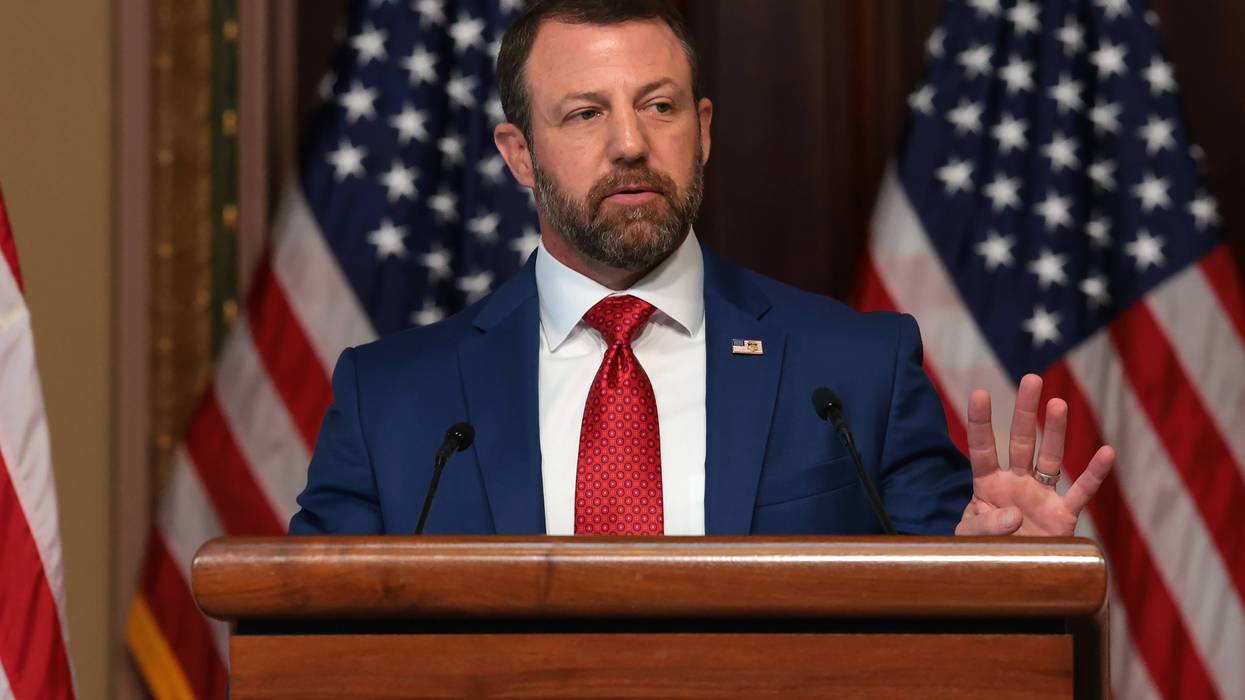
"They are losing, and they know it. Election officials will not be intimidated," said Senate Minority Leader Chuck Schumer.
US Homeland Security Secretary Markwayne Mullin on Friday threatened state election officials with prison time if they do not comply with the Trump administration's "mandatory" changes to how they run their elections.
During a press conference, Mullin said that the Trump administration was making so-called "security enhancements" to US elections "mandatory," adding that any uncooperative states will be penalized.
"If these states want a grant and they want to be reimbursed to run federal elections, they're going to have to implement security issues," Mullin said. "We're saying that your [voting] machines have to be secured and that your voter registration list needs to be scrubbed."
Later in the press conference, Mullin elaborated further on penalties states could face if they didn't "scrub" their voter rolls to the administration's specifications.
"The states that choose... not to participate in securing the elections, we will make sure we make those states a priority to look into who voted in their states, and hold then the election officials accountable," he said. "If the election officials, once we gave them the information they need to secure their elections, and they chose not to, then those individuals can also be held accountable."
Mullin added that this accountability can come "by fines, by penalties, and even, depending on how far it goes, prison time."
Mullin says that election officials in states that don’t cooperate with the Trump administration may face jail time pic.twitter.com/FvIaKmTEdc
— Aaron Rupar (@atrupar) July 17, 2026
Article 1, Section 4 of the United States Constitution explicitly gives states the power to run their own elections, while granting the US Congress the authority to implement federal regulations if needed.
The executive branch of the federal government is given no role in the administration and regulation of elections.
Democratic California Gov. Gavin Newsom reacted to Mullin's threats of jail time for election officials with defiance.
"California has free, fair, and secure elections and we will fight for them," Newsom wrote in a social media post. "Try us."
Senate Minority Leader Chuck Schumer (D-NY) similarly vowed to fight the administration's efforts to meddle in the elections.
"They are losing, and they know it," Schumer wrote. "Election officials will not be intimidated. Senate Democrats will make sure resources are in place to fight back against any illegal activity by the Trump administration."
Sen. Raphael Warnock (D-Ga.) warned that Mullin's Friday statements appear to be an escalation in the administration's tactics.
"First, they sent the FBI to seize ballots in Georgia," he wrote. "Then, they tried to get data on election workers in Fulton County. Now, they’re threatening to imprison election officials. This is escalating quickly. Every single American should be alarmed."
Government watchdog Citizens for Responsibility and Ethics in Washington also indicated it would file legal challenges to the administration's efforts to take over the elections process.
"The Constitution gives states, not the federal government, the power to administer elections," the group wrote. "That's for a good reason, but the Trump admin keeps trying and failing to grab power anyway. We're fighting back in court."
Aaron Reichlin-Melnick, senior fellow at the American Immigration Council, expressed skepticism that the Trump White House's election meddling would be successful.
The Department of Homeland Security "has literally zero power to do this," Reichlin-Melnick wrote. "The Trump admin has lost every single lawsuit on their efforts to get state voter data or change voter requirements. The power to administer elections is given to the states."
Historian Patrick Wyman similarly predicted the administration's efforts would end in failure.
"They’re going to threaten this stuff, they’ll ham-fistedly screw up the implementation, commit seven atrocities, and still lose every election that matters in November," Wyman wrote. "We’re now nearing the 'fuck you, do it, see what happens' stage of this confrontation."

ICE is already on track to arrest more people this month than any other month during the second Trump administration.
As scrutiny builds over two fatal shootings by Immigration and Customs Enforcement in less than a week, US Homeland Security Secretary Markwayne Mullin said the Trump administration was only going to keep ramping up its aggressive mass deportation push. Arrests have already reached a record high this month.
Mullin brushed off questions from reporters on Friday about the shootings of Lorenzo Salgado Araujo in Texas and Johan Sebastián Durán Guerrero in Maine—neither of whom was the target of ICE's operations—which have generated calls for investigations and reforms to ICE's tactics, including the traffic stops that led to the fatal shootings.
Earlier this week, acting assistant secretary Lauren Bis called on critical politicians and media outlets to "turn down the temperature" of their rhetoric towards ICE, which she claimed is “fueling vehicle attacks" against agents. The administration has claimed that both men attempted to "weaponize" their vehicles, but video and eyewitness accounts have not backed this up.
In light of the agency's calls to "turn down the temperature," a reporter asked Mullin whether he could assure Americans that ICE officers who violate the agency's use-of-force policy would face consequences and whether he'd commit to making that determination publicly.
"Let me clarify. When I say 'turn down the temperature,' I mean turn down the temperature with you guys," Mullin said, pointing at members of the media. "We're turning up the heat on the streets."
"We're out there working harder than we ever have because we've empowered law enforcement to do their jobs," he said. "What I'm trying to do is remove us from the headlines every single day."
Mullin added that "everybody will be held accountable," and that he would enforce the law "with our own agency" and "with the criminals on the streets."
Facing pressure from senior White House adviser Stephen Miller to reach a quota of 3,000 arrests per day, ICE has overwhelmingly prioritized going after individuals without criminal convictions during President Donald Trump's second term, despite the administration's claims that it's targeting "the worst of the worst."
A leaked Department of Homeland Security report published in February showed that just 14% of the nearly 400,000 people taken into custody by ICE in 2025 had been charged with or convicted of violent criminal offenses, while 40% have never been charged with any crime.
The Washington Post reported on Friday that ICE is on track to arrest more people in July than any previous month of the second Trump administration. Arrests dropped for a short time in February after immigration agents shot two US citizens—Renee Good and Alex Pretti—in Minneapolis, but spiked to a new high of over 39,500 in June.
None of the agents involved in January's pair of fatal shootings have faced federal charges, and the Trump administration has actively sought to obstruct state-level investigations into the shootings by withholding evidence, some of which was finally turned over on Monday.

Forty-seven percent of Americans surveyed say they have been cutting back on food and medical care to save money.
As the resumption of President Donald Trump's illegal war with Iran sends gas prices back to an average of $4 per gallon, a poll released by CNBC on Friday shows Americans' perceptions of the US economy growing increasingly negative.
The latest CNBC All-America Economic Survey finds that 61% of Americans are feeling pessimistic about the current state of the economy, with just 25% saying they feel optimistic.
This marks the most pessimistic Americans have felt about the economy since December 2023, after the US suffered through an inflationary shock primarily driven by the re-opening of the global economy after the Covid-19 pandemic.
Americans' biggest concerns are with the cost of living, with voters expressing particular worry about gas and grocery prices.
Forty-seven percent of Americans surveyed say they have been cutting back on food and medical care to save money, while two-thirds report reducing spending on "non-essential" purchases, such as restaurant meals and entertainment.
The survey also finds that US voters are pinning the blame for the state of the economy squarely on Trump, as just 38% of Americans approve of his economic performance while 60% disapprove. Americans are even harsher in their assessment of Trump's handling of the Iran war, with just 35% approving and 63% disapproving.
Democratic pollster Jay Campbell, a partner at Hart Research, told CNBC that the recent drop in gas prices from their peak earlier this year is not enough to put Americans in a better mood, especially given that prices are headed up again.
"People are still paying a lot more for stuff than they were a year and a half ago, two years ago, and that’s recent enough in memory that it still hurts and it still drives a lot of anger," said Campbell. “When gas prices drop 50 cents for a month, that’s just not enough to make up the difference."
According to data published by AAA on Friday, the average price of gas in the US is now $3.98 per gallon, 10 cents higher than it was a week before.
The price of diesel fuel has also risen back over $5 per gallon, up 15 cents from one week ago, according to AAA.
Despite Trump's brutal polling numbers, the CNBC survey finds that Democrats currently have a modest four-point advantage in the generic congressional ballot, which Campbell said "doesn’t point to a wave [election] at the moment."

“Yesterday, we were reminded who the Republicans are: a group of millionaires working for billionaires who will rip healthcare away from those who need it most," said one campaigner.
In what critics called a troubling sign of where US healthcare policy is headed, Senate Republicans on Thursday torpedoed an effort by their Democratic colleagues to block a Trump administration pilot program under which private companies will use artificial intelligence to review—and possibly deny—healthcare to patients seeking certain Medicare services.
Senators voted 50-46 along party lines against a Congressional Review Act resolution introduced by Sen. Ron Wyden (D-Ore.) and supported by 20 Democratic colleagues and Sen. Bernie Sanders (I-Vt.). The resolution was aimed at overturning the Trump administration's final rule establishing the US Centers for Medicare and Medicaid Services’ (CMS) so-called Wasteful and Inappropriate Service Reduction (WISeR) Model.
"Yesterday, I voted to block [President Donald] Trump’s plan to let AI decide whether Medicare will approve or deny your medical care. Every Senate Republican supported Trump’s scheme," Sen. Ed Markey (D-Mass.) said Friday on social media. "Doctors should be deciding what care seniors need—not a computer program."
The AFL-CIO, the nation's largest labor union federation, said on X: "No senior should have to wait weeks to see a doctor because a flawed AI system won’t authorize it. The Trump [administration's] WISeR program is delaying treatment for Medicare patients and putting tech companies’ interests first. Congress must end it."
Alex Jacquez, senior vice president of policy, advocacy, and research at the Groundwork Collaborative, highlighted the "horrendous" WISeR rollout, which, according to KFF, "has created confusion, errors, long wait times, and stress" and has left many patients "ensnared in the same red tape as those with private insurance."
CMS claims WISeR “helps protect American taxpayers by leveraging enhanced technologies, such as artificial intelligence (AI) and machine learning, along with human clinical review, to ensure timely and appropriate Medicare payment for select items and services.”
However, critics warn that AI will make it easier and faster to deny or delay care and have raised concerns that AI would likely be used as a cost-cutting tool to fulfill financial incentives.
“Yesterday, we were reminded who the Republicans are: a group of millionaires working for billionaires who will rip healthcare away from those who need it most," Alex Lawson, executive director of the advocacy group Social Security Works, told Common Dreams on Friday.
"The White House leaned on the Republican senators and they folded like the cheap suits they are," he continued. "Cowards to a person."
Singling out Sen. Josh Hawley, Lawson said the Missouri Republican "pretends he would oppose Medicare delays and denials by algorithm or AI, but when the vote is called dutifully dances to the tune his master calls."
"Their goal is to destroy Medicare, to destroy guaranteed healthcare, to ensure that every facet of the 'healthcare system' serves only one purpose, profit," Lawson said of Republican lawmakers.
Private Medicare Advantage healthcare profiteers have been using AI to deny care for years. Consumers are aware of—and outraged by—the practice.
“I don’t know any senior, Republican or Democrat, who asked President Trump to let AI decide if their doctor-recommended treatment was necessary," Sen. Patty Murray (D-Wash.) said on Thursday.

"One brutal kick sent the robot's head hanging loose."
Amid warnings from experts and political leaders about "killer robots," a Chinese robotics company on Thursday hosted an unprecedented combat tournament in which one humanoid robot decapitated another.
The fight featuring the decapitation—footage of which quickly circulated online—was part of the opening night of the Ultimate Robot Knock-out Legend (URKL) competition in Shenzhen, organized by the company EngineAI, which developed the humanoid.
The Chinese Embassy in Ireland was among the accounts on the social media platform X that highlighted the moment when one robot's "head" was dislodged.
The "white humanoid robot, named 'White Eagle' landed a high kick to the head of its black opponent, 'Matador,' which made the robot's head rock precariously in its socket before rolling completely out of place," according to Newsweek. "The two continued to spar as Matador's head was swinging from its socket until eventually the robot fell, crushing its head underneath its body."
Unveiled last year, the humanoid is called T800, a nod to the Terminator franchise. EngineAI's website features videos of T800 executing various mixed martial arts (MMA) moves, from a combination punch and a roundhouse kick to punch-kick combos.
EngineAI announced UKRL, the "world's first" humanoid robot combat league, early this year, seeking 32 teams from universities, enterprises, and research institutions worldwide to compete using its robots. The first round of competition is scheduled for July-August, followed by another round in September-October, and the grand finals in November-December.
As the Chinese tabloid Global Times reported when the tournament was announced in February:
Pan Helin, a Beijing-based veteran analyst, told the Global Times on Monday that such competitions help enhance public awareness of humanoid robots and expand potential application scenarios.
Pan noted that humanoid robots still face technological and practical limitations, and real-world application is key to their further development. Such events could yield positive effects in the entertainment and performance market, which is a necessary step forward in paving the way for further applications in factories or households, Pan said.
Tian Feng, former dean of SenseTime's Intelligence Industry Research Institute, said that the free provision of T800 robots will lower research and development barriers for smaller companies and promote the integration of applications involving industry, academia, and research bodies.
The tournament's opening night came on the heels of a series of artificial intelligence events hosted by the United Nations earlier this month, during which Secretary-General António Guterres said that "if AI is to be powerful, it must be governed," and "my main concern is with 'lethal autonomous weapon systems.'"
"Let us call them what they are: killer robots," Guterres continued. "Machines selecting and engaging their target and taking a life—without human control and judgment. That is morally repugnant. It is politically unacceptable. And it must be banned by international law."
"States are already at the discussion table. But let us not wait for atrocity to act. Some decisions must remain forever human—none more than taking a human life," he added. "Some might claim that governance is the enemy of innovation. But innovation needs guardrails. The technologies we trust most—in aviation, in medicine, in nuclear energy and beyond—earned that trust because we acted to hold their makers to account."
As Wired detailed in Friday reporting, "the US military has a long-standing interest in humanoids," and Sankaet Pathak's startup Foundation Future Industries aims to "produce an all-American robot supersoldier."
The startup's "unique in its targeting of the military market, and so far it's been lucrative," the outlet added. "The company has government contracts worth millions of dollars and high-profile backers to spread its message: Eric Trump, the president's son, is both an investor and the company's chief strategy adviser."
This article has been updated to include the Wired reporting.