SUBSCRIBE TO OUR FREE NEWSLETTER
Daily news & progressive opinion—funded by the people, not the corporations—delivered straight to your inbox.
5
#000000
#FFFFFF
To donate by check, phone, or other method, see our More Ways to Give page.
Daily news & progressive opinion—funded by the people, not the corporations—delivered straight to your inbox.
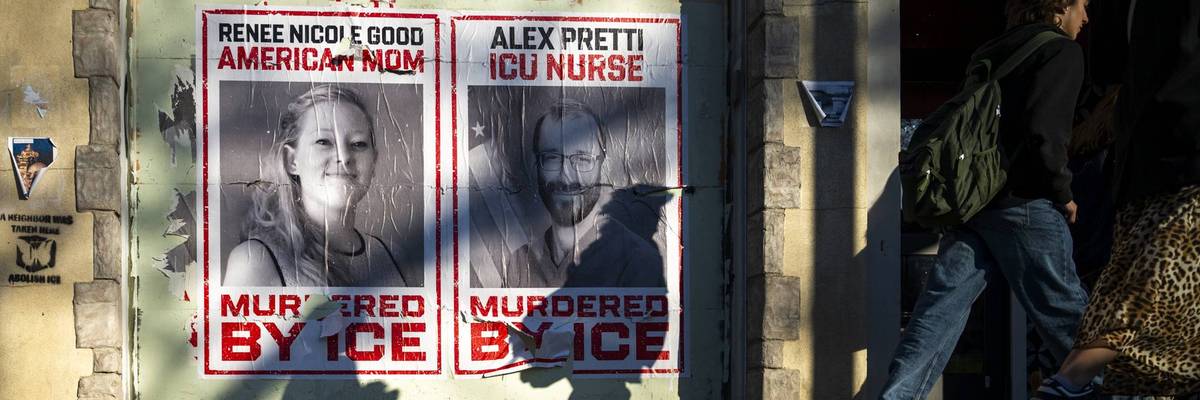
People walk by signs memorializing Renee Good and Alex Pretti on February 12, 2026 in Minneapolis, Minnesota.
Minnesota Attorney General Keith Ellison said it "should never have taken this long."
After being shut out of the investigations by the Trump administration, Minnesota prosecutors announced on Monday that federal investigators finally turned over reams of unseen evidence related to shootings by immigration agents that killed Renee Good and Alex Pretti and injured Julio Sosa-Celis in January.
Hennepin County Attorney Mary Moriarty announced that after "six months of relentless collective effort," state and local prosecutors had "obtained hard drives of previously withheld evidence" about the killings, which took place during the administration's aggressive surge of immigration agents in and around Minneapolis and sparked a wave of protests.
Moriarty added that prosecutors had also obtained some physical evidence that was "previously withheld" by federal investigators. This includes the SUV that Good, a 37-year-old US citizen and mother of three, had been driving when she was shot through her driver's side window by US Immigration and Customs Enforcement (ICE) agent Jonathan Ross as she appeared to be leaving the scene of an enforcement operation.
Attorney Antonio Romanucci and the legal team representing the family of Good said in a statement that turning over the vehicle and other evidence was "an important and meaningful step towards justice and accountability," and that they were "grateful for the resumption of regular investigatory protocols, which is not only important for the families impacted in these cases, but it is essential for the community and the country."
Shortly after Good was shot, Department of Homeland Security (DHS) spokesperson Tricia McLaughlin portrayed her as a “violent rioter" who had attempted to run over Ross with her car, which then-Secretary Kristi Noem claimed was an "act of domestic terrorism." But video evidence showed that her wheels were pointed away from the agent, indicating that she was attempting to leave.
Homeland Security adviser Stephen Miller similarly described Pretti, a 37-year-old intensive care nurse, another US citizen, as a "would-be assassin” while DHS said he showed up at a protest against ICE attempting to "massacre law enforcement" based on the fact that he was carrying a legal firearm when he was shot by two Customs and Border Protection (CBP) agents.
Videos showed that Pretti had intervened to stop agents from harming another protester and only held his phone during the confrontation, never reaching for his gun.
Sosa-Celis, a 24-year-old Venezuelan national, was called a "violent criminal alien" by DHS, which accused him and his two roommates of having attacked agent Christian Castro with snow shovels, leading Sosa-Celis to be shot in the leg through the door of the home.
Assault charges against him and his roommate were dropped by federal prosecutors after video and medical evidence showed that Castro had not been attacked. ICE Director Todd Lyons acknowledged that the agents had lied about the incident, and Castro has since been arrested after being charged by Moriarty's office as part of an independent investigation.
Neither Ross nor the two CBP agents who shot Pretti—Jesus Ochoa and Raymundo Gutierrez—have been charged.
Federal authorities have repeatedly rejected demands from Minnesota officials to cooperate with investigations into the three shootings and grant access to evidence and the ability to interview witnesses.
In the case of Pretti, agents blocked investigators with the Minnesota Bureau of Criminal Apprehension from entering the shooting scene after the BCA had obtained a search warrant and removed physical evidence before Minnesota investigators could document it. This included Pretti's gun, cellphone, and body camera footage, and other physical and digital evidence.
In March, Minnesota sued the Trump administration over its refusal to cooperate with the investigations, a lawsuit that was still ongoing as of Monday.
The federal government did not explain its sudden change of direction. The Associated Press described it as part of an agreement in which Minnesota agreed to share evidence it had collected in Castro's case if the federal government shared evidence it was withholding about the shootings of Good and Pretti.
Moriarty thanked the federal officials for "their willingness to consider changing course to share evidence and promote public trust."
But Minnesota Attorney General Keith Ellison emphasized that it "should never have taken this long."
"I remain deeply troubled that the federal government spent more than half a year attempting to conceal this evidence from state investigators," he said in a statement. "And I hope this is the beginning of a major course correction on the part of the federal government."
US Sen. Tina Smith (D-Minn.) agreed that "this took way too long" and said, "It's not enough."
"Minnesotans' trust has been fundamentally broken," she said. "There's a long way to go before we get true justice for ICE killing two of our neighbors."
The federal government's decision to turn over evidence to Minnesota officials came less than a week after an ICE agent shot and killed Lorenzo Salgado Araujo, a 52-year-old Mexican father in Houston, whom DHS claimed had attempted to attack officers with his car, only to once again be undermined by video and witness accounts.
DHS has acknowledged that it was not attempting to target Salgado for removal and had mistaken his van for someone else's.
Harris County District Attorney Sean Teare has said that, just like in Minnesota, the federal government was refusing to share evidence with local officials.
“The federal government has not invited us in,” Teare said. “The federal government is not collaborating with us with this investigation.”
On Monday, ICE agents killed another man in Maine, 26-year-old Colombian father Joan Sebastian Guerrero, who was reportedly shot several times after stopping his vehicle, according to video footage.
DHS Secretary Markwayne Mullin has said Guerrero “weaponized” his vehicle and attempted to ram officers. One eyewitness told Reuters they saw a federal SUV ram Guerrero's car.
According to Sen. Angus King (I-Maine), Mullin said that Guerrero, who was authorized to work in the US and had a Social Security number, was not the target of the warrant agents were executing.
Dear Common Dreams reader, It’s been nearly 30 years since I co-founded Common Dreams with my late wife, Lina Newhouser. We had the radical notion that journalism should serve the public good, not corporate profits. It was clear to us from the outset what it would take to build such a project. No paid advertisements. No corporate sponsors. No millionaire publisher telling us what to think or do. Many people said we wouldn't last a year, but we proved those doubters wrong. Together with a tremendous team of journalists and dedicated staff, we built an independent media outlet free from the constraints of profits and corporate control. Our mission has always been simple: To inform. To inspire. To ignite change for the common good. Building Common Dreams was not easy. Our survival was never guaranteed. When you take on the most powerful forces—Wall Street greed, fossil fuel industry destruction, Big Tech lobbyists, and uber-rich oligarchs who have spent billions upon billions rigging the economy and democracy in their favor—the only bulwark you have is supporters who believe in your work. But here’s the urgent message from me today. It's never been this bad out there. And it's never been this hard to keep us going. At the very moment Common Dreams is most needed, the threats we face are intensifying. We need your support now more than ever. We don't accept corporate advertising and never will. We don't have a paywall because we don't think people should be blocked from critical news based on their ability to pay. Everything we do is funded by the donations of readers like you. When everyone does the little they can afford, we are strong. But if that support retreats or dries up, so do we. Will you donate now to make sure Common Dreams not only survives but thrives? —Craig Brown, Co-founder |
After being shut out of the investigations by the Trump administration, Minnesota prosecutors announced on Monday that federal investigators finally turned over reams of unseen evidence related to shootings by immigration agents that killed Renee Good and Alex Pretti and injured Julio Sosa-Celis in January.
Hennepin County Attorney Mary Moriarty announced that after "six months of relentless collective effort," state and local prosecutors had "obtained hard drives of previously withheld evidence" about the killings, which took place during the administration's aggressive surge of immigration agents in and around Minneapolis and sparked a wave of protests.
Moriarty added that prosecutors had also obtained some physical evidence that was "previously withheld" by federal investigators. This includes the SUV that Good, a 37-year-old US citizen and mother of three, had been driving when she was shot through her driver's side window by US Immigration and Customs Enforcement (ICE) agent Jonathan Ross as she appeared to be leaving the scene of an enforcement operation.
Attorney Antonio Romanucci and the legal team representing the family of Good said in a statement that turning over the vehicle and other evidence was "an important and meaningful step towards justice and accountability," and that they were "grateful for the resumption of regular investigatory protocols, which is not only important for the families impacted in these cases, but it is essential for the community and the country."
Shortly after Good was shot, Department of Homeland Security (DHS) spokesperson Tricia McLaughlin portrayed her as a “violent rioter" who had attempted to run over Ross with her car, which then-Secretary Kristi Noem claimed was an "act of domestic terrorism." But video evidence showed that her wheels were pointed away from the agent, indicating that she was attempting to leave.
Homeland Security adviser Stephen Miller similarly described Pretti, a 37-year-old intensive care nurse, another US citizen, as a "would-be assassin” while DHS said he showed up at a protest against ICE attempting to "massacre law enforcement" based on the fact that he was carrying a legal firearm when he was shot by two Customs and Border Protection (CBP) agents.
Videos showed that Pretti had intervened to stop agents from harming another protester and only held his phone during the confrontation, never reaching for his gun.
Sosa-Celis, a 24-year-old Venezuelan national, was called a "violent criminal alien" by DHS, which accused him and his two roommates of having attacked agent Christian Castro with snow shovels, leading Sosa-Celis to be shot in the leg through the door of the home.
Assault charges against him and his roommate were dropped by federal prosecutors after video and medical evidence showed that Castro had not been attacked. ICE Director Todd Lyons acknowledged that the agents had lied about the incident, and Castro has since been arrested after being charged by Moriarty's office as part of an independent investigation.
Neither Ross nor the two CBP agents who shot Pretti—Jesus Ochoa and Raymundo Gutierrez—have been charged.
Federal authorities have repeatedly rejected demands from Minnesota officials to cooperate with investigations into the three shootings and grant access to evidence and the ability to interview witnesses.
In the case of Pretti, agents blocked investigators with the Minnesota Bureau of Criminal Apprehension from entering the shooting scene after the BCA had obtained a search warrant and removed physical evidence before Minnesota investigators could document it. This included Pretti's gun, cellphone, and body camera footage, and other physical and digital evidence.
In March, Minnesota sued the Trump administration over its refusal to cooperate with the investigations, a lawsuit that was still ongoing as of Monday.
The federal government did not explain its sudden change of direction. The Associated Press described it as part of an agreement in which Minnesota agreed to share evidence it had collected in Castro's case if the federal government shared evidence it was withholding about the shootings of Good and Pretti.
Moriarty thanked the federal officials for "their willingness to consider changing course to share evidence and promote public trust."
But Minnesota Attorney General Keith Ellison emphasized that it "should never have taken this long."
"I remain deeply troubled that the federal government spent more than half a year attempting to conceal this evidence from state investigators," he said in a statement. "And I hope this is the beginning of a major course correction on the part of the federal government."
US Sen. Tina Smith (D-Minn.) agreed that "this took way too long" and said, "It's not enough."
"Minnesotans' trust has been fundamentally broken," she said. "There's a long way to go before we get true justice for ICE killing two of our neighbors."
The federal government's decision to turn over evidence to Minnesota officials came less than a week after an ICE agent shot and killed Lorenzo Salgado Araujo, a 52-year-old Mexican father in Houston, whom DHS claimed had attempted to attack officers with his car, only to once again be undermined by video and witness accounts.
DHS has acknowledged that it was not attempting to target Salgado for removal and had mistaken his van for someone else's.
Harris County District Attorney Sean Teare has said that, just like in Minnesota, the federal government was refusing to share evidence with local officials.
“The federal government has not invited us in,” Teare said. “The federal government is not collaborating with us with this investigation.”
On Monday, ICE agents killed another man in Maine, 26-year-old Colombian father Joan Sebastian Guerrero, who was reportedly shot several times after stopping his vehicle, according to video footage.
DHS Secretary Markwayne Mullin has said Guerrero “weaponized” his vehicle and attempted to ram officers. One eyewitness told Reuters they saw a federal SUV ram Guerrero's car.
According to Sen. Angus King (I-Maine), Mullin said that Guerrero, who was authorized to work in the US and had a Social Security number, was not the target of the warrant agents were executing.
After being shut out of the investigations by the Trump administration, Minnesota prosecutors announced on Monday that federal investigators finally turned over reams of unseen evidence related to shootings by immigration agents that killed Renee Good and Alex Pretti and injured Julio Sosa-Celis in January.
Hennepin County Attorney Mary Moriarty announced that after "six months of relentless collective effort," state and local prosecutors had "obtained hard drives of previously withheld evidence" about the killings, which took place during the administration's aggressive surge of immigration agents in and around Minneapolis and sparked a wave of protests.
Moriarty added that prosecutors had also obtained some physical evidence that was "previously withheld" by federal investigators. This includes the SUV that Good, a 37-year-old US citizen and mother of three, had been driving when she was shot through her driver's side window by US Immigration and Customs Enforcement (ICE) agent Jonathan Ross as she appeared to be leaving the scene of an enforcement operation.
Attorney Antonio Romanucci and the legal team representing the family of Good said in a statement that turning over the vehicle and other evidence was "an important and meaningful step towards justice and accountability," and that they were "grateful for the resumption of regular investigatory protocols, which is not only important for the families impacted in these cases, but it is essential for the community and the country."
Shortly after Good was shot, Department of Homeland Security (DHS) spokesperson Tricia McLaughlin portrayed her as a “violent rioter" who had attempted to run over Ross with her car, which then-Secretary Kristi Noem claimed was an "act of domestic terrorism." But video evidence showed that her wheels were pointed away from the agent, indicating that she was attempting to leave.
Homeland Security adviser Stephen Miller similarly described Pretti, a 37-year-old intensive care nurse, another US citizen, as a "would-be assassin” while DHS said he showed up at a protest against ICE attempting to "massacre law enforcement" based on the fact that he was carrying a legal firearm when he was shot by two Customs and Border Protection (CBP) agents.
Videos showed that Pretti had intervened to stop agents from harming another protester and only held his phone during the confrontation, never reaching for his gun.
Sosa-Celis, a 24-year-old Venezuelan national, was called a "violent criminal alien" by DHS, which accused him and his two roommates of having attacked agent Christian Castro with snow shovels, leading Sosa-Celis to be shot in the leg through the door of the home.
Assault charges against him and his roommate were dropped by federal prosecutors after video and medical evidence showed that Castro had not been attacked. ICE Director Todd Lyons acknowledged that the agents had lied about the incident, and Castro has since been arrested after being charged by Moriarty's office as part of an independent investigation.
Neither Ross nor the two CBP agents who shot Pretti—Jesus Ochoa and Raymundo Gutierrez—have been charged.
Federal authorities have repeatedly rejected demands from Minnesota officials to cooperate with investigations into the three shootings and grant access to evidence and the ability to interview witnesses.
In the case of Pretti, agents blocked investigators with the Minnesota Bureau of Criminal Apprehension from entering the shooting scene after the BCA had obtained a search warrant and removed physical evidence before Minnesota investigators could document it. This included Pretti's gun, cellphone, and body camera footage, and other physical and digital evidence.
In March, Minnesota sued the Trump administration over its refusal to cooperate with the investigations, a lawsuit that was still ongoing as of Monday.
The federal government did not explain its sudden change of direction. The Associated Press described it as part of an agreement in which Minnesota agreed to share evidence it had collected in Castro's case if the federal government shared evidence it was withholding about the shootings of Good and Pretti.
Moriarty thanked the federal officials for "their willingness to consider changing course to share evidence and promote public trust."
But Minnesota Attorney General Keith Ellison emphasized that it "should never have taken this long."
"I remain deeply troubled that the federal government spent more than half a year attempting to conceal this evidence from state investigators," he said in a statement. "And I hope this is the beginning of a major course correction on the part of the federal government."
US Sen. Tina Smith (D-Minn.) agreed that "this took way too long" and said, "It's not enough."
"Minnesotans' trust has been fundamentally broken," she said. "There's a long way to go before we get true justice for ICE killing two of our neighbors."
The federal government's decision to turn over evidence to Minnesota officials came less than a week after an ICE agent shot and killed Lorenzo Salgado Araujo, a 52-year-old Mexican father in Houston, whom DHS claimed had attempted to attack officers with his car, only to once again be undermined by video and witness accounts.
DHS has acknowledged that it was not attempting to target Salgado for removal and had mistaken his van for someone else's.
Harris County District Attorney Sean Teare has said that, just like in Minnesota, the federal government was refusing to share evidence with local officials.
“The federal government has not invited us in,” Teare said. “The federal government is not collaborating with us with this investigation.”
On Monday, ICE agents killed another man in Maine, 26-year-old Colombian father Joan Sebastian Guerrero, who was reportedly shot several times after stopping his vehicle, according to video footage.
DHS Secretary Markwayne Mullin has said Guerrero “weaponized” his vehicle and attempted to ram officers. One eyewitness told Reuters they saw a federal SUV ram Guerrero's car.
According to Sen. Angus King (I-Maine), Mullin said that Guerrero, who was authorized to work in the US and had a Social Security number, was not the target of the warrant agents were executing.