SUBSCRIBE TO OUR FREE NEWSLETTER
Daily news & progressive opinion—funded by the people, not the corporations—delivered straight to your inbox.
5
#000000
#FFFFFF
To donate by check, phone, or other method, see our More Ways to Give page.
Daily news & progressive opinion—funded by the people, not the corporations—delivered straight to your inbox.
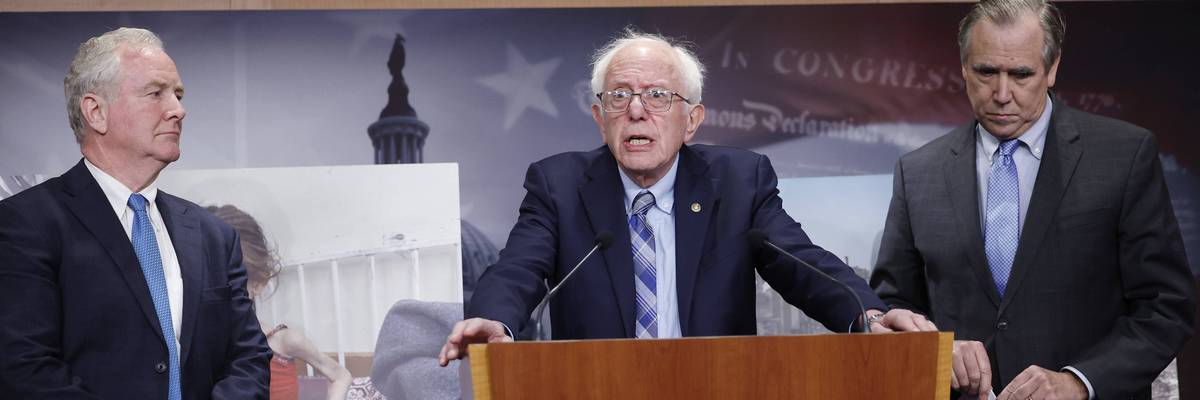
US Sen. Bernie Sanders (I-Vt.) speaks while Sens. Chris Van Hollen (D-Md.) (left) and Jeff Merkley (D-Ore.) (right) stand by in the US Capitol in Washington, DC on November 19, 2024.
"It's time to invest in the American people, not endless war," said Sen. Bernie Sanders.
As expected, members of the Senate Democratic Caucus on Tuesday blocked debate on an annual military spending authorization bill over President Donald Trump’s ongoing illegal war of choice on Iran and provisions for closer US-Israeli military integration.
Upper chamber lawmakers voted 50-46, mostly along party lines, against proceeding with debate on the National Defense Authorization Act (NDAA) for fiscal year 2027.
The Trump administration’s broader national security proposal requests nearly $1.5 trillion in total defense-related spending for 2027, which includes $350 billion in supplemental funding for munitions production, shipbuilding, missile defense, drones, artificial intelligence, and other long-term military programs.
Sen. Bernie Sanders (I-Vt.), who along with Sen. Chris Van Hollen (D-Md.) led the effort to vote down the NDAA in its current form, said on social media: "At a time when millions struggle to pay the bills, virtually every Senate Republican voted for a staggering $1.15 trillion Pentagon bill, which includes funding for the illegal and immoral war in Iran and a special provision to provide even more weapons to Israel with almost zero oversight."
"It's time to invest in the American people, not endless war," he added.
"I’m a NO on the NDAA," Sen. Jeff Merkley (D-Ore.) said on social media. "I can’t support excessive military spending, de facto approval of Trump’s illegal war with Iran, and deeply troubling provisions that force deeper US-Israeli defense and intelligence sharing."
Sen. Ron Wyden (D-Ore.) said he "cannot support an outrageous $1.15 trillion in military spending while Donald Trump engages in an idiotic war with Iran that is doing nothing to make Americans safer, puts US servicemembers and civilians in harm's way, and spikes the price of gas."
“I also cannot support new authorities included in the bill, which seek to deepen and accelerate cooperation with Israeli contractors on surveillance and AI technologies that are ripe for abuse," Wyden added. "On [Israeli Prime Minister Benjamin] Netanyahu’s watch, surveillance technologies developed by Israeli companies have repeatedly been used by repressive regimes, contributed to human rights violations in Gaza, and have been used against Americans."
Republicans, on the other hand, denounced Tuesday's vote, with Sen. Bernie Moreno of Ohio accusing his Democratic colleagues of "holding America hostage" and Sen. John Cornyn of Texas alleging they're "once again playing politics with our national security instead of prioritizing the safety of the American people."
Progressive groups campaigners cheered Tuesday's vote.
"For once, the Senate refused to fast-track a $1.15 trillion Pentagon budget," Medea Benjamin, co-founder of the women-led peace group CodePink, said on social media following the vote. "After sustained grassroots pressure... people power made this vote possible. Now let’s make sure senators hold the line."
Taxpayers for Common Sense president Steve Ellis said, "The Senate just sent a clear signal to the Pentagon that its request for a $250 billion, 28% boost in its base budget is not going to fly."
"Taxpayers deserve a Pentagon budget that invests strategically in the essentials while cutting out outdated, unnecessary, and wasteful programs," he continued. "Instead, the Pentagon’s request would set a new baseline of unsustainable spending that would add more than $3 trillion to the debt over the next eight years."
"With the end of the fiscal year looming, lawmakers need to get realistic and work together to pass a bipartisan Pentagon budget aligned with our genuine needs, not this grab bag of ill-advised boondoggles," Ellis added.
At the consumer advocacy watchdog Public Citizen, co-president Robert Weissman called the vote "both a repudiation of throwing more money at the waste-and-fraud-ridden Pentagon while Republican cuts have forced millions to lose health coverage and food assistance, and a forceful rejection of the Trump’s Iran War."
“The American people are fed up with spending more on bombs and less on basic needs," Weissman continued. "And they are furious with a pointless, deadly, illegal, unconstitutional, and protracted war that is costing lives and driving up gas prices."
“Elected officials are beginning to listen," he added. "Today’s defeat of the procedural motion on... legislation that normally sails through Congress on a bipartisan basis is a sign that the Pentagon budget will no longer get a rubber stamp.”
Greg Williams, director of the Center for Defense Information at the Project on Government Oversight, said in a statement that "the Senate was right to reject the National Defense Authorization Act, particularly as the executive branch continues its illegal, unsanctioned war in Iran."
"The budget topline in the bill is recklessly high—bringing an increase in military spending not seen since World War II," Williams added.
In a bid to address that point, Sen. Ed Markey (D-Mass.) recently introduced the Slash the Pentagon Act, legislation that would cap military spending at what some critics say is a still staggering $750 billion.
Dear Common Dreams reader, It’s been nearly 30 years since I co-founded Common Dreams with my late wife, Lina Newhouser. We had the radical notion that journalism should serve the public good, not corporate profits. It was clear to us from the outset what it would take to build such a project. No paid advertisements. No corporate sponsors. No millionaire publisher telling us what to think or do. Many people said we wouldn't last a year, but we proved those doubters wrong. Together with a tremendous team of journalists and dedicated staff, we built an independent media outlet free from the constraints of profits and corporate control. Our mission has always been simple: To inform. To inspire. To ignite change for the common good. Building Common Dreams was not easy. Our survival was never guaranteed. When you take on the most powerful forces—Wall Street greed, fossil fuel industry destruction, Big Tech lobbyists, and uber-rich oligarchs who have spent billions upon billions rigging the economy and democracy in their favor—the only bulwark you have is supporters who believe in your work. But here’s the urgent message from me today. It's never been this bad out there. And it's never been this hard to keep us going. At the very moment Common Dreams is most needed, the threats we face are intensifying. We need your support now more than ever. We don't accept corporate advertising and never will. We don't have a paywall because we don't think people should be blocked from critical news based on their ability to pay. Everything we do is funded by the donations of readers like you. When everyone does the little they can afford, we are strong. But if that support retreats or dries up, so do we. Will you donate now to make sure Common Dreams not only survives but thrives? —Craig Brown, Co-founder |
As expected, members of the Senate Democratic Caucus on Tuesday blocked debate on an annual military spending authorization bill over President Donald Trump’s ongoing illegal war of choice on Iran and provisions for closer US-Israeli military integration.
Upper chamber lawmakers voted 50-46, mostly along party lines, against proceeding with debate on the National Defense Authorization Act (NDAA) for fiscal year 2027.
The Trump administration’s broader national security proposal requests nearly $1.5 trillion in total defense-related spending for 2027, which includes $350 billion in supplemental funding for munitions production, shipbuilding, missile defense, drones, artificial intelligence, and other long-term military programs.
Sen. Bernie Sanders (I-Vt.), who along with Sen. Chris Van Hollen (D-Md.) led the effort to vote down the NDAA in its current form, said on social media: "At a time when millions struggle to pay the bills, virtually every Senate Republican voted for a staggering $1.15 trillion Pentagon bill, which includes funding for the illegal and immoral war in Iran and a special provision to provide even more weapons to Israel with almost zero oversight."
"It's time to invest in the American people, not endless war," he added.
"I’m a NO on the NDAA," Sen. Jeff Merkley (D-Ore.) said on social media. "I can’t support excessive military spending, de facto approval of Trump’s illegal war with Iran, and deeply troubling provisions that force deeper US-Israeli defense and intelligence sharing."
Sen. Ron Wyden (D-Ore.) said he "cannot support an outrageous $1.15 trillion in military spending while Donald Trump engages in an idiotic war with Iran that is doing nothing to make Americans safer, puts US servicemembers and civilians in harm's way, and spikes the price of gas."
“I also cannot support new authorities included in the bill, which seek to deepen and accelerate cooperation with Israeli contractors on surveillance and AI technologies that are ripe for abuse," Wyden added. "On [Israeli Prime Minister Benjamin] Netanyahu’s watch, surveillance technologies developed by Israeli companies have repeatedly been used by repressive regimes, contributed to human rights violations in Gaza, and have been used against Americans."
Republicans, on the other hand, denounced Tuesday's vote, with Sen. Bernie Moreno of Ohio accusing his Democratic colleagues of "holding America hostage" and Sen. John Cornyn of Texas alleging they're "once again playing politics with our national security instead of prioritizing the safety of the American people."
Progressive groups campaigners cheered Tuesday's vote.
"For once, the Senate refused to fast-track a $1.15 trillion Pentagon budget," Medea Benjamin, co-founder of the women-led peace group CodePink, said on social media following the vote. "After sustained grassroots pressure... people power made this vote possible. Now let’s make sure senators hold the line."
Taxpayers for Common Sense president Steve Ellis said, "The Senate just sent a clear signal to the Pentagon that its request for a $250 billion, 28% boost in its base budget is not going to fly."
"Taxpayers deserve a Pentagon budget that invests strategically in the essentials while cutting out outdated, unnecessary, and wasteful programs," he continued. "Instead, the Pentagon’s request would set a new baseline of unsustainable spending that would add more than $3 trillion to the debt over the next eight years."
"With the end of the fiscal year looming, lawmakers need to get realistic and work together to pass a bipartisan Pentagon budget aligned with our genuine needs, not this grab bag of ill-advised boondoggles," Ellis added.
At the consumer advocacy watchdog Public Citizen, co-president Robert Weissman called the vote "both a repudiation of throwing more money at the waste-and-fraud-ridden Pentagon while Republican cuts have forced millions to lose health coverage and food assistance, and a forceful rejection of the Trump’s Iran War."
“The American people are fed up with spending more on bombs and less on basic needs," Weissman continued. "And they are furious with a pointless, deadly, illegal, unconstitutional, and protracted war that is costing lives and driving up gas prices."
“Elected officials are beginning to listen," he added. "Today’s defeat of the procedural motion on... legislation that normally sails through Congress on a bipartisan basis is a sign that the Pentagon budget will no longer get a rubber stamp.”
Greg Williams, director of the Center for Defense Information at the Project on Government Oversight, said in a statement that "the Senate was right to reject the National Defense Authorization Act, particularly as the executive branch continues its illegal, unsanctioned war in Iran."
"The budget topline in the bill is recklessly high—bringing an increase in military spending not seen since World War II," Williams added.
In a bid to address that point, Sen. Ed Markey (D-Mass.) recently introduced the Slash the Pentagon Act, legislation that would cap military spending at what some critics say is a still staggering $750 billion.
As expected, members of the Senate Democratic Caucus on Tuesday blocked debate on an annual military spending authorization bill over President Donald Trump’s ongoing illegal war of choice on Iran and provisions for closer US-Israeli military integration.
Upper chamber lawmakers voted 50-46, mostly along party lines, against proceeding with debate on the National Defense Authorization Act (NDAA) for fiscal year 2027.
The Trump administration’s broader national security proposal requests nearly $1.5 trillion in total defense-related spending for 2027, which includes $350 billion in supplemental funding for munitions production, shipbuilding, missile defense, drones, artificial intelligence, and other long-term military programs.
Sen. Bernie Sanders (I-Vt.), who along with Sen. Chris Van Hollen (D-Md.) led the effort to vote down the NDAA in its current form, said on social media: "At a time when millions struggle to pay the bills, virtually every Senate Republican voted for a staggering $1.15 trillion Pentagon bill, which includes funding for the illegal and immoral war in Iran and a special provision to provide even more weapons to Israel with almost zero oversight."
"It's time to invest in the American people, not endless war," he added.
"I’m a NO on the NDAA," Sen. Jeff Merkley (D-Ore.) said on social media. "I can’t support excessive military spending, de facto approval of Trump’s illegal war with Iran, and deeply troubling provisions that force deeper US-Israeli defense and intelligence sharing."
Sen. Ron Wyden (D-Ore.) said he "cannot support an outrageous $1.15 trillion in military spending while Donald Trump engages in an idiotic war with Iran that is doing nothing to make Americans safer, puts US servicemembers and civilians in harm's way, and spikes the price of gas."
“I also cannot support new authorities included in the bill, which seek to deepen and accelerate cooperation with Israeli contractors on surveillance and AI technologies that are ripe for abuse," Wyden added. "On [Israeli Prime Minister Benjamin] Netanyahu’s watch, surveillance technologies developed by Israeli companies have repeatedly been used by repressive regimes, contributed to human rights violations in Gaza, and have been used against Americans."
Republicans, on the other hand, denounced Tuesday's vote, with Sen. Bernie Moreno of Ohio accusing his Democratic colleagues of "holding America hostage" and Sen. John Cornyn of Texas alleging they're "once again playing politics with our national security instead of prioritizing the safety of the American people."
Progressive groups campaigners cheered Tuesday's vote.
"For once, the Senate refused to fast-track a $1.15 trillion Pentagon budget," Medea Benjamin, co-founder of the women-led peace group CodePink, said on social media following the vote. "After sustained grassroots pressure... people power made this vote possible. Now let’s make sure senators hold the line."
Taxpayers for Common Sense president Steve Ellis said, "The Senate just sent a clear signal to the Pentagon that its request for a $250 billion, 28% boost in its base budget is not going to fly."
"Taxpayers deserve a Pentagon budget that invests strategically in the essentials while cutting out outdated, unnecessary, and wasteful programs," he continued. "Instead, the Pentagon’s request would set a new baseline of unsustainable spending that would add more than $3 trillion to the debt over the next eight years."
"With the end of the fiscal year looming, lawmakers need to get realistic and work together to pass a bipartisan Pentagon budget aligned with our genuine needs, not this grab bag of ill-advised boondoggles," Ellis added.
At the consumer advocacy watchdog Public Citizen, co-president Robert Weissman called the vote "both a repudiation of throwing more money at the waste-and-fraud-ridden Pentagon while Republican cuts have forced millions to lose health coverage and food assistance, and a forceful rejection of the Trump’s Iran War."
“The American people are fed up with spending more on bombs and less on basic needs," Weissman continued. "And they are furious with a pointless, deadly, illegal, unconstitutional, and protracted war that is costing lives and driving up gas prices."
“Elected officials are beginning to listen," he added. "Today’s defeat of the procedural motion on... legislation that normally sails through Congress on a bipartisan basis is a sign that the Pentagon budget will no longer get a rubber stamp.”
Greg Williams, director of the Center for Defense Information at the Project on Government Oversight, said in a statement that "the Senate was right to reject the National Defense Authorization Act, particularly as the executive branch continues its illegal, unsanctioned war in Iran."
"The budget topline in the bill is recklessly high—bringing an increase in military spending not seen since World War II," Williams added.
In a bid to address that point, Sen. Ed Markey (D-Mass.) recently introduced the Slash the Pentagon Act, legislation that would cap military spending at what some critics say is a still staggering $750 billion.