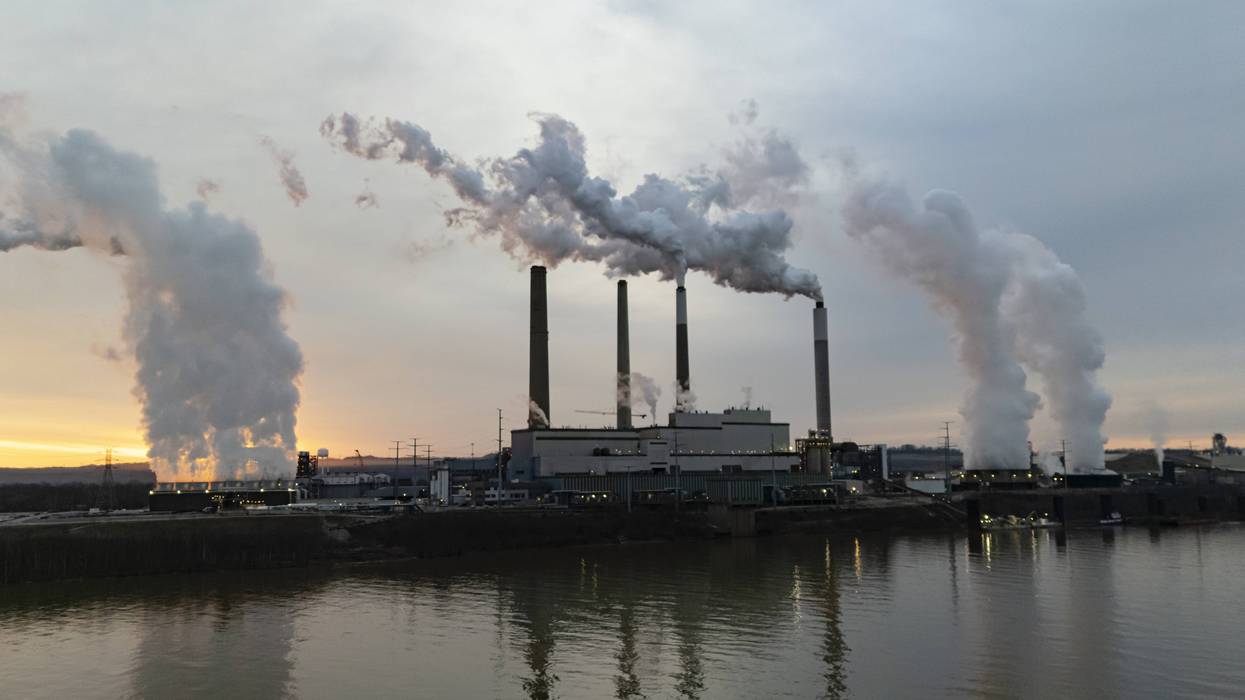
GIJÓN, Spain - Climate change is altering the world's oceans in so many ways scientists cannot keep pace, and as a result there is no comprehensive vision of its present and future impacts, say experts.
Rising sea levels, changes in hurricane intensity and seasonality, declines in fisheries and corals are among the many effects attributed to climate change.
In an attempt to put some order to their disconcerting findings, more than 450 scientists from some 60 countries gathered in the northern Spanish city of Gijón for the symposium "Effects of Climate Change on the World's Oceans" May 19-23.
Change is evident where ever marine scientists look. Sea level rise and warmer ocean temperatures are the most obvious, but other changes include a decline in the oceans' productivity, which means many areas are unable to support as many fish as they once did, according to Luis Valdés, a world expert on plankton and one of the symposium organizers.
Species are moving into new regions in response to warming waters in their original habitats, says Valdés, of the Spanish Oceanographic Institute.
"Off the coast here, in the Bay of Biscay, we are now seeing tropical species we've never seen before," he told Tierramérica.
Such alterations of marine ecosystems have unknown consequences and increase the need and urgency for monitoring and observations of what is happening in the oceans.
Ocean science lags far behind research on the atmosphere, mainly due to lack of funding. There are few sets of measurements about conditions in the oceans that extend back more than 20 years, and most information is from a very small proportion of the oceans, said Valdés.
"Will we be catching less sardines and anchovies in the near future? I don't know because we don't have the information, but it seems probable," stated the expert.
Valdés said he hoped the symposium would encourage policy makers to fund permanent ocean observation and monitoring systems so that scientists can detect changes and make informed recommendations.
"The European Commission has called this the most important meeting in Europe this year," he said.
Some changes in the oceans are easier to detect, such as the consistent rise in sea surface temperatures in the Caribbean Sea.
Nearly every month for the past 20 years researchers in the Department of Marine Sciences at the University of Puerto Rico (UPR) have measured the average temperatures and salinity of the Caribbean's surface waters.
Over this period they have detected a strong upward trend, despite variability due to the seasons and impacts of El Niño climate events, according to UPR scientist Jorge Corredor, who presented these findings at the Symposium.
At the current rate of increase, the average year-round temperature will be more than 27.4 Celsius, which is the threshold for hurricane formation. This means hurricanes could form at any time of the year in three or four decades if the warming trend continues. "There will no longer be a hurricane season", Corredor told Tierramérica.
Corredor cautions that warmer water is just one factor in hurricane formation and that other published research suggests climate change will not increase the total number of hurricanes in the region. However, the number of very powerful storms is likely to increase.
Warm water also poses a significant risk to corals, and the UPR research shows that summer season water temperatures will likely to be too warm for corals in future.
A new concern is ocean acidification of the oceans. Detected less than four years ago it is a process in which carbon dioxide emissions from the burning of fossil fuels is turning the surface waters more acidic.
This is starting to affect shell-forming species, including coral and plankton. Acidification has the potential in just a few decades to not only turn coral into rubble but also undermine the entire marine food chain.
Much more research is needed to identify and determine the effects, Valdés said.
Newer still are the findings that the Southern Ocean is absorbing less carbon dioxide, the principal greenhouse-effect gas, from the atmosphere.
Only a year ago Corinne Le Quere, of Britain's University of East Anglia, reported that the Southern Ocean is taking up less CO2 and appears to be reaching its saturation point.
Oceans absorb half of all human-created carbon emissions and trap them in the ocean depths.
Le Quere's findings sparked much debate. She told the Symposium she has additional evidence that clearly shows less CO2 is being absorbed. What's more, there is some proof this is happening in other parts of the oceans. "It appears to be a global weakening of the oceans as a carbon sink," she said.
While there is still some uncertainty, it looks like more CO2 is remaining in the atmosphere than expected. None of the climate projections used by the Intergovernmental Panel on Climate Change (IPCC) include this factor, which means their projections likely underestimate the speed with which CO2 levels will rise.
Indeed, Le Quere showed an IPCC projection from the late 1990s that underestimated the actual rise of CO2 over the last few years.
Rather than thinking the IPCC work is completed -- with the organization receiving the 2007 Nobel Peace Prize -- it is time to accelerate efforts to understand what is happening to the carbon sinks, she said.
Valdés insists that the oceans and climate are changing in ways we don't yet understand: "The key question we are trying to address is what kind of world will our children inherit?"
© 2008 Inter Press Service
Delicious
Digg
StumbleUpon
Newsvine
Facebook
Google
Yahoo
Technorati
16 Comments so far
Show AllWorld governments either get on the clean green energy bandwagon now, or we won't be here twenty years from now discussing it.
And twenty years may be optomistic.
ike kay: Does anyone really believe that the corporate nightmare will end?
The corporate nightmare ends when you quit your exchange/association with corporations! Employ your local craftsmen to build any machines that you might need. Enjoy your local production, people! Just like in the old days! Heh heh. Spit-ting!
Obama for prez & Al Gore is his pic for E.P.A.
Global warming top priority in his administration.
bbr-001
All that you say is what people should be doing. . .it is time for everyone who believes this is the last chance to get involved, than do so! The young people need help with a leg up! So many folks here on these pages are terribly concerned and spend a lot of their time doing anything they are able. For those who can join the group out there to make sense out of this nonsense give it a shot you will find that the reward is very good!
Hey Ike,
Maybe TV, video games and sports will take the edge off when we are all unemployed. I agree that diversions shouldn't be all consuming.
We need leadership in Washington to promote and plan the effort. During WWII the auto plants built planes, trucks, tanks and jeeps. The steel mills built ships and made armor... We could make a similar effort to build wind turbines, reactor vessels, solar cells... We built the interstate highways in something like 20 years. The steel and concrete needed for a crash program would be a fraction of that.
The leadership in Washington needs a push from folks like us. It isn't something I'm used to doing, but as you say, time is short.
Hey Kem,
My '01 Impala does the same, and 27-28 mpg commuting old lady style to work. When it isn't in the shop!!!! That lock-up / coaster overdrive transmission must be the secret. It is weird how they can build a big comfy car that gets almost 30 mpg and goes like a rocket when you want it to, and a Cobalt, or even a Corolla, only gets 35-36 tops. Even so, I'm trying to cut my driving to the bare minimum. Ford is bringing out a Fusion hybrid next year. Sounds expensive.
You are very welcome ~Grandma~.
Here is another good one and compliments the other one.
http://www.energybulletin.net/3647.html
Sometimes it won't open, it did today.
~LOL TWICE~ I'm right about the nUkes too ~BBR-001~.
You know what else is funny ~BBR~? These new "economy" cars average about 33 MPG highway driving. We have a 2004 Bonneville with all the toys and it gets 30-31 at 65mph.
bbr-001
Nuclear Energy is the wrong way to go. It takes too long and too much money to build, it is a place that becomes open to attack, there is no place safe to store the waste, and those resources could be used to find ways to power transport particularly the public variety quickly. If everyone in the USA cut back on fuel consumption, went wind and geo-thermal with heavy duty conservation quickly, we might have a chance.
There is not reason why the car cannot HAVE 80 MPG AND THOSE BEING FLOGGED BY THE AUTO INDUSTRY COULD NOT BE RETROFITTED BEFORE EXPORT! Who is going to do that? The auto industry? The Americans can land a space vehicle on Mars but cannot produce a vehicle that is non-polluting or gets a minimum 80 to 100-mpg whose is fooling whom? This is how the seriousness of this crisis is handled, its all about business nothing else!
The world had a ten year window to reign it in environmental abuse. All who write here should work like hell for those who will change the way the USA does business and also work for and vote the right people in . . . that is congress as well as the president.
America must turn the page there is no time left! The USA must lead the way and give up the video games and nonsense of American Idol which is more of the TV Hollywood garbage your country is hooked on. I am embarrassed to say I am a member of this country. I am embarrassed when I walk in the world.
All three remaining Presidential candidates are at least paying lip service to global warming. We need to hold the winner to his/her promises. (No point in bothering the morons in the White House at the moment. They won't listen and Fox turns it into "global warming hysteria".) January is the time to turn up the activism.
Personally, we can drive as little as possible and stop shopping for anything but necessities. Improve home insulation, arrange for zone heating, and replace the oil furnace if possible. Use a fan instead of mindlessly running the air conditioning all the time. Have the double effect of reducing energy use and contributing to the recession.
The Secretary of Energy needs to become the global warming czar, he needs a plan "Ready on Day 1", and they have to reduce the influence of Big Oil and King Coal execs in energy planning. We need a hard cap and planned reductions of CO2 emissions, even if it results in rationing.
I'm hoping China will decline. Most of its money comes from exports to the US, and the average Chinese does not buy all the toys they make for the US. The US is about to tailspin, and China shouldn't be far behind. Maybe the US and China in deep recession and Europe going nuclear/renewable will slow CO2 accumulation some.
I think Kem Patrick called what we need a "war effort" or something like that a few weeks ago, but they ganged up on him last night and called him stupid. He's right about this one, even if he doesn't like nukes.
Kem - Thanks for that link. Great site.
"This is the absolute absurdity, the absolute paradox no one cares about anything else but money, it's all about greed and money, the future generations be damned!"
- because money represents personal security. The rich believe that they will be safe if they have the cash to remain mobile and protected. What can we do to disabuse them of this notion, assuming they have better information about eco-collapse than we do? If we could somehow 'occupy the lifeboats' would they reconsider their current tactic of just letting the world go straight to the bottom and trying to live through the mass die-off?
ike kay:
Don't think anyone could say it better than you just did.
It is time for both the United States and China — the world's two biggest polluters — "playing a more constructive role" in vital new negotiations on tackling climate change but the meetings recently don't hold much promise. George bush has been tolling the bell for the environment since he assumed office. This current primary has had the candidates adopt the obvious but few with the exception of Obama have begun to spell out the implications.
The new IPCC report, which is designed to give impetus to the negotiations, highlights the little-known acidification of the oceans the ocean is losing its ability as a means to absorb carbon dioxide . Carbon dioxide — the main cause of global warming — have already increased the acidity of ocean surface water by 30 per cent, and threaten to treble it by the end of the century.
Achim Steiner, the executive director of the United Nations Environment Program (UNEP), said yesterday: "The report has put a spotlight on a threat to the marine environment that the world has hardly yet realized. The threat is immense as it can fundamentally alter the life of the seas, reducing the productivity of the oceans, while reinforcing global warming."
Scientists have found that the seas have already absorbed about half of all the carbon dioxide emitted by humanity since the start of the industrial revolution, a staggering 500 billion tons of it. This has so far helped slow global warming — which would have accelerated even faster if all this pollution had stayed in the atmosphere, already causing catastrophe — but at an increasingly severe cost.
Does anyone really believe that the corporate nightmare will end? Does anyone think that that the profit motive as it is constituted in the "Free Market System" will somehow be modified by the need to save the planet? We are entering a phase of the final meltdown of the planet. The poles are beginning to break up but that has not deterred the oil market or has it lead to the kind of conservation necessary, at the speed necessary, in the face of this catastrophe.

There are still people out there like George Will and the Republican menace that will continue the objection to scientific reality, some of the scientists saying that we are already in feedback mode the above is clearly one of the example.
 James Lovelock says that there will be about 500 million left at the poles for a few hundred thousand years until the planet rights itself and begins to cool or it might continue to heat until all life is finished. This small period of time in Earth's evolution and geology has been set in motion for another life extinction episode.
This time we are the catalyst for our own extinction. The Chinese are producing more coal plants that will substantially diminish their fresh water supplies as well as adding to the globes greenhouse gasses is a grand example of this environment be damned global economy. The ethanol versus food production shows us that the chance to change rapidly is out of our grasp. We have all done it! Who has turned off their life style or their 401ks?
Our selfish opportunism has turned love to stone? Will we spin to oblivion on a dead planet, probably? Where is the profit to be found here can someone from Wall Street explain this? 
Their is a fundamental feedback problem between the economic style that Americans are trying to get the world to accept, a consumer disposable auto centered existence, and its affect on continued life.
Lester Brown has been saying this for to many years with no one really taking him seriously. I have been fighting climate change in my work since my film, about Acid Rain, produced in 1980.
Its the same problem, for the same reasons that has now become the basis for this catastrophe now impacting on humanity. All the above, while the nations of the world argue about who will have the Lion's share of the oil and gas reserves in the waters now opened by global warming in the arctic. This is the absolute absurdity, the absolute paradox no one cares about anything else but money, it's all about greed and money, the future generations be damned!
Can't hardly wait for the trolls to arrive and explain this is all normal nature at work.
What kind of a world will our childen inherit? Very likely a near dead world. What is happening right now could even cause another Mars like planet.
Read Michael J. Benton's book, "When Life Nearly Died". I realize that sounds dramatic and doom-sayer and the vast majority may be repelled by such words, but facts are facts.
Here is one good three minute read and it's facts. Hundreds of Arctic lake should be ice bound as they have been for millions of years, now they are open water and methane gas is spewing out into our atmosphere. Methane is 25% more potent as a greenhouse gas than Co2 is.
http://www.farnorthscience.com/2007/09/26
There are other links within this one which are also educational eye openers.
Is there a perfect storm of events swirling around us, leaving us like deer caught in a car's headlights: accelerating warming, an economy big enough to wreck the global ecology but too weak to pay for the required reduction in CO2 emissions, and a political culture that always puts economic growth ahead of matters of ecology--seeming to either ignore or not understand that it is the ecology that makes possible the economy and not the other way around.
"Valdés insists that the oceans and climate are changing in ways we don't yet understand: "The key question we are trying to address is what kind of world will our children inherit?""
Indeed.