

SUBSCRIBE TO OUR FREE NEWSLETTER
Daily news & progressive opinion—funded by the people, not the corporations—delivered straight to your inbox.
5
#000000
#FFFFFF
To donate by check, phone, or other method, see our More Ways to Give page.
Daily news & progressive opinion—funded by the people, not the corporations—delivered straight to your inbox.
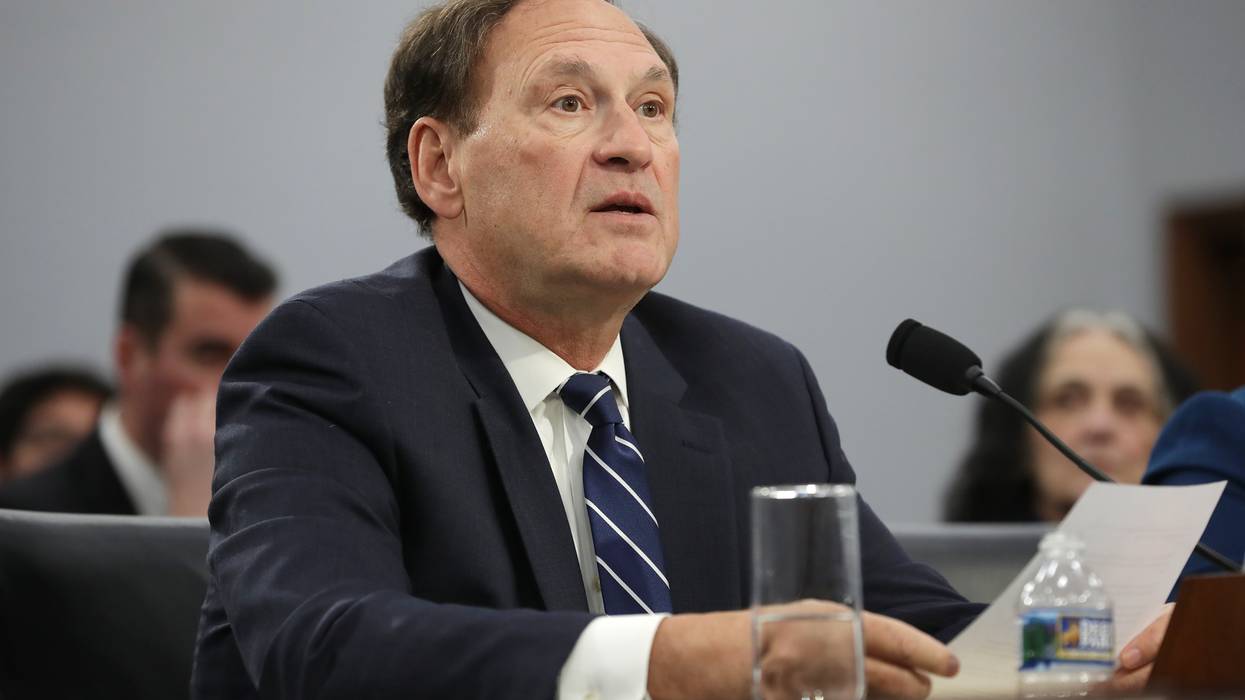
So many thanks to the dozen anonymous everyday people in New York who courageously did what the nation's highest court likely will not.
Last Thursday, 12 ordinary citizens unanimously convicted Donald Trump of 34 felonies. As many have commented, in doing so they upheld the rule of law—the fundamental principle that no person is above the law and that even a former president may be convicted for violating it.
Later this month, however, the six right-wing Justices on the U.S. Supreme Court may issue a decision in U.S. v Trump that would significantly undermine the rule of law, finding that presidents are either wholly or partially immune from federal prosecution (although it would not overturn the New York State conviction.)
SCOTUS has already slow walked its decision for so long that even if it decides that Trump is not immune from prosecution for inciting the January 6 insurrection, it will probably be too late to try him before the November 2024 election.
In late 2023, trial court Judge Tanya Chutkin denied Trump’s motion to dismiss the charges on Trump’s claim that he’s immune from prosecution. She set a trial date for March 4, 2024. Last December, Special Prosecutor Jack Smith asked SCOTUS to review that decision without waiting for a D.C. Circuit Appeal Court ruling but SCOTUS refused. On February 6, the D.C. Circuit unanimously rejected Trump’s claim and ruled that the trial could move forward unless SCOTUS intervened.
SCOTUS did intervene on February 28, postponing the trial indefinitely and agreeing to decide whether and, if so, to what extent a former president enjoys presidential immunity from criminal prosecution for conduct alleged to involve official acts during his tenure in office. SCOTUS set oral arguments for nearly two months later on April 24, the very last day of the term to hear oral arguments, virtually ensuring that there would be no decision until late June or early July, effectively giving Trump the delay that he most wanted.
The right-wing Justices hardly asked questions about text or original meaning. Instead, they behaved like they were delegates to a Constitutional convention debating whether or not a President should have some degree of immunity...
The right-wing SCOTUS majority claims to decide cases based on “originalism” or “textualism,” the theory that cases should be decided based on the text of the Constitution as generally understood at the time it was written. But in oral arguments, the right-wing Justices had little to say about text or original meaning. There is no text in the Constitution that mentions or implies presidential immunity from criminal conduct and there’s nothing in the debate about drafting the Constitution that implies that the founders intended to grant king-like immunity to the president. Quite the opposite. The entire purpose and structure of the Constitution is to protect against anyone having power like England's King George III.
So the right-wing Justices hardly asked questions about text or original meaning. Instead, they behaved like they were delegates to a Constitutional convention debating whether or not a President should have some degree of immunity—whether for official or unofficial acts—as a matter of pure policy as if they were writing a new Constitution from scratch.
Justice Samuel Alito (he of the two pro-coup flags over his house) argued “[I]f an incumbent who loses a very close, hotly contested election knows that a real possibility after leaving office is not that the president is going to be able to go off into a peaceful retirement but that the president may be criminally prosecuted by a bitter political opponent, will that not lead us into a cycle that destabilizes the functioning of our country as a democracy?” And where does it say this in the text or original meaning of the Constitution?
Gorsuch claimed that “I’m not concerned about this case so much as future ones.” Kavanaugh agreed stating “…like Justice Gorsuch, I’m not focused on the here and now of this case. I’m very concerned about the future.” This is in complete violation of the text of Article III of the Constitution which limits the power of Federal Courts to reviewing actual “cases and controversies” and bars them from issuing advisory opinions which merely advise on the constitutionality or interpretation of a law.
Apparently the right-wing “Justices” only believe in textualism and originalism when these theories can arguably support their policy views. They’re prepared to toss them out when they don’t back up their political views such as Trump should be immune from prosecution for breaking criminal laws by inciting an insurrection.
It’s possible that SCOTUS will forge a “compromise” opinion that Presidents cannot be prosecuted for “official” acts (like ordering Seal Team 6 to assassinate a political opponent) but only for “unofficial” acts and send the case back to the lower court to determine whether Trump’s insurrectionary acts were “official” or “unofficial.” This will accomplish Trump’s goal of delaying a trial until after the election, if ever.
So many thanks to the 12 anonymous jurors in New York who courageously upheld the rule of law. But be ready for the U.S. Supreme Court to undermine the rule of law and effectively declare that the president of the United States is a king.
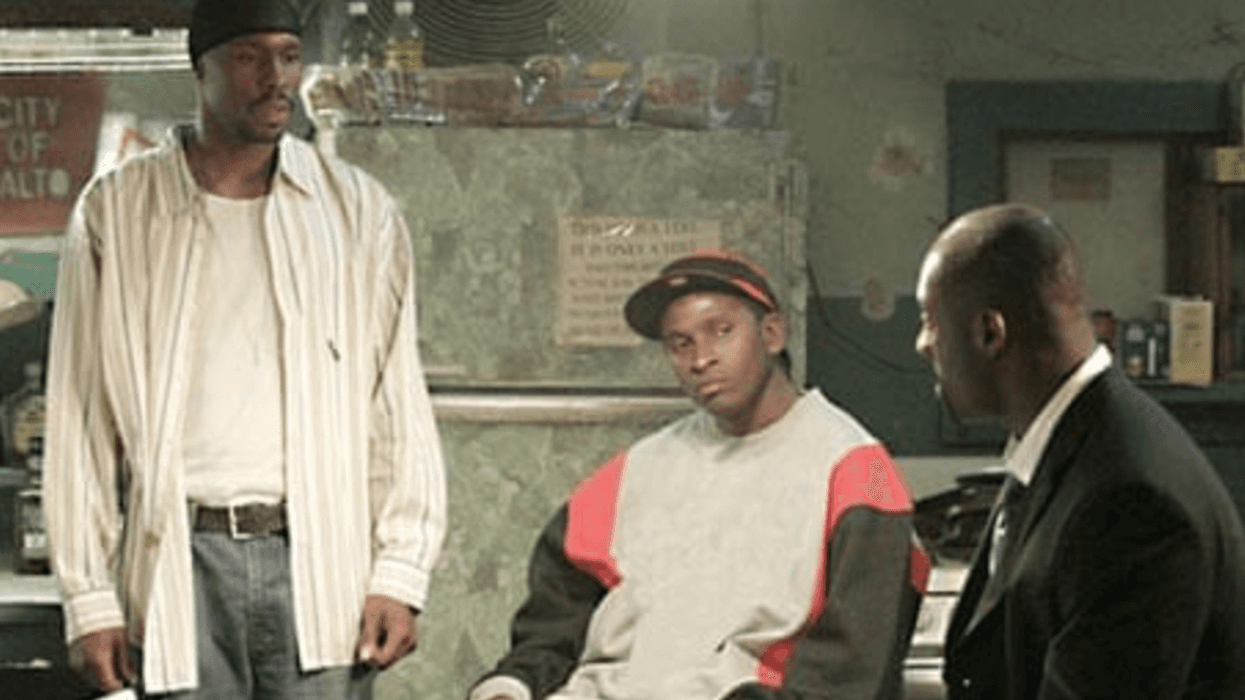
"The thing about the old days, they the old days."
A 2022 U.S. Supreme Court ruling paved the way for states to weaken gun safety laws, but the Hawaii Supreme Court made clear on Wednesday—with the help of the character Slim Charles on HBO's "The Wire"—that the high court's regressive decision would not force the state to allow residents to carry unlicensed firearms in public.
The court unanimously upheld the state's ban, saying that "states retain the authority to require individuals have a license before carrying firearms in public."
The 5-0 decision was at odds with New York State Rifle & Pistol Association, Inc. v. Bruen, the 2022 case in which the Supreme Court's right-wing majority ruled that laws and regulations pertaining to firearms must fall within the United States' so-called "historical tradition."
Last year, Bruen underpinned a decision made by a federal judge in Virginia that 18-to-20-year-olds could not be barred from purchasing guns since men as young as 18 were permitted to join armed militias at the time of the United States' founding.
"Time-traveling to 1791 or 1868 to collar how a state regulates lethal weapons—per the Constitution's democratic design—is a dangerous way to look at the federal constitution," wrote Hawaii Supreme Court Justice Todd Eddins in the ruling. "The Constitution is not a 'suicide pact.'"
Eddins acknowledged that the state's constitution, like the U.S. Constitution, says, "A well-regulated militia being necessary to the security of a free state, the right of the people to keep and bear arms shall not be infringed."
"Those words do not support a right to possess lethal weapons in public for possible self-defense," he wrote.
The court issued an unequivocal rebuke of the importance the Supreme Court placed on the United States' "historical tradition."
"As the world turns, it makes no sense for contemporary society to pledge allegiance to the founding era's culture, realities, laws, and understanding of the Constitution," wrote Eddins before citing the words of Slim Charles, the fictional character from the popular series, who once said: "The thing about the old days, they the old days."
"This is a top-10 court precedent in history," one lawyer said of the citation.
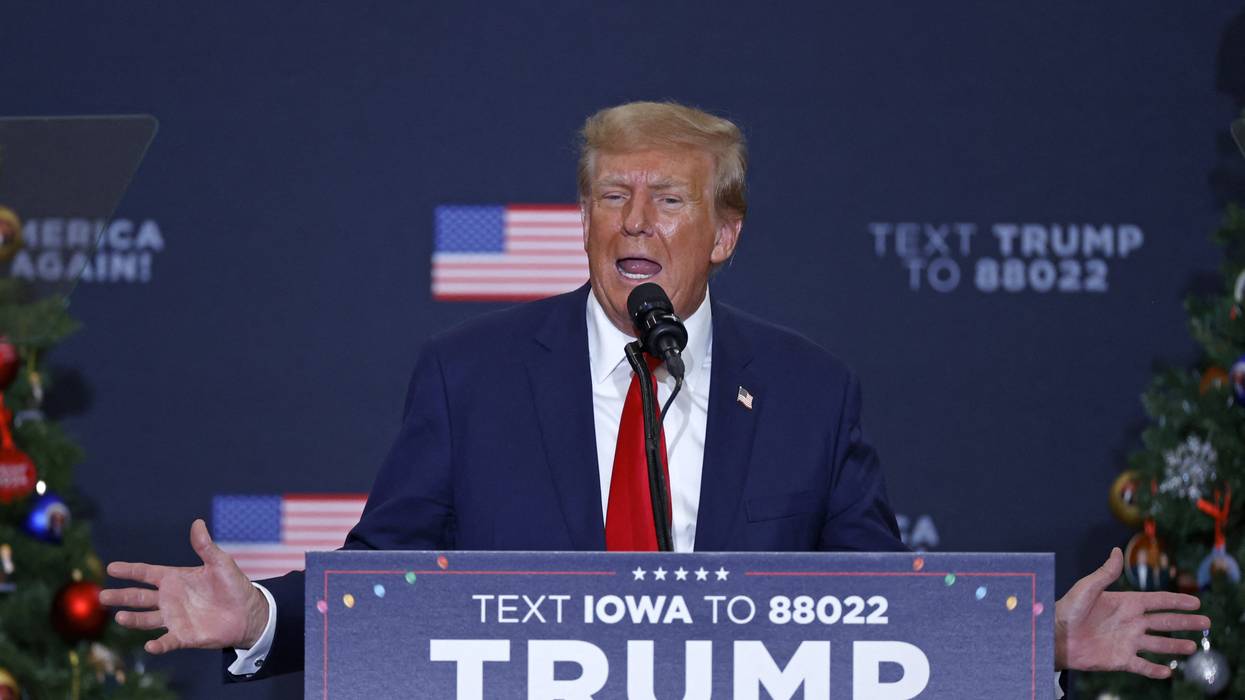
"The critical question of Donald Trump's eligibility—given his incitement of insurrection—should be resolved before primary voters cast their ballots," said a watchdog group involved in the legal battle.
After the Colorado Republican Party asked the U.S. Supreme Court to reverse a ruling that removed former President Donald Trump from the state GOP's 2024 primary ballot, the legal team for voters behind the initial case requested a swift decision.
The legal battle was launched in September by the government watchdog Citizens for Responsibility and Ethics in Washington (CREW) and law firms representing six GOP and unaffiliated Colorado voters, who argued that Section 3 of the 14th Amendment to the U.S. Constitution disqualifies Trump from holding office again because he incited the January 6, 2021 insurrection.
The Colorado Supreme Court last week overturned a lower court's decision and threw Trump off the state's primary ballot but also paused its ruling until January 4, to give the nation's highest court—which includes three Trump appointees—time to weigh in. Hoping the high court's right-wing majority will reverse the Colorado decision, the state party on Wednesday asked the justices to review and rule on the case by Super Tuesday, which is March 5, 2024, or if that's not possible, by the end of the current term.
The voters' legal representatives responded on Thursday with their own motion requesting a decision by February 11, explaining that "Colorado votes almost exclusively by mail" and clerks must mail ballots to many residents starting February 12.
One of the voters' attorneys, Sean Grimsley of Olson Grimsley Kawanabe Hinchcliff & Murray, said in a statement that "the ruling issued by the Colorado Supreme Court affirmed our clients' argument: Donald Trump engaged in insurrection after taking an oath to support the Constitution and is consequently disqualified from serving as president and barred from Colorado primary ballots."
"The Colorado Supreme Court's decision was well-rooted in the text and historical context of the 14th Amendment and they correctly applied those principles to the facts of this case," he continued. "The Colorado Republican Party's appeal of our clients' case will address an issue of exceptional national importance—whether, as the Colorado Supreme Court found, a former president, and current candidate for office, who has engaged in insurrection against the Constitution is disqualified from holding office again."
"We have filed a motion asking the United States Supreme Court to expedite their consideration of the Colorado Republican Party's appeal and any subsequent review on the issues so that the important question of Trump's eligibility can be resolved before nearly all primary voters cast their ballots," he added.
As Politico reported Thursday:
The state GOP's petition argues three points: The office of the presidency is not covered by the 14th Amendment, the insurrection clause is not "self-executing"—meaning Congress alone must enforce it, and states cannot make that determination on their own—and that by kicking Trump off the primary ballot, the state Republican Party's First Amendment rights of association have been violated.
The party is represented by the American Center for Law and Justice, a conservative Christian law group. Jay Sekulow, who defended Trump during his first impeachment trial, is the organization's chief counsel.
Colorado is the first state where Trump—the GOP's 2024 front-runner—has been barred from the primary ballot but it's not the only one where voters and advocacy groups, backed by legal scholars across the ideological spectrum, are challenging his eligibility. Free Speech for People (FSFP) is leading similar legal challenges in Michigan and Minnesota.
The Minnesota Supreme Court dismissed the case last month while the Michigan Supreme Court on Wednesday let stand a lower court ruling that the secretary of state lacks the legal authority to remove Trump from the ballot.
"We are disappointed by the Michigan Supreme Court's decision," said FSFP legal director Ron Fein. "The ruling conflicts with longstanding U.S. Supreme Court precedent that makes clear that when political parties use the election machinery of the state to select, via the primary process, their candidates for the general election, they must comply with all constitutional requirements in that process."
"However, the Michigan Supreme Court did not rule out that the question of Donald Trump's disqualification for engaging in insurrection against the U.S. Constitution may be resolved at a later stage," he added. "The decision isn't binding on any court outside Michigan and we continue our current and planned legal actions in other states to enforce Section 3 of the 14th Amendment against Donald Trump."
The owner of Minocqua Brewing Company, Kirk Bangstad, on Thursday filed a complaint with the Wisconsin Elections Commission seeking to remove Trump from the state's primary ballot, citing the 14th Amendment. The WEC refused to hear the complaint.
"It's pivotal that someone at least try in Wisconsin to do this," Bangstad told local reporters, vowing that "If WEC, and they will deny our complaint, we will sue in Dane County."
Meanwhile, in Maine, Democratic Secretary of State Shenna Bellows on Thursday barred Trump from the state's primary ballot.
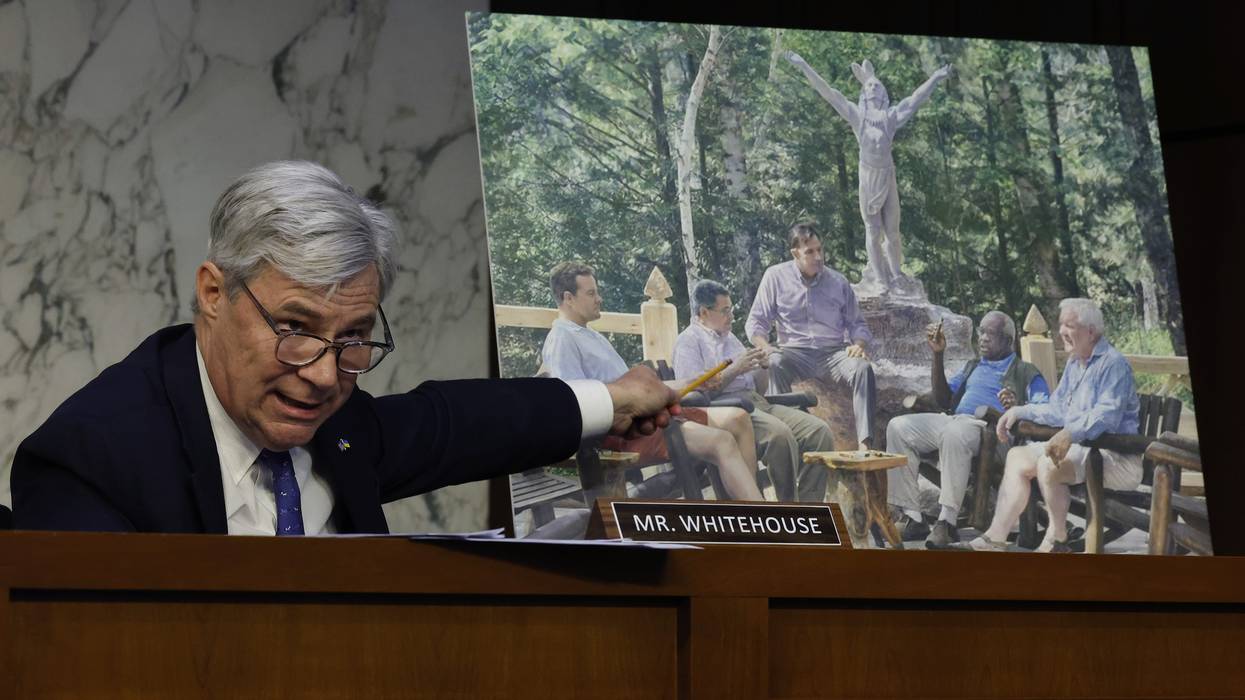
A new analysis shows Republicans on the Senate Judiciary Committee have received more than $450,000 from the same GOP megadonor who has lavished Justice Clarence Thomas with undisclosed gifts.
The Senate Judiciary Committee on Monday sent a letter asking Harlan Crow—the billionaire GOP megadonor who has secretly showered U.S. Supreme Court Justice Clarence Thomas with hundreds of thousands of dollars in gifts since the mid-1990s—to provide a full accounting of his financial ties to Thomas and any other judges on the high court.
It comes as "no surprise" that none of the panel's nine Republicans signed the letter, Accountable.US declared Tuesday, because they have collectively accepted nearly half a million dollars in campaign cash from Crow since the turn of the century, as a new analysis from the watchdog group shows.
Last month, one day after ProPublica published its bombshell report on Crow's under-the-table funding of near-annual luxury vacations for Thomas—the first of what would become many revelations about the two men's financial relationship—Accountable.US calculated that the current Republican members of the Senate Judiciary Committee received $453,300 from Crow between 2001 and 2022. The group revised that figure up to $457,000 on Tuesday in light of a $3,700 donation Crow made to Sen. John Cornyn (R-Texas) earlier this year.
The following is a list of Crow's total contributions to the nine GOP lawmakers on the panel as well as their affiliated PACs and joint fundraising committees, in descending order:
"There should be bipartisan outrage about the undisclosed gifts and travel billionaire megadonor Harlan Crow has given Justice Thomas," Accountable.US president Kyle Herrig said last month. "Senate Judiciary Republicans should join their Democratic colleagues to act. However, their silence so far may be because they have received hundreds of thousands of dollars from Crow as well."
"The highest court in the land should have the highest ethical standards," he added. "When it doesn't, Congress should exert its oversight authority."
Not only have Republicans on the Senate Judiciary Committee with apparent conflicts of interest refused to join their Democratic colleagues in trying to establish enforceable ethics rules for the Supreme Court, but they have attempted to downplay the seriousness of the court's growing crisis of legitimacy.
Several of the panel's GOP members used last week's hearing on proposed Supreme Court ethics reforms—a hearing Chief Justice John Roberts refused to testify at despite mounting evidence of possible corruption involving Thomas and others, including Roberts himself as well as Justice Neil Gorsuch—as "an opportunity for political grandstanding and performative outrage," Accountable.US noted Tuesday.
"Cornyn claimed Congress did not have the authority to regulate the courts due to separation of powers—a claim that was disproven by an expert witness that testified at the hearing," Accountable.US pointed out. "Cruz claimed the hearing was not about judicial ethics, but instead, was an attempt to attack Justice Thomas for having rich friends."
Lee went so far as to say that "when this chapter of American history is written, those who attack Justice Thomas today will be justly dismissed as intolerant bigots."
Meanwhile, Graham, the ranking member, accused the left of trying to "delegitimize the court and cherry-pick examples to make a point." Echoing his right-wing ally, Grassley argued that recent revelations are part of a long-term effort to "cast doubt on certain judges and justices, all because the left is opposed to recent court rulings."
Kennedy, for his part, denounced "attacks on conservative justices" as "targeted" and "exaggerated" and dismissed proposed Supreme Court ethics rules as "unnecessary."
Two days after right-wing senators accused reform advocates of launching what Cruz called a "smear campaign" against Thomas, ProPublica revealed that Crow also paid tens of thousands of dollars for the jurist's grandnephew to attend a pair of elite private schools. This came after earlier exposés about Crow footing the bill for yacht trips, buying and remodeling Thomas' mother's home, and more.
Given the mounting evidence of potential connections between Crow's gifts, which Thomas sought to keep hidden, and Thomas' inclination to rule in ways favorable to his superrich benefactor, calls for the judge to resign or face impeachment are growing.
Not only does Crow have links to numerous right-wing groups involved in Supreme Court cases since Thomas was first confirmed to the bench in 1991, but his own real estate company, Crow Holdings, was directly implicated in a 2021 case before the court.
As The Lever reported last month, Thomas voted to end the Covid-era federal eviction moratorium after Crow Holdings called the lifesaving policy a threat to its "profit margins." Now, as a group of New York City landlords prepares to ask the high court to overturn local rent control laws condemned by Crow Holdings—a move that would endanger rent stabilization efforts nationwide—"there is no indication" Thomas would recuse himself, the outlet noted.
Moreover, as Common Dreams reported last week, an Americans for Tax Fairness analysis of campaign finance data shows that after Thomas provided a deciding vote in the Citizens United v. Federal Election Commission case, the Crow family's average annual campaign contributions soared by 862%, from $163,241 before 2010 to $1.57 million since.
This massive increase, which is partly reflected in Crow's donations to Republicans on the Senate Judiciary Committee, underscores how the 5-4 ruling that effectively legalized unlimited political spending has strengthened the wealthy's ability to shape electoral outcomes, further undermining U.S. democracy.
On Tuesday, The Lever argued that the main goal of Crow and other billionaires who provide gifts and outside money to members of the Supreme Court is not to obtain certain decisions in specific cases, given that the court's right-wing ideologues would likely rule conservatively anyway, but to prevent GOP appointees from becoming more liberal over time—a phenomenon that has occurred in the past.
Alluding to Monday's letter from Senate Judiciary Committee Chair Dick Durbin (D-Ill.), The Washington Post reported that "if Crow ignores the request for information by the committee's May 22 deadline, it's unclear what Durbin's next move would be."
The San Francisco Chronicle reported Tuesday that Sen. Dianne Feinstein (D-Calif.) is returning to Capitol Hill after an illness kept her away from the Senate since February. Feinstein's absence has left Durbin without a majority on the panel, enabling the GOP minority to impede action, but her return would open up options.
In an interview with CNN on Sunday, Durbin did not rule out the possibility of a subpoena, saying that "everything is on the table."
In addition to the implementation of robust ethics rules, progressives have called for other far-reaching changes to disempower the country's "rogue" Supreme Court justices, including expanding the court. Seats have been added seven times throughout U.S. history.
Polling data shows that public approval of the nation's chief judicial body has decreased sharply in the months since its reactionary supermajority eliminated the constitutional right to abortion care, among other harmful and unpopular decisions. According to a survey conducted last month, nearly two-thirds of U.S. adults no longer have confidence in the high court.
The significance of Monday's landmark Supreme Court decision on abortion is already being felt across the nation, giving women's health advocates reason to hope that the concerted right-wing assault on reproductive rights has been "stopped in its tracks."
On Tuesday, the Supreme Court rejected appeals from Mississippi and Wisconsin seeking to put admitting privilege restrictions similar to those struck down in Whole Women's Health v. Hellerstedt. Mississippi's law would have closed the lone abortion clinic in the state.
"Today's decision should send a loud signal to anti-abortion politicians that they can no longer hide behind sham rationales to shut down clinics and prevent a woman who has decided to end a pregnancy from getting the care she needs," said Larry Dupuis, legal director of the American Civil Liberties Union of Wisconsin, which represented an abortion clinic in the Wisconsin case.
"Whether in Mississippi, Texas, or any other state across the U.S., politicians cannot insert their personal beliefs into a woman's decision whether to continue or end a pregnancy," added Nancy Northup, president and CEO of the Center for Reproductive Rights, which filed the Mississippi lawsuit in 2012. "We are confident that courts across the country will continue to affirm that politicians cannot pass laws attacking women's access to safe, legal abortion."
Additionally, late on Monday, Alabama's Attorney General Luther Strange said his office would drop its appeal in a similar case because of Monday's ruling, admitting "there is no good faith argument that Alabama's law remains constitutional in light of the Supreme Court ruling."
According to the Center for Reproductive Rights, similar admitting privilege requirements—for which the Supreme Court could find no medical justification—exist in Missouri, North Dakota, Utah, and Tennessee and are on hold in Kansas, Louisiana, and Oklahoma. The surgical-center standards that the Court also struck down are in place in Michigan, Missouri, Pennsylvania, and Virginia and are on hold in Tennessee.
"We are currently looking at all avenues to invalidate those two restrictions in Missouri," president and CEO of Planned Parenthood of Kansas and Mid-Missouri Laura McQuade said in a conference call with reporters on Monday.
"As the news in Alabama, Wisconsin, and Mississippi shows, yesterday's landmark ruling was just the beginning," said Cecile Richards, president of the Planned Parenthood Federation of America. "This decision has opened the door to go state by state, legislature by legislature, law by law, and restore access to safe, legal abortion."
Indeed, as author and columnist Jessica Valenti wrote on Monday:
The ruling represents a significant loss for anti-abortion groups, who have been pushing Targeted Regulation of Abortion Providers (Trap laws) over the last decade: as of this year, 24 states have some sort of law or policy that restricts abortion access through targeting the way providers work.
But the Whole Woman's Health decision - which laid bare the way that these mandates constitute an undue burden on women seeking abortion - stands to put that years-long strategy in jeopardy. It will be that much harder for anti-choice legislators to shroud their policies in rhetoric about protecting women when the highest court in the country has essentially called the tactic nonsense.
Furthermore, as Politico wrote on Tuesday, "The decision's political ramifications are significant. It will galvanize both sides of the divisive abortion debate as the presidential campaign builds toward the national party conventions and intensify the political focus on the Supreme Court's vacancy, which has been frozen in the Senate. The Whole Women's Health decision will surely be cited as the two sides in the debate remind voters that the next president will almost certainly name several justices to the bench, providing a rare opportunity to cement the court's political stance for years to come."
While both Hillary Clinton and Bernie Sanders praised the Supreme Court ruling on Monday, GOP frontrunner Donald Trump "has gone into hiding," as Planned Parenthood Action Fund political communications director Erica Sackin said on Tuesday. Trump, who earlier this year suggested women who have abortions should be "punished," has thus far stayed silent on Monday's decision.
The US Supreme Court on Monday affirmed (pdf) a federal law that bars those convicted of misdemeanor domestic assault from owning a firearm.
In doing so, the court struck down an unusual argument from two Maine residents who pleaded guilty to domestic violence charges but asserted that their assaults on their former girlfriends had been "reckless" rather than knowing or intentional. Therefore, they argued, their actions should neither have qualified as a "use of physical force" nor triggered the federal gun ban.
Victim advocacy groups celebrated the court's decision.
"The Supreme Court today affirmed what we know--domestic violence escalates and is often deadly. Ensuring that convicted abusers do not have access to firearms will save lives," said Kim Gandy, president and CEO of the National Network to End Domestic Violence (NNEDV), in a statement.
"This is really important and relevant gun-control policy, as opposed to the xenophobic and largely irrelevant no-fly list," argued author and activist Rebecca Solnit on Facebook.
Indeed, NNEDV explained the rationale behind the federal legislation that bars convicted abusers from owning firearms:
Many perpetrators of domestic violence are often convicted only of misdemeanor crimes. In fact, the Supreme Court opinion states that 35 jurisdictions have assault laws extending to recklessness, and the "petitioners' reading risked allowing domestic abusers of all mental states to evade 922(g)(9)'s firearms ban." (p.9) Studies show these misdemeanor perpetrators often escalate the severity of their abuse over time, and the presence of a firearm can increase chances of homicide by nearly 500 percent.
Solnit added, "It's totally insane to argue that someone hit someone else 'recklessly,' as in not intentionally and knowingly and that therefore that assault does not constitute 'use of physical force.'"
The case garnered attention in February when Justice Clarence Thomas broke his decade-long silence on the bench to ask questions demonstrating sympathy toward the two men's argument: "Can you give me--this is a misdemeanor violation," Thomas said. "It suspends a constitutional right. Can you give me another area where a misdemeanor violation suspends a constitutional right?"
Thomas then reiterated that the case referred to "a misdemeanor violation of domestic conduct that results in a lifetime ban on possession of a gun, which, at least as of now, is still a constitutional right."
Referring to those questions, Solnit wrote, "The creep seemed very concerned about the rights of men who beat women."
Thomas authored the dissent to the court's ruling, which Justice Sonia Sotomayor partially joined. The case was decided 6-2.
The U.S. Supreme Court announced Monday that it will soon weigh in on whether North Carolina's redistricting relied too heavily on race, deliberately clustering large populations of black voters into two districts in an attempt to diminish their influence and sway election results.
The Hill reports:
North Carolina citizens bringing the case forward argued that the redrawn lines were a "textbook example of racial gerrymandering" that violated the equal protection clause of the 14th Amendment.
They claimed North Carolina lawmakers packed black voters from "disparate black communities" into the 1st Congressional District and 12th Congressional District.
A federal court ruled earlier this year that the 2011 redistricting did constitute racially motivated gerrymandering and ordered the lines to be redrawn, though voters challenged the new districts as well. According to Politico's Josh Gerstein, "The latest revision of the map is expected to preserve a 10-to-3 Republican-Democratic split in the state's U.S. House delegation."
Nonetheless, North Carolina Republican Gov. Patrick McCrory and the state Board of Elections petitioned the Supreme Court to weigh in on the lower court ruling, claiming that "the trial court's finding of racial gerrymandering was based on erroneous fact-finding," Courthouse News Service reports.
As the Supreme Court will now consider the case when it reconvenes this fall, the maps will unlikely change before November's presidential election.
North Carolina's voter suppression efforts have come under increased scrutiny since the passage in 2013 of House Bill 589, which eliminated same-day registration, required strict forms of voter ID, and shortened the early voting period, among other things. Citing the widespread disenfranchisement caused by these and other new voting restrictions, voting rights advocates across the nation are pressuring federal lawmakers to restore the 1965 Voting Rights Act before the upcoming election.
In a narrow but significant 4-3 ruling, the U.S. Supreme Court upheld the University of Texas at Austin's affirmative action program on Thursday.
The court's decision (pdf) in Fisher v. University of Texas at Austin "is a victory for children of every color in America," the NAACP Legal Defense Fund said on Twitter.
The case was brought by Abigail Fisher of Sugar Land, Texas, a white woman who said the university denied her admission based on race. Fisher, who has since graduated from Louisiana State University, had the backing of anti-affirmative action groups.
As Vox explains:
The case, Fisher v. Texas, challenged the University of Texas at Austin's admissions procedures. Most of its students are chosen by admitting the students at the top of every high school class in the state.
Because Texas's high schools are generally racially homogenous, that ensures a certain amount of racial diversity: The majority-black high schools send black students, the majority-Latino high schools send Latino students, and the majority-white high schools send white students.
But the university also admits some students who aren't in the top 10 percent of their high school class through another process, one that takes into account musical and athletic talent, as well as race and other factors. That's the process that was challenged by Abigail Fisher, who was denied admission through the so-called "holistic review."
Thursday's decision, penned by Justice Anthony Kennedy, states that the university's race-conscious admissions program is lawful under the Equal Protection Clause. Kennedy was joined by Justices Ruth Bader Ginsburg, Stephen G. Breyer, and Sonia Sotomayor. Chief Justice John G. Roberts Jr. and Justices Clarence Thomas and Samuel A. Alito Jr. dissented.
Justice Elena Kagan had recused herself for prior work on the case as United States solicitor general and Justice Antonin Scalia's seat has remained vacant since his death in February.
When the nine-justice panel heard oral arguments in the case last year, Scalia drew gasps and controversy when he asserted: "There are those who contend that it does not benefit African-Americans to get them into the University of Texas, where they do not do well, as opposed to having them go to a less-advanced school ... a slower-track school where they do well."
On Thursday, Steve Vladeck, CNN contributor and professor of law at American University Washington College of Law, described the ruling as both "something of a surprise" and "an unexpected victory for proponents of race-conscious admissions programs."
"The decision itself is written quite narrowly and tailored to the UT program specifically," he said. "But it's safe to assume that public universities across the country will now look at this ruling as a roadmap for how to constitutionally take race into account in admissions programs going forward."
Indeed, Fusion wrote that the outcome "appears to be a compromise of sorts," noting that "Kennedy, the most centrist justice on the Court, required the university to continue to assess the importance of race-based admissions in creating a diverse student body, and seemed to leave the door open for future challenges to the use of race in college admissions."
Still, despite its narrow parameters, civil rights advocates celebrated the ruling as a major win.
"This decision reaffirms the value of diversity in higher education and preserves the ability of colleges and universities to further that value through well-thought-out admissions plans," said Dennis Parker, director of the ACLU's Racial Justice Program.
"Education is richest when student bodies reflect the unique makeup of our communities," added Judith Browne Dianis, executive director of the national office of the racial justice organization Advancement Project.
"Universities are strongest when scholars contribute knowledge that cannot simply be learned but lived--through their unique cultural experiences, including those influenced by race," Dianis said. "Admissions policies that promote diversity and inclusion are necessary, and we are pleased by the Supreme Court's ruling to reaffirm them."
In a decision hailed as a "major victory for voters," the U.S. Supreme Court on Monday upheld an Arizona ballot initiative, adopted by voters in 2000, which took redistricting power away from elected politicians and gave it to a nonpartisan commission.
The 5-4 decision (pdf), in which Justice Anthony Kennedy served as the swing vote, allows redistricting commissions to remain in place across the country. This, in turn, works to curb the practice known as gerrymandering—the manipulation of electoral districts to favor one political party.
"The Supreme Court has resoundingly upheld the right of We the People to take redistricting out of secret backrooms run by politicians and into the public light of citizen-driven commissions."
--Kathay Feng, Common Cause
"This decision reaffirms the people's authority to rein in self-dealing legislators," said Wendy Weiser, director of the Democracy Program at the Brennan Center for Justice at NYU School of Law, which submitted an amicus brief in the case. "The Constitution is not a barrier to states who want to address the problem of partisan gerrymandering."
What's more, according to the Brennan Center, the ruling "also leaves intact dozens of other election laws enacted by ballot initiative, legislative referendum, or constitutional amendment." The center provided an interactive map detailing the kind of measures that were at risk.
"Today, voters win," declared Kathay Feng, national redistricting director for Common Cause, which also submitted a brief supporting the independent redistricting commission. "The Supreme Court has resoundingly upheld the right of We the People to take redistricting out of secret backrooms run by politicians and into the public light of citizen-driven commissions."
Justice Ruth Bader Ginsberg wrote the opinion for the majority. "The people of Arizona turned to the initiative to curb the practice of gerrymandering," she wrote, "and, thereby, to ensure that Members of Congress would have 'an habitual recollection of their dependence on the people'."
She continued, quoting a 2005 gerrymandering case: "In so acting, Arizona voters sought to restore 'the core principle of republican government,' namely, 'that the voters should choose their representatives, not the other way around'."
"Today's decision is a victory for representative democracy and a sharp rebuke to the Arizona legislators who sued to overturn the popular will of the state's citizens in order to regain their ability to handpick their constituents and safeguard their seats through blatant political gerrymanders."
--J. Gerald Hebert, Campaign Legal Center
Or, as the ACLU put it: "In essence, [the ruling] says voters can keep the fox from guarding the henhouse."
The case, Arizona State Legislature v. Arizona Independent Redistricting Commission, challenged a state constitutional amendment adopted in 2000 by Arizona voters, which created a politically neutral commission drawing new boundaries for the state's congressional districts every 10 years. Before the amendment, the state legislature, as in many states, had been responsible for setting and adjusting district lines.
The Commission drew district boundaries in 2001 and again in 2011. After the 2011 redistricting, however, the Republican-controlled state legislature sued the Commission, arguing that using the Commission to draw maps violated the U.S. Constitution's Elections Clause. As the Arizona Republic notes: "If the Republican-led Legislature had won, lawmakers might have drawn boundaries to favor the GOP."
The SCOTUS decision on Monday goes beyond Arizona and reaffirms maps drawn in other states through a similar process. California also has a redistricting commission that was established through ballot initiative during the past decade.
"Today's ruling is a big win for voters because it validates the power of citizens to use the ballot box to combat dysfunction," said Michael Li, counsel at the Brennan Center.
But the implications are even bigger than that, Li added. "By leaving in place important redistricting reforms in Arizona and California," he said, "the Supreme Court reaffirmed the principle that voters have the freedom under the Constitution to experiment with ways to make their democracy work better."
Indeed, "Today's decision affirms Abraham Lincoln's declaration that ours is a government of, by and for the people," said Common Cause president Miles Rapoport in a statement after the ruling. "The citizens of Arizona were justifiably outraged at the way politicians in their state legislature had manipulated the state's political boundaries, so they created an independent commission to take charge of redistricting."
Looking to the future, Rapoport continued: "Now that our highest court has given their initiative its blessing, we're hopeful that citizens and legislators alike in other states will push politics aside and create independent bodies to draw truly representative districts after the 2020 census."
Meanwhile, J. Gerald Hebert, executive director of the Washington, D.C.-based Campaign Legal Center, chastised the four dissenting justices who were "willing to deny voters a fair chance to choose their own representatives"--Chief Justice John Roberts, as well as Justices Antonin Scalia, Clarence Thomas, and Samuel Alito.
Hebert added: "Today's decision is a victory for representative democracy and a sharp rebuke to the Arizona legislators who sued to overturn the popular will of the state's citizens in order to regain their ability to handpick their constituents and safeguard their seats through blatant political gerrymanders. Article I, Section 2 of the U.S. Constitution guarantees that Members of Congress will be chosen 'by the People of the several States,' not that Members of Congress will handpick the constituents most likely to reelect them."
Antonin Scalia is furious, of course, attacking everyone and everything, including Justice Kennedy's writing style, hippies, California and fortune cookies. Wisconsin Gov.
Antonin Scalia is furious, of course, attacking everyone and everything, including Justice Kennedy's writing style, hippies, California and fortune cookies. Wisconsin Gov. Scott Walker is puffing out his scrawny white male chest, wailing for a Constitutional amendment. Other nutballs and extremists are in a panic, too: Mike "Sniffing Glue" Huckabee is, you might say, freaking out. A deeply disturbed guy from the American Family Association is equating the decision to Pearl Harbor and 9/11. A very unfortunate pastor in Texas will shortly be setting himself on fire, because that's what he promised to do and hey, God is watching, right?
Nevertheless, they finally did it. SCOTUS, very narrowly, very reluctantly, against all their famously regressive instincts and against the last, cruel vestiges of virulent homophobia in the land, let love in. Gay marriage is now the law of the land. Now and forever.
The most surprising thing, really, is that the decision wasn't more unanimous, that, after 36 states have already legally validated same-sex marriage, after tens of thousands of gay couples have already been enjoying the fruits (and surely, the pits) of state-sanctioned marriage, after the tone and timber of the country, the culture, the younger generations, the outright moral and spiritual obviousness have all shifted dramatically in favor of "the last civil right," that the issue still wasn't foregone, that there was still a real and present threat, in the form of the still very hotly regressive wing of the Supreme Court.
Of course, that's not how this Roberts court works, and it wouldn't be the harshly conservative, often downright nasty SCOTUS we know and are forced to endure today if Scalia and his crew didn't at least make a few ugly, historic wails of dissent over a harmless, open-hearted variation of love they, like millions of older, calcified conservatives, refuse to understand.
Nevertheless, it's official: the last remaining serious challenge to same-sex marriage in America has been shot down by a narrow (but expected) 5-4 vote, with Thomas, Roberts, Alito and, of course, the ever gay-hating Scalia all writing lengthy dissents, the contents of which will surely be, at least in Scalia's catchy, meaner-than-thou timbre, nicely quotable for years to come. The decision takes effect immediately.
Meanwhile, love prevails. The last civil right has been vindicated. America, once again and just for a glorious, fleeting moment, lurches just a little more forward. Praise Jesus and pass the rainbow glitter.