5
#000000
#FFFFFF
To donate by check, phone, or other method, see our More Ways to Give page.
Daily news & progressive opinion—funded by the people, not the corporations—delivered straight to your inbox.
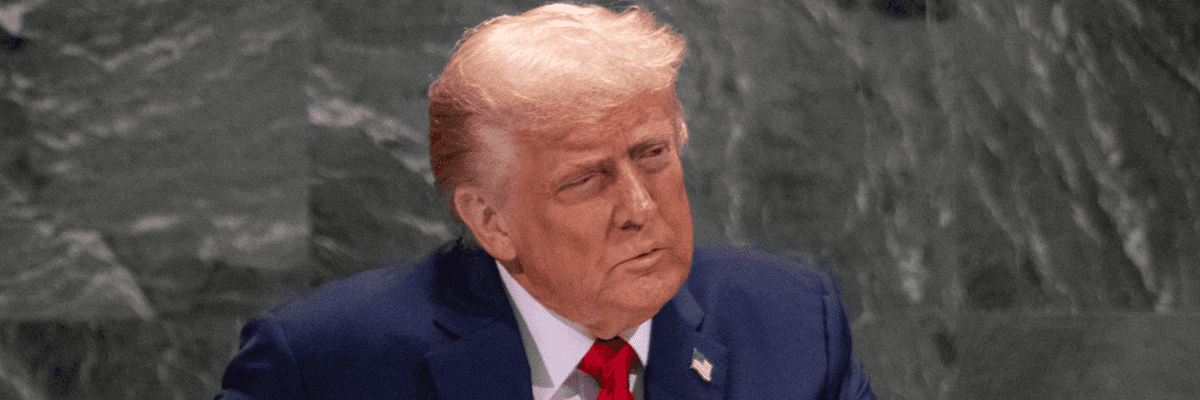
In his UN General Assembly speech this week, Trump told the world that he is in the process of deciding whether to “annihilate” Iran and “send them to hell,” implying that he might use nuclear weapons. He has to be convinced that this is totally unacceptable—before he does something even more crazy than usual!
In a highly aggressive 40-minute speech to the United Nations General Assembly on September 22, President Donald Trump once again issued ominous threats to Iran, saying: “I have a very big decision to make. Will a deal be made with Iran that lets them rebuild and create a far greater country than it ever was before, maybe one of the greatest in the Middle East or even the world? Or do I annihilate the Islamic Republic and do it quickly, never giving them a chance to kill or destroy people or countries again? Do I drive them into hell with no chance of survival and no hope of future greatness or generations?”
He implied that his “very big decision” would come after the midterms, suggesting that Iran is waiting to make a deal until then and, if one isn’t forthcoming, then he would choose annihilation.
Several commentators have noted that his extreme rhetoric was all the more shocking in the context of being delivered, as it was, at the world’s foremost international organization for the peaceful settlement of disputes, created in the aftermath of World War II “to save succeeding generations from the scourge of war which twice in our lifetime has brought untold sorrow to mankind.”
Every one of us has an obligation to ensure that we don’t experience such a bleak future, and to totally reject the idea that anyone should be able to decide to “destroy a civilization” or “annihilate” a people and a culture.
Indeed, all states that become members of the UN agree to resolve their disputes peacefully and to refrain from the threat or use of force against one another, as an obligation of membership—an agreement that the US is currently violating.
Although some news outlets lamented the tone of Trump’s speech and fact-checked it (finding the usual errors), few have explicitly pointed out his not-so-veiled threat to use nuclear weapons. Most have simply ignored it, and a few have even seemed to excuse it, suggesting that it was simply a “negotiating ploy.”
But this threat is similar to others he has made over the last seven months of the war, at moments of extreme personal frustration. On Easter morning, for example, he wrote on his social media account, “Open the F***in’ Strait, you crazy bastards, or you’ll be living in Hell—JUST WATCH! Praise be to Allah.”
A couple of days later, he warned: “A whole civilization will die tonight never to be brought back again. I don't want that to happen, but it probably will… We will find out tonight, one of the most important moments in the long and complex history of the World.” He has also threatened on several occasions to “bomb Iran back to the Stone Ages.”
I have previously written about the extreme danger of the president of the United States having “sole authority” to launch nuclear weapons and the ease with which he can do so. As William Perry, former secretary of defense under Clinton, has written, “For President Trump, starting nuclear war is about as easy as sending a tweet.”
This is especially concerning given his mental state. On April 30, a group of 36 senior mental health professionals, experienced in the diagnosis of cognitive impairment and the evaluation of dangerousness, issued an update to their earlier 2024 report, concluding (after citing the reasons):
It is our professional opinion that the behaviors of Donald Trump, tragically, are neither momentary lapses nor political theater. It is our professional opinion that they reflect a rapidly worsening, reality-untethered, increasingly dangerous decline… For the reasons cited above, emphasizing that he presents a clear and present danger to our country and to the world, it is our expert opinion that Donald J. Trump is mentally unfit to be the president of the United States and that steps to remove him from office must be undertaken with the greatest urgency.
Although the use of nuclear weapons is a considered to be a taboo, Trump has previously broken international taboos (seemingly without even knowing they existed), such as the taboo against political assassination, which he violated on February 28, when Israel and the US attacked Iran, assassinating its supreme leader, Ayatollah Ali Khameni, four of his family members, and a number of other senior Iranian leaders.
Most ghastly of all is what would happen if Trump were to use his “sole authority” to launch nuclear weapons against a country of 90 million people. The horrors of Hiroshima and Nagasaki—already overwhelming in terms of human tragedy—would be unleashed exponentially against the population of Iran, with whom Trump has previously claimed to empathize.
Because of the dramatically increased power of today’s nuclear weapons and their sheer numbers, the results could be more monstrous than any war crime in human history. Even the use of tactical nuclear weapons would be appalling beyond comprehension, and the use of a full-fledged nuclear attack that would “annihilate” the country would, without doubt, bring about one of the darkest periods in world history. The death, destruction, and suffering would be beyond parallel.
It would also make Trump the worst war criminal in history, instantly convert the US into a state pariah, be a terrible blight on humanity, and lead to many unforeseen consequences.
One playbook of unforeseen consequences is that Russian President Vladimir Putin could follow suit in Ukraine (with equally horrific effects). NATO might then feel that it would have to respond in kind, and the resulting escalation could lead to World War III and nuclear Armageddon.
Even if there were no further iterations (which is unlikely), the results could lead to a nuclear winter, where smoke and soot from Iran’s burning cities and other infrastructure would loft into the upper atmosphere, blocking sunlight, darkening the sky, and chilling the Earth, creating massive crop failures and famine. Studies have shown that even a “limited” war could cause a nuclear winter that would (depending on the size of the attack) cause untold billions around the world to die of starvation.
It is no wonder that everyone wants to pretend that Trump’s threats weren’t really what they seemed and probably wouldn’t be acted upon because Trump would live up to his TACO (“Trump Always Chickens Out”) reputation.
But one of the very important, hard-learned lessons of international relations is that, when a leader makes a threat against another state, it should be taken with deadly seriousness. This has sometimes been overlooked, as, for example, in 1990, when Saddam Hussein amassed troops on his border with Kuwait and threatened to invade. No one took it seriously—until Iraq followed through, leading to the first Gulf War.
Much as we would all like to forget these terrible threats, we can’t. The leaders of the world must clearly communicate to Trump the likely consequences of his actions and the utter unacceptability of this path. Members of Congress must do the same, and we, the public, must collectively urge them to do so.
Legal means of removing Trump from office should also be undertaken, such as the 25th Amendment; Rep. Jamie Raskin’s (D-Md.) proposed nonpartisan “Commission on Presidential Capacity to Discharge the Powers and Duties of Office”; or impeachment. All of this is much more likely if the Democrats win the House and the Senate in the upcoming midterms, in which we, the public, can also make a significant difference—by voting accordingly.
Every one of us has an obligation to ensure that we don’t experience such a bleak future, and to totally reject the idea that anyone should be able to decide to “destroy a civilization” or “annihilate” a people and a culture (regardless of how we judge their behavior or our fears of their future actions). This is totally against international law, including international humanitarian and human rights law. Such a decision should NOT be made under any circumstances, especially by one individual, who is most likely cognitively impaired; definitely feeling frustrated and aggrieved; and who doesn’t have any understanding of the consequences of the extreme threats he is making—but who does have the capacity to carry out a nuclear launch at any time.
Dear Common Dreams reader, It’s been nearly 30 years since I co-founded Common Dreams with my late wife, Lina Newhouser. We had the radical notion that journalism should serve the public good, not corporate profits. It was clear to us from the outset what it would take to build such a project. No paid advertisements. No corporate sponsors. No millionaire publisher telling us what to think or do. Many people said we wouldn't last a year, but we proved those doubters wrong. Together with a tremendous team of journalists and dedicated staff, we built an independent media outlet free from the constraints of profits and corporate control. Our mission has always been simple: To inform. To inspire. To ignite change for the common good. Building Common Dreams was not easy. Our survival was never guaranteed. When you take on the most powerful forces—Wall Street greed, fossil fuel industry destruction, Big Tech lobbyists, and uber-rich oligarchs who have spent billions upon billions rigging the economy and democracy in their favor—the only bulwark you have is supporters who believe in your work. But here’s the urgent message from me today. It's never been this bad out there. And it's never been this hard to keep us going. At the very moment Common Dreams is most needed, the threats we face are intensifying. We need your support now more than ever. We don't accept corporate advertising and never will. We don't have a paywall because we don't think people should be blocked from critical news based on their ability to pay. Everything we do is funded by the donations of readers like you. When everyone does the little they can afford, we are strong. But if that support retreats or dries up, so do we. Will you donate now to make sure Common Dreams not only survives but thrives? —Craig Brown, Co-founder |
In a highly aggressive 40-minute speech to the United Nations General Assembly on September 22, President Donald Trump once again issued ominous threats to Iran, saying: “I have a very big decision to make. Will a deal be made with Iran that lets them rebuild and create a far greater country than it ever was before, maybe one of the greatest in the Middle East or even the world? Or do I annihilate the Islamic Republic and do it quickly, never giving them a chance to kill or destroy people or countries again? Do I drive them into hell with no chance of survival and no hope of future greatness or generations?”
He implied that his “very big decision” would come after the midterms, suggesting that Iran is waiting to make a deal until then and, if one isn’t forthcoming, then he would choose annihilation.
Several commentators have noted that his extreme rhetoric was all the more shocking in the context of being delivered, as it was, at the world’s foremost international organization for the peaceful settlement of disputes, created in the aftermath of World War II “to save succeeding generations from the scourge of war which twice in our lifetime has brought untold sorrow to mankind.”
Every one of us has an obligation to ensure that we don’t experience such a bleak future, and to totally reject the idea that anyone should be able to decide to “destroy a civilization” or “annihilate” a people and a culture.
Indeed, all states that become members of the UN agree to resolve their disputes peacefully and to refrain from the threat or use of force against one another, as an obligation of membership—an agreement that the US is currently violating.
Although some news outlets lamented the tone of Trump’s speech and fact-checked it (finding the usual errors), few have explicitly pointed out his not-so-veiled threat to use nuclear weapons. Most have simply ignored it, and a few have even seemed to excuse it, suggesting that it was simply a “negotiating ploy.”
But this threat is similar to others he has made over the last seven months of the war, at moments of extreme personal frustration. On Easter morning, for example, he wrote on his social media account, “Open the F***in’ Strait, you crazy bastards, or you’ll be living in Hell—JUST WATCH! Praise be to Allah.”
A couple of days later, he warned: “A whole civilization will die tonight never to be brought back again. I don't want that to happen, but it probably will… We will find out tonight, one of the most important moments in the long and complex history of the World.” He has also threatened on several occasions to “bomb Iran back to the Stone Ages.”
I have previously written about the extreme danger of the president of the United States having “sole authority” to launch nuclear weapons and the ease with which he can do so. As William Perry, former secretary of defense under Clinton, has written, “For President Trump, starting nuclear war is about as easy as sending a tweet.”
This is especially concerning given his mental state. On April 30, a group of 36 senior mental health professionals, experienced in the diagnosis of cognitive impairment and the evaluation of dangerousness, issued an update to their earlier 2024 report, concluding (after citing the reasons):
It is our professional opinion that the behaviors of Donald Trump, tragically, are neither momentary lapses nor political theater. It is our professional opinion that they reflect a rapidly worsening, reality-untethered, increasingly dangerous decline… For the reasons cited above, emphasizing that he presents a clear and present danger to our country and to the world, it is our expert opinion that Donald J. Trump is mentally unfit to be the president of the United States and that steps to remove him from office must be undertaken with the greatest urgency.
Although the use of nuclear weapons is a considered to be a taboo, Trump has previously broken international taboos (seemingly without even knowing they existed), such as the taboo against political assassination, which he violated on February 28, when Israel and the US attacked Iran, assassinating its supreme leader, Ayatollah Ali Khameni, four of his family members, and a number of other senior Iranian leaders.
Most ghastly of all is what would happen if Trump were to use his “sole authority” to launch nuclear weapons against a country of 90 million people. The horrors of Hiroshima and Nagasaki—already overwhelming in terms of human tragedy—would be unleashed exponentially against the population of Iran, with whom Trump has previously claimed to empathize.
Because of the dramatically increased power of today’s nuclear weapons and their sheer numbers, the results could be more monstrous than any war crime in human history. Even the use of tactical nuclear weapons would be appalling beyond comprehension, and the use of a full-fledged nuclear attack that would “annihilate” the country would, without doubt, bring about one of the darkest periods in world history. The death, destruction, and suffering would be beyond parallel.
It would also make Trump the worst war criminal in history, instantly convert the US into a state pariah, be a terrible blight on humanity, and lead to many unforeseen consequences.
One playbook of unforeseen consequences is that Russian President Vladimir Putin could follow suit in Ukraine (with equally horrific effects). NATO might then feel that it would have to respond in kind, and the resulting escalation could lead to World War III and nuclear Armageddon.
Even if there were no further iterations (which is unlikely), the results could lead to a nuclear winter, where smoke and soot from Iran’s burning cities and other infrastructure would loft into the upper atmosphere, blocking sunlight, darkening the sky, and chilling the Earth, creating massive crop failures and famine. Studies have shown that even a “limited” war could cause a nuclear winter that would (depending on the size of the attack) cause untold billions around the world to die of starvation.
It is no wonder that everyone wants to pretend that Trump’s threats weren’t really what they seemed and probably wouldn’t be acted upon because Trump would live up to his TACO (“Trump Always Chickens Out”) reputation.
But one of the very important, hard-learned lessons of international relations is that, when a leader makes a threat against another state, it should be taken with deadly seriousness. This has sometimes been overlooked, as, for example, in 1990, when Saddam Hussein amassed troops on his border with Kuwait and threatened to invade. No one took it seriously—until Iraq followed through, leading to the first Gulf War.
Much as we would all like to forget these terrible threats, we can’t. The leaders of the world must clearly communicate to Trump the likely consequences of his actions and the utter unacceptability of this path. Members of Congress must do the same, and we, the public, must collectively urge them to do so.
Legal means of removing Trump from office should also be undertaken, such as the 25th Amendment; Rep. Jamie Raskin’s (D-Md.) proposed nonpartisan “Commission on Presidential Capacity to Discharge the Powers and Duties of Office”; or impeachment. All of this is much more likely if the Democrats win the House and the Senate in the upcoming midterms, in which we, the public, can also make a significant difference—by voting accordingly.
Every one of us has an obligation to ensure that we don’t experience such a bleak future, and to totally reject the idea that anyone should be able to decide to “destroy a civilization” or “annihilate” a people and a culture (regardless of how we judge their behavior or our fears of their future actions). This is totally against international law, including international humanitarian and human rights law. Such a decision should NOT be made under any circumstances, especially by one individual, who is most likely cognitively impaired; definitely feeling frustrated and aggrieved; and who doesn’t have any understanding of the consequences of the extreme threats he is making—but who does have the capacity to carry out a nuclear launch at any time.
In a highly aggressive 40-minute speech to the United Nations General Assembly on September 22, President Donald Trump once again issued ominous threats to Iran, saying: “I have a very big decision to make. Will a deal be made with Iran that lets them rebuild and create a far greater country than it ever was before, maybe one of the greatest in the Middle East or even the world? Or do I annihilate the Islamic Republic and do it quickly, never giving them a chance to kill or destroy people or countries again? Do I drive them into hell with no chance of survival and no hope of future greatness or generations?”
He implied that his “very big decision” would come after the midterms, suggesting that Iran is waiting to make a deal until then and, if one isn’t forthcoming, then he would choose annihilation.
Several commentators have noted that his extreme rhetoric was all the more shocking in the context of being delivered, as it was, at the world’s foremost international organization for the peaceful settlement of disputes, created in the aftermath of World War II “to save succeeding generations from the scourge of war which twice in our lifetime has brought untold sorrow to mankind.”
Every one of us has an obligation to ensure that we don’t experience such a bleak future, and to totally reject the idea that anyone should be able to decide to “destroy a civilization” or “annihilate” a people and a culture.
Indeed, all states that become members of the UN agree to resolve their disputes peacefully and to refrain from the threat or use of force against one another, as an obligation of membership—an agreement that the US is currently violating.
Although some news outlets lamented the tone of Trump’s speech and fact-checked it (finding the usual errors), few have explicitly pointed out his not-so-veiled threat to use nuclear weapons. Most have simply ignored it, and a few have even seemed to excuse it, suggesting that it was simply a “negotiating ploy.”
But this threat is similar to others he has made over the last seven months of the war, at moments of extreme personal frustration. On Easter morning, for example, he wrote on his social media account, “Open the F***in’ Strait, you crazy bastards, or you’ll be living in Hell—JUST WATCH! Praise be to Allah.”
A couple of days later, he warned: “A whole civilization will die tonight never to be brought back again. I don't want that to happen, but it probably will… We will find out tonight, one of the most important moments in the long and complex history of the World.” He has also threatened on several occasions to “bomb Iran back to the Stone Ages.”
I have previously written about the extreme danger of the president of the United States having “sole authority” to launch nuclear weapons and the ease with which he can do so. As William Perry, former secretary of defense under Clinton, has written, “For President Trump, starting nuclear war is about as easy as sending a tweet.”
This is especially concerning given his mental state. On April 30, a group of 36 senior mental health professionals, experienced in the diagnosis of cognitive impairment and the evaluation of dangerousness, issued an update to their earlier 2024 report, concluding (after citing the reasons):
It is our professional opinion that the behaviors of Donald Trump, tragically, are neither momentary lapses nor political theater. It is our professional opinion that they reflect a rapidly worsening, reality-untethered, increasingly dangerous decline… For the reasons cited above, emphasizing that he presents a clear and present danger to our country and to the world, it is our expert opinion that Donald J. Trump is mentally unfit to be the president of the United States and that steps to remove him from office must be undertaken with the greatest urgency.
Although the use of nuclear weapons is a considered to be a taboo, Trump has previously broken international taboos (seemingly without even knowing they existed), such as the taboo against political assassination, which he violated on February 28, when Israel and the US attacked Iran, assassinating its supreme leader, Ayatollah Ali Khameni, four of his family members, and a number of other senior Iranian leaders.
Most ghastly of all is what would happen if Trump were to use his “sole authority” to launch nuclear weapons against a country of 90 million people. The horrors of Hiroshima and Nagasaki—already overwhelming in terms of human tragedy—would be unleashed exponentially against the population of Iran, with whom Trump has previously claimed to empathize.
Because of the dramatically increased power of today’s nuclear weapons and their sheer numbers, the results could be more monstrous than any war crime in human history. Even the use of tactical nuclear weapons would be appalling beyond comprehension, and the use of a full-fledged nuclear attack that would “annihilate” the country would, without doubt, bring about one of the darkest periods in world history. The death, destruction, and suffering would be beyond parallel.
It would also make Trump the worst war criminal in history, instantly convert the US into a state pariah, be a terrible blight on humanity, and lead to many unforeseen consequences.
One playbook of unforeseen consequences is that Russian President Vladimir Putin could follow suit in Ukraine (with equally horrific effects). NATO might then feel that it would have to respond in kind, and the resulting escalation could lead to World War III and nuclear Armageddon.
Even if there were no further iterations (which is unlikely), the results could lead to a nuclear winter, where smoke and soot from Iran’s burning cities and other infrastructure would loft into the upper atmosphere, blocking sunlight, darkening the sky, and chilling the Earth, creating massive crop failures and famine. Studies have shown that even a “limited” war could cause a nuclear winter that would (depending on the size of the attack) cause untold billions around the world to die of starvation.
It is no wonder that everyone wants to pretend that Trump’s threats weren’t really what they seemed and probably wouldn’t be acted upon because Trump would live up to his TACO (“Trump Always Chickens Out”) reputation.
But one of the very important, hard-learned lessons of international relations is that, when a leader makes a threat against another state, it should be taken with deadly seriousness. This has sometimes been overlooked, as, for example, in 1990, when Saddam Hussein amassed troops on his border with Kuwait and threatened to invade. No one took it seriously—until Iraq followed through, leading to the first Gulf War.
Much as we would all like to forget these terrible threats, we can’t. The leaders of the world must clearly communicate to Trump the likely consequences of his actions and the utter unacceptability of this path. Members of Congress must do the same, and we, the public, must collectively urge them to do so.
Legal means of removing Trump from office should also be undertaken, such as the 25th Amendment; Rep. Jamie Raskin’s (D-Md.) proposed nonpartisan “Commission on Presidential Capacity to Discharge the Powers and Duties of Office”; or impeachment. All of this is much more likely if the Democrats win the House and the Senate in the upcoming midterms, in which we, the public, can also make a significant difference—by voting accordingly.
Every one of us has an obligation to ensure that we don’t experience such a bleak future, and to totally reject the idea that anyone should be able to decide to “destroy a civilization” or “annihilate” a people and a culture (regardless of how we judge their behavior or our fears of their future actions). This is totally against international law, including international humanitarian and human rights law. Such a decision should NOT be made under any circumstances, especially by one individual, who is most likely cognitively impaired; definitely feeling frustrated and aggrieved; and who doesn’t have any understanding of the consequences of the extreme threats he is making—but who does have the capacity to carry out a nuclear launch at any time.