5
#000000
#FFFFFF
To donate by check, phone, or other method, see our More Ways to Give page.
Daily news & progressive opinion—funded by the people, not the corporations—delivered straight to your inbox.
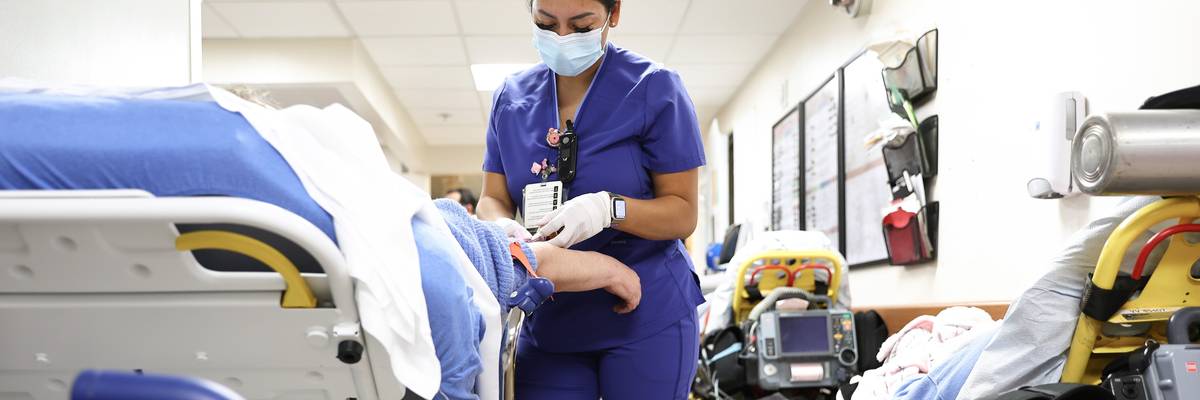
Patients receive care at the Providence St. Mary Medical Center in Apple Valley, California on March 11, 2022.
"Not exactly the cancer cure we were promised," quipped one critic.
Artificial intelligence proponents claim AI will make healthcare more efficient, but an analysis published Wednesday suggests that the burgeoning technology is instead helping hospitals identify more lucrative diagnoses—and is driving nearly $1 billion in additional costs for patients and insurers.
The Blue Cross Blue Shield Association (BCBSA) analysis found that the share of inpatient cases billed as "medically complex" rose from 37% at the beginning of 2023 to 40% by the end of 2025. While that may seem like a small increase, it translated into an estimated $942 million in additional costs for Blue Cross plans over two years, including $653 million attributable to secondary diagnoses that pushed hospital claims into higher-paying categories.
“Critically, what we found is underneath all of that data [was] no change in corresponding care for a more complex patient,” Luke Chalker, BCBSA’s senior vice president of product and data science and a co-author of the analysis, told reporters. “We find no evidence of a corresponding change in care.”
The analysis' findings underscore an intensifying battle between hospitals seeking maximum reimbursement and insurers trying to contain payouts—a conflict increasingly mediated by AI. AI-powered coding systems can scan medical records, doctors' notes, and laboratory results for additional diagnoses that can increase the amount hospitals are paid. Ambient AI systems can also listen to clinician-patient conversations and automatically document them.
While AI can have legitimate benefits—like reducing paperwork and administrative burdens—BCBSA contends that the financial incentives built into the nation's fee-for-service healthcare system can turn those capabilities toward maximizing profits.
"Not exactly the cancer cure we were promised," More Perfect Union quipped on social media.
In one example, the analysis examined secondary diagnoses like anemia following major bowel surgery.
“If patients are truly sicker, we'd expect to see more treatment,” Chalker said. “For example, we're seeing significantly more anemia diagnoses at these hospitals without a corresponding increase in transfusions. The disconnect between diagnoses and treatment suggests that AI is identifying more billable conditions, not sicker patients.”
The analysis' findings echo an earlier BCBSA study of maternity care, which found that some hospitals dramatically increased diagnoses of acute posthemorrhagic anemia, while transfusion rates barely changed. BCBSA estimated that the increase in that single diagnosis alone added $22 million to maternity admission costs in one year.
Progressive healthcare advocates argue that the problem cannot be solved by tweaking the current system. Advocates for a Medicare for All-type system, including US Sen. Bernie Sanders (I-Vt.) and Rep. Pramila Jayapal (D-Wash.), propose replacing the for-profit insurance system with a universal public program.
In August, Sanders cited a Yale study estimating that his Medicare for All legislation could save 114,000 lives each year, while reducing national healthcare spending by more than $1 trillion annually.
“We do not suffer from scarcity in this country; we suffer from greed,” Jayapal said at a July Medicare for All shadow hearing.
"Medicare for All is the path to fix the broken healthcare system that has let corporate interests determine who lives and dies," Jayapal added. "The reality is that Medicare for All is the only solution that guarantees care for everyone in the US, brings down costs for working families, and generates savings for the country.
Dear Common Dreams reader, It’s been nearly 30 years since I co-founded Common Dreams with my late wife, Lina Newhouser. We had the radical notion that journalism should serve the public good, not corporate profits. It was clear to us from the outset what it would take to build such a project. No paid advertisements. No corporate sponsors. No millionaire publisher telling us what to think or do. Many people said we wouldn't last a year, but we proved those doubters wrong. Together with a tremendous team of journalists and dedicated staff, we built an independent media outlet free from the constraints of profits and corporate control. Our mission has always been simple: To inform. To inspire. To ignite change for the common good. Building Common Dreams was not easy. Our survival was never guaranteed. When you take on the most powerful forces—Wall Street greed, fossil fuel industry destruction, Big Tech lobbyists, and uber-rich oligarchs who have spent billions upon billions rigging the economy and democracy in their favor—the only bulwark you have is supporters who believe in your work. But here’s the urgent message from me today. It's never been this bad out there. And it's never been this hard to keep us going. At the very moment Common Dreams is most needed, the threats we face are intensifying. We need your support now more than ever. We don't accept corporate advertising and never will. We don't have a paywall because we don't think people should be blocked from critical news based on their ability to pay. Everything we do is funded by the donations of readers like you. When everyone does the little they can afford, we are strong. But if that support retreats or dries up, so do we. Will you donate now to make sure Common Dreams not only survives but thrives? —Craig Brown, Co-founder |
Artificial intelligence proponents claim AI will make healthcare more efficient, but an analysis published Wednesday suggests that the burgeoning technology is instead helping hospitals identify more lucrative diagnoses—and is driving nearly $1 billion in additional costs for patients and insurers.
The Blue Cross Blue Shield Association (BCBSA) analysis found that the share of inpatient cases billed as "medically complex" rose from 37% at the beginning of 2023 to 40% by the end of 2025. While that may seem like a small increase, it translated into an estimated $942 million in additional costs for Blue Cross plans over two years, including $653 million attributable to secondary diagnoses that pushed hospital claims into higher-paying categories.
“Critically, what we found is underneath all of that data [was] no change in corresponding care for a more complex patient,” Luke Chalker, BCBSA’s senior vice president of product and data science and a co-author of the analysis, told reporters. “We find no evidence of a corresponding change in care.”
The analysis' findings underscore an intensifying battle between hospitals seeking maximum reimbursement and insurers trying to contain payouts—a conflict increasingly mediated by AI. AI-powered coding systems can scan medical records, doctors' notes, and laboratory results for additional diagnoses that can increase the amount hospitals are paid. Ambient AI systems can also listen to clinician-patient conversations and automatically document them.
While AI can have legitimate benefits—like reducing paperwork and administrative burdens—BCBSA contends that the financial incentives built into the nation's fee-for-service healthcare system can turn those capabilities toward maximizing profits.
"Not exactly the cancer cure we were promised," More Perfect Union quipped on social media.
In one example, the analysis examined secondary diagnoses like anemia following major bowel surgery.
“If patients are truly sicker, we'd expect to see more treatment,” Chalker said. “For example, we're seeing significantly more anemia diagnoses at these hospitals without a corresponding increase in transfusions. The disconnect between diagnoses and treatment suggests that AI is identifying more billable conditions, not sicker patients.”
The analysis' findings echo an earlier BCBSA study of maternity care, which found that some hospitals dramatically increased diagnoses of acute posthemorrhagic anemia, while transfusion rates barely changed. BCBSA estimated that the increase in that single diagnosis alone added $22 million to maternity admission costs in one year.
Progressive healthcare advocates argue that the problem cannot be solved by tweaking the current system. Advocates for a Medicare for All-type system, including US Sen. Bernie Sanders (I-Vt.) and Rep. Pramila Jayapal (D-Wash.), propose replacing the for-profit insurance system with a universal public program.
In August, Sanders cited a Yale study estimating that his Medicare for All legislation could save 114,000 lives each year, while reducing national healthcare spending by more than $1 trillion annually.
“We do not suffer from scarcity in this country; we suffer from greed,” Jayapal said at a July Medicare for All shadow hearing.
"Medicare for All is the path to fix the broken healthcare system that has let corporate interests determine who lives and dies," Jayapal added. "The reality is that Medicare for All is the only solution that guarantees care for everyone in the US, brings down costs for working families, and generates savings for the country.
Artificial intelligence proponents claim AI will make healthcare more efficient, but an analysis published Wednesday suggests that the burgeoning technology is instead helping hospitals identify more lucrative diagnoses—and is driving nearly $1 billion in additional costs for patients and insurers.
The Blue Cross Blue Shield Association (BCBSA) analysis found that the share of inpatient cases billed as "medically complex" rose from 37% at the beginning of 2023 to 40% by the end of 2025. While that may seem like a small increase, it translated into an estimated $942 million in additional costs for Blue Cross plans over two years, including $653 million attributable to secondary diagnoses that pushed hospital claims into higher-paying categories.
“Critically, what we found is underneath all of that data [was] no change in corresponding care for a more complex patient,” Luke Chalker, BCBSA’s senior vice president of product and data science and a co-author of the analysis, told reporters. “We find no evidence of a corresponding change in care.”
The analysis' findings underscore an intensifying battle between hospitals seeking maximum reimbursement and insurers trying to contain payouts—a conflict increasingly mediated by AI. AI-powered coding systems can scan medical records, doctors' notes, and laboratory results for additional diagnoses that can increase the amount hospitals are paid. Ambient AI systems can also listen to clinician-patient conversations and automatically document them.
While AI can have legitimate benefits—like reducing paperwork and administrative burdens—BCBSA contends that the financial incentives built into the nation's fee-for-service healthcare system can turn those capabilities toward maximizing profits.
"Not exactly the cancer cure we were promised," More Perfect Union quipped on social media.
In one example, the analysis examined secondary diagnoses like anemia following major bowel surgery.
“If patients are truly sicker, we'd expect to see more treatment,” Chalker said. “For example, we're seeing significantly more anemia diagnoses at these hospitals without a corresponding increase in transfusions. The disconnect between diagnoses and treatment suggests that AI is identifying more billable conditions, not sicker patients.”
The analysis' findings echo an earlier BCBSA study of maternity care, which found that some hospitals dramatically increased diagnoses of acute posthemorrhagic anemia, while transfusion rates barely changed. BCBSA estimated that the increase in that single diagnosis alone added $22 million to maternity admission costs in one year.
Progressive healthcare advocates argue that the problem cannot be solved by tweaking the current system. Advocates for a Medicare for All-type system, including US Sen. Bernie Sanders (I-Vt.) and Rep. Pramila Jayapal (D-Wash.), propose replacing the for-profit insurance system with a universal public program.
In August, Sanders cited a Yale study estimating that his Medicare for All legislation could save 114,000 lives each year, while reducing national healthcare spending by more than $1 trillion annually.
“We do not suffer from scarcity in this country; we suffer from greed,” Jayapal said at a July Medicare for All shadow hearing.
"Medicare for All is the path to fix the broken healthcare system that has let corporate interests determine who lives and dies," Jayapal added. "The reality is that Medicare for All is the only solution that guarantees care for everyone in the US, brings down costs for working families, and generates savings for the country.