SUBSCRIBE TO OUR FREE NEWSLETTER
Daily news & progressive opinion—funded by the people, not the corporations—delivered straight to your inbox.
5
#000000
#FFFFFF
To donate by check, phone, or other method, see our More Ways to Give page.

Daily news & progressive opinion—funded by the people, not the corporations—delivered straight to your inbox.
In Latin American, the neoliberal agenda and how it has been implemented in ways that are not entirely democratic has a structure that can be painfully familiar.
Since December 2022, Peruvians have been on the streets demanding early elections and the resignation of President Dina Boluarte.
Yet in Peru elections are more than a desired constitutional process—they are about resisting exploitation and neocolonialism that are threatening to intensify their grip on the country's marginalized communities.
The protests began last December when Peru's first leftist president, Pedro Castillo, was removed from office after dissolving Congress and declaring a state of emergency. It was the third attempt by Congress to impeach the president—this time successful—after which Castillo was arrested under charges of rebellion.
The state violence unleashed on its people did not seem to spare anyone and targeted the most vulnerable populations.
Then the country's vice president, Boluarte, was sworn in and has refused to hold early elections to this day.
First, the protests broke out in Peru's southern areas where its indigenous Quechua and Aymara communities live; these are the poorer areas that voted for Castillo, a teacher and union leader and a son of a peasant farmer himself.
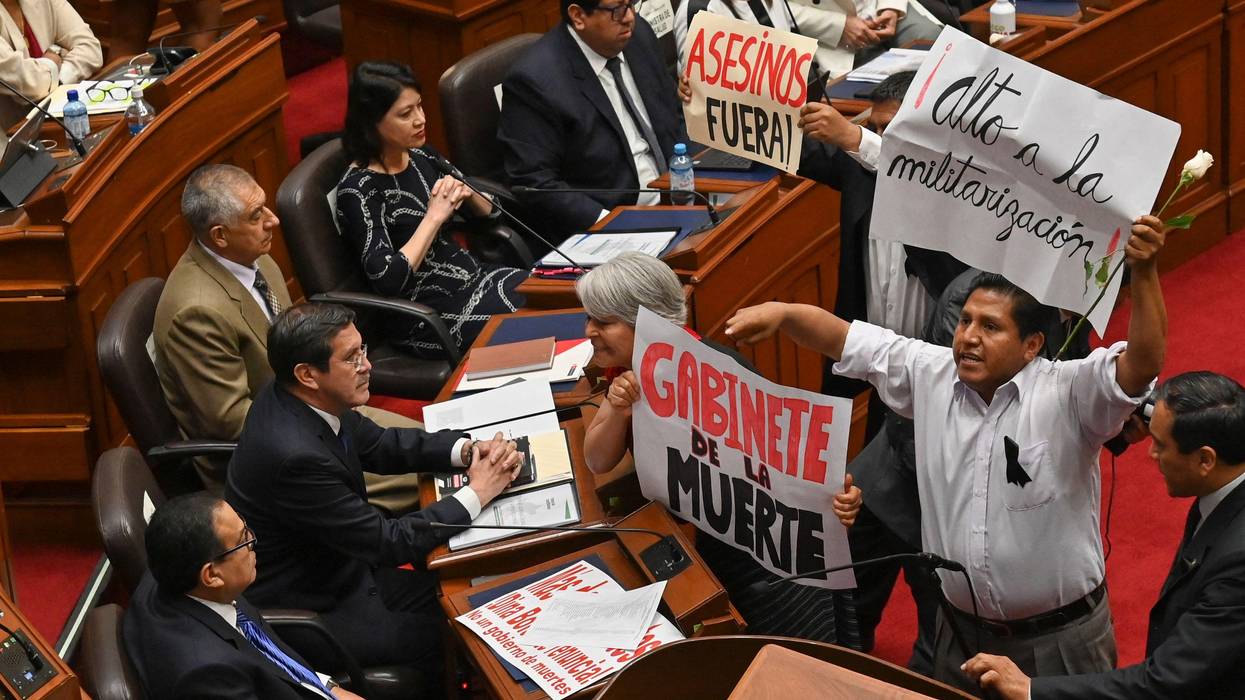
The protests then spread to other areas of the country including the capital, and it was becoming clearer that the dissatisfaction with the government was as widespread: In February, the disapproval rating of Boluarte was 77%, and the disapproval rating of the Peruvian Congress was 90%.
How the government chose to respond was not to call for new elections, which is still one of the demands of the protesters. Instead, it has been to employ violence and deem the ones protesting "terrorists."
The state violence unleashed on its people did not seem to spare anyone and targeted the most vulnerable populations. In May, Amnesty International released its report documenting cases of 49 civilians—including children and youth—killed by Peruvian forces in the country's poorer areas, and called them extrajudicial executions.
You might have heard of one such executions: the Juliaca massacre, a brutal and deadly assault on Peru's predominantly indigenous protesters, where 18 civilians were killed.
The demands of the protesters have not been just about Castillo, new elections, and replacing the county's Constitution (the latest one was written in 1993, after the then-President Alberto Fujimori’s coup in 1992). As Nicolás Lynch explains in his article at NACLA, the protesters' demands stem from decades of dissatisfaction:
The popular rage can be explained by three structural issues: the plundering of our natural resources, which has only deepened in the last 30 years; the exploitation of workers, evident in 80% of the economically active population with informal employment; and the resurgence of oligarchic abuse expressed in particular through rampant racism, especially now when the protesters are mostly Quechua or Aymara. It is no coincidence that the movement is concentrated in regions with gas deposits and in the mining corridor—from Huancavelica to Puno—which have been especially impacted by the neoliberal attack.
Peru's mining corridor is rich in lithium that, once exploited, would join what is called the Lithium Triangle, which is comprised of Chile, Bolivia, and Argentina. It is concentrated in the country's southern region that is more rural, Indigenous, and poor.
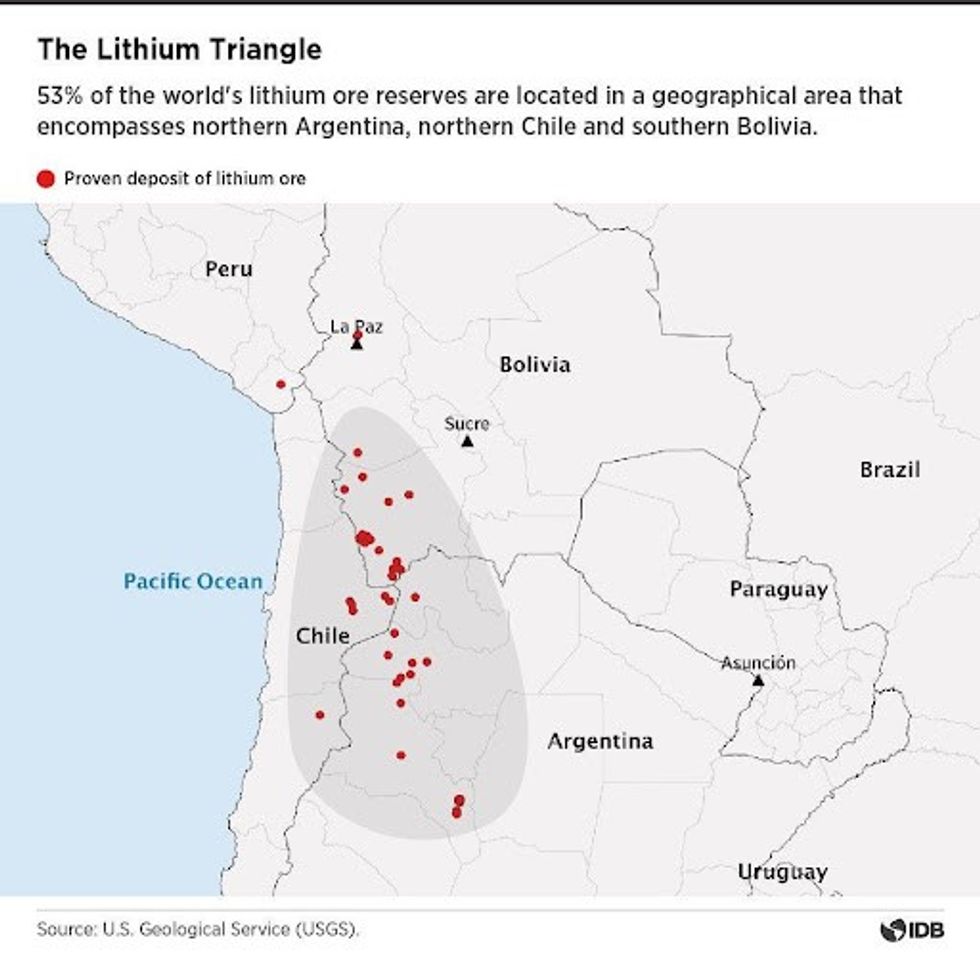
Initially, as part of his presidential campaign, Castillo had made promises to nationalize Peru's lithium resources (which the country has not started exploring yet) but in a meeting with representatives of the mining industry in October 2022 supposedly reversed his stance.
What policies Castillo would have pursued we cannot know now. Yet what was not difficult to predict knowing the extractivist history of the continent and right-wing parliamentary coup precedents in neighboring countries (let me come back to that in a moment), is what followed next.
In April, Peru's Minister of Energy and Mines, Óscar Vera, announced that the government would
Set to grant permits to a Canadian mining subsidiary for lithium exploration in the southern region of Puno, near the border with Bolivia.
Vera also reported that the authorities were working to reduce license approval time for copper mining projects from about two years to about six months.
In May, exploration rights were sold to Canadian Lithium, a subsidiary of American Lithium, which already operates another project in Peru: the Macusani uranium project in the same southern region of the country.
Soon after, in June, Boluarte's government invited over 1,000 U.S. soldiers to come to Peru and train its military and national police.
As TeleSur reported,
The U.S. military will arrive in various groups, between June 1 and December 31. The largest group will be made up of 970 members of the U.S. Air Force, Space Force, and Special Forces.
Besides carrying their personal regulation weapons, they will arrive in Peru with planes, trucks, and rapid response boats to take part in the "Resolute Sentinel 2023" maneuver.
Every country is different and has its own political forces; Peru is not Brazil, Colombia, or Chile. Yet the neoliberal agenda and how we have seen it being implemented, in ways that are not entirely democratic, in Latin America has a structure that can be painfully familiar. It would be completely ahistorical to disregard the common history of right-wing coups installed by CIA-backed militaries in the second half of the 20th century—but we do not have to go that far back in history.
Here I want to say what the levers former President Castillo was pulling to avoid impeachment should be assessed by legal scholars. If an abuse of power is real, it should be condemned no matter who the person in question in this case is. At the same time, the reasons behind Castillo's impeachment, the arrest of the president, and, perhaps most importantly, the actions of Congress and Boluarte following the impeachment, have to be inspected through the same lens of democratic practices.
It is almost impossible not to draw parallels to what happened to Dilma Rousseff in Brazil in 2016 when she was impeached by the Brazilian Congress although no crime calling for her impeachment was committed, as concluded by the Senate itself, making it clear it was a politically motivated move. What followed was a period of neoliberal reforms and a downward spiral of weakening Brazilian democracy from within.
An impeachment of Castillo did not have to mean the same for Peru.
But when we look at police brutality, the refusal to call for early elections, the beginning of the country's privatization of its lithium resources, and calling for foreign military support, it looks like this is where the country is heading.
At this point, we can't say that the only crime Castillo committed was daring to challenge the powerful and be the voice of the historically marginalized. For that, a due legal process should be set in place; a impartial investigation and a fair trial should follow (something we now know did not happen in Brazil to Luis Inácio Lula da Silva in 2017).
Yet what the current government is doing surely looks criminal.
And it is not being seen as more acceptable by the Peruvians themselves: As of August 2023, the disapproval rating of Congress is at 90% while approval for Boluarte is at 11%.
So where could changes begin?
Professor César Landa, a legal scholar, says a new Constitution, something the protesters have been demanding, could be a good start:
Channeling the historical demands of citizens requires a constituent process that could create dialogue and restore social consensus based on the necessity of incorporating new subjects, the protection of new rights, and better control of the traditional public and private powers.
The alternative is grim. It is more state violence needed to suppress dissent, prolonged periods of suspension of democratic practices, and continuous exploitation without which neocolonialism cannot operate.
In a continent whose riches have been violently robbed from it for the last five centuries and whose raw materials continue to be exported to make profits for foreign corporations, this is all extremely concerning.
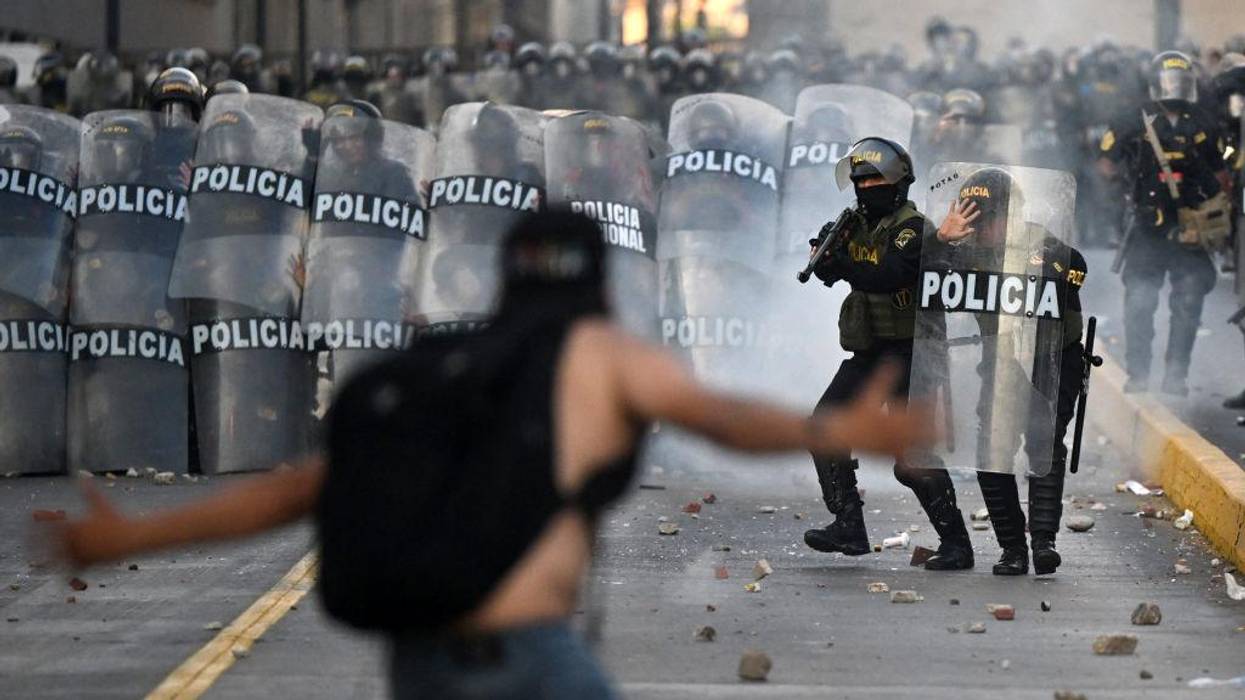
Autocracy threatens to take hold if a more stable democratic renewal is not found.
On 25 January, roughly six weeks after being sworn in following her predecessor’s removal, Peruvian president Dina Boluarte finally recognized that elections were the only way out of political crisis. Elections were rescheduled for April 2024, much earlier than the end of the presidential term she’s been tasked with completing, but not soon enough for thousands who’ve taken to the streets demanding her immediate resignation.
Boluarte’s call for a ‘national truce’ has been met with further protests. Their repression has led to major bloodshed: the Ombudsman’s office has reported close to 60 dead – mostly civilians killed by security forces – and 1,500 injured.
What happened and what it means
It’s unusually easy to impeach Peru’s presidents: a legislative majority can vote to remove them on vaguely defined grounds.
Pedro Castillo, elected president in July 2021, had already survived two removal attempts and faced a third. On 7 December he made a pre-emptive strike: he dissolved Congress and announced a restructuring of the judiciary, as former president Alberto Fujimori had done decades earlier in the ‘self-coup’ that started several years of authoritarian rule.
Castillo announced the establishment of an exceptional emergency government where he would rule by decree and promised to hold congressional elections soon. The new Congress, he said, would have the power to draft a new constitution.
But unlike Fujimori, Castillo enjoyed meager support, and within hours Congress voted to remove him from office. He was arrested and remains in pretrial detention on rebellion charges. Vice-president Boluarte was immediately sworn in.
In the whirlwind that followed there was much talk that a coup, or a coup attempt, had taken place – but opinions differed radically as to who was the victim and who was the perpetrator.
The prevailing view was that Castillo’s dissolution of Congress was an attempt at a presidential coup. But others saw Castillo’s removal as a coup. Debate has been deeply polarised on ideological grounds, making clear that in Peru and Latin America, a principled rather than partisan defense of democracy is still lacking.
Permanent crisis
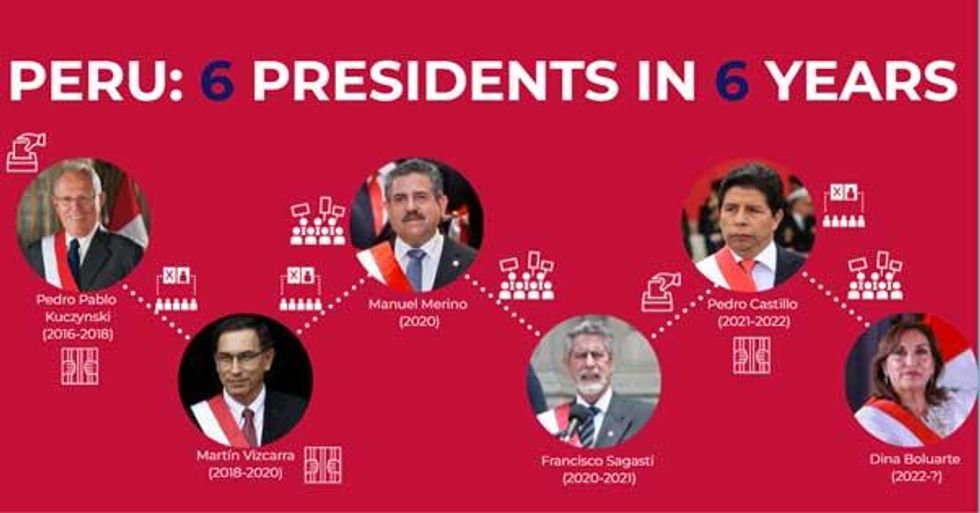
Recent events are part of a bigger political crisis that has seen six presidents in six years. In 2021, a polarising presidential campaign was followed by an extremely fragmented vote. The runoff election yielded an unexpected winner: a leftist outsider of humble origins, Castillo, defeated the right-wing heiress of the Fujimori dynasty by under one percentage point. Keiko Fujimori initially rejected the results and baselessly claimed fraud. Castillo’s presidency was born fragile. It was an unstable government, with a high rotation of ministers and fluctuating congressional support.
Although Castillo had promised to break the cycle of corruption, his government, himself, and close associates soon became the target of corruption allegations coming not just from the opposition but also from state watchdog institutions. Castillo’s response was to attack the prosecutor and ask the Organization of American States (OAS) to apply its Democratic Charter to preserve Peruvian democracy supposedly under attack. The OAS sent a mission that ended with a call for dialogue. Only two weeks later, Castillo embarked on his short-lived coup adventure.
Protests and repression
According to Peru’s Constitution, Boluarte should complete Castillo’s term. But observers generally agree there’s no way she can stay in office until 2024, never mind 2026, given the rejection she faces from protesters and political parties in Congress.
A wave of protests demanding her resignation rose as soon as she was sworn in, led mostly by students, Indigenous groups, and unions. Many also demanded Castillo’s freedom and government action to address poverty and inequality. Some demands went further, including a call for a constituent assembly – the promise Castillo made before being removed from office—to produce more balanced representation, particularly for Indigenous people. For many of Peru’s poorest people, Castillo represented hope for change. With him gone, they feel forgotten.
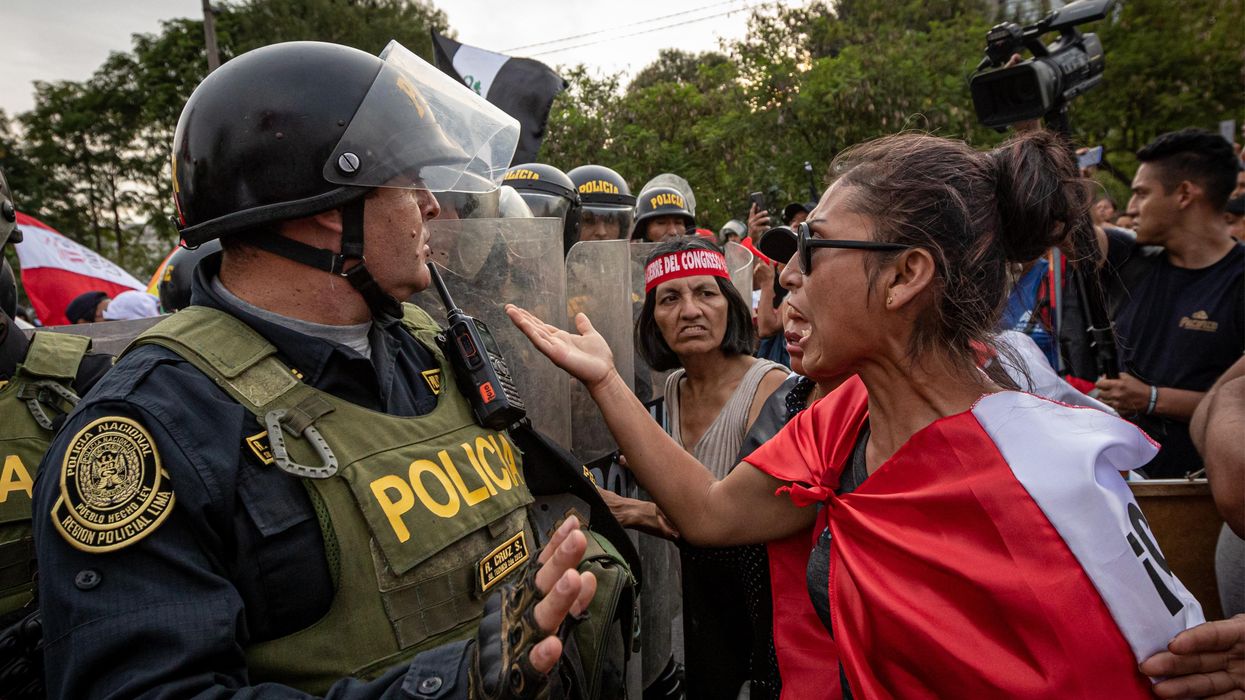
Four days into the job, Boluarte declared a regional state of emergency, later extended to the whole country. Protests only increased, and security forces responded with extreme violence, often shooting to kill. No wonder so many Peruvians feel this isn’t a democracy anymore.
The state of Peruvian democracy
The Economist Intelligence Unit’s Democracy Index rates Peru as a ‘flawed democracy’. A closer look at the index’s components suggests what’s wrong with Peruvian democracy: it gets its lowest score in the political culture dimension. In line with this, the Americas Barometer shows Peru has one of the lowest levels of support for democracy in Latin America and is the country where opposition to coups is weakest.
Peru’s democracy scores low on critical indicators such as checks and balances, corruption, and political participation. This points to the heart of the problem: it’s a dysfunctional system where those elected to govern fail to do so and public policies are inconsistent and ineffective.
According to every survey, just a tiny minority of Peruvians are satisfied with their country’s democracy. The fact that no full-fledged alternative has yet emerged seems to be the only thing currently keeping democracy alive. Democratic renewal is urgently needed, or an authoritarian substitute could well take hold.
Peruvian security forces have met protests against unelected President Dina Boluarte with "indiscriminate violence," the U.S. lawmakers wrote.
Twenty House Democrats on Monday pressed the Biden administration to immediately halt the flow of security funding to the Peruvian government over its vicious crackdown on protests against unelected President Dina Boluarte, who rose to power following the arrest of leftist President Pedro Castillo last month.
Since Castillo's arrest and imprisonment—which drew vocal opposition from political leaders in the region—mass demonstrations have broken out and spread across Peru as largely low-income and Indigenous supporters of Castillo mobilize to demand his release, Boluarte's resignation, and sweeping constitutional reforms. Peru's security forces have swiftly and violently cracked down in an unsuccessful attempt to quell the uprising, killing more than 50 people and injuring hundreds more.
In a letter to U.S. President Joe Biden, a group of House Democrats led by Reps. Susan Wild (D-Pa.) and Chuy Garcia (D-Ill.) condemned the "indiscriminate violence" and "consistent use of excessive force" by Peruvian security forces and urged the administration to "publicly denounce these ongoing human rights violations."
The lawmakers also called on Biden to pause all security funding to Peru, which amounts to tens of millions of dollars annually. The House Democrats pointed with alarm to the U.S. ambassador to Peru's "recent meeting with the Peruvian minister of defense and announcement of $8 million in further U.S. funding for CORAH, a Peruvian government coca eradication program, which includes funding for forces involved in the egregious human rights violations that are currently taking place."
"We urge your administration to immediately suspend U.S. security assistance to Peru until the violent repression of protests ends and steps are taken by the country's authorities to investigate human rights crimes and prosecute those responsible," the lawmakers wrote.
The letter came days after police killed a 55-year-old demonstrator in the Peruvian capital of Lima, where protests have swelled in recent days.
Boluarte, who has imposed curfews in several regions and curtailed civil liberties, is urging Peru's conservative-dominated Congress to approve a plan to hold new elections this year instead of in 2024 in an effort to end the demonstrations. Resisting pressure to resign, Boluarte—who served as vice president under Castillo—has pledged to stay on as president until new elections are held.
As Agence France-Presse reported Monday: "Boluarte said that if lawmakers refused to bring forward the vote, she would propose a constitutional reform so that a first round of elections would be held in October and a runoff in December. Demonstrators are calling for immediate elections, as well as Boluarte's removal, the dissolution of Congress, and a new constitution."
In their letter, the 20 House Democrats raised concern that the Biden administration has granted legitimacy and support to the Boluarte government as it rolls back basic freedoms and kills demonstrators.
Less than two weeks after Castillo's arrest, U.S. Secretary of State Antony Blinken held a call with Boluarte in which he
said he "looks forward" to working with her "on shared goals and values related to democracy, human rights, security, anti-corruption, and economic prosperity."
The Democratic lawmakers also pointed to the Biden administration's expressed support for "peace on all sides," a message that the members of Congress called "ambiguous" in the face of massive human rights violations.
"The U.S. government can and must do more," the lawmakers wrote. "We believe our proposed actions would send a powerful signal in support of fundamental rights and help promote effective engagement for a political resolution."
Peru is far from the only democracy where the political system is increasingly divorced from the problems of its people.
With all eyes on the fight for democratic government in Brazil, with its obvious parallels to events in the United States, it’s easy to miss another equally alarming struggle in the region. Peru has been shaken by protests and violence since the Peruvian Congress removed President Pedro Castillo from office on December 7 following his own attempt to shutter Congress. As of this writing, 55 people have died so far in the unrest, with 18 killed in the town of Juliaca on January 9 alone.
The deepening crisis is a cautionary tale about the risks of democratic governments’ failure to do their jobs and deliver for ordinary people.
Since its independence from Spain in 1821, Peru has been riven by severe economic inequality and systemic racism. A third of the population lives in Lima, where the bulk of government services and wealth are concentrated, while rural areas and Indigenous populations in general have significantly higher rates of extreme poverty and social exclusion. Inequality, including the lack of access to health services in many rural areas, contributed to Peru experiencing the world’s highest reported death rate from COVID-19.
Poverty has shot up in the last three years, including in rural areas where it was already most acute. Food insecurity has doubled since the start of the pandemic. The UN Food and Agriculture Organization reported in 2022 that more than half of Peruvians are food insecure — the highest rate in South America.
Meanwhile, Peru has experienced unrelenting political turmoil. In part, that’s due to corruption scandals touching nearly every president in the last decade. But it’s also because so many members of Congress seem more interested in horse-trading, partisan gains, and pursuing petty personal agendas — such as an unpopular law weakening the university accreditation system — than in addressing the country’s problems.
Since Keiko Fujimori, the daughter of the autocratic and now imprisoned former President Alberto Fujimori, lost the 2016 presidential election, her party and others aligned with it in Congress have repeatedly sought to undermine whoever held the presidency. In 2020, they successfully ousted President Martin Vizcarra on questionable legal grounds. Several members of Congress, as well as Keiko Fujimori, are themselves under criminal investigation for various offenses. In a January poll, 88 percent of Peruvians disapproved of Congress’s performance.
The ousted President Castillo, a rural school teacher, was never widely popular either. But in some rural areas, he was able to gain support from communities who identified with him and believed his promises of greater inclusion.
When Castillo took office after eking out an electoral victory over Keiko Fujimori in 2021, it was clear from the behavior of some members of Congress — including false claims of electoral fraud — that they would seek to remove him as they did Vizcarra. When Congress finally did remove Castillo for what was effectively an attempted coup and Vice-President Dina Boluarte assumed the presidency, to some Peruvians this read as an effort to wrest power from them. As a result, protesters’ main initial demand was for new elections in the short term.
While thousands have protested peacefully, reports of violence, arson, vandalism, and attacks on journalists have been common. Many police officers have been injured and one killed. Protesters have blocked roads, in some cases interfering with ambulances and contributing to deaths. The government has a responsibility to provide security and ensure accountability for violent acts.
At Boluarte’s request, Congress voted on December 20 to move elections up from 2026 to 2024, but that decision needs to be confirmed in a second round of voting. Meanwhile, the government’s brutal response to the protests is only compounding the indignation many feel.
President Boluarte has failed unequivocally to call on security forces to respect protesters’ rights, even in the face of reports of excessive use of force and mass detention. The pervasive lack of accountability for police violence, and successive governments’ failure to reform the police to ensure respect for human rights, amounts to a blank check for abuse.
Instead, administration officials have blamed the protesters for causing “chaos” or dismissed them — without offering evidence — as under the control of “foreign agitators” like former Bolivian President Evo Morales.
In a January 13 speech, Boluarte apologized for protesters’ deaths, but further incensed many by stating that those “truly responsible” for the violence needed to be held accountable — and suggesting that “terrorism” played a role. In Peru, the “terrorism” label is often used in reference to the Maoist Shining Path insurgency, which killed thousands in the 1980s, to stigmatize protesters, activists, Indigenous people, or left-leaning political actors.
Protests have kept spreading, affecting more than a quarter of the country on January 19, with many protesters traveling to Lima. Increasingly, their calls are for Boluarte to resign, or for a constituent assembly to review the constitution.
Democracy is very much on the line in Peru. The protesters’ demand for new elections is, ultimately, democratic. But repression and denial are likely to breed more anger and despair, playing into the hands of would-be autocrats across the political spectrum.
National and regional leaders need to rise above the petty politics, corruption, and personal interests that have marred Peru’s political system. Broad, genuine, and constructive dialogue that takes people’s needs and aspirations into account, along with positive outcomes secured through democratic institutions and effective action to protect the right of peaceful assembly, should be the priority.
Peru is far from the only democracy where the political system is increasingly divorced from the problems of its people. Others should take heed.
"We're at a breaking point between dictatorship and democracy," warned one student demonstrator.
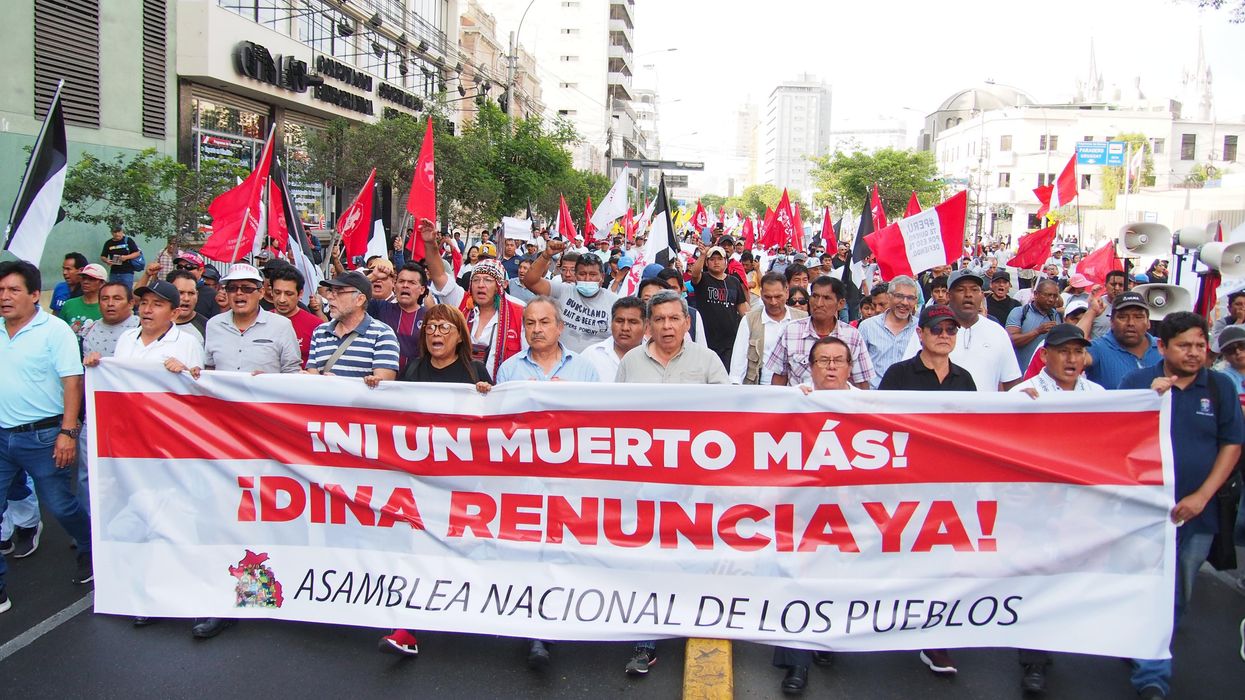
Thousands of Peruvians took to the streets of the nation's capital on Thursday demanding the resignation of Dina Boluarte—the unelected U.S.-backed president—justice for the more than 50 people killed during the six-week uprising, the return to power of jailed former President Pedro Castillo, and the dissolution of the Congress that ousted him.
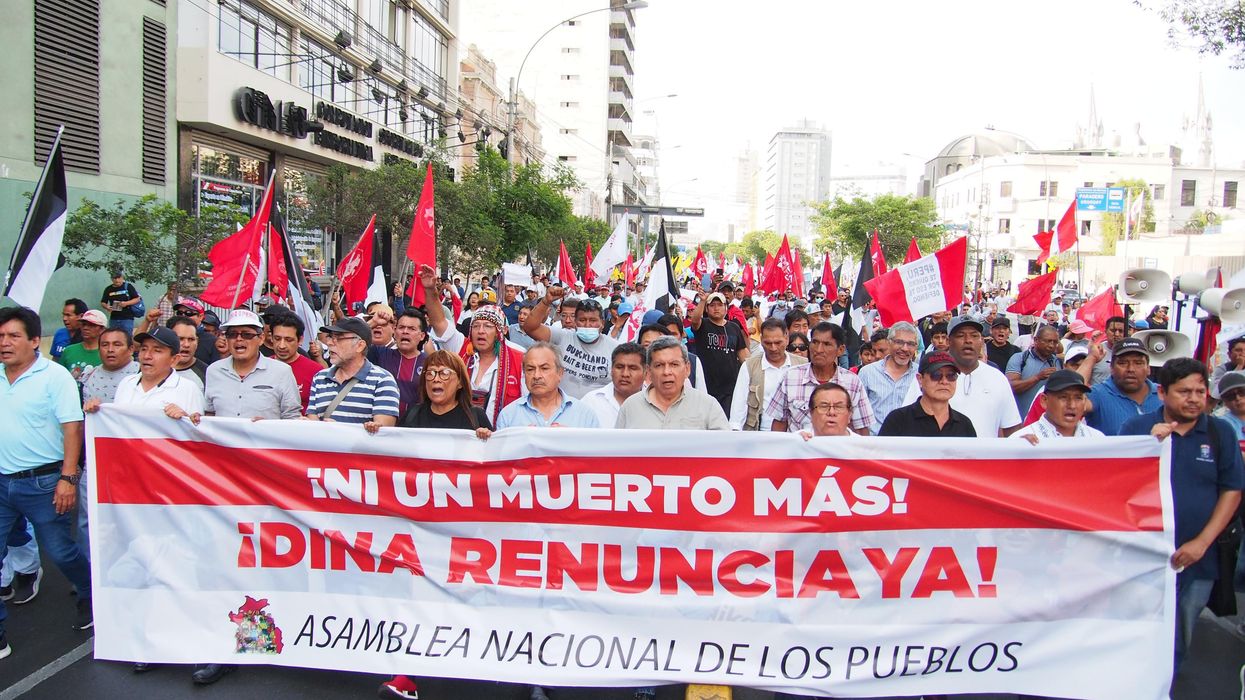
The protesters, many of them Indigenous Aymara and Quecha people, traveled to what they called the "Takeover of Lima" from all over the nation of 34 million inhabitants to take part in mostly peaceful demonstrations against what opponents call a "coup regime." The demonstrators carried banners with slogans including "Out, Dina Boluarte," "Dina, Murderer," and "Not One More Death."
"We want justice, we don't want our dead to be forgotten," protester Zulema Chacón told The Guardian.
"We want that usurper out, she doesn't represent us," she added, referring to Boluarte.
Carrying a Bible, protester Paulina Consac, who traveled 750 miles from the Andean city of Cusco to coastal Lima, told the Associated Press that "our God says thou shalt not kill your neighbor. Dina Boluarte is killing, she's making brothers fight."
Referring to the right-wing-controlled Congress that overthrew Castillo—a leftist who was democratically elected but moved to dissolve the legislature before it could overthrow him—shopkeeper Delia Zevallos told The Guardian that "they are the thieves and they lie and lie to us."
"The people have woken up, we're not children anymore, we know how to read and write... and no one can tell us what to do," she added.
Pedro Mamani, a student at the National University of San Marcos, said that "we're at a breaking point between dictatorship and democracy."
According to Defensoria del Pueblo, Peru's national ombudsman, the 6,000-7,000 demonstrators who marched on Plaza 2 de Mayo and Plaza San Martín were peaceful. However, "violent groups" attempted to reach the building housing Peru's Congress. A massive fire broke out at a building near Plaza San Martín late in the evening; there was no indication that the blaze was related to the protests, although some on the left accused police of causing the inferno.
Defensoría del Pueblo reported injuries to 13 civilians and four of the more than 11,800 police officers deployed in the capital. The ombudsman said at least 53 people including one police officer have been killed and hundreds more were wounded since Castillo was ousted on December 7.
Protests continued elsewhere Thursday, including in the southern city of Arequipa, where a group of around 200 people attempted to storm Rodríguez Ballón International Airport. One protester, identified as 30-year-old Jhancarlo Condori Arcana, died after being shot in the abdomen by police at the airport.
Boluarte said during a nighttime television address that the protests had "no social agenda" and that protesters wanted to "break the rule of law, generate chaos and disorder, and seize power."
Earlier on Thursday, Boluarte met with officials from the United Nations Office of the High Commissioner for Human Rights, whose spokesperson, Maria Hurtado, said earlier this month that the agency was "very concerned at the rising violence."
Weighing in on the protests in a Spanish-language tweet, U.S. Ambassador Lisa Kenna—a former CIA agent appointed by former President Donald Trump whom Castillo claims met with Boluarte the day before his removal—said it's "fundamental that the forces of order respect human rights and protect the citizenry."
Commenting on the uprising, former Greek Finance Minister and progressive activist Yanis Varoufakis tweeted that "the protesters in Peru are right: When the elected president is deposed in a palace coup, only fresh elections can cure the rift and restore democracy."
" Solidarity with Peruvian democrats = solidarity with democracy," Varoufakis added.
"We have come to Lima to defend our country, considering we are under a dictatorial government... which has stained our country with blood," one protester explained.
Thousands of Indigenous and other Peruvians descended on the capital Lima on Wednesday to demand the resignation of unelected President Dina Boluarte, show support for imprisoned former leftist leader Pedro Castillo, and condemn government forces for killing dozens of protesters over the past six weeks.
The demonstrators—who include Aymara and Quecha people from Andean regions, trade unionists, and other activists—traveled to the coastal capital in caravans during the second week of a general strike as part of a new "March from the Four Corners." The first such march took place in 2000 against then-President Alberto Fujimori, a U.S.-backed right-wing autocrat.
"We are from Chota in Cajamarca. We have come to Lima to defend our country, considering we are under a dictatorial government... which has stained our country with blood," protester Yorbin Herrera told Al Jazeera.
Another demonstrator, Luis Garro, said: "I am upset. Angry. Traumatized and shocked by what is happening here. I believe that the people are going to force Dina Boluarte and the Congress out."
Florencia Fernández, a lawyer who lives in Cusco, told the Associated Press that "in my own country, the voices of the Andes, the voices of the majority have been silenced."
"We've had to travel to this aggressive city, this centralist city, and we say, the Andes have descended," she added.
Alonso Cárdenas, a professor of public policy at the Antonio Ruiz de Montoya University in Lima, noted the significance of protests in the capital.
"When there are tragedies, bloodbaths outside the capital, it doesn't have the same political relevance in the public agenda as if it took place in the capital,” he told the AP. "The leaders have understood that and say, they can massacre us in Cusco, in Puno, and nothing happens, we need to take the protest to Lima."
At least 17 people were killed by state security forces in what human rights defenders called a "massacre" in Juliaca, the capital of San Román province in Puno, on January 9.
Some of this week's protesters traveled to Lima on the tour bus of renowned cumbia singer Yarita Lizeth, who has donated money to cover wounded protesters' medical bills while condemning "this violent repression against my brothers from Juliaca... who were unjustly killed."
By taking to the street, protesters were defying the government's extended state of emergency in Lima and three other regions, a move that suspended constitutional rights including the inviolability of the home, freedom of transit, and freedom of assembly.
A counter-demonstration in support of Boluarte, dubbed a "march for peace," also took place in Lima on Thursday. The de facto president said Tuesday that she would meet with anti-government demonstrators "to talk about the social agendas that you have because you well know that the political agenda that you are proposing is not feasible."
At least 53 people have been killed since the December 7 overthrow and arrest of Castillo—a democratically elected former rural teacher and union organizer—by the country's right-wing-controlled Congress after he moved to dissolve the legislature in a bid to preempt a move to dismiss him for "permanent moral incapacity."
The latest deaths include Sonia Aguilar Quispe, a 35-year-old woman who was shot in the head in the southern town of Macusani; Salomón Valenzuela Chua, a 30-year-old father of four; and the unborn child of a teenager.
Castillo, who faces charges of rebellion and conspiracy, remains imprisoned by order of a panel of Peru's Supreme Court of Justice.
Boluarte has proposed elections for April 2024. Her government is recognized by the United States, Canada, Chile, and several other countries, while leftist leaders of Latin American and Caribbean nations including Argentina, Bolivia, Colombia, Cuba, Mexico, Nicaragua, and Venezuela have condemned Castillo's removal.
A poll published earlier this week by the Institute of Peruvian Studies showed 71% of respondents disapprove of Boluarte, while 60% say the protests against her government are justified.
"You are a murderer, many people are dying because of you," said one protester, referring to interim President Dina Boluarte. "You must accept that the people don't want you."
Thousands of people hit the streets of Peru's capital Lima on Thursday in a peaceful protest against the national government, which has been led for over a month by unelected President Dina Boluarte.
"Dina Boluarte you are being used. Why are you turning your back on the people? There are so many deaths, for God's sake, stop this massacre," Olga Espejo, one of many Peruvians calling on the country's interim president to step down, told Agence France-Presse.
An unnamed protester told Al Jazeera: "We call on Mrs. Dina to resign because... you are a murderer, many people are dying because of you. You must accept that the people don't want you."
The December 7 overthrow of leftist former President Pedro Castillo sparked ongoing nationwide demonstrations demanding Boluarte's resignation, the dissolution of Congress, fresh elections, the creation of a new constitution by a constituent assembly, and Castillo's release from prison. The state's violent repression of protests has left at least 48 people dead so far.
"It is a human rights crisis of an increasingly high degree," Jo-Marie Burt, associate professor of political science and Latin American studies at George Mason University, told Al Jazeera. "There's a clear excessive use of force by security forces."
"International organizations around the world have called upon the Boluarte government to cease the repression and to seek dialogue to Peru's current political crisis," she added.
Those who marched in Lima on Thursday carried cardboard coffins to represent the dozens of civilians killed by Peruvian police.
Roughly 900 miles southeast, thousands of people carried the real coffins of the 17 local residents slain earlier this week in the Juliaca massacre.
The city of Juliaca is part of the Puno region of southeastern Peru near the Bolivian border. This impoverished and largely Indigenous Andean zone—where support for Castillo, the son of illiterate peasant farmers, is strongest—has been the epicenter of protests and the government's deadly crackdown, which escalated after Boluarte declared a 30-day state of emergency on December 14.
Thursday's action in Lima and the funeral procession in Juliaca remained peaceful, but recent clashes in the southern city of Cusco, during which at least one protester was killed, led officials to preemptively close the international airport there—a busy gateway to Machu Picchu, one of the planet's most visited archaeological sites.
Also on Thursday, "Labor Minister Eduardo García announced his resignation, urging the government to recognize that mistakes have been made that must be corrected," AFP reported.
Castillo was removed by Peru's deeply unpopular right-wing majority Congress and ordered by a panel of the country's Supreme Court of Justice to complete an 18-month pre-trial prison sentence last month in what critics have described as a U.S.-backed legislative coup.
Lawmakers dismissed Castillo after he attempted to dissolve Congress and establish an emergency government in a desperate bid to preempt his imminent expulsion, which Peruvian oligarchs had sought from the moment the former rural educator and union organizer upset Keiko Fujimori, daughter of the country's former neoliberal dictator, in the 2021 presidential election.
Boluarte was Castillo's running mate and vice president, but "critics say she has now been 'captured' by the legislature's conservative majority," The Washington Post reported.
According to the newspaper:
She accused protesters last month of "terrorism," before backtracking and distinguishing the spectrum of views and tactics among them. She appointed as head of national intelligence Juan Carlos Liendo, a conservative retired army colonel who had argued that all the demonstrators were, by definition, terrorists. (She later forced him out.)
Boluarte, a lawyer and civil servant, has lamented the deaths and called for "dialogue." But she also said the demonstrators' demands "can't be understood," a claim with racist overtones. Her first prime minister, Pedro Angulo, who lasted just a week in the job, infamously blamed protester deaths on the supposed inability of Andeans to understand police orders in Spanish.
Among those who have condemned Castillo's ouster and the ensuing bloodshed are current and former Latin American leaders, including ex-Bolivian President Evo Morales and ex-Honduran President Manuel Zelaya—both democratically elected leftists who became victims of U.S.-backed right-wing coups.
In a joint statement published last month, the leftist presidents of Argentina, Bolivia, Colombia, and Mexico expressed their "deep concern over the recent events that resulted in the removal and detention of Jose Pedro Castillo Terrones, president of the Republic of Peru."
"It is not news to the world that President Castillo Terrones, from the day of his election, was the victim of anti-democratic harassment," the presidents said. "Our governments call on all the actors involved... to prioritize the will of the citizens that was pronounced at the polls."
Meanwhile, "the U.S. Embassy in Peru was incredibly quick to recognize the coup government in Peru but has been completely silent about the multiple killings and heavy repression by police," Manolo De Los Santos, co-executive director of the People's Forum, tweeted last month. "The blood of those young Peruvians killed by the Boluarte regime is also on the hands of the U.S. government."
In the wake of the massacre in Juliaca on Monday, "the United Nations, the British ambassador in Peru, and other international players issued statements explicitly calling on Peruvian security forces to respect human rights," The New York Times reported. "The United States, which has repeatedly expressed support for Ms. Boluarte's government and last week announced $8 million in new funding for Peru to support efforts to fight drug trafficking, was less direct."
Lisa Kenna, the U.S. ambassador to Peru, tweeted Tuesday: "It is urgent that measures are taken to stop this painful situation of violence and avoid the loss of more human lives."
According to AFP: "Peru's prosecutor's office is opening an investigation into President Boluate and other top officials as a result of the deaths. But so far Boluarte has resisted calls to resign. She supports the plan for presidential elections in 2024 at the earliest and still has the support of Congress."
The governor of Puno province has declared three days of mourning for the victims of the killing in Juliaca, who include a 17-year-old girl.
At least 17 people were killed by state security forces in southern Peru Monday while protesting the government of unelected President Dina Boluarte and the ouster and imprisonment of former leftist leader Pedro Castillo.
The Peruvian Health Ministry published the names and ages of 17 victims of what's being called the Juliaca massacre, which took place in the Indigenous Aymara city of Juliaca, the capital of San Román province in the Puno region of southeastern Peru near Lake Titicaca and the Bolivian border. The youngest of the slain protesters is a 17-year-old girl, Nataly Aroquipa, who was reportedly shot in the abdomen.
"At nine o'clock at night on January 9, 2023, we recorded 17 deaths in Juliaca, and one further death due to events related to the road blockade in Chucuito, Puno. The total number dead since the coup is now at 46," Defensoría del Pueblo, the national ombudsman's office, said on Twitter. In addition to the deaths, at least 500 protesters have been injured, according to officials.
Local media report one Peruvian National Police officer, identified as Sonco Quispe José Luis, was burned to death in his patrol vehicle during a protest, and two pistols and a rifle were stolen from his car.
Puno Gov. Richard Hancco Soncco on Tuesday
declared three days of official mourning in honor of those killed in Juliaca, while rejecting "any act of violence and the exaggerated use of public force by the Peruvian National Police and the Peruvian Armed Forces."
The killings happened on the seventh day of a national strike. Protesters—who Anahí Durand, Castillo's minister for women and vulnerable populations, said are "the excluded, marginalized, informal, rural, and Indigenous"—are demanding Boluarte's resignation, the closure of Congress, immediate elections, and a new constitution.
Peru's National Coordinator for Human Rights (CNDDHH) condemned the killings and asserted that "Boluarte and her ministers" are "responsible for the massacre in Juliaca."
Marta Hurtado, a spokesperson for the United Nations Office of the High Commissioner for Human Rights, on Tuesday called on "security forces to comply with human rights standards and ensure that force is only used when strictly necessary, and, if so, in full compliance with the principles of legality, precaution, and proportionality."
Hurtado, who also asked protesters to "show restraint," urged Peruvian authorities to "carry out prompt, impartial, and effective investigations into the deaths and injuries, holding those responsible to account and ensuring victims receive access to justice and redress."
Speaking Monday evening in a televised address, Peruvian Prime Minister Alberto Otárola defended the actions of state security forces. Otárola declared that "we will not cease in our defense of the rule of the law," while blaming the violence on groups backed by "foreign interests and the dark money of drug trafficking" who want to "destroy the country."
While condemning the "seizure of airports, aggression against other people—including law enforcement—preventing the movement of ambulances, and all forms of attack on public or private property" perpetrated by some protesters, the national ombudsman reminded police and military forces of their "duty to comply with current regulations and international standards on the use of force."
The current protests began following the December 7 overthrow and arrest of Castillo—a democratically elected former rural teacher and union organizer—by the country's right-wing-controlled Congress after he moved to dissolve the legislature in a bid to preempt a move to dismiss him for "permanent moral incapacity."
Incensed by Castillo's promise of sweeping social reforms and a new constitution, Peru's oligarchs and the National Society of Industries, the country's leading business group, had long sought his removal.
On December 16, a judicial panel of Peru's Supreme Court of Justice ordered Castillo imprisoned for 18 months while prosecutors investigate charges of rebellion and conspiracy against the former Peruvian president.
Boluarte has proposed holding elections in April 2024.
Countries recognizing Boluarte's government include the United States, Canada, Chile, Costa Rica, Ecuador, and Uruguay. The leftist leaders of Latin American and Caribbean nations including Argentina, Bolivia, Colombia, Cuba, Mexico, Nicaragua, and Venezuela have condemned Castillo's removal.
While there is no evidence of direct U.S. involvement in Castillo's ouster, the ex-president sounded the alarm over a meeting held the day before his removal at the Government Palace in Lima between Boluarte and U.S. Ambassador Lisa Kenna, a former longtime CIA agent appointed by then-President Donald Trump.
The United States has a long history of supporting right-wing dictatorships in the region. During the 1970s and '80s, successive U.S. administrations backed "Operation Condor," a coordinated effort by right-wing military dictatorships in Chile, Argentina, Uruguay, Bolivia, Paraguay, Brazil, and, later, Peru and Ecuador in which around 60,000 leftists were killed and tens of thousands others arrested and tortured.
Organized labor and progressive civil society groups in Peru are calling for a national strike as unelected interim President Dina Boluarte imposes a 30-day state of emergency in a bid to quell protests demanding her resignation and an end to the country's neoliberal economic model.
Thousands of Peruvian workers have taken to the streets in recent days to push for the immediate dissolution of Congress, fresh elections, and the creation of a new constitution by a constituent assembly.
They are also advocating for the release of ousted leftist President Pedro Castillo, who was removed by the country's deeply unpopular right-wing majority Congress and jailed last Wednesday in what critics describe as a U.S.-backed legislative coup. The state's violent repression of demonstrators has left at least eight people dead.
"We declared ourselves in a popular insurgency against the coup d'etat planned and perpetrated by Congress, the leadership of the armed forces, the mainstream media, and the judiciary, which acted as operators of economic groups," the Agrarian and Rural Front of Peru (FARP) and the National Peoples' Assembly (ANP) said in a recent joint statement, teleSUR reported Thursday.
"On December 15, the working class across the country will take to the streets to demand the closure of Congress, general elections, and a new constitution. All power to the people!" the General Confederation of Workers of Peru (CGTP) added, calling for an afternoon rally at Dos de Mayo Square in the capital of Lima.
Protests erupted last week after Peruvian lawmakers dismissed Castillo following his attempt to dissolve Congress. Prosecutors are seeking an 18-month prison sentence for Castillo, who remains incarcerated for allegedly fomenting a rebellion.
Castillo and his defenders have portrayed his move to form an emergency government as a last-ditch effort to preempt his overthrow, which the country's right-wing oligarchs had sought from the moment the former educator and union organizer upset Keiko Fujimori, daughter of the country's former neoliberal dictator, in the 2021 presidential election.
"The oligarchic rulers of Peru could never accept that a rural schoolteacher and peasant leader could be brought into office by millions of poor, Black, and Indigenous people who saw their hope for a better future in Castillo," Manolo De Los Santos, co-executive director of the People's Forum, wrote last week in People's Dispatch.
That sentiment has been echoed by U.S.-based peace group CodePink and other progressives around the world. Among those who have condemned Castillo's ouster and the ensuing bloodshed are current and former Latin American leaders, including ex-Bolivian President Evo Morales and ex-Honduran President Manuel Zelaya--both democratically elected leftists who became victims of U.S.-backed right-wing coups.
In a joint statement published Tuesday, the leftist presidents of Argentina, Bolivia, Colombia, and Mexico--respectively, Alberto Fernandez, Luis Arce, Gustavo Petro, and Andres Manuel Lopez Obrador--expressed their "deep concern over the recent events that resulted in the removal and detention of Jose Pedro Castillo Terrones, president of the Republic of Peru."
"It is not news to the world that President Castillo Terrones, from the day of his election, was the victim of anti-democratic harassment," the presidents said. "Our governments call on all the actors involved... to prioritize the will of the citizens that was pronounced at the polls."
"We exhort those in our [national] institutions to refrain from reversing the popular will expressed through free suffrage," the statement added. "We request that the authorities fully respect the human rights of President Pedro Castillo and that he be guaranteed judicial protection."
The message from regional leaders came as Peruvian security forces escalated their crackdown against protesters, especially in the impoverished Andean region where support for Castillo, the son of illiterate peasant farmers, is strongest.
"The U.S. Embassy in Peru was incredibly quick to recognize the coup government in Peru but has been completely silent about the multiple killings and heavy repression by police," De Los Santos tweeted Tuesday. "The blood of those young Peruvians killed by the Boluarte regime is also on the hands of the U.S. government."