
On 25 January, roughly six weeks after being sworn in following her predecessor’s removal, Peruvian president Dina Boluarte finally recognized that elections were the only way out of political crisis. Elections were rescheduled for April 2024, much earlier than the end of the presidential term she’s been tasked with completing, but not soon enough for thousands who’ve taken to the streets demanding her immediate resignation.
Boluarte’s call for a ‘national truce’ has been met with further protests. Their repression has led to major bloodshed: the Ombudsman’s office has reported close to 60 dead – mostly civilians killed by security forces – and 1,500 injured.
What happened and what it means
It’s unusually easy to impeach Peru’s presidents: a legislative majority can vote to remove them on vaguely defined grounds.
Pedro Castillo, elected president in July 2021, had already survived two removal attempts and faced a third. On 7 December he made a pre-emptive strike: he dissolved Congress and announced a restructuring of the judiciary, as former president Alberto Fujimori had done decades earlier in the ‘self-coup’ that started several years of authoritarian rule.
Castillo announced the establishment of an exceptional emergency government where he would rule by decree and promised to hold congressional elections soon. The new Congress, he said, would have the power to draft a new constitution.
But unlike Fujimori, Castillo enjoyed meager support, and within hours Congress voted to remove him from office. He was arrested and remains in pretrial detention on rebellion charges. Vice-president Boluarte was immediately sworn in.
In the whirlwind that followed there was much talk that a coup, or a coup attempt, had taken place – but opinions differed radically as to who was the victim and who was the perpetrator.
The prevailing view was that Castillo’s dissolution of Congress was an attempt at a presidential coup. But others saw Castillo’s removal as a coup. Debate has been deeply polarised on ideological grounds, making clear that in Peru and Latin America, a principled rather than partisan defense of democracy is still lacking.
Permanent crisis
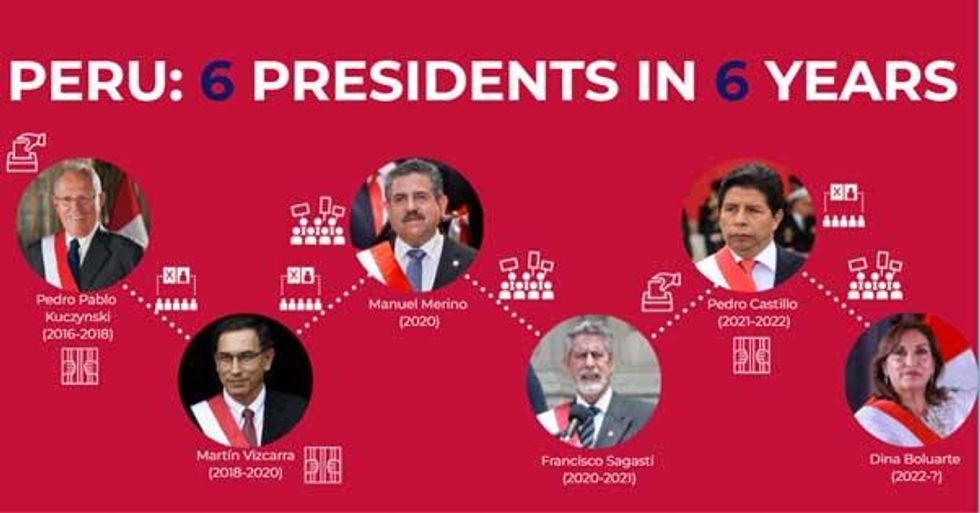
Recent events are part of a bigger political crisis that has seen six presidents in six years. In 2021, a polarising presidential campaign was followed by an extremely fragmented vote. The runoff election yielded an unexpected winner: a leftist outsider of humble origins, Castillo, defeated the right-wing heiress of the Fujimori dynasty by under one percentage point. Keiko Fujimori initially rejected the results and baselessly claimed fraud. Castillo’s presidency was born fragile. It was an unstable government, with a high rotation of ministers and fluctuating congressional support.
Although Castillo had promised to break the cycle of corruption, his government, himself, and close associates soon became the target of corruption allegations coming not just from the opposition but also from state watchdog institutions. Castillo’s response was to attack the prosecutor and ask the Organization of American States (OAS) to apply its Democratic Charter to preserve Peruvian democracy supposedly under attack. The OAS sent a mission that ended with a call for dialogue. Only two weeks later, Castillo embarked on his short-lived coup adventure.
Protests and repression
According to Peru’s Constitution, Boluarte should complete Castillo’s term. But observers generally agree there’s no way she can stay in office until 2024, never mind 2026, given the rejection she faces from protesters and political parties in Congress.
A wave of protests demanding her resignation rose as soon as she was sworn in, led mostly by students, Indigenous groups, and unions. Many also demanded Castillo’s freedom and government action to address poverty and inequality. Some demands went further, including a call for a constituent assembly – the promise Castillo made before being removed from office—to produce more balanced representation, particularly for Indigenous people. For many of Peru’s poorest people, Castillo represented hope for change. With him gone, they feel forgotten.
Four days into the job, Boluarte declared a regional state of emergency, later extended to the whole country. Protests only increased, and security forces responded with extreme violence, often shooting to kill. No wonder so many Peruvians feel this isn’t a democracy anymore.
The state of Peruvian democracy
The Economist Intelligence Unit’s Democracy Index rates Peru as a ‘flawed democracy’. A closer look at the index’s components suggests what’s wrong with Peruvian democracy: it gets its lowest score in the political culture dimension. In line with this, the Americas Barometer shows Peru has one of the lowest levels of support for democracy in Latin America and is the country where opposition to coups is weakest.
Peru’s democracy scores low on critical indicators such as checks and balances, corruption, and political participation. This points to the heart of the problem: it’s a dysfunctional system where those elected to govern fail to do so and public policies are inconsistent and ineffective.
According to every survey, just a tiny minority of Peruvians are satisfied with their country’s democracy. The fact that no full-fledged alternative has yet emerged seems to be the only thing currently keeping democracy alive. Democratic renewal is urgently needed, or an authoritarian substitute could well take hold.
On 25 January, roughly six weeks after being sworn in following her predecessor’s removal, Peruvian president Dina Boluarte finally recognized that elections were the only way out of political crisis. Elections were rescheduled for April 2024, much earlier than the end of the presidential term she’s been tasked with completing, but not soon enough for thousands who’ve taken to the streets demanding her immediate resignation.
Boluarte’s call for a ‘national truce’ has been met with further protests. Their repression has led to major bloodshed: the Ombudsman’s office has reported close to 60 dead – mostly civilians killed by security forces – and 1,500 injured.
What happened and what it means
It’s unusually easy to impeach Peru’s presidents: a legislative majority can vote to remove them on vaguely defined grounds.
Pedro Castillo, elected president in July 2021, had already survived two removal attempts and faced a third. On 7 December he made a pre-emptive strike: he dissolved Congress and announced a restructuring of the judiciary, as former president Alberto Fujimori had done decades earlier in the ‘self-coup’ that started several years of authoritarian rule.
Castillo announced the establishment of an exceptional emergency government where he would rule by decree and promised to hold congressional elections soon. The new Congress, he said, would have the power to draft a new constitution.
But unlike Fujimori, Castillo enjoyed meager support, and within hours Congress voted to remove him from office. He was arrested and remains in pretrial detention on rebellion charges. Vice-president Boluarte was immediately sworn in.
In the whirlwind that followed there was much talk that a coup, or a coup attempt, had taken place – but opinions differed radically as to who was the victim and who was the perpetrator.
The prevailing view was that Castillo’s dissolution of Congress was an attempt at a presidential coup. But others saw Castillo’s removal as a coup. Debate has been deeply polarised on ideological grounds, making clear that in Peru and Latin America, a principled rather than partisan defense of democracy is still lacking.
Permanent crisis
Recent events are part of a bigger political crisis that has seen six presidents in six years. In 2021, a polarising presidential campaign was followed by an extremely fragmented vote. The runoff election yielded an unexpected winner: a leftist outsider of humble origins, Castillo, defeated the right-wing heiress of the Fujimori dynasty by under one percentage point. Keiko Fujimori initially rejected the results and baselessly claimed fraud. Castillo’s presidency was born fragile. It was an unstable government, with a high rotation of ministers and fluctuating congressional support.
Although Castillo had promised to break the cycle of corruption, his government, himself, and close associates soon became the target of corruption allegations coming not just from the opposition but also from state watchdog institutions. Castillo’s response was to attack the prosecutor and ask the Organization of American States (OAS) to apply its Democratic Charter to preserve Peruvian democracy supposedly under attack. The OAS sent a mission that ended with a call for dialogue. Only two weeks later, Castillo embarked on his short-lived coup adventure.
Protests and repression
According to Peru’s Constitution, Boluarte should complete Castillo’s term. But observers generally agree there’s no way she can stay in office until 2024, never mind 2026, given the rejection she faces from protesters and political parties in Congress.
A wave of protests demanding her resignation rose as soon as she was sworn in, led mostly by students, Indigenous groups, and unions. Many also demanded Castillo’s freedom and government action to address poverty and inequality. Some demands went further, including a call for a constituent assembly – the promise Castillo made before being removed from office—to produce more balanced representation, particularly for Indigenous people. For many of Peru’s poorest people, Castillo represented hope for change. With him gone, they feel forgotten.
Four days into the job, Boluarte declared a regional state of emergency, later extended to the whole country. Protests only increased, and security forces responded with extreme violence, often shooting to kill. No wonder so many Peruvians feel this isn’t a democracy anymore.
The state of Peruvian democracy
The Economist Intelligence Unit’s Democracy Index rates Peru as a ‘flawed democracy’. A closer look at the index’s components suggests what’s wrong with Peruvian democracy: it gets its lowest score in the political culture dimension. In line with this, the Americas Barometer shows Peru has one of the lowest levels of support for democracy in Latin America and is the country where opposition to coups is weakest.
Peru’s democracy scores low on critical indicators such as checks and balances, corruption, and political participation. This points to the heart of the problem: it’s a dysfunctional system where those elected to govern fail to do so and public policies are inconsistent and ineffective.
According to every survey, just a tiny minority of Peruvians are satisfied with their country’s democracy. The fact that no full-fledged alternative has yet emerged seems to be the only thing currently keeping democracy alive. Democratic renewal is urgently needed, or an authoritarian substitute could well take hold.
- Outraged Peruvians Demand Boluarte Resign During Tumultuous 'Takeover of Lima' ›
- Latin American Leaders Call Peru's President Castillo a 'Victim of Anti-Democratic Harassment' ›