SUBSCRIBE TO OUR FREE NEWSLETTER
Daily news & progressive opinion—funded by the people, not the corporations—delivered straight to your inbox.
5
#000000
#FFFFFF
To donate by check, phone, or other method, see our More Ways to Give page.
Daily news & progressive opinion—funded by the people, not the corporations—delivered straight to your inbox.
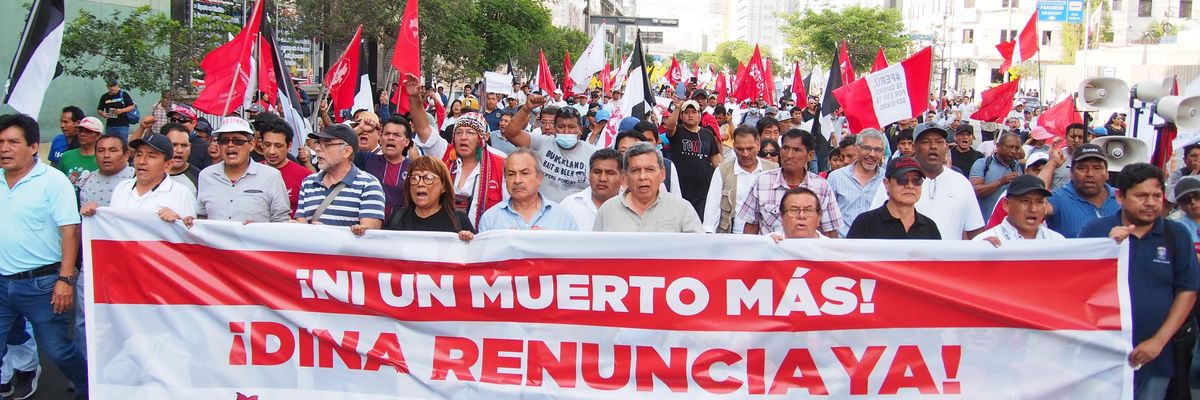
Demonstrators carrying a banner reading "Not One More Death! Dina Resign Now!" march in Lima, Peru on January 19, 2023.
"We're at a breaking point between dictatorship and democracy," warned one student demonstrator.
Thousands of Peruvians took to the streets of the nation's capital on Thursday demanding the resignation of Dina Boluarte—the unelected U.S.-backed president—justice for the more than 50 people killed during the six-week uprising, the return to power of jailed former President Pedro Castillo, and the dissolution of the Congress that ousted him.
The protesters, many of them Indigenous Aymara and Quecha people, traveled to what they called the "Takeover of Lima" from all over the nation of 34 million inhabitants to take part in mostly peaceful demonstrations against what opponents call a "coup regime." The demonstrators carried banners with slogans including "Out, Dina Boluarte," "Dina, Murderer," and "Not One More Death."
"We want justice, we don't want our dead to be forgotten," protester Zulema Chacón told The Guardian.
"We want that usurper out, she doesn't represent us," she added, referring to Boluarte.
Carrying a Bible, protester Paulina Consac, who traveled 750 miles from the Andean city of Cusco to coastal Lima, told the Associated Press that "our God says thou shalt not kill your neighbor. Dina Boluarte is killing, she's making brothers fight."
Referring to the right-wing-controlled Congress that overthrew Castillo—a leftist who was democratically elected but moved to dissolve the legislature before it could overthrow him—shopkeeper Delia Zevallos told The Guardian that "they are the thieves and they lie and lie to us."
"The people have woken up, we're not children anymore, we know how to read and write... and no one can tell us what to do," she added.
Pedro Mamani, a student at the National University of San Marcos, said that "we're at a breaking point between dictatorship and democracy."
According to Defensoria del Pueblo, Peru's national ombudsman, the 6,000-7,000 demonstrators who marched on Plaza 2 de Mayo and Plaza San Martín were peaceful. However, "violent groups" attempted to reach the building housing Peru's Congress. A massive fire broke out at a building near Plaza San Martín late in the evening; there was no indication that the blaze was related to the protests, although some on the left accused police of causing the inferno.
Defensoría del Pueblo reported injuries to 13 civilians and four of the more than 11,800 police officers deployed in the capital. The ombudsman said at least 53 people including one police officer have been killed and hundreds more were wounded since Castillo was ousted on December 7.
Protests continued elsewhere Thursday, including in the southern city of Arequipa, where a group of around 200 people attempted to storm Rodríguez Ballón International Airport. One protester, identified as 30-year-old Jhancarlo Condori Arcana, died after being shot in the abdomen by police at the airport.
Boluarte said during a nighttime television address that the protests had "no social agenda" and that protesters wanted to "break the rule of law, generate chaos and disorder, and seize power."
Earlier on Thursday, Boluarte met with officials from the United Nations Office of the High Commissioner for Human Rights, whose spokesperson, Maria Hurtado, said earlier this month that the agency was "very concerned at the rising violence."
Weighing in on the protests in a Spanish-language tweet, U.S. Ambassador Lisa Kenna—a former CIA agent appointed by former President Donald Trump whom Castillo claims met with Boluarte the day before his removal—said it's "fundamental that the forces of order respect human rights and protect the citizenry."
Commenting on the uprising, former Greek Finance Minister and progressive activist Yanis Varoufakis tweeted that "the protesters in Peru are right: When the elected president is deposed in a palace coup, only fresh elections can cure the rift and restore democracy."
" Solidarity with Peruvian democrats = solidarity with democracy," Varoufakis added.
Dear Common Dreams reader, It’s been nearly 30 years since I co-founded Common Dreams with my late wife, Lina Newhouser. We had the radical notion that journalism should serve the public good, not corporate profits. It was clear to us from the outset what it would take to build such a project. No paid advertisements. No corporate sponsors. No millionaire publisher telling us what to think or do. Many people said we wouldn't last a year, but we proved those doubters wrong. Together with a tremendous team of journalists and dedicated staff, we built an independent media outlet free from the constraints of profits and corporate control. Our mission has always been simple: To inform. To inspire. To ignite change for the common good. Building Common Dreams was not easy. Our survival was never guaranteed. When you take on the most powerful forces—Wall Street greed, fossil fuel industry destruction, Big Tech lobbyists, and uber-rich oligarchs who have spent billions upon billions rigging the economy and democracy in their favor—the only bulwark you have is supporters who believe in your work. But here’s the urgent message from me today. It's never been this bad out there. And it's never been this hard to keep us going. At the very moment Common Dreams is most needed, the threats we face are intensifying. We need your support now more than ever. We don't accept corporate advertising and never will. We don't have a paywall because we don't think people should be blocked from critical news based on their ability to pay. Everything we do is funded by the donations of readers like you. When everyone does the little they can afford, we are strong. But if that support retreats or dries up, so do we. Will you donate now to make sure Common Dreams not only survives but thrives? —Craig Brown, Co-founder |
Thousands of Peruvians took to the streets of the nation's capital on Thursday demanding the resignation of Dina Boluarte—the unelected U.S.-backed president—justice for the more than 50 people killed during the six-week uprising, the return to power of jailed former President Pedro Castillo, and the dissolution of the Congress that ousted him.
The protesters, many of them Indigenous Aymara and Quecha people, traveled to what they called the "Takeover of Lima" from all over the nation of 34 million inhabitants to take part in mostly peaceful demonstrations against what opponents call a "coup regime." The demonstrators carried banners with slogans including "Out, Dina Boluarte," "Dina, Murderer," and "Not One More Death."
"We want justice, we don't want our dead to be forgotten," protester Zulema Chacón told The Guardian.
"We want that usurper out, she doesn't represent us," she added, referring to Boluarte.
Carrying a Bible, protester Paulina Consac, who traveled 750 miles from the Andean city of Cusco to coastal Lima, told the Associated Press that "our God says thou shalt not kill your neighbor. Dina Boluarte is killing, she's making brothers fight."
Referring to the right-wing-controlled Congress that overthrew Castillo—a leftist who was democratically elected but moved to dissolve the legislature before it could overthrow him—shopkeeper Delia Zevallos told The Guardian that "they are the thieves and they lie and lie to us."
"The people have woken up, we're not children anymore, we know how to read and write... and no one can tell us what to do," she added.
Pedro Mamani, a student at the National University of San Marcos, said that "we're at a breaking point between dictatorship and democracy."
According to Defensoria del Pueblo, Peru's national ombudsman, the 6,000-7,000 demonstrators who marched on Plaza 2 de Mayo and Plaza San Martín were peaceful. However, "violent groups" attempted to reach the building housing Peru's Congress. A massive fire broke out at a building near Plaza San Martín late in the evening; there was no indication that the blaze was related to the protests, although some on the left accused police of causing the inferno.
Defensoría del Pueblo reported injuries to 13 civilians and four of the more than 11,800 police officers deployed in the capital. The ombudsman said at least 53 people including one police officer have been killed and hundreds more were wounded since Castillo was ousted on December 7.
Protests continued elsewhere Thursday, including in the southern city of Arequipa, where a group of around 200 people attempted to storm Rodríguez Ballón International Airport. One protester, identified as 30-year-old Jhancarlo Condori Arcana, died after being shot in the abdomen by police at the airport.
Boluarte said during a nighttime television address that the protests had "no social agenda" and that protesters wanted to "break the rule of law, generate chaos and disorder, and seize power."
Earlier on Thursday, Boluarte met with officials from the United Nations Office of the High Commissioner for Human Rights, whose spokesperson, Maria Hurtado, said earlier this month that the agency was "very concerned at the rising violence."
Weighing in on the protests in a Spanish-language tweet, U.S. Ambassador Lisa Kenna—a former CIA agent appointed by former President Donald Trump whom Castillo claims met with Boluarte the day before his removal—said it's "fundamental that the forces of order respect human rights and protect the citizenry."
Commenting on the uprising, former Greek Finance Minister and progressive activist Yanis Varoufakis tweeted that "the protesters in Peru are right: When the elected president is deposed in a palace coup, only fresh elections can cure the rift and restore democracy."
" Solidarity with Peruvian democrats = solidarity with democracy," Varoufakis added.
Thousands of Peruvians took to the streets of the nation's capital on Thursday demanding the resignation of Dina Boluarte—the unelected U.S.-backed president—justice for the more than 50 people killed during the six-week uprising, the return to power of jailed former President Pedro Castillo, and the dissolution of the Congress that ousted him.
The protesters, many of them Indigenous Aymara and Quecha people, traveled to what they called the "Takeover of Lima" from all over the nation of 34 million inhabitants to take part in mostly peaceful demonstrations against what opponents call a "coup regime." The demonstrators carried banners with slogans including "Out, Dina Boluarte," "Dina, Murderer," and "Not One More Death."
"We want justice, we don't want our dead to be forgotten," protester Zulema Chacón told The Guardian.
"We want that usurper out, she doesn't represent us," she added, referring to Boluarte.
Carrying a Bible, protester Paulina Consac, who traveled 750 miles from the Andean city of Cusco to coastal Lima, told the Associated Press that "our God says thou shalt not kill your neighbor. Dina Boluarte is killing, she's making brothers fight."
Referring to the right-wing-controlled Congress that overthrew Castillo—a leftist who was democratically elected but moved to dissolve the legislature before it could overthrow him—shopkeeper Delia Zevallos told The Guardian that "they are the thieves and they lie and lie to us."
"The people have woken up, we're not children anymore, we know how to read and write... and no one can tell us what to do," she added.
Pedro Mamani, a student at the National University of San Marcos, said that "we're at a breaking point between dictatorship and democracy."
According to Defensoria del Pueblo, Peru's national ombudsman, the 6,000-7,000 demonstrators who marched on Plaza 2 de Mayo and Plaza San Martín were peaceful. However, "violent groups" attempted to reach the building housing Peru's Congress. A massive fire broke out at a building near Plaza San Martín late in the evening; there was no indication that the blaze was related to the protests, although some on the left accused police of causing the inferno.
Defensoría del Pueblo reported injuries to 13 civilians and four of the more than 11,800 police officers deployed in the capital. The ombudsman said at least 53 people including one police officer have been killed and hundreds more were wounded since Castillo was ousted on December 7.
Protests continued elsewhere Thursday, including in the southern city of Arequipa, where a group of around 200 people attempted to storm Rodríguez Ballón International Airport. One protester, identified as 30-year-old Jhancarlo Condori Arcana, died after being shot in the abdomen by police at the airport.
Boluarte said during a nighttime television address that the protests had "no social agenda" and that protesters wanted to "break the rule of law, generate chaos and disorder, and seize power."
Earlier on Thursday, Boluarte met with officials from the United Nations Office of the High Commissioner for Human Rights, whose spokesperson, Maria Hurtado, said earlier this month that the agency was "very concerned at the rising violence."
Weighing in on the protests in a Spanish-language tweet, U.S. Ambassador Lisa Kenna—a former CIA agent appointed by former President Donald Trump whom Castillo claims met with Boluarte the day before his removal—said it's "fundamental that the forces of order respect human rights and protect the citizenry."
Commenting on the uprising, former Greek Finance Minister and progressive activist Yanis Varoufakis tweeted that "the protesters in Peru are right: When the elected president is deposed in a palace coup, only fresh elections can cure the rift and restore democracy."
" Solidarity with Peruvian democrats = solidarity with democracy," Varoufakis added.