
SUBSCRIBE TO OUR FREE NEWSLETTER
Daily news & progressive opinion—funded by the people, not the corporations—delivered straight to your inbox.
5
#000000
#FFFFFF
To donate by check, phone, or other method, see our More Ways to Give page.


Daily news & progressive opinion—funded by the people, not the corporations—delivered straight to your inbox.
The NTSB chair said the company tried to "manufacture" evidence, avoided sharing information, and threatened agency staff as she released findings from a 17-month investigation into the East Palestine disaster.
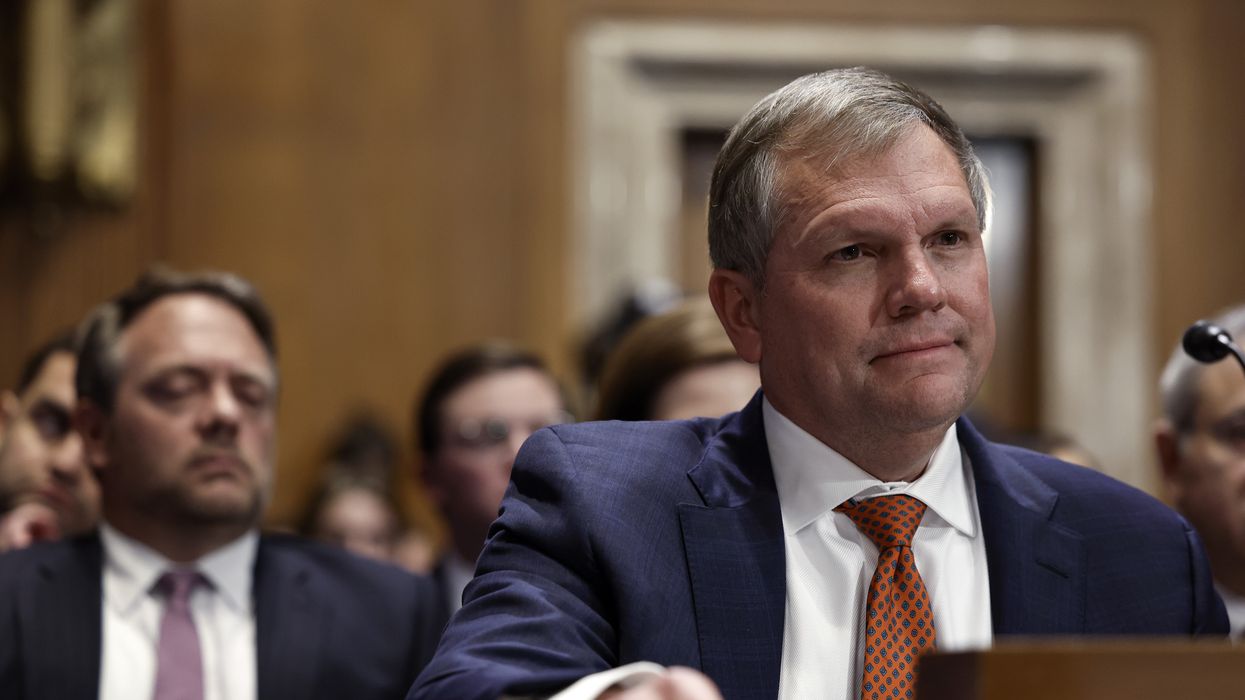
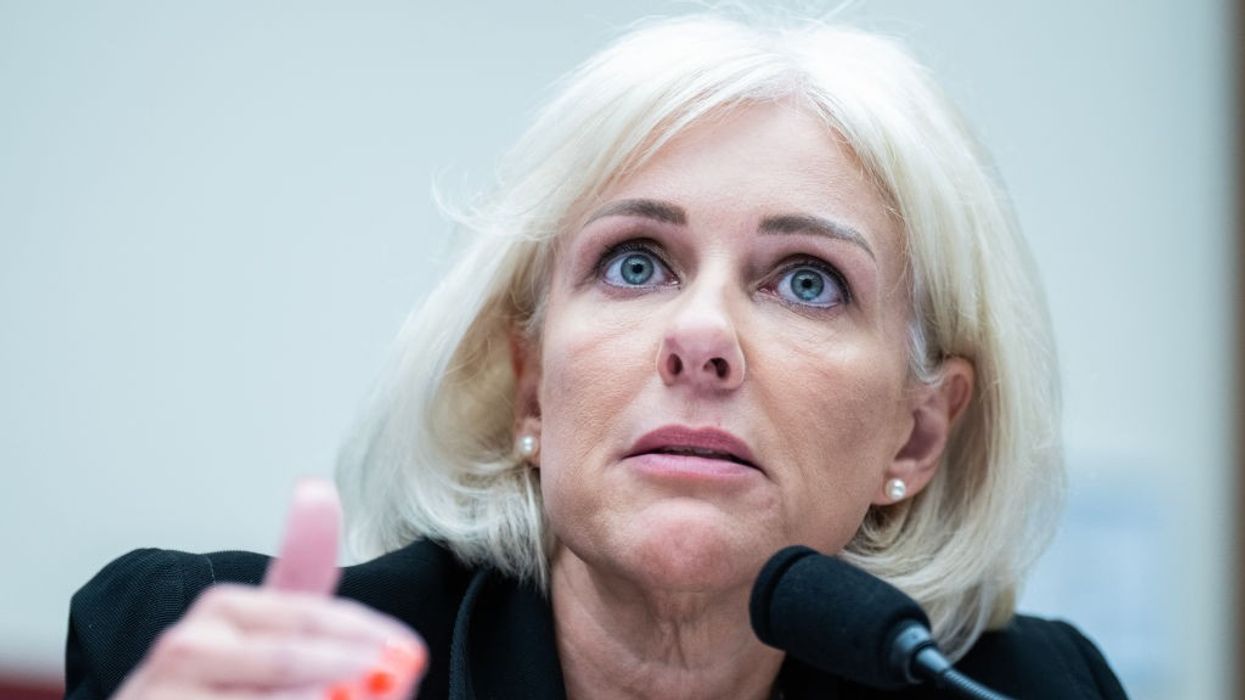
The chair of the National Transportation Safety Board on Tuesday condemned Norfolk Southern for interfering with its investigation into last year's East Palestine train crash and the "vent and burn" of harmful chemicals that followed.
The remarks came at the final NTSB hearing on the disaster, in which the agency released a preliminary report—damning to Norfolk Southern and its contractors—from a 17-month investigation. NTSB officials explained that a decision to intentionally burn vinyl chloride, a carcinogen, from five derailed train cars was flawed and resulted from the company's selective sharing of information with officials at the time.
Norfolk Southern's uncooperative approach didn't stop after the vent-and-burn, according to the NTSB. Throughout the investigation, the company delayed or avoided sharing information, sought to "manufacture" evidence, and even issued a "threat" to agency staff, Jennifer Homendy, the NTSB chair, said.
"Norfolk Southern's abuse of the party process was unprecedented and reprehensible," Homendy said, also describing it as "unconscionable."
She praised NTSB investigators "for their fortitude in the face of mounting pressure, for their laser focus on the facts."
Why is this so predictable? The head of the NTSB said Norfolk Southern repeatedly tried to interfere with the agency’s investigation into the East Palestine derailment. Oh, and the venting and burning of the chemicals was unnecessary and they failed to disclose it, too.
“Norfolk… pic.twitter.com/BrKYD0Cm6s
— Truthstream Media (@truthstreamnews) June 26, 2024
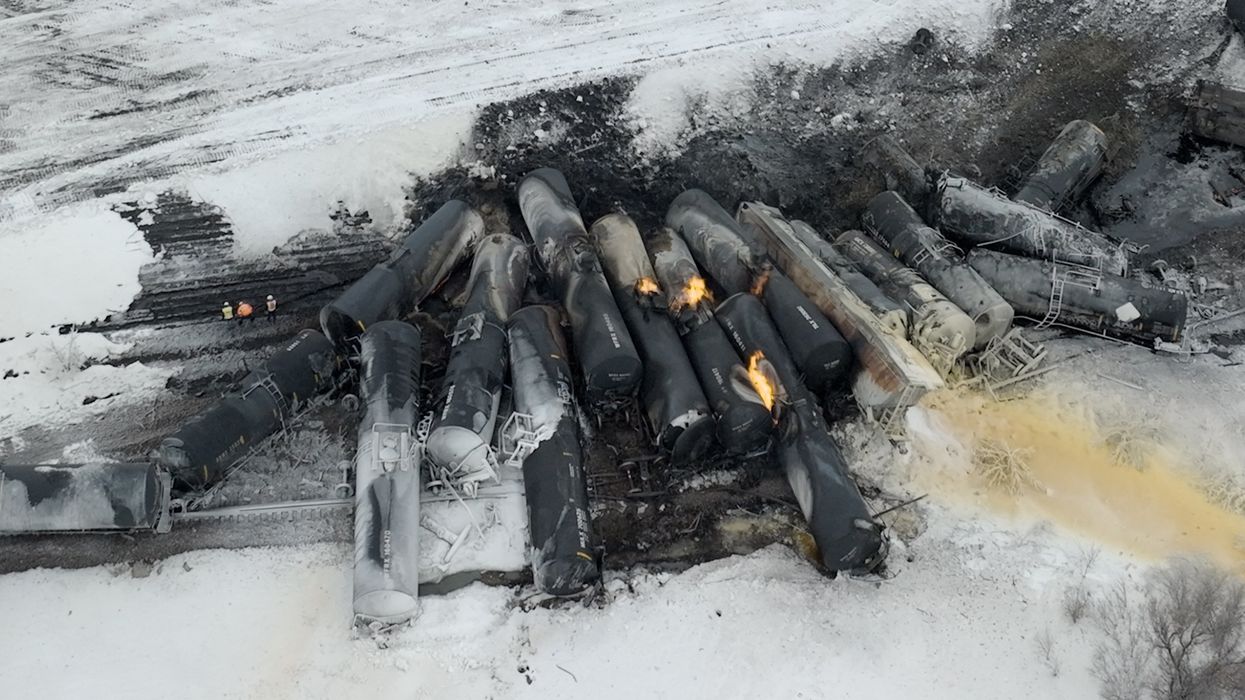
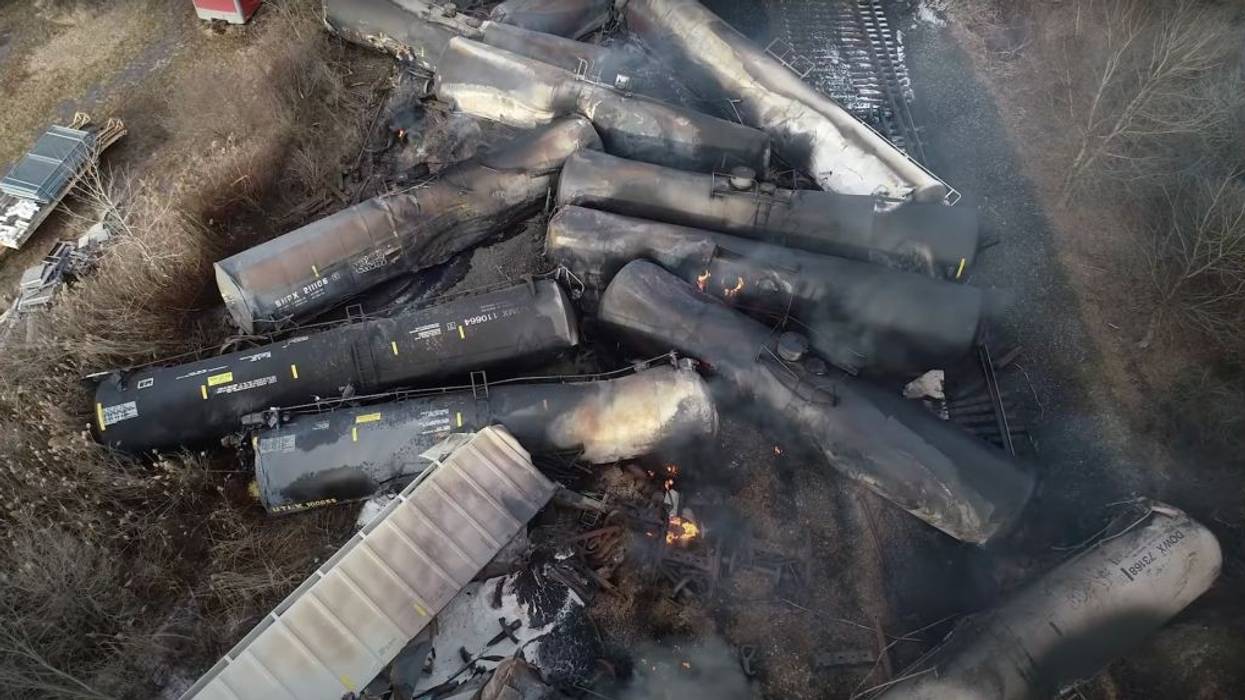
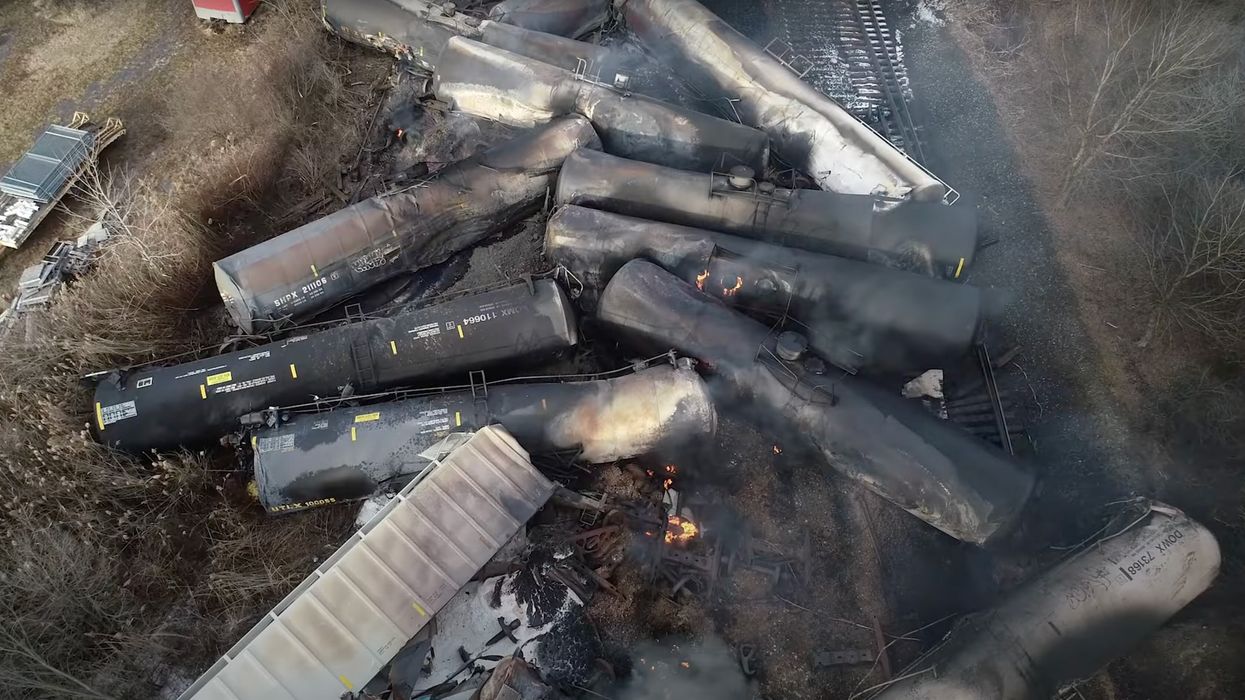
Dozens of train cars derailed in East Palestine, Ohio, a village near the Pennsylvania border, on February 3, 2023. Hazardous materials were released when a DOT-111 model of train car—not ideal for carrying hazardous materials—was punctured during the crash. This set off fires that spread more than 1,000 feet and lasted for days.
On February 6, concerned that there would be a large-scale explosion, the company got official approval to breach five train cars carrying the vinyl chloride, drained it into a trench, and set it alight in a controlled burn.
That vent-and-burn was "not necessary," says the NTSB's new report, which is set to be finalized in the coming weeks. Homendy had previously said as much while testifying to a congressional committee in March, and a former Environmental Protection Agency employee also said that the incineration likely went against federal regulations, as Common Dreams reported in March.
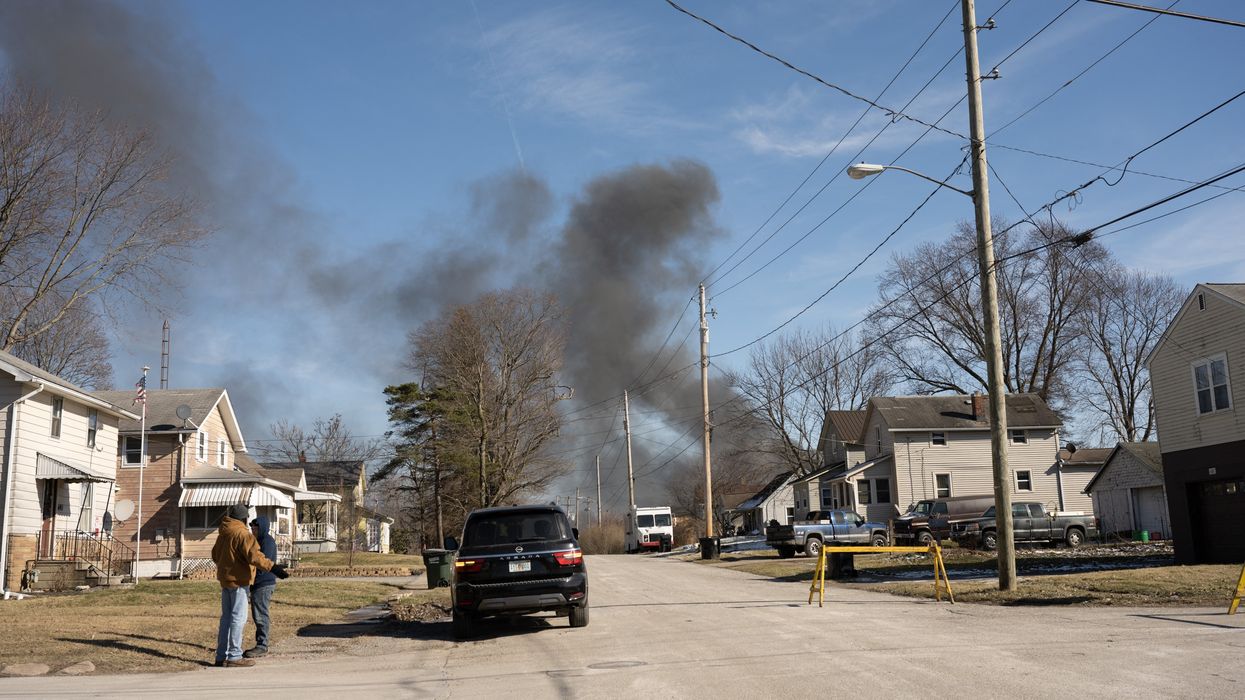
The burning of the vinyl chloride left a chemical odor over the town, and may have been the cause of nausea, rashes, and headaches. And its impact was not limited to East Palestine—the burned chemicals spread to 16 states and likely Canada, a study released last week found.
Tuesday's hearing helped clarify why the flawed decision to burn the vinyl chloride was made: Norfolk Southern didn't share all available information with authorities, and pressured them to approve the burn immediately.
Oxy Vinyls, the company that produced the chemical, had already assessed the situation and determined that a feared chemical reaction that could have led to an explosion wasn't happening, but Norfolk Southern didn't share this with the incident commander, the report says. The East Palestine fire chief has said the company gave him only 13 minutes to approve the burn; the new report cites "unwarranted urgency."
Norfolk Southern presented vent-and-burn as the only option, the report says.
"There was another option: Let it cool down," Homendy said previously.
In fact, the temperature of one of the train cars in question was already going down, indicating that the feared chemical reaction wasn't happening, but Norfolk Southern didn't share this fact with authorities, the report says.
The company's lack of transparency began even earlier: Firefighters and emergency personnel weren't told which hazardous materials were on board until an hour after they arrived.
"This resulted in greater exposure of emergency responders and to the public to post-derailment hazards," said NTSB investigator Troy Lloyd.
When a responder called Norfolk Southern to ask for more information about the materials on board, a company representative said they would call back, but never did, The Washington Post reported.
Krissy Ferguson, a 50-year-old local resident, told the Post that she felt "heartbroken" after the hearing and called for criminal charges to be filed.
Other local people expressed similar discontent with the company after the hearing.
"Community members deserve transparency and proactive protection, not the silence, secrecy, and manipulation that has been unveiled today about Norfolk Southern," East Palestine resident Misti Allison told The Associated Press.
Homendy expressed her own discontent with Norfolk Southern's approach to dealing with her agency. She said that a senior executive had requested that the agency "put to bed" the "rumor" that the company had rushed through the vent-and-burn to keep trains moving and had said that the results of the agency's investigation could "close a chapter" for the company and allow it to "move on."
Homendy said the request was not only "unethical and inappropriate," but also that the entire room full of NTSB staff perceived it as a "threat," as "it was delivered that way."
The alleged intimidation didn't have apparent effect. In addition to its findings about the accident and the burn, the NTSB on Tuesday set forth more than two dozen recommendations for stricter safety regulations, one of which is removing the DOT-111 model of train car from flammable liquids service.
The recommendations are not binding and must be enacted by Congress, which failed to pass a proposed package of railroad reforms last year likely due to industry lobbying and Republican resistance. The Biden administration did institute new regulations in April.
Norfolk Southern issued a statement in response to the NTSB's findings.
"We resolved not to wait for the NTSB's final report before taking decisive action," said John Fleps, the company's chief safety officer. "We will continue to build on our strong safety culture through partnership and innovation to be the gold standard of safety for the rail industry."
Fires after the February 2023 accident caused plumes of toxic chemicals to spread farther than researchers anticipated. "I think we should be concerned," an expert said.
Toxic chemicals released during fires following the Norfolk Southern train derailment in Ohio last year spread to 16 states and likely Canada, according to a study released Wednesday.
The pollution, some of which came from the burning of vinyl chloride, a carcinogen, spread over 540,000 square miles, showing clearly that "the impacts of the fire were larger in scale and scope than the initial predictions," the authors of the study, published in Environmental Research Letters, found.
Lead author David Gay, coordinator of the National Atmospheric Deposition Program, said that he was very surprised by the way the chemicals had spread. "I didn't expect to see an impact this far out," he told The Washington Post.
Gay said the results did not mean "death and destruction," as concentrations were low on an absolute scale—"not melting steel or eating paint off buildings"—but that they were still "very extreme" compared to normal, with measurements higher than recorded in the previous ten years.
"I think we should be concerned," Juliane Beier, an expert on vinyl chloride effects who didn't take part in the study, told the Post, citing the possibility of long-term environmental impacts on communities.
A Norfolk Southern train crashed in East Palestine, Ohio, a village near the Pennsylvania border and the Appalachian foothills, on February 3, 2023. Dozens of train cars derailed, at least 11 of which were carrying hazardous materials, some of which caught fire after the accident and burned for days. Fearing a large-scale explosion, authorities drained the vinyl chloride from five cars into a trench and set it alight in a controlled burn.
A former U.S. Environmental Protection Agency official later said that the controlled burn went against EPA rules; the head of the National Transportation Safety Board said the deliberate burning was unnecessary.
The local impact of the fires was felt acutely in the month after the accident—a "potent chemical odor hung in the air for weeks," according to The Guardian, and people reported nausea, rashes, and headaches.
The new study helps explain the wider environmental impact. The researchers looked at inorganic compound samples in rain and snow at 260 sites. The highest levels of chloride were found in northern Pennsylvania and near the Canada-New York border, which was downwind from the accident. The authors also found "exceptionally high" pH levels in rain as far away as northern Maine. They did not look at organic compounds such as dioxin or PFAS, which likely also spread following the accident, The Guardian reported. The elevated inorganic chemical levels dropped two to three weeks after the accident.
Norfolk Southern has agreed to pay nearly $1 billion in damages following two settlements reached in recent months. In April, the company reached a $600 million deal with class action plaintiffs living within 20 miles of the derailment site. That deal won't be finalized until the residents officially agree. In May, the company reached a separate $310 million settlement with the federal government. The company has said that it has already spent $107 million on community support and removed the impacted soil.
Norfolk Southern makes billions in profits every year, and the company gave its CEO a 37% pay hike last year, drawing widespread criticism. The company also spent $2.3 million on federal lobbying last year, according to OpenSecrets data reported by Roll Call.
"It's inconceivable that there wouldn't have been someone from the enforcement office, or general counsel, saying, 'Oh, Norfolk Southern wants to do an uncontrolled burn—that's illegal, you cannot do that," said a former EPA official.
A day after the head of the National Transportation Safety Board told Congress that the deliberate burning of toxic chemicals in five crashed train cars in East Palestine, Ohio last year was unnecessary, a former Environmental Protection Agency official said the so-called "controlled burn" also likely went against EPA regulations.
Kevin Garrahan, who worked for the agency for 40 years and focused on environmental risk assessment and hazardous waste cleanup, told HuffPost that soon after a Norfolk Southern train derailed in the town of 4,700 people, he alerted a former EPA colleague to a 2022 memo on the open burning and open detonation of waste explosives.
The memo described when local EPA officials can issue permits for the pre-planned combustion of waste explosives, and said the open burning of hazardous waste should be a last resort.
Because the EPA determined in 1987 that "open burning of nonexplosive waste could not be conducted in a manner that was protective of human health and the environment," the memo says, the method "is generally the least environmentally preferred treatment technology and, consistent with existing requirements, should only be available where there are no safe modes of treatment."
Considering laws banning the open burning of chemicals and the EPA's knowledge of the danger that was spelled out in the memo, the decision to allow emergency crews to blast holes in five train cars, drain the toxic vinyl chloride they were carrying into pits, and set the chemicals on fire seemed "incredibly stupid and reckless," Garrahan wrote to his colleague.
"Am I missing something?" he asked.
"The big question is if there is another train derailment involving toxic chemicals—and there will be—would EPA sit idly by and allow a state and a polluter to decide to do an open burn again?"
Garrahan's former colleague agreed that there were concerns about "OB/OD," or open burning and open detonation, but did not reply to Garrahan's later emails about the safety of the operation.
In a case of a private company directing a public official regarding their response to a potential public safety threat, East Palestine fire chief Keith Drabick told the NTSB that Norfolk Southern and its contractors pushed him to approve the deliberate burning of the vinyl chloride, a known carcinogen that has been linked to liver, brain, lung, and blood cancers as well as neurological damage. Drabick said railroad officials gave him just 13 minutes to make the decision.
Garrahan told HuffPost that the EPA, which deployed state and federal officials to the crash site, should have stepped in and cited the 2022 memo as proof that the so-called "controlled burn" that Norfolk Southern was suggesting actually fit the definition of open detonation.
"It's inconceivable that there wouldn't have been someone from the enforcement office, or general counsel, saying, 'Oh, Norfolk Southern wants to do an uncontrolled burn—that's illegal, you cannot do that," Garrahan said, calling the memo a "bombshell."
Instead, the EPA to this day has referred to the operation, which sent huge plumes of black smoke into the surrounding area and forced an evacuation of East Palestine, as a "controlled burn," suggesting any damage would have been contained.
The incineration of the vinyl chloride raised concerns about the release of dioxins, another class of toxic compounds that are linked to reproductive and developmental harms and are also carcinogenic. HuffPost reported that an EPA dioxin expert was not consulted about the Norfolk Southern derailment and its aftermath until a month after the accident.
Judith Enck, a former EPA regional administrator, told the outlet that the EPA went against their previous protocols, which were in place in 2012 when a train carrying vinyl chloride derailed in Paulsboro, New Jersey.
Officials in that case sealed off the affected cars and vacuumed the hazardous materials before taking it to a facility for safe disposal.
As Jennifer Homendy, chair of the NTSB, testified at a congressional hearing on Wednesday, Drabick and other officials tasked with approving the deliberate burn were not given all the relevant information they needed from Norfolk Southern about a potential spontaneous explosion.
The maker of the vinyl chloride in the cars, Oxy Vinyls, told the rail company that there was no hazardous chemical reaction happening in the crashed train.
"They believed polymerization was not occurring, and there was no justification to do a vent and burn," Homendy said. "There was another option: let it cool down."
Oxy Vinyls' input was not passed along to Ohio Gov. Mike DeWine, Drabick, or other local authorities who proceeded with the incineration that allowed Norfolk Southern to reopen the railroad the following day.
"Meanwhile," said Plain Dealer reporter Jake Zuckerman, "some of the locals are still stuck in hotels, that Norfolk Southern is no longer paying for. And they say they're suffering symptoms of chemical exposure, which the EPA and Norfolk Southern deny."
The EPA's decision-making in the case of East Palestine raises questions about the future safety of other American communities if a similar accident happens.
"EPA sat idly by when a major bad decision was made," Enck told HuffPost. "The big question is if there is another train derailment involving toxic chemicals—and there will be—would EPA sit idly by and allow a state and a polluter to decide to do an open burn again?"
"These companies siphon billions into share buybacks, dividends, and bonuses rather than into the vital maintenance and infrastructure growth we need to build a safe, modern, and thriving rail industry," said one worker.
After at least six major freight train derailments occurred across the United States over the past week, the need for stronger rail safety rules couldn't be clearer, an interunion alliance of rail workers said Monday.
"The recent uptick in derailments across the U.S. highlights the dire need for stricter regulations on the length and weight of trains, as well as a focus on preventing unsafe operational practices such as precision scheduled railroading (PSR) which prioritizes short-term financial gains for Wall Street over the safety of communities and railroad workers," Jason Doering, a locomotive engineer and general secretary of Railroad Workers United (RWU), said in a statement.
The past week "was not a good one" for the nation's Class 1 rail carriers, RWU observed.
On Sunday, March 26, a Canadian Pacific train carrying hazardous materials careened off the tracks outside Wyndmere, North Dakota, spilling liquid asphalt and ethylene glycol and releasing propylene vapor.
Last Monday, a Union Pacific iron ore train reached 118 miles per hour as it ran away down Cima Hill in the Mojave Desert before wrecking on a curve, destroying two locomotives and 55 cars in San Bernardino County, California.
On Wednesday, a Canadian National iron ore train derailed in Butler County, Pennsylvania.
On Thursday, a BNSF train carrying ethanol and corn syrup crashed near Raymond, Minnesota, causing a fire that forced local residents to flee.
On Friday, a Norfolk Southern train went off the tracks in Irondale, Alabama.
One day ago, a train operated by the Class 2 regional Montana Rail Link—soon to be owned by BNSF—derailed on the banks of the Clark Fork River in Paradise, Montana.
"The recent uptick in derailments across the U.S. highlights the dire need for stricter regulations on the length and weight of trains, as well as a focus on preventing unsafe operational practices such as precision scheduled railroading."
"Rail workers are not surprised to see the dramatic increase in rail incidents following the widespread cuts to the industry," said locomotive engineer and RWU steering committee member Paul Lindsey.
"Each year these companies siphon billions into share buybacks, dividends, and bonuses rather than into the vital maintenance and infrastructure growth we need to grow a safe, modern, and thriving rail industry," Lindsey added.
Norfolk Southern has become the poster child for freight industry greed as the toxic aftermath of February's fiery train derailment and ensuing chemical spill and burnoff continues to unfold in East Palestine, Ohio.
Questioned last month at a U.S. Senate hearing about the ongoing public health and environmental disaster, Norfolk Southern president and CEO Alan Shaw refused to commit to giving workers seven days of paid sick leave or halting stock buybacks.
More Perfect Union has calculated that payouts to Norfolk Southern's shareholders soared by more than 4,500% over the past 20 years, from $101 million in stock repurchases and dividend bumps in 2002 to $4.7 billion in 2022.
Shaw also refused to commit to ending PSR, the profit-maximizing scheduling system that forces fewer workers to manage longer trains in less time, even though unions and progressive lawmakers argue the Wall street-endorsed model makes the U.S. rail system more dangerous and contributes to the 1,500-plus derailments seen nationwide each year.
Although Norfolk Southern epitomizes how railroad executives prioritize profits above all else, the corporation is far from alone in pushing for deregulation and implementing anti-worker, pro-investor policies.
An OpenSecrets analysis published last month found that the rail industry spent more than $713 million lobbying against enhanced rail safety rules at the federal and state levels between 2002 and 2022. Top spenders include the Association of American Railroads trade group, CSX, Union Pacific, Norfolk Southern, and BNSF's parent company Berkshire Hathaway, which is owned by billionaire Warren Buffett.
While RWU has made the case for nationalizing the railroads, it has also outlined a plan for reforms that can be quickly implemented in the absence of such a sweeping transformation. Specific provisions the alliance has called for include sufficient staffing; limits on train length and weight; adequate maintenance and inspections; and better training and employee benefits.
Last week, Sens. John Fetterman (D-Pa.), Bob Casey (D-Pa.), and Sherrod Brown (D-Ohio) introduced the Railway Accountability Act, which includes some of the measures sought by RWU and is supported by unions including the Transport Workers of America (TWU), the National Conference of Firemen & Oilers (NCFO), and the International Association of Sheet Metal, Air, Rail, and Transportation Workers-Mechanical Division (SMART-MD).
Questioned at a Senate hearing on the East Palestine disaster, Alan Shaw also wouldn't agree to end "precision-scheduled railroading," a Wall Street-led profit-maximizing approach that critics say endangers communities nationwide.
Thursday's U.S. Senate hearing about the ongoing environmental and public health disaster in East Palestine, Ohio "did not go well" for Norfolk Southern president and CEO Alan Shaw, the progressive media outlet More Perfect Union declared.
Shaw refused to commit to providing workers with seven days of paid sick leave, ceasing stock buybacks, and abandoning Wall Street-endorsed policies that critics say contribute to the 1,500-plus derailments seen each year in the U.S., including Norfolk Southern's toxic crash near the Ohio-Pennsylvania border last month as well as a derailment that happened in Alabama just before the multimillionaire executive testified.
In remarks prepared for the Senate Committee on Environment and Public Works, Shaw wrote, "I am deeply sorry for the impact this derailment has had on the people of East Palestine and surrounding communities, and I am determined to make it right."
But during the committee's hearing, Shaw refused to use the multiple opportunities he was given to publicly commit to enacting meaningful changes.
Noting that Norfolk Southern has recently rewarded wealthy investors with $10 billion in stock buybacks, Independent Sen. Bernie Sanders of Vermont asked Shaw if he could "tell the American people and your employees right now that... you will guarantee at least seven paid sick days to the 15,000 workers you employ."
Sanders acknowledged that Norfolk Southern recently agreed to provide up to a week of paid sick leave per year to roughly 3,000 track maintenance workers. However, he asked Shaw, "Will you make that commitment right now to your entire workforce?"
"I will commit to continuing to discuss with them important quality-of-life issues," Shaw responded.
Sanders told Shaw he sounds "like a politician" and reiterated his question, but the executive repeated his dodge.
Sanders, chair of the Senate Health, Education, Labor, and Pensions Committee, then told Shaw that he looks forward to discussing the matter further, hinting at a potential request to testify before the panel he leads.
Later during the hearing, Democratic Sen. Jeff Merkley of Oregon asked Shaw, "Will you pledge today that you will do no more stock buybacks until a raft of safety measures have been completed to reduce the risk of derailments and crashes in the future?"
Once again, Shaw refused to give a straight answer, saying that he will commit to "continuing to invest in safety." Merkley repeated his question, to no avail.
More Perfect Union has calculated that payouts to Norfolk Southern's shareholders surged by more than 4,500% over the past 20 years, from $101 million in stock repurchases and dividend bumps in 2002 to $4.7 billion in 2022.
In response to Merkely's inquiry, Shaw claimed that thanks to his company's safety investments, "the number of derailments, hazardous material releases, and personal injuries has declined" over time.
Not helping Shaw's case, a Norfolk Southern train careened off the tracks in Calhoun County, Alabama around 6:45 am ET on Thursday, about three hours before the hearing began. The rail giant was also responsible for other derailments last month in addition to the highly visible one in East Palestine. Moreover, a Norfolk Southern conductor was killed in a collision in Ohio early Tuesday.
More Perfect Union shared data showing that Norfolk Southern's accident rate grew faster than the industry average over the past decade and accused the CEO of lying about his company's safety record.
According to Railroad Workers United and others, industry-led deregulation and Wall Street-backed policies such as "precision-scheduled railroading" (PSR) have made the U.S. rail system more dangerous.
During Thursday's hearing, Sanders brought up PSR, which forces fewer workers to manage longer trains in less time.
The profit-maximizing practice championed by Wall Street has enabled Norfolk Southern to rake in billions of dollars while reducing the size of its workforce by nearly 40% over a recent six-year period, said Sanders, but that has come at the expense of safety.
"Will you make a commitment right now to the American people that you will lead the industry in ending this disastrous precision-scheduled railroading?"
Despite Sanders' request for a "yes or no" answer, Shaw danced around the question, saying that he has increased hiring since becoming CEO last May.
Sanders characterized the recent uptick in hiring as an attempt to recover from a preceding round of mass layoffs and asked once again if Shaw "will lead the industry in doing away with" the PSR model that was "imposed" by profit-hungry Wall Street actors.
Shaw, however, refused to commit to such a change.
Thursday's hearing comes two days after the National Transportation Safety Board—which is already probing the causes of the East Palestine disaster—announced a "special investigation" into Norfolk Southern's "organization and safety culture."
It also comes less than a month after Shaw angered East Palestine residents by skipping a town hall where people expressed their concerns over the long-term consequences of air pollution and groundwater contamination stemming from the release and burnoff of carcinogenic chemicals, a move that was made to avoid a catastrophic explosion.
Following the hearing on Capitol Hill, Food & Water Watch executive director Wenonah Hauter said in a statement that "Shaw's apology today rings hollow," coming as it did "after years spent pushing to roll back the very sorts of safety regulations that would have prevented an accident like this."
"If Norfolk Southern had real concern for the safety of the countless communities like East Palestine through which their trains run, they would be calling for more safety measures for the industry," said Hauter. "Instead they offer voluntary steps that can easily be undone, prioritizing profit margins over people."
"We need systemic reforms to stop the petrochemical industry from having carte blanche to profit off of poisoning people and the planet," says the international Break Free From Plastic alliance.
One month after a fiery train crash in East Palestine, Ohio sparked an ongoing environmental and public health crisis, an anti-plastic coalition on Friday highlighted how the petrochemical industry poisons communities across the United States and called for "systemic change."
The Norfolk Southern-owned train that derailed and ignited near the Ohio-Pennsylvania border on February 3 was overloaded with hazardous materials, many of them derived from fossil fuels. To avert a catastrophic explosion, authorities released and burned vinyl chloride—a carcinogenic petrochemical used to make plastic—from five tanker cars, provoking residents' fears about the long-term health impacts of toxic air pollution and groundwater contamination.
"This is a plastics and petrochemical disaster," the global Break Free From Plastic (BFFP) coalition said Friday in a statement.
According to the coalition:
A preliminary report by the National Transportation Safety Board (NTSB) found that the train derailment was caused by a hot axle that heated one of the train cars carrying polypropylene plastic pellets, according to NTSB Chair Jennifer Homendy. These plastic pellets serve as the pre-production materials that corporations manufacture into shampoo bottles, plastic cups, and other single-use items. The highly combustible, fossil fuel-derived pellets ignited the initial fire aboard the Norfolk Southern train, which led to its derailment.
In addition to the pellets, yet another plastic building block is at the heart of this disaster: vinyl chloride. Vinyl chloride is a known human carcinogen used almost exclusively to produce polyvinyl chloride, also known as PVC plastic, which is often turned into pipes, flooring, shower curtains, and even plastic food wrap. Not only is vinyl chloride toxic and harmful itself, Norfolk Southern's burning of the chemical likely resulted in dioxins, one of the most persistent and toxic chemicals, even at low levels of exposure.
In response to public pressure, the U.S. Environmental Protection Agency (EPA) on Thursday ordered Norfolk Southern to test for dioxins, a class of highly toxic industrial byproducts that the agency had previously opted to ignore in the East Palestine disaster zone.
"While we're glad to see this announcement, we wish it had come sooner," said Graham Hamilton, U.S. policy officer at BFFP. "Justice delayed is justice denied, and we expect more from an administration that claims to prioritize environmental justice."
Mike Schade, director of Toxic-Free Future's Mind the Store campaign, said that "the EPA must not only test for dioxins in soil, but also in indoor dust, sediments, fish, and on farms impacted by the massive plume."
"Importantly, the EPA should be conducting the testing itself and/or hiring independent scientists to test for dioxins, rather than requiring the community of East Palestine to rely on Norfolk Southern for that accountability," said Schade.
"This disaster is yet another painful reminder of the dangers of making, transporting, using, and disposing of chemicals in plastics, especially polyvinyl chloride (PVC) plastic," Schade added. "Governments, retailers, and brands must redouble their efforts to phase out PVC plastic and other highly hazardous plastics and chemicals and move towards safer solutions."
The U.S. is home to more than 1,000 train derailments per year, and according to one estimate, the country is averaging one chemical disaster every two days.
Low-income communities in the Ohio River Valley and along the Gulf Coast are disproportionately harmed by the petrochemical industry.
"These communities subsidize the cost of cheap disposable plastic at the fenceline of oil rigs, petrochemical plants, incinerators, and the trains and trucks used for transporting the toxic and deadly chemicals," said Yvette Arellano, the founder and director of Fenceline Watch, a Texas-based advocacy group and BFFP member.
"The price we pay is with our lives, from shortened lifespans [to] reproductive harm [and] developmental issues; these toxics trespass our bodies and harm our communities for generations," added Arellano, whose organization helped pressure the EPA to halt the 1,300-mile shipment of contaminated wastewater from East Palestine to the Houston area, where it had been slated to be injected underground.
"The petrochemical industry is inherently unsafe. Even standard operations pollute and damage communities, and regulators continue to fail to do the bare minimum to hold polluters accountable."
As BFFP pointed out, the ongoing East Palestine disaster "is not the only petrochemical crisis" hurting residents of the Ohio River Valley.
"Less than 15 miles from the derailment site," a new Shell facility in Beaver County, Pennsylvania "has received numerous violations and exceeded its annual emissions limits since coming online in November of 2022," the coalition pointed out.
As Andie from the Eyes on Shell watchdog group observed: "With the community already on edge, just one week following the release and burn in East Palestine, Shell activated an enormous emergency flare which, without warning, continued flaring for hours. The derailment and emergency flare are terrifying reminders of the risks the petrochemical industry poses to our community every single day."
Earthworks campaigner Anaïs Peterson stressed that "the petrochemical industry is inherently unsafe."
"Even standard operations pollute and damage communities," said Peterson, "and regulators continue to fail to do the bare minimum to hold polluters accountable."
Amanda Kiger of River Valley Organizing (RVO)—a Columbiana County-based group that has been working to support East Palestine residents since the derailment—said that "nobody should have their entire lives upended because Norfolk Southern and makers of these hazardous chemicals put their profits ahead of the safety of our communities and our country."
"With people developing rashes and breathing problems, it's clear people are still being exposed to dangerous chemicals," said Kiger. "Norfolk Southern should give residents the resources to relocate and should pay for independent testing of the soil, water, and air, as well as medical exams and follow-up for years to come."
Ultimately, BFFP argued, "we need systemic reforms to stop the petrochemical industry from having carte blanche to profit off of poisoning people and the planet."
Despite BFFP's demands for a robust, legally binding global plastics treaty that prohibits corporations from manufacturing an endless stream of toxic single-use items, Inside Climate News reported this week that the initial proposal from the Biden administration's delegation to the United Nations was described as "low ambition" and "underwhelming" because it "sidesteps calls for cuts in production, praises the benefits of plastics, and focuses on national priorities versus global mandates."
"Every day that this community doesn't have relocation options," said local organizers, "is another day this community is in crisis."
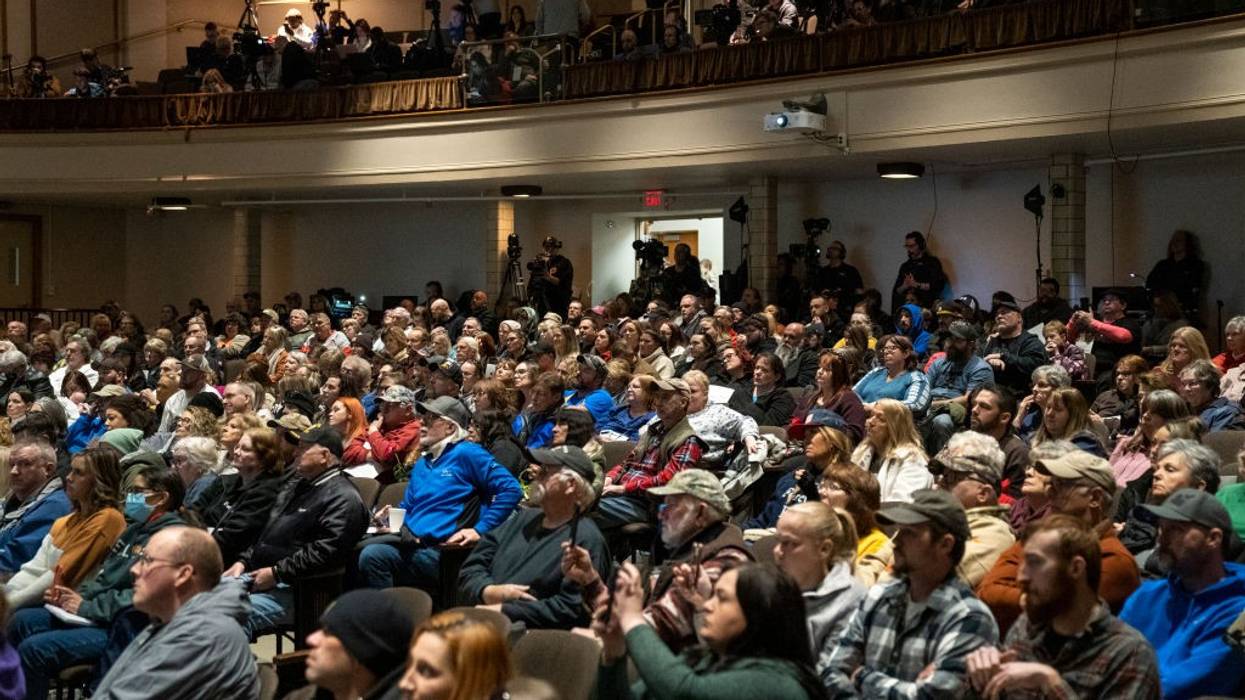
At a town hall meeting in East Palestine, Ohio Thursday night, hundreds of residents had their first chance to directly confront the rail company responsible for the train derailment that took place in the town last month, and used the opportunity to share their outrage over Norfolk Southern's failure to keep residents safe following its release of toxic chemicals from the crash site.
Residents called on the company representative present at the meeting to "do the right thing" and ensure Norfolk Southern pays to evacuate anyone who wants to leave the town following the controlled release of vinyl chloride, a carcinogenic chemical that was carried by several of the cars on the train that derailed.
The burning of vinyl chloride can send hydrogen chloride and phosgene—which was used in chemical warfare during World War II—into the environment. The chemicals are known to cause headaches, vomiting, and rashes, among other symptoms.
"Every day that this community doesn't have relocation options, independent environmental testing, comprehensive health monitoring, and safe disposal of this toxic waste, is another day this community is in crisis."
Those symptoms, as well as lingering chemical smells, have been reported by East Palestine residents since the February 3 derailment, despite officials' claims that the area is safe.
Tests on more than 150 private well systems and municipal water has not shown disconcerting contamination levels thus far, according to officials, but locals reported serious concerns about the long-term safety of their town.
"Get my grandchildren out of here!" one man demanded as the Norfolk Southern representative said the company feels "horrible" about the derailment, which prompted a temporary evacuation of some residents.
"If you care about us, get our grandkids out," he added.
As "CBS Mornings" reported, other East Palestine residents told the representative and state and federal officials who attended the meeting that they feel "stuck" in the town as their symptoms persist.
One woman told the officials she has witnessed "kids vomiting, nosebleeds, numbness in their mouth, numbness in their fingers."
The meeting was held weeks after Norfolk Southern officials backed out of attending a previous town hall meeting in the days after the crash, citing safety concerns.
Last week, the EPA ordered Norfolk Southern to take full responsibility for cleaning up any contamination, issuing a legally binding order that also required the company to take part in public meetings.
Ahead of the Thursday meeting, the EPA also ordered testing in East Palestine for dioxins, which can also form when vinyl chloride is burned. Dioxins are already present in the environment and are a byproduct of fuel burning, and the agency has held off on testing for them. River Valley Organizing (RVO), a local grassroots organization, said public pressure from locals pushed officials to conduct the testing.
Earlier this week, RVO released a list of five demands from East Palestine residents that were agreed upon at another community meeting, including:
The company has removed 2.1 million gallons of wastewater and 1,400 tons of solid waste so far, but its shipment of the waste to towns in Texas and Michigan have led to outcry from locals and officials, leading the EPA to order a temporary pause on the shipments this week.
"Every day that this community doesn't have relocation options, independent environmental testing, comprehensive health monitoring, and safe disposal of this toxic waste," said RVO on Friday, "is another day this community is in crisis."
"We can't trust giant corporations like Norfolk Southern to keep communities safe out of the goodness of their hearts," said Rep. Chris Deluzio. "They're in it for profits, plain and simple."
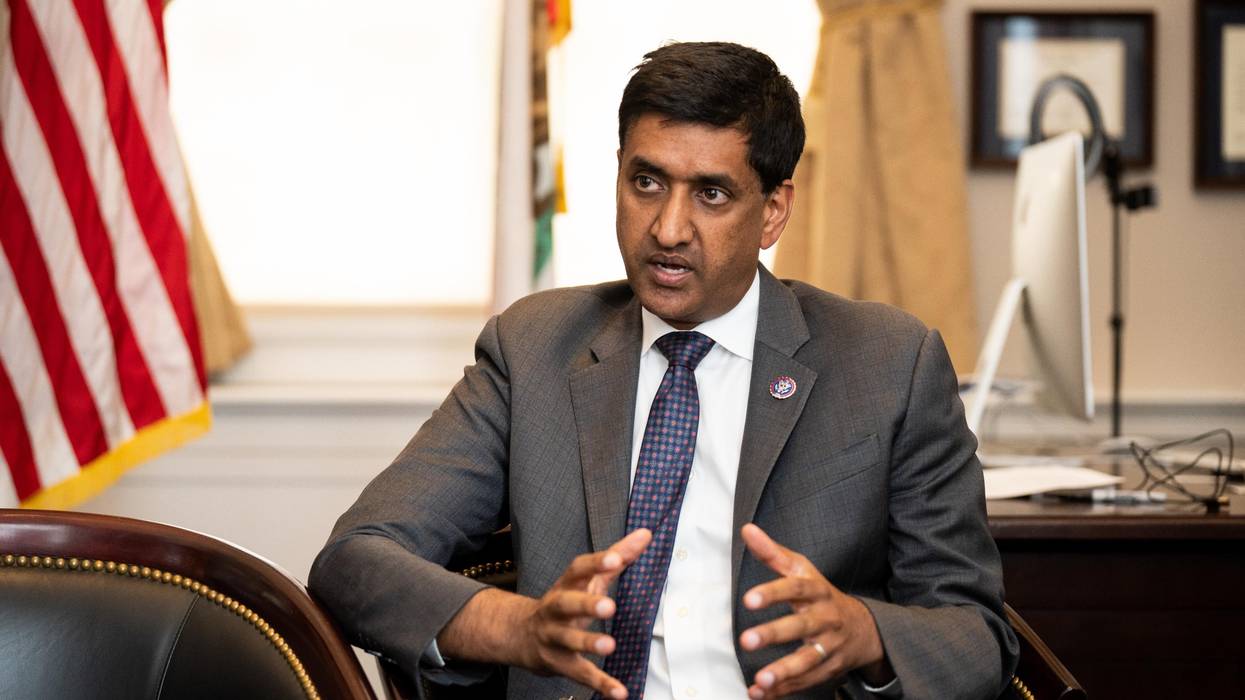
Democratic Reps. Ro Khanna of California and Chris Deluzio of Pennsylvania introduced legislation Tuesday that would require the U.S. Transportation Department to impose more strict regulations on trains carrying hazardous materials, an effort to prevent disasters like the toxic derailment in East Palestine, Ohio from happening in the future.
"The people in East Palestine and western Pennsylvania are the working-class folks who feel invisible and abandoned by our nation," Khanna said in a statement. "This is a moment where we need political leaders from all parties and from across the country to speak out loudly for better safety regulations and to acknowledge what so many Americans are going through."
If passed, the Decreasing Emergency Railroad Accident Instances Locally (DERAIL) Act would direct the head of the Department of Transportation to "modify the definition of 'high-hazard flammable train' to mean a single train transporting one or more loaded tank cars of a Class 3 flammable liquid or a Class 2 flammable gas and other materials the secretary determines necessary for safety."
Thanks in part to aggressive industry lobbying, the Transportation Department currently defines a high-hazard flammable train as one carrying hazardous materials in at least 20 consecutive cars or 35 total, limiting the number of trains subject to more stringent safety rules.
Deluzio, who represents constituents located just miles from the East Palestine derailment, said in a statement that many people are "worried about their health and livelihoods and whether their air, water, and soil will be safe" after the East Palestine wreck.
"Following this derailment, many of them are worried about their health and livelihoods and whether their air, water, and soil will be safe after this disaster," Deluzio added. "They want answers, accountability, and assurance that something like this will never happen again. For too long, railroads have prioritized profit ahead of public safety and their workers, and it is time to regulate the railroads. This legislation is an important step forward to finally strengthen our rail regulations and improve rail safety in communities like Western Pennsylvania and across America."
As The Lever has reported, the Norfolk Southern train that derailed in eastern Ohio and spilled toxic chemicals—including the flammable carcinogen vinyl chloride—was not being regulated as a "high-hazard flammable train" (HHFT) due to a narrow definition of the category adopted by the Obama administration.
"The Obama administration in 2014 proposed improving safety regulations for trains carrying petroleum and other hazardous materials," The Lever noted earlier this month. "However, after industry pressure, the final measure ended up narrowly focused on the transport of crude oil and exempting trains carrying many other combustible materials."
"Then came 2017," The Lever continued. "After rail industry donors delivered more than $6 million to GOP campaigns, the Trump administration—backed by rail lobbyists and Senate Republicans—rescinded part of that rule aimed at making better braking systems widespread on the nation's rails."
In addition to requiring tougher regulation of trains carrying hazardous substances, Khanna and Deluzio's bill would require rail carriers involved in any potentially toxic derailment to provide the National Response Center, state and local officials, and tribal governments with a list of dangerous materials present on the train no later than 24 hours after the crash.
The House Democrats' legislation comes as Transportation Secretary Pete Buttigieg is facing growing pressure to strengthen lax regulations that are allowing railroad giants like Norfolk Southern to cut corners in pursuit of greater profits—often with dangerous consequences.
More than 1,000 trains derail in the United States each year, according to one estimate. A recent USA Today analysis found that hazardous material violations by rail companies "appear to be climbing," with federal inspectors flagging 36% more infractions over the last five years than they did in the preceding half-decade.
The Norfolk Southern train that crashed in eastern Ohio had a reputation among workers as a serious safety hazard. The train, formally known as 32N but nicknamed "32 Nasty," included around 20 cars carrying hazardous chemicals.
Greg Hynes, the national legislative director of SMART Transportation Division—the union that represents the workers who staffed the derailed Norfolk Southern train—said Tuesday that Khanna and Deluzio's proposal represents "positive action to improve rail safety for Pennsylvania and America."
PennEnvironment executive director David Masur agreed, saying the measure would "take commonsense and important steps to improve reporting and the public's right to know about volatile and hazardous materials rumbling through U.S. communities every day."
"As the derailment and explosion in East Palestine, Ohio showed us," Masur said, "federal laws excluding freight companies from reporting the dangerous and explosive materials that they are carrying have loopholes large enough to drive a train through."
The hazardous chemicals being transported by the derailed train — including vinyl chloride, a known carcinogen — are used to make PVC, the world’s third most used type of plastic.
Last December, I testified in the US Senate at its first-ever public hearing about plastics. I called for a 50 percent reduction in the nation’s production of plastics over the next decade. That was immediately met with criticism by the plastics and chemical lobbyists. These lobbyists are not the ones living in East Palestine, Ohio, where a train derailment spewed dangerous chemicals into the air, soil, and water. They’re not the ones living in neighborhoods next to railroad tracks. They’re not the ones facing health risks from plastic production plants in their backyards every single day.
The East Palestine disaster was a direct result of the country’s reliance on fossil fuels and plastic. The hazardous chemicals being transported by the derailed train — including vinyl chloride, a known carcinogen — are used to make PVC, the world’s third most used type of plastic, typically used in pipes to deliver drinking water, packaging, gift cards, and toys that kids chew on.So let’s be clear about what happened this month in Ohio: Thousands of residents were ordered to evacuate — all to make PVC plastics. People reported rashes, headaches, and other symptoms associated with chemical exposure — all to make PVC pipes used to deliver drinking water, when alternatives to PVC piping exist. Thousands of fish in nearby streams were killed — all to make plastic toys our children play with and chew on. Ohioans’ drinking water may have been threatened — all to make cheap vinyl shower curtains.
When I talk to restaurant owners about the need to eliminate plastic packaging, they often say they use plastic because it’s cheap. Don’t tell residents of eastern Ohio and western Pennsylvania that plastics are cheap — or the people of Louisiana and Texas, living in the shadow of where PVC is manufactured.Plastic’s risks to human health shouldn’t be understated. Long-term exposure to vinyl chloride is associated with lymphoma, leukemia, and cancers of the brain and lungs. It can increase the risk of miscarriage and birth defects in pregnant women. Experts have advised East Palestine farmers and other residents to test their wells over the next few months in order to protect the health of both people and livestock. A Cornell University scientist stated that nearby soil should be tested to make sure crops aren’t contaminated.
Plastic is not cheap. Just ask the Americans living this nightmare. No parent should have to worry about their little ones digging in the dirt or splashing around in the local creek. Residents will be dealing with this toxic train derailment for years to come.
They deserve better. We all do. Plastic threatens human health at every stage of its life cycle, from the toxic substances released into the air during fossil fuel extraction, to the dangerous transport of these chemicals, to the plastic particles and toxins we consume from our food and drinking water, to the hazardous emissions from facilities burning or burying the waste after consumer use.
East Palestine made headlines because most people don’t expect these strikingly obvious displays of chemical contamination from plastic. However, in areas like Louisiana’s Cancer Alley — an 85-mile stretch of petrochemical plants along the Mississippi River — the danger is a daily reality. It consists primarily of Black and low-income neighborhoods, which suffer from an unusually high number of cancer cases on top of the constant threat of chemical accidents.Plastic is not cheap. And Americans will continue to pay the price as plastic production grows. In East Palestine, residents should be provided with long-term medical monitoring and Norfolk Southern Railway should be held fully accountable for all costs, including damages to natural resources.
On a national level, labor unions must be taken more seriously when they express safety concerns — and guaranteed more time off. Congress needs to stop caving to railroad industry lobbyists and require braking improvements and tighter regulation of rail cars.
Finally, our national leaders must pass federal policies reducing the production and use of unnecessary plastic. PVC is a great place to start — Taiwan, Korea, and New Zealand have already banned it in food packaging. In Massachusetts, state Representative Michael Day introduced a bill to reduce packaging and some of its toxic substances. The bill bans PVC and PFAS (also known as “forever chemicals”) in all consumer packaging.
Big Plastic has spent decades distracting the public from the industry’s responsibility in the plastic pollution crisis — which is also a climate and health crisis — and their lobbyists continue to shape legislation that prioritizes profits over people. It’s time our elected officials put their collective foot down, hold companies accountable, protect people from plastic, and pass policies curbing plastic production. Americans deserve better.
Brockovich's Friday night Town Hall filled the auditorium and also two overflow rooms at East Palestine High School
"Unfortunately, this is not a quick fix," activist Erin Brockovich said to a packed crowd in an East Palestine, Ohio High School auditorium Friday night. "This is going to be a long game."
About 2,500 people and 100 reporters attended the town hall meeting with the crowd spilling into the school gymnasium. Brockovich, who became an activist in 1993 battling Pacific Gas & Electric Co. over groundwater contamination in Hinkley, California, told the audience to fight back and trust their instincts.
Brockovich and attorneys warned of long-term health and environmental dangers from the chemicals released after the fiery train derailment in East Palestine.
"I can't tell you how many communities feel that these moments are the biggest gaslight of their life," Brockovich told the audience.
"I've never seen in 30 years a situation like this," she said, warning residents that what her team was going to present them may scare them. "... I feel your angst, and I feel your frustration. And I want to share something with you; you're not alone."
"You want to be heard, but you’re going to be told it’s safe; you’re going to be told not to worry,” she said. “That’s just rubbish because you’re going to worry. Communities want to be seen and heard.”
“These chemicals take time to move in the water. You’re going to need groundwater monitoring. People on well water: You really need to be on alert. They’re going to need to implement soil vapor intrusion modeling. Believe us. It’s coming,” she said.
“You start getting 50 and 100,000 pissed-off moms together — I’m telling you right now: Things change,” she said.
“You have the ability to become — and you will become — your own critical thinker. You will vet information; you will ask questions, you will demand answers. You will listen to that gut and that instinct that will keep you connected as a community,” Brockovich said. “Don’t let what’s happened here divide you.”
A presentation followed Brockovich's speech by Texas lawyer Mikal Watts, who cited rulings by the Ohio Supreme Court to explain why he could not offer advice on specific cases in a public meeting or stay after the meeting to answer questions.
Watts did, however, say: "I'm begging you — for your own good — go get your blood and urine tested now."
Environmental advocate Erin Brockovich joins East Palestine residents in town hall meetingEnvironmental advocate Erin Brockovich will attend a town hall meeting in East Palestine, Ohio Friday evening to talk with ...
Common Dreams reported Friday that almost half of U.S. voters surveyed by progressive think tank Data for Progress blame rail company Norfolk Southern for the February 3 train derailment in East Palestine, Ohio which forced 1,500 residents to evacuate, contaminated soil and water, and has been blamed for causing a number of symptoms even as officials claim air and water monitoring hasn't shown dangerous levels of pollution.
Forty-nine percent of the 1,243 people surveyed by Data for Progress from February 17-22 said they believed Norfolk Southern was responsible for the crash, including 50% of Democrats, 52% of Independents, and 47% of Republicans.