SUBSCRIBE TO OUR FREE NEWSLETTER
Daily news & progressive opinion—funded by the people, not the corporations—delivered straight to your inbox.
5
#000000
#FFFFFF
To donate by check, phone, or other method, see our More Ways to Give page.
Daily news & progressive opinion—funded by the people, not the corporations—delivered straight to your inbox.
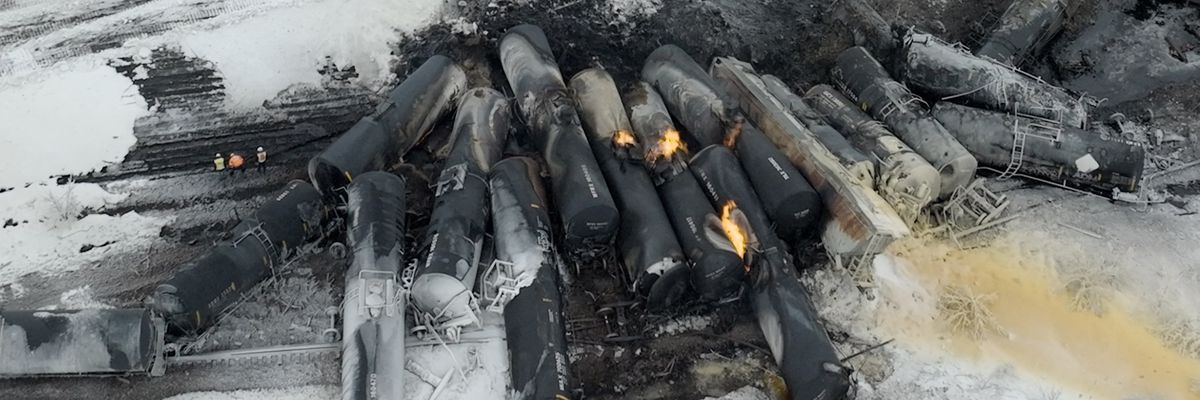
This aerial photo shows the aftermath of a fiery BNSF train derailment that occurred near Raymond, Minnesota on March 30, 2023.
"These companies siphon billions into share buybacks, dividends, and bonuses rather than into the vital maintenance and infrastructure growth we need to build a safe, modern, and thriving rail industry," said one worker.
After at least six major freight train derailments occurred across the United States over the past week, the need for stronger rail safety rules couldn't be clearer, an interunion alliance of rail workers said Monday.
"The recent uptick in derailments across the U.S. highlights the dire need for stricter regulations on the length and weight of trains, as well as a focus on preventing unsafe operational practices such as precision scheduled railroading (PSR) which prioritizes short-term financial gains for Wall Street over the safety of communities and railroad workers," Jason Doering, a locomotive engineer and general secretary of Railroad Workers United (RWU), said in a statement.
The past week "was not a good one" for the nation's Class 1 rail carriers, RWU observed.
On Sunday, March 26, a Canadian Pacific train carrying hazardous materials careened off the tracks outside Wyndmere, North Dakota, spilling liquid asphalt and ethylene glycol and releasing propylene vapor.
Last Monday, a Union Pacific iron ore train reached 118 miles per hour as it ran away down Cima Hill in the Mojave Desert before wrecking on a curve, destroying two locomotives and 55 cars in San Bernardino County, California.
On Wednesday, a Canadian National iron ore train derailed in Butler County, Pennsylvania.
On Thursday, a BNSF train carrying ethanol and corn syrup crashed near Raymond, Minnesota, causing a fire that forced local residents to flee.
On Friday, a Norfolk Southern train went off the tracks in Irondale, Alabama.
One day ago, a train operated by the Class 2 regional Montana Rail Link—soon to be owned by BNSF—derailed on the banks of the Clark Fork River in Paradise, Montana.
"The recent uptick in derailments across the U.S. highlights the dire need for stricter regulations on the length and weight of trains, as well as a focus on preventing unsafe operational practices such as precision scheduled railroading."
"Rail workers are not surprised to see the dramatic increase in rail incidents following the widespread cuts to the industry," said locomotive engineer and RWU steering committee member Paul Lindsey.
"Each year these companies siphon billions into share buybacks, dividends, and bonuses rather than into the vital maintenance and infrastructure growth we need to grow a safe, modern, and thriving rail industry," Lindsey added.
Norfolk Southern has become the poster child for freight industry greed as the toxic aftermath of February's fiery train derailment and ensuing chemical spill and burnoff continues to unfold in East Palestine, Ohio.
Questioned last month at a U.S. Senate hearing about the ongoing public health and environmental disaster, Norfolk Southern president and CEO Alan Shaw refused to commit to giving workers seven days of paid sick leave or halting stock buybacks.
More Perfect Union has calculated that payouts to Norfolk Southern's shareholders soared by more than 4,500% over the past 20 years, from $101 million in stock repurchases and dividend bumps in 2002 to $4.7 billion in 2022.
Shaw also refused to commit to ending PSR, the profit-maximizing scheduling system that forces fewer workers to manage longer trains in less time, even though unions and progressive lawmakers argue the Wall street-endorsed model makes the U.S. rail system more dangerous and contributes to the 1,500-plus derailments seen nationwide each year.
Although Norfolk Southern epitomizes how railroad executives prioritize profits above all else, the corporation is far from alone in pushing for deregulation and implementing anti-worker, pro-investor policies.
An OpenSecrets analysis published last month found that the rail industry spent more than $713 million lobbying against enhanced rail safety rules at the federal and state levels between 2002 and 2022. Top spenders include the Association of American Railroads trade group, CSX, Union Pacific, Norfolk Southern, and BNSF's parent company Berkshire Hathaway, which is owned by billionaire Warren Buffett.
While RWU has made the case for nationalizing the railroads, it has also outlined a plan for reforms that can be quickly implemented in the absence of such a sweeping transformation. Specific provisions the alliance has called for include sufficient staffing; limits on train length and weight; adequate maintenance and inspections; and better training and employee benefits.
Last week, Sens. John Fetterman (D-Pa.), Bob Casey (D-Pa.), and Sherrod Brown (D-Ohio) introduced the Railway Accountability Act, which includes some of the measures sought by RWU and is supported by unions including the Transport Workers of America (TWU), the National Conference of Firemen & Oilers (NCFO), and the International Association of Sheet Metal, Air, Rail, and Transportation Workers-Mechanical Division (SMART-MD).
Dear Common Dreams reader, It’s been nearly 30 years since I co-founded Common Dreams with my late wife, Lina Newhouser. We had the radical notion that journalism should serve the public good, not corporate profits. It was clear to us from the outset what it would take to build such a project. No paid advertisements. No corporate sponsors. No millionaire publisher telling us what to think or do. Many people said we wouldn't last a year, but we proved those doubters wrong. Together with a tremendous team of journalists and dedicated staff, we built an independent media outlet free from the constraints of profits and corporate control. Our mission has always been simple: To inform. To inspire. To ignite change for the common good. Building Common Dreams was not easy. Our survival was never guaranteed. When you take on the most powerful forces—Wall Street greed, fossil fuel industry destruction, Big Tech lobbyists, and uber-rich oligarchs who have spent billions upon billions rigging the economy and democracy in their favor—the only bulwark you have is supporters who believe in your work. But here’s the urgent message from me today. It's never been this bad out there. And it's never been this hard to keep us going. At the very moment Common Dreams is most needed, the threats we face are intensifying. We need your support now more than ever. We don't accept corporate advertising and never will. We don't have a paywall because we don't think people should be blocked from critical news based on their ability to pay. Everything we do is funded by the donations of readers like you. When everyone does the little they can afford, we are strong. But if that support retreats or dries up, so do we. Will you donate now to make sure Common Dreams not only survives but thrives? —Craig Brown, Co-founder |
After at least six major freight train derailments occurred across the United States over the past week, the need for stronger rail safety rules couldn't be clearer, an interunion alliance of rail workers said Monday.
"The recent uptick in derailments across the U.S. highlights the dire need for stricter regulations on the length and weight of trains, as well as a focus on preventing unsafe operational practices such as precision scheduled railroading (PSR) which prioritizes short-term financial gains for Wall Street over the safety of communities and railroad workers," Jason Doering, a locomotive engineer and general secretary of Railroad Workers United (RWU), said in a statement.
The past week "was not a good one" for the nation's Class 1 rail carriers, RWU observed.
On Sunday, March 26, a Canadian Pacific train carrying hazardous materials careened off the tracks outside Wyndmere, North Dakota, spilling liquid asphalt and ethylene glycol and releasing propylene vapor.
Last Monday, a Union Pacific iron ore train reached 118 miles per hour as it ran away down Cima Hill in the Mojave Desert before wrecking on a curve, destroying two locomotives and 55 cars in San Bernardino County, California.
On Wednesday, a Canadian National iron ore train derailed in Butler County, Pennsylvania.
On Thursday, a BNSF train carrying ethanol and corn syrup crashed near Raymond, Minnesota, causing a fire that forced local residents to flee.
On Friday, a Norfolk Southern train went off the tracks in Irondale, Alabama.
One day ago, a train operated by the Class 2 regional Montana Rail Link—soon to be owned by BNSF—derailed on the banks of the Clark Fork River in Paradise, Montana.
"The recent uptick in derailments across the U.S. highlights the dire need for stricter regulations on the length and weight of trains, as well as a focus on preventing unsafe operational practices such as precision scheduled railroading."
"Rail workers are not surprised to see the dramatic increase in rail incidents following the widespread cuts to the industry," said locomotive engineer and RWU steering committee member Paul Lindsey.
"Each year these companies siphon billions into share buybacks, dividends, and bonuses rather than into the vital maintenance and infrastructure growth we need to grow a safe, modern, and thriving rail industry," Lindsey added.
Norfolk Southern has become the poster child for freight industry greed as the toxic aftermath of February's fiery train derailment and ensuing chemical spill and burnoff continues to unfold in East Palestine, Ohio.
Questioned last month at a U.S. Senate hearing about the ongoing public health and environmental disaster, Norfolk Southern president and CEO Alan Shaw refused to commit to giving workers seven days of paid sick leave or halting stock buybacks.
More Perfect Union has calculated that payouts to Norfolk Southern's shareholders soared by more than 4,500% over the past 20 years, from $101 million in stock repurchases and dividend bumps in 2002 to $4.7 billion in 2022.
Shaw also refused to commit to ending PSR, the profit-maximizing scheduling system that forces fewer workers to manage longer trains in less time, even though unions and progressive lawmakers argue the Wall street-endorsed model makes the U.S. rail system more dangerous and contributes to the 1,500-plus derailments seen nationwide each year.
Although Norfolk Southern epitomizes how railroad executives prioritize profits above all else, the corporation is far from alone in pushing for deregulation and implementing anti-worker, pro-investor policies.
An OpenSecrets analysis published last month found that the rail industry spent more than $713 million lobbying against enhanced rail safety rules at the federal and state levels between 2002 and 2022. Top spenders include the Association of American Railroads trade group, CSX, Union Pacific, Norfolk Southern, and BNSF's parent company Berkshire Hathaway, which is owned by billionaire Warren Buffett.
While RWU has made the case for nationalizing the railroads, it has also outlined a plan for reforms that can be quickly implemented in the absence of such a sweeping transformation. Specific provisions the alliance has called for include sufficient staffing; limits on train length and weight; adequate maintenance and inspections; and better training and employee benefits.
Last week, Sens. John Fetterman (D-Pa.), Bob Casey (D-Pa.), and Sherrod Brown (D-Ohio) introduced the Railway Accountability Act, which includes some of the measures sought by RWU and is supported by unions including the Transport Workers of America (TWU), the National Conference of Firemen & Oilers (NCFO), and the International Association of Sheet Metal, Air, Rail, and Transportation Workers-Mechanical Division (SMART-MD).
After at least six major freight train derailments occurred across the United States over the past week, the need for stronger rail safety rules couldn't be clearer, an interunion alliance of rail workers said Monday.
"The recent uptick in derailments across the U.S. highlights the dire need for stricter regulations on the length and weight of trains, as well as a focus on preventing unsafe operational practices such as precision scheduled railroading (PSR) which prioritizes short-term financial gains for Wall Street over the safety of communities and railroad workers," Jason Doering, a locomotive engineer and general secretary of Railroad Workers United (RWU), said in a statement.
The past week "was not a good one" for the nation's Class 1 rail carriers, RWU observed.
On Sunday, March 26, a Canadian Pacific train carrying hazardous materials careened off the tracks outside Wyndmere, North Dakota, spilling liquid asphalt and ethylene glycol and releasing propylene vapor.
Last Monday, a Union Pacific iron ore train reached 118 miles per hour as it ran away down Cima Hill in the Mojave Desert before wrecking on a curve, destroying two locomotives and 55 cars in San Bernardino County, California.
On Wednesday, a Canadian National iron ore train derailed in Butler County, Pennsylvania.
On Thursday, a BNSF train carrying ethanol and corn syrup crashed near Raymond, Minnesota, causing a fire that forced local residents to flee.
On Friday, a Norfolk Southern train went off the tracks in Irondale, Alabama.
One day ago, a train operated by the Class 2 regional Montana Rail Link—soon to be owned by BNSF—derailed on the banks of the Clark Fork River in Paradise, Montana.
"The recent uptick in derailments across the U.S. highlights the dire need for stricter regulations on the length and weight of trains, as well as a focus on preventing unsafe operational practices such as precision scheduled railroading."
"Rail workers are not surprised to see the dramatic increase in rail incidents following the widespread cuts to the industry," said locomotive engineer and RWU steering committee member Paul Lindsey.
"Each year these companies siphon billions into share buybacks, dividends, and bonuses rather than into the vital maintenance and infrastructure growth we need to grow a safe, modern, and thriving rail industry," Lindsey added.
Norfolk Southern has become the poster child for freight industry greed as the toxic aftermath of February's fiery train derailment and ensuing chemical spill and burnoff continues to unfold in East Palestine, Ohio.
Questioned last month at a U.S. Senate hearing about the ongoing public health and environmental disaster, Norfolk Southern president and CEO Alan Shaw refused to commit to giving workers seven days of paid sick leave or halting stock buybacks.
More Perfect Union has calculated that payouts to Norfolk Southern's shareholders soared by more than 4,500% over the past 20 years, from $101 million in stock repurchases and dividend bumps in 2002 to $4.7 billion in 2022.
Shaw also refused to commit to ending PSR, the profit-maximizing scheduling system that forces fewer workers to manage longer trains in less time, even though unions and progressive lawmakers argue the Wall street-endorsed model makes the U.S. rail system more dangerous and contributes to the 1,500-plus derailments seen nationwide each year.
Although Norfolk Southern epitomizes how railroad executives prioritize profits above all else, the corporation is far from alone in pushing for deregulation and implementing anti-worker, pro-investor policies.
An OpenSecrets analysis published last month found that the rail industry spent more than $713 million lobbying against enhanced rail safety rules at the federal and state levels between 2002 and 2022. Top spenders include the Association of American Railroads trade group, CSX, Union Pacific, Norfolk Southern, and BNSF's parent company Berkshire Hathaway, which is owned by billionaire Warren Buffett.
While RWU has made the case for nationalizing the railroads, it has also outlined a plan for reforms that can be quickly implemented in the absence of such a sweeping transformation. Specific provisions the alliance has called for include sufficient staffing; limits on train length and weight; adequate maintenance and inspections; and better training and employee benefits.
Last week, Sens. John Fetterman (D-Pa.), Bob Casey (D-Pa.), and Sherrod Brown (D-Ohio) introduced the Railway Accountability Act, which includes some of the measures sought by RWU and is supported by unions including the Transport Workers of America (TWU), the National Conference of Firemen & Oilers (NCFO), and the International Association of Sheet Metal, Air, Rail, and Transportation Workers-Mechanical Division (SMART-MD).