

SUBSCRIBE TO OUR FREE NEWSLETTER
Daily news & progressive opinion—funded by the people, not the corporations—delivered straight to your inbox.
5
#000000
#FFFFFF
To donate by check, phone, or other method, see our More Ways to Give page.
Daily news & progressive opinion—funded by the people, not the corporations—delivered straight to your inbox.
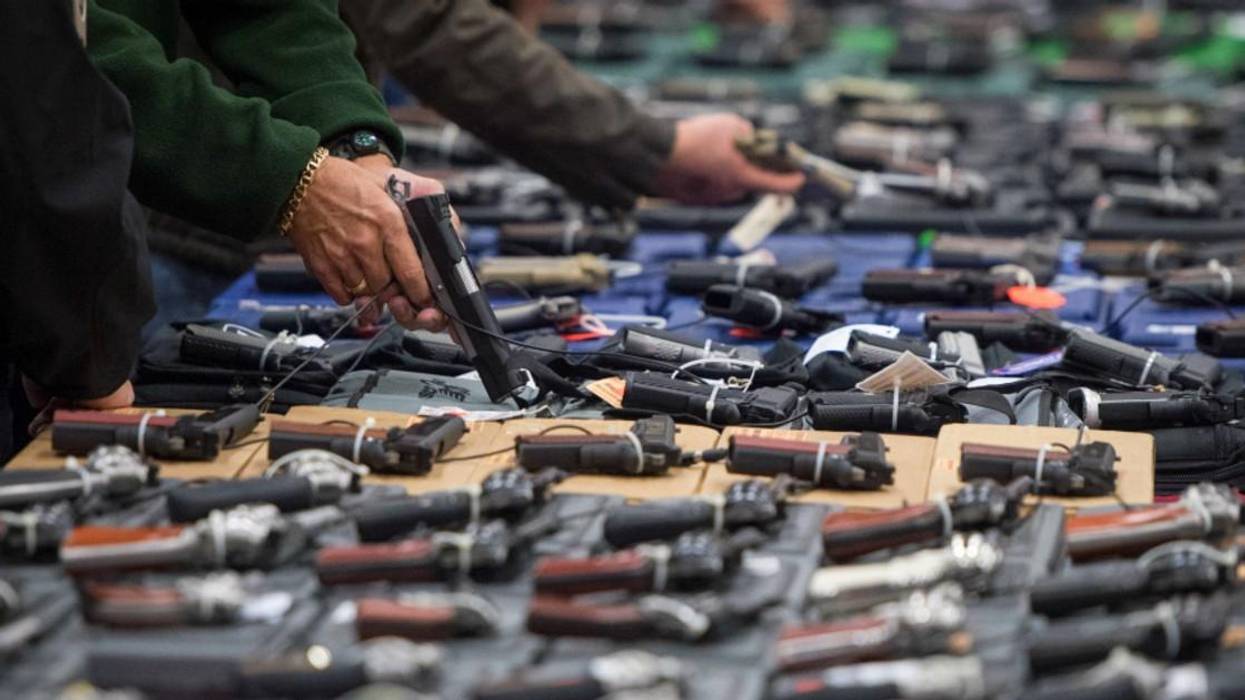
Hold a gun in your hand and suddenly you have the agency of the commander-in-chief. What could happen next is not hard to imagine. Indeed, as we know, it happens all the time.
“The man suspected in the incident... camped outside the golf course in West Palm Beach with food and a rifle for nearly 12 hours, according to court documents filed Monday. He is accused of lying in wait for the former president before a Secret Service agent opened fire, thwarting the potential attack.”
The guy was apparently waiting to assassinate Donald Trump—attempt No. 2 this election season to kill the former president. The would-be alleged assassin was thwarted before he fired a shot, but still...
What the hell?
Mass killings, political assassination attempts or, indeed, any resort to violence, especially when such phenomena start to become “normal,” indicate a social problem that transcends gun availability.
Something is crazy-wrong in the Land of the Free and Home of the Brave. I think it amounts to this (to put it in advertising terms): The kwik-option to make your point—to win the argument—is way too readily available. Hate someone’s politics? Feel ignored? Feel your interests being threatened? There’s a far simpler “solution” available than actually tying to address the issue in the real world: Just kill it!
While I support more stringent gun-control regulations, I have minimal faith in a purely bureaucratic fix to this enormously psycho-spiritual issue. America is the inheritor of the delusion of empire—not just geopolitically but domestically. Our country was born not just in a cry for freedom (for some), but also in slavery and genocidal land theft. This hellish facet of our history hasn’t gone away. Our national belief in violence may hide behind the words on the Statue of Liberty—“Give me your tired, your poor,/Your huddled masses yearning to breathe free...,”—but this belief is at the core of who we are and how we act.
Let me put this another way: This is the god we worship.
We have a trillion-dollar annual military budget and—certainly throughout my lifetime—have launched unbelievably horrific wars around the world. We’ve claimed the mantle of global colonialism. We support our “interests” (excuse me, our security and our values) with, as Vice President Kamala Harris put it, “the strongest, most lethal fighting force in the world.”
This is how you get cheers: We run things, man. We run the planet. Hurray! My point here is that this attitude spreads—domestically—like a social disease. If you are a stalwart, unskeptical patriot, you have no choice but to worship the god of violence. And maybe, just maybe, you feel the presence of this god not just abstractly, at the level of the national government, but within your own soul. Hold a gun in your hand and suddenly you have the agency of the commander-in-chief. What could happen next is not hard to imagine. Indeed, as we know, it happens all the time.
In other words, mass killings, political assassination attempts or, indeed, any resort to violence, especially when such phenomena start to become “normal,” indicate a social problem that transcends gun availability. For God’s sake, why is this happening? It’s a social problem that is, you might say, spiritual in nature, and must be addressed as such—whatever that means.
At the very least, it means that, as a society—as a species—we need to move seriously beyond our worship of the god of violence, or what theologian and author Walter Wink has called “the myth of redemptive violence.” We need to move beyond our unquestioned assumption that it settles conflict and fixes problems. Talking to one another—negotiating with the enemy, transcending conflict by working to create a world that works for everybody—can be unimaginably complex. It doesn’t make for quick and easy headlines or movie plots.
Indeed, in the real world, violent “solutions” always cause further harm, even if some temporary good is also accomplished. Violent victories come with repression and eventual backlash. But you wouldn’t know this from the myth of redemptive violence, which endlessly portrays violence—well, “good violence”—as consequence free.
As I wrote several years ago:
Strike up the orchestra. Here’s how it plays out: John Wayne, the Ringo Kid, has climbed atop the stagecoach and the Apaches are tearing after them as the music swells. In two minutes of the 1939 John Ford classic Stagecoach, I counted 15 Indians dying, each one flying dramatically off his horse. There are hundreds of them, hooting, armed with rifles, but they never hit anyone. They have almost no impact on the valiant stagecoach, on which four white men return fire at the savages with grim precision. One of them actually has a wry smile on his face, relishing his opportunity to do so. They blast away. Eventually the cavalry shows up and the Indians flee.
Yeah, the myth of redemptive violence is God’s gift to scriptwriters. And worse. It’s God’s pseudo-gift to lost souls who decide that their best hope is to blast all their problems off Planet Earth.
I write these words believing only this: Violence will never fully go away, but national policy must transcend war. All we can do is keep pushing beyond that myth of redemptive violence—toward redemptive connection and understanding.
I end with the words of a 12-year-old boy named Jose, who was in a writing class I convened for a while, many years ago, at a Chicago elementary school. I learned much about the nature of gang life from his words, including the ritual of tossing someone’s shoes over a telephone wire, as a memorial, if he’s shot, if he’s killed.
In a writing exercise, Jose wrote:
One of my friends he got stabbed with a pencil because he was in a gang, but now he isn’t in a gang because he doesn’t want his family to see his shoes dangling from a telephone wire. And he wants to go back and fix all the things he has done wrong and now he never wants to have a relation with a gang member. Now he is in my house to play video games.
America, America: It’s possible to transcend war. It’s possible to stop worshiping the god of violence.
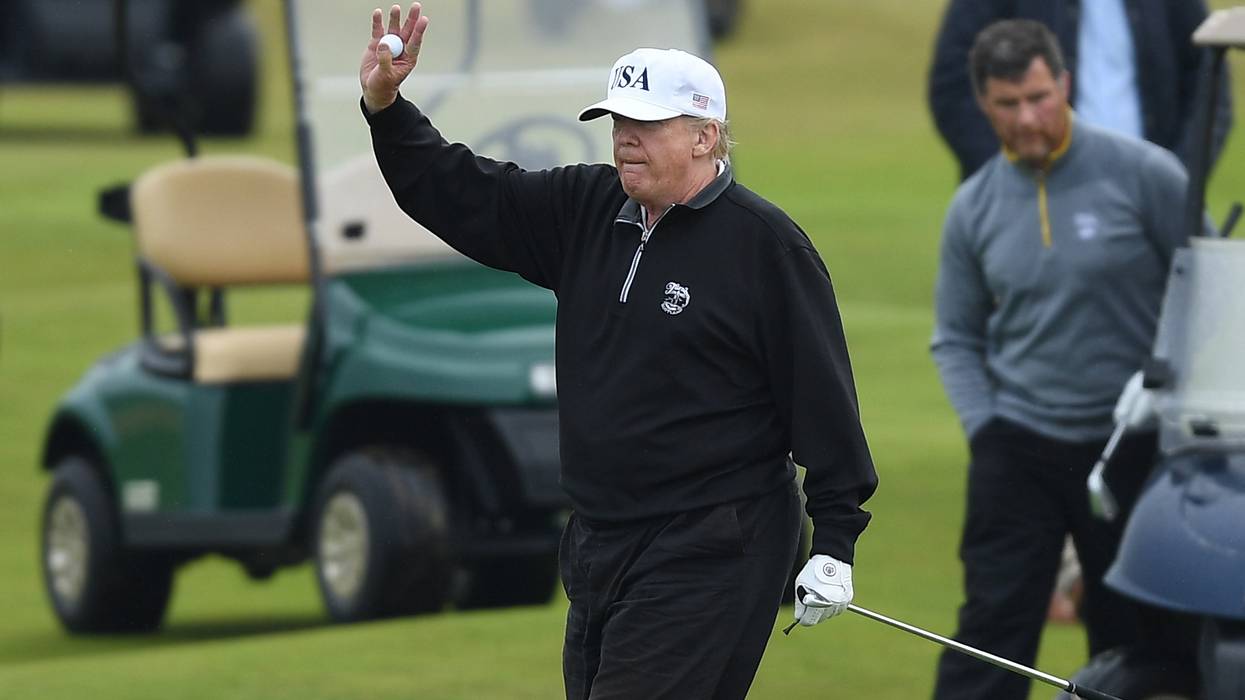
"Violence has no place in America," said U.S. Vice President and his 2024 election opponent Kamala Harris.
This is a developing story... Please check back for possible updates...
Update (6:18 pm):
The FBI said on Sunday that it was "investigating what appears to be an attempted assassination” of former U.S. President Donald Trump after members of the Secret Service fired shots at an individual who appeared to place the muzzle of a rifle over the perimeter of where Trump was playing golf in West Palm Beach, Florida.
Trump wrote in a fundraising email that he was "SAFE AND WELL" following the incident.
Several public figures issued statements condemning political violence.
Minnesota Gov. and Democratic vice presidential candidate Tim Walz wrote on social media that he and his wife Gwen were "glad to hear that Donald Trump is safe."
"Violence has no place in our country. It's not who we are as a nation," Walz wrote.
Rep. Ro Khanna (D-Calif.) said: "I am relieved that President Trump and those that were with him are safe. This is a deeply concerning time for our country, and I pray we can prevent this kind of violence and find ways to heal the divisions."
Earlier:
Former U.S. President and current Republican presidential candidate Donald Trump is "safe" after gunshots were fired "in his vicinity," the Trump campaign announced on Sunday.
Law enforcement officials told The Associated Press that Secret Service agents opened fire after they saw an individual appear to lift the muzzle of their rifle through the barrier surrounding Trump's golf course in West Palm Beach, Florida while he was playing. The suspect then fled in an SUV and was later apprehended by local law enforcement. An AK-style rifle was later found on the grounds of the golf course.
The Secret Service said that the incident took place around 2 pm Eastern Time.
Steven Cheung, the Trump Campaign's communications director, said there were "no further details at this time."
The incident comes a month and two days after Trump survived an assassination attempt while speaking at a rally in Butler County, Pennsylvania.
"I have been briefed on reports of gunshots fired near former President Trump and his property in Florida, and I am glad he is safe," U.S. Vice President Kamala Harris, who is running against Trump in the 2024 presidential election, wrote on social media. "Violence has no place in America."
The White House said in a statement that it was "relieved" the Trump was safe.
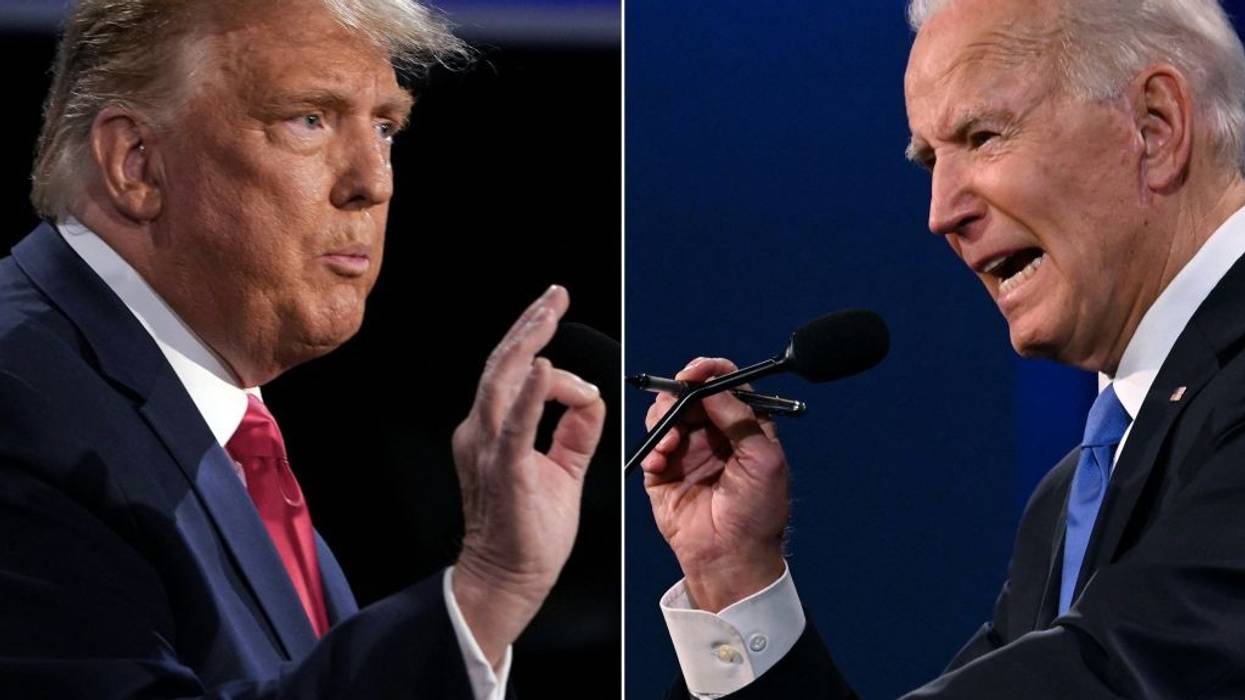
The stakes are still as high as they were since the campaigns kicked off more than a year ago.
Even before U.S. President Joe Biden dropped out of the race on Sunday, November’s presidential election had become a dizzying roller-coaster ride.
In the run-up to this election, the Democratic Party failed to consider the impact a weakened Biden would have on the electorate, and it assumed that fear of former president Donald Trump would be enough to win.
In just the past few weeks, however, two new factors emerged, wreaking additional havoc on the foundation of these two assumptions: the horrifying mass shooting at a Trump rally in Butler, Pennsylvania, and the growing chorus of prominent Democrats urging Biden to step down as their party’s presidential nominee.
This is truly, as my brother John would say, “an Armageddon election.”
Even before last week’s Republican National Convention, polls were showing Trump commanding the support of his party’s faithful. In the aftermath of the shooting, the embrace intensified, with some seeing his escape as a sign of divine intervention.
This deification of Trump and the wild enthusiasm seen at the Republican convention made Democrats more concerned about their electoral prospects and more troubled by Biden’s all-too-apparent weaknesses.
His frailty was already an issue, having come into sharp focus during the June 27 debate. With polls showing almost two thirds of Democrats displeased with Biden, senior party elected officials had publicly urged the president to pass the torch to a younger candidate.
Now that Biden has withdrawn his candidacy and endorsed Vice President Kamala Harris to be his party’s nominee, the election is once again wide open. Harris isn’t the nominee just yet, with various factions in the Democratic Party possibly jockeying for power, but she will be the hot favorite ahead of the Democratic National Convention in Chicago next month.
It is fair to say, then, that the current election cycle has been topsy-turvy, particularly over the past week. And yet it’s worth pointing out that within the larger American political context, it is still business as usual.
For starters, the stakes are still as high as they were since the campaigns kicked off more than a year ago.
This is truly, as my brother John would say, “an Armageddon election.” No matter who emerges as the Democratic nominee, this will be a contest between two fundamentally different visions of America. Despite Trump’s statement that it was time to unify the country, his convention, choice of a running mate, and the rhetoric used by many of the Republican convention’s speakers made it clear that the leopard hasn’t changed its spots.
The Trump-led GOP continues to prey on the fears and anger of the white working class, using the same exploitation of social and cultural issues and racist and Christian nationalist xenophobia and resentment of “elites” that they have been cultivating for years. This will distract attention from their policies favoring the wealthiest and most entitled at the expense of the safety, security, and prosperity of the middle class and those seeking to become middle class.
Trump will continue to project his frightening dystopian vision of American life, targeting his favorite line-up of evildoers—federal law enforcement, media elites, immigrants. His use of ridicule and hostile language will continue to inflame passions and incite violence.
Democrats, meanwhile, will continue to call for greater economic, social, and political equity. Biden had previously called out the widening income gap between the richest Americans and those struggling to make ends meet. Democrats will call for a fairer tax system, a raised minimum wage, and protection of unions and labor rights.
Despite their crackdown to stop the flow of illegal immigrants, they’ll call for a humane approach to those fleeing persecution. They will call for expanded healthcare, lower drug prices, support of women’s rights to make their own healthcare decisions, and continued progress towards racial justice.
And finally, Democrats will continue to focus this election on the need to protect democracy and the rule of law, warning about the threat posed by Trump supporters’ plans to reject the outcome of this election by using administrative tactics and even violence as they did in 2020 to disrupt the peaceful transfer of power.
One additional factor that will remain the same is the threat posed by gun violence and the failure of the GOP to support even modest gun control reforms—despite the attempt on Trump’s life.
America now has more than one mass shooting each day, with tens of thousands needlessly losing their lives in these and other shootings. It still hasn’t addressed its diseased obsession with weapons. Nor has it faced up to the fact that political violence is not an aberration, when in fact it is who we are as Americans.
When The New York Times writes as editorial titled “The Attack on Trump is Antithetical to America,” or when Biden asserts that political violence isn’t who we are or that it’s an aberration, they are ignoring the reality that political violence is “as American as cherry pie.”
Living in denial is not only ignoring the dozens of attempted assassinations that have defined American history, but also means that the country isn’t ready to learn lessons and take much needed remedial steps to end this plague.
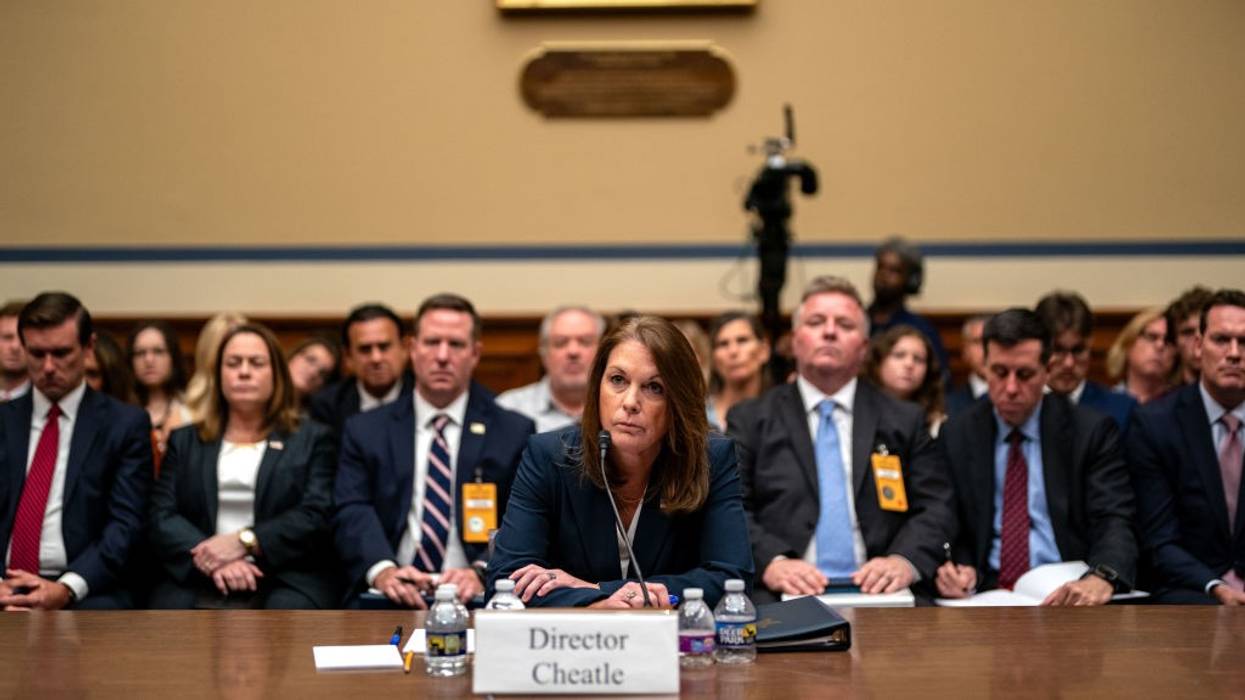
Kimberly Cheatle said in an email to colleagues that the agency "fell short" of its mission to protect U.S. leaders.
United States Secret Service Director Kimberly Cheatle resigned Tuesday following the attempted assassination of former President Donald Trump at a Pennsylvania campaign rally and intense bipartisan grilling by members of a congressional committee.
The New York Times reported that Cheatle—who led the Secret Service since September 2022—said in an internal email that the agency "fell short" of its mission to protect Trump, the Republican presidential nominee who was shot in the ear while speaking at a July 13 rally in Butler, Pennsylvania.
"In light of recent events, it is with a heavy heart that I have made the difficult decision to step down as your director," Cheatle wrote.
Calls for Cheatle's resignation mounted following her Monday testimony before the House Oversight and Accountability Committee, during which she acknowledged that "we failed" in "the Secret Service's solemn mission... to protect our nation's leaders."
Following the hearing, Rep. James Comer (R-Ky.), who chairs the committee, and Rep. Jamie Raskin (D-Md.), the ranking member, issued a joint letter accusing Cheatle of failing "to provide answers to basic questions regarding that stunning operational failure" and calling on her to resign "as a first step to allowing new leadership to swiftly address this crisis and rebuild the trust of a truly concerned Congress and the American people."
In her resignation email, Cheatle told colleagues, "I do not want my calls for resignation to be a distraction from the great work each and every one of you do towards our vital mission."
Responding to Cheatle's resignation, Raskin said that "yesterday's Oversight Committee hearing identified two urgent priorities in the wake of the assassination attempt against former President Donald Trump and the accompanying mass shooting. The first was the need for Director Cheatle to step down... We accomplished that today."
"The other urgent need was to ban assault weapons to protect the rest of us from mass shootings like the one that took place in Butler," he added. "As I made clear during yesterday's hearing, a weapon that can be used to commit a mass shooting at an event under the full protection of the Secret Service and state and local police is a danger to schoolchildren; Walmart shoppers; and congregants in church, synagogue, and mosque services."
Twenty-year-old Thomas Matthew Crooks used a legally purchased AR-15-style semiautomatic rifle to shoot Trump before he was killed by a Secret Service sniper. A rally attendee, Corey Comperatore, was fatally shot, and two other men were seriously injured by gunfire.
"As a weapon of war, the AR-15 has no legitimate place in our society," Raskin argued. "Congress must act now."

"Inciting violence over an election that hasn't even occurred yet is irresponsible and undemocratic," said the Ohio Senate Democrats.
Just over a week after an assassination attempt against Republican presidential candidate Donald Trump resulted in the killing of one bystander and left two people critically injured, a GOP state senator from Ohio was condemned for saying a Democratic victory in November would result in a "civil war."
"I believe wholeheartedly Donald Trump and Butler County's JD Vance are the last chance to save our country, politically," state SEn. George Lang (R-4) said at a rally for Vance, the first-term U.S. senator from Ohio whom Trump selected as his running mate last week. "I'm afraid if we lose this one, it's going to take a civil war to save the country, and it will be saved."
Lang apologized on social media soon after he made his comments at the rally in Middletown, Ohio, saying they were "divisive" and calling for all politicians to "be mindful" of what they say at political events ahead of the election.
But Lang's comments came after numerous polls have shown sizable portions of Americans, particularly Republican voters, sympathizing with the state lawmaker's message.
In May, the Marist National Poll found that 47% of Americans believed a civil war in the U.S. would occur in their lifetime, including 53% of Republican voters.
In April, 28% of Republican voters said in a PBS NewsHour/NPR/Marist survey that violence may be needed to "get the country back on track."
Lang's call for "civil war" came as endorsements poured in for Vice President Kamala Harris to run as the Democratic nominee, a day after President Joe Biden announced he was stepping aside in the presidential race following weeks of pressure and concerns about his age and health.
Ammar Moussa, spokesperson for the Harris for President campaign, said Lang's comments were no accident and called on Trump and Vance to denounce the call for violence.
"Donald Trump and JD Vance are running a campaign openly sowing hatred and promising revenge against their political opponents. It's a feature, not a bug, of their campaign and message to the American people," said Moussa. "Trump and Vance pay lip service to unity, but their actions are more focused on dividing Americans than bringing us together. It's the polar opposite of everything Vice President Harris stands for."
The Ohio state Senate Democrats denounced Lang's comments as "irresponsible and undemocratic," and noted that lawmakers on both sides of the aisle have condemned political violence.
But despite widespread agreement that violence is not the way to solve divisions in the U.S. over immigration, abortion rights, and other issues, Lang's remarks echoed Trump's repeated warning of a "blood bath for the country" if he loses the election, as well as West Virginia Gov. Jim Justice's statement last week at the Republican National Convention that "we become totally unhinged if Donald Trump is not elected in November."
Earlier this month, Heritage Foundation President Kevin Roberts said the country is already in the midst of a "second American Revolution, which will remain bloodless if the left allows it to be."
Trump's electoral loss in 2020 resulted in the then-president urging his supporters to riot at the U.S. Capitol to try to stop Congress from certifying Biden's victory.
Despite Lang's apology on Monday, said Sean Carberry, managing editor of National Defense, his call at the rally was "not some isolated/offhand comment."
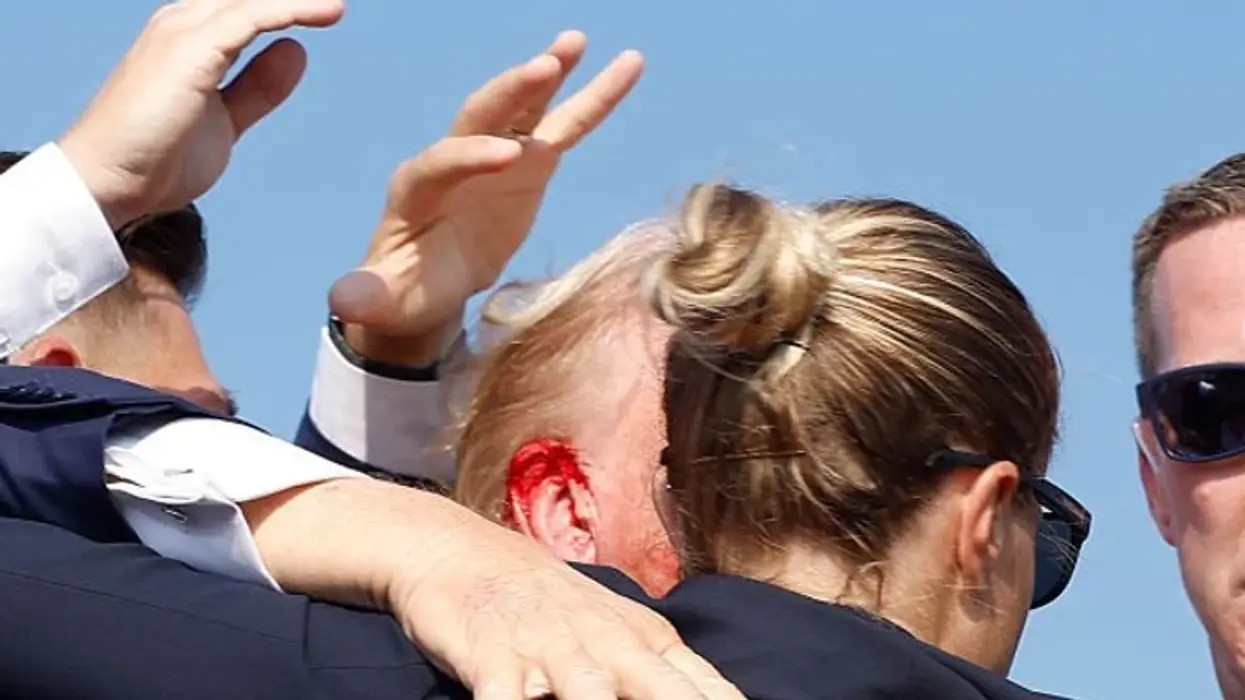
In the immediate aftermath of the attempt to assassinate former U.S. President Donald Trump, social media became a cesspool of conspiracy theories and an amplifier of partisan propaganda.
At a time of political turmoil and uncertainty about mainstream news coverage, more Americans are turning to social media for the information they need to understand current events. But once there, they’re met with a slew of lies, making it difficult to separate fiction from the facts people need to participate in civic society.
In the immediate aftermath of the attempt to assassinate former U.S. President Donald Trump, social media became a cesspool of conspiracy theories and an amplifier of partisan propaganda as Trump supporters and trolls exploited the violence to deepen political divides and sow chaos. Meanwhile, so many on the left went online to claim that the entire incident was fabricated that tens of millions of people saw Twitter posts containing the hashtag “#staged.”
So where should people go to get the accurate news and information they need to engage in the democratic process during a contentious election year?
Nationwide, more people understand the shortcomings of the existing media environment and support the changes needed to fix it.Nationwide, more people understand the shortcomings of the existing media environment and support the changes needed to fix it.
The answer isn’t simple, but it’s clear that the status quo isn’t working. According to a recent Free Press Action poll, nearly 3 out of every 4 Americans say they don’t feel “very well informed” when voting in local elections.
The poll results strongly suggest that both old and new media are in need of a shake-up in advance of November.
The poll surveyed 3,000 people from across the country, and respondents relayed their concerns about the twin problems of dwindling local news coverage and the prevalence of false information online. Almost 80% said they were concerned that the information they see online is false, fake, or a deliberate attempt to confuse. A majority of people across the country believe that having more independent news outlets could safeguard against disinformation and strengthen our democracy. They support increasing public funding to create and expand local and independent news.
In statehouses across the country, lawmakers are weighing legislation to address the crisis in local journalism. One such proposal in California (SB 1327) would impose a fee on major tech platforms to help support the production of local news. The estimated $500 million this fee would generate would provide outlets with an employment tax credit to cover a portion of employees’ wages. SB 1327 passed the state Senate in June and is expected before the state Assembly in August. Bill champions are still working to gather support for the legislation as it moves closer to passage.
In 2018, New Jersey established the Civic Information Consortium and provided it with the state funding necessary to distribute millions of dollars in grants to community outlets working to engage people in civic affairs.
Measures like these are a good start. Over the past two decades, the country has lost nearly 60% of local-newspaper reporters. Instead of filling that void, social media has stuffed it full of high-engagement content that often spreads falsehoods and conspiracy theories instead of informing people about local issues.
And it’s not just public policy that’s needed. In response to concerns about the spread of disinformation, Free Press joined with 200 other civil society groups to demand that social media platforms strengthen election-integrity efforts. We’ve asked the likes of Google, Meta, and X to reinstate election-integrity policies and staff up critical trust and safety teams to better enforce policies across languages.
According to our poll, the vast majority of Americans across racial, ethnic, and political lines—including two-thirds of independents and GOP voters—want these companies to prevent the spread of misinformation online.
At a time of extreme and heated partisan divides, the poll reveals a silver lining: Nationwide, more people understand the shortcomings of the existing media environment and support the changes needed to fix it.
The challenge before people everywhere is to mobilize behind efforts to compel popular media—both traditional and online—to engage with and be more responsive to the needs of their readers and viewers.
There’s no doubt that this is a hard moment in U.S. history, that tensions are high, that divisions run hot. The media too often play a role in stoking those flames. But people from across the political spectrum are telling us that they’re ready for a change, and today I feel hopeful that we can work together to build a media system that supports full democratic participation.

From guns to militarism, the national religion is the religion of us vs. them.
Every bullet fired into a crowd penetrates the national soul—or so it seems to me, as I continue to grapple emotionally with the Trump rally shooting in Butler, Pennsylvania on July 13, which left one attendee murdered, several others wounded, and the shooter himself dead.
As with all such shootings, this goes beyond “motive” into a collective nethersphere of uncertainty. For God’s sake, what is life? Why is it so, shall we say, cheap? Why are we organized—politically, socially—primarily around its elimination? Why are guns so damn sacred... not to mention fighter jets, nuclear weapons, our annual military budget? Why do the following words make me cringe:
“We cannot—must not—go down this road in America, Violence has never been the answer.”
The power to obliterate opposition—the power to kill—has long been sacred, both collectively and personally.
This is U.S. President Joe Biden, blathering a heart-stabbing lie—also known as the thing most politicians mean the least when they say it—to clueless America in the wake of the latest mass shooting. We are deeply, deeply down this road! We have a trillion-dollar annual military budget and maintain around 750 military bases around the world. We are, under Joe’s watch, bleeding billions of dollars to Israeli Prime Minister Benjamin Netanyahu so Israel can inflict genocide on Palestine. Indeed, an Israeli airstrike in southern Gaza on the same day as the Trump rally assassination attempt killed nearly 100 Palestinians.
“We cannot—must not—go down this road in America... ” Yeah, sure. This is the road we’ve chosen: the road to hell. The job most presidents have chosen, at least in my lifetime, has been that of public relations director in chief, softening our militarism with the platitudes of state.
As Phil Wilson writes at Common Dreams: “Until 1949, the federal agency responsible for the U.S. military was simply called The Department of War—a rather nondescript, generic title that tells us nothing about intent. But with the advent of the Cold War and the new mandate to unleash military might against leftist regimes in every corner of the globe, our military needed a brand new identity. In 1949, just in time for decades of war in Southeast Asia, we decided to call our military The Department of Defense. This made it clear that bombing, defoliating, and reducing civilian populations to ash thousands of miles from U.S. borders—in Korea, Vietnam, Laos, and Cambodia—were acts of ‘defense.’”
Wilson also notes, cogently: “I have always suspected that the Republicans control the American narrative and the Democrats lip sync to the latest MAGA tunes.”
In other words, this is a “unified” nation, despite the anger, despite the hatred, volleying back and forth between the two primary political parties. The nation is unified in its militarism, unified in its refusal to acknowledge that war always comes home and that humanity must evolve beyond it or we will surely destroy ourselves.
America, guns—the two entities seem to be linked... religiously. This link very much predates our founding. Think of the Crusades. Think of the sheer emergence of empires across the planet throughout history. Our god is better than your god! The power to obliterate opposition—the power to kill—has long been sacred, both collectively and personally.
The irony of this is soul twisting, especially as it exists in present-day America, where personal weapon use, aka, self-defense, is ever more glorified, leading us into the current social structure. Guns are the essential symbol of freedom; they are increasingly available to almost everyone and legal to possess almost everywhere. Hence, the irony:
“Thanks to Wisconsin state law, guns will be allowed in the outer perimeter of the Republican National Convention even after Saturday’s assassination attempt against Donald Trump.”
Thus reports The New Republic, adding: “People can open-carry guns and conceal-carry with a permit in a less strict perimeter surrounding a ‘hard’ perimeter controlled by the Secret Service around the Fiserv Forum in Milwaukee as the RNC begins tonight. A Milwaukee city ordinance, however, bans tennis balls and paintball guns in the outer perimeter. Effectively, an AR-15 can be carried within walking distance of the RNC hall, but a paintball gun can’t, and it’s all thanks to Wisconsin’s open-carry laws.”
Declaring the situation “utterly ridiculous,” Milwaukee alderman Robert Bauman put it this way to ABC News: “I mean, I could just picture this image of somebody coming up to the entry point with, you know, an AR-15 strapped over one shoulder, a long rifle over another, and two pistols in his belt, and the cops asking him, ‘You got any tennis balls?’”
Yeah, the irony! I definitely do not expect this matter to be resolved politically. Tougher and saner gun laws have been shot and killed, but it’s bigger than that anyway. The USA has adorned itself in military cammies. It has a holster and a six-gun on its belt. This is who we are, and we’re always on the lookout for enemies, which are everywhere (particularly at the southern border). The national religion is us vs. them—the simplest religion available.
And it’s also the most profitable.
Nonetheless, many, many Americans—many citizens of the world—are devoting their lives to the long, complex trek beyond the religion of guns and violence and militarism. Power is a matter of connection with the whole universe.

In the aftermath of the apparent attempted assassination, the mainstream media have exhorted us to embrace a form of collective amnesia, and to forget the dangers of Trumpism, MAGA, and Project 2025.
Following the attempt on former U.S. President Donald Trump’s life on July 13, it’s worth keeping in mind the old maxim that two things can be true at the same time.
One truth is that political violence has no place in a democracy. Even in a faltering and deeply flawed one such as ours, violence is wrong and must be condemned. At the same time, Donald Trump remains an existential threat to democracy. Trump, the MAGA movement, and the program for right-wing governance proposed by the Heritage Foundation’s Project 2025 are all intertwined, and they have not changed. They remain as threatening as ever, and we must not shrink from saying so.
And yet, in the aftermath of the apparent attempted assassination, the mainstream media have exhorted us to embrace a form of collective amnesia, and to forget the dangers of Trumpism, MAGA, and Project 2025. We are told that what’s needed in this hour of peril is national unity, and to achieve unity we must accept a bogus narrative of moral equivalency that asserts that Democrats and Republicans, liberals, progressives, and conservatives, are equally guilty of using hyperbolic and divisive rhetoric for partisan gain.
Whether out of fear of reprisals from Trump should he be reelected or simply because of their fundamental corporate orientation, the mainstream media have attempted to steer the conversation away from the dangers of Project 2025 and MAGA extremism to a one-dimensional discussion of the need for unity. We cannot afford to go along.
Lester Holt’s July 15 interview with President Joe Biden is a prime example of this trend. The 20-minute session began with the NBC anchor pressing Biden to engage in “soul-searching” about a call he had with donors a week earlier, in which he reportedly said it was time to stop talking about his poor performance in the first debate and time to start putting Trump in a “bullseye.”
Holt brushed aside Biden’s weak attempt to defend the comment as a metaphor for focusing on Trump’s election denialism and history of using violent rhetoric to scapegoat immigrants and his political opponents. “This doesn’t sound like you’re turning down the heat,” Holt insisted, before segueing to the issues of Biden’s age and the persistent calls for him to drop out of the race.
Holt also dismissed Biden’s weak attempt to discuss Trump’s policy positions on abortion and climate change, and his selection of the crackpot JD Vance as his running mate. But most lamentable of all, neither Biden nor Holt brought up Trump’s longstanding ties to Project 2025, also known as the Presidential Transition Project, and the inchoate violence the project holds in store for all those who oppose it.
Although Trump has recently sought to distance himself from Project 2025, and has even gone so far as to claim he knows nothing about it, the former president is nothing if not a polished liar. In fact, Trump served as the keynote speaker at the Heritage Foundation event in April 2022 where the project was launched by the foundation’s president, Kevin Roberts.
“Our country is going to hell,” Trump declared in familiar fashion at the event, reprising the theme of American carnage that propelled him to presidency in 2016. From there, he went on to praise Heritage as a “great group… that will lay the groundwork and detail plans for exactly what our movement will do and what your movement will do when the American people give us a colossal mandate to save America and that’s coming. That’s coming.”
As Roberts explained in an appearance on Steve Bannon’s “War Room” podcast on July 2, what’s coming with Project 2025 is nothing less than a “second American Revolution” that will be “bloodless if the left allows it to be.”
The details of the “revolution” are set forth in the Project’s 920-page manifesto called the “Mandate for Leadership: The Conservative Promise.” Produced by Heritage with input, support, and advice from over 100 conservative groups, the mandate consists of 30 chapters written by leading figures on the American right, who demand sweeping overhauls of virtually every federal agency, from the Department of Defense to the Department of Homeland Security, the Justice Department, and the Federal Reserve. Although drafted by different authors and directed at disparate agencies, each chapter promotes the common goal of centralizing all federal power in the hands of the president, advancing the so-called “unitary executive theory” long championed by the radical right.
The chapter on the Justice Department—written by Gene Hamilton, the vice president and general counsel of the America First Legal Foundation, a group founded by Trump adviser Stephen Miller—calls for the DOJ to be placed under direct presidential supervision. It also calls on the attorney general to pursue an aggressively “anti-woke” legal agenda, using “the full force of federal prosecutorial resources to investigate and prosecute all state and local governments, institutions of higher education, corporations, and any other private employers who are engaged in discrimination” against white people under the guise of “diversity, equity, and inclusion” programs.
The chapter on the Office of Personnel Management, written by a trio of authors, including Paul Dans, the director of Project 2025 who served as and Trump’s OPM chief of staff, calls for reinstituting “Schedule F,” a job classification program implemented by Trump in October 2020 but subsequently repealed by President Biden. Under a renewed Schedule F, tens of thousands of federal workers would be stripped of civil service protections, and transformed into “at-will” employees who could be hired and fired solely on the basis of their loyalty to the president.
The chapter on the Department of Homeland Security, written by former Trump cabinet member Ken Cuccinelli, calls for the department to be dismantled and combined with other immigration agencies to create a more powerful force of border security and facilitate Trump’s goal of conducting the largest deportation program in American history.
And the parade of horrors does not end there. Other chapters advise the next Republican president to “stop the war on oil and natural gas” and replace carbon-reduction goals with initiatives to increase fossil-fuel production; “dismantle the administrative state;” eliminate the Department of Education and the National Weather Service (considered an agent of climate-change propaganda); and prohibit the mailing of the abortion pill mifepristone.
Whether out of fear of reprisals from Trump should he be reelected or simply because of their fundamental corporate orientation, the mainstream media have attempted to steer the conversation away from the dangers of Project 2025 and MAGA extremism to a one-dimensional discussion of the need for unity. We cannot afford to go along. As November approaches, remember the old maxim that two things can be true at the same time: Violence is wrong, and so is Trump and all that he stands for.

A majority of respondents said they want both Biden and Trump to quit the race, and were not confident in the mental fitness of either candidate.
A majority of U.S. voters want both President Joe Biden and Republican nominee Donald Trump to drop out of the 2024 presidential contest, with nearly two-thirds of Democrats favoring the Democratic incumbent's withdrawal amid mounting concerns over his mental fitness, a poll published Wednesday revealed.
The AP-NORC Center for Public Affairs Research survey of 1,253 U.S. adults conducted between July 11-15 found that 70% of all respondents want Biden to step aside in favor of an alternative nominee and 57% think Trump should quit the race. Broken down by partisan affiliation, 73% of Republicans, 70% of Independents, and 65% of Democrats want Biden to stand down, while 26% of Republicans, 51% of Independents, and 86% of Democrats say Trump should withdraw.
"I just feel like these two individuals are a sad choice," Alexi Mitchell, a 35-year-old civil servant in Virginia and self-described Democratic-leaning Independent, told The Associated Press, adding that Biden has "put us in a bad position where Trump might win."
Black Democrats are Biden's strongest supporters—50% want Biden to continue running—while only 25% of all Democratic voters aged 18-44 want him to stay in the race.
A majority of respondents said they were not confident in the mental fitness of either candidate. Seventy percent of voters said they had little or no confidence in Biden's "mental capacity to be an effective president," while 51% said the same thing about Trump.
The former president was recently convicted of 34 felony charges in New York state related to the falsification of business records regarding hush money payments to cover up sex scandals during the 2016 presidential election. Trump still faces dozens of federal and state charges in connection with his efforts to overturn the 2020 election, cases that could be impacted by a recent U.S. Supreme Court ruling granting presidents "absolute immunity" for acts committed in their official capacity.
Earlier this week, a Trump-appointed federal judge dismissed a case involving Trump's alleged mishandling of classified documents—a decision Special Counsel Jack Smith, who has led the case since Trump announced his current campaign, is appealing.
Trump was also impeached twice by the House of Representatives—but not convicted by the Senate—during his first presidential term.
A separate survey by Data for Progress published Wednesday found that "swing" voters are increasingly more concerned about Biden's age than Trump's criminal charges.
According to Data for Progress:
Before the debate and before Trump was found guilty on 34 felony counts, we found that swing voters were more concerned about Trump's criminal charges (48%) than Biden's age (41%), with 11% unsure.
After the debate, swing voters have flipped. Now, 53% say they are more concerned about Biden's age, a 12-point increase from our last survey of swing voters. Only 37% say they are more concerned about Trump's criminal charges, an 11-point decrease.
Notably, the new AP-NORC survey was conducted before Saturday's attempted assassination of Trump at a Pennslyvania campaign rally. The deadly shooting seemed to take some wind out of the sails of the burgeoning movement of Democrats urging Biden to withdraw from the race: In the four days before the incident, over a dozen Democratic U.S. lawmakers called on Biden to step aside. In the four days since the assassination attempt, only one more has joined the list, Rep. Adam Schiff of California.
"Our nation is at a crossroads," Schiff told the Los Angeles Times on Wednesday. "A second Trump presidency will undermine the very foundation of our democracy, and I have serious concerns about whether the president can defeat Donald Trump in November."
A Pew Research Center poll published last week showed that more than 6 in 10 U.S. voters see both Biden and Trump as "embarrassing" choices and nearly 9 in 10 said that the 2024 election campaign "does not make them feel proud of the country."
What the grotesque shooting should not be allowed to do is shut down legitimate and necessary criticism of the Republican Party's nominee and what he represents.
Immediately after the attempted assassination of Donald Trump, when little was known about the white male shooter (except that he was a registered Republican), right-wing politicians directly blamed Democratic rhetoric for the shooting.
“Today is not just some isolated incident,” Sen. J.D. Vance wrote on X (7/13/24), just days before Trump named him as his running mate:
The central premise of the Biden campaign is that President Donald Trump is an authoritarian fascist who must be stopped at all costs. That rhetoric led directly to President Trump’s attempted assassination.
(That Trump might be considered a fascist did not always seem so far-fetched to Vance; in 2016, he privately worried that Trump might become “America’s Hitler”—Reuters, 7/15/24.)
“For years, Democrats and their allies in the media have recklessly stoked fears, calling President Trump and other conservatives threats to democracy,” Sen. Tim Scott posted on X (7/13/24). “Their inflammatory rhetoric puts lives at risk.”
Rather than denounce both the assassination attempt and these hypocritical and opportunistic attacks on critical speech, the country’s top editorial boards cravenly bothsidesed their condemnations of “political violence.”
In an editorial headlined, “Turn Down the Heat, Let in the Light,” the Washington Post (7/14/24) praised Donald Trump for appearing to call for national unity. The Post wrote that the assassination attempt offered Trump the chance to “cool the nation’s political fevers and set a new direction.”
The editorial board quickly admonished both sides equally for “unthinkably uncivil” actions and “physical violence.” They pointed to protesters who “harass lawmakers, justices, journalists and business leaders with bullhorns at their homes,” universities that have “become battlegrounds,” and the “bipartisan hazard” of political violence, citing Nancy Pelosi’s husband and GOP Rep. Steve Scalise.
(The link the Post inserted leads to an earlier editorial in which they condemned peacefulprotests outside Supreme Court justices’ houses as “totalitarian,” and recommended that the protesters be imprisoned—FAIR.org, 5/17/22).
New York Times editors, meanwhile, called the shooting “Antithetical to America” (7/13/24), a formulation clearly more aspirational than actual. “Violence is antithetical to democracy,” the editorial board wrote, acknowledging moments later that “violence is infecting and inflecting American political life.” They explained:
Acts of violence have long shadowed American democracy, but they have loomed larger and darker of late. Cultural and political polarization, the ubiquity of guns and the radicalizing power of the internet have all been contributing factors, as this board laid out in its editorial series “The Danger Within” in 2022. This high-stakes presidential election is further straining the nation’s commitment to the peaceful resolution of political differences.
It’s a remarkable obfuscation, in which responsibility is ascribed to no one and—as at the Post—everyone.
Curiously, the 2022 editorial series the Times cites (11/3–12/24/22) did make clear where most of the responsibility lay, explaining that “the threat to the current order comes disproportionately from the right.” It pointed out that of the hundreds of extremism-related murders of the past decade, more than three-quarters were committed by “right-wing extremists, white supremacists or anti-government extremists.” While there have been occasional attacks on conservatives (like the attack on a congressional baseball game that wounded Scalise), the Times noted,
the number and nature of the episodes aren’t comparable, and no leading figures in the Democratic Party condone, mock or encourage their supporters to violence in ways that are common from politicians on the right and their supporters in the conservative media.
But two years later, the Times, like the Post, carefully avoids bringing that much-needed clarity to the current situation and apportions responsibility for avoiding political violence equally to both sides:
It is now incumbent on political leaders of both parties, and on Americans individually and collectively, to resist a slide into further violence and the type of extremist language that fuels it. Saturday’s attack should not be taken as a provocation or a justification.
Of course, there’s a crucial difference between criticizing Trump and his allies for their anti-democratic positions and actions—which is what the Democrats and the left have done—and actually threatening and calling for violence, as the right has been doing.
The list of examples is nearly endless, but would prominently include Trump’s incitement of violence at the Capitol on January 6; his personal attacks on prosecutors, judges and politicians who have subsequently required increased security protections; and his refusal to rule out violence if he loses the 2024 election: “If we don’t win, you know, it depends.” His supporters have repeatedly called for armed uprisings after perceived attacks on Trump, including immediately after the assassination attempt.
That’s why it’s critical that leading newspapers push back against right-wing attempts to equate criticisms of Trump with calls for violence.
The Wall Street Journal (7/14/24), unsurprisingly, took this bothsidesism the farthest.
Leaders on both sides need to stop describing the stakes of the election in apocalyptic terms. Democracy won’t end if one or the other candidate is elected. Fascism is not aborning if Mr. Trump wins, unless you have little faith in American institutions.
We agree with former Attorney General Bill Barr’s statement Saturday night: “The Democrats have to stop their grossly irresponsible talk about Trump being an existential threat to democracy—he is not.”
Readers of those top US papers would have to look across the pond to the British Guardian (7/14/24) for the kind of clear-eyed take newspaper editors with concern for democracy ought to have: “There must also be care that extreme acts by a minority are not used to silence legitimate criticism.”
Research Assistance: Alefiya Presswala