SUBSCRIBE TO OUR FREE NEWSLETTER
Daily news & progressive opinion—funded by the people, not the corporations—delivered straight to your inbox.
5
#000000
#FFFFFF
To donate by check, phone, or other method, see our More Ways to Give page.
Daily news & progressive opinion—funded by the people, not the corporations—delivered straight to your inbox.
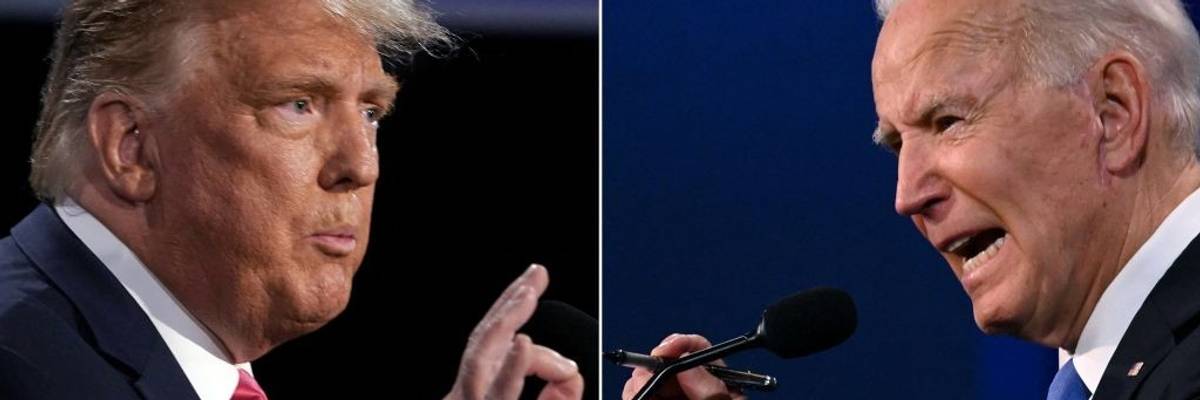
This composite photo shows Republican presidential nominee Donald Trump (L) and current U.S. President Joe Biden (R), during an October 22, 2020 debate at Belmont University in Nashville, Tennessee.
The stakes are still as high as they were since the campaigns kicked off more than a year ago.
Even before U.S. President Joe Biden dropped out of the race on Sunday, November’s presidential election had become a dizzying roller-coaster ride.
In the run-up to this election, the Democratic Party failed to consider the impact a weakened Biden would have on the electorate, and it assumed that fear of former president Donald Trump would be enough to win.
In just the past few weeks, however, two new factors emerged, wreaking additional havoc on the foundation of these two assumptions: the horrifying mass shooting at a Trump rally in Butler, Pennsylvania, and the growing chorus of prominent Democrats urging Biden to step down as their party’s presidential nominee.
This is truly, as my brother John would say, “an Armageddon election.”
Even before last week’s Republican National Convention, polls were showing Trump commanding the support of his party’s faithful. In the aftermath of the shooting, the embrace intensified, with some seeing his escape as a sign of divine intervention.
This deification of Trump and the wild enthusiasm seen at the Republican convention made Democrats more concerned about their electoral prospects and more troubled by Biden’s all-too-apparent weaknesses.
His frailty was already an issue, having come into sharp focus during the June 27 debate. With polls showing almost two thirds of Democrats displeased with Biden, senior party elected officials had publicly urged the president to pass the torch to a younger candidate.
Now that Biden has withdrawn his candidacy and endorsed Vice President Kamala Harris to be his party’s nominee, the election is once again wide open. Harris isn’t the nominee just yet, with various factions in the Democratic Party possibly jockeying for power, but she will be the hot favorite ahead of the Democratic National Convention in Chicago next month.
It is fair to say, then, that the current election cycle has been topsy-turvy, particularly over the past week. And yet it’s worth pointing out that within the larger American political context, it is still business as usual.
For starters, the stakes are still as high as they were since the campaigns kicked off more than a year ago.
This is truly, as my brother John would say, “an Armageddon election.” No matter who emerges as the Democratic nominee, this will be a contest between two fundamentally different visions of America. Despite Trump’s statement that it was time to unify the country, his convention, choice of a running mate, and the rhetoric used by many of the Republican convention’s speakers made it clear that the leopard hasn’t changed its spots.
The Trump-led GOP continues to prey on the fears and anger of the white working class, using the same exploitation of social and cultural issues and racist and Christian nationalist xenophobia and resentment of “elites” that they have been cultivating for years. This will distract attention from their policies favoring the wealthiest and most entitled at the expense of the safety, security, and prosperity of the middle class and those seeking to become middle class.
Trump will continue to project his frightening dystopian vision of American life, targeting his favorite line-up of evildoers—federal law enforcement, media elites, immigrants. His use of ridicule and hostile language will continue to inflame passions and incite violence.
Democrats, meanwhile, will continue to call for greater economic, social, and political equity. Biden had previously called out the widening income gap between the richest Americans and those struggling to make ends meet. Democrats will call for a fairer tax system, a raised minimum wage, and protection of unions and labor rights.
Despite their crackdown to stop the flow of illegal immigrants, they’ll call for a humane approach to those fleeing persecution. They will call for expanded healthcare, lower drug prices, support of women’s rights to make their own healthcare decisions, and continued progress towards racial justice.
And finally, Democrats will continue to focus this election on the need to protect democracy and the rule of law, warning about the threat posed by Trump supporters’ plans to reject the outcome of this election by using administrative tactics and even violence as they did in 2020 to disrupt the peaceful transfer of power.
One additional factor that will remain the same is the threat posed by gun violence and the failure of the GOP to support even modest gun control reforms—despite the attempt on Trump’s life.
America now has more than one mass shooting each day, with tens of thousands needlessly losing their lives in these and other shootings. It still hasn’t addressed its diseased obsession with weapons. Nor has it faced up to the fact that political violence is not an aberration, when in fact it is who we are as Americans.
When The New York Times writes as editorial titled “The Attack on Trump is Antithetical to America,” or when Biden asserts that political violence isn’t who we are or that it’s an aberration, they are ignoring the reality that political violence is “as American as cherry pie.”
Living in denial is not only ignoring the dozens of attempted assassinations that have defined American history, but also means that the country isn’t ready to learn lessons and take much needed remedial steps to end this plague.
Dear Common Dreams reader, It’s been nearly 30 years since I co-founded Common Dreams with my late wife, Lina Newhouser. We had the radical notion that journalism should serve the public good, not corporate profits. It was clear to us from the outset what it would take to build such a project. No paid advertisements. No corporate sponsors. No millionaire publisher telling us what to think or do. Many people said we wouldn't last a year, but we proved those doubters wrong. Together with a tremendous team of journalists and dedicated staff, we built an independent media outlet free from the constraints of profits and corporate control. Our mission has always been simple: To inform. To inspire. To ignite change for the common good. Building Common Dreams was not easy. Our survival was never guaranteed. When you take on the most powerful forces—Wall Street greed, fossil fuel industry destruction, Big Tech lobbyists, and uber-rich oligarchs who have spent billions upon billions rigging the economy and democracy in their favor—the only bulwark you have is supporters who believe in your work. But here’s the urgent message from me today. It's never been this bad out there. And it's never been this hard to keep us going. At the very moment Common Dreams is most needed, the threats we face are intensifying. We need your support now more than ever. We don't accept corporate advertising and never will. We don't have a paywall because we don't think people should be blocked from critical news based on their ability to pay. Everything we do is funded by the donations of readers like you. When everyone does the little they can afford, we are strong. But if that support retreats or dries up, so do we. Will you donate now to make sure Common Dreams not only survives but thrives? —Craig Brown, Co-founder |
Even before U.S. President Joe Biden dropped out of the race on Sunday, November’s presidential election had become a dizzying roller-coaster ride.
In the run-up to this election, the Democratic Party failed to consider the impact a weakened Biden would have on the electorate, and it assumed that fear of former president Donald Trump would be enough to win.
In just the past few weeks, however, two new factors emerged, wreaking additional havoc on the foundation of these two assumptions: the horrifying mass shooting at a Trump rally in Butler, Pennsylvania, and the growing chorus of prominent Democrats urging Biden to step down as their party’s presidential nominee.
This is truly, as my brother John would say, “an Armageddon election.”
Even before last week’s Republican National Convention, polls were showing Trump commanding the support of his party’s faithful. In the aftermath of the shooting, the embrace intensified, with some seeing his escape as a sign of divine intervention.
This deification of Trump and the wild enthusiasm seen at the Republican convention made Democrats more concerned about their electoral prospects and more troubled by Biden’s all-too-apparent weaknesses.
His frailty was already an issue, having come into sharp focus during the June 27 debate. With polls showing almost two thirds of Democrats displeased with Biden, senior party elected officials had publicly urged the president to pass the torch to a younger candidate.
Now that Biden has withdrawn his candidacy and endorsed Vice President Kamala Harris to be his party’s nominee, the election is once again wide open. Harris isn’t the nominee just yet, with various factions in the Democratic Party possibly jockeying for power, but she will be the hot favorite ahead of the Democratic National Convention in Chicago next month.
It is fair to say, then, that the current election cycle has been topsy-turvy, particularly over the past week. And yet it’s worth pointing out that within the larger American political context, it is still business as usual.
For starters, the stakes are still as high as they were since the campaigns kicked off more than a year ago.
This is truly, as my brother John would say, “an Armageddon election.” No matter who emerges as the Democratic nominee, this will be a contest between two fundamentally different visions of America. Despite Trump’s statement that it was time to unify the country, his convention, choice of a running mate, and the rhetoric used by many of the Republican convention’s speakers made it clear that the leopard hasn’t changed its spots.
The Trump-led GOP continues to prey on the fears and anger of the white working class, using the same exploitation of social and cultural issues and racist and Christian nationalist xenophobia and resentment of “elites” that they have been cultivating for years. This will distract attention from their policies favoring the wealthiest and most entitled at the expense of the safety, security, and prosperity of the middle class and those seeking to become middle class.
Trump will continue to project his frightening dystopian vision of American life, targeting his favorite line-up of evildoers—federal law enforcement, media elites, immigrants. His use of ridicule and hostile language will continue to inflame passions and incite violence.
Democrats, meanwhile, will continue to call for greater economic, social, and political equity. Biden had previously called out the widening income gap between the richest Americans and those struggling to make ends meet. Democrats will call for a fairer tax system, a raised minimum wage, and protection of unions and labor rights.
Despite their crackdown to stop the flow of illegal immigrants, they’ll call for a humane approach to those fleeing persecution. They will call for expanded healthcare, lower drug prices, support of women’s rights to make their own healthcare decisions, and continued progress towards racial justice.
And finally, Democrats will continue to focus this election on the need to protect democracy and the rule of law, warning about the threat posed by Trump supporters’ plans to reject the outcome of this election by using administrative tactics and even violence as they did in 2020 to disrupt the peaceful transfer of power.
One additional factor that will remain the same is the threat posed by gun violence and the failure of the GOP to support even modest gun control reforms—despite the attempt on Trump’s life.
America now has more than one mass shooting each day, with tens of thousands needlessly losing their lives in these and other shootings. It still hasn’t addressed its diseased obsession with weapons. Nor has it faced up to the fact that political violence is not an aberration, when in fact it is who we are as Americans.
When The New York Times writes as editorial titled “The Attack on Trump is Antithetical to America,” or when Biden asserts that political violence isn’t who we are or that it’s an aberration, they are ignoring the reality that political violence is “as American as cherry pie.”
Living in denial is not only ignoring the dozens of attempted assassinations that have defined American history, but also means that the country isn’t ready to learn lessons and take much needed remedial steps to end this plague.
Even before U.S. President Joe Biden dropped out of the race on Sunday, November’s presidential election had become a dizzying roller-coaster ride.
In the run-up to this election, the Democratic Party failed to consider the impact a weakened Biden would have on the electorate, and it assumed that fear of former president Donald Trump would be enough to win.
In just the past few weeks, however, two new factors emerged, wreaking additional havoc on the foundation of these two assumptions: the horrifying mass shooting at a Trump rally in Butler, Pennsylvania, and the growing chorus of prominent Democrats urging Biden to step down as their party’s presidential nominee.
This is truly, as my brother John would say, “an Armageddon election.”
Even before last week’s Republican National Convention, polls were showing Trump commanding the support of his party’s faithful. In the aftermath of the shooting, the embrace intensified, with some seeing his escape as a sign of divine intervention.
This deification of Trump and the wild enthusiasm seen at the Republican convention made Democrats more concerned about their electoral prospects and more troubled by Biden’s all-too-apparent weaknesses.
His frailty was already an issue, having come into sharp focus during the June 27 debate. With polls showing almost two thirds of Democrats displeased with Biden, senior party elected officials had publicly urged the president to pass the torch to a younger candidate.
Now that Biden has withdrawn his candidacy and endorsed Vice President Kamala Harris to be his party’s nominee, the election is once again wide open. Harris isn’t the nominee just yet, with various factions in the Democratic Party possibly jockeying for power, but she will be the hot favorite ahead of the Democratic National Convention in Chicago next month.
It is fair to say, then, that the current election cycle has been topsy-turvy, particularly over the past week. And yet it’s worth pointing out that within the larger American political context, it is still business as usual.
For starters, the stakes are still as high as they were since the campaigns kicked off more than a year ago.
This is truly, as my brother John would say, “an Armageddon election.” No matter who emerges as the Democratic nominee, this will be a contest between two fundamentally different visions of America. Despite Trump’s statement that it was time to unify the country, his convention, choice of a running mate, and the rhetoric used by many of the Republican convention’s speakers made it clear that the leopard hasn’t changed its spots.
The Trump-led GOP continues to prey on the fears and anger of the white working class, using the same exploitation of social and cultural issues and racist and Christian nationalist xenophobia and resentment of “elites” that they have been cultivating for years. This will distract attention from their policies favoring the wealthiest and most entitled at the expense of the safety, security, and prosperity of the middle class and those seeking to become middle class.
Trump will continue to project his frightening dystopian vision of American life, targeting his favorite line-up of evildoers—federal law enforcement, media elites, immigrants. His use of ridicule and hostile language will continue to inflame passions and incite violence.
Democrats, meanwhile, will continue to call for greater economic, social, and political equity. Biden had previously called out the widening income gap between the richest Americans and those struggling to make ends meet. Democrats will call for a fairer tax system, a raised minimum wage, and protection of unions and labor rights.
Despite their crackdown to stop the flow of illegal immigrants, they’ll call for a humane approach to those fleeing persecution. They will call for expanded healthcare, lower drug prices, support of women’s rights to make their own healthcare decisions, and continued progress towards racial justice.
And finally, Democrats will continue to focus this election on the need to protect democracy and the rule of law, warning about the threat posed by Trump supporters’ plans to reject the outcome of this election by using administrative tactics and even violence as they did in 2020 to disrupt the peaceful transfer of power.
One additional factor that will remain the same is the threat posed by gun violence and the failure of the GOP to support even modest gun control reforms—despite the attempt on Trump’s life.
America now has more than one mass shooting each day, with tens of thousands needlessly losing their lives in these and other shootings. It still hasn’t addressed its diseased obsession with weapons. Nor has it faced up to the fact that political violence is not an aberration, when in fact it is who we are as Americans.
When The New York Times writes as editorial titled “The Attack on Trump is Antithetical to America,” or when Biden asserts that political violence isn’t who we are or that it’s an aberration, they are ignoring the reality that political violence is “as American as cherry pie.”
Living in denial is not only ignoring the dozens of attempted assassinations that have defined American history, but also means that the country isn’t ready to learn lessons and take much needed remedial steps to end this plague.