SUBSCRIBE TO OUR FREE NEWSLETTER
Daily news & progressive opinion—funded by the people, not the corporations—delivered straight to your inbox.
5
#000000
#FFFFFF
To donate by check, phone, or other method, see our More Ways to Give page.

Daily news & progressive opinion—funded by the people, not the corporations—delivered straight to your inbox.
"We'll see what the definition of term limit is," said Steve Bannon, the far-right podcast host and former top advisor to the president.
A former top advisor and strategist for President Donald Trump said Tuesday that secretive efforts are ongoing to prop him up for a third presidential run in three years, with not-so-cryptic remarks that included "we'll have a couple of alternatives" and "we've had greater long shots than Trump 2028."
Appearing on journalist Chris Cuomo's NewsNation podcast, far-right mouthpiece Steve Bannon demurred when asked if he had ambitions to run for president. He replied, "No, and I'm a firm believer that President Trump will run and win again in 2028, so I've already endorsed President Trump."
When Cuomo pressed Bannon on the existence of term limits that would bar Trump from seeking a third term, Bannon said, "We're working on it. I think we’ll have a couple of alternatives, let’s say that. We’ll see what the definition of term limit is."
“We’re working on it.” Steve Bannon says Trump will run for, and win, a third term in 2028. (Video: NewsNation) pic.twitter.com/oycAONyOb3
— Mike Sington (@MikeSington) March 19, 2025
"We've had greater long shots than Trump 2028, and we've got a lot of stuff we're working on there," Bannon added. "We're not prepared to talk about it publicly, but in a couple of months, I think we will be."
Trump and his far-right allies have repeatedly suggested that the president would seek to stay in power beyond what is made possible in the U.S. Constitution, including the 22nd Amendment, which expressly forbids the president from serving more than two terms.
As Noah Bookbinder, president of the Citizens for Responsibility and Ethics in Washington (CREW), said last week: "The 22nd Amendment is clear: No president can be elected to a third term."
"These popular reforms will help to restore confidence in the court, strengthen our democracy, and ensure no one is above the law," said Vice President Kamala Harris, the presumptive Democratic nominee.
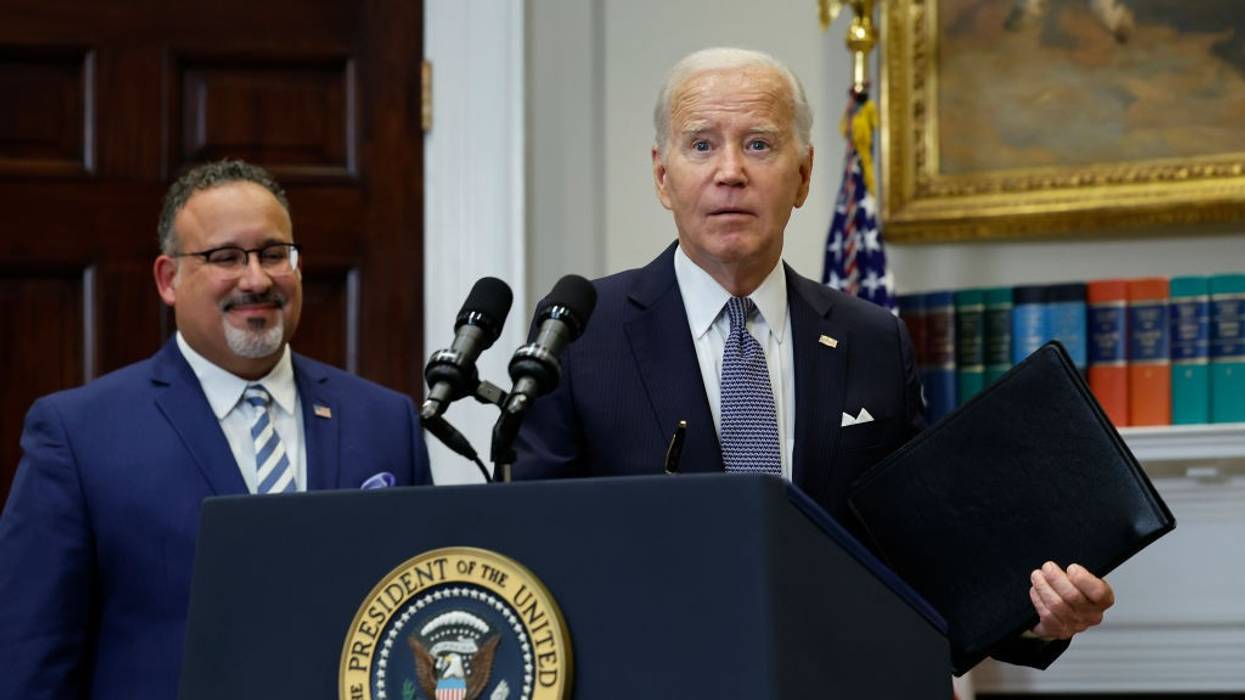
U.S. President Joe Biden on Monday detailed his plan to reform the U.S. Supreme Court and address one of its most controversial recent decisions in an op-ed published by The Washington Post.
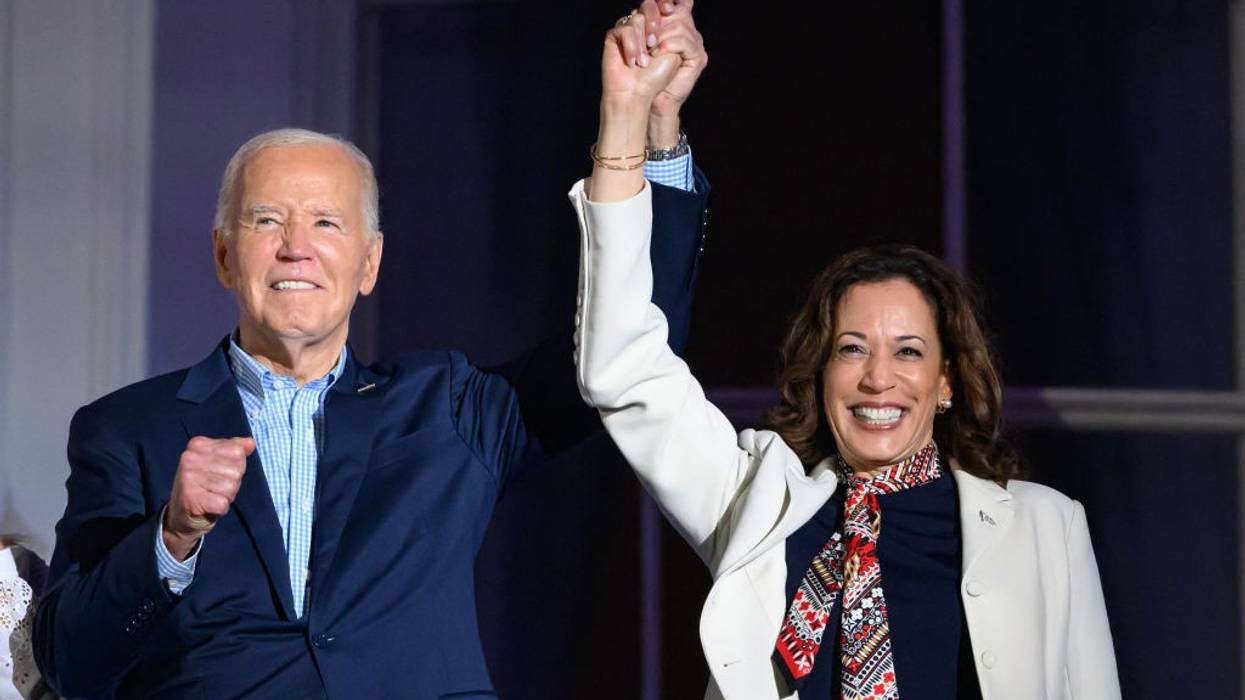
Vice President Kamala Harris, the presumptive Democratic presidential nominee, quickly endorsed his plan, which calls for term limits for Supreme Court justices, an enforceable code of ethics, and a constitutional amendment reversing the court's decision to grant presidents broad immunity for official acts.
"These popular reforms will help to restore confidence in the court, strengthen our democracy, and ensure no one is above the law," Harris said in a statement.
"Americans deserve a Supreme Court they can trust. It's time for Congress to follow the White House's lead and take action to rein in this out-of-touch court."
After long resisting calls to push court reform, Biden told progressive lawmakers he would propose a plan earlier this month. His shift came weeks after a series of court rulings that granted current and former U.S. presidents broad immunity; overturned the Chevron doctrine empowering federal agencies to rely on their expertise in crafting environmental, public health, labor, and other regulations; and supported the criminalization of homelessness.
The majority-conservative Supreme Court—three of whose members were appointed by former U.S. President Donald Trump—has also in recent years reversed Roe v. Wade, ended affirmative action, and struck down Biden's student loan forgiveness program. It has done all this even as Justices Clarence Thomas and Samuel Alito have been at the center of a series of ethics scandals involving undisclosed gifts from right-wing billionaires and a refusal to recuse themselves from Trump's immunity case despite signals that they or their loved ones supported the January 6, 2021 insurrection to overturn the 2020 election results.
"What is happening now is not normal, and it undermines the public's confidence in the court's decisions, including those impacting personal freedoms," Biden wrote on Monday. "We now stand in a breach."
Biden first called for an amendment to the Constitution called the "No One Is Above the Law" amendment, which would address the court's decision on presidential immunity by clarifying that no president is broadly immune from criminal prosecution, including for official acts.
"We are a nation of laws—not of kings or dictators," Biden wrote.
Next, Biden backed a system of term limits for the court whereby a president would appoint one justice every two years to serve a total of 18 years.
"The United States is the only major constitutional democracy that gives lifetime seats to its high court," Biden noted. "Term limits would help ensure that the court's membership changes with some regularity. That would make timing for court nominations more predictable and less arbitrary. It would reduce the chance that any single presidency radically alters the makeup of the court for generations to come."
Finally, the president called for a binding ethics code, as every other federal judge is subject to.
"This is common sense," Biden wrote. "The court's current voluntary ethics code is weak and self-enforced. Justices should be required to disclose gifts, refrain from public political activity, and recuse themselves from cases in which they or their spouses have financial or other conflicts of interest."
Biden stopped short of endorsing court expansion, a move backed by many court reform advocates. It is also unlikely that any of Biden's proposals would currently pass the Republican-controlled House or win over the 60 votes needed in the Senate.
"President Biden's plan renews the system of checks and balances and also establishes binding ethics reforms for a court that has been embroiled in scandal in recent years."
Still, his proposal was welcomed by accountability and good governance groups.
"This is a remarkable and historical step forward on the path to reforming SCOTUS," Wendy Weiser, vice president for democracy at the Brennan Center for Justice, said on social media. "No one should have public power for so long; no one should be the judge in their own case; and no one should be above the law."
Craig Holman, Ph.D., government affairs lobbyist for Public Citizen, said in a statement: "The White House's endorsement of these critical court reforms comes at a time of increasing questions about the lack of transparency and accountability at the court. The White House's new calls for court reform will vastly boost the prospects of moving this reform legislation forward."
Public Citizen co-president Lisa Gilbert said that the group "enthusiastically supports this effort by the Biden-Harris administration and lawmakers to impose term limits and a binding code of ethics on the Supreme Court, and we applaud the support for an amendment to ensure that no president is above the law."
Stand Up America noted that court reform is widely popular with U.S. voters: A vast majority want Congress to pass reform, including 18-year term limits, and 78% want it to impose a code of ethics.
"Americans' confidence in the Supreme Court is at historic lows, which is no surprise given the Roberts Court's blatant disregard for ethical standards, long-standing precedent, and Americans' fundamental freedoms," Stand Up America's executive director, Christina Harvey, said. "We applaud President Biden and Vice President Harris for supporting urgently needed reforms to restore trust in our nation's highest court."
Stand Up America's founder and president Sean Eldridge said on social media that the 18-year term-limit proposal in particular was a "huge step forward for meaningful court reform."
Both Eldridge and Harvey noted that 49 out of 50 U.S. states impose either term limits or retirement ages on their top judges, or have them chosen via election.
"The Supreme Court should be the gold standard for judicial ethics, yet conservative justices have accepted millions of dollars in gifts, attended private retreats with billionaire conservative donors, and failed to meet legal disclosure requirements," Harvey said. "Americans deserve a Supreme Court they can trust. It's time for Congress to follow the White House's lead and take action to rein in this out-of-touch court."
The Congressional Progressive Caucus seemed ready to take up that challenge.
"We are grateful to President Biden for taking action on this longtime priority of the progressive movement to address the crisis facing our democracy," Reps. Pramila Jayapal (D-Wash.) and Hank Johnson (D-Ga.) said in a statement. "We call on our colleagues in Congress to protect the foundation of our country by passing the Judiciary Act to expand the Supreme Court; Supreme Court Ethics, Transparency, & Recusal Act (SCERT) to require a binding code of ethics and transparency measures for justices; and the TERM Act setting term limits for justices."
Another way Congress could act would be to put forward Rep. Ro Khanna's (D-Calif.) Supreme Court Term Limits and Regular Appointments Act, which journalist John Nichols noted had many things in common with Biden's proposal.
In a thread on social media, Nichols put the movement for court term limits in the context of U.S. history.
"The U.S. has since its founding regularly amended the Constitution to guard against an imperial presidency—including the term limits outlined in the 22nd Amendment and ratified in 1951. Now, President Biden proposes judicial term limits to guard against an imperial Supreme Court," he wrote.
After describing the president's plan, Nichols continued: "President Biden's plan renews the system of checks and balances and also establishes binding ethics reforms for a court that has been embroiled in scandal in recent years—as justices have refused to recuse themselves from cases where they have conflicts of interest."
The president is reportedly planning to endorse term limits for Supreme Court justices—but not adding seats to the bench.
In the wake of rulings that have significantly weakened the regulatory authority of federal agencies, backed the criminalization of homelessness, and granted U.S. presidents sweeping immunity from criminal prosecution, President Joe Biden is reportedly preparing to endorse reforms that would establish term limits and a binding code of ethics for the nation's Supreme Court justices—changes that progressive advocates and many Democratic lawmakers have backed for years.
The Washington Post reported late Tuesday that Biden is "finalizing plans" to embrace the proposals "in the coming weeks" as the November presidential election against GOP nominee Donald Trump looms. Trump appointed half of the Supreme Court's right-wing supermajority during his first four years in the White House, paving the way for the overturning of Roe v. Wade and other hugely consequential decisions.
Biden told members of the Congressional Progressive Caucus—some of the most vocal advocates of substantial court reforms—during a call this past weekend that he was "about to come out with a major initiative on limiting the court," according to a transcript obtained by the Post.
But Biden has been facing and resisting pressure to back transformative changes to the high court for years, and it's far from clear that the reforms he's planning to put forth—which would require congressional approval—will satisfy campaigners or members of his party who are calling for high court expansion and other bold changes.
The president, who is facing calls to drop his reelection campaign, has consistently opposed Supreme Court expansion, which is backed by 75% of Democratic voters. The New York Times reported Tuesday that Biden's forthcoming proposal will likely not back high court expansion.
Sean Eldridge, founder and president of the progressive advocacy group Stand Up America, said in a statement late Tuesday that "elected officials are catching up to the growing consensus among the American people that it is time for court reform."
Term limits for Supreme Court justices are broadly popular with the U.S. public, according to new polling from Data for Progress. Nearly 75% of voters across party lines support ending lifetime terms on the high court, the group found.
The specifics of Biden's plan are unclear. Legislation introduced by House Democrats would impose 18-year term limits on Supreme Court justices.
"The Supreme Court should be the gold standard for judicial ethics, but right now, nothing could be further from the truth," Eldridge said Tuesday. "That's why a supermajority of Americans support legislation to enact Supreme Court term limits and a binding code of ethics. It is time for our leaders to listen to the American people and take action to address the growing crisis on our nation's highest court."
"We urge President Biden to support the Supreme Court Ethics, Recusal, and Transparency Act and the TERM Act, which would establish term limits for current and future justices," he added.
Even in the aftermath of rulings that have directly undercut his agenda—such as the high court's decision last year to block his student debt cancellation plan—Biden has dismissed more ambitious proposals to overhaul the Supreme Court, including adding more justices to the bench.
"If we start the process of trying to expand the court, we're going to politicize it maybe forever in a way that is not healthy, that you can't get back," Biden said last June, ignoring the reality that the high court has already been packed by Republicans.
Elie Mystal, The Nation's justice correspondent, argued Tuesday that term limits and other proposed court reforms are doomed to fail "if you don't expand the court."
"The only way to get term limits is to appoint a majority of justices who think term limits are constitutional," Mystal wrote. "And right now, I don't even know if there are three justices who think they're constitutional, much less the necessary five."
"So, again, the constitutional way to bring the Supreme Court to heel," he added, "is to expand it, then pass your ethics bills and term limit bills, which will then be upheld by the newly expanded court."
A breach of this magnitude—in a case that implicates the health of our democratic institutions, by a justice that hasn’t shown a single shred of contrition—is a fit topic for robust political intervention.
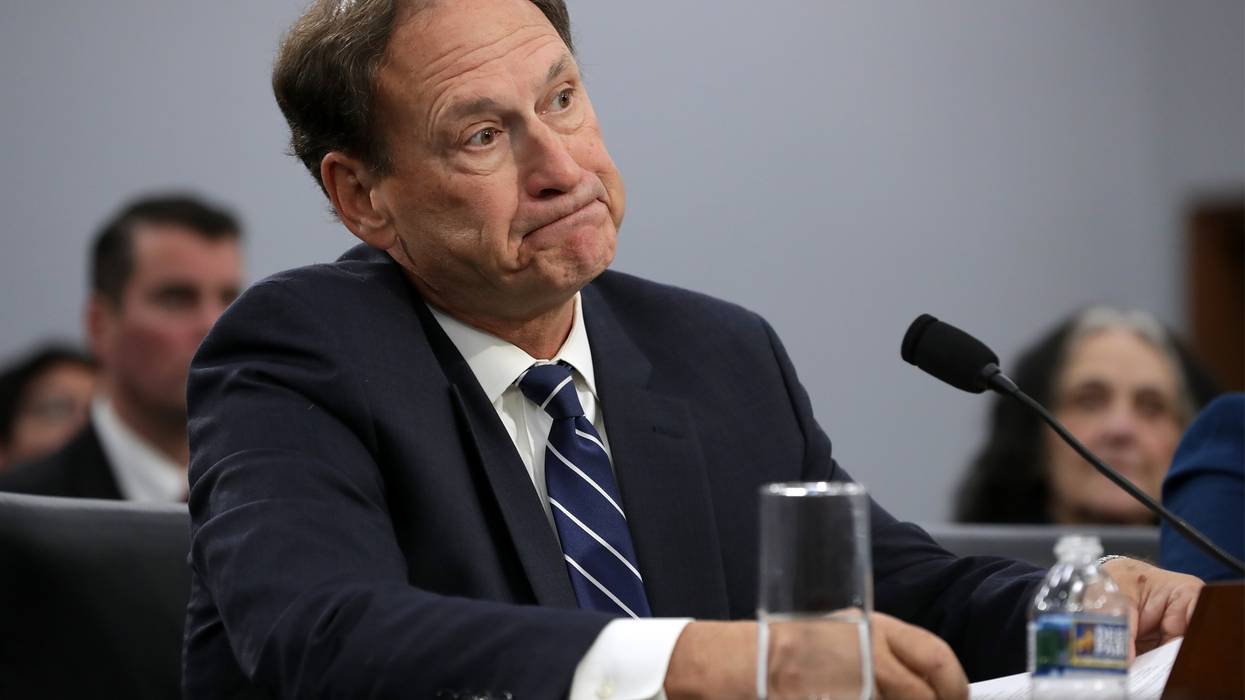
In January 2021, the upside down American flag had become a banner for former U.S. President Donald Trump’s effort to block the peaceful transfer of power. Armed insurrectionists carried it into the U.S. Capitol on January 6. Eleven days later, even as National Guard troops still guarded the Capitol and the Supreme Court building itself, Justice Samuel Alito flew the insurrectionists’ flag outside his Virginia home.
This was far more than an act of indiscreet partisanship, troubling though that might have been. We’ve had those before, from Sandra Day O’Connor backing George W. Bush to Ruth Bader Ginsburg mocking Trump. Justices are human, and sometimes they slip up.
No, this was not a gaffe. It was a senior government official hoisting the banner of a violent insurrectionist movement devoted to overturning a core constitutional principle. At the time, there were numerous cases before the court in which the justices swatted away Trump’s false claims of a stolen election.
In response to the latest scandal, Alito has shrugged. That is a powerful demonstration of the dangerously emboldening effects of lifetime power.
And now this term alone, three major cases have been argued that go straight to the misconduct that marked the “Stop the Steal” effort. Already Alito joined the majority in rejecting Colorado’s effort to keep Trump off the ballot because he had engaged in an insurrection. The court is considering a challenge to the use of federal criminal law that could toss the convictions of 350 insurrectionists who stormed the Capitol.
And of course, Alito is part of the Supreme Court’s most egregious intervention on Trump’s behalf—its refusal to allow the timely federal prosecution of the former president. Special Counsel Jack Smith asked for a ruling confirming that Trump is not immune from prosecution in December 2023. Instead, Alito and his colleagues scheduled arguments for the last hour of the term and seemed to make up a doctrine of wide immunity for some criminal misconduct on the spot. Stop the steal? Start the stall.
Alito has long been inscrutably angry, unwaveringly dogmatic, and the most predictably partisan of all justices. But his growing brazenness still shocks. Judges are required to “act at all times in a manner that promotes public confidence in the integrity and impartiality of the judiciary.” There is simply no question that Alito has breached the rules. Of course he should recuse himself from consideration of the Trump immunity case and the other cases dealing with January 6. Of course he won’t.
So in the face of this kind of brazenness, what to do?
To start, Congress must finally pass a binding code of conduct for the justices. The current code, which the court announced in November, is vague and toothless. It was always a bid to forestall congressional action.
Last year, Alito told The Wall Street Journal, “I know this is a controversial view, but I’m willing to say it. No provision in the Constitution gives [Congress] the authority to regulate the Supreme Court—period.” That’s silly. As my colleagues Jennifer Ahearn and Michael Milov-Cordoba recently documented in a well-timed law review article, Congress has a major role to play in enforcing Supreme Court ethics. Congress can, and repeatedly has, expanded and shrunk the size of the court. It can change the court’s jurisdiction. It has set rules for recusal and financial disclosure. Congress even wrote the justices’ first mandatory oath of office way back in 1789. As Justice Elena Kagan wisely responded last year, “It just can’t be that the court is the only institution that somehow is not subject to checks and balances from anybody else. We’re not imperial.”
Congress can also demand that Alito answer questions under oath, rather than hiding behind incomplete press releases (and his wife). Maybe it can do more.
A breach of this magnitude—in a case that implicates the health of our democratic institutions, by a justice that hasn’t shown a single shred of contrition—is a fit topic for robust political intervention.
And, as we’ve said before, it’s time for term limits. In response to the latest scandal, Alito has shrugged. That is a powerful demonstration of the dangerously emboldening effects of lifetime power. Nobody should hold too much power for too long.
And where is Chief Justice John Roberts? He often purports to be an institutionalist and tries to curate the credibility of the court. He knows that public approval for the high court has plunged to nearly its lowest level ever recorded in polls. That goes beyond a reaction to Dobbs and other activist rulings—it reflects wide public dismay with what has become a partisan institution.
Ultimately, this kind of power grab should be a part of the national debate in our national election. Where is President Joe Biden? He seems reluctant to engage, clinging to an outdated reverence many liberals still have for the court as an institution. But as conservatives taught us for decades, it is entirely appropriate for the Supreme Court, its actions, and its impact, to be a major part of public debate.
The U.S. Flag Code instructs that the upside down flag should not be flown “except as a signal of dire distress in instance of extreme danger to life or property.” Today it is our constitutional system that is in extreme danger—but not in the way Alito and his allies believe. If Alito won’t voluntarily do the bare minimum to protect our democracy, the coequal branches should do everything they can to force him to do so.
"The TERM Act is necessary because lifetime tenure on the United States Supreme Court leads to a court that is insulated from, and unaccountable to, the American people," said Rep. Hank Johnson, the bill's sponsor.
As the U.S. Supreme Court prepares to weigh in on presidential immunity and other major issues in the months ahead, more than 50 advocacy groups on Tuesday endorsed legislation that would create 18-year terms for current and future justices and provide two appointments for each presidential term.
"Extremists on the Supreme Court have undermined our democracy and fundamental freedoms by gutting voting rights, opening the floodgates to unlimited corporate money in our elections, and reversing 50 years of precedent by overturning Roe v. Wade," said Stand Up America executive director Christina Harvey in a statement.
"No one deserves power for life," she argued. "That's why 49 out of 50 states have either term limits, elections, or age limits for their highest courts. To protect our democracy and our fundamental freedoms, Congress should enact term limits for the U.S. Supreme Court."
"To protect our democracy and our fundamental freedoms, Congress should enact term limits for the U.S. Supreme Court."
Along with Stand Up, organizations calling on Congress to pass the Supreme Court Tenure Establishment and Retirement Modernization (TERM) Act include Accountable.US, Alliance for Justice, Brennan Center for Justice, Color of Change, Center for Popular Democracy, Citizens for Responsibility and Ethics in Washington, Demand Justice, Greenpeace USA, Indivisible, March for Our Lives, MoveOn, NextGen America, People for the American Way, Public Citizen, and Working Families Party.
The TERM Act (H.R. 5566) is led by Congressman Hank Johnson (D-Ga.), who reintroduced the bill in September and said during an event outside the Supreme Court that "our system is broken, and Congress must act if we are to save freedom, liberty, and democracy for all."
Noting that the bill is part of a reform package that includes the Judiciary Act and the Supreme Court Ethics, Recusal, and Transparency Act, Johnson argued that "the TERM Act is necessary because lifetime tenure on the United States Supreme Court leads to a court that is insulated from, and unaccountable to, the American people, which is bad for democracy."
As Johnson's office detailed at the time, along with establishing term limits and the new appointment schedule, the bill would:
The legislation now has 28 co-sponsors—including key House leaders: Congressional Progressive Caucus Chair Pramila Jayapal (D-Wash.), Rules Committee Ranking Member Jim McGovern (D-Mass.), Judiciary Committee Ranking Member Jerry Nadler (D-N.Y.), and Oversight Committee Ranking Member Jamie Raskin (D-Md.).
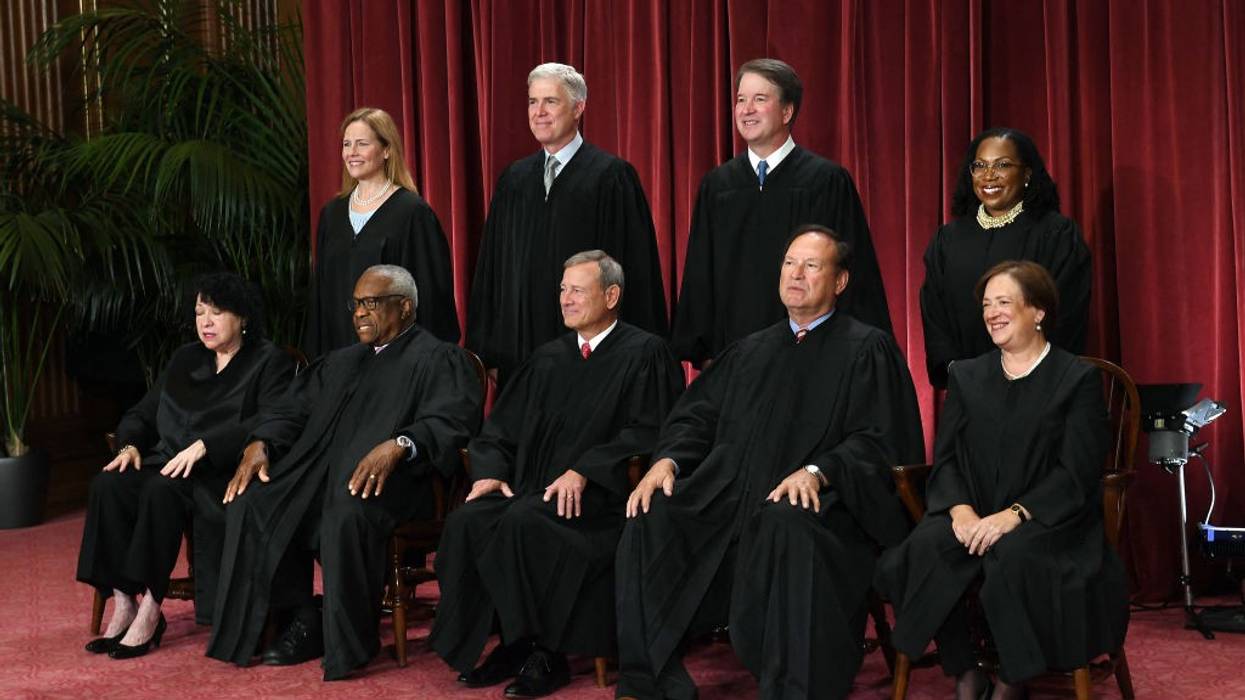
Since former GOP President Donald Trump worked with Senate Republicans to create a right-wing supermajority on the country's highest court by appointing Justices Neil Gorsuch, Brett Kavanaugh, and Amy Coney Barrett, people and advocacy groups across the country have been increasingly demanding reforms.
Those calls have been bolstered by revelations about multiple justices' relationships with ultrawealthy individuals and the Supreme Court's November response to mounting concerns: a nonbinding code of conduct that critics decried as a "toothless PR stunt."
In contrast with his predecessor, Democratic President Joe Biden has so far only appointed one member of the court: Justice Ketanji Brown Jackson—who in 2022 replaced a retiring liberal, keeping in place the 6-3 ideological split.
After beating Trump in 2020, Biden is set to face him again in the November presidential election, thanks in part to the Supreme Court's 9-0 ruling last month that states can't remove federal candidates from their ballots—as Colorado had, determining that the former president was constitutionally ineligible to return to elected office because he had engaged in insurrection.
The court is set to hear arguments in another Trump-related case later this month. The Republican is trying to dodge federal charges for interfering with the 2020 election—one of his four ongoing criminal cases—by claiming presidential immunity. In amicus briefs submitted Monday, advocacy groups, business leaders, constitutional scholars, former government and military officials, historians, and national security professionals warned that a finding in Trump's favor would endanger U.S. democracy.
The three Trump appointees have not recused themselves from the cases; neither has Justice Clarence Thomas, whose activist wife Ginni Thomas was involved in right-wing efforts to block certification of Biden's win.
Given the Supreme Court’s recent track record and its virtually unchecked power, inaction is no longer acceptable.
he Supreme Court concluded its October 2022 term with three reactionary rulings. In rapid succession, it ended affirmative action in college admissions; overturned President Biden’s student debt forgiveness program; and held that an evangelical Christian graphic designer has a First Amendment right to refuse to create websites for same-sex weddings.
Biden reacted quickly, issuing separate statements on each of the decisions. He condemned them as wrongly decided, painful and disappointing, and promised to develop strategies to counter their impacts. But he stopped short of backing the only reform that can reverse the Supreme Court’s extreme rightward turn: expanding the court and filling the new seats with liberal jurists if he is reelected and the Democrats galvanize their base to retake both houses of Congress in 2024.
To his credit, Biden was forceful in rebuking the court’s 6-3 majority opinion on affirmative action written by Chief Justice John Roberts.
“For 45 years,” he said in a televised address delivered on June 29 from the Roosevelt Room at the White House, “the United States Supreme Court has recognized a college’s freedom to decide…how to build diverse student bodies to meet their responsibility of opening doors of opportunity for every single American. In case after case…the court has affirmed…that colleges could use race not as a determinative factor for admission, but as one of the factors among many in deciding who [sic] to admit from a… qualified pool of applicants.”
He added, “Today, the court once again walked away from decades of precedent” …and issued a decision that as the dissent [written by Justice Sonia Sotomayor] states, ‘rolls back decades of precedent and momentous progress.’”
Biden also rebutted the insidious myth that affirmative action leads to the admission of unqualified students, and pledged his support for new measures to bolster diversity in higher education.
As he was leaving the room, a reporter shouted out, “President Biden, the Congressional Black Caucus said the Supreme Court has ‘thrown into question its own legitimacy.’ Is this a rogue court?”
Biden paused for a moment, smiled slightly and turned toward the reporter. “This is not a normal court,” he answered. Without further comment, he exited through a side door.
Later that afternoon, in an interview with MSNBC’s Nicolle Wallace, Biden was asked what he meant by his answer. He replied that the court has “done more to unravel basic rights and basic decisions than any court in recent history, and that’s what I meant by not normal.” He cited last year’s reversal of Roe v. Wade, and observed that the court has “ruled on a number of issues that … had been precedent for 50, 60 years sometimes.”
But he also flatly shot down growing calls by progressives for court expansion, saying, “I think if we start the process of trying to expand the court, we’re going to politicize it maybe forever in a way that is not healthy.”
Given the Supreme Court’s recent track record and its virtually unchecked power, such inaction can no longer be justified.
Biden is a steadfast opponent of court expansion. Throughout the 2020 campaign, when repeatedly pressed on the issue, he promised to convene a blue-ribbon commission to study the need for court reform. He made good on that promise in April 2021 when he issued an executive order that created a bipartisan member panel of former federal judges, high-powered attorneys and law professors to examine the pros and cons, not only of expansion, but also such measures as term limits for Supreme Court justices and ethics reforms aimed at establishing a binding code of judicial conduct for the court, which remains the only federal judicial body that operates without a code.
In the end, however, the commission issued a 288-page final report the following December that can charitably be described as a dud. Apart from tepid and vague language endorsing increased transparency in the court’s internal procedures and the adoption of an “advisory” [but not mandatory] code of conduct, the commission failed to advance any concrete proposals. In the words of The Nation columnist Elie Mystal, the entire endeavor “was designed to fail” from the start, and was “set up to give the president and Senate Democrats cover for total inaction.”
Given the Supreme Court’s recent track record and its virtually unchecked power, such inaction can no longer be justified. With its six-member Republican supermajority, including three justices appointed by Donald Trump, the court is driving the country and American law backward.
The court’s extremism is inflaming voter anger and will likely be a key driver of turnout in the 2024 election. Biden should be shrewd enough to harness that anger. It is not sufficient for him to acknowledge that the Supreme Court isn’t “normal.” It’s time for him to recognize that the court is broken, and the only way to fix it is to expand it.
With a majority of the public now alienated by the reactionary, corrupt Supreme Court, it’s time for Democrats to turn the tables. Leadership must come from the White House.
On the very day last week that The Supreme Court overturned affirmative action and the day before it outlawed Biden’s signature student loan program and gave businesses the right to discriminate against gay people, Biden told Nicolle Wallace that while SCOTUS is not “normal” he opposes court reform because it would “politicize the court in a way that’s not healthy.”
Sorry Joe, but that ship sailed decades ago. The current Court is not just “not normal” but a corrupt, unelected, thoroughly politicized right-wing Republican institution with lifetime appointments that will continue to impose its reactionary vision on the nation for decades to come.
Unchecked, the Court will continue to ignore precedent, take away longstanding Constitutional rights from women, Blacks and other minorities, allow businesses to discriminate against disfavored groups, block the President from doing anything significant about climate change, student debt and just about anything else significant, and overturn common sense gun safety laws.
It’s time for President Biden to put away his butter knife and take out his AR-15 to run against the reactionary, corrupt Supreme Court.
For decades, Democrats have brought a butter knife while Republicans have brought AR-15s to the fight over the courts. Republicans have packed the court with right-wing extremists; refused to give Merrick Garland a hearing; confirmed Amy Coney Barrett while citizens had already begun voting in the 2020 election; confirmed Brett Kavanaugh (and Clarence Thomas) despite credible accusations of sexual harassment; and let Justices take personal financial benefits from right-wing billionaire donors. In his comments opposing court reform, President Biden pulled out the same old butter knife again.
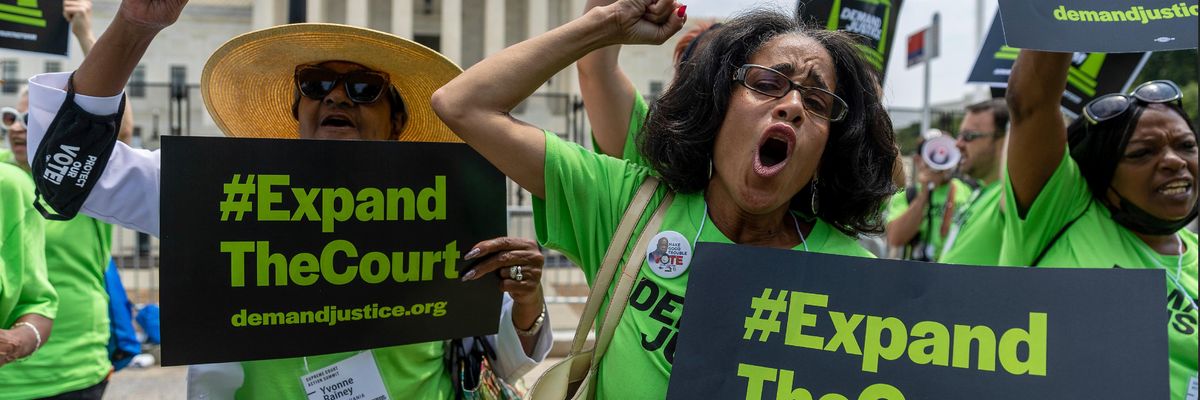
Activists for expanding the U.S. Supreme Court rally outside the nation's highest court in Washington, D.C. on June 22, 2022.
(Photo: Tasos Katopodis/Getty Images for Demand Justice)
There are credible proposals for court reform on the table that Biden is refusing to acknowledge. For example over 60 Senate and House members just reintroduced the Judiciary Act of 2023 that would unpack the court by adding four seats to the U.S. Supreme Court, bringing the bench from nine to 13 justices. Sponsors include Senators Ed Markey, Tina Smith and Elizabeth Warren and Representatives Jerry Nadler, Hank Johnson, Cori Bush and Adam Schiff.
A coalition of over 40 grassroots organizations called Just Majority support the bill including: Alliance for Justice; American Constitution Society; Black Voters Matter; Center for Popular Democracy Action; Color of Change; Demand Justice; Demos; Greenpeace USA; Guns Down America; Indivisible; Justice Democrats; Latino Victory Project; League of Conservation Voters; MoveOn; NARAL National Asian Pacific American Women's Forum; People for the American Way; Planned Parenthood; Public Citizen; Sunrise Movement; Teachers Unify to End Gun Violence; and Women's March.
According to an Indivisible spokesperson:
“Court expansion is the best chance we have to bring our Supreme Court back from the brink. We’re not calling for expansion because we have passing disagreements with the conservative supermajority. We’re calling for it because our democracy and our fundamental freedoms are at stake. This is a majority that has gutted the Voting Rights Act repeatedly, allowed radical gerrymandering of our congressional maps that undermine the political power of Black and brown folks, and possibly most horrifyingly, has overturned Roe v. Wade and thrown our ability to receive abortion care into utter chaos nationwide. This cannot continue. The only way to save the Supreme Court is to expand it. The American people deserve a Court that’s beholden to the law and the constitution, not billionaire MAGA donors who offer free trips on private jets.”
Another strong court reform proposal comes from The Brennan Center—Term limits for Supreme Court justices to replace lifetime tenure in which Justices serve for decades. As with the proposal to add Justices, Term Limits could be enacted by a majority vote of Congress signed by the President.
Under the Brennan Center’s Term Limits proposal justices would sit in staggered 18-year terms of active service on the Supreme Court, with a new vacancy opening every two years. Each president would have two, and only two, appointments during a four-year term. When a Justice’s term is up, the Justice would move to senior status under which s/he would by designation hear cases in the lower federal courts, and occasionally step in to hear cases on the Supreme Court’s docket upon a recusal by an active justice or an unexpected vacancy. As The Brennan Center writes, “Limiting the justices to specific terms would ensure that every president has an equal imprint on the Court and create more opportunities to appoint new justices that reflect changing demographics and the sentiments of many different communities.”
All but one state supreme court in America has either fixed terms or mandatory retirement, and so do constitutional courts in every other major democratic country in the world. America’s lifetime tenure for Supreme Court justices stands out as the sole outlier among worldwide democracies. A new study estimates that without reform, the Court won’t have a majority of Democratic appointees again until 2065.
While court expansion and term limits are compatible, term limits may have a better chance of of being enacted.
Student loan borrowers and advocates gather for a rally outside the U.S. Supreme Court on February 28, 2023.(Photo: Jemal Countess/Getty Images for People's Rally to Cancel Student Debt )Polls show that only 30% of voters approve of the Court. Over 2/3 of respondents (67%) support term limits including 82% of Democrats and 57% of Republicans.
Even Nancy Pelosi endorsed court reform this week, supporting term limits and leaving the door open to court expansion.
It’s time for President Biden to put away his butter knife and take out his AR-15 to run against the reactionary, corrupt Supreme Court. Republicans have successfully run against the court for decades, mobilizing particularly Christian fundamentalists with promises to overturn abortion rights and limit rights for minorities and the LGBTQ + community.
With a majority of the public now alienated by the reactionary, corrupt Supreme Court, it’s time for Democrats to turn the tables. In addition to defending democracy and supporting economics from the middle out instead of the top down, in 2024 Democrats should aggressively run against the Supreme Court and call for reforms. In light of Dobbs and now the affirmative action, student loan and bad gay rights decisions, this could particularly mobilize minority voters and young voters who Democrats need to inspire to turn out in large numbers.
President Biden must change his naïve institutionalist view opposing court reform and join the majority of the public, grassroots organizations, congressional leaders in making the corrupt reactionary Supreme Court and court reform a major issue in 2024.
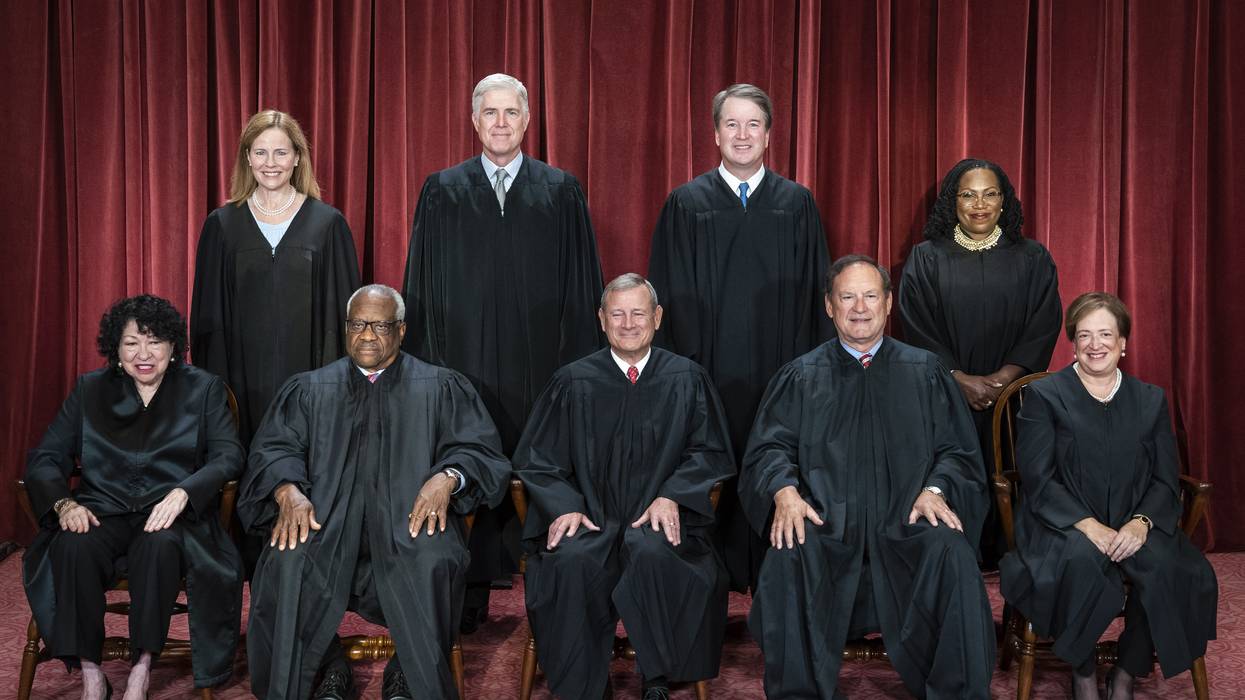
"Our Founding Fathers intended for lifetime appointments to ensure impartiality," said Rep. Ro Khanna. "The decision today demonstrates how justices have become partisan and out of step with the American public."
Condemning the right-wing majority on the U.S. Supreme Court as corrupt and "heavily politicized," U.S. Reps. Ro Khanna and Don Beyer on Friday reintroduced legislation to impose term limits for the nine justices in order to "restore judicial independence."
Hours after the court ruled that businesses can refuse services to LGBTQ+ people and struck down President Joe Biden's student loan debt relief program, Khanna (D-Calif.) said that the framers of the Constitution established lifetime appointments for justices on the nation's highest court in order "to ensure impartiality," but recent rulings by the six right-wing members of the panel's supermajority have not held up that standard.
"The Supreme Court's decision to block student debt relief will put many hardworking Americans at risk of default and will be a disaster for our economy," said Rep. Ro Khanna. "Our Founding Fathers intended for lifetime appointments to ensure impartiality. The decision today demonstrates how justices have become partisan and out of step with the American public. I'm proud to reintroduce the Supreme Court Term Limits and Regular Appointments Act to implement term limits to rebalance the court and stop extreme partisanship."
The legislation would create an 18-year term limit for justices appointed after the law was enacted. Justices would be permitted to serve on lower courts after their term was up.
Beyer (D-Va.) said the time has come to impose term limits following numerous partisan decisions by the Supreme Court, including its overturning of Roe v. Wade last year, and revelations about undisclosed financial ties that right-wing Justices Clarence Thomas, Samuel Alito, and Neil Gorsuch have had to Republican megadonors and operatives who have had business before the court.
"For many Americans, the Supreme Court is a distant, secretive, unelected body that can make drastic changes in their lives without any accountability," said Beyer. "Recent partisan decisions by the Supreme Court that destroyed historic protections for reproductive rights, voting rights, and more have undermined public trust in the Court—even as inappropriate financial relationships between justices and conservative donors raised new questions about its integrity."
Currently, said Rep. Rashida Tlaib (D-Mich.), "six extremist, unelected activists" are doing "the bidding of billionaire Republican donors from the bench."
"This illegitimate Supreme Court has become a cesspool of corruption and is in urgent need of reform," she said. "It's time to end lifetime appointments to the Supreme Court."
A poll by Marist College in April found that 68% of Americans back term limits for Supreme Court justices while just 37% of respondents said they had confidence in the high court.
The judicial watchdog group Fix the Court endorsed Khanna and Beyer's proposal, noting that from the nation's founding until 1970, Supreme Court justices served 15 years on average.
"That number has nearly doubled in the last few decades, as the power the court has abrogated to itself has also increased exponentially," said the group.
The current system has allowed Supreme Court justices to "possess unchecked power for life," said Gabe Roth, executive director of Fix the Court. "Luckily, there's a popular, apolitical way to fix this: by requiring future justices to take 'senior status' after 18 years, at which point they'd fill in at SCOTUS when needed, rotate down to a lower court, or retire."
"This idea forms the basis of Rep. Khanna's bill," he said, "and I'm pleased to support his work to establish fundamental guardrails for the most powerful, least accountable part of our government."