SUBSCRIBE TO OUR FREE NEWSLETTER
Daily news & progressive opinion—funded by the people, not the corporations—delivered straight to your inbox.
5
#000000
#FFFFFF
To donate by check, phone, or other method, see our More Ways to Give page.
Daily news & progressive opinion—funded by the people, not the corporations—delivered straight to your inbox.
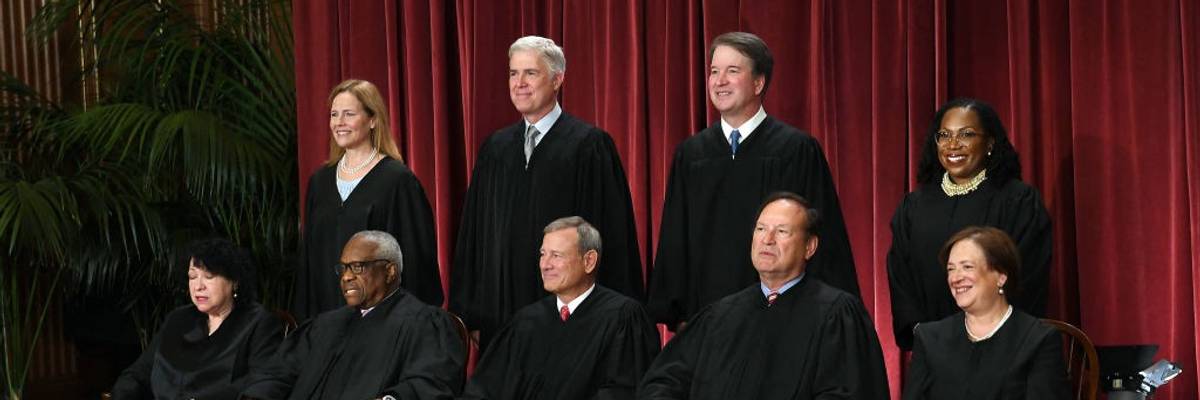
The current Justices of the U.S. Supreme Court sit for a photograph.
"This unenforceable public relations document serves absolutely no purpose other than to permit the media to revert to pretending that our unaccountable and unethical Supreme Court retains legitimacy," one advocate said.
In the wake of a series of high-profile scandals surrounding the relationship between right-wing justices and billionaires, the U.S. Supreme Court announced on Monday that it had formally adopted a new Code of Conduct.
The 14-page code is based on requirements for lower court judges, and most of the rules it outlines are not new, the court said. Watchdog groups have been widely critical of the new document, which does not stipulate how the conduct it promotes will be enforced, with the Revolving Door Project labeling it a "toothless PR stunt."
"This unenforceable public relations document serves absolutely no purpose other than to permit the media to revert to pretending that our unaccountable and unethical Supreme Court retains legitimacy," the project's executive director Jeff Hauser said in a statement.
Pressure on the Supreme Court to reform its ethics rules has mounted since ProPublica revealed in April that Justice Clarence Thomas had failed to disclose more than two decades worth of trips he had taken that had been paid for by billionaire Harlan Crow. Additional reporting in June uncovered the fact that Justice Samuel Alito had also taken undisclosed trips financed by hedge fund billionaire Paul Singer, who had appealed to the court to side with him in business disputes.
In response to these and other revelations of financial gifts to justices from wealthy and influential individuals, Democrats on the Senate Judiciary Committee advanced legislation in July that would require the court to follow stricter disclosure rules, adhere to an enforceable ethics code, and explain any recusal decisions to the American people. It would also enable investigations of any suspected breaches of the ethics code. Sen. Sheldon Whitehouse (D-R.I.), who led the push for the law, said that the Supreme Court's newly announced code was not an effective substitution.
"This is a long-overdue step by the justices, but a code of ethics is not binding unless there is a mechanism to investigate possible violations and enforce the rules," Whitehouse said in a statement. "The honor system has not worked for members of the Roberts Court. My ethics bill would create a transparent process for complaints and allow a panel of chief judges from the lower courts to investigate and make recommendations based on those complaints."
In the newly published code, the justices promised to "uphold the integrity and independence of the judiciary" and "avoid impropriety and the appearance of impropriety," among other key points. It stipulated that "a justice should not allow family, social, political, financial, or other relationships to influence official conduct or judgment," or "knowingly convey or permit others to convey the impression that they are in a special position to influence the justice."
However, the code begins with a statement that the court had "largely" already adhered to the tenets of the document, saying that the lack of an official code had "led in recent years to the misunderstanding that the justices of this court, unlike all other jurists in this country, regard themselves as unrestricted by any ethics rules." It says the primary purpose of the new code was "to dispel this misunderstanding."
"This document reeks of a cover-up for, among others, Justice Clarence Thomas," Hauser said in response to the preamble. "The list of weak ethics-adjacent aphori[s]ms is prefaced by a statement from the justices that they have 'largely' been complying with the loose norms they set forth today. Yet Thomas' conduct, in particular, has long been at odds with any pretense to any remotely serious standard of ethics."
"Will a risible PR stunt succeed in relieving pressure off a Supreme Court that is rightly widely deemed to be in crisis?"
Stand Up America managing director for policy and political affairs Brett Edkins said the document was "clearly" a response to public outrage over the ProPublica revelations.
"The court is attempting to halt momentum for transparency and real reform," Edkins said in a statement. "Congress must use its authority as a co-equal branch of government to pass a code of ethics with real enforcement mechanisms, and the Senate Judiciary Committee should move forward with subpoenas of Harlan Crow and Leonard Leo. The American people deserve to know the full scope of this court's corruption."
A committee vote on the committee on whether or not to issue such subpoenas was postponed last week, as NBC News reported.
Take Back the Court Action Fund president Sarah Lipton-Lubet also saw the code as a response to public pressure.
"With 53 uses of the word 'should' and only six of the word 'must,' the court's new 'code of ethics' reads a lot more like a friendly suggestion than a binding, enforceable guideline," Lipton-Lubet said in a statement.
Lipton-Lubet added that the document's lack of enforcement was more evidence that the court "cannot police itself."
"We've all seen what happens when it is left to do so, and the result is public confidence in the illegitimate Supreme Court has reached an all-time low," Lipton-Lubet continued. "Now is not the time to let up. Congress should move forward with actual ethics rules as soon as possible."
Trevor Potter, president of Campaign Legal Center and a former Republican chairman of the Federal Election Commission, said the code "may seem like a step in the right direction" but was "little more than an effort to assuage public outrage without assuming any actual accountability."
"Every other branch of government has a dedicated body responsible for enforcing its ethics code, yet the court does not even attempt to create one for itself here," Potter continued. "This 'code' changes nothing about the existing system of ethics self-policing in the Supreme Court. In fact, buried at the end of the document, the Court says they may rely on a variety of sources in interpreting the requirements of the ethics code—business as usual."
Senate Majority Leader Chuck Schumer (D-N.Y.) said the code was an "important first step," but added that "the lack of any way to enforce the code of conduct should any justice decide to ignore it is a glaring omission."
Ultimately, Hauser said the code was a "big test" for media and legal elites.
"Will a risible PR stunt succeed in relieving pressure off a Supreme Court that is rightly widely deemed to be in crisis?" Hauser asked. "People who care about the rule of law must hope those who lead our national coverage about the Supreme Court are not readily co-opted by lawyering that, truth be told, is not even especially slick or sophisticated."
Dear Common Dreams reader, It’s been nearly 30 years since I co-founded Common Dreams with my late wife, Lina Newhouser. We had the radical notion that journalism should serve the public good, not corporate profits. It was clear to us from the outset what it would take to build such a project. No paid advertisements. No corporate sponsors. No millionaire publisher telling us what to think or do. Many people said we wouldn't last a year, but we proved those doubters wrong. Together with a tremendous team of journalists and dedicated staff, we built an independent media outlet free from the constraints of profits and corporate control. Our mission has always been simple: To inform. To inspire. To ignite change for the common good. Building Common Dreams was not easy. Our survival was never guaranteed. When you take on the most powerful forces—Wall Street greed, fossil fuel industry destruction, Big Tech lobbyists, and uber-rich oligarchs who have spent billions upon billions rigging the economy and democracy in their favor—the only bulwark you have is supporters who believe in your work. But here’s the urgent message from me today. It's never been this bad out there. And it's never been this hard to keep us going. At the very moment Common Dreams is most needed, the threats we face are intensifying. We need your support now more than ever. We don't accept corporate advertising and never will. We don't have a paywall because we don't think people should be blocked from critical news based on their ability to pay. Everything we do is funded by the donations of readers like you. When everyone does the little they can afford, we are strong. But if that support retreats or dries up, so do we. Will you donate now to make sure Common Dreams not only survives but thrives? —Craig Brown, Co-founder |
In the wake of a series of high-profile scandals surrounding the relationship between right-wing justices and billionaires, the U.S. Supreme Court announced on Monday that it had formally adopted a new Code of Conduct.
The 14-page code is based on requirements for lower court judges, and most of the rules it outlines are not new, the court said. Watchdog groups have been widely critical of the new document, which does not stipulate how the conduct it promotes will be enforced, with the Revolving Door Project labeling it a "toothless PR stunt."
"This unenforceable public relations document serves absolutely no purpose other than to permit the media to revert to pretending that our unaccountable and unethical Supreme Court retains legitimacy," the project's executive director Jeff Hauser said in a statement.
Pressure on the Supreme Court to reform its ethics rules has mounted since ProPublica revealed in April that Justice Clarence Thomas had failed to disclose more than two decades worth of trips he had taken that had been paid for by billionaire Harlan Crow. Additional reporting in June uncovered the fact that Justice Samuel Alito had also taken undisclosed trips financed by hedge fund billionaire Paul Singer, who had appealed to the court to side with him in business disputes.
In response to these and other revelations of financial gifts to justices from wealthy and influential individuals, Democrats on the Senate Judiciary Committee advanced legislation in July that would require the court to follow stricter disclosure rules, adhere to an enforceable ethics code, and explain any recusal decisions to the American people. It would also enable investigations of any suspected breaches of the ethics code. Sen. Sheldon Whitehouse (D-R.I.), who led the push for the law, said that the Supreme Court's newly announced code was not an effective substitution.
"This is a long-overdue step by the justices, but a code of ethics is not binding unless there is a mechanism to investigate possible violations and enforce the rules," Whitehouse said in a statement. "The honor system has not worked for members of the Roberts Court. My ethics bill would create a transparent process for complaints and allow a panel of chief judges from the lower courts to investigate and make recommendations based on those complaints."
In the newly published code, the justices promised to "uphold the integrity and independence of the judiciary" and "avoid impropriety and the appearance of impropriety," among other key points. It stipulated that "a justice should not allow family, social, political, financial, or other relationships to influence official conduct or judgment," or "knowingly convey or permit others to convey the impression that they are in a special position to influence the justice."
However, the code begins with a statement that the court had "largely" already adhered to the tenets of the document, saying that the lack of an official code had "led in recent years to the misunderstanding that the justices of this court, unlike all other jurists in this country, regard themselves as unrestricted by any ethics rules." It says the primary purpose of the new code was "to dispel this misunderstanding."
"This document reeks of a cover-up for, among others, Justice Clarence Thomas," Hauser said in response to the preamble. "The list of weak ethics-adjacent aphori[s]ms is prefaced by a statement from the justices that they have 'largely' been complying with the loose norms they set forth today. Yet Thomas' conduct, in particular, has long been at odds with any pretense to any remotely serious standard of ethics."
"Will a risible PR stunt succeed in relieving pressure off a Supreme Court that is rightly widely deemed to be in crisis?"
Stand Up America managing director for policy and political affairs Brett Edkins said the document was "clearly" a response to public outrage over the ProPublica revelations.
"The court is attempting to halt momentum for transparency and real reform," Edkins said in a statement. "Congress must use its authority as a co-equal branch of government to pass a code of ethics with real enforcement mechanisms, and the Senate Judiciary Committee should move forward with subpoenas of Harlan Crow and Leonard Leo. The American people deserve to know the full scope of this court's corruption."
A committee vote on the committee on whether or not to issue such subpoenas was postponed last week, as NBC News reported.
Take Back the Court Action Fund president Sarah Lipton-Lubet also saw the code as a response to public pressure.
"With 53 uses of the word 'should' and only six of the word 'must,' the court's new 'code of ethics' reads a lot more like a friendly suggestion than a binding, enforceable guideline," Lipton-Lubet said in a statement.
Lipton-Lubet added that the document's lack of enforcement was more evidence that the court "cannot police itself."
"We've all seen what happens when it is left to do so, and the result is public confidence in the illegitimate Supreme Court has reached an all-time low," Lipton-Lubet continued. "Now is not the time to let up. Congress should move forward with actual ethics rules as soon as possible."
Trevor Potter, president of Campaign Legal Center and a former Republican chairman of the Federal Election Commission, said the code "may seem like a step in the right direction" but was "little more than an effort to assuage public outrage without assuming any actual accountability."
"Every other branch of government has a dedicated body responsible for enforcing its ethics code, yet the court does not even attempt to create one for itself here," Potter continued. "This 'code' changes nothing about the existing system of ethics self-policing in the Supreme Court. In fact, buried at the end of the document, the Court says they may rely on a variety of sources in interpreting the requirements of the ethics code—business as usual."
Senate Majority Leader Chuck Schumer (D-N.Y.) said the code was an "important first step," but added that "the lack of any way to enforce the code of conduct should any justice decide to ignore it is a glaring omission."
Ultimately, Hauser said the code was a "big test" for media and legal elites.
"Will a risible PR stunt succeed in relieving pressure off a Supreme Court that is rightly widely deemed to be in crisis?" Hauser asked. "People who care about the rule of law must hope those who lead our national coverage about the Supreme Court are not readily co-opted by lawyering that, truth be told, is not even especially slick or sophisticated."
In the wake of a series of high-profile scandals surrounding the relationship between right-wing justices and billionaires, the U.S. Supreme Court announced on Monday that it had formally adopted a new Code of Conduct.
The 14-page code is based on requirements for lower court judges, and most of the rules it outlines are not new, the court said. Watchdog groups have been widely critical of the new document, which does not stipulate how the conduct it promotes will be enforced, with the Revolving Door Project labeling it a "toothless PR stunt."
"This unenforceable public relations document serves absolutely no purpose other than to permit the media to revert to pretending that our unaccountable and unethical Supreme Court retains legitimacy," the project's executive director Jeff Hauser said in a statement.
Pressure on the Supreme Court to reform its ethics rules has mounted since ProPublica revealed in April that Justice Clarence Thomas had failed to disclose more than two decades worth of trips he had taken that had been paid for by billionaire Harlan Crow. Additional reporting in June uncovered the fact that Justice Samuel Alito had also taken undisclosed trips financed by hedge fund billionaire Paul Singer, who had appealed to the court to side with him in business disputes.
In response to these and other revelations of financial gifts to justices from wealthy and influential individuals, Democrats on the Senate Judiciary Committee advanced legislation in July that would require the court to follow stricter disclosure rules, adhere to an enforceable ethics code, and explain any recusal decisions to the American people. It would also enable investigations of any suspected breaches of the ethics code. Sen. Sheldon Whitehouse (D-R.I.), who led the push for the law, said that the Supreme Court's newly announced code was not an effective substitution.
"This is a long-overdue step by the justices, but a code of ethics is not binding unless there is a mechanism to investigate possible violations and enforce the rules," Whitehouse said in a statement. "The honor system has not worked for members of the Roberts Court. My ethics bill would create a transparent process for complaints and allow a panel of chief judges from the lower courts to investigate and make recommendations based on those complaints."
In the newly published code, the justices promised to "uphold the integrity and independence of the judiciary" and "avoid impropriety and the appearance of impropriety," among other key points. It stipulated that "a justice should not allow family, social, political, financial, or other relationships to influence official conduct or judgment," or "knowingly convey or permit others to convey the impression that they are in a special position to influence the justice."
However, the code begins with a statement that the court had "largely" already adhered to the tenets of the document, saying that the lack of an official code had "led in recent years to the misunderstanding that the justices of this court, unlike all other jurists in this country, regard themselves as unrestricted by any ethics rules." It says the primary purpose of the new code was "to dispel this misunderstanding."
"This document reeks of a cover-up for, among others, Justice Clarence Thomas," Hauser said in response to the preamble. "The list of weak ethics-adjacent aphori[s]ms is prefaced by a statement from the justices that they have 'largely' been complying with the loose norms they set forth today. Yet Thomas' conduct, in particular, has long been at odds with any pretense to any remotely serious standard of ethics."
"Will a risible PR stunt succeed in relieving pressure off a Supreme Court that is rightly widely deemed to be in crisis?"
Stand Up America managing director for policy and political affairs Brett Edkins said the document was "clearly" a response to public outrage over the ProPublica revelations.
"The court is attempting to halt momentum for transparency and real reform," Edkins said in a statement. "Congress must use its authority as a co-equal branch of government to pass a code of ethics with real enforcement mechanisms, and the Senate Judiciary Committee should move forward with subpoenas of Harlan Crow and Leonard Leo. The American people deserve to know the full scope of this court's corruption."
A committee vote on the committee on whether or not to issue such subpoenas was postponed last week, as NBC News reported.
Take Back the Court Action Fund president Sarah Lipton-Lubet also saw the code as a response to public pressure.
"With 53 uses of the word 'should' and only six of the word 'must,' the court's new 'code of ethics' reads a lot more like a friendly suggestion than a binding, enforceable guideline," Lipton-Lubet said in a statement.
Lipton-Lubet added that the document's lack of enforcement was more evidence that the court "cannot police itself."
"We've all seen what happens when it is left to do so, and the result is public confidence in the illegitimate Supreme Court has reached an all-time low," Lipton-Lubet continued. "Now is not the time to let up. Congress should move forward with actual ethics rules as soon as possible."
Trevor Potter, president of Campaign Legal Center and a former Republican chairman of the Federal Election Commission, said the code "may seem like a step in the right direction" but was "little more than an effort to assuage public outrage without assuming any actual accountability."
"Every other branch of government has a dedicated body responsible for enforcing its ethics code, yet the court does not even attempt to create one for itself here," Potter continued. "This 'code' changes nothing about the existing system of ethics self-policing in the Supreme Court. In fact, buried at the end of the document, the Court says they may rely on a variety of sources in interpreting the requirements of the ethics code—business as usual."
Senate Majority Leader Chuck Schumer (D-N.Y.) said the code was an "important first step," but added that "the lack of any way to enforce the code of conduct should any justice decide to ignore it is a glaring omission."
Ultimately, Hauser said the code was a "big test" for media and legal elites.
"Will a risible PR stunt succeed in relieving pressure off a Supreme Court that is rightly widely deemed to be in crisis?" Hauser asked. "People who care about the rule of law must hope those who lead our national coverage about the Supreme Court are not readily co-opted by lawyering that, truth be told, is not even especially slick or sophisticated."