SUBSCRIBE TO OUR FREE NEWSLETTER
Daily news & progressive opinion—funded by the people, not the corporations—delivered straight to your inbox.
5
#000000
#FFFFFF
To donate by check, phone, or other method, see our More Ways to Give page.
Daily news & progressive opinion—funded by the people, not the corporations—delivered straight to your inbox.
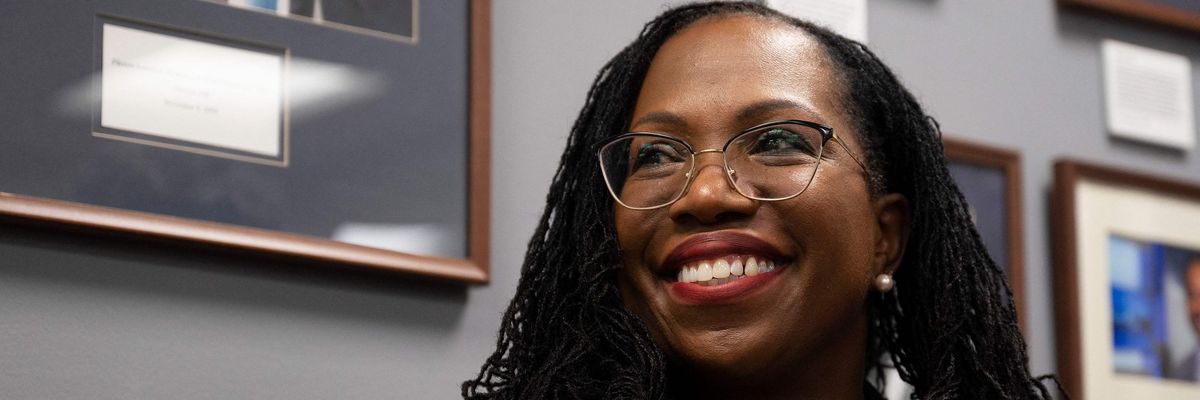
Judge Ketanji Brown Jackson smiles during an April 5, 2022 Capitol Hill meeting with U.S. Senator Sherrod Brown (D-Ohio) on her nomination to be an associate justice of the Supreme Court of the United States. (Photo: Jim Watson/AFP via Getty Images)
Progressive politicians, activists, and advocacy groups on Thursday cheered as Judge Ketanji Brown Jackson was confirmed to the United States Supreme Court, becoming the first Black woman and first public defender to serve on the nation's highest judicial body.
"Judge Ketanji Brown Jackson's rise to the Supreme Court is a moment unlike any other in our nation's history."
Jackson, who was nominated by President Joe Biden to replace retiring Justice Stephen Breyer, was confirmed by the U.S. Senate in a mostly party-line vote of 53-47. Three Republican senators--Susan Collins (Maine), Lisa Murkowski (Alaska), and Mitt Romney (Utah)--joined all members of the Democratic caucus in voting to confirm the 51-year old federal appellate judge.
"This is truly a joyful day for the country," said Congressional Progressive Caucus Chair Pramila Jayapal (D-Wash.), calling Jackson "one of the most experienced nominees in decades: a former district court and court of appeals judge, Supreme Court clerk, U.S. Sentencing Commission member, and former public defender."
"The country saw her poise, grace, thoughtfulness, and brilliance as she handled every part of the confirmation process--including some outrageous attacks from Republican senators that damaged only their credibility, not hers," she added. "She has shown what it means to rise above the nastiness and to bring her history as a judge and her experience as a Black woman to her jurisprudence. She rightfully has earned the admiration and respect of millions across the country."
Sen. Bernie Sanders (I-Vt.) said in a statement that "in these difficult times, the stakes for the future of this country are higher than ever and the Supreme Court will play a significant role in shaping that future."
"In my view, we need a new member of the Supreme Court who has a strong track record of standing up for justice--economic justice, racial justice, social justice, political justice, and environmental justice," he added. "There is no doubt that Judge Jackson is that person."
Jackson's confirmation was also hailed by Rashad Robinson, president of the civil rights advocacy group Color of Change, who said she "has raised the bar in terms of qualifications for the Supreme Court--greatly raising our country's expectations for who should sit on our courts."
"Her perspective as a public defender has long been missing from the court and denied influence across the judiciary, as has her real-world experience addressing racial injustices in sentencing," he continued. "We must remember and redouble our commitment to redefining the role of judges and prosecutors across our country--to ensure they serve the people rather than serving corrupt interests and ensure they end racial injustice rather than exacerbating it."
"We must also remember that Black activism--and Black voters--brought us to this long-awaited moment," Robinson added. "Black voters and activists made President Biden promise to appoint a Black woman to the Supreme Court, and Black voters and activists made him keep that promise."
Lawyers' Committee for Civil Rights Under Law president and executive director Damon Hewitt said that "Judge Ketanji Brown Jackson's rise to the Supreme Court is a moment unlike any other in our nation's history."
Hewitt added:
Our democracy is on the precipice, which is evident from the relentless attacks on voting rights and the right to reproductive freedom, efforts to ban truthful curriculum from schools, and threats to school board members and election workers. These are all manifestations of the politically motivated "culture war" that undoubtedly fueled the unnecessarily fraught process that Judge Jackson endured these past few weeks. The spectacle should not be regulated to a historical footnote, but should instead stand as a warning that the embrace of baseless attacks on nominees corrodes our political system--and that those intent on waging a culture war ultimately will not win.
The disability advocacy group RespectAbility noted that "during her time on the lower courts, Justice Jackson has ruled that public school districts must do their due diligence to comply with the Individuals with Disabilities Education Act, providing students adequate services before placing them in private school."
"Justice Jackson has also ruled incarceration facilities must address the needs of every prisoner with a disability upon entry," the group added. "As a public defender, Justice Jackson defended clients with mental health, intellectual, and developmental disabilities."
In a statement, RespectAbility policy director Philip Kahn-Pauli said that "we look forward to her continuing to advocate for people with disabilities on the highest court in the land."
A coalition of climate and environmental advocacy groups--Azul, Chispa League of Conservation Voters, Clean Water Action, Corazon Latino, Earthjustice, Endangered Species Coalition, Friends of the Earth, Greenpeace USA, Interfaith Power and Light, League of Conservation Voters, Natural Resources Defense Council, National Wildlife Federation, Sierra Club, Trust for Public Land, Waterway Advocates, and The Wilderness Society--released a joint statement celebrating Jackson's confirmation.
"Clean air, clean water, climate action, environmental justice, and the right to vote are at stake in our judicial system right now--especially in the Supreme Court," the groups wrote. "Our laws are only as strong as the judges who uphold them. We are confident that Justice Jackson understands the government's authority to protect the public and will hold everyone, including powerful corporate polluters, to the same high standards of the law."
"After 233 years, it is well past time for the Supreme Court to include a Black woman," they added. "This is an essential step forward, as communities of color bear disproportionate burdens of toxic air and water pollution and our nation faces the enormous challenge of addressing environmental injustices from coast to coast."
Dear Common Dreams reader, It’s been nearly 30 years since I co-founded Common Dreams with my late wife, Lina Newhouser. We had the radical notion that journalism should serve the public good, not corporate profits. It was clear to us from the outset what it would take to build such a project. No paid advertisements. No corporate sponsors. No millionaire publisher telling us what to think or do. Many people said we wouldn't last a year, but we proved those doubters wrong. Together with a tremendous team of journalists and dedicated staff, we built an independent media outlet free from the constraints of profits and corporate control. Our mission has always been simple: To inform. To inspire. To ignite change for the common good. Building Common Dreams was not easy. Our survival was never guaranteed. When you take on the most powerful forces—Wall Street greed, fossil fuel industry destruction, Big Tech lobbyists, and uber-rich oligarchs who have spent billions upon billions rigging the economy and democracy in their favor—the only bulwark you have is supporters who believe in your work. But here’s the urgent message from me today. It's never been this bad out there. And it's never been this hard to keep us going. At the very moment Common Dreams is most needed, the threats we face are intensifying. We need your support now more than ever. We don't accept corporate advertising and never will. We don't have a paywall because we don't think people should be blocked from critical news based on their ability to pay. Everything we do is funded by the donations of readers like you. When everyone does the little they can afford, we are strong. But if that support retreats or dries up, so do we. Will you donate now to make sure Common Dreams not only survives but thrives? —Craig Brown, Co-founder |
Progressive politicians, activists, and advocacy groups on Thursday cheered as Judge Ketanji Brown Jackson was confirmed to the United States Supreme Court, becoming the first Black woman and first public defender to serve on the nation's highest judicial body.
"Judge Ketanji Brown Jackson's rise to the Supreme Court is a moment unlike any other in our nation's history."
Jackson, who was nominated by President Joe Biden to replace retiring Justice Stephen Breyer, was confirmed by the U.S. Senate in a mostly party-line vote of 53-47. Three Republican senators--Susan Collins (Maine), Lisa Murkowski (Alaska), and Mitt Romney (Utah)--joined all members of the Democratic caucus in voting to confirm the 51-year old federal appellate judge.
"This is truly a joyful day for the country," said Congressional Progressive Caucus Chair Pramila Jayapal (D-Wash.), calling Jackson "one of the most experienced nominees in decades: a former district court and court of appeals judge, Supreme Court clerk, U.S. Sentencing Commission member, and former public defender."
"The country saw her poise, grace, thoughtfulness, and brilliance as she handled every part of the confirmation process--including some outrageous attacks from Republican senators that damaged only their credibility, not hers," she added. "She has shown what it means to rise above the nastiness and to bring her history as a judge and her experience as a Black woman to her jurisprudence. She rightfully has earned the admiration and respect of millions across the country."
Sen. Bernie Sanders (I-Vt.) said in a statement that "in these difficult times, the stakes for the future of this country are higher than ever and the Supreme Court will play a significant role in shaping that future."
"In my view, we need a new member of the Supreme Court who has a strong track record of standing up for justice--economic justice, racial justice, social justice, political justice, and environmental justice," he added. "There is no doubt that Judge Jackson is that person."
Jackson's confirmation was also hailed by Rashad Robinson, president of the civil rights advocacy group Color of Change, who said she "has raised the bar in terms of qualifications for the Supreme Court--greatly raising our country's expectations for who should sit on our courts."
"Her perspective as a public defender has long been missing from the court and denied influence across the judiciary, as has her real-world experience addressing racial injustices in sentencing," he continued. "We must remember and redouble our commitment to redefining the role of judges and prosecutors across our country--to ensure they serve the people rather than serving corrupt interests and ensure they end racial injustice rather than exacerbating it."
"We must also remember that Black activism--and Black voters--brought us to this long-awaited moment," Robinson added. "Black voters and activists made President Biden promise to appoint a Black woman to the Supreme Court, and Black voters and activists made him keep that promise."
Lawyers' Committee for Civil Rights Under Law president and executive director Damon Hewitt said that "Judge Ketanji Brown Jackson's rise to the Supreme Court is a moment unlike any other in our nation's history."
Hewitt added:
Our democracy is on the precipice, which is evident from the relentless attacks on voting rights and the right to reproductive freedom, efforts to ban truthful curriculum from schools, and threats to school board members and election workers. These are all manifestations of the politically motivated "culture war" that undoubtedly fueled the unnecessarily fraught process that Judge Jackson endured these past few weeks. The spectacle should not be regulated to a historical footnote, but should instead stand as a warning that the embrace of baseless attacks on nominees corrodes our political system--and that those intent on waging a culture war ultimately will not win.
The disability advocacy group RespectAbility noted that "during her time on the lower courts, Justice Jackson has ruled that public school districts must do their due diligence to comply with the Individuals with Disabilities Education Act, providing students adequate services before placing them in private school."
"Justice Jackson has also ruled incarceration facilities must address the needs of every prisoner with a disability upon entry," the group added. "As a public defender, Justice Jackson defended clients with mental health, intellectual, and developmental disabilities."
In a statement, RespectAbility policy director Philip Kahn-Pauli said that "we look forward to her continuing to advocate for people with disabilities on the highest court in the land."
A coalition of climate and environmental advocacy groups--Azul, Chispa League of Conservation Voters, Clean Water Action, Corazon Latino, Earthjustice, Endangered Species Coalition, Friends of the Earth, Greenpeace USA, Interfaith Power and Light, League of Conservation Voters, Natural Resources Defense Council, National Wildlife Federation, Sierra Club, Trust for Public Land, Waterway Advocates, and The Wilderness Society--released a joint statement celebrating Jackson's confirmation.
"Clean air, clean water, climate action, environmental justice, and the right to vote are at stake in our judicial system right now--especially in the Supreme Court," the groups wrote. "Our laws are only as strong as the judges who uphold them. We are confident that Justice Jackson understands the government's authority to protect the public and will hold everyone, including powerful corporate polluters, to the same high standards of the law."
"After 233 years, it is well past time for the Supreme Court to include a Black woman," they added. "This is an essential step forward, as communities of color bear disproportionate burdens of toxic air and water pollution and our nation faces the enormous challenge of addressing environmental injustices from coast to coast."
Progressive politicians, activists, and advocacy groups on Thursday cheered as Judge Ketanji Brown Jackson was confirmed to the United States Supreme Court, becoming the first Black woman and first public defender to serve on the nation's highest judicial body.
"Judge Ketanji Brown Jackson's rise to the Supreme Court is a moment unlike any other in our nation's history."
Jackson, who was nominated by President Joe Biden to replace retiring Justice Stephen Breyer, was confirmed by the U.S. Senate in a mostly party-line vote of 53-47. Three Republican senators--Susan Collins (Maine), Lisa Murkowski (Alaska), and Mitt Romney (Utah)--joined all members of the Democratic caucus in voting to confirm the 51-year old federal appellate judge.
"This is truly a joyful day for the country," said Congressional Progressive Caucus Chair Pramila Jayapal (D-Wash.), calling Jackson "one of the most experienced nominees in decades: a former district court and court of appeals judge, Supreme Court clerk, U.S. Sentencing Commission member, and former public defender."
"The country saw her poise, grace, thoughtfulness, and brilliance as she handled every part of the confirmation process--including some outrageous attacks from Republican senators that damaged only their credibility, not hers," she added. "She has shown what it means to rise above the nastiness and to bring her history as a judge and her experience as a Black woman to her jurisprudence. She rightfully has earned the admiration and respect of millions across the country."
Sen. Bernie Sanders (I-Vt.) said in a statement that "in these difficult times, the stakes for the future of this country are higher than ever and the Supreme Court will play a significant role in shaping that future."
"In my view, we need a new member of the Supreme Court who has a strong track record of standing up for justice--economic justice, racial justice, social justice, political justice, and environmental justice," he added. "There is no doubt that Judge Jackson is that person."
Jackson's confirmation was also hailed by Rashad Robinson, president of the civil rights advocacy group Color of Change, who said she "has raised the bar in terms of qualifications for the Supreme Court--greatly raising our country's expectations for who should sit on our courts."
"Her perspective as a public defender has long been missing from the court and denied influence across the judiciary, as has her real-world experience addressing racial injustices in sentencing," he continued. "We must remember and redouble our commitment to redefining the role of judges and prosecutors across our country--to ensure they serve the people rather than serving corrupt interests and ensure they end racial injustice rather than exacerbating it."
"We must also remember that Black activism--and Black voters--brought us to this long-awaited moment," Robinson added. "Black voters and activists made President Biden promise to appoint a Black woman to the Supreme Court, and Black voters and activists made him keep that promise."
Lawyers' Committee for Civil Rights Under Law president and executive director Damon Hewitt said that "Judge Ketanji Brown Jackson's rise to the Supreme Court is a moment unlike any other in our nation's history."
Hewitt added:
Our democracy is on the precipice, which is evident from the relentless attacks on voting rights and the right to reproductive freedom, efforts to ban truthful curriculum from schools, and threats to school board members and election workers. These are all manifestations of the politically motivated "culture war" that undoubtedly fueled the unnecessarily fraught process that Judge Jackson endured these past few weeks. The spectacle should not be regulated to a historical footnote, but should instead stand as a warning that the embrace of baseless attacks on nominees corrodes our political system--and that those intent on waging a culture war ultimately will not win.
The disability advocacy group RespectAbility noted that "during her time on the lower courts, Justice Jackson has ruled that public school districts must do their due diligence to comply with the Individuals with Disabilities Education Act, providing students adequate services before placing them in private school."
"Justice Jackson has also ruled incarceration facilities must address the needs of every prisoner with a disability upon entry," the group added. "As a public defender, Justice Jackson defended clients with mental health, intellectual, and developmental disabilities."
In a statement, RespectAbility policy director Philip Kahn-Pauli said that "we look forward to her continuing to advocate for people with disabilities on the highest court in the land."
A coalition of climate and environmental advocacy groups--Azul, Chispa League of Conservation Voters, Clean Water Action, Corazon Latino, Earthjustice, Endangered Species Coalition, Friends of the Earth, Greenpeace USA, Interfaith Power and Light, League of Conservation Voters, Natural Resources Defense Council, National Wildlife Federation, Sierra Club, Trust for Public Land, Waterway Advocates, and The Wilderness Society--released a joint statement celebrating Jackson's confirmation.
"Clean air, clean water, climate action, environmental justice, and the right to vote are at stake in our judicial system right now--especially in the Supreme Court," the groups wrote. "Our laws are only as strong as the judges who uphold them. We are confident that Justice Jackson understands the government's authority to protect the public and will hold everyone, including powerful corporate polluters, to the same high standards of the law."
"After 233 years, it is well past time for the Supreme Court to include a Black woman," they added. "This is an essential step forward, as communities of color bear disproportionate burdens of toxic air and water pollution and our nation faces the enormous challenge of addressing environmental injustices from coast to coast."