

SUBSCRIBE TO OUR FREE NEWSLETTER
Daily news & progressive opinion—funded by the people, not the corporations—delivered straight to your inbox.
5
#000000
#FFFFFF
To donate by check, phone, or other method, see our More Ways to Give page.
Daily news & progressive opinion—funded by the people, not the corporations—delivered straight to your inbox.

"They singled out a few of us to try to make an example out of us," said one of the student plaintiffs.
Three Columbia University students on Monday filed a lawsuit against the school administration challenging their suspensions related to pro-Palestine activism, according to an exclusive from the outlet Drop Site.
The students, Aidan Parisi, Brandon Murphy, and Catherine Curran-Groome, were all set to graduate this coming spring prior to their suspensions. After "a monthslong convoluted, and often intimidating, disciplinary process," Parisi and Murphy were given one-year suspensions and Curran-Groome was given a two-year suspension.
According to Drop Site, the complaint alleges that "the university violated its own policies during the disciplinary process, that the university targeted the students for their views, and that it violated New York's landlord tenant laws when it evicted the students from university housing."
"They singled out a few of us to try to make an example out of us," Curran-Groome told Drop Site. "None of us, absolutely none of us, deserved what we've experienced this year at Columbia in terms of the targeting and the discrimination and the violence and the repression."
The university was also sued back in March 2024 by the New York Civil Liberties Union and Palestine Legal, a legal advice and advocacy group, over its suspension of the school's chapters of Students for Justice in Palestine and Jewish Voice for Peace.
Columbia University was the site of vigorous pro-Palestine (and pro-Israel) activism starting in fall 2023, following a deadly Hamas attack on Israel that prompted a devastating Israeli military campaign in the Gaza Strip. Pro-Palestine students and student groups at Columbia demanded that the university divest from companies with ties to Israel.
In spring 2024, students launched two successive Gaza solidarity encampments on Colombia's campus. The launch of the first encampment coincided with an appearance by the university's then-president, Minouche Shafik, before Congress. (Shafik resigned in mid-August.)
Curran-Groome and Parisi were first suspended on an interim basis prior the launch of the first encampment for their involvement in a March 2024 event that featured speakers who discussed the history of different strategies for confronting occupation and colonialism, including armed resistance, according to Drop Site. Curran-Groome helped organize the event in her capacity as co-president of the Palestine Working Group, an official student organization.
According to the legal complaint, Curran-Groome sought approval to hold the event on campus. However, after sharing biographies of the speakers with the administration, a university official told her that the group would need approval for the event to be held on campus, per the complaint. The university officials allegedly said that the group could have the event on zoom, hold it on another date, or move it off campus. The Palestine Working Group chose the third option, according to Drop Site.
After the event, Columbia issued a statement calling it "unsanctioned" and "unapproved." Later, the school told Parisi and Curran-Groome they had been interim suspended for violating university policy and compromising the "well-being and safety of the university community," according to Drop Site, quoting the email that the students received.
"After the encampment was established, the students received an additional interim suspension, alleging they violated the first order by being on campus," according to Drop Site.
The school "used that suspension to then levy additional disciplinary actions, alleging that the plaintiffs had violated that first illegitimate interim suspension by then returning to campus," James Carlson, an attorney representing the students, told Drop Site.
The outlet did not give the specific circumstances around Murphy's suspension.

"She finally got the memo," said Columbia Students for Justice in Palestine. "Any future president who does not pay heed to the Columbia student body's overwhelming demand for divestment will end up exactly as President Shafik did."
The president of Columbia University announced her resignation late Wednesday, months after she authorized a violent police crackdown on student demonstrators urging the school to divest from Israel over the country's devastating assault on the Gaza Strip.
Minouche Shafik said in her announcement that recent months have been "a period of turmoil where it has been difficult to overcome divergent views across our community." Dozens of Columbia students were arrested and injured during a Shafik-approved police raid of a campus building in late April.
"This period has taken a considerable toll on my family, as it has for others in our community," said Shafik, whose resignation was effective immediately. "Over the summer, I have been able to reflect and have decided that my moving on at this point would best enable Columbia to traverse the challenges ahead."
Pro-Palestine student organizers at Columbia—a university at the center of the protest movement that swept the country earlier this year—celebrated Shafik's departure but vowed to continue pressuring the institution's leadership to divest from Israel. Students specifically demanded that Columbia drop its Tel-Aviv Global Center project, which also drew backlash from faculty members when it was announced last year.
Shafik was adamant that Columbia "will not divest from Israel."
Columbia Students for Justice in Palestine said in response to Shafik's resignation that "after months of chanting 'Minouche Shafik you can't hide,' she finally got the memo."
"To be clear," the group added, "any future president who does not pay heed to the Columbia student body's overwhelming demand for divestment will end up exactly as President Shafik did."
The Columbia chapter of Jewish Voice for Peace wrote on social media that students "will never forget the sheer violence unleashed upon us by Minouche Shafik, and we will not be placated by her removal as the university's repression of the pro-Palestinian student movement continues."
🇵🇸 Protesters erupt in cheers after WOL announced that Columbia President Nemat ‘minouche’ Shafik resigned after a year of repressing and arresting Columbia University students protesting the genocide of Palestinians. pic.twitter.com/hx4VBnXK4R
— Within Our Lifetime (@WOLPalestine) August 15, 2024
Mahmoud Khalil, a student negotiator for Columbia University Apartheid Divest, told The New York Times on Wednesday that "regardless of who leads Columbia, the students will continue their activism and actions until Columbia divests from Israeli apartheid."
"We want the president to be a president for Columbia students, answering to their needs and demands, rather than answering to political pressure from outside the university," said Khalil.
The right is weaponizing antisemitism as a way of furthering its campaign to suppress the kind of freedom of thought and speech on campus that threatens its authoritarian goals of turning this country Christian, conservative, straight, and white.
Helicopters have been throbbing overhead for days now. Nights, too. Police are swarming the streets of Broadway, many in riot gear. Police vans, some as big as a city bus, are lined up along side streets and Broadway.
Outside the gates of the Columbia University campus, a penned-in group of pro-Israel demonstrators has faced off against a penned-in group of anti-genocide and pro-Palestinian protesters. These groups are usually small, often vastly outnumbered by the police around them, but they are loud and they are not Columbia students. They’ve been coming every day this April to shout, chant, and hold up signs, some of which are filled with hateful speech directed at the other side, equating protests against the slaughter in Gaza with being pro-Hamas, and calls to bring home the hostages with being pro-genocide.
For those who don’t know the Columbia campus, the encampment is blocking nobody’s way and presents a danger to no one.
Inside the locked gates of the campus, the atmosphere is entirely different. Even as the now-notorious student tent encampment there stretches through its second week, all is calm. Inside the camp, students sleep, eat, and sit on bedspreads studying together and making signs saying, “Nerds for Palestine,” “Passover is for Liberation,” and “Stop the Genocide.” The Jewish students there held a seder on Passover. The protesters even asked faculty to come into the encampment and teach because they miss their classes. Indeed, it’s so quiet on campus that you can hear birds singing in the background. The camp, if anything, is hushed.
Those protesters who have been so demonized, for whom the riot police are waiting outside—the same kinds of students Columbia University’s president, Minouche Shafik, invited the police to arrest, zip-tie, and cart away on April 18—are mostly undergraduate women, along with a smaller number of undergraduate men, 18 to 20 years old, standing up for what they have a right to stand up for: their beliefs. Furthermore, for those who don’t know the Columbia campus, the encampment is blocking nobody’s way and presents a danger to no one. It is on a patch of lawn inside a little fence buffered by hedges. As I write, those students are not preventing anyone from walking anywhere, nor occupying any buildings, perpetrating any violence, or even making much noise. (In the early hours of April 30, however, student protesters did occupy Hamilton Hall in reaction to a sweep of suspensions the day before.)
As a tenured professor at Columbia’s Journalism School, I’ve been watching the student protests ever since the brutal Hamas attack of October 7, and I’ve been struck by the decorum of the protesting students, as angry and upset as they are on both sides. This has particularly impressed me knowing that several students are directly affected by the ongoing war. I have a Jewish student who has lost family and friends to the attack by Hamas, and a Palestinian student who learned of the deaths of her family and friends in Gaza while she was sitting in my class.
Not only is the slaughter in Gaza getting lost in the growing fog of hysterical speech about antisemitism on American college campuses, but so is the fact that Arab and Muslim students are being targeted, too.
Given how horrific this war is, it’s not surprising that there have been a few protesters who lose control and shout hideous things, but for the most part, such people have been quietly walked away by other students or campus security guards. All along, the main messages from the students have been “Bring back our hostages” on the Israeli side and “Stop slaughtering Gazan civilians” on the antiwar and pro-Palestinian-rights side. Curiously enough, those messages are not so far apart, for almost everyone wants the hostages safe and almost everyone is calling for Israeli Prime Minister Benjamin Netanyahu to take a different direction and protect the innocent.
Unfortunately, instead of allowing students to have their say and disciplining those who overstep boundaries, Columbia President Shafik and her administration suspended two of the most vocal groups protesting Israel’s war on Gaza: the student chapter of Jewish Voice for Peace and Students for Justice in Palestine. This only enraged and galvanized students and some faculty more.
Then the right got involved, using accusations of widespread antisemitism to take eyes off the astronomical death toll in Gaza—more than 34,000 reportedly dead as I write this, more than 14,500 of them children—while fretting about the safety of Jewish students instead.
The faculty of Columbia takes antisemitism seriously, and we have methods in place to deal with it. We also recognize that some of the chants of the protesters do make certain Jewish students and faculty uncomfortable. But as a group of Jewish faculty pointed out in an op-ed for the student newspaper, the Columbia Daily Spectator, it’s absurd to claim that antisemitism, which is defined by the Jerusalem Declaration as “discrimination, prejudice, hostility, or violence against Jews as Jews,” is rampant on our campus. “To argue that taking a stand against Israel’s war on Gaza is antisemitic is to pervert the meaning of the term,” we wrote. “Labeling pro-Palestinian expression as anti-Jewish hate speech requires a dangerous and false conflation of Zionism with Jewishness.”
The real threat to American Jews comes not from students but from the very white nationalist MAGA Republicans who are shouting about antisemitism the loudest.
Sadly, that’s exactly what the right has succeeded in doing. Not only is the slaughter in Gaza getting lost in the growing fog of hysterical speech about antisemitism on American college campuses, but so is the fact that Arab and Muslim students are being targeted, too. Some students even reported they were sprayed with a mace-like material, possibly manufactured by the Israeli military, and that, as a result, several protesters had to go to the hospital. My own students told me they have been targeted with hate mail and threats over social media. I even saw a doxxing truck sponsored by the far-right group Accuracy in Media driving around the Columbia neighborhood bearing photographs of Muslim students, naming them and calling them terrorists. Again, it’s important to note that most of the harassers have been outsiders, not students.
No, the real threat to American Jews comes not from students but from the very white nationalist MAGA Republicans who are shouting about antisemitism the loudest.
Then came the Republican hearings.
Having watched the presidents of Harvard, MIT, and the University of Pennsylvania stumble and fall in the face of MAGA Representative Elise Stefanik’s bullying accusations of antisemitism in December, Columbia President Shafik did all she could to avoid a similar fate when it was her turn. But when she submitted to four hours of McCarthyite-style questioning in Congress on April 17—one Republican even asked if there were Republicans among the faculty—Shafik cringed, evaded, and caved.
“I agree with you” was her most frequent phrase. She never pushed back against the characterization of the Columbia campus by Republican Representatives Virginia Foxx and Stefanik as riddled with antisemitism. She never stood up for the integrity of our faculty and students or for the fact that we’re a campus full of remarkable scholars and artists perfectly capable of governing ourselves. She never even pointed out that who we suspend, fire, or hire is none of Congress’ business. Instead, she broke all our university rules by agreeing to investigate and fire members of our own faculty and to call in the police when she deemed it necessary.
The very day after the hearings, that’s exactly what she did.
Meanwhile, the death toll in Gaza was never even mentioned.
Shafik’s craven performance in front of Republican lawmakers opened a Pandora’s box of troubles. The student protesters swelled in numbers and erected their encampment. Faculty members wrote outraged opinion pieces condemning Shafik’s behavior. And when she called in the police to arrest students, more students than ever joined the protests all over the country.
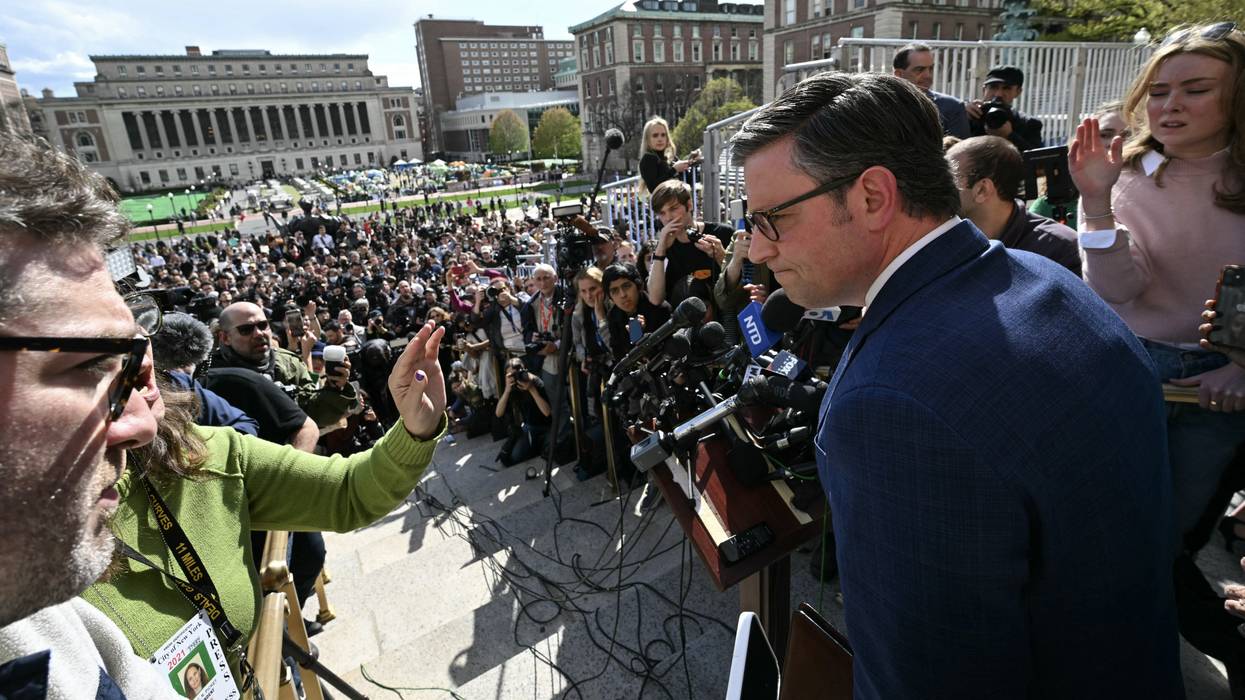
Then, on April 24, Speaker of the House Mike Johnson visited Columbia with Republicans Mike Lawler, Nicole Malliotakis, and Anthony D’Esposito (and even Foxx from North Carolina), acting as if some kind of terrible riot had gone on here. Standing at the top of the steps in front of the grand facade of Low Library, a century-old building meant to symbolize learning and reason, and surrounded by heckling students, Johnson declared that some Jewish students had told him of “heinous acts of bigotry,” characterized the protesters as “endorsed by Hamas,” and called for Shafik to resign “if she cannot immediately bring order to the chaos.”
“What chaos?” said an undergraduate standing next to me on the steps as we listened.
“He’s saying a bunch of 20-year-old American college students are in cahoots with Hamas?” another asked incredulously.
Sadly, despite the reality on the ground at Columbia, the right’s wild narrative of virulent antisemitism here has been swallowed whole, not just by Republicans but by a long list of Democrats, too.
Johnson then escalated the threats, claiming the National Guard might be called in and that Congress might even revoke federal funding if universities couldn’t keep such protests under control.
I looked behind me at the encampment on the other side of campus. In front of the tents on the grass, the students had erected a sign listing what they called “Gaza Encampment Community Guidelines.” These included: “No desecration of the land. No drug/alcohol consumption. Respect personal boundaries.” And most significantly, “We commit to assuming the best intentions, granting ourselves and others grace when mistakes are made, and approaching conflict with the goal of addressing and repairing.” Designated faculty and students stood at the entrance to make sure no outsiders got in, and that nobody entered the encampment unless they had read and agreed to that list of commitments. The noisiest people on campus were the thronging media. But nobody and nothing was out of control.
Sadly, despite the reality on the ground at Columbia, the right’s wild narrative of virulent antisemitism here has been swallowed whole, not just by Republicans but by a long list of Democrats, too, including President Joe Biden and Senators Kirsten Gillibrand and Chuck Schumer, not to speak of New York Representatives Hakeem Jeffries, Jerry Nadler, Dan Goldman, and Adriano Espaillat. They have all publicly condemned the supposedly rampant antisemitism on campus without, it seems, bothering to check their facts.
Meanwhile, MAGA Christian Nationalist Sean Feucht posted on X that “Columbia has been taken over by radical Pro-Hamas protesters.”
Back in the real world, the right’s hysteria over such supposed antisemitism hasn’t really been about protecting Jews at all, as many faculty members (including us Jewish ones) have written and spoken about. Rather, the right is weaponizing antisemitism as a way of furthering its campaign to suppress the kind of freedom of thought and speech on campus that threatens its authoritarian goals of turning this country Christian, conservative, straight, and white—not to mention their urge to suppress support of Palestinian autonomy.
My students tell me they feel perfectly safe on campus. They may not like some of the chants they sometimes hear. I myself have caught a few that chilled me as a Jew. I’ve also heard chants that sicken me on behalf of my Muslim friends. But those have been rare. And campus is a place where everyone should be free to debate, disagree, express their opinions, listen, and learn. We have to remember that free speech does not mean speech we agree with.
No, where my students do not feel safe is out on Broadway, where extremists on both sides gather. They don’t feel safe when the false narratives of Republican politicians draw far-right angry mobs to the campus gates, something that is happening just as I’m writing this piece. Most of all, they don’t feel safe when police arrive on campus with guns in their holsters and zip-ties hanging from their belts.
I stood and watched that day the police came. Four huge drones hovered overhead, along with those eternally buzzing helicopters. Dozens of police buses were lined up on West 114th Street on the south side of campus as if prepared to deal with some massive, violent riot. Then, in came the police, some in riot gear, to tie the hands of more than 100 students behind their backs and march them onto police buses.
Not only is the protest against Israel’s pathological spree of murder in Palestine and on the West Bank being drowned out in this debate, so are the student protesters’ demands.
Not a single student resisted. Even the police were quoted as saying they presented no danger to anyone. As NYPD Chief of Patrol John Chell said, “To put this in perspective, the students that were arrested were peaceful, offered no resistance whatsoever, and were saying what they wanted to say in a peaceful manner.”
Not long later, those arrested students were suspended and the ones who attend Barnard were locked out of their dorms. Faculty and friends had to offer their couches and spare beds to save those young women from being homeless on the streets of New York. One of them is in my building staying with a colleague downstairs. “Nobody told our parents that we were being evicted,” she told me in my lobby.
Many faculty were so shocked by these events that on Monday, April 22, some 300 of us gathered on the steps of Low Library, holding up signs that said, “Hands Off Our Students” and “End Student Suspensions Now.” Several professors gave impassioned speeches praising those students for their courage, demanding that academic freedom be protected, and castigating Shafik for throwing us all under the bus.
Still, Gaza was not mentioned. It seemed as if the genocide occurring there was disappearing in the fog.
“I’m worried that the message of our protest is getting lost,” that suspended student told me as we spoke in the lobby. “Everyone’s talking about academic freedom and police repression instead.”
Indeed, not only is the protest against Israel’s pathological spree of murder in Palestine and on the West Bank being drowned out in this debate, so are the student protesters’ demands, so let me reiterate them here:
The other day, on New York’s National Public Radio station, WNYC, I heard a caller who had been a campus protester in 1968 say something like, “It’s funny how the protesters of 50 years ago are always right, but the protesters of today are always wrong.” The people who demonstrated for civil rights then were demonized, beaten, even murdered, but they were right, he pointed out, as were the people who demonstrated against the Vietnam War. (I would say the same for those who protested against the Iraq War and for the #MeToo and Black Lives Matter movements.)
One day, the students who are protesting the genocide in Gaza and the persecution of Palestinians today will be seen as on the right side, too. History will prove it. Until then, let’s turn the discussion back to where it belongs: an end to the war on Gaza.
Final Note: This piece was written before the president and trustees of Columbia called in the riot police on the night of April 30, against the advice of many faculty, to arrest the students in the encampment, as well as those who had occupied Hamilton Hall. Videos show considerable police violence against the students. What happens next remains to be seen.

One student organizer called the move "just another intimidation tactic from the university."
This is a developing story… Please check back for possible updates...
As Palestinians in the Gaza Strip and progressives around the world praise U.S. student protesters for pressuring their institutions to divest from Israel and its war on the besieged enclave, Columbia University on Monday gave members of a campus encampment a 2:00 pm deadline to leave or face suspension.
After hundreds of students and faculty surrounded the encampment to express support for anti-war demonstrators following the notice, Ben Chang, Columbia's vice president for communications, told journalists around 5:00 pm that the university had begun suspending students.
The New York Times reported that "according to the university, only the students who remained in the encampment after 2:00 pm would face immediate suspension, not the hundreds of other students who were encircling the camp to protect it and show their support."
Mary Lawlor, the United Nations special rapporteur on human rights defenders, said on social media: "I'm hearing disturbing reports that students face suspension if they don't end their peaceful protests in Columbia University in the USA. This is a clear violation of their right to peaceful assembly."
The Ivy League university had already suspended over 100 students, who were arrested after president Minouche Shafik invited New York Police Department officers to clear the first encampment. Since Columbia students built the initial encampment, similar demonstrations have popped up at dozens of campuses across the country throughout April.
"As you are probably aware, the dialogue between the university and student leaders of the encampment is, regrettably, at an impasse," says Columbia's notice, noting that finals are beginning and graduation looms. "The university will offer an alternative venue for the demonstrations after the exam period and commencement have concluded. If the encampment is not removed, we will need to initiate disciplinary procedures because of a number of violations of university policies."
"If you voluntarily leave by 2:00 pm, identify yourself to a university official, and sign the provided form where you commit to abide by all university policies through June 30, 2025, or the date of the conferral of your degree, whichever is earlier, you will be eligible to complete the semester in good standing (and will not be placed on suspension) as long as you adhere to this commitment," the document continues.
The notice states that "it is important for you to know that the university has already identified many students in the encampment. If you do not identify yourself upon leaving and sign the form now, you will not be eligible to sign and complete the semester in good standing. If you do not leave by 2:00 pm, you will be suspended pending further investigation."
Suspended students, the document details, are restricted from all university property, are ineligible to participate in any academic or extracurricular activities, and must notify the Department of Public Safety to conduct any official business on campus. The notice adds that those who do not leave the encampment before the deadline could ultimately be expelled.
Mahmoud Khalil, a graduate student and the lead negotiator on behalf of Columbia University Apartheid Divest, the student coalition that organized the encampment, told The New York Times that the deadline is "just another intimidation tactic from the university."
"The university is dealing with this matter as a disciplinary issue, not as a movement to divest from war," Khalil added.
Responding to the notice on social media, Columbia Students for Justice in Palestine on Monday urged students not to "sign anything with administration" and called on supporters to show up to protect the encampment at noon.
The student group—which held a 2:30 pm press conference—said that "Columbia's threat to mass suspend, evict, and possibly expel students with only a few hours' notice violates university rules."
While the organization said faculty who objected to Columbia's plans were informed that the administration had declared a "state of emergency," the university said in a media advisory that "the rumor... is a fabrication and totally false."
The group said: "We have informed the university that we are prepared to escalate our direct actions if they do not adopt basic standards of conduct for negotiations... We must take action to end the true 'state of emergency,' Columbia's complicity in genocide."
The notice came after a statement from Shafik—emailed to students across campus Monday morning—acknowledging the breakdown in talks with student organizers, noting Columbia's offers, declaring that "the encampment has created an unwelcoming environment for many of our Jewish students and faculty," and reaffirming that "the university will not divest from Israel."
It also followed Congressmen Josh Gottheimer (D-N.J.) and Dan Goldman (D-N.Y.) leading a Monday letter to the board of trustees expressing disappointment that "Columbia University has not yet disbanded the unauthorized and impermissible encampment of anti-Israel, anti-Jewish activists on campus," and arguing that "the time for negotiation is over; the time for action is now."
Columbia's encampment has drawn national media attention and visits from supportive and unsupportive members of Congress.
Rep. Ilhan Omar (D-Minn.)—whose daughter Isra Hirsi was suspended from Columbia University's Barnard College earlier this month—said last week that "contrary to right-wing attacks, these students are joyfully protesting for peace and an end to the genocide taking place in Gaza. I'm in awe of their bravery and courage."

We are now seeing the comprador class in action as the presidents of Columbia, NYU, Yale, and other universities serve ruling-class interests by trying to quash student protests aimed at stopping the genocide in Gaza.
I once listened to a colleague rail against the million-dollar salaries paid to some university presidents and chancellors. As he saw it, such salaries were grossly wasteful; it would be possible, he argued, to find people willing and able to do the same work, just as well, for far less pay. He was right, of course. But the point of those high salaries, I said, is not really to attract rare talent. The point is to create class identification with business elites and wealthy donors, and to ensure complicity with their desires.
University administrators whose allegiance is bought in this way constitute a comprador class. A “comprador,” in political theory, is a member of a colonized group who abets the colonizer, against the interests of his or her own people, in exchange for wealth, privilege, and local power. We are now seeing this comprador class in action, as its members—the presidents of Columbia, NYU, Yale, and other universities—serve ruling-class interests by trying to quash student protests aimed at stopping the genocide underway in Gaza.
Minouche Shafik, president of Columbia University, is the most visible representative of the category. She obediently accepted a summons from grandstanding MAGA politicians on the House Committee on Education and the Workforce, and in her testimony sold out pro-Palestinian students and faculty, accepting committee members’ spurious claims that these students and faculty are antisemitic and should be purged. Shafik offered no defense of free speech or academic freedom, and upon her return to campus deployed police to tear down a peaceful protest encampment by pro-Palestinian students.
What’s going on, in short, is that institutional authority and state power are being deployed to silence Americans who object not only to Israel’s brutality, but also to U.S. support for Israel as an outpost of imperialism in the Middle East.
Despite her craven performance, Shafik was criticized by committee members—Reps. Elise Stefanik (R-N.Y.), Virginia Foxx (R-N.C.), Jim Banks (R-Ind.)—for being insufficiently vigorous in quashing pro-Palestinian voices on the Columbia campus. For this failure, Stefanik and other lawmakers insisted that Shafik follow the pattern set by Harvard’s Claudine Gay and Penn’s Liz Magill and resign her post. The treatment of these university presidents illustrates how the comprador arrangement works: You get rewarded only as long as you keep the natives under control. If you can’t manage this task, you will be replaced.
Other university presidents who as yet still enjoy the perks of collaboration have been put on notice, and are falling in line. Peaceful protest encampments—efforts that symbolically express support for the Palestinian people and opposition to the genocide that they are suffering at the hands of Israel and the U.S.—have been shut down by administrators at Columbia, NYU, Minnesota, Vanderbilt, Texas, Emory, and other schools (the list is growing daily). This is such an unhinged overreaction that even the police have wondered at times, when called upon to arrest peaceful protesters, what is going on.
What’s going on, in short, is that institutional authority and state power are being deployed to silence Americans who object not only to Israel’s brutality, but also to U.S. support for Israel as an outpost of imperialism in the Middle East. It is popular opposition to the human damage caused by U.S. imperialism, as well as to the enormous military spending needed to sustain it, that threatens capitalist-class interests. The charge of antisemitism, wielded to discredit protesters seeking divestment from Israel and an end to Israeli violence, is a smoke screen. It is a propaganda tactic that turns Zionist victimizers into victims, deflects attention from the horrors being perpetrated in Gaza, and keeps a critique of U.S. imperialism off the table.
The mendacity of the antisemitism charge is further exposed when one notices that many of the students and faculty opposing Israel’s genocide are Jewish, some citing Judaic values as their motivation. Partisans of Zionism must render these students and faculty invisible as Jews, since their involvement belies the claim that the solidarity encampments, freedom chants, and expressions of support for decolonizing Palestine make Jewish students and faculty fear for their safety. No doubt those who support the removal of Palestinians from Palestine might be unsettled by campus solidarity protests. But that’s not because their Jewishness is under attack; it’s because the protests may prompt them to question their anti-Palestinian racism and reflect on the injustice baked into Zionism.
The compradors of academia are losing control. More students, faculty, and other members of campus communities are questioning Israel’s savagery and U.S. backing for this behavior. More Americans in general are recognizing, with no love for Hamas, that Israel has gone too far and is becoming a pariah state. These may be indications that the moral arc of the universe, in regard to Palestine, has begun to bend toward justice. Yet these heartening developments also pose the danger that soft methods of repression—suspending student organizations, canceling commencement speeches, denying venues for films and lectures—will give way, as we are now seeing, to the harder methods of violence, arrest, and jail.
To their credit, student activists are remaining steadfast in their commitment to free speech in the pursuit of justice for Palestinians. More solidarity encampments are popping up. Even more importantly, student activists have wisely said that focusing on their campus struggles is a distraction from the real issue: stopping the genocide in Palestine. That’s what matters now. When university administrators stand in the way, when they follow the implicit or explicit orders of the capitalist class they serve, they become compradors in genocide—a role that history will record to their shame.

Said’s legacy reads today as a scathing condemnation of the hypocrisy of U.S. liberal institutions, their moral corruption, and the hollowness of the very values that they profess to teach.
Students across the United States are rising up against Israel’s genocide in Gaza, bringing to memory the student movements of the 1960s. From Columbia to Brown, from Yale to Harvard, students are staging sit-ins, hunger strikes, class walkouts, and interfaith prayers, demanding an end to U.S. support for Israel and the complicity of their academic institutions in the ongoing genocide.
While some U.S. institutions are treading a delicate path, the Columbia University administration, led by President Minouche Shafik, has violently cracked down on its own students, summoning the NYPD to mass arrest over 100 students, and suspending others with a 15-minute notice. In an unprecedented brutal crackdown on free speech on campus, the police destroyed solidarity encampments and student belongings, while charging arrested students with “trespassing” on the campus that they are charged a whopping tuition of more than $60,000 a year to attend!
In its attempt to appease far-right extremists in Congress, and to save Columbia from “being cursed by God,” as a Republican Congressman warned Shafik, Columbia has sided with genocide, thus undermining its own legacy of safeguarding free speech and peaceful protest on campus.
Perceptively, Said warned of weaponizing antisemitism and the plight of Jews in Europe as a means to suppress and vilify Palestinians, and to justify Israel’s oppression of its victims.
The violence has backfired, as hundreds of students continue to protest at Columbia, sparking a ripple effect across U.S. campuses, and defying what they see as a growing McCarthyism in U.S. academia. An early target of this academic McCarthyism was the prominent Palestinian-American intellectual and distinguished Columbia Professor Edward Said, whose writings on postcolonialism, humanism, and democratic criticism are required readings at Columbia and across the humanities.
Said was a victim of anti-Palestinian intimidation himself. His office at Columbia was occasionally raided and vandalized. He received several death threats and was smeared with terrorism accusations and spied on by students and AIPAC agents. Shortly before his death, Said became the target of a vicious academic persecution, which he survived only because Columbia still had a shred of academic and moral integrity at the time.
In July 2000, Said went to South Lebanon on a solidarity tour, where he hurled a rock toward an Israeli guardhouse from the Lebanese border, which he described as “a symbolic gesture of joy” to mark the end of Israeli occupation of southern Lebanon. A photographer caught the action, featuring Said with his arm reached far behind him, ready to throw. The Israeli lobby, led by Anti-Defamation League, called on Columbia to punish Said. Columbia refused to be intimidated, though it took the administration two months of eerie silence to respond. In its five-page letter response, the university said that Said’s action was protected under the principles of academic freedom. Citing John Stuart Mill as well as from the Columbia Faculty Handbook, the letter asserted:
There is nothing more fundamental to a university than the protection of the free discourse of individuals who should feel free to express their views without fear of the chilling effect of a politically dominant ideology... This matter cuts to the heart of what are fundamental values at a great university.
In defense of Said, the letter added: “If we are to deny Professor Said the protection to write and speak freely, whose speech will next be suppressed and who will be the inquisitor who determines who should have a right to speak his or her mind without fear of retribution?”
The era of moral clarity and intellectual integrity in academia is now unraveling amid Israel’s genocide in Gaza. The tragic irony is that the current atmosphere of anti-Palestinian McCarthyism on U.S. campuses—led by an unlikely coalition of far-right Republicans, mainstream media, and liberal academic institutions—was foreseen by none other than Said himself. In his seminal essay, “Zionism from the Standpoint of Its Victims” (1979), Said warned:
The special, one might even call it the privileged, place in this discussion of the United States is impressive, for all sorts of reasons. In no other country, except Israel, is Zionism enshrined as an unquestioned good, and in no other country is there so strong a conjuncture of powerful institutions and interests—the press, the liberal intelligentsia, the military-industrial complex, the academic community, labor unions—for whom […] uncritical support of Israel and Zionism enhances their domestic as well as international standing.”
Presaging the rise of anti-Palestinian McCarthyism in academia, Said detected a state of academic repression and campus policing in which Palestinians “have no permission to narrative” and are increasingly demonized and silenced in the name of fighting antisemitism—a loaded concept that has become a shield for Israel’s genocide and ethnic cleansing of Palestinians. Perceptively, Said warned of weaponizing antisemitism and the plight of Jews in Europe as a means to suppress and vilify Palestinians, and to justify Israel’s oppression of its victims. He understood that systematically inflating antisemitism with the critique of Zionism was feeding anti-Palestinian sentiments in U.S. academic and media discourse. He further warned:
One must admit, however, that all liberals and even most “radicals” have been unable to overcome the Zionist habit of equating anti-Zionism with antisemitism. Any wellmeaning person can thus oppose South African or American racism and at the same time tacitly support Zionist racial discrimination against non-Jews in Palestine. The almost total absence of any handily available historical knowledge from non-Zionist sources, the dissemination by the media of malicious simplifications (e.g., Jews vs. Arabs), the cynical opportunism of various Zionist pressure groups, the tendency endemic to university intellectuals uncritically to repeat cant phrases and political clichés (this is the role Gramsci assigned to traditional intellectuals, that of being “experts in legitimation”), the fear of treading upon the highly sensitive terrain of what Jews did to their victims, in an age of genocidal extermination of Jews—all this contributes to the dulling, regulated enforcement of almost unanimous support for Israel.
The assault on Columbia students is an attack on constitutional rights and the basic tenets of democracy. It’s deplorable that the one of the most violent crackdown on student protests in U.S. history is coinciding with one of the worst genocides in recent memory, which has killed over 35,000 Palestinians in Gaza, most of them children, and displaced nearly two million others.
One day after the mass arrests at Columbia, Palestinians in Gaza unearthed large mass graves at Nasser Hospital in Khan Younis, containing hundreds of civilians and patients who were massacred or buried alive by Israel. More deplorable, from the young generation’s standpoint, is that this genocide is being backed and sustained by U.S. weapons and tax money, diplomatic support, and media and academic complicity. (The Biden administration is preparing to send its largest military aid package to Israel in U.S. history, with bipartisan blessing.) Despite massive protests, U.S. colleges have refused to divest from Israel over its genocidal war in Gaza (with few notable exceptions that include Rutgers and UC Davis.) Several universities, including Columbia, have suspended the chapters of Students for Justice in Palestine and Jewish Voice for Peace.
Edward Said’s legacy reads today as a scathing condemnation of the hypocrisy of U.S. liberal institutions, their moral corruption, and the hollowness of the very values that they profess to teach. This irony is best illustrated by a Columbia student’s protest sign, which read:
“Columbia, why require me to read Prof. Edward Said, if you don’t want me to use it?”

Even after dozens of students were arrested, hundreds "rushed to take the place of their classmates" and continued the protest.
The arrests of dozens of Columbia University and Barnard College students on Thursday "galvanized" other supporters of Palestinian rights on the campuses, as hundreds of students occupied the school's western lawn after New York City police filled at least two buses with protesters who had been detained for setting up an encampment.
"Disclose, divest, we will not stop, we will not rest," chanted hundreds of students as they marched around the area where organizers had set up a tent encampment early Wednesday morning.
Columbia President Minouche Shafik informed the campus community on Thursday that she had authorized the police to clear the encampment.
As it has been in the past, the school has become a center of anti-war protests—and crackdowns by school officials and the police—since Israel began its bombardment of Gaza in October.
Pro-Palestinian students and alumni have demanded that Columbia divest from companies that profit from Israel's apartheid policies in the occupied Palestinian territories and cancel its dual degree program with Tel Aviv University.
In response to pro-Palestinian demonstrations, Columbia in November suspended the campus chapters of Jewish Voice for Peace and Students for Justice in Palestine—an action that pushed the New York Civil Liberties Union and Palestine Legal to file a lawsuit on behalf of the students last month.
On Thursday, police and Columbia employees took down about 50 tents that had been up for more than a day and disposed of them in trash cans and alleyways—but The New York Times reported later that "demonstrators repitched a couple of tents, and ... recovered the main signage from the encampment as well," while hundreds of students were "still gathered and chanting on the south side of the grass."
The arrests came a day after Shafik testified before the U.S. House Committee on Education and the Workforce about antisemitism on campus.
U.S. Rep. Ilhan Omar (D-Minn.), whose daughter, Isra Hirsi, was among the Barnard students who were suspended on Thursday for participating in the encampment protest, questioned Shafik about whether antisemitic protests have actually taken place at Columbia, prompting the president to say there have not.
"There has been a rise in targeting and harassment against anti-war protesters, because it's been pro-war and anti-war protesters is what it seems, like, correct?" asked Omar.
"Correct," replied Shafik.
On Thursday, Omar posted on social media two images of protesters at Columbia: one from the encampment this week, and one from 1968, when students protested the U.S. war in Vietnam.
New York City Council member Tiffany Cabán was among those who condemned the university's crackdown on the protests on Thursday.
"Suspending and arresting Columbia/Barnard student activists and disbanding student organizations—including Jewish students and organizations—doesn't combat antisemitism or increase safety," said Cabán. "All it does is punish and intimidate those who believe in human rights for Palestinians. Shameful."