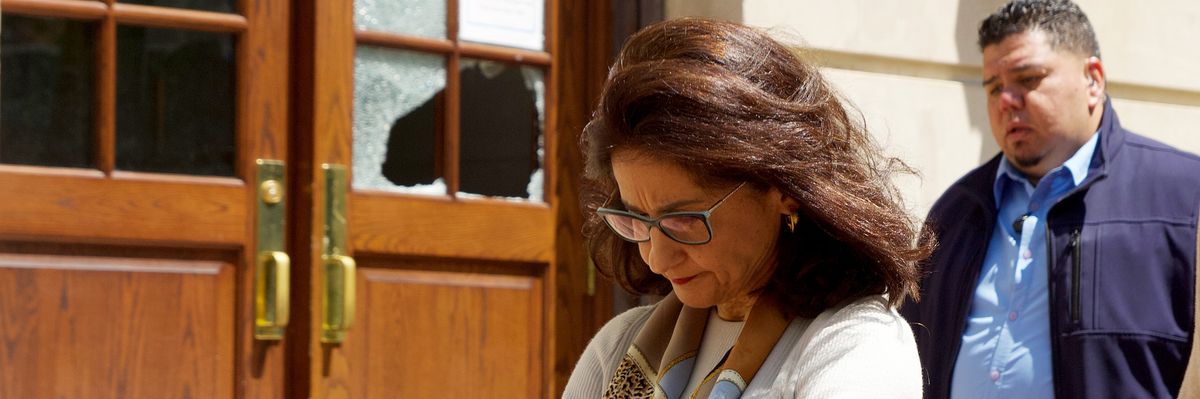
Then-Columbia University President Minouche Shafik visited a building on the school's campus on May 1, 2024 in New York City.
Columbia President Resigns After Violent Crackdown on Pro-Palestine Student Protests
"She finally got the memo," said Columbia Students for Justice in Palestine. "Any future president who does not pay heed to the Columbia student body's overwhelming demand for divestment will end up exactly as President Shafik did."
The president of Columbia University announced her resignation late Wednesday, months after she authorized a violent police crackdown on student demonstrators urging the school to divest from Israel over the country's devastating assault on the Gaza Strip.
Minouche Shafik said in her announcement that recent months have been "a period of turmoil where it has been difficult to overcome divergent views across our community." Dozens of Columbia students were arrested and injured during a Shafik-approved police raid of a campus building in late April.
"This period has taken a considerable toll on my family, as it has for others in our community," said Shafik, whose resignation was effective immediately. "Over the summer, I have been able to reflect and have decided that my moving on at this point would best enable Columbia to traverse the challenges ahead."
Pro-Palestine student organizers at Columbia—a university at the center of the protest movement that swept the country earlier this year—celebrated Shafik's departure but vowed to continue pressuring the institution's leadership to divest from Israel. Students specifically demanded that Columbia drop its Tel-Aviv Global Center project, which also drew backlash from faculty members when it was announced last year.
Shafik was adamant that Columbia "will not divest from Israel."
Columbia Students for Justice in Palestine said in response to Shafik's resignation that "after months of chanting 'Minouche Shafik you can't hide,' she finally got the memo."
"To be clear," the group added, "any future president who does not pay heed to the Columbia student body's overwhelming demand for divestment will end up exactly as President Shafik did."
The Columbia chapter of Jewish Voice for Peace wrote on social media that students "will never forget the sheer violence unleashed upon us by Minouche Shafik, and we will not be placated by her removal as the university's repression of the pro-Palestinian student movement continues."
🇵🇸 Protesters erupt in cheers after WOL announced that Columbia President Nemat ‘minouche’ Shafik resigned after a year of repressing and arresting Columbia University students protesting the genocide of Palestinians. pic.twitter.com/hx4VBnXK4R
— Within Our Lifetime (@WOLPalestine) August 15, 2024
Mahmoud Khalil, a student negotiator for Columbia University Apartheid Divest, told The New York Times on Wednesday that "regardless of who leads Columbia, the students will continue their activism and actions until Columbia divests from Israeli apartheid."
"We want the president to be a president for Columbia students, answering to their needs and demands, rather than answering to political pressure from outside the university," said Khalil.
We are at a crossroads
This country and this world are at a monumental crossroads. In a few short weeks, US voters will have an opportunity to beat back the forces of fascism and confront the billionaires who are rigging the economy, our media system, and our democracy, making it increasingly impossible for ordinary people to get by. We’re not just talking about the election. We’re talking about what must be done once these fascist elements are vanquished from power. We need a bolder set of solutions than what either major party has so far been willing to offer and a working-class movement ready to fight like hell for it. Trump didn't emerge from nowhere. The conditions that fueled MAGA authoritarianism were created by decades of radical neoliberal economic policies and a corrupt political system dominated by corporate interests. They slashed taxes on the super-rich, promising that the benefits would trickle down. They said giveaways to the corporate titans would make life more affordable for the rest of us. It was all bullshit. And when a bitter, betrayed populace searches for someone to blame, right-wing demagogues have little trouble finding scapegoats. People know when they're being lied to, but you won't hear any of this from the corporate media. Only independent journalism—powered and funded by people who believe in building a better world—can deliver truly trustworthy daily news. Our Fall Campaign is underway, and we need your help. To power our newsroom through the rest of the year, we need to raise $125,000 by midnight on October 31. So if you share our vision, please contribute whatever you can to sustain our work. |
The president of Columbia University announced her resignation late Wednesday, months after she authorized a violent police crackdown on student demonstrators urging the school to divest from Israel over the country's devastating assault on the Gaza Strip.
Minouche Shafik said in her announcement that recent months have been "a period of turmoil where it has been difficult to overcome divergent views across our community." Dozens of Columbia students were arrested and injured during a Shafik-approved police raid of a campus building in late April.
"This period has taken a considerable toll on my family, as it has for others in our community," said Shafik, whose resignation was effective immediately. "Over the summer, I have been able to reflect and have decided that my moving on at this point would best enable Columbia to traverse the challenges ahead."
Pro-Palestine student organizers at Columbia—a university at the center of the protest movement that swept the country earlier this year—celebrated Shafik's departure but vowed to continue pressuring the institution's leadership to divest from Israel. Students specifically demanded that Columbia drop its Tel-Aviv Global Center project, which also drew backlash from faculty members when it was announced last year.
Shafik was adamant that Columbia "will not divest from Israel."
Columbia Students for Justice in Palestine said in response to Shafik's resignation that "after months of chanting 'Minouche Shafik you can't hide,' she finally got the memo."
"To be clear," the group added, "any future president who does not pay heed to the Columbia student body's overwhelming demand for divestment will end up exactly as President Shafik did."
The Columbia chapter of Jewish Voice for Peace wrote on social media that students "will never forget the sheer violence unleashed upon us by Minouche Shafik, and we will not be placated by her removal as the university's repression of the pro-Palestinian student movement continues."
🇵🇸 Protesters erupt in cheers after WOL announced that Columbia President Nemat ‘minouche’ Shafik resigned after a year of repressing and arresting Columbia University students protesting the genocide of Palestinians. pic.twitter.com/hx4VBnXK4R
— Within Our Lifetime (@WOLPalestine) August 15, 2024
Mahmoud Khalil, a student negotiator for Columbia University Apartheid Divest, told The New York Times on Wednesday that "regardless of who leads Columbia, the students will continue their activism and actions until Columbia divests from Israeli apartheid."
"We want the president to be a president for Columbia students, answering to their needs and demands, rather than answering to political pressure from outside the university," said Khalil.
The president of Columbia University announced her resignation late Wednesday, months after she authorized a violent police crackdown on student demonstrators urging the school to divest from Israel over the country's devastating assault on the Gaza Strip.
Minouche Shafik said in her announcement that recent months have been "a period of turmoil where it has been difficult to overcome divergent views across our community." Dozens of Columbia students were arrested and injured during a Shafik-approved police raid of a campus building in late April.
"This period has taken a considerable toll on my family, as it has for others in our community," said Shafik, whose resignation was effective immediately. "Over the summer, I have been able to reflect and have decided that my moving on at this point would best enable Columbia to traverse the challenges ahead."
Pro-Palestine student organizers at Columbia—a university at the center of the protest movement that swept the country earlier this year—celebrated Shafik's departure but vowed to continue pressuring the institution's leadership to divest from Israel. Students specifically demanded that Columbia drop its Tel-Aviv Global Center project, which also drew backlash from faculty members when it was announced last year.
Shafik was adamant that Columbia "will not divest from Israel."
Columbia Students for Justice in Palestine said in response to Shafik's resignation that "after months of chanting 'Minouche Shafik you can't hide,' she finally got the memo."
"To be clear," the group added, "any future president who does not pay heed to the Columbia student body's overwhelming demand for divestment will end up exactly as President Shafik did."
The Columbia chapter of Jewish Voice for Peace wrote on social media that students "will never forget the sheer violence unleashed upon us by Minouche Shafik, and we will not be placated by her removal as the university's repression of the pro-Palestinian student movement continues."
🇵🇸 Protesters erupt in cheers after WOL announced that Columbia President Nemat ‘minouche’ Shafik resigned after a year of repressing and arresting Columbia University students protesting the genocide of Palestinians. pic.twitter.com/hx4VBnXK4R
— Within Our Lifetime (@WOLPalestine) August 15, 2024
Mahmoud Khalil, a student negotiator for Columbia University Apartheid Divest, told The New York Times on Wednesday that "regardless of who leads Columbia, the students will continue their activism and actions until Columbia divests from Israeli apartheid."
"We want the president to be a president for Columbia students, answering to their needs and demands, rather than answering to political pressure from outside the university," said Khalil.