

SUBSCRIBE TO OUR FREE NEWSLETTER
Daily news & progressive opinion—funded by the people, not the corporations—delivered straight to your inbox.
5
#000000
#FFFFFF
To donate by check, phone, or other method, see our More Ways to Give page.
Daily news & progressive opinion—funded by the people, not the corporations—delivered straight to your inbox.

Matt Witt’s new book Make Holidays Your Own encourages creative rethinking of family gatherings and community practices on major holidays.
It’s a good thing that labor journalist and author Matt Witt was not running for governor of Wisconsin this year like Democratic Socialists of America candidate Francesca Hong.
Democratic primary rivals and Republican opposition researchers would have badly distorted the message of Witt’s new book Make Holidays Your Own (Common Ground Press). It encourages creative rethinking of family gatherings and community practices on major holidays.
In their effort to discredit Hong, her foes in both parties created what The New York Times called a “social media kerfuffle” over old posts dissing Thanksgiving, Christmas, Valentine’s Day, and Halloween.
The outspoken state legislator and former restaurant owner from Madison lost her August 11 primary despite polling very strongly beforehand. Given the annual sense of foreboding that overtakes millions of Americans when tense family reunions draw near in late November, Hong’s past call for Thanksgiving to be “canceled”—because of its connection to “colonialism”—probably had its local fans.
Sometimes the development of alternative celebrations—such as the reclaiming of May Day by the modern day, more immigrant-influenced US labor movement--can lead to two opportunities to picnic, protest, and march, rather than just one!
Under fire on the campaign trail, Hong did concede that bringing people together around a table can be “a good thing.” But, according to the Times, she also courted controversy by “questioning the value of Valentine’s Day and Christmas trees.” So not only Wisconsin turkey farmers, but gift card sellers and Christmas tree growers—if sufficiently miffed—might have voted instead for the moderate Democrat from Milwaukee, David Crowley, who won the primary.
And even if Hong had prevailed, according to the Times, she faced the challenge of winning over voters like John Wilson, a 61-year old pharmacist from Platteville, Wisconsin, who usually “leans Democratic.” However, when asked whether he favored Hong or US Rep. Tom Tiffany, the Republican running for governor, Wilson chose the latter because “you have to take people at their word” about serious matters like Thanksgiving.
Tiffany has strong views on holidays too; in 2021, he was one of 14 House members who voted against making Juneteenth Day a federal holiday, which won’t be popular with African-American voters statewide.
In the future, left-leaning candidates can avoid even momentarily distracting flaps like this by reading Matt Witt’s book—hopefully, before pulling the trigger on Twitter, in a moment of pique. The few paid days off that most Americans get to enjoy should not be cancel culture targets, when, as the author argues, they can be celebrated in ways “more historically accurate, meaningful, inclusive, and fun,”
In Make Holidays Your Own, Witt offers much creative advice about dealing with Turkey Day, Mother’s Day, Memorial Day, Veterans Day, the Fourth of July, and eight others; his focus is on countering their crass commercialization, historical baggage, stultifying traditionalism, or exploitation by the right.
See, for example, the garish 250th birthday party staged on July 4 of this year in Washington, DC by the White House and its corporate funders. While no doubt critical of that, Abdul El-Sayed, the successful Democratic Senate primary winner in Michigan is definitely tip-toeing around the issue of fireworks on the Fourth.
As the Times notes, “He has deleted a number of videos and posts where he floated the idea of abandoning fireworks on Independence Day.” El-Sayed’s press spokesperson is now reminding voters that he “is the former captain of his high school football team, loves Michigan football on Saturdays, and celebrates the Fourth of July with fireworks like the next Michigander.”
In other words, he’s an all-American guy! As Witt explains: “In every culture, holidays matter. They come with a message and symbols—with a story that reinforces a certain way of looking at society and passes on certain values to the next generation.” According to the author, what’s good about remaking holidays, in ways that send a different message, “is that you don’t have to convince everyone in your community who doesn’t agree. They can celebrate however they want and so can you.”
And sometimes the development of alternative celebrations—such as the reclaiming of May Day by the modern day, more immigrant-influenced US labor movement--can lead to two opportunities to picnic, protest, and march, rather than just one!
As a former communications director for the United Mine Workers, Teamsters, and Service Employees International Union, the author delves, most informatively, into the political agenda behind the creation of Labor Day, as a counter to nascent working-class internationalism in the late 19th century.
Readers will learn that it was a corporate Democrat president—rather than any anti-union Republican—who first tried to erase the memory of May 1, as an international workers holiday born in the USA, and replace it with an end of summer day off out of step with the rest of the world.
To add insult to injury, May 1 then got officially rebranded, during the McCarthy era, as Law Day—although nobody, even corporate lawyers, get time off for that. Yet, thanks to multiple MAGA threats to the “rule of law” since President Donald Trump got reelected, more than 1,000 California bar members used their lunch hour to stage a first-time ever May Day-style protest in downtown San Francisco.)
As Witt recounts, massive demonstrations seeking shorter working hours occurred in Chicago and other US cities on May 1, 1886; when repeated on May Day four years later, workers in “dozens of countries in Europe and Latin America also held rallies and marches to support the eight-hour day demand.”
Thereafter, much to the alarm of “robber barons” here and abroad, May 1 protests became “an annual event for workers all around the world” and an expression of cross-border solidarity between labor radicals of varying stripes.
By 1896, however, a business-backed resident of the White House named Grover Cleveland needed a “sop to unions.” He had, after all, just called out federal troops to crush the Pullman strike organized by the American Railway Union, a pioneering alternative to craft unionism led by future Socialist Party presidential candidate Eugene Victor Debs (who was jailed for his role in the strike).
At Cleveland’s request, Congress declared that workers should be given a day off, every year, on the first Monday in September so, as Witt notes, “Actions taken by US unions would not be coordinated with their counterparts in the rest of the world.”
“Today, Labor Day is a paid holiday for about 3 in 4 workers in the US. Ironically, the lowest paid workers are the least likely to have the day off with pay. That includes non-union workers in food service, retail, hotels, agriculture, delivery, and janitorial services, as well as part-time workers, or those whose companies claim are ‘independent contractors’ rather than employees.”
On the holiday counterprogramming front, the good news is that May Day (as noted above) has made a major comeback over the last two decades. There is also “the shining example of the transformation of Columbus Day to Indigenous Peoples Day as now observed in many cities and states.”
Thanks to the efforts of progressive veterans’ groups like Veterans for Peace and Common Defense, at least some commemorative events on Memorial Day and Veterans Day now focus on peace and justice issues, rather than uncritical celebration of past wars.
In his chapter on Martin Luther King Day, the author suggests a range of activities that “can be about the movement and not just the man.” (This is advice that venerators of Cesar Chavez are taking, but only belatedly, after recent revelations about his history of sexual abuse while president of the United Farm Workers.)
Witt reports that all proceeds from his book are going to Rethinking Schools, a “national nonprofit organization that supports social, economic, and environmental justice teaching at a time when the very idea of public education is under attack. Rethinking Schools’ materials have been used by tens of thousands of educators and have reached millions of students.”
Let’s hope that Make Holidays Your Own also gets into the hands of many educators who have to come up with fresh ideas for in-school celebrations of holidays, that cannot be cancelled even in blue states. But, of course, don’t want their personal creativity in the classroom (or pet peeves) unleashing a conservative backlash of the sort that did not help Hong.
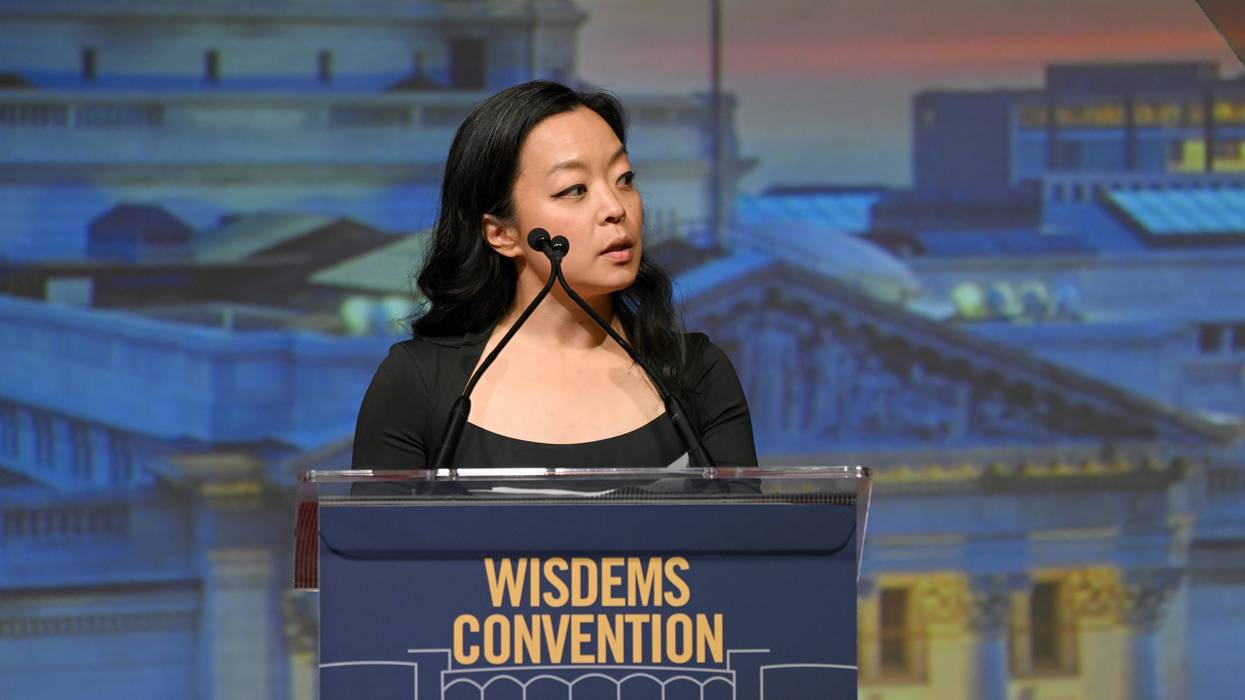
Her defeat was welcomed by conventional media and pundits impatiently awaiting some sign that a wave of progressive victories was finally being halted by sensibly moderate Midwestern voters. But is this accurate?
Mainstream media voices reflexively advising “moderate” politics for the Democrats have unveiled a comfortably reassuring explanation of the razor-thin 3,796-vote defeat of democratic socialist Francesca Hong in Wisconsin’s Democratic gubernatorial primary.
Her defeat was welcomed by conventional media and pundits impatiently awaiting some sign that a wave of progressive victories—especially by democratic socialists—was finally being halted by sensibly moderate Midwestern voters. Apparently, Beltway observers had no problem discounting left-wing progressives in places including Pennsylvania, Michigan, Colorado, and most recently with Senate primary winner Peggy Flanagan in Minnesota on August 11.
Wisconsin’s Democratic gubernatorial primary provided the opportunity to serve up a pre-baked narrative favored by many journalists. Following democratic socialist Francesca Hong’s narrow defeat by just 3,796 votes, “The socialists met their match,” The New York Times concluded smugly. Axios similarly declared, “Hong's loss blunts progressives' recent momentum and hands moderate Democrats a chance to prove their electability.“ For other outlets, too, the central narrative was depicted as a decisive repudiation of progressive politics in a swing state.
This theme was rapidly spread across conventional media despite Francesca Hong’s notable inroads for a combative and visionary brand of fighting for economic and social justice.
But the fact remains—much to the discomfort of establishment media and centrist Democratic leaders—that Francesca Hong got over 311,000 votes, just shy of victory.
But in Wisconsin with Hong’s defeat, mainstream media sources found an opportunity to stretch the real picture to fit their established frame. Rather than a major setback for the spreading success of progressive and democratic socialist candidates across the nation, Hong convincingly demonstrated that Wisconsin has a large and powerful base for innovative progressive policies.
Hong, 37, is a former chef and restauranteur and was first elected to the State Assembly in 2020. A diminutive and soft-spoken Korean American making her first run for statewide office, Hong supplied the vision and energy to build a massive statewide campaign machine while running as an unabashed democratic socialist. She was rightly perceived as reviving the traditions of Wisconsin’s much-revered anti-corporate populist governor “Fighting Bob” LaFollette and Milwaukee’s “sewer socialist” movement that ruled the city for much of the 20th century.
But the fact remains—much to the discomfort of establishment media and centrist Democratic leaders—that Francesca Hong got over 311,000 votes, just shy of victory. This outcome was hardly the momentous repudiation of progressive politics in a key swing state that was frequently portrayed.
Hong demonstrated the broad hunger for policies like taxing the super rich, calling for the termination of school privatization, substantially raising revenues for public schools and urban areas, marijuana legalization, and universal healthcare, proposals that far exceeded what "moderate" Dems in Wisconsin have been offering.
Second, she also showed the power of grassroots organizing as a potent political strategy. She amassed an army of 7,000 volunteers, mostly young people. This youthful infusion of energy seems certain to be a major force in Wisconsin politics to be reckoned with in the future.
Third, where Axios headlined Crowley’s victory as the win of a “moderate,” Crowley explicitly labeled himself as a "progressive" in his TV ads, stressing his pro-labor credentials and his support for “guardrails” on highly unpopular data centers.
(However, while Crowley campaigned as a “progressive,” many progressives are troubled by his opposition to the elimination of education privatization via “school choice,” which transfers funding away from public education.)
Fourth, Hong compiled 311,00 votes in her run for governor and brought in more votes—excepting of course the winner Crowley—than any previous Democrat running in a contested gubernatorial primary.
The excitement ignited by Hong’s bold campaign helped in part to produce a huge Democratic turnout. The Democratic gubernatorial candidates raked in a record 792.009 votes, a level normally attained only in presidential campaigns. Meanwhile, the Republican primary winner Tom Tiffany and a marginal candidate pulled in just 490,819 votes.
While The New York Times and other media have dwelled on the meltdown of her big polling lead on election day, Hong’s strong final results show that her democratic socialist politics were not somehow disqualifying for hundreds of thousands of Democratic voters. The campaign showed an enormous base for policies like taxing the super rich, a $20-an-hour minimum wage, a state-owned bank as in North Dakota, paid family leave, an end to school privatization, and universal healthcare that far exceeded what "moderate" Dems have been offering in the state.
With the pressure of Hong’s ambitious program and substantial lead in polling, Crowley felt compelled to label himself as a "progressive" in his TV ads, stressing his pro-labor positions and criticism of data centers.
Crowley is a Black man who overcame a childhood that included homelessness to rise to become the largest county’s top elected official. After entering the primary, Crowley, becoming discouraged by low poll numbers, temporarily dropped out of the race. But the state’s establishment Democrats pulled him back into the race with promises of all-out support, and they delivered. Top Dems like Gov. Tony Evers almost instantaneously uncapped a gusher of funds fueling a flood of Crowley TV ads in the closing days of the primary.
In her first statewide campaign, Hong found herself hammered in the closing two weeks by a relentless media spotlight on her old social media posts. Carelessly left online by her campaign, these posts—calling for “defunding the police” and criticizing traditional holidays like Thanksgiving—do not reflect her current perspective. But they generated derisive headlines and overwhelmingly unfavorable discussion. With the terrifying specter of the Republican nominee hard-line MAGA acolyte and election denier US Rep. Tom Tiffany eagerly poised to feast on her old social posts and aspirational and ambitious program, even some of Hong’s loyal following seemingly trickled away. This late-arriving erosion was likely enough to tip the final outcome away from her to David Crowley.
Still, Francesca Hong came within 0.5% of access with an aspirational program and an innovative grassroots campaign strategy. Yet the dominant media frame for Hong’s narrow defeat—as supposed proof that serious progressive politics are a fatal formula outside the coasts—has been simmering in recent months. Centrists among leading media voices and top Democrats have uneasily watched a parade of left-wing successes in Democratic primaries across the nation, in states as diverse as New Jersey, Pennsylvania, Michigan, Colorado, and in Minnesota with the election of Peggy Flanagan.
Although Hong fell just short of winning the primary, she powerfully demonstrated the growing demand for a bolder vision by voters.
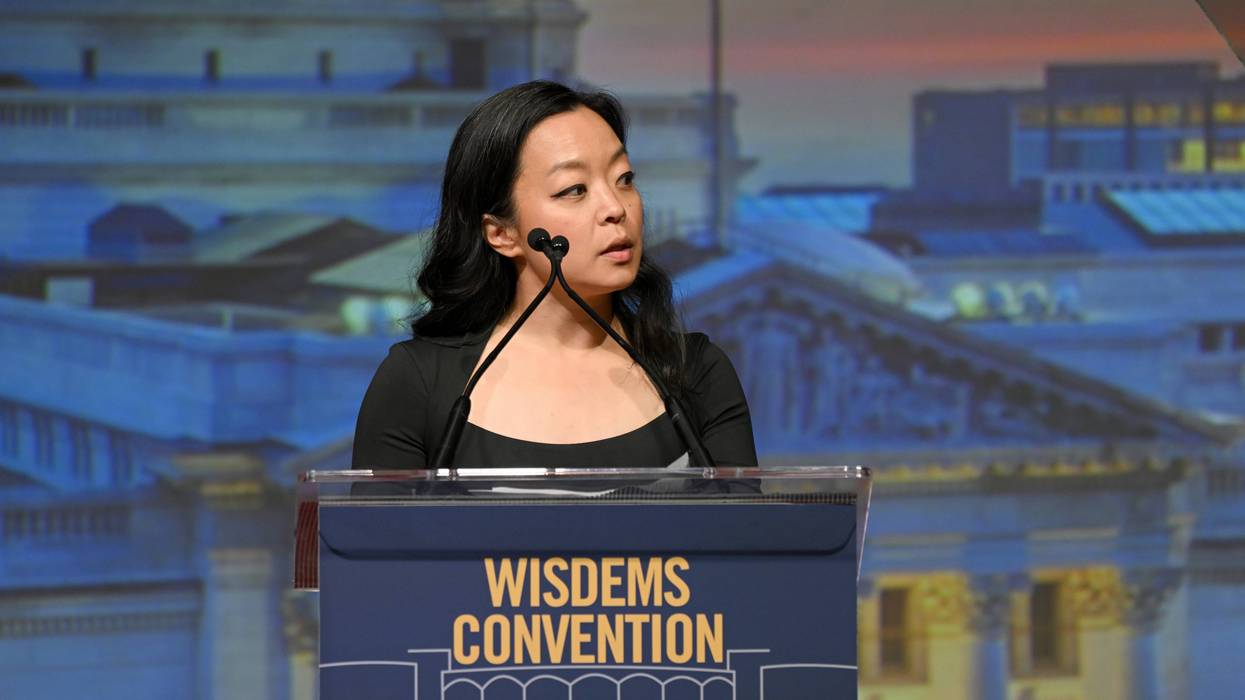
Francesca Hong said she looks forward to working with David Crowley to defeat Republican Rep. Tom Tiffany in November.
Francesca Hong on Wednesday unequivocally endorsed David Crowley in Wisconsin's gubernatorial contest following her razor-close loss in the Democratic primary, a show of unity in the face of the Republican Party's extremist nominee, Trump-endorsed US Rep. Tom Tiffany.
"Congratulations to David Crowley and his team," said Hong, a grassroots candidate who lost by less than one percentage point despite a massive fundraising disadvantage. "I fully support him and look forward to working with him to defeat Congressman Tiffany in November."
Hong said she is "overwhelmingly proud" of her campaign and emphasized that her run "was not about getting one person into office."
"It is about building a movement for permanent affordability and a government that puts working people first," said Hong. "Our movement is strong, and the work isn't done."
The last 11 months have been one of the greatest joys of my life. Traveling the state, meeting people in churches and dive bars and bike races and dance parties and in their homes, and hearing about what matters most to them informed every decision we made on the trail. It will… pic.twitter.com/Navh81hgvP
— Francesca Hong For Governor (@FrancescaHongWI) August 12, 2026
Crowley, the Milwaukee County executive who suspended his campaign in early July only to reenter the primary less than a month ago with the support of outgoing Democratic Gov. Tony Evers, echoed Hong's call for party unity to defeat the GOP in November.
“Every one of us has something much bigger to unite around,” Crowley said at a press conference on Wednesday. “And that is keeping MAGA extremism from bringing the chaos we see in Washington into our neighborhoods right here in the state of Wisconsin. From the very first day I announced this campaign, I said the real threat wasn’t any of my primary opponents. The real opponent has always been Tom Tiffany. That remains true today.”
Of the more than 311,000 Wisconsinites who voted for Hong on Tuesday, Crowley said, "I look forward to earning their support."
“We may not agree on every policy," said Crowley. "We may not use the same labels, but we all want safe communities, strong schools, affordable health care, good-paying jobs, and a brighter future for all of our children."

The Minnesota official took aim at the "special interests" funding her opponent's campaign ahead of the election, while Francesca Hong rejected claims that her priorities are too "extreme" for Wisconsin.
As the Democratic establishment and the corporate media continue to grapple with the results of last week's Senate primary in Michigan, which Abdul El-Sayed won after campaigning on Medicare for All, ending corporations' grip on elections, and investing in the social safety net instead of foreign wars, two more high-profile Midwestern races on Tuesday may provide more answers about the direction in which the Democratic base hopes to push the party.
In Minnesota, progressive Lt. Gov. Peggy Flanagan is facing US Rep. Angie Craig in the Democratic Senate primary, while in neighboring Wisconsin, democratic socialist state Rep. Francesca Hong's (D-76) closest opponent is Milwaukee County Executive David Crowley.
As in Michigan, where Democratic operatives have insisted that Rep. Haley Stevens would have been a better bet to win against Republican candidate Mike Rogers, supporters of Craig claim the congresswoman is more "electable" than Flanagan, who supports Medicare for All, an end to "offensive weapons sales to Israel," and publicly financed universal pre-kindergarten.
“Electability is probably the No. 1 factor,” Joe Radinovich, a Democratic strategist who views Craig as the better candidate to face a Republican in the November midterms, told The New York Times.
But a number of Craig's positions and ties suggest her backers may be working with a flawed understanding of what makes a candidate appealing to voters in 2026, with nearly half of Democratic voters in swing districts last year telling Upswing Strategies that they would avoid supporting a candidate who was funded by the pro-Israel lobby, 78% of Democrats saying in a poll in December that they supported Medicare for All, and half of Americans telling YouGov last month that they believed US Immigration and Customs Enforcement (ICE) should be abolished.
Craig has received major support from the American Israel Public Affairs Committee (AIPAC) in the past, but says she asked the powerful pro-Israel group not to donate to her this year as Americans sour on US military support for Israel, which, with the backing of the Biden and Trump administrations, has slaughtered more than 73,000 Palestinians in Gaza since October 2023. AIPAC has continued hosting fundraisers to boost Craig's campaign indirectly.
Craig has refused to call Israel's attacks on Gaza a genocide, while Flanagan has joined top human rights organizations and Holocaust experts in doing so, saying that “American taxpayer dollars should not be used to fuel the horrific violence and suffering that’s being experienced there."
The congresswoman is also out of step with the majority of Democrats on healthcare, pushing for legislation that would "build on" the Affordable Care Act instead of establishing a national healthcare plan, and on immigration policy. She was the only Democrat in Minnesota to support the Laken Riley Act, which gave ICE broader power to detain immigrants. Although Craig initially defended her vote, she expressed regret in March, after two Minnesota residents were killed by federal immigration agents who were part of President Donald Trump's crackdown in the state.
Flanagan has not joined the specific call to abolish ICE, but told The New York Times: “Whatever word you want to use, it can’t exist like this anymore. We have to rip ICE apart and start over.”
Outside groups, including super political action committees (PACs) representing cryptocurrency interests, have poured roughly $20 million into the effort to elect Craig, a co-sponsor of the CLARITY Act. The bill would split regulation of digital assets between the Securities and Exchange Commission and the industry-friendly Commodity Futures Trading Commission.
Flanagan on Monday said she was not intimidated by the special interests that, as she said "think they can buy this Senate seat."
The lieutenant governor has been endorsed by Sens. Bernie Sanders (I-Vt.), Elizabeth Warren (D-Mass.), and Tina Smith (D-Minn.), among others, as well as a number of labor unions, the anti-corruption group End Citizens United, and the advocacy group Indivisible.
Some recent polls have shown Craig with a small lead, while some internal surveys by Flanagan's campaign have shown the lieutenant governor several points ahead of her opponent.
Sanders predicted "a tight race" on Sunday in an interview with Margaret Brennan of CBS News' "Face the Nation."
"I hope very much that Peggy wins," said the senator. "I think what we’re seeing in Minnesota, Margaret, in Michigan, and all across this country, is that people understand that we’re living with an economy that is rigged. You have working families, 60% of our people, living paycheck to paycheck. People can’t afford groceries, housing, healthcare, basic necessities of life."
In Wisconsin, Sanders, Warren, and Rep. Alexandria Ocasio-Cortez (D-NY) are among the high-profile progressives who have declined to wade into the race and endorse Hong, who has consistently led by double digits in polls since February.
The gubernatorial candidate has distanced herself recently from what she called "bad takes"—a call in 2020 to "cancel Thanksgiving" and support for abolishing law enforcement.
“I will not abolish the police," said Hong in a debate in July. “I want to focus on stopping violent crime and giving law enforcement the resources and the training that they need but ensure that we are also holding accountable law enforcement that does not follow the law."
But Hong has won the support of Reps. Ilhan Omar (D-Minn.) and Ro Khanna (D-Calif.), with Omar calling her a "true champion for working families" and highlighting her support for broadly popular proposals like universal childcare, Medicare for All, and guaranteed paid leave.
Opponents of Hong are striving to attach the word "communism" to her political priorities—a clear sign, said Gustavo Gordillo of the Democratic Socialists of America (DSA) chapter in New York City recently, that "democratic socialism is not the scary word it used to be" for voters.
When asked by Fox News on Tuesday about alleged "fears that democratic socialism could turn into communism," Hong dismissed the idea, echoing Ocasio-Cortez's recent comment that "we can't even raise the minimum wage" in Congress.
"This is a state where we still have a $2.33 tipped minimum wage and $7.25 minimum wage," said Hong. "I think it's gonna be hard to turn that into socialism soon, but what we can do with this campaign is make sure we fight for policies that put working-class people first."
She added that she rejects claims that she is too "extreme" to win the general election in November due to her support for policies like taxing the rich and abolishing ICE, countering that Republican primary front-runner Rep. Tom Tiffany has displayed extremism by denying the 2020 election results and voting to keep files regarding convicted sex offender Jeffrey Epstein, a former associate of Trump, hidden from the public.
"What's extreme is that Congressman Tiffany, a longtime DC congressman, has voted against the interests of Wisconsinites over and over again," said Hong.
Q: Were you prepared for the pushback you received, especially from Republicans, framing you as far too extreme for Wisconsin?
FRANCESCA HONG: What's extreme is Rep. Tiffany has voted against the interests of Wisconsinites over and over again. What's extreme is that he's an… pic.twitter.com/QW0M5AVIVc
— Aaron Rupar (@atrupar) August 11, 2026
The Intercept noted that despite the recent hand-wringing in the corporate media over Hong's past comments on Thanksgiving—complete with a Times article that asked whether voters can forgive her—"the Times’ on-the-ground reporting managed to dig up precisely one Wisconsinite who would not."
"Even allowing for the fact that the attacks on Hong follow a well-established right-wing tradition—let us never forget those who laid down their lives in the War on Christmas—why has such a ridiculous controversy come to dominate efforts to quash her campaign?" asked Intercept reporter Sean Bell.
"The answer is simple: Nothing else has worked, and that failure indicates a worrying pattern for the Democratic establishment terrified of an insurgent left," Bell continued. "As the numerous recent victories for DSA-backed or progressive Democratic candidates have demonstrated, attacking the left on policy is not the winning strategy it once was. Many voters no longer recoil at the mere mention of universal healthcare, rent controls, or the dreaded 'socialism.'"
Joseph Geevarghese, executive director of Our Revolution, which has endorsed both Hong and Flanagan, issued a reminder on Tuesday: "Here’s how electability actually works: The most electable candidate is the one who gets the most votes. This narrative was always manufactured by people afraid of Francesca—and afraid of what happens when working people actually win. Her supposedly ‘radical’ agenda is healthcare, affordable childcare, and making billionaires pay their fair share."
"That’s not unelectable," he said. "That’s what working people are asking for.”