SUBSCRIBE TO OUR FREE NEWSLETTER
Daily news & progressive opinion—funded by the people, not the corporations—delivered straight to your inbox.
5
#000000
#FFFFFF
To donate by check, phone, or other method, see our More Ways to Give page.
Daily news & progressive opinion—funded by the people, not the corporations—delivered straight to your inbox.
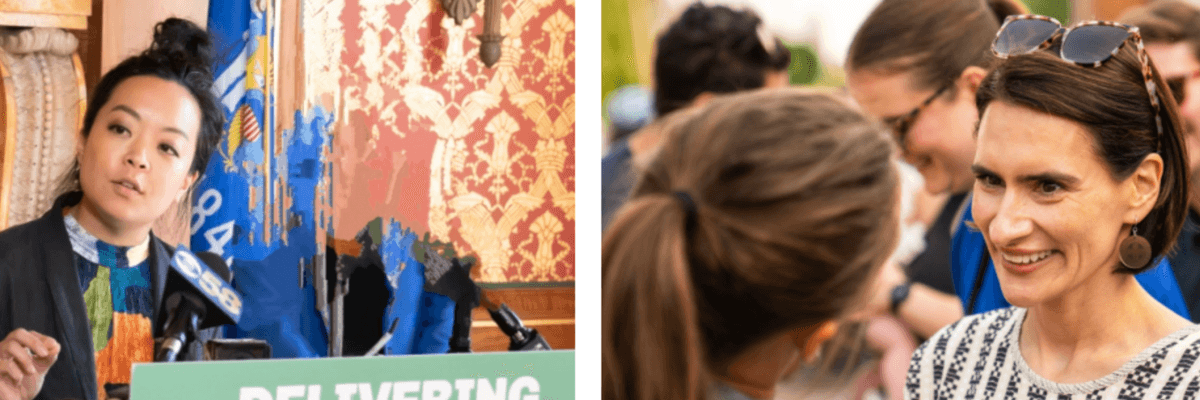
Wisconsin state Rep. Francesca Hong (D-76), who is running for governor, and Minnesota Lt. Gov. Peggy Flanagan, a Democrat who is running for US Senate, are seen at campaign events ahead of their state primaries on August 11, 2026.
The Minnesota official took aim at the "special interests" funding her opponent's campaign ahead of the election, while Francesca Hong rejected claims that her priorities are too "extreme" for Wisconsin.
As the Democratic establishment and the corporate media continue to grapple with the results of last week's Senate primary in Michigan, which Abdul El-Sayed won after campaigning on Medicare for All, ending corporations' grip on elections, and investing in the social safety net instead of foreign wars, two more high-profile Midwestern races on Tuesday may provide more answers about the direction in which the Democratic base hopes to push the party.
In Minnesota, progressive Lt. Gov. Peggy Flanagan is facing US Rep. Angie Craig in the Democratic Senate primary, while in neighboring Wisconsin, democratic socialist state Rep. Francesca Hong's (D-76) closest opponent is Milwaukee County Executive David Crowley.
As in Michigan, where Democratic operatives have insisted that Rep. Haley Stevens would have been a better bet to win against Republican candidate Mike Rogers, supporters of Craig claim the congresswoman is more "electable" than Flanagan, who supports Medicare for All, an end to "offensive weapons sales to Israel," and publicly financed universal pre-kindergarten.
“Electability is probably the No. 1 factor,” Joe Radinovich, a Democratic strategist who views Craig as the better candidate to face a Republican in the November midterms, told The New York Times.
But a number of Craig's positions and ties suggest her backers may be working with a flawed understanding of what makes a candidate appealing to voters in 2026, with nearly half of Democratic voters in swing districts last year telling Upswing Strategies that they would avoid supporting a candidate who was funded by the pro-Israel lobby, 78% of Democrats saying in a poll in December that they supported Medicare for All, and half of Americans telling YouGov last month that they believed US Immigration and Customs Enforcement (ICE) should be abolished.
Craig has received major support from the American Israel Public Affairs Committee (AIPAC) in the past, but says she asked the powerful pro-Israel group not to donate to her this year as Americans sour on US military support for Israel, which, with the backing of the Biden and Trump administrations, has slaughtered more than 73,000 Palestinians in Gaza since October 2023. AIPAC has continued hosting fundraisers to boost Craig's campaign indirectly.
Craig has refused to call Israel's attacks on Gaza a genocide, while Flanagan has joined top human rights organizations and Holocaust experts in doing so, saying that “American taxpayer dollars should not be used to fuel the horrific violence and suffering that’s being experienced there."
The congresswoman is also out of step with the majority of Democrats on healthcare, pushing for legislation that would "build on" the Affordable Care Act instead of establishing a national healthcare plan, and on immigration policy. She was the only Democrat in Minnesota to support the Laken Riley Act, which gave ICE broader power to detain immigrants. Although Craig initially defended her vote, she expressed regret in March, after two Minnesota residents were killed by federal immigration agents who were part of President Donald Trump's crackdown in the state.
Flanagan has not joined the specific call to abolish ICE, but told The New York Times: “Whatever word you want to use, it can’t exist like this anymore. We have to rip ICE apart and start over.”
Outside groups, including super political action committees (PACs) representing cryptocurrency interests, have poured roughly $20 million into the effort to elect Craig, a co-sponsor of the CLARITY Act. The bill would split regulation of digital assets between the Securities and Exchange Commission and the industry-friendly Commodity Futures Trading Commission.
Flanagan on Monday said she was not intimidated by the special interests that, as she said "think they can buy this Senate seat."
The lieutenant governor has been endorsed by Sens. Bernie Sanders (I-Vt.), Elizabeth Warren (D-Mass.), and Tina Smith (D-Minn.), among others, as well as a number of labor unions, the anti-corruption group End Citizens United, and the advocacy group Indivisible.
Some recent polls have shown Craig with a small lead, while some internal surveys by Flanagan's campaign have shown the lieutenant governor several points ahead of her opponent.
Sanders predicted "a tight race" on Sunday in an interview with Margaret Brennan of CBS News' "Face the Nation."
"I hope very much that Peggy wins," said the senator. "I think what we’re seeing in Minnesota, Margaret, in Michigan, and all across this country, is that people understand that we’re living with an economy that is rigged. You have working families, 60% of our people, living paycheck to paycheck. People can’t afford groceries, housing, healthcare, basic necessities of life."
In Wisconsin, Sanders, Warren, and Rep. Alexandria Ocasio-Cortez (D-NY) are among the high-profile progressives who have declined to wade into the race and endorse Hong, who has consistently led by double digits in polls since February.
The gubernatorial candidate has distanced herself recently from what she called "bad takes"—a call in 2020 to "cancel Thanksgiving" and support for abolishing law enforcement.
“I will not abolish the police," said Hong in a debate in July. “I want to focus on stopping violent crime and giving law enforcement the resources and the training that they need but ensure that we are also holding accountable law enforcement that does not follow the law."
But Hong has won the support of Reps. Ilhan Omar (D-Minn.) and Ro Khanna (D-Calif.), with Omar calling her a "true champion for working families" and highlighting her support for broadly popular proposals like universal childcare, Medicare for All, and guaranteed paid leave.
Opponents of Hong are striving to attach the word "communism" to her political priorities—a clear sign, said Gustavo Gordillo of the Democratic Socialists of America (DSA) chapter in New York City recently, that "democratic socialism is not the scary word it used to be" for voters.
When asked by Fox News on Tuesday about alleged "fears that democratic socialism could turn into communism," Hong dismissed the idea, echoing Ocasio-Cortez's recent comment that "we can't even raise the minimum wage" in Congress.
"This is a state where we still have a $2.33 tipped minimum wage and $7.25 minimum wage," said Hong. "I think it's gonna be hard to turn that into socialism soon, but what we can do with this campaign is make sure we fight for policies that put working-class people first."
She added that she rejects claims that she is too "extreme" to win the general election in November due to her support for policies like taxing the rich and abolishing ICE, countering that Republican primary front-runner Rep. Tom Tiffany has displayed extremism by denying the 2020 election results and voting to keep files regarding convicted sex offender Jeffrey Epstein, a former associate of Trump, hidden from the public.
"What's extreme is that Congressman Tiffany, a longtime DC congressman, has voted against the interests of Wisconsinites over and over again," said Hong.
Q: Were you prepared for the pushback you received, especially from Republicans, framing you as far too extreme for Wisconsin?
FRANCESCA HONG: What's extreme is Rep. Tiffany has voted against the interests of Wisconsinites over and over again. What's extreme is that he's an… pic.twitter.com/QW0M5AVIVc
— Aaron Rupar (@atrupar) August 11, 2026
The Intercept noted that despite the recent hand-wringing in the corporate media over Hong's past comments on Thanksgiving—complete with a Times article that asked whether voters can forgive her—"the Times’ on-the-ground reporting managed to dig up precisely one Wisconsinite who would not."
"Even allowing for the fact that the attacks on Hong follow a well-established right-wing tradition—let us never forget those who laid down their lives in the War on Christmas—why has such a ridiculous controversy come to dominate efforts to quash her campaign?" asked Intercept reporter Sean Bell.
"The answer is simple: Nothing else has worked, and that failure indicates a worrying pattern for the Democratic establishment terrified of an insurgent left," Bell continued. "As the numerous recent victories for DSA-backed or progressive Democratic candidates have demonstrated, attacking the left on policy is not the winning strategy it once was. Many voters no longer recoil at the mere mention of universal healthcare, rent controls, or the dreaded 'socialism.'"
Joseph Geevarghese, executive director of Our Revolution, which has endorsed both Hong and Flanagan, issued a reminder on Tuesday: "Here’s how electability actually works: The most electable candidate is the one who gets the most votes. This narrative was always manufactured by people afraid of Francesca—and afraid of what happens when working people actually win. Her supposedly ‘radical’ agenda is healthcare, affordable childcare, and making billionaires pay their fair share."
"That’s not unelectable," he said. "That’s what working people are asking for.”
Dear Common Dreams reader, It’s been nearly 30 years since I co-founded Common Dreams with my late wife, Lina Newhouser. We had the radical notion that journalism should serve the public good, not corporate profits. It was clear to us from the outset what it would take to build such a project. No paid advertisements. No corporate sponsors. No millionaire publisher telling us what to think or do. Many people said we wouldn't last a year, but we proved those doubters wrong. Together with a tremendous team of journalists and dedicated staff, we built an independent media outlet free from the constraints of profits and corporate control. Our mission has always been simple: To inform. To inspire. To ignite change for the common good. Building Common Dreams was not easy. Our survival was never guaranteed. When you take on the most powerful forces—Wall Street greed, fossil fuel industry destruction, Big Tech lobbyists, and uber-rich oligarchs who have spent billions upon billions rigging the economy and democracy in their favor—the only bulwark you have is supporters who believe in your work. But here’s the urgent message from me today. It's never been this bad out there. And it's never been this hard to keep us going. At the very moment Common Dreams is most needed, the threats we face are intensifying. We need your support now more than ever. We don't accept corporate advertising and never will. We don't have a paywall because we don't think people should be blocked from critical news based on their ability to pay. Everything we do is funded by the donations of readers like you. When everyone does the little they can afford, we are strong. But if that support retreats or dries up, so do we. Will you donate now to make sure Common Dreams not only survives but thrives? —Craig Brown, Co-founder |
As the Democratic establishment and the corporate media continue to grapple with the results of last week's Senate primary in Michigan, which Abdul El-Sayed won after campaigning on Medicare for All, ending corporations' grip on elections, and investing in the social safety net instead of foreign wars, two more high-profile Midwestern races on Tuesday may provide more answers about the direction in which the Democratic base hopes to push the party.
In Minnesota, progressive Lt. Gov. Peggy Flanagan is facing US Rep. Angie Craig in the Democratic Senate primary, while in neighboring Wisconsin, democratic socialist state Rep. Francesca Hong's (D-76) closest opponent is Milwaukee County Executive David Crowley.
As in Michigan, where Democratic operatives have insisted that Rep. Haley Stevens would have been a better bet to win against Republican candidate Mike Rogers, supporters of Craig claim the congresswoman is more "electable" than Flanagan, who supports Medicare for All, an end to "offensive weapons sales to Israel," and publicly financed universal pre-kindergarten.
“Electability is probably the No. 1 factor,” Joe Radinovich, a Democratic strategist who views Craig as the better candidate to face a Republican in the November midterms, told The New York Times.
But a number of Craig's positions and ties suggest her backers may be working with a flawed understanding of what makes a candidate appealing to voters in 2026, with nearly half of Democratic voters in swing districts last year telling Upswing Strategies that they would avoid supporting a candidate who was funded by the pro-Israel lobby, 78% of Democrats saying in a poll in December that they supported Medicare for All, and half of Americans telling YouGov last month that they believed US Immigration and Customs Enforcement (ICE) should be abolished.
Craig has received major support from the American Israel Public Affairs Committee (AIPAC) in the past, but says she asked the powerful pro-Israel group not to donate to her this year as Americans sour on US military support for Israel, which, with the backing of the Biden and Trump administrations, has slaughtered more than 73,000 Palestinians in Gaza since October 2023. AIPAC has continued hosting fundraisers to boost Craig's campaign indirectly.
Craig has refused to call Israel's attacks on Gaza a genocide, while Flanagan has joined top human rights organizations and Holocaust experts in doing so, saying that “American taxpayer dollars should not be used to fuel the horrific violence and suffering that’s being experienced there."
The congresswoman is also out of step with the majority of Democrats on healthcare, pushing for legislation that would "build on" the Affordable Care Act instead of establishing a national healthcare plan, and on immigration policy. She was the only Democrat in Minnesota to support the Laken Riley Act, which gave ICE broader power to detain immigrants. Although Craig initially defended her vote, she expressed regret in March, after two Minnesota residents were killed by federal immigration agents who were part of President Donald Trump's crackdown in the state.
Flanagan has not joined the specific call to abolish ICE, but told The New York Times: “Whatever word you want to use, it can’t exist like this anymore. We have to rip ICE apart and start over.”
Outside groups, including super political action committees (PACs) representing cryptocurrency interests, have poured roughly $20 million into the effort to elect Craig, a co-sponsor of the CLARITY Act. The bill would split regulation of digital assets between the Securities and Exchange Commission and the industry-friendly Commodity Futures Trading Commission.
Flanagan on Monday said she was not intimidated by the special interests that, as she said "think they can buy this Senate seat."
The lieutenant governor has been endorsed by Sens. Bernie Sanders (I-Vt.), Elizabeth Warren (D-Mass.), and Tina Smith (D-Minn.), among others, as well as a number of labor unions, the anti-corruption group End Citizens United, and the advocacy group Indivisible.
Some recent polls have shown Craig with a small lead, while some internal surveys by Flanagan's campaign have shown the lieutenant governor several points ahead of her opponent.
Sanders predicted "a tight race" on Sunday in an interview with Margaret Brennan of CBS News' "Face the Nation."
"I hope very much that Peggy wins," said the senator. "I think what we’re seeing in Minnesota, Margaret, in Michigan, and all across this country, is that people understand that we’re living with an economy that is rigged. You have working families, 60% of our people, living paycheck to paycheck. People can’t afford groceries, housing, healthcare, basic necessities of life."
In Wisconsin, Sanders, Warren, and Rep. Alexandria Ocasio-Cortez (D-NY) are among the high-profile progressives who have declined to wade into the race and endorse Hong, who has consistently led by double digits in polls since February.
The gubernatorial candidate has distanced herself recently from what she called "bad takes"—a call in 2020 to "cancel Thanksgiving" and support for abolishing law enforcement.
“I will not abolish the police," said Hong in a debate in July. “I want to focus on stopping violent crime and giving law enforcement the resources and the training that they need but ensure that we are also holding accountable law enforcement that does not follow the law."
But Hong has won the support of Reps. Ilhan Omar (D-Minn.) and Ro Khanna (D-Calif.), with Omar calling her a "true champion for working families" and highlighting her support for broadly popular proposals like universal childcare, Medicare for All, and guaranteed paid leave.
Opponents of Hong are striving to attach the word "communism" to her political priorities—a clear sign, said Gustavo Gordillo of the Democratic Socialists of America (DSA) chapter in New York City recently, that "democratic socialism is not the scary word it used to be" for voters.
When asked by Fox News on Tuesday about alleged "fears that democratic socialism could turn into communism," Hong dismissed the idea, echoing Ocasio-Cortez's recent comment that "we can't even raise the minimum wage" in Congress.
"This is a state where we still have a $2.33 tipped minimum wage and $7.25 minimum wage," said Hong. "I think it's gonna be hard to turn that into socialism soon, but what we can do with this campaign is make sure we fight for policies that put working-class people first."
She added that she rejects claims that she is too "extreme" to win the general election in November due to her support for policies like taxing the rich and abolishing ICE, countering that Republican primary front-runner Rep. Tom Tiffany has displayed extremism by denying the 2020 election results and voting to keep files regarding convicted sex offender Jeffrey Epstein, a former associate of Trump, hidden from the public.
"What's extreme is that Congressman Tiffany, a longtime DC congressman, has voted against the interests of Wisconsinites over and over again," said Hong.
Q: Were you prepared for the pushback you received, especially from Republicans, framing you as far too extreme for Wisconsin?
FRANCESCA HONG: What's extreme is Rep. Tiffany has voted against the interests of Wisconsinites over and over again. What's extreme is that he's an… pic.twitter.com/QW0M5AVIVc
— Aaron Rupar (@atrupar) August 11, 2026
The Intercept noted that despite the recent hand-wringing in the corporate media over Hong's past comments on Thanksgiving—complete with a Times article that asked whether voters can forgive her—"the Times’ on-the-ground reporting managed to dig up precisely one Wisconsinite who would not."
"Even allowing for the fact that the attacks on Hong follow a well-established right-wing tradition—let us never forget those who laid down their lives in the War on Christmas—why has such a ridiculous controversy come to dominate efforts to quash her campaign?" asked Intercept reporter Sean Bell.
"The answer is simple: Nothing else has worked, and that failure indicates a worrying pattern for the Democratic establishment terrified of an insurgent left," Bell continued. "As the numerous recent victories for DSA-backed or progressive Democratic candidates have demonstrated, attacking the left on policy is not the winning strategy it once was. Many voters no longer recoil at the mere mention of universal healthcare, rent controls, or the dreaded 'socialism.'"
Joseph Geevarghese, executive director of Our Revolution, which has endorsed both Hong and Flanagan, issued a reminder on Tuesday: "Here’s how electability actually works: The most electable candidate is the one who gets the most votes. This narrative was always manufactured by people afraid of Francesca—and afraid of what happens when working people actually win. Her supposedly ‘radical’ agenda is healthcare, affordable childcare, and making billionaires pay their fair share."
"That’s not unelectable," he said. "That’s what working people are asking for.”
As the Democratic establishment and the corporate media continue to grapple with the results of last week's Senate primary in Michigan, which Abdul El-Sayed won after campaigning on Medicare for All, ending corporations' grip on elections, and investing in the social safety net instead of foreign wars, two more high-profile Midwestern races on Tuesday may provide more answers about the direction in which the Democratic base hopes to push the party.
In Minnesota, progressive Lt. Gov. Peggy Flanagan is facing US Rep. Angie Craig in the Democratic Senate primary, while in neighboring Wisconsin, democratic socialist state Rep. Francesca Hong's (D-76) closest opponent is Milwaukee County Executive David Crowley.
As in Michigan, where Democratic operatives have insisted that Rep. Haley Stevens would have been a better bet to win against Republican candidate Mike Rogers, supporters of Craig claim the congresswoman is more "electable" than Flanagan, who supports Medicare for All, an end to "offensive weapons sales to Israel," and publicly financed universal pre-kindergarten.
“Electability is probably the No. 1 factor,” Joe Radinovich, a Democratic strategist who views Craig as the better candidate to face a Republican in the November midterms, told The New York Times.
But a number of Craig's positions and ties suggest her backers may be working with a flawed understanding of what makes a candidate appealing to voters in 2026, with nearly half of Democratic voters in swing districts last year telling Upswing Strategies that they would avoid supporting a candidate who was funded by the pro-Israel lobby, 78% of Democrats saying in a poll in December that they supported Medicare for All, and half of Americans telling YouGov last month that they believed US Immigration and Customs Enforcement (ICE) should be abolished.
Craig has received major support from the American Israel Public Affairs Committee (AIPAC) in the past, but says she asked the powerful pro-Israel group not to donate to her this year as Americans sour on US military support for Israel, which, with the backing of the Biden and Trump administrations, has slaughtered more than 73,000 Palestinians in Gaza since October 2023. AIPAC has continued hosting fundraisers to boost Craig's campaign indirectly.
Craig has refused to call Israel's attacks on Gaza a genocide, while Flanagan has joined top human rights organizations and Holocaust experts in doing so, saying that “American taxpayer dollars should not be used to fuel the horrific violence and suffering that’s being experienced there."
The congresswoman is also out of step with the majority of Democrats on healthcare, pushing for legislation that would "build on" the Affordable Care Act instead of establishing a national healthcare plan, and on immigration policy. She was the only Democrat in Minnesota to support the Laken Riley Act, which gave ICE broader power to detain immigrants. Although Craig initially defended her vote, she expressed regret in March, after two Minnesota residents were killed by federal immigration agents who were part of President Donald Trump's crackdown in the state.
Flanagan has not joined the specific call to abolish ICE, but told The New York Times: “Whatever word you want to use, it can’t exist like this anymore. We have to rip ICE apart and start over.”
Outside groups, including super political action committees (PACs) representing cryptocurrency interests, have poured roughly $20 million into the effort to elect Craig, a co-sponsor of the CLARITY Act. The bill would split regulation of digital assets between the Securities and Exchange Commission and the industry-friendly Commodity Futures Trading Commission.
Flanagan on Monday said she was not intimidated by the special interests that, as she said "think they can buy this Senate seat."
The lieutenant governor has been endorsed by Sens. Bernie Sanders (I-Vt.), Elizabeth Warren (D-Mass.), and Tina Smith (D-Minn.), among others, as well as a number of labor unions, the anti-corruption group End Citizens United, and the advocacy group Indivisible.
Some recent polls have shown Craig with a small lead, while some internal surveys by Flanagan's campaign have shown the lieutenant governor several points ahead of her opponent.
Sanders predicted "a tight race" on Sunday in an interview with Margaret Brennan of CBS News' "Face the Nation."
"I hope very much that Peggy wins," said the senator. "I think what we’re seeing in Minnesota, Margaret, in Michigan, and all across this country, is that people understand that we’re living with an economy that is rigged. You have working families, 60% of our people, living paycheck to paycheck. People can’t afford groceries, housing, healthcare, basic necessities of life."
In Wisconsin, Sanders, Warren, and Rep. Alexandria Ocasio-Cortez (D-NY) are among the high-profile progressives who have declined to wade into the race and endorse Hong, who has consistently led by double digits in polls since February.
The gubernatorial candidate has distanced herself recently from what she called "bad takes"—a call in 2020 to "cancel Thanksgiving" and support for abolishing law enforcement.
“I will not abolish the police," said Hong in a debate in July. “I want to focus on stopping violent crime and giving law enforcement the resources and the training that they need but ensure that we are also holding accountable law enforcement that does not follow the law."
But Hong has won the support of Reps. Ilhan Omar (D-Minn.) and Ro Khanna (D-Calif.), with Omar calling her a "true champion for working families" and highlighting her support for broadly popular proposals like universal childcare, Medicare for All, and guaranteed paid leave.
Opponents of Hong are striving to attach the word "communism" to her political priorities—a clear sign, said Gustavo Gordillo of the Democratic Socialists of America (DSA) chapter in New York City recently, that "democratic socialism is not the scary word it used to be" for voters.
When asked by Fox News on Tuesday about alleged "fears that democratic socialism could turn into communism," Hong dismissed the idea, echoing Ocasio-Cortez's recent comment that "we can't even raise the minimum wage" in Congress.
"This is a state where we still have a $2.33 tipped minimum wage and $7.25 minimum wage," said Hong. "I think it's gonna be hard to turn that into socialism soon, but what we can do with this campaign is make sure we fight for policies that put working-class people first."
She added that she rejects claims that she is too "extreme" to win the general election in November due to her support for policies like taxing the rich and abolishing ICE, countering that Republican primary front-runner Rep. Tom Tiffany has displayed extremism by denying the 2020 election results and voting to keep files regarding convicted sex offender Jeffrey Epstein, a former associate of Trump, hidden from the public.
"What's extreme is that Congressman Tiffany, a longtime DC congressman, has voted against the interests of Wisconsinites over and over again," said Hong.
Q: Were you prepared for the pushback you received, especially from Republicans, framing you as far too extreme for Wisconsin?
FRANCESCA HONG: What's extreme is Rep. Tiffany has voted against the interests of Wisconsinites over and over again. What's extreme is that he's an… pic.twitter.com/QW0M5AVIVc
— Aaron Rupar (@atrupar) August 11, 2026
The Intercept noted that despite the recent hand-wringing in the corporate media over Hong's past comments on Thanksgiving—complete with a Times article that asked whether voters can forgive her—"the Times’ on-the-ground reporting managed to dig up precisely one Wisconsinite who would not."
"Even allowing for the fact that the attacks on Hong follow a well-established right-wing tradition—let us never forget those who laid down their lives in the War on Christmas—why has such a ridiculous controversy come to dominate efforts to quash her campaign?" asked Intercept reporter Sean Bell.
"The answer is simple: Nothing else has worked, and that failure indicates a worrying pattern for the Democratic establishment terrified of an insurgent left," Bell continued. "As the numerous recent victories for DSA-backed or progressive Democratic candidates have demonstrated, attacking the left on policy is not the winning strategy it once was. Many voters no longer recoil at the mere mention of universal healthcare, rent controls, or the dreaded 'socialism.'"
Joseph Geevarghese, executive director of Our Revolution, which has endorsed both Hong and Flanagan, issued a reminder on Tuesday: "Here’s how electability actually works: The most electable candidate is the one who gets the most votes. This narrative was always manufactured by people afraid of Francesca—and afraid of what happens when working people actually win. Her supposedly ‘radical’ agenda is healthcare, affordable childcare, and making billionaires pay their fair share."
"That’s not unelectable," he said. "That’s what working people are asking for.”