SUBSCRIBE TO OUR FREE NEWSLETTER
Daily news & progressive opinion—funded by the people, not the corporations—delivered straight to your inbox.
5
#000000
#FFFFFF
To donate by check, phone, or other method, see our More Ways to Give page.


Daily news & progressive opinion—funded by the people, not the corporations—delivered straight to your inbox.
"You're deluded if you believe Joe Biden, at this stage of his life, is the best person Democrats have to offer against Donald Trump, against a fascist," said journalist Mehdi Hasan.
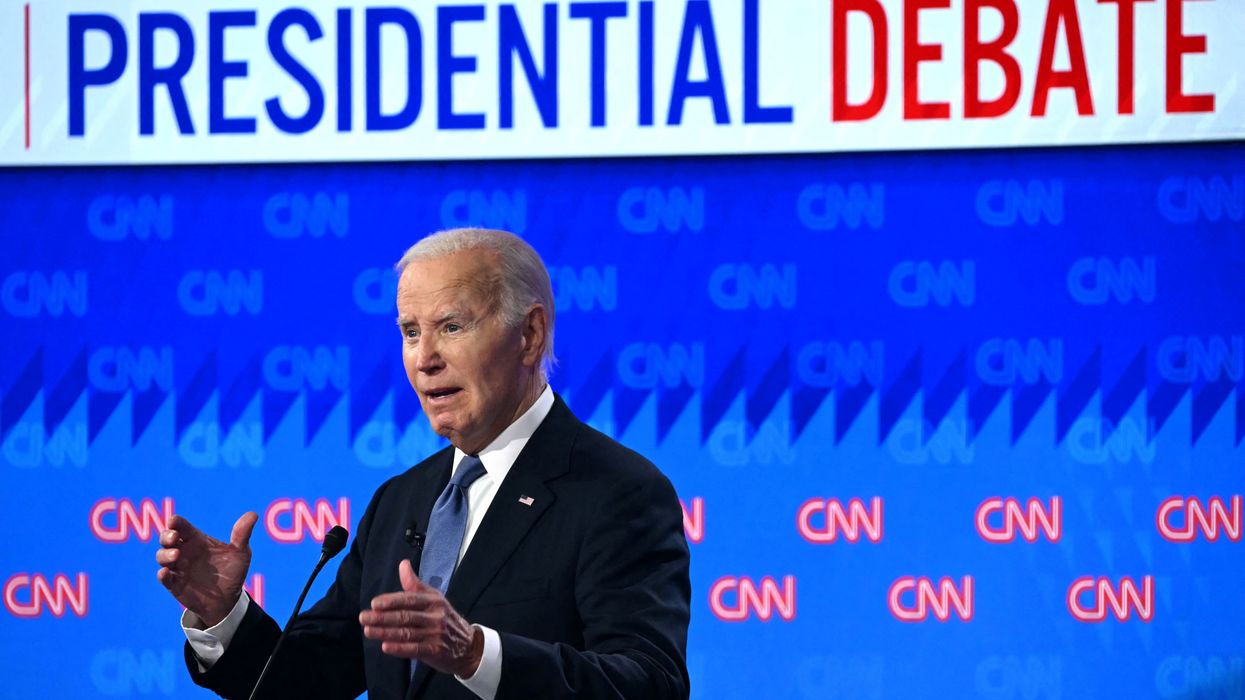
President Joe Biden's disastrous debate performance Thursday evening against presumptive GOP nominee Donald Trump—an unhinged, would-be authoritarian whose lies were glaring and constant—sent much of the Democratic Party establishment into a spiral of panic and ignited calls for the incumbent to step aside to allow another Democratic candidate to take on the former president in November.
The alarm began to set in just minutes into the
CNN-moderated event in Atlanta, with Democratic operatives and lawmakers exchanging despairing texts with reporters and each other after the president declared—after appearing to lose his train of thought—that "we finally beat Medicare," an absurd line that followed his stumbling attempt to explain that the nation's ultra-rich pay far too little in taxes.
"For example, we have a thousand trillionaires in America—I mean billionaires, in America," said Biden, his voice raspy from what his campaign says was a cold. "And what's happening? They're in a situation where they, in fact, pay 8.2% in taxes. If they just paid 24% or 25%, either one of those numbers, they'd raised $500 million—billion dollars, I should say, in a 10-year period."
The beltway access outlet Politico reported that the text message inboxes of its journalists quickly blew up with expressions of dismay from Democratic lawmakers and the names of potential options to replace the 81-year-old incumbent, who cruised through the primary process without a serious challenge.
"I picked the wrong day to stop sniffing glue," an unnamed member of the House Democratic caucus wrote to Politico. An anonymous Democratic insider told the outlet that they believe "there are short lists being made" for Biden's potential replacement, lists that reportedly include Michigan Gov. Gretchen Whitmer, Kentucky Gov. Andy Beshear, North Carolina Gov. Roy Cooper, and California Gov. Gavin Newsom.
An unnamed Democratic lawmaker told The Financial Times that "many House Democrats tonight, representing a wide cross-section of the Democratic caucus, were privately texting one another that Biden needs to announce he's decided not to run for reelection"—a belated conclusion that drew disdain from commentators who have been warning for months that a Biden reelection bid could be calamitous.
"Hilarious to watch elite consensus shift and see all the media folk who knowingly created the Biden 2024 catastrophe now desperately try to maintain credibility by depicting themselves as the courageous voices demanding a course correction when it may already be too late," The Lever's David Sirota wrote Friday morning.
The frenzied discussions of a last-ditch replacement effort spilled over into the
editorial pages of major newspapers, panel discussions with former White House officials and ex-lawmakers, and the segments of prominent corporate television shows, including MSNBC's "Morning Joe"—which Biden reportedly watches obsessively.
Morning Joe, Biden’s favorite show, is wavering.
“If he were CEO and he turned in a performance like that, would any corporation in America, any Fortune 500 corporation in America keep him on as CEO?”
pic.twitter.com/bSZisE3FDU
— Alex Thompson (@AlexThomp) June 28, 2024
In a panel discussion following Thursday night's 90-minute debate, CNN national political correspondent John King said that "there is a deep, a wide, and a very aggressive panic in the Democratic Party" that began shortly after the debate kicked off and "continues right now."
"It involves party strategists, it involves elected officials, and it involves fundraisers. They are having conversations about the president's performance, which they think was dismal, which they think will hurt other people down the party in the ticket," said King. "And they're having conversations about what they should do about it. Some of those conversations include should we go to the White House and ask the president to step aside. Other conversations are about should prominent Democrats go public with that call."
Dire concerns about Biden's performance and broader readiness to compete in the November election were amplified by Trump's showing during Thursday night's debate, which further showed that the presumptive Republican candidate poses a grave threat to democracy, the climate, workers, and fundamental rights.
"Tonight put on full display how broken our political system is. Our generation deserves better," Stevie O'Hanlon, communications director for the youth-led Sunrise Movement, said in a statement. "The debate also made it undeniable that a Trump presidency would be a climate catastrophe. When Trump was asked if he would address the climate crisis, he ignored the question completely—because he can't answer it. He has promised oil and gas CEOs that he will expedite drilling permits, hasten fracked gas pipeline approvals, and release 'vast stores' of oil and gas on public lands. In return, they're bankrolling his campaign."
"Biden touted achievements that young people fought hard and long to win: the Civilian Climate Corps and the Inflation Reduction Act. Like in 2020, we will fight like hell to defeat Donald Trump so we have the political conditions to end the fossil fuel era and win a Green New Deal," O'Hanlon added. "But President Biden and the Democratic establishment's choices have made an election against a convicted felon dangerously tight. Young people have offered Democrats the vision, energy, and policy on which to beat Donald Trump. They have turned away from it. If there is to be any chance of beating Trump this November, they must listen to young voters."
"Biden is manifestly not up to the task of combating Trump's lies, vitriol, and neofascism—nor is he capable of articulating a coherent progressive vision capable of galvanizing voters this fall."
It's far from clear that mounting calls for Biden to end his reelection campaign and clear the way for a viable replacement will move Democratic leaders or the White House, which has been adamant that the president will be on the ballot in November even as Democratic voters indicate they would prefer someone else as their nominee.
A Gallup survey released ahead of Thursday's debate showed that just 42% of Democratic voters are pleased with Biden as the nominee and a majority want a different candidate.
But Robert Costa of CBS News reported in the debate's aftermath that unnamed sources close to Biden said there is "zero chance" the president "steps away from running."
Newsom, one of the Democrats most commonly floated as a potential alternative to Biden, came to the president's defense Thursday night, urging the party to rally behind the incumbent.
"You don't turn your back because of one performance," Newsom said. "What kind of party does that?"
Alex Wagner presses Gov. Gavin Newsom on questions about whether Biden should step down.
Newsom: “You don’t turn your back because of one performance. What kind of party does that?”
“This president has delivered. We need to deliver for him at this moment.” pic.twitter.com/J5G9XGNYWn
— MSNBC (@MSNBC) June 28, 2024
House Minority Leader Hakeem Jeffries (D-N.Y.) also stood by the president, telling reporters on Friday that he should not drop out of the race even as one unnamed House Democrat—described as an "outspoken defender" of Biden—told Politico's Jonathan Martin that Jeffries and Senate Majority Leader Chuck Schumer (D-N.Y.) should seriously consider a "combined effort" to convince the incumbent to step aside.
"The movement to convince Biden to not run is real," the lawmaker said.
However, Martin noted, "many top party officials" feel that "Biden can't be persuaded let alone pressured."
"One Democratic governor called the debate 'beyond bad,' but said it was 'too late' to nominate a new standard bearer," Martin reported.
But analysts argued Thursday's debacle solidified the case that a Biden candidacy is untenable—and could gift Trump and his far-right allies another four years in power, which they're planning to use to unleash a massive assault on reproductive rights, public education, immigrants, environmental regulations, and more.
"I'm not saying that Joe Biden is going to lose the presidential election because of tonight's debate. The race is still ridiculously too close to call at this point," said Zeteo's Mehdi Hasan, a former MSNBC host. "But it's not looking good. And what I am saying is that you're deluded if you believe Joe Biden, at this stage of his life, is the best person Democrats have to offer against Donald Trump, against a fascist."
"Small-d American democracy, if it is to survive, needs Democrats—big-d Democrats—to put their big boy pants on and get their act together," Hasan added.
I have spent months, both on MSNBC and at Zeteo, refusing to obsess over Biden’s age and fitness for office. But no longer. Not after tonight’s car crash of a ‘debate’.
It’s time for Biden to step aside. The Democrats need to find a new nominee. https://t.co/20UUcW06TK pic.twitter.com/oMtRbED3Bx
— Mehdi Hasan (@mehdirhasan) June 28, 2024
After acknowledging that "a comatose Joe Biden would make a better president than Donald Trump," Vox's Eric Levitz wrote Thursday that even though "there is no way for the Democratic Party to deny Biden the nomination at this point," party leaders could "personally lobby the president to step aside and endorse his preferred successor, preempting the hazards of a contested Democratic convention in late August."
"Waiting months to anoint a presumptive nominee would be highly risky. Rallying around Biden's handpicked heir now would be much less so," Levitz added. "The president's policy positions and governing record matter more than his current skills as a rhetorician. But precisely because of how much is substantively at stake in this election, Democrats cannot afford to wager it on American voters changing their minds and deciding that Biden isn't too old for his job after watching him struggle to remember the topics of his own sentences."
RootsAction, a progressive group that urged Biden in late 2022 not to run for reelection and has been calling on the president to step aside for more than a year, said in a statement that Thursday night underscored the incumbent's "severe liabilities as a candidate."
"Biden is manifestly not up to the task of combating Trump's lies, vitriol, and neofascism—nor is he capable of articulating a coherent progressive vision capable of galvanizing voters this fall," the group said. "There is still time before the party convention to decide on a different nominee for the party. Democratic leaders must finally heed the clear preference of Democratic voters and reconsider their backing of Biden's candidacy."
"We need a swift intervention to make Biden voluntarily a one-term president so a Democratic nominee can be up to the job of defeating Trump," RootsAction added. "The stakes could not be higher for the future of the United States, and the world."
What's happening to Judith Whitmer and her allies in Nevada is a classic battle between top-down corporate money and bottom-up progressive activism.
To understand the current fierce attacks on the progressive leadership of the Nevada Democratic Party, it's helpful to recall the panicked reaction from political elites three years ago when results came in from the state's contest for the presidential nomination. Under the headline "Moderates Hustle to Blunt Sanders' Momentum After Nevada Win," the Associated Press reported that "Bernie Sanders' commanding Nevada caucus victory made him a top target for his Democratic rivals and a growing source of anxiety for establishment Democrats."
Such anxiety spiked for Nevada's establishment Democrats a year later, in early March 2021, when a progressive slate, headed by activist Judith Whitmer, won every officer seat in the state party, stunning its entrenched leaders. As she explained at the time, "what they just didn't expect is that we got better and better at organizing and out-organizing them at every turn."
At the eleventh hour, seeing the progressive writing on the wall, the sore losers-to-be had siphoned $450,000 out of the state party's treasury, transferring the loot to the Democratic Senatorial Campaign Committee, safely under the control of corporate-aligned operatives. And when Whitmer's victory became clear, all the employees of the Nevada Democratic Party greeted the newly elected chair by immediately quitting.
Bloviating predictions of disaster quickly ensued. But Nevada's Catherine Cortez Masto, widely seen as the nation's most vulnerable Democrat in the Senate, won re-election last November. So did each Democratic member of the U.S. House. And Democrats control both chambers of the state legislature. (The only major loss was the governor's seat.) Whitmer cites nearly 2 million "direct voter contacts," increased rural turnout and "wins in deep red territories."
With her two-year term as state party chair about to expire, Whitmer is running for re-election as part of a progressive slate, while old-guard forces ousted by party delegates two years ago are on the attack under the banner of the ironically named "Unity Slate." The Nevada Democratic Party's central committee will vote on March 4.
The Unity Slate candidates "work for corporations and Republican-backed lobbyists," Whitmer said, adding that if elected "the Unity Slate would work in an echo chamber to only serve the most funded politicians in our state, and only support the status quo's agenda."
The Unity Slate's corporate ties are underscored by sponsors of its Sapphire PAC, which recently reported taking donations totaling $10,000 from Southwest Gas as well as $5,000 from NV Energy. Whitmer charged that acceptance of such funding from utility corporations "screws over the same voters we're working hard to fight for as the so-called Unity Slate turns a blind eye to rising costs that impact our community's most vulnerable."
Whitmer said on Monday that her opponents "have the audacity and brazenness to run a registered lobbyist" on their Unity Slate as the candidate for second vice chair of the state party. She added that he "lobbies for an anti-union company fighting against our largest hardest-working union," referring to the Culinary Union -- which days ago "tweeted against his company," the lobbying law firm Brownstein Hyatt Farber Schreck.
Nationally, Whitmer has been a leader in efforts to reform the Democratic National Committee. In early February, the DNC resolutions committee refused to act on a motion she co-authored to ban dark money in party primaries. "Time and time again, we've watched 'dark money' used to silence the voices our party most needs to hear," Whitmer said. When "strong Democratic candidates willing to speak truth to power" have messages that "can be drowned out in a flood of untraceable expenditures," she pointed out, "many candidates are questioning why they should even run."
Three years ago, during the leadup to the hard-fought Nevada caucuses for delegates in the presidential nomination race, the wide gap between powerful union officials and rank-and-file workers was thrown into sharp relief. The hierarchy of the powerful Las Vegas-based Culinary Workers Union bashed Bernie Sanders for championing Medicare for All, but workers and their families overwhelmingly voted for Sanders. Now, the state AFL-CIO leadership is backing the "unity" slate against progressives.
The Nevada showdown comes right after notable progressive breakthroughs this winter in two other western states: Shasti Conrad won election to become chair of the Washington Democratic Party. Yolanda Bejarano, a leader of Communications Workers of America and a member of Progressive Democrats of America, won election to chair the Arizona Democratic Party.
Methodical organizing at the grassroots makes such progress possible. That's what happened in West Virginia, where last summer activists wrested control of the state Democratic Party away from Joe Manchin, the archetypal big-money-talks Democratic senator.
Now, powerful forces are doing all they can to prevent the re-election of Judith Whitmer as chair of the Nevada Democratic Party. It's a classic battle between top-down corporate money and bottom-up progressive activism.
Moumita Ahmed, an at-large delegate for Bernie Sanders and co-founder of Millennials For Bernie, walked down the aisle to rally fellow delegates at the New York state meeting. The chair of the meeting, Michael Reich, a lawyer for the Democratic Party, refused to accept motions from the floor. Ahmed attempted to mobilize people in the back of the room to challenge Reich. But, as she was walking, an elderly white man who is a delegate for Hillary Clinton reached out and grabbed her.
This man took his hand and smacked her on her upper back "really hard," according to Ahmed. He gave her a "little bruise." When she turned around, Ahmed said "he hit me with his cane" and "tried to trip me." She asked people sitting by the man if they had seen what just happened. Some were a bit stunned, but one person suggested he was old, so she shouldn't worry about it. Staffers at the New York meeting had a similar reaction and acted like nothing could be done to remove this person.
Ahmed told Shadowproof she went back to the man and sharply warned him never to hit her again. He took his cane and hit her with it. Staff working registration for the state meeting were urged to do something about this man, but they maintained it was no big deal.
Ahmed is a woman of color. She said, "the imagery of this old white man caning someone like me" is a potent symbol of "racial inequality." And throughout the Democratic presidential primary, the Clinton campaign and Democratic Party establishment has tried to "erase people" like Ahmed, who support Sanders.
Clinton would like to be the first woman president of the United States, however, an older white man, who is one of her delegates, caned a woman at a delegate convention, Ahmed said. "To me, that is just ridiculous."
When Ahmed and a few of her colleagues at the meeting confronted the Clinton delegate while he was leaving, he told them to, "Go to hell!" He also reacted to accusations of assault by saying, "Why do you beat your wife?" Ahmed has since filed a complaint with the police department.
It turns out the man is well-known within the Democratic Party in New York. He has hosted meet-and-greets and fundraisers at his home in Granville, according to Sanders surrogate and at-large Sanders delegate Nomiki Konst. But Ahmed said officials working the meeting claimed they had no idea who had hit her with a cane.
This is but one example of foul behavior or improprieties, which occurred at the New York State Democratic Committee meeting on July 21. It was held to select a chair, who will represent New York delegates at the Democratic National Convention in Philadelphia. It also was an opportunity to propose motions, like a motion to abolish superdelegates, which delegates could support at the convention. However, the leadership of the meeting effectively ensured that no motions were brought to a vote and that Governor Andrew Cuomo was anointed the chair of the delegation through an unfair process.
"Sanders delegates can see clearly that the Democrats are going to try and avoid following the rules at the convention in Philadelphia. There is a sense that now is the time to prepare for it and warn others of what is to come."
Kat Brezler, a delegate who serves on the People For Bernie press committee, told Shadowproof the New York for Bernie delegation plans to file a legal challenge against the vote because the party did not follow Robert's Rules of Order or a proper procedure for the meeting. They believe the vote for Cuomo as chair should be nullified or a Sanders delegate should be granted a co-chairmanship with the governor.
As Konst recounted, a little over one hour into the meeting, Reich called for a vote on making Cuomo the delegation chair. Fifteen people stood up to say they did not recognize the nominee and that they wanted to make a motion to nominate another person for the position. Delegates wanted to nominate Sanders at-large delegate Linda Sarsour, an American Muslim activist and prominent figure in the campaign. Reich ignored everyone. He pounded the gavel and indicated Cuomo had won the vote.
Konst rushed up to the microphone, along with Ahmed, to demand the chair of the meeting recognize those individuals trying to make motions. She informed the chair that there were twenty motions. The chair maintained those motions were not made when he asked.
Konst claimed Basil Smikle, the executive director of the New York State Democratic Party, was under the impression no Sanders delegate would motion during the meeting. No such agreement was made with the Democratic state party, but regardless, that did not mean a procedure could be ignored. She also claimed Reich told her it did not matter what Sanders delegates did. What happened during the meeting was entirely up to him.
The delegates did not necessarily think they would stop Cuomo from becoming delegation chair, but they wanted a fair vote.
"It's just very peculiar always to the Bernie camp why there is so much subversion of democracy," Brezler suggested. "When democracy's in your favor, why would you subvert it?"
Yet, Konst declared, "[This] shows that the party is controlled by Andrew Cuomo. He wasn't there, but his presence was very real. He clearly didn't want anything on the record that showed opposition. That's why they shut down mics. That's why they didn't allow motions or objections."
Konst added:
I've been a Democrat my whole life. My parents were very involved in the Democratic Party. My mom was an elected official. I've raised money for Democrats. This is the fifth national convention I'm going to. I've worked on presidential campaigns. I even used to volunteer for Hillary Clinton. This is not the Democratic Party that I want to be a part of. I'm disgusted. We've given up on all the things that we stand for. We go overseas and we teach other countries. I was representing the State Department in Libya, teaching other people about due process and electoral process and fairness, and we can't even conduct it that way. And we turn a blind eye like this is the way it is.
Konst referred to the nomination of Cuomo as a "theatrical nomination." It was not discussed with all delegates ahead of time. There was no deliberation.
She said, "Andrew Cuomo is very unpopular in our state. He's being investigated by the U.S. Attorney. He shut down an anti-corruption commission when it started looking into his administration." He also ran in a primary a few years ago against Zephyr Teachout, someone with little name recognition at the time, and Teachout stunned pollsters by winning thirty-four percent of the vote.
"It's not how a democratic society functions. Especially in a progressive state like New York, to allow such things to happen is absolutely, as someone who is getting involved for the first time with electoral politics, it just turns me off even more and just makes me want to never do anything with the Democratic Party," Ahmed stated.
There were no people from the Sanders campaign allowed to play a role in the administration of the state meeting in New York, even though Sanders won 42% of the vote in the state primary.
Christine Quinn, a former speaker of the New York City Council and vice-chair of the New York State Democratic Committee, delivered a provocative speech that deeply offended Sanders delegates. Brezler said Quinn was "yelling at us from the floor."
"They weren't looking to settle the room. They very much seemed to be provocateurs," Brezler said.
Konst said the speech was "tone-deaf." She said Quinn was basically arguing they had no choice but to support Clinton so "we better suck it up." She was essentially scolding Sanders delegates for being "bad Democrats." She even suggested they might cost Democrats the election. So, Sanders delegates booed and then they stopped booing and turned their backs to Quinn. (Clinton delegates were not happy about that.)
"The party does not realize that it's in crisis," Konst asserted. "They're losing membership at record rates. It's not just they're ignoring newcomers. They're ignoring loyal members that worked very hard to keep the party alive."
These are members, who have "raised money for them. They've organized for them. They've gotten elected. But unless they're cutting deals right now for Hillary Clinton, it's like they don't exist," Konst maintained. Democrats "can't sustain themselves if they're using that model because it's just going to be a bunch of Democratic establishment members and nobody else to vote them in."
Many of the Sanders delegates in New York are under 30 years-old, including Ahmed. She's one of the youngest members of the delegation. However, the Democrats don't really seem to want these people to be in their party.
Ahmed said they don't like the way the Sanders people, especially young Sanders supporters, engage in politics. They don't think these individuals "follow the rules." They want them to "just sit down and behave."
Returning to the issue of the Clinton delegate, who hit Ahmed with his cane, Konst referenced Michelle Fields, the Huffington Post reporter who pressed charges against Donald Trump's campaign manager Corey Lewandowski when she grabbed her arm. If Fields can do that, then Ahmed should definitely be able to pursue charges.
"You do not hit a woman and then be allowed to be a delegate," Ahmed stated. "That's unacceptable. He should be punished."
With stark language, Ahmed wondered, "What are we going to do when their people are assaulting and ready to beat Bernie people into compliance instead of discussing party unity? What do we do?" She expressed concern about people's safety at the Democratic National Convention.
"They clearly aren't interested in party unity or having any civility. They just want to agitate. They just want to paint us a certain way, and some of them are actually willing to beat us and assault us."
Sanders delegates can see clearly that the Democrats are going to try and avoid following the rules at the convention in Philadelphia. There is a sense that now is the time to prepare for it and warn others of what is to come.
Democrats are "used to getting away with this crap for so long because they have not had the media to shame them, to show how it really is run," Konst concluded. "The more the media highlights this, the more people become aware and don't want to be engaged in the Democratic Party. And that's what they're in fear of right now."
Watch video from the meeting posted by New York For Bernie Sanders 2016 on Facebook:
In 2013, President Obama, speaking at a fundraiser in Medina, Washington -- home to a small community of wealthy donors -- expressed a sentiment that has become all too common among Democratic Party liberals.
"I'm not a particularly ideological person," the president said in a reassuring nod to those made anxious by Republican hysteria, suggesting that Obama, despite his calm exterior, is, in fact, a raving revolutionary.
While not particularly remarkable, given the current temperament of the Democratic Party, Obama's casual, throwaway line is rather instructive: It describes quite well the shifting foundations of American liberalism.
Liberalism has become a political framework that, as Emmett Rensin has written, "insists it has no ideology at all, only facts. No moral convictions, only charts, the kind that keeps them from 'imposing their morals' as the bad guys do."
Since Bill Clinton's presidency, Democrats have become increasingly anti-ideological (in word), opting instead for an approach cloaked in the garb of objectivity and pragmatism: No longer, for instance, would liberals favor labor over business in principle.
Simultaneously, however, despite liberals' professed disdain for political doctrines, a new ideology arose in place of the New Deal tradition, an ideology that would ultimately infect both of America's major political parties: neoliberalism.
With the rise of neoliberalism came an aversion to the left's politics and projects, including its persistent support for the working class, its focus on rising income inequality, and its opposition to the entrenched free market consensus.
Bill Clinton, the embodiment of neoliberalism's rise to prominence, insisted that it was necessary to end "the era of big government" and embrace the "third way," a path that would smoothly navigate between the competing visions of conservatism and pro-labor progressivism, with the ostensible goal of transcending partisan squabbles altogether.
Riding the tide of an evolving Democratic Party, liberals came to embrace the riches of corporate sponsorship, abandoning, as a result, the party's working-class base.
And while many on the left were enthusiastic about the election of Barack Obama, he has insisted all along that he, himself, is no leftist -- no break from the trends set into motion by Bill Clinton. Rather, as he noted in 2009, he falls firmly in the camp of the neoliberals.
"I am a New Democrat," President Obama declared, a statement that should have done away with any illusions, still harbored by some, that the president is a leftist at heart -- that is if some of his key appointments had failed to do away with them already.
Although the Democratic Party -- the vehicle through which the left forced many important reforms throughout the 20th century -- has continued its rightward drift, the left has refused to go away. And in the face of intolerable income inequality, some of the left's core messages are hitting home.
When Bernie Sanders entered the scene in April of last year, his candidacy was widely dismissed. Everyone knew Hillary Clinton was already the nominee—despite the crucial fact that no one had cast a ballot.
At the end of the process, however, the picture looks nothing like analysts predicted it would: Though Hillary Clinton has effectively won the Democratic nomination, Sanders, that obscure democratic socialist from the small state of Vermont, far outperformed anyone's expectations, winning 22 states and sparking a movement that will set out to continue far beyond this race.
Yet despite the support he has garnered and the enthusiasm his campaign has generated among both new voters and longtime Democrats, from the beginning, Sanders faced near-total opposition from the Democratic establishment -- including politicians, top Democratic donors, and major media outlets.
"The elite freeze-out of Bernie Sanders," writes Matt Karp, "is without parallel in modern party history."
This opposition (in contrast with overall public opinion of Sanders, which is favorable) has not been due to animus toward Sanders, personally -- rather, it sprang from the Democratic Party's disdain for the left, for the ideas that the Sanders campaign has pushed on the national stage for more than a year.
The Democratic Party often purports to fight for the issues the left holds dear—a higher minimum wage, universal healthcare, a robust labor movement, and more democratic politics (namely, by removing corporate interests from the political process).
But as we have seen over the past several decades, this is a facade.
Democrats did not merely stand by and watch as Republicans destroyed welfare, deregulated Wall Street, and passed disastrous trade deals: They have been at the front fighting, with impressive enthusiasm, for the interests of corporate America and against the interests of those they claim to support.
President Obama has carried the baton with his endorsement of and aggressive lobbying for the Trans-Pacific Partnership, an agreement that, if passed, would grant corporations unprecedented power and influence.
Though her rhetoric has shifted drastically in the face of pressure from her left, Hillary Clinton represents more of the same -- another self-styled progressive whose campaign is heavily bankrolled by some of America's largest financial institutions and whose agenda focuses almost entirely on tempering the expectations and ambitions of Democratic voters rather than pushing them upward.
Though Clinton has attempted to position herself as a pragmatist, she has repeatedly demonstrated that her deep commitment to pragmatism is really a lack of commitment to progressive causes -- a lack of commitment that applies to the Democratic Party, broadly.
Bernie Sanders's campaign has exposed this reality. As Matt Karp argues, "The Sanders campaign has offered a valuable reminder of how few professional Democrats are willing to fight for a social-democratic platform -- and how many are eager to fight against it."
Sanders, by aggressively fighting for progressive causes, has pushed liberal hypocrisy out into the open.
Hillary Clinton has frequently touted her history of fighting for universal healthcare. But when confronted by a candidate who brings an ambitious proposal to the national stage -- a proposal supported by most Americans -- Clinton turns her back, insisting that it will "never, ever come to pass."
Barney Frank has long been an outspoken opponent of America's corrupt campaign finance system. Today, he equates criticism of Hillary Clinton's fundraising with McCarthyism.
The media has followed suit: The Washington Post has run article after article criticizing Sanders for running a campaign that cynically preys on the hopes of the masses. The New York Times, replete with voices similar to that of Paul Krugman -- who has offered take after take lamenting that Sanders just isn't very serious and that no serious person supports his agenda -- and Vox have fallen in line behind the liberal consensus, as well.
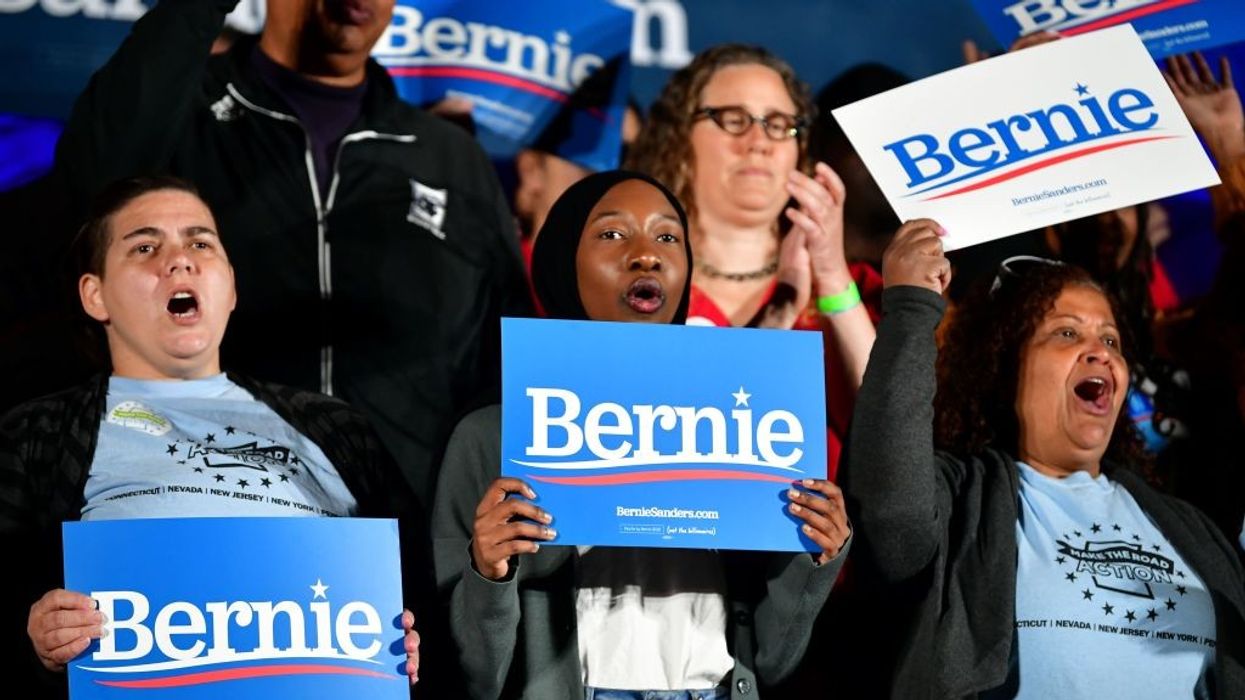
Not content to attack Sanders's platform, liberals have also, on many occasions, expressed utter contempt for his supporters, often pushing some version of the narrative that falsely characterizes backers of the Vermont senator as racist, sexist, "Bernie bros."
(They forget, of course, that in doing so, they, as Wendi Muse observes, erase from view the people of color and women among Sanders's supporters.)
One commentator anticipates the day when Democrats can finally shed the mask of progressivism and "gleefully and comprehensively trash" those who dared to back a democratic socialist for president of the United States.
High-ranking Democrats have been further angered by the idea that Sanders would actually hold to his promise to remain in the race through the Democratic convention to continue pushing his ideas and keep pressure on the wavering establishment.
Because Sanders has remained consistent in his denunciations of "establishment politics and establishment economics," Democrats have undergone a much-needed period of intense scrutiny from their left, from a movement that embodies the mass politics they long ago abandoned.
But as Matt Taibbi notes, they are likely to miss -- or disregard -- all of the lessons that could have been learned.
These lessons, if taken to heart, could prove significant for millions of Americans who are being crushed by a political system (and thus an economy) that answers predominantly to the desires of the few.
The party apparatus has been resilient, however, and elite liberals have fervently resisted the suggestion that the Sanders agenda could meaningfully influence the party's platform.
However, as Taibbi writes, "This inability to grasp that the problem is bigger than Bernie Sanders is a huge red flag."
Progressives are, in many ways, winning the war of ideas. Democrats have closed their eyes to this reality, seemingly content to believe that neoliberalism, with a view to adjustments, is adequate to address the problems we face. It's not.
As Lily Geismer has written, "A party without a working-class core can't be expected to improve the prospects of the working class."
Instead of devoting their efforts to a party that has lost its way, many are voting with their feet, demanding a $15 minimum wage, universal healthcare, tuition-free public college, an end to corporate-negotiated "trade" pacts, and a crackdown on Wall Street fraudsters.
Democrats have been slow to respond -- and quick to attack those on their left who offer ambitious solutions.
On the other hand, Democrats have been quick to recognize the blindingly obvious collapse of the Republican Party. But if they don't soon confront the deep flaws and extensive failures permeating their party, they may soon look back, as Republicans are today, asking what went wrong.
And the left will be there to answer the question.
Attendees said a conference organized around the progressive issues that formed the cornerstone of Bernie Sanders's presidential run has re-energized the American left. The gathering provoked conversations and connections that will invigorate political and social movements to come.
Coming in the wake of Sanders' primary losses earlier this month and after the recent murders in Orlando and in the U.K., the so-called People's Summit became a "place of healing," said activist and author Naomi Klein, who took part in the opening panel.
"I could feel that people were down," Klein said of the start of the summit. "This was not a rah-rah rally. People came in licking their wounds."
Klein continued:
So many people had given their lives over to chasing this dream... And he got so close, you know, I think 12 million votes was the last tally. So, people had tasted this thing which the left hadn't tasted in a long time. [Bernie Sanders] came so close to winning.
We were also coming off of this really bloody week of political violence, with Orlando, with the murder of Jo Cox... It was absolutely fitting that we had been convened by nurses, by caregivers, because we were bruised. And it became this space of healing.
By the end of it, people were so ready to be back in it. By the end of the opening panel and by the end of the whole gathering, people were energized and ready to go again. Energized by these face to face connections.
"This was very much an exchange," Klein added. "It was as much about the conversations you're having in the hallways and over meals as the speeches. It was very much the connective tissue of movements that was what this was all about."
"You really felt how much bigger this movement is than Bernie."
--Naomi Klein
"There was a sense among many activists--not all, but most--that the Bernie campaign was not a defeat," Jeff Cohen, director of the Park Center for Independent Media, told Common Dreams via email. "That it was not an end, but a big acceleration of movements that existed pre-FeelTheBern--for example, Occupy Wall Street, Black Lives Matter, Fight for Fifteen, immigrants' rights, etc. That it will lead to all sorts of progressive electoral interventions in the coming years."
Indeed, "if the summit had any common theme, it may have been 'Don't count us out,'" reported D.D. Guttenplan in The Nation. "Though there were more than a handful of Bernie-or-busters in attendance[...] Becky Bond, a former senior adviser to the [Sanders] campaign, spoke for a much greater proportion when she said, 'Bernie didn't create this movement. He recognized the movement moment we are in.'"
Klein agreed, noting, "You really felt how much bigger this movement is than Bernie. This slogan, 'Not me, us,' is so much more than a slogan."
Cohen observed that "normally when a candidate does not win a hard-fought race, the candidate slinks away and supporters of that candidate drift off disheartened."
"Unlike most electoral campaigns," Cohen wrote, "the Bernie campaign resulted in a massive conference this weekend, a search for candidates to run for local offices, some real networking among progressive groups, and a plan for major national protests in February in D.C. and locally, no matter who is elected."
Klein said that many conversations at the gathering revolved around how to support and organize new progressive candidates in electoral politics and how to keep up the energy in the social movements that are currently pushing for many of Sanders' suggested reforms.
"We can't forget that it was social movements that produced the conditions that made governing thinkable," Klein said. "It was winning enough victories, enough local battles --increases in minimum wage, bans on fracking--that made people feel like, 'Wow, well, maybe we could govern.' If we swing all the way in the direction of, 'Okay, now it's all about electoral politics,' then we lose that force and all of that momentum, and that is going to be absolutely necessary to hold neoliberal politicians accountable."
"There is massive corruption in the machinery of the Democratic Party."
--RoseAnn DeMoro, National Nurses United
"I heard no sectarian discussion," Klein continued, "no 'My way or the highway.' I heard, 'We need it all. We need people to go into politics, but we also need people in social movements.'"
Many discussions also focused on how to reform the Democratic party--how to eliminate the much-criticized superdelegate system and super PACs, and how to influence the party platform, Klein said.
"There is massive corruption in the machinery of the Democratic Party," said RoseAnn DeMoro to CNN. DeMoro is the executive director of National Nurses United, the "convening force" behind the gathering, as Klein described it.
"The only way that we can overcome that corruption and manipulation is for all of us not to work in isolation," DeMoro added, telling CNN that the party's efforts to garner endorsements for Clinton from Sanders backers had been "a very negative dialogue."
To that point, Becky Bond, a senior advisor to the Sanders campaign, told the gathering that the progressive movement was better equipped to defeat Trump than the Clinton campaign.
Bond argued that "because Trump is a multimillionaire or billionaire, depending on who you believe, and [progressives] are the people who know how to take on the one percent of the one percent. Hillary is very much aligned with those interests, and she is every much a part of it," Klein said, summarizing Bond's comments.
"It is necessary for us to continue our fight on the ground."
--Dominique Scott, student and summit participant
According to Newsweek, Bond told the conference attendees, "We do have to defeat Trump, but we don't have to do it in the way the Democratic establishment wants us to. "
The choice between Trump and Clinton is an appalling one, many attendees seemed to agree.
The stark choice "brings to light how important it is that we are all here as the people," said a student and participant named Dominique Scott to Newsweek. "It is necessary for us to continue our fight on the ground. We've never relied on a presidential candidate to solve all our problems for us, and it would be silly and irresponsible for us to do that."
Looking to the near future, Klein argued that the "fight in the Democratic Party does matter in the coming weeks. People are going to see how far they can take this attempt to democratize the Democratic Party. They're pushing on all fronts, they're going to see what they can come up with."
"It might turn out that [the Democratic Party is] absolutely irredeemable," Klein continued, "and we have to organize outside of the Democratic Party, but let's see how things turn out. Let's see what happens."
Bernie Sanders is trying to start a revolution, and if ever there was a country in need of one, the US is it. But his defeat in South Carolina and the polls heading into Super Tuesday suggest the revolution is in jeopardy.
A quick look at the other candidates in the race tells you how desperate we, as a nation, should be for this revolution to succeed.
Republicans: Unleashing our National Id: The last Republican debate in Houston was literally frightening. Can you honestly imagine any of this collection of crazed and deluded - not to mention deluding - hatemongering, fear-frenzied misfits running our country?
Endless war; racial division; economic ruin - all await the US if one of them should win. Well, Kasich might just spell economic ruin - those rosy job numbers he boasts about are partly attributable to Obama's bailout of the auto industry, which he opposed. But the rest? Apocalypse now.
The Republican establishment - which is to say the uber rich and the corporatists - who, since Reagan have fed the national id with a toxic brew of fear, hate and greed masquerading as wedge issues, seems shocked that the wedge issues have eclipsed their precious conservative values. The drown-the-government in the bathtub, trickle-down neocons have been left at the alter of unconstrained of capitalism and uber-patriotism, jilted by the very forces they unleashed.
Which brings us to the Confederacy of Dunces in the Democratic Establishment: They're busy pushing Hillary, the one candidate who could lose to this collection of Dr. Jekylls. The fact is, Sanders does better in head-to-head races against Republicans than Hillary does. A lot better. He also better represents the views of the people who make up the Party.
Clinton has done a hard left turn the likes of which has rarely been see in American politics, and she's busy mischaracterizing Sanders positions on a host of things, aided and abetted by the establishment elite in the media, unions, and think tanks.
But this free pass will end if she becomes the candidate, and her high unfavorability ratings, high distrust levels, and her record of flip-flops and bizarre statements will make her a sitting duck in the general election. Remember, for example, Clinton's weird claim to have landed in Bosnia under sniper fire - a claim she double and triple downed on - until tapes showed her and her teenage daughter being greeted on the tarmac by a young girl with flowers? Or the claim to have been penniless when leaving the White House?
African Americans are a major source of Clinton's base, although that support is slowly eroding as leaders in the community become familiar with Sanders positions and switch to him. Moreover, as Michelle Alexander noted in The Nation, a review of Hillary's positions, from the Crime Bill to Welfare Reform, shows the policies she's backed "decimated" Black America. After all, Sanders was marching with Martin Luther King at about the time Hillary was abandoning her position as President of the Wellesley Republican Club.
So Why is Sanders' Revolution in Danger of Stalling? Sanders base of support, young people, aren't showing up at the polls in the numbers he needs to win.
Writing in the Huffington Post, Scott Conroy quotes a student who was attending a Sanders' rally in Iowa, who, when asked if he was going to caucus, said, "I was going to, but we have an intramural basketball game, so I can't make it out."
Sanders' whole revolution is predicated on getting the dropouts to reengage in electoral politics, or to engage for the first time. To succeed, it requires a big turnout.
Yet while Republican caucuses and primaries are setting records for turnouts, Democratic turnouts are down.
The Worst are filled with a passionate intensity, while the best lack all conviction. In fact, The Democrats in general need a big turnout to win. If 2014 - which featured the lowest turnout for any elections since World War II - taught us anything, it's that Democrats get creamed when voter turnout is low. The 2014 mid-terms saw Republicans seizing both Houses of Congress, most of the state Legislatures and most of the governorships - and they did far better than any of the pundits and pollsters predicted. It was an epic rout. And it could happen again if Democratic turnout stays low.
The Establishment embrace of Hillary Clinton guarantees a low turnout. Basically, the Democratic establishment is shooting itself in the foot with their support of Hillary. With the New York Times and the rest of the media in the tank for Hillary, those voters who dropped out see the same 'ol, same 'ol money-driven election in which the PACsters win and the people lose. So why show up, if the fix is in.
Sometimes cynicism reflects an accurate assessment, not a misanthropic world view. One definition of cynicism is, "believing that people are motivated by self-interest; distrustful of human sincerity or integrity." Well, the steady drumbeat of fallacious establishment misinformation - Hillary is the most electable; Hillary knows how to govern; Bernie and his supporters are dreamers - is custom-designed to keep the justifiably cynical from showing up, thereby guaranteeing a low turnout -- the one thing that could cause a Democratic defeat in the general election.
We can't have a revolution if no one shows up, so get up off your asses and vote. We cynics gotta believe. In Bernie Sanders we have a shot at snatching our country and our government back from the PACsters. It's possibly our last shot. So get the hell up off your ass and vote. Even if you think it's futile, do it.
Here's the thing, and it's the only thing that matters. If enough of us do, we'll win.
Nevada's unpredictable electorate and "fractured Latino vote" are in the spotlight on the eve of the state's Democratic caucus, with polls showing Hillary Clinton and Bernie Sanders going into Saturday's contest neck-and-neck.
While the Silver State was supposed to be a lock for Clinton, recent endorsements (and non-endorsements) and demonstrable voter enthusiasm have signaled a Sanders surge backed up by polling.
| #americatogether Tweets |
As The New Republic explained, "Nevada offers a much different terrain" than Iowa or New Hampshire: "The state's population is 28 percent Latino, 8 percent Asian-American, and 9 percent African-American."
"Sanders needs to prove he can win over Latinos, Asian-Americans, and African-Americans--there's no other way that he can seriously compete for the nomination," wrote TNR's Jeet Heer. "Clinton, conversely, needs to prove that her 'firewall' of non-white support, which she's also counting on in the upcoming Southern primaries, will be strong enough to block Sanders."
Des Moines Register reporter Jennifer Jacobs wrote on Friday:
For Clinton to be victorious in the Nevada caucuses, she needs blacks and Latinos to turn out in numbers like in the 2008 race, and she needs to carry that Las Vegas-based segment of the electorate. She has to make sure she doesn't get swamped in rural counties like she did running against Barack Obama eight years ago. And although she doesn't need to dominate Nevada's other population base -- Reno -- she needs to post a decent showing there.
"Our state is a three-pronged approach," said Leo Murrieta, a Democratic political consultant and Latino activist in Las Vegas who supports Clinton.
Sanders, who didn't open his first office here until October, three months later than Clinton, must thwart her meticulously planned strategy in those three areas by stoking the last-minute fever of enthusiasm that left-leaning Nevadans are feeling for him, strategists said.
Indeed, "the fractured Latino vote threatens further to erode Clinton's aura as the party's nominee-in-waiting," the Guardian reported on Friday.
While Clinton "still maintains the backing of Nevada's older, democratic establishment, including a string of prominent Latino figures...look beyond the endorsements from prominent figures, such as civil rights leaders Astrid Silva and Dolores Huerta and actor Eva Longoria, and the Latino community's alliances begins to fray," the paper continued, writing:
The same is true for unions in Nevada, which also tend to be heavily Latino and, in a service-sector dominated state, have historically been kingmakers in Democratic elections.
While labor leaders back Clinton, low-wage workers and indebted students are being drawn to the message of radical economic change propagated by the 74-year-old senator from Vermont who some are calling "El Viejito" (the little old man).
Meanwhile, the Clark County Black Caucus, an organization in Nevada's largest county, endorsed Sanders late Thursday. On Friday, the Sanders campaign launched its #AmericaTogether hashtag, highlighting the Vermont senator's multicultural appeal.
To that end, the Clinton campaign has appeared to be trying to lower expectations, painting Nevada as a largely-white state.
"There's an important Hispanic element to the Democratic caucus in Nevada, but it's still a state that is 80% white voters," Brian Fallon, the Clinton campaign press secretary, said last week. "You have a caucus-style format, and he'll have the momentum coming out of New Hampshire presumably, so there's a lot of reasons he should do well."
Renowned Nevada pundit Jon Ralston scoffed at that "canard," noting that "Nevada's Hispanic population is about 27 percent" and that "nearly half of the state's population is made up of minorities."
According to Politico, Sanders' surge in Nevada has been served by his "ability to tap directly into the bloodstream of Nevada progressives."
Politico reports:
While Clinton has been making a direct appeal to Latino voters here by saying she would go further than President Barack Obama on immigration reform, Sanders' resolute message reverberated across the demographic board here, party leaders said.
"Nevada was one of the states hit hardest by the Bush recession and the foreclosure crisis," said Rebecca Lambe, a senior adviser to the Nevada Democratic party and to Sen. Harry Reid, who has not endorsed a candidate in the race. "The unemployment rate was the worst in the nation. The Sanders campaign recognized that their candidate's economic message would resonate here and they pounced."
Or, as University of Nevada-Las Vegas English instructor and restaurant server Brittany Bronson wrote in a New York Times op-ed on Friday:
Clinton's proposals are a step in the right direction. But with the economy tepid and income inequality only growing, modesty is not a good enough policy. And as anyone who has spent time in the real Las Vegas -- the struggling, striving working-class metropolis behind the neon lights -- can attest, her proposals won't make a dent in most Americans' lives.
Nevada's recent history testifies to the tragic ramifications of corporate greed and power, but also to the benefits of worker-centered policies. Mr. Sanders speaks directly to those themes, and to voters' growing concerns. Nevada, more than any other early contest, will show how well he is getting through to them.
"With its relatively few delegates, Nevada isn't a do-or-die state--but its diversity does make it a bellwether state," Heer wrote at TNR. "If Sanders can pull off a win on Saturday, or even if he comes close, it'll be clear that his revolution has real legs."