SUBSCRIBE TO OUR FREE NEWSLETTER
Daily news & progressive opinion—funded by the people, not the corporations—delivered straight to your inbox.
5
#000000
#FFFFFF
To donate by check, phone, or other method, see our More Ways to Give page.
Daily news & progressive opinion—funded by the people, not the corporations—delivered straight to your inbox.
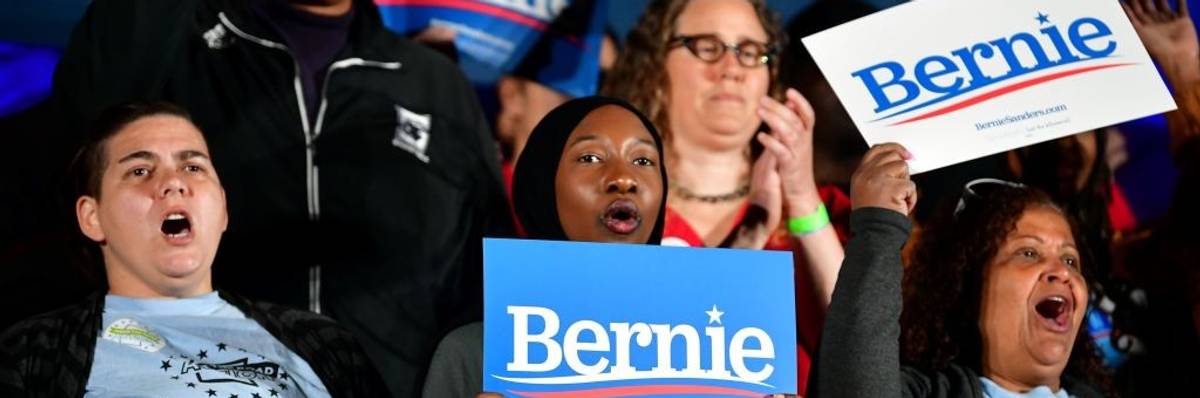
Supporters hold Bernie placards as Democratic presidential hopeful Vermont Senator Bernie Sanders speaks during a Get Out to Caucus Rally at Springs Preserve Amphitheater in Las Vegas, Nevada, on February 21, 2020.
What's happening to Judith Whitmer and her allies in Nevada is a classic battle between top-down corporate money and bottom-up progressive activism.
To understand the current fierce attacks on the progressive leadership of the Nevada Democratic Party, it's helpful to recall the panicked reaction from political elites three years ago when results came in from the state's contest for the presidential nomination. Under the headline "Moderates Hustle to Blunt Sanders' Momentum After Nevada Win," the Associated Press reported that "Bernie Sanders' commanding Nevada caucus victory made him a top target for his Democratic rivals and a growing source of anxiety for establishment Democrats."
Such anxiety spiked for Nevada's establishment Democrats a year later, in early March 2021, when a progressive slate, headed by activist Judith Whitmer, won every officer seat in the state party, stunning its entrenched leaders. As she explained at the time, "what they just didn't expect is that we got better and better at organizing and out-organizing them at every turn."
At the eleventh hour, seeing the progressive writing on the wall, the sore losers-to-be had siphoned $450,000 out of the state party's treasury, transferring the loot to the Democratic Senatorial Campaign Committee, safely under the control of corporate-aligned operatives. And when Whitmer's victory became clear, all the employees of the Nevada Democratic Party greeted the newly elected chair by immediately quitting.
Bloviating predictions of disaster quickly ensued. But Nevada's Catherine Cortez Masto, widely seen as the nation's most vulnerable Democrat in the Senate, won re-election last November. So did each Democratic member of the U.S. House. And Democrats control both chambers of the state legislature. (The only major loss was the governor's seat.) Whitmer cites nearly 2 million "direct voter contacts," increased rural turnout and "wins in deep red territories."
With her two-year term as state party chair about to expire, Whitmer is running for re-election as part of a progressive slate, while old-guard forces ousted by party delegates two years ago are on the attack under the banner of the ironically named "Unity Slate." The Nevada Democratic Party's central committee will vote on March 4.
The Unity Slate candidates "work for corporations and Republican-backed lobbyists," Whitmer said, adding that if elected "the Unity Slate would work in an echo chamber to only serve the most funded politicians in our state, and only support the status quo's agenda."
The Unity Slate's corporate ties are underscored by sponsors of its Sapphire PAC, which recently reported taking donations totaling $10,000 from Southwest Gas as well as $5,000 from NV Energy. Whitmer charged that acceptance of such funding from utility corporations "screws over the same voters we're working hard to fight for as the so-called Unity Slate turns a blind eye to rising costs that impact our community's most vulnerable."
Whitmer said on Monday that her opponents "have the audacity and brazenness to run a registered lobbyist" on their Unity Slate as the candidate for second vice chair of the state party. She added that he "lobbies for an anti-union company fighting against our largest hardest-working union," referring to the Culinary Union -- which days ago "tweeted against his company," the lobbying law firm Brownstein Hyatt Farber Schreck.
Nationally, Whitmer has been a leader in efforts to reform the Democratic National Committee. In early February, the DNC resolutions committee refused to act on a motion she co-authored to ban dark money in party primaries. "Time and time again, we've watched 'dark money' used to silence the voices our party most needs to hear," Whitmer said. When "strong Democratic candidates willing to speak truth to power" have messages that "can be drowned out in a flood of untraceable expenditures," she pointed out, "many candidates are questioning why they should even run."
Three years ago, during the leadup to the hard-fought Nevada caucuses for delegates in the presidential nomination race, the wide gap between powerful union officials and rank-and-file workers was thrown into sharp relief. The hierarchy of the powerful Las Vegas-based Culinary Workers Union bashed Bernie Sanders for championing Medicare for All, but workers and their families overwhelmingly voted for Sanders. Now, the state AFL-CIO leadership is backing the "unity" slate against progressives.
The Nevada showdown comes right after notable progressive breakthroughs this winter in two other western states: Shasti Conrad won election to become chair of the Washington Democratic Party. Yolanda Bejarano, a leader of Communications Workers of America and a member of Progressive Democrats of America, won election to chair the Arizona Democratic Party.
Methodical organizing at the grassroots makes such progress possible. That's what happened in West Virginia, where last summer activists wrested control of the state Democratic Party away from Joe Manchin, the archetypal big-money-talks Democratic senator.
Now, powerful forces are doing all they can to prevent the re-election of Judith Whitmer as chair of the Nevada Democratic Party. It's a classic battle between top-down corporate money and bottom-up progressive activism.
Dear Common Dreams reader, It’s been nearly 30 years since I co-founded Common Dreams with my late wife, Lina Newhouser. We had the radical notion that journalism should serve the public good, not corporate profits. It was clear to us from the outset what it would take to build such a project. No paid advertisements. No corporate sponsors. No millionaire publisher telling us what to think or do. Many people said we wouldn't last a year, but we proved those doubters wrong. Together with a tremendous team of journalists and dedicated staff, we built an independent media outlet free from the constraints of profits and corporate control. Our mission has always been simple: To inform. To inspire. To ignite change for the common good. Building Common Dreams was not easy. Our survival was never guaranteed. When you take on the most powerful forces—Wall Street greed, fossil fuel industry destruction, Big Tech lobbyists, and uber-rich oligarchs who have spent billions upon billions rigging the economy and democracy in their favor—the only bulwark you have is supporters who believe in your work. But here’s the urgent message from me today. It's never been this bad out there. And it's never been this hard to keep us going. At the very moment Common Dreams is most needed, the threats we face are intensifying. We need your support now more than ever. We don't accept corporate advertising and never will. We don't have a paywall because we don't think people should be blocked from critical news based on their ability to pay. Everything we do is funded by the donations of readers like you. When everyone does the little they can afford, we are strong. But if that support retreats or dries up, so do we. Will you donate now to make sure Common Dreams not only survives but thrives? —Craig Brown, Co-founder |
Norman Solomon is the national director of RootsAction.org and executive director of the Institute for Public Accuracy. The paperback edition of his latest book, War Made Invisible: How America Hides the Human Toll of Its Military Machine, includes an afterword about the Gaza war.
To understand the current fierce attacks on the progressive leadership of the Nevada Democratic Party, it's helpful to recall the panicked reaction from political elites three years ago when results came in from the state's contest for the presidential nomination. Under the headline "Moderates Hustle to Blunt Sanders' Momentum After Nevada Win," the Associated Press reported that "Bernie Sanders' commanding Nevada caucus victory made him a top target for his Democratic rivals and a growing source of anxiety for establishment Democrats."
Such anxiety spiked for Nevada's establishment Democrats a year later, in early March 2021, when a progressive slate, headed by activist Judith Whitmer, won every officer seat in the state party, stunning its entrenched leaders. As she explained at the time, "what they just didn't expect is that we got better and better at organizing and out-organizing them at every turn."
At the eleventh hour, seeing the progressive writing on the wall, the sore losers-to-be had siphoned $450,000 out of the state party's treasury, transferring the loot to the Democratic Senatorial Campaign Committee, safely under the control of corporate-aligned operatives. And when Whitmer's victory became clear, all the employees of the Nevada Democratic Party greeted the newly elected chair by immediately quitting.
Bloviating predictions of disaster quickly ensued. But Nevada's Catherine Cortez Masto, widely seen as the nation's most vulnerable Democrat in the Senate, won re-election last November. So did each Democratic member of the U.S. House. And Democrats control both chambers of the state legislature. (The only major loss was the governor's seat.) Whitmer cites nearly 2 million "direct voter contacts," increased rural turnout and "wins in deep red territories."
With her two-year term as state party chair about to expire, Whitmer is running for re-election as part of a progressive slate, while old-guard forces ousted by party delegates two years ago are on the attack under the banner of the ironically named "Unity Slate." The Nevada Democratic Party's central committee will vote on March 4.
The Unity Slate candidates "work for corporations and Republican-backed lobbyists," Whitmer said, adding that if elected "the Unity Slate would work in an echo chamber to only serve the most funded politicians in our state, and only support the status quo's agenda."
The Unity Slate's corporate ties are underscored by sponsors of its Sapphire PAC, which recently reported taking donations totaling $10,000 from Southwest Gas as well as $5,000 from NV Energy. Whitmer charged that acceptance of such funding from utility corporations "screws over the same voters we're working hard to fight for as the so-called Unity Slate turns a blind eye to rising costs that impact our community's most vulnerable."
Whitmer said on Monday that her opponents "have the audacity and brazenness to run a registered lobbyist" on their Unity Slate as the candidate for second vice chair of the state party. She added that he "lobbies for an anti-union company fighting against our largest hardest-working union," referring to the Culinary Union -- which days ago "tweeted against his company," the lobbying law firm Brownstein Hyatt Farber Schreck.
Nationally, Whitmer has been a leader in efforts to reform the Democratic National Committee. In early February, the DNC resolutions committee refused to act on a motion she co-authored to ban dark money in party primaries. "Time and time again, we've watched 'dark money' used to silence the voices our party most needs to hear," Whitmer said. When "strong Democratic candidates willing to speak truth to power" have messages that "can be drowned out in a flood of untraceable expenditures," she pointed out, "many candidates are questioning why they should even run."
Three years ago, during the leadup to the hard-fought Nevada caucuses for delegates in the presidential nomination race, the wide gap between powerful union officials and rank-and-file workers was thrown into sharp relief. The hierarchy of the powerful Las Vegas-based Culinary Workers Union bashed Bernie Sanders for championing Medicare for All, but workers and their families overwhelmingly voted for Sanders. Now, the state AFL-CIO leadership is backing the "unity" slate against progressives.
The Nevada showdown comes right after notable progressive breakthroughs this winter in two other western states: Shasti Conrad won election to become chair of the Washington Democratic Party. Yolanda Bejarano, a leader of Communications Workers of America and a member of Progressive Democrats of America, won election to chair the Arizona Democratic Party.
Methodical organizing at the grassroots makes such progress possible. That's what happened in West Virginia, where last summer activists wrested control of the state Democratic Party away from Joe Manchin, the archetypal big-money-talks Democratic senator.
Now, powerful forces are doing all they can to prevent the re-election of Judith Whitmer as chair of the Nevada Democratic Party. It's a classic battle between top-down corporate money and bottom-up progressive activism.
Norman Solomon is the national director of RootsAction.org and executive director of the Institute for Public Accuracy. The paperback edition of his latest book, War Made Invisible: How America Hides the Human Toll of Its Military Machine, includes an afterword about the Gaza war.
To understand the current fierce attacks on the progressive leadership of the Nevada Democratic Party, it's helpful to recall the panicked reaction from political elites three years ago when results came in from the state's contest for the presidential nomination. Under the headline "Moderates Hustle to Blunt Sanders' Momentum After Nevada Win," the Associated Press reported that "Bernie Sanders' commanding Nevada caucus victory made him a top target for his Democratic rivals and a growing source of anxiety for establishment Democrats."
Such anxiety spiked for Nevada's establishment Democrats a year later, in early March 2021, when a progressive slate, headed by activist Judith Whitmer, won every officer seat in the state party, stunning its entrenched leaders. As she explained at the time, "what they just didn't expect is that we got better and better at organizing and out-organizing them at every turn."
At the eleventh hour, seeing the progressive writing on the wall, the sore losers-to-be had siphoned $450,000 out of the state party's treasury, transferring the loot to the Democratic Senatorial Campaign Committee, safely under the control of corporate-aligned operatives. And when Whitmer's victory became clear, all the employees of the Nevada Democratic Party greeted the newly elected chair by immediately quitting.
Bloviating predictions of disaster quickly ensued. But Nevada's Catherine Cortez Masto, widely seen as the nation's most vulnerable Democrat in the Senate, won re-election last November. So did each Democratic member of the U.S. House. And Democrats control both chambers of the state legislature. (The only major loss was the governor's seat.) Whitmer cites nearly 2 million "direct voter contacts," increased rural turnout and "wins in deep red territories."
With her two-year term as state party chair about to expire, Whitmer is running for re-election as part of a progressive slate, while old-guard forces ousted by party delegates two years ago are on the attack under the banner of the ironically named "Unity Slate." The Nevada Democratic Party's central committee will vote on March 4.
The Unity Slate candidates "work for corporations and Republican-backed lobbyists," Whitmer said, adding that if elected "the Unity Slate would work in an echo chamber to only serve the most funded politicians in our state, and only support the status quo's agenda."
The Unity Slate's corporate ties are underscored by sponsors of its Sapphire PAC, which recently reported taking donations totaling $10,000 from Southwest Gas as well as $5,000 from NV Energy. Whitmer charged that acceptance of such funding from utility corporations "screws over the same voters we're working hard to fight for as the so-called Unity Slate turns a blind eye to rising costs that impact our community's most vulnerable."
Whitmer said on Monday that her opponents "have the audacity and brazenness to run a registered lobbyist" on their Unity Slate as the candidate for second vice chair of the state party. She added that he "lobbies for an anti-union company fighting against our largest hardest-working union," referring to the Culinary Union -- which days ago "tweeted against his company," the lobbying law firm Brownstein Hyatt Farber Schreck.
Nationally, Whitmer has been a leader in efforts to reform the Democratic National Committee. In early February, the DNC resolutions committee refused to act on a motion she co-authored to ban dark money in party primaries. "Time and time again, we've watched 'dark money' used to silence the voices our party most needs to hear," Whitmer said. When "strong Democratic candidates willing to speak truth to power" have messages that "can be drowned out in a flood of untraceable expenditures," she pointed out, "many candidates are questioning why they should even run."
Three years ago, during the leadup to the hard-fought Nevada caucuses for delegates in the presidential nomination race, the wide gap between powerful union officials and rank-and-file workers was thrown into sharp relief. The hierarchy of the powerful Las Vegas-based Culinary Workers Union bashed Bernie Sanders for championing Medicare for All, but workers and their families overwhelmingly voted for Sanders. Now, the state AFL-CIO leadership is backing the "unity" slate against progressives.
The Nevada showdown comes right after notable progressive breakthroughs this winter in two other western states: Shasti Conrad won election to become chair of the Washington Democratic Party. Yolanda Bejarano, a leader of Communications Workers of America and a member of Progressive Democrats of America, won election to chair the Arizona Democratic Party.
Methodical organizing at the grassroots makes such progress possible. That's what happened in West Virginia, where last summer activists wrested control of the state Democratic Party away from Joe Manchin, the archetypal big-money-talks Democratic senator.
Now, powerful forces are doing all they can to prevent the re-election of Judith Whitmer as chair of the Nevada Democratic Party. It's a classic battle between top-down corporate money and bottom-up progressive activism.