

SUBSCRIBE TO OUR FREE NEWSLETTER
Daily news & progressive opinion—funded by the people, not the corporations—delivered straight to your inbox.
5
#000000
#FFFFFF
To donate by check, phone, or other method, see our More Ways to Give page.
Daily news & progressive opinion—funded by the people, not the corporations—delivered straight to your inbox.
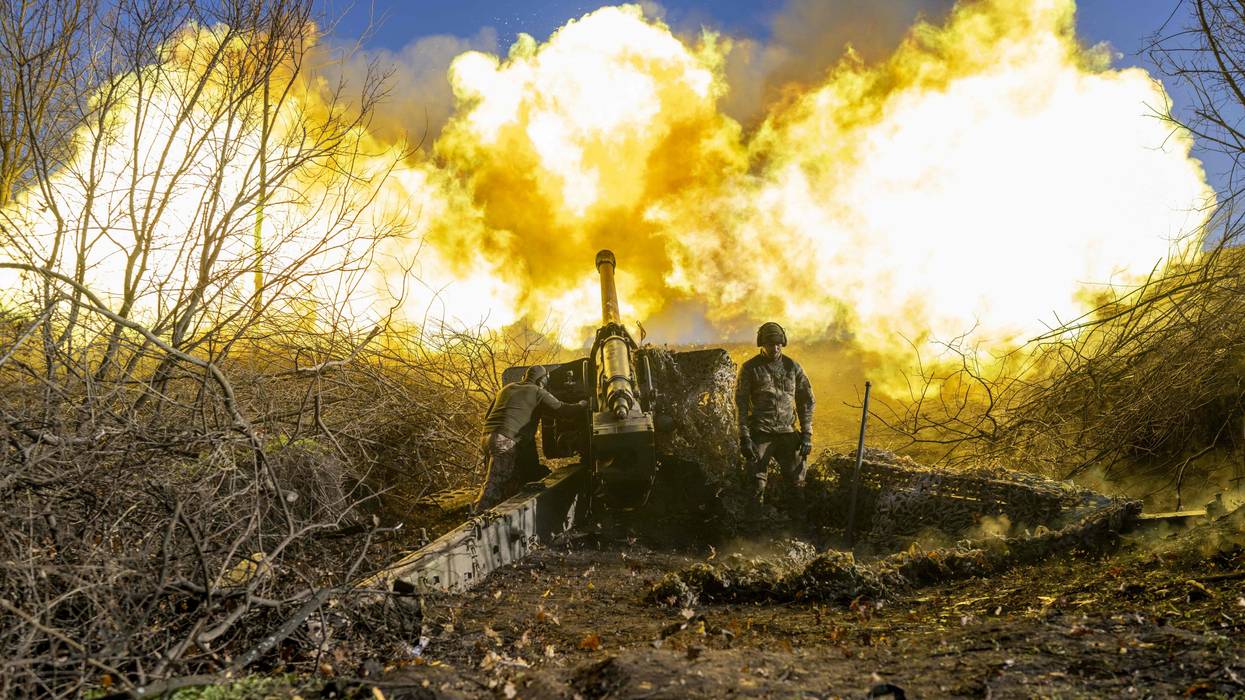
It goes without saying that Russia's invasion of Ukraine is wrong, violates the UN Charter, and cannot be justified under international law. Yet still we must ask: where is the path towards ending this conflict and the horrors being faced by Ukrainians?
Is it Russian imperialism or great-power politics that explains Putin’s invasion of Ukraine? And how likely is it that we could see regime change in Moscow? Moreover, do ideological labels matter in today’s political climate? C. J. Polychroniou tackles these questions in an interview with the French-Greek journalist Alexandra Boutri. He contends that Russia’s invasion of Ukraine is a major war crime but that the ongoing war is rooted in NATO’s eastward expansion and associated with the game of great-power politics. As for those who compare Putin to Hitler and call for regime change in Russia, Polychroniou argues that such claims and demands are both absurd and dangerous.
Alexandra Boutri: Let me start by asking you to share with me your views about an international relations topic that has dominated headlines for the past year, namely, the Russia-Ukraine war. Does it have its roots on Russian imperialistic aggression, which is the general view among most mainstream pundits, including many on the Left, or is it something more complicated than that?
C. J. Polychroniou: I think the best way to address your question is by putting this unnecessary tragedy, which, incidentally, could very well drag on for years to come, in historical context and thus realizing how easily it could have been avoided. Indeed, Putin’s decision to launch a full-scale invasion of Ukraine on February 24, 2022, may have taken everyone by surprise but the seeds of this war had been sown long before. Now, Ukrainians tend to emphasize Russia’s seizure of Crimea in 2014 as the origin of the conflict between the two countries. This is not an accurate description because the great-power rivalry between the United States and Russia is left out of the equation.
But let’s start with Crimea. For whatever reason, Crimea was gifted from Soviet Russia to Soviet Ukraine in 1954. Interestingly enough, the overwhelming majority of the population of Crimea in the 1950s was ethnic Russian and there was still an ethnic Russian majority of over 60 percent in 2014. It should also be pointed out that the Crimean Peninsula has always been a strategically vital location on the Black Sea. Indeed, Crimea’s position in the Black Sea holds such strategic importance that Zbigniew Brzezinski, the hawkish national security adviser to President Jimmy Carter, made strong hints in a 1997 book titled The Grand Chessboard that the Crimean Peninsula could become a major source of instability in the territories of the former Soviet Union. Putting aside for now the legality of the Russian operation to annex Crimea, what is often ignored in the Ukrainian and western narrative is that it took place in the aftermath of NATO’s enlargement following the collapse of the Soviet Union. And it wasn’t just Putin who was wary of NATO’s eastward expansion. Gorbachev was also suspicious of the perpetuation of NATO following the end of the Cold War while Boris Yeltsin, in a letter sent to President Clinton in 1993, had strongly opposed NATO’s expansion to the east.
It seems appropriate here to recall that Putin did not mince words when it came to giving his opinion about the eastward expansion of NATO at the Security Conference in Munich on February 2007:
I think it is obvious that NATO expansion does not have any relation with the modernisation of the Alliance itself or with ensuring security in Europe. On the contrary, it represents a serious provocation that reduces the level of mutual trust. And we have the right to ask: against whom is this expansion intended? And what happened to the assurances our western partners made after the dissolution of the Warsaw Pact? Where are those declarations today? No one even remembers them. But I will allow myself to remind this audience what was said. I would like to quote the speech of NATO General Secretary Mr Woerner in Brussels on 17 May 1990. He said at the time that: "the fact that we are ready not to place a NATO army outside of German territory gives the Soviet Union a firm security guarantee." Where are these guarantees?
Each round of NATO expansion since the fall of the Berlin Wall (NATO grew from 16 countries at the peak of the Cold War to 30 today, several of which were part of the Warsaw Pact) was followed by loud complaints from Russia that such moves posed a threat to Russia’s national security. Moreover, the prospect of Georgia and Ukraine becoming members of the trans-Atlantic military alliance constituted a red line for Moscow. Yet pledges were made by NATO leaders at the Budapest Summit in April 2008 that Georgia and Ukraine would eventually become NATO member states. In fact, relations between NATO and Ukraine go back to the early 1990s and, after 2014, the level of military cooperation between the two intensified in critical areas.
From the perspective of the Kremlin, what NATO (i.e., the US) was up to amounted to an “encirclement” of Russia. Indeed, it shouldn’t be difficult to understand why Russian leaders felt this way, and there is no doubt that US officials knew all along that they were crossing Russia’s red lines on NATO expansion.
In this context, Russia’s invasion of the territories of South Ossetia and Abkhazia in Georgia in 2008, Crimea’s annexation in 2014, and the disastrous invasion of Ukraine in 2022 are all part of the game of great-power politics and have little to do with Putin’s alleged push for a new Russian empire.
Alexandra Boutri: So, according to the analysis you just provided, the idea that Putin might want to invade countries in Europe is utter hogwash. But what about the suggestion that Putin is a tyrant, this generation’s Adolf Hitler, and therefore his regime must be overthrown?
In the United States, of course, the situation is in some ways quite different. The Republican Party has moved so far to the right that it has developed a serious extremism problem while the Democratic Party has drifted towards its progressive faction. However, both “left” and “right” in the US are involved in a growing “culture war” and both practice cancel culture. The mania over political correctness and identity politics, which are the last things that the Left should be embracing given its historical commitment to free speech and universality, is terrible business. It is in fact helping today to give shape and form to the reactionary politics and policies of Ron DeSantis, the rising star of America’s hard- right.
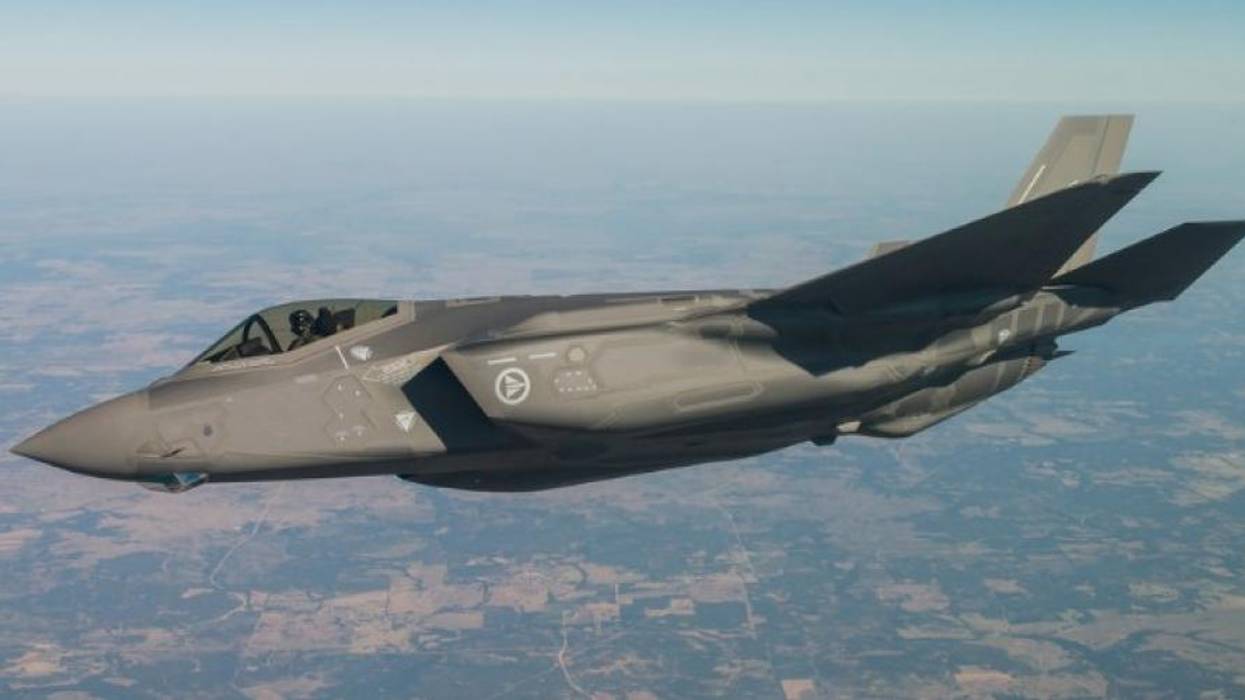
Should the United States build a permanent military base in Poland? Dangle a couple billion dollars in front of Donald Trump -- who seems to see himself as America's premier arms merchant, when he's not using the presidency to make money for himself and his family -- and you can see his eyes light up. "Fort Trump," we will call it, suggested Poland's president Andrzej Duda, who knows how to manipulate an insatiable ego.
Trump responded positively: "Poland would be paying billions of dollars for a base, and we are looking at that."
But even some of the more hawkish military analysts, such as Ben Hodges, commander of US Army Europe from 2014 to 2017, have argued that this is "unnecessarily provocative."
But even some of the more hawkish military analysts, such as Ben Hodges, commander of US Army Europe from 2014 to 2017, have argued that this is "unnecessarily provocative." The idea was roundly rejected by the US and Germany when it was suggested in 2016.
If the power of the weapons industry were to prevail, however, it wouldn't be the first time. In fact, that's a big part of the story of how we got in this New Cold War in the first place. From The New York Times' reporting:
"At night, Bruce L. Jackson is president of the U.S. Committee to Expand NATO, giving intimate dinners for Senators and foreign officials. By day, he is director of strategic planning for Lockheed Martin Corporation, the world's biggest weapons maker."
That was 1997. Two years later, Poland, Hungary, and the Czech Republic would join NATO, hauling in billions of dollars of arms sales. Ten more countries would join over the next nine years, bringing NATO's military to Russia's doorstep.
The United States and Germany promised Russia in 1990, as the Soviet Union was collapsing, that they would not expand NATO even "an inch" to the East. Although many Americans have forgotten World War II, the Russians have not; they lost 27 million people to Nazi invaders. Needless to say, they are not fond of the violent neo-Nazis that the US government has supported in Ukraine, or the idea that Ukraine could end up with the next NATO military base, on their border.
Americans are understandably upset about any foreign interference in our elections. As are Hondurans, Chileans, Haitians, Nicaraguans, Italians, Iranians, or citizens of scores of other countries where the United States has intervened much more heavily -- sometimes with military coups to reverse results -- in elections.
These are the most important structural causes of the New Cold War, not Russia's annexation of Crimea -- which violated international law -- or Russian interference in the 2016 US presidential election. Americans are understandably upset about any foreign interference in our elections. As are Hondurans, Chileans, Haitians, Nicaraguans, Italians, Iranians, or citizens of scores of other countries where the United States has intervened much more heavily -- sometimes with military coups to reverse results -- in elections. This includes Russia itself, where Americans organized and spent heavily to reelect their ally, Boris Yeltsin, in 1996.
Election expert Nate Silver noted this week that Russian troll farms, memes and Tweets were much too small and without evidence of effectiveness to have made a difference in the 2016 election. But in any case, the New Cold War with Russia has deeper structural causes that will not be resolved through sanctions, threats, and certainly not by expanding NATO's military encirclement of Russia. Ironically, despite Trump's personal friendliness with Putin -- and whatever private financial gains he has sought there -- he has been more aggressive toward Russia through stepped-up sanctions, sending lethal weapons to Ukraine, proposing to abandon the Intermediate-Range Nuclear Forces Treaty, and continuing to expand NATO.
This is no way to manage relations between the two countries that have the vast majority of the world's nuclear weapons. Of course, even talking about a new military base in Poland shows how far US foreign policy toward Russia has descended into stupidity and recklessness. It will take much more public awareness and political mobilization to reverse course.
In the historic port city of Yalta, located on the Crimean Peninsula, we visited the site where Churchill, Roosevelt and Stalin, in February of 1945, concluded negotiations ending World War II.
These leaders and their top advisors were also present at the creation of the United Nations and other instruments of international negotiation and non-military cooperation. Tragically, the creation of the "Cold War" was underway soon after. Reviving tensions between the United States and Russia make it seem as though the Cold War might not have ended.
We also met with groups of young adults, teachers, and veterans of foreign wars. At each meeting, participants readily agreed that new peace agreements are needed.
Olga, a tour guide, told me that she was fairly sure most young people here in Yalta would know what NATO is, what the acronym stands for, and they would know about recent NATO developments. Our delegation has been wondering how to cope with a quite different reality in the U.S., where many people may be poorly informed about NATO and would know even less about the Anti -Ballistic Missile treaty that the U.S. more or less tore up in 2001.
The Federation of American Scientists, in its 2016 inventory of nuclear forces, states that approximately 93 percent of all nuclear warheads are owned by Russia and the United States who each have roughly 4,500-4,700 warheads in their military stockpiles.
Konstatin, a veteran from the USSR war in Afghanistan, now a grandfather, spoke to us about Yalta's history during World War II. "Many people perished here," he said. "More than a million perished during WWII. This tourist resort was founded from the bones of people killed in the war." Some 22 million Russians overall died during World War II, most of them civilians. Konstatin urged all of us to find ways for avoiding further war, and he spoke about how funds spent on weapons are crucially needed to help heal children afflicted by disease or hunger.
Julia, a University student who wants to become an interpreter working with diplomats, said that she is glad and grateful never to have lived through a war." I always want to choose words instead of weapons," Julia said.
We asked university students what they thought of prospects for abolition of nuclear weapons. Anton, who studies engineering, told us that he believes "the youth of different countries would like to bridge the gap and work out ways to unite people." His words are extremely important now, as Russia and the U.S., possessing such huge stockpiles of nuclear weapons, engage in intensifying conflict. "All of us should soften the geopolitical relations between our countries," Anton continued, "and try to get together on the same level, on the same ground. The idea of this future should be attractive to everyone and enable us to solve ecological problems. And if we all put efforts into reaching this idea of development and creativity, in the future, then the nuclear abolition will be something we can accomplish"
In 1954 the Soviet government transferred this largely Russian-speaking area from Russia to the Ukraine. In 2014, after Ukraine's elected president was ousted and its new government formed in part by avowed neo-Nazis, Russia occupied the Crimea and after overwhelmingly winning an uncomfortably hasty vote, annexed it or "reunited" the Crimean peninsula with Russia, depending on who describes the history. The Ukraine ouster, it is widely believed here and in much of the world outside the United States, is considered to have been engineered by the United States and NATO. What plays in the U.S. as Russian aggression is seen by many here as a response to antidemocratic NATO interference along the Russian border.
It can be credibly argued that at its creation NATO's mission was essentially defensive. Stalin was a terrifying dictator, suffering from increasing psychosis, with a long history of betraying even those who seemed to be his closest allies. Yet, as one Russian World War II veteran noted, the Russians had not tried to take over other countries far from their borders. They actually had been very cautious and conservative about extending the boundaries or reach of the Soviet empire by military force, and after World War II Russia needed to focus on rebuilding the internal Soviet economy and society.
The continuously assertive military posturing of NATO undermines and conflicts with the mission and development of instruments for international negotiation and constructive cooperation. Among the most striking examples in recent years are:
New conflicts around the Ukraine are still brewing.
Milan Rai, writing for Peace News, helps put this conflict in context:
"Since Vladimir Putin's first ascendancy to the Russian presidency in 2000, the Russian state has used its armed forces against other countries twice: against Georgia, in 2008; and now against Ukraine...
In the same time period, the US has used its armed forces in a criminal fashion against a number of countries, including: Afghanistan (2001-present); Yemen (drone attacks, 2002-present); Iraq (2003-present); Pakistan (drone attacks, 2004-present); Libya (2011); Somalia (2011-present)....
The western powers are in no position to lecture Putin, whose actions in Crimea look like a Gandhian direct action when compared to the normal US-UK mode of operation. From 28 February to 18 March, Russian forces captured over a dozen Ukrainian bases or military posts without the loss of a single life. Compare this to the US use of tank-mounted ploughs to bury alive perhaps thousands of Iraqi conscripts in desert trenches during the opening moves of the 1991 invasion of Iraq. (US colonel Lon Maggart, in charge of one of the brigades involved, estimated that between 80 and 250 Iraqis had been buried alive.)
When one thinks of the number of deaths caused by US-UK aggression since 2000, including the grim ongoing tragedy of the Iraqi civil war, it is difficult to listen to the wave of western outrage."
"This is not to deny that Putin has presided over a repressive administration," Mil continues, noting that Putin has also carried out atrocities, particularly the indiscriminate bombing of civilians in the southern Russian republic of Chechnya, which followed massacres and the enforced disappearance of hundreds, perhaps thousands, of Chechens."
I believe that the greatest threat to the long-range peace and security of Europe and the United States is the reality that the military sectors of Western governments and the military spending sectors of Western economies are so huge and bloated, like incurable cancers, that they cannot give up on inventing military threats and advocating military solutions which powerfully undermine diplomatic efforts to secure peace.
I hope Anton's ideas will echo in the U.S. and help steer his generation toward pursuit of new acutely needed agreements.
War games conducted by Russian and NATO forces go far beyond the hypothetical, raising the specter of a very real conflict on the European continent, a new study warns.
According to the European Leadership Network (ELN), a think tank based in London, "[o]ver the last 18 months, against the backdrop of the war in Ukraine, the relationship between Russia and the West has deteriorated considerably"--at least in part due to war games that feed a "climate of mistrust."
ELN's report, Preparing for the Worst: Are Russian and NATO Military Exercises Making War in Europe More Likely? (pdf), analyzes a Russian 'snap exercise' in March involving 80,000 military personnel from bases across the country and NATO's Allied Shield set of war games conducted on air, land, and sea in June, involving 15,000 personnel from 22 countries.
Though both sides "may maintain that these operations are targeted against hypothetical opponents, the nature and scale of them indicate otherwise: Russia is preparing for a conflict with NATO, and NATO is preparing for a possible confrontation with Russia," the authors write.
NATO's activities, for example, are "clearly intended to simulate the kinds of operations NATO forces would need to engage in, in the context of a military crisis or confrontation with Russia somewhere in the Baltic region," the report reads, while the scale and geographical distribution of Russia's drill "means it could only have been a simulated war with U.S.-led NATO."
"We do not suggest that the leadership of either side has decided to go to war or that a military conflict between the two is inevitable," the report continues, "but that the changed profile of exercises is a fact, and it does play a role in sustaining the current climate of tensions in Europe."
The exercises also indicate "what each side sees as its most exposed areas," ELN states. NATO concentrates its activities in the Baltic States and Poland, while Russia focuses primarily on the Arctic and High North, the seaport city of Kaliningrad occupied Crimea, and its border areas with NATO members Estonia and Latvia.
While Russia and NATO both insist that their moves are defensive in nature, the authors argue that war games can be easily perceived "as provocative and deliberate aggravation of the crisis."
To "defuse or at least minimize the tensions" between the world powers, the report recommends increased transparency and communication around the scheduling of exercises, "restraint in terms of size or scenarios used in exercises," and--most grandly--the immediate commencement of "conceptual work" on a new treaty limiting the deployment of specific categories of weapons.
Did Russia's annexation of Crimea on March violate the 1994 Budapest agreement among Ukraine, Russia, Great Britain and the U.S.? Specifically, in Paragraph One, Ukraine agreed to remove all nuclear weapons from its territory in return for a commitment by Russia, Britain and the U.S. "to respect the independence and sovereignty and existing borders of Ukraine?"
I'm no lawyer, but I can read the words. And, taken literally, the answer seems to be Yes - despite a host of extenuating circumstances that can be adduced to explain why Crimea rejoined Russia, including the alarm among Crimean leaders over the unconstitutional ouster of Ukraine's elected president and the Russian government's fear about the possible berthing of NATO's nuclear-missile warships at the naval base at Sebastopol.
But there's also the item in Paragraph Three in which Russia, the UK, and the U.S. also commit "to refrain from economic coercion designed to subordinate to their own interest the exercise by the Ukraine of the rights inherent in its sovereignty."
Might the EU's take-it-or-leave-it proposal last fall offering Ukraine "associate" status in return for draconian economic austerity imposed on the Ukrainian people come under the rubric of the "economic coercion" prohibited at Budapest? An arguable Yes, it seems to me.
Some will try to dismiss President Viktor Yanukovych's ill-fated rejection of these International Monetary Fund demands to make the hard lives of average Ukrainians even harder as "history," now that the EU and Ukraine's replacement President Petro Poroshenko signed on June 27 that "associate" status agreement - the same agreement that Yanukovich rejected in favor of what appeared to be a better deal from Russia.
Was Yanukovich also under pressure from Moscow to maintain Ukraine's historic, cultural and economic ties to Russia? Of course. Putin reportedly weighed in heavily with Yanukovich last October and early November when U.S. and EU diplomats were pressuring the Ukrainian president as well.
But did Yanukovich expect to be overthrown if he opted for Moscow's offer? If he did not, he sorely underestimated what $5 billion in U.S. "democracy promotion" can buy. After Yanukovych's decision, American neoconservatives - the likes of National Endowment for Democracy President Carl Gershman and Assistant Secretary of State for European Affairs Victoria Nuland - pulled out all the stops to enable Ukraine to fulfill what Nuland called its "European aspirations."
The central problem confronting Ukraine, however, was not whether it leaned toward Europe or toward Russia. It was that after the collapse of the Soviet Union in 1991, some ruthless businessmen used their insider connections to snap up (or "privatize") the natural and industrial resources of the country. These handful of "oligarchs" then corrupted the political process, buying off politicians from both pro-EU and pro-Moscow perspectives.
Last fall, Yanukovych, who was elected from a political base in the more industrial Russian-ethnic east, was looking for how to bail Ukraine out of the financial and economic crisis that it was facing amid widespread unemployment and the hangover from the Great Recession.
In a layman's way of understanding what happened in Ukraine, Yanukovych issued what in the consulting world is called a Request for Proposal (RFP), i.e., a feeler to see who could offer the most promising plan for helping Ukraine escape insolvency. After initially tilting toward the EU proposal (before he learned of its draconian IMF small print), he later shifted to the less onerous offer from Russia.
In the world of contractors and RFPs, there are orderly procedures for firms whose bids are turned down to contest the selection of the eventual winner. But I know of no case where one of the losing firms turned around and violently removed the leadership of the RFP-issuing institution, installed new leadership and got the contract.
Abortive Feb. 21 Agreement
And, in assessing which side - the U.S./EU or Russia - is in the wrong on Ukraine, there was also the agreement, facilitated on Feb. 21 by the foreign ministers of Poland, Germany and France, in which then-President Yanukovich acceded to demands from the opposition by accepting limits on his powers and agreeing to early elections to vote him out of office.
Yanukovych also fatefully agreed to pull back the police, opening the way for right-wing militias, including neo-Nazis, to seize government buildings and force Yanukovych and his government officials to flee for their lives. With these paramilitary forces patrolling government offices, what was left of the Parliament voted to replace Yanukovych and install a new regime, giving four ministries to the far right and the neo-Nazis in recognition of their crucial role.
As the U.S. and the EU hailed the "legitimacy" of this new regime -- with Nuland's hand-picked leader Arseniy Yatsenyuk appointed as the new prime minister - the Western "mainstream media" quickly forgot the Feb. 21 agreement (surprise, surprise!). But Russian President Vladimir Putin had a personal representative there, Russian Human Rights Commissioner Vladimir Lukin.
Yet, because the MSM was already parading Putin (and Yanukovych) around the op-ed pages and talks shows as the black-hatted villains of the Ukraine saga, few Americans got to hear Putin's perception of what happened, as he explained at a Moscow press conference ten days after Yanukovich was overthrown:
"First of all, my assessment of what happened in Kiev and in Ukraine in general. ... This was an unconstitutional takeover, an armed seizure of power. Does anyone question this? Nobody does. ... The question is why this was done? ...
"President Yanukovich, through the mediation of the foreign ministers of three European countries - Poland, Germany and France - and in the presence of my representative signed an agreement with the opposition on Feb. 21. I would like to stress that under that agreement (I am not saying this was good or bad, just stating the fact) Mr. Yanukovich actually handed over power. He agreed to all the opposition's demands: he agreed to early parliamentary elections, to early presidential elections, and to return to the 2004 Constitution, as demanded by the opposition.
"He gave a positive response to our request, the request of western countries and, first of all, of the opposition not to use force. ... he issued orders to withdraw all police forces from the capital, and they complied. He went to Kharkov to attend an event, and as soon as he left, instead of releasing the occupied administrative buildings, they [the opposition] immediately occupied the President's residence and the Government building - all that instead of acting on the agreement.
"I ask myself, what was the purpose of all this? ... He had in fact given up his power already; and as I believe, as I told him, he had no chance of being re-elected. ... What was the purpose of all those illegal, unconstitutional actions, why did they have to create this chaos in the country? Armed and masked militants are still roaming the streets of Kiev. ...
"If you want, I can tell you even more. He [Yanukovich] called me on the phone and I told him not to do it. I said, 'You will have anarchy, you will have chaos in the capital. Think about the people.' But he did it anyway. And as soon as he did it, his office was seized, and that of the government, and the chaos I had warned him about and which continues to this day, erupted."
If Putin's account of how the Feb. 21 agreement was violated the very next day is accurate, and by almost all indications it is, then we have the anatomy of an undisguised putsch - an unconstitutional overthrow of a duly elected president of a sovereign state. The apparent aim, to install a government friendlier to the EU, is relevant but not essential here. The fact of the coup is essential.
Guaranteeing Ukraine's Sovereignty
Friday's lead editorial in the neocon flagship Washington Post, "Potemkin drawdown: The West must hold Russia to a real withdrawal from Ukraine," charged that "the rebellion in the east is manufactured by Russia to undermine Ukraine's sovereignty. The United States and Britain guaranteed support for that sovereignty in 1994 when Ukraine gave up its nuclear weapons."
That claim brought my thoughts back to a conference of distinguished scholars at the U.S.-Russia Forum in the Hart Senate office building on June 16. With Professors Stephen Cohen and Robert Legvold presenting, it was the most sensible discussion of the Ukraine imbroglio that I have witnessed to date.
The point was made that Russia had violated the Budapest agreement in annexing Ukraine. But were the Russians the only culprits? What about the rest of the story? Russia, the UK and the U.S. all pledged "to respect the independence and sovereignty and existing borders of Ukraine?" Okay. Gotcha on Putin considering the "existing borders."
But what about the political destabilization supported by the U.S. government, including the $5 billion that Assistant Secretary of State Nuland publicly announced had been invested in Ukraine's "European aspirations" - or the scores of projects financed by the U.S.-funded National Endowment for Democracy, training activists, supporting "journalists" and organizing business and political groups.
During the crisis, U.S. officials even showed up in Kiev's Maidan square to urge on the protesters seeking to overthrow Yanukovych. Sen. John McCain gave a speech on a platform of the right-wing Svoboda party under a banner hailing the late Nazi collaborator Stepan Bandera. Nuland went so far as to pass out cookies to the demonstrators and discuss with the U.S. ambassador to Ukraine who should be take over after Yanukovych was ousted.
How does this overt and covert interference square with the Budapest pledge "to respect the independence and sovereignty ... of Ukraine?" And how do the strong-arm tactics of the EU square with the commitment "to refrain from economic coercion designed to subordinate to their own interest the exercise by the Ukraine of the rights inherent in its sovereignty?"
Luckily, at the U.S.-Russia Forum, I was able to go first during the Q and A.
I said: "I have a brief question having to do with the Budapest agreement and also in the perspective of Vladimir Putin being more in a reactive mode than anything else. He's been accused, of course, of violating that agreement because of the Crimea [annexation].
"I'm wondering, if you look at the putsch, if you look at the coup d'etat of Feb. 22nd, supported to the tune of $5 billion by outside forces over the course of several years, of course, could that not also be regarded as a violation of the Budapest memorandum?"
Columbia University Professor Legvold's answer was, I think, instructive - instinctive, perhaps. His first thought was to associate my point with an argument the Russians have made. For many listeners, that might put me in the category of some kind of apologist for Putin. I know Legvold well enough to doubt this was his intent. But still: Is Putin's account of the Feb. 21-22 events to be dismissed out of hand simply because it is from Putin?
The main takeaway for me from the forum was the Cohen-Legvold common assertion that we have already entered a New Cold War. Cohen was very direct in exposing the extraordinary abuse regularly accorded to scholars and specialists who try to discern and explain honestly Moscow's point of view.
Legvold suggested it would be "naive" not to recognize that the new Cold War is already upon us, that it will be "immensely expensive and immensely dangerous," and that all of us need to do whatever we can to make it "short and shallow."
That endeavor of averting the costs and the risks of Cold War II might well start with a truthful narrative of what happened, not the one-sided account that the American people have been seeing and hearing in the U.S. media.
us russia forum 061614www.youtube.com
Interim president Oleksandr Turchynov on Monday was the latest to indicate that the spiraling violence in an increasingly divided Ukraine looks more and more like civil war as efforts to contain uprisings in the east against Kiev's authority have only elevated the violence in recent days.
"War is in effect being waged against us, and we must be ready to repel this aggression," said Turchynov in a televised address from Kiev and referring to violence in the cities of Odessa, Slavyansk, and elsewhere over the weekend.
According to Agence France-Presse, the latest high-level warning from Kiev comes as Ukraine spirals "further into a chaos that many fear could result in open civil war."
Turchynov has called up additional forces and reintroduced conscription for military-aged Ukrainians citing fear of a Russian invasion on the eastern border.
This AFP video report shows how some regular Ukrainians are preparing for "civil war":
Report: civilians in Ukraine ready for civil warCitizens of the Ukrainian city of Luhansk, 30 kilometres from the Russian border, are learning how to use Kalashnikovs in case the ...
Meanwhile, in and around the city of Slavyansk on Monday, journalists reported that opposing factions were exchanging heavy gunfire and that loud explosions could be heard throughout the area.
And in Donetsk, militias opposed to Kiev's rule and calling for a referendum vote on their autonomy have now taken full control of the city despite continued threats from the Ukraine army.
"What is happening in the east is not a short-term action," said Vasyl Krutov, who heads the Kiev government's military operations in the east. "This is essentially a war."
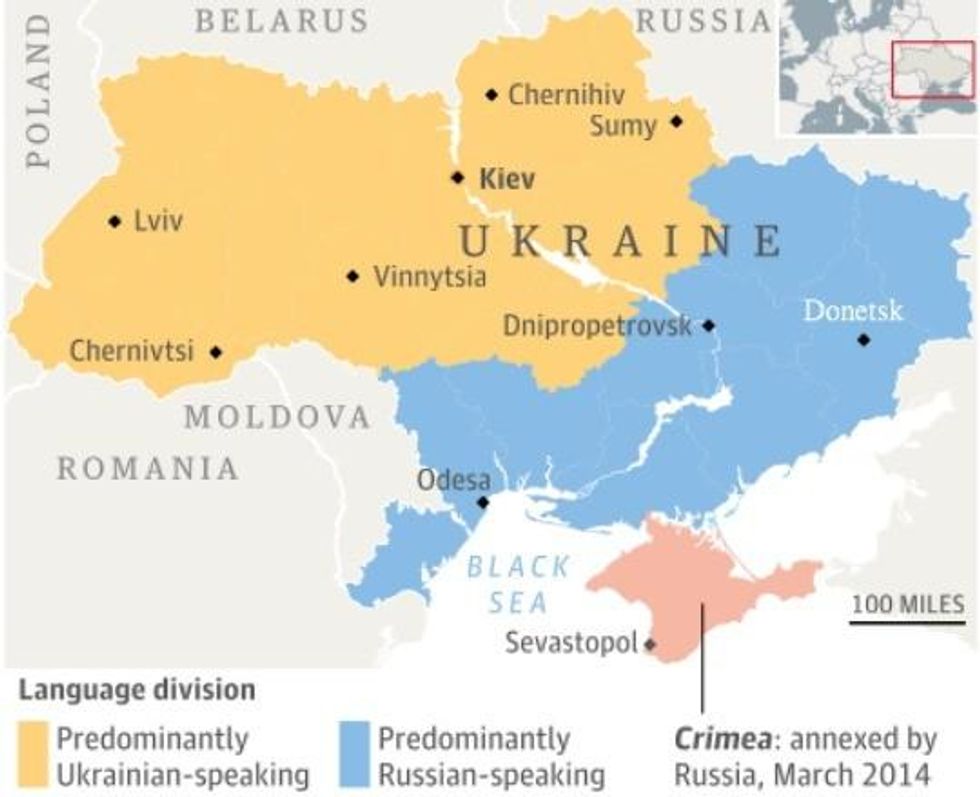
As the following map by AFP shows, the number of cities in open revolt against the Kiev government is growing:
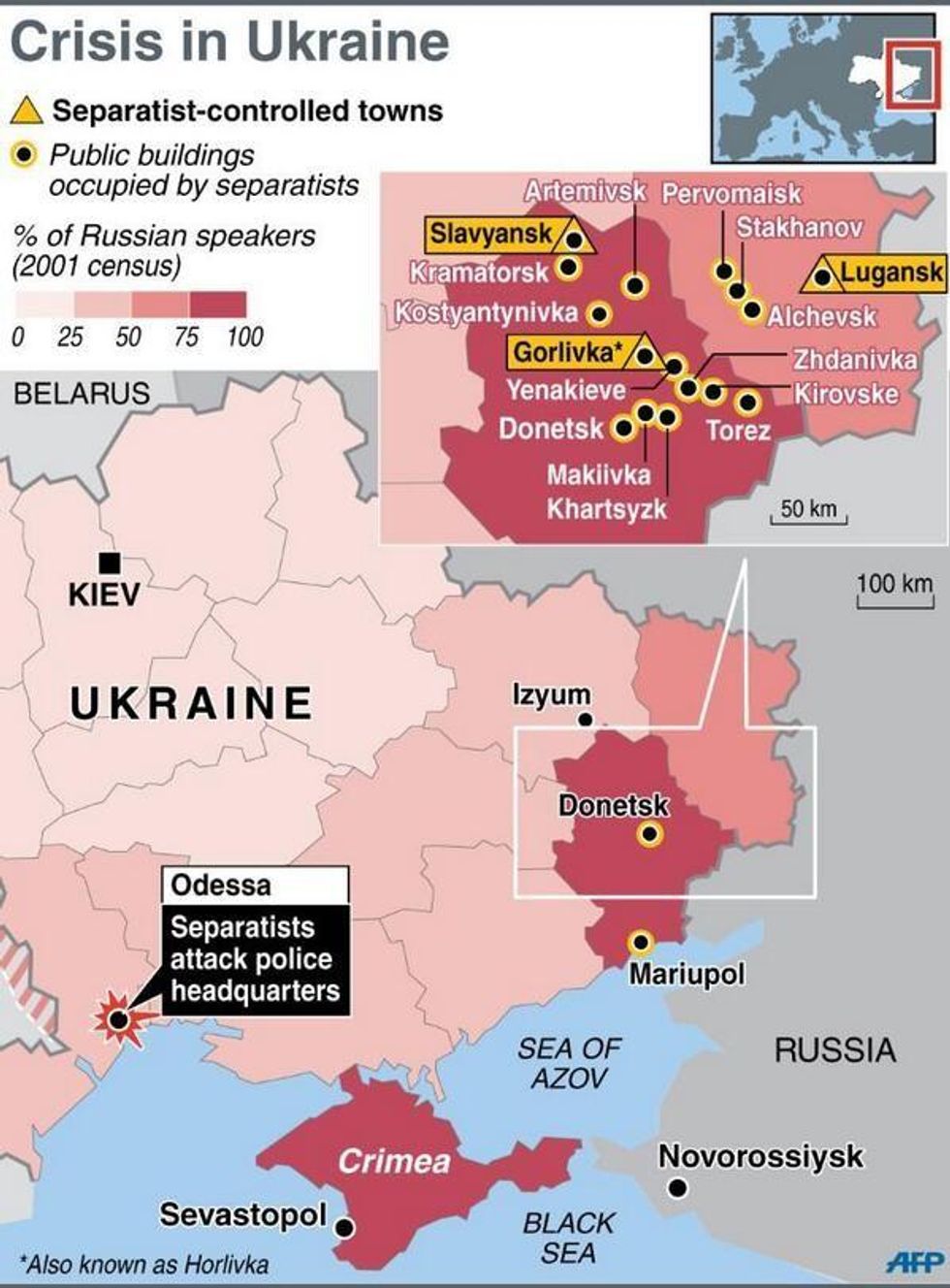
The Associated Press reports:
Ukraine is facing its worst crisis in decades as the polarised nation of 46 million tries to decide whether to look towards Europe, as its western regions want to do, or improve ties with Russia, which is favoured by the many Russian-speakers in the east.
In the last few weeks, anti-government forces have stormed and seized government buildings and police stations in a dozen eastern Ukrainian cities. Authorities in Kiev - who blame Russia for backing the insurgents - have up to now been largely powerless to react.
And since Russia has kept tens of thousands of troops along Ukraine's eastern border - and annexed its key Black Sea peninsula of Crimea last month - Ukraine's central government fears Russia could try to invade and grab more territory.
Since the government began trying to take back the buildings late last week, Slavyansk has been under a tight security cordon. Movement in and out of the city has ground almost to a halt, causing shortages in basic supplies. Lines have been seen at grocery stores.
The goals of the insurgency are ostensibly geared towards pushing for broader powers of autonomy for the region, but some insurgents favour separatism, and the annexation of Crimea looms over the entire political and military discussion.
Following Friday's violence in Odessa and the growing number of revolts in the east, former U.S. ambassador to Moscow, Michael McFaul, spoke with Time magazine and made this warning: "The last 24 hours was a major escalation," told TIME. "This is real. This is war."
The takeover of additional government buildings in eastern Ukraine on Thursday appeared to confirm statements from officials in Kiev that the interim government is fast losing control of the region despite military operations and previous vows to quell protests and dismantle encampments held by pro-Russian citizens in numerous cities.
In Donetsk a dramatic confrontation occurred at the local prosecutor's headquarters between state security forces loyal to Kiev and locals demanding a referendum vote on the future of the eastern city.
And, as the following footage from Kharkiv shows pro-Russian protesters seize state building:
Ukraine: Clashes in Kharkiv as pro-Russian protesters seize state buildingPro-Russian protesters temporarily seized on Sunday (April 6) the regional administration building in the eastern Ukrainian city of ...
Also on Thursday, Russian President Vladimir Putin spoke with German Chancellor Angela Merkel by phone and said that the government in Kiev should halt its military operations in the east of Ukraine in order to promote the possibility of a "national dialogue" that could lead to the end of the crisis.
According to the Russian news agency Interfax, Putin emphasized to Merkel that it was vital for the authorities in Kiev "to withdraw all military units from the southeastern regions, stop the violence and immediately launch a broad national dialogue as part of the constitutional reform process involving all regions and political forces."
Al-Jazeera reports, citing comments by a Merkel spokesperson, that the focus of the call had been "the German chancellor asking for Putin's assistance in freeing seven observers from the Organisation for Security and Co-operation in Europe who are being held by pro-Russia separatists in eastern Ukraine."
The latest conflagrations in the east come a day after the International Monetary Fund approved an aid and loan package worth nearly $17 billion. Though many in the western mainstream media have treated the deal as a "lifeline" to a nation teetering on the brink of political and economic collapse, others have consistently pointed out (here, here, and here) that the debt burden and austerity measures tied to the package may do the people of Ukraine more harm than good in the long run.
Regarding another aspect of the crisis, this report gathered from various agencies adds:
The Russian foreign ministry said earlier on Thursday that a proposal from Ukraine's prime minister, Arseniy Yatsenyuk, to hold a poll on Ukrainian unity and territorial integrity was a sham that would only deepen the crisis in the country.
On Wednesday, Yatsenyuk said the Kiev government would send to parliament a law on conducting the nationwide poll on 25 May, when the country is also due to hold a presidential election.
The Russian foreign ministry said the plans were "cynical" given what it said was Kiev's military operation against "its own people".
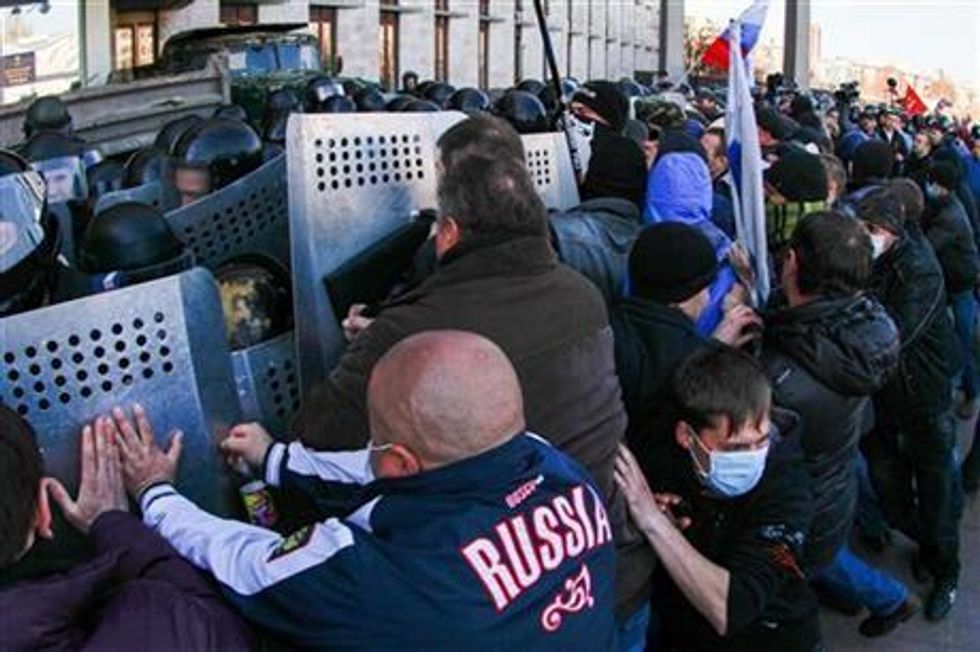
Pro-Russian citizens in the eastern cities of Ukraine are rising up against the government in Kiev, storming government buildings, raising the Russian flag, and calling for referendum votes to proclaim their independence. In their eyes, the recently established government based in the western capital city is not legitimate and now, like Crimea, they wish to exercise their right to break free of Ukraine and rejoin the Russian confederacy.
On Sunday night, protesters stormed buildings in three key cities--Kharkiv, Luhansk and Donetsk, clashing with security forces but ultimately gaining access to buildings and refusing to leave.
After taking control in Donetsk, with several thousand people occupying the main administrative building, the group released a video declaring their independence. "Seeking to create a popular, legitimate, sovereign state, I proclaim the creation for the sovereign state of the People's Republic of Donetsk," the spokesperson said, as the watching crowd reportedly cheered.
The unidentified man called for assistance from Moscow, saying, "Without your support, without the support of Russia, it will be hard for us to resist the Kiev junta on our own."
From Kiev, the interim Prime Minister Arseny Yatseniuk on Monday morning blamed the upheaval on Russian interference.
"The plan is to destabilize the situation, the plan is for foreign troops to cross the border and seize the country's territory, which we will not allow," Yatseniuk said.
According to Reuters:
The protesters appeared to be responding in part to Yanukovich, who fled to Russia after he was ousted and who on March 28 issued a public call for each of Ukraine's regions to hold a referendum on its status inside the country.
Separately, Ukraine's defense ministry said a Russian marine had shot and killed a Ukrainian naval officer in Crimea on Sunday night.
The 33-year-old officer, who was preparing to leave Crimea, was shot twice in officers' quarters in the locality of Novofedorovka. It was not clear why the Russian marine had opened fire.
Yatseniuk said that though much of the unrest had died down in eastern Ukraine in the past month there remained about 1,500 "radicals" in each region who spoke with "clear Russian accents" and whose activity was being coordinated through foreign intelligence services.
But he said Ukrainian authorities had drawn up a plan to handle the crisis.
"We have a clear action plan," he said, adding that senior officials would head to the towns concerned.
Meanwhile, news from Crimea on Sunday revealed that a Ukrainian military officer had been shot and killed by a Russian soldier. And though the incident appeared to result from a drunken brawl, observers on all sides have warned that it could be just such an incident of violence that could quickly escalate tensions between Kiev, Moscow, and the western powers that have continued to cast the situation in Ukraine in "Cold War" terms.
President Obama is on the receiving end of scorn for remarks made during a high-profile speech in Brussels on Wednesday in which he defended the U.S. invasion of Iraq in an attempt to chastise Russia for recent developments in Crimea and Ukraine.
Speaking to the international community about the ongoing crisis in Ukraine and fending off repeated accusations that the U.S. has lost its moral authority given the invasion of Iraq and other breaches of international law in recent years, Obama said:
Russia has pointed to America's decision to go into Iraq as an example of Western hypocrisy. Now, it is true that the Iraq war was a subject of vigorous debate, not just around the world but in the United States, as well. I participated in that debate, and I opposed our military intervention there.
But even in Iraq, America sought to work within the international system. We did not claim or annex Iraq's territory. We did not grab its resources for our own gain. Instead, we ended our war and left Iraq to its people in a fully sovereign Iraqi state that can make decisions about its own future.
But instead of tamping down accusations of hypocrisy, Obama inflamed it.
Responding to the speech on FireDogLake, DSWright shot back: "Worked within the international system? So if Russia had gone to the UN to get a resolution, failed, then annexed Crimea it would have been OK?"
Reaction on Twitter was swift--and among those with a seemingly better memory of the devastation caused by the U.S. invasion of Iraq than the president--fierce:
Ross Caputi and Matt Howard, members of the Iraq Veterans Against the War, spoke with Common Dreams by phone and said that President Obama's argument was both weak factually and morally. As it happens, both IVAW members were together in Washington, DC on Wednesday, organizing an evening event focused on the devastating impacts of the Iraq War--both for veterans like themselves and the Iraqi civilian population--when they heard news about what the president had said.
"What President Obama said is false," said Caputi. "The U.S. did not attempt to work within the international system. We acted unilaterally, without the approval of the UN Security Council."
Howard said the president's narrative on the events that led up to the Iraq invasion, inside or outside the context of Ukraine, was simply "not grounded in reality."
"We went from one lie, which was weapons of mass destruction, to another lie which was liberation and freedom," said Howard. Citing the devastation cited by Iraqi civil society allies, especially women in the country, he continued, "This idea that Iraq is somehow better off or that the U.S. waged a so-called 'Good War' is ridiculous."
In addition, argued Caputi, the U.S. did make very real and successful attempts to gain access to Iraqi resources, namely through the writing of the new Iraqi Constitution and aspects of the so-called "Bremer Orders," referring to Paul Bremer who was the U.S.-appointed Administrator of the Coalition Provisional Authority of Iraq during the aftermath of the 2003 invasion. Those efforts "privatized Iraq's formally nationalized energy resources," paving the way for foreign oil companies, including those from U.S., to gain coveted access to Iraq oil and gas fields.
The Huffington Post's Ryan Grim also made note of this false assertion by Obama regarding Iraqi "resources," writing:
In fact, the U.S. forced Iraq to privatize its oil industry, which had previously been under the control of the state, and further required that it accept foreign ownership of the industry. The effort to transfer the resources to the control of multinational, largely U.S.-based oil companies has been hampered in part by the decade of violence unleashed by the invasion.
Obama's assertion also hinges on how broadly one construes the word "our." Taxpayers on the one hand are worse off, as the wars in Afghanistan and Iraq have added $2 trillion to the national debt, according to one study. But contractors reaped tremendous gains, and Halliburton -- a company often associated with the invasion, of which former Vice President Dick Cheney served as CEO -- saw its stock price surge from under $10 a share to over $50, before falling along with the rest of the market in 2008. (It has since recovered.)